Christian environmental stewardship: Disciples of Christ and the Alverna Covenant

August 5, 2009

I learned something new tonight.  The Disiciples of Christ formally adopted wise environmental stewardship as a denominational goal in 1981.

History of the Alverna Covenant

The Alverna Covenant was written by members of the Task Force on Christian Lifestyle and Ecology of the Christian Church (Disciples of Christ) while meeting at Alverna Retreat Center, a Franciscan retreat in Indianapolis, Ind. The name has added significance. Alverna is named for Mt. Alverna in Italy, the mountain retreat given to Francis of Assisi. Francis is honored for his concern for the care of and relatedness of all creation. The 800th anniversary of Francis’ birth was celebrated in 1981, the year the Alverna Covenant was first introduced at the General Assembly of the Christian Church (Disciples of Christ).

The Alverna Covenant

Whereas:

  • God has created the world with finite resources;
  • God has given to us the stewardship of the earth;
  • God has established order through many natural cycles.

And it is evident that:

  • We are consuming resources at a rate that cannot be maintained;
  • We are interrupting many natural cycles;
  • We are irresponsibly modifying the environment through consumption and pollution;
  • We are populating the earth at a rate that cannot be maintained;

As a member of the human family and a follower of Jesus Christ, I hereby covenant that:

  • I will change my lifestyle to reduce my contribution to pollution;
  • I will support recycling efforts;
  • I will search for sustainable lifestyles;
  • I will work for public policies which lead to a just and sustainable society;
  • I will share these concerns with others and urge them to make this Covenant.
  • What other denominations have statements on wise resource stewardship? What do they say?

    Tip of the old scrub brush to Darrel Manson, who writes at Hollywood Jesus.

    Resources:


    Drought: Heckuva way to run the end to global warming

    July 30, 2009

    “This is a hell of a way to run a desert.”
    Utah Gov. Scott Matheson, during floods in 1983

    A new Dust Bowl?

    A new Dust Bowl? (Image updated January 2013; old links dead)

    No, I’m not repeating the error of many who take every snowflake as bizarre evidence that global warming has ended.

    I think we need to stick to the facts.

    2009 may be cooler than 1998, one of the hottest years on record, but that in no way suggests an end to the climate crisis scientists have been tracking for the past couple of decades.

    Cooler weather in New York does not offset the rest of reality.

    Reality is we have crushing droughts in California and Texas.

    California drought explained by USA Today:

    FIREBAUGH, Calif. — The road to Todd Allen’s farm wends past irrigation canals filled with the water that California‘s hot Central Valley depends on to produce vegetables and fruit for the nation. Yet not a drop will make it to his barren fields.

    Three years into a drought that evokes fears of a modern-day dust bowl, Allen and others here say the culprit now isn’t Mother Nature so much as the federal government. Court and regulatory rulings protecting endangered fish have choked the annual flow of water from California’s Sierra mountains down to its people and irrigated fields, compounding a natural dry spell.

    “This is a regulatory drought, is what it is,” Allen says. “It just doesn’t seem fair.”

    For those like Allen at the end of the water-rights line, the flow has slowed to a trickle: His water district is receiving just 10% of the normal allocation of water from federal Bureau of Reclamation reservoirs. He says he’s been forced to lay off all his workers and watch the crops die on his 300 acres while bills for an irrigation system he put in are due.

    “My payments don’t stop when they cut my water off,” Allen says.

    Although some farmers with more senior water rights are able to keep going, local officials say 250,000 acres has gone fallow for lack of water in Fresno County, the nation’s most productive agriculture county. Statewide, the unplanted acreage is almost twice that.

    Unemployment has soared into Depression-era range; it is 40% in this western Fresno County area where most everyone’s job is dependent on farming. Resident laborers who for years sweated in fields to fill the nation’s food baskets find themselves waiting for food handouts.

    “The water’s cut off,” complains Robert Silva, 68, mayor of the farm community of Mendota. “Mendota is known as the cantaloupe capital of the world. Now we’re the food-line capital.”

    Three years of dry conditions is being felt across much of the nation’s most populous state.

    Gov. Arnold Schwarzenegger declared a water emergency in February and asked for 20% voluntary cuts in water use. The U.S. Department of Agriculture’s Drought Monitor lists 44% of the state as in a “severe” drought.

    In arid Southern California, cities and water districts have raised rates to encourage conservation and imposed limits on use

    Texas drought, detailed in the Dallas Morning News:

    AUSTIN – The drought that has gripped Central Texas is approaching the severity of Texas’ most famous drought, the 1950s dry spell that lasted several years, Lower Colorado River Authority officials say.

    But the current drought, which began in the fall of 2007, has seen more intense concentrations of high temperatures and less rainfall than the majority of the earlier drought.

    “It was hot, yes, it was dry” in the 1950s, said LCRA meteorologist Bob Rose, “but it wasn’t crazy hot like this year.” Soil moisture is negligible now. And with spotty precipitation, “we haven’t been able to generate any runoff” to replenish reservoirs, he said.

    “What makes our current drought unique is not the duration but the severity,” Rose said this week at a drought briefing for meteorologists and reporters.

    With state officials warning of wildfire dangers, and water restrictions spreading rapidly across the state, Texas Gov. Rick Perry (R) issued disaster declarations for 167 of the states 254 counties.

    Texas suffers more than California, across a broader area with deeper drought, according to the Associated Press:

    According to drought statistics released by the U.S. Department of Agriculture, 77 of Texas’ 254 counties are in extreme or exceptional drought, the most severe categories. No other state in the continental U.S. has even one area in those categories.

    John Nielsen-Gammon, the Texas state climatologist at Texas A&M University, said he expects harsh drought conditions to last at least another month.

    In the bone-dry San Antonio-Austin area, the conditions that started in 2007 are being compared to the devastating drought of the 1950s. There have been 36 days of 100 degrees or more this year in an area where the total usually is closer to 12.

    Among the most obvious problems are the lack of water in Lake Travis and Lake Buchanan near Austin, two massive reservoirs along the Colorado River that provide drinking water for more than 1 million people and also are popular boating and swimming spots. Streams and tributaries that feed the lakes have “all but dried up,” according to the Lower Colorado River Authority.

    San Antonio, which relies on the Edwards Aquifer for its water, is enduring its driest 23-month period since the start of recorded weather data in 1885, according to the National Weather Service. The aquifer’s been hovering just above 640 feet deep, and if it dips below that, the city will issue its harshest watering restrictions yet.

    Self-professed climate skeptics will argue that everything is hunky-dory and we can continue blundering along pollutiong willy-nilly because droughts alone are not evidence of warming, and so cannot rebut spot evidence of increased rainfall or local cooling.  Notice how they try to have the argument both ways?  Local weather counts for their side, but can’t count against it.

    It’s more complex than that.  Much of the damage from climate change occurs in the upset of a balance in local ecosystems.  The Green Blog at the Boston Globe site discusses the subtle, ecosystem distorting effects and how easy they are to miss in the grand schemes of things.

    A lot of the problem has to do with timing. About half of the water that recharges the [Northeast] region’s aquifer is from spring snowmelt, said [USGS hydrologist Thomas] Mack, allowing it to be plentiful to residents for summer lawn watering and other uses.

    But global warming is causing the snow to melt earlier by around two to four weeks. At the same time, more rain, instead of snow, is expected to fall in the winter. That means the aquifer is filling up earlier in the spring.

    The problem is the region’s bedrock aquifer can’t hold water for a long time – filling it up when it is needed the least and draining before the busy summer.

    All environmental problems are complex, and global “warming” is massively more complex than any other environmental issue humans have recognized and dealt with.  Climate change deals with the entire Earth, and with the two great pools of fluids on the Earth, the oceans and the atmosphere, where the sheer physics of change are nearly impossible to understand, let alone predict.

    Perhaps, as local conditions in more and more places demonstrate damages from climate change, skeptics can be brought around to understand that action is required even when we don’t have all the possible data points we’d like.

    Resources:


    News flash: Texas has a second natural lake!

    July 20, 2009

    Years ago, in Virginia, I had learned that Virginia had only one natural lake, the Great Dismal Swamp.  Accompanying that chunk of information in that lecture was that Texas had only two natural lakes.

    But upon arriving in Texas, I could find reference to only one natural lake, Caddo, and it had ceased being fully natural when its maintenance fell to a dam.

    What happened to Texas’s second natural lake?

    A Google search right now on “Texas +’natural lake'” produces ten listings on the first page, all of them pointing to the fact that Texas has just one natural lake.  Here are the first five:

    I have found a second natural lake in Texas. It’s not a new discovery at all — it’s just a case of people not having the facts, and overlooking how to find the truth.  It’s especially difficult when the lake hides itself.

    Our testing coordinator at Molina High School, Brad Wachsmann, spins yarns that belie his youth.  In the middle of one yarn last year, corroborated by other yarns, he mentioned that he has family in Big Lake, Texas; and he described visiting and having relatives urge people to run out and see the lake since it’s rebirth in torrential rains.

    “A second natural lake in Texas?” I asked.  Wachsmann knew the drill.  Yes, Big Lake is a natural lake in Texas, and yes, people forget about it.

    Texas teachers, listen to your testing coordinators, okay?

    All of this came to mind reading the Austin American-Statesman, still a bastion of great journalism despite problems in the newspaper industry.  On Monday, July 7, the paper ran a story and an editorial about the clean up of the oil industry refuse that killed the shoreline of part of the lake; the springs that once fed the lake have mostly gone dry, but that’s likely due to agricultural water mining.

    It’s a story of boom and bust, environmental degradation for profit, and eventual recovery we hope.

    Looking at the landscape that surrounds the Reagan County seat, you wonder whether the name Big Lake was somebody’s idea of joke. It’s dry and dusty, where the flora sprouts reluctantly and lives precariously.

    Yet, the West Texas town of Big Lake got its name from a natural lake that was fed by springs that have long since gone dry. While the area may not fit everyone’s definition of photogenic, it has its own brand of charm – charm that could be enhanced if the damage done to the fragile ecosystem by salt spills were reversed or even minimized.

    As the American-Statesman’s Ralph K.M. Haurwitz reported in Monday’s editions, the University of Texas and Texas A&M systems have benefited from the $4.4 billion in royalty payments and mineral income produced by its West Texas acreage since Santa Rita No. 1 well came in on May 28, 1923.

    The salt water byproduct of oil and natural gas production, however, contaminated 11 square miles near Big Lake, killing most everything that grows. The lack of vegetation allows wind and water erosion.

    Hey, it gets better.  This is real Texas history, real American history — you can’t make this stuff up.  Haurwitz’s article talks about the heritage of Texas education.   Remember that old story about setting aside certain sections of townships to help fund education in lands on the American frontier?  Texas wasn’t a public lands state as farther west, but it still reserved sections of land for the benefit of education.

    Rose petals blessed by a priest?  I’ll wager the priest didn’t make the trip to the top of the derrick.  Haurwitz wrote:

    BIG LAKE — Investors appealed to the patron saint of impossible causes when oil drilling began on University of Texas System land in 1921. It didn’t hurt.

    Santa Rita No. 1 blew in on May 28, 1923, after rose petals blessed by a priest were scattered from the top of the derrick at the behest of some Catholic women in New York who had purchased shares in the Texon Oil and Land Co., which drilled that first well.

    Since then, the UT System’s 2.1 million acres in West Texas have produced $4.4 billion in royalty payments and other mineral income for the Permanent University Fund, an endowment that supports the UT and Texas A&M University systems.

    But this long-running bonanza for higher education exacted a price from the remote, semiarid landscape where it all began. Millions of barrels of salt water, a byproduct of oil and natural gas production, contaminated 11 square miles, or more than 7,000 acres, killing virtually all vegetation and leaving the land vulnerable to wind and water erosion. Hundreds of mesquite stumps with three feet of exposed roots testify to the dramatic loss of topsoil.

    Texas, and Big Lake - from BigLakeTx.com

    Where in Texas is Big Lake?

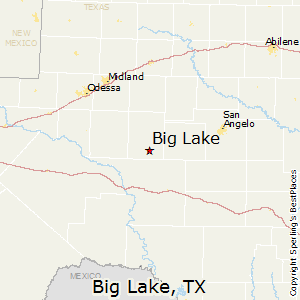
    The town of Big Lake is just north of the lake itself, on State Highway 137 running north and south, and U.S. Highway 67 running east and west, approximately 65 miles west of San Angelo.   Big Lake sits about 10 miles north of Interstate 10, and about 75 miles south of Interstate 20.  Big Lake calls itself “the gateway to the Permian Basin.”

    Big Lake is the home of Reagan County High School.  Jim Morris was baseball coach for the Reagan High Owls when his team persuaded him to try out for a major league baseball team.  His story was chronicled, with some artistic license, in the Disney movie “Rookie.”

    Land managers are working to stop erosion on the often-dry shores of Big Lake using any trick they can find.  One trick:  Plant salt grass.

    Salt grass?  Along Texas’s Gulf Coast, there are a few species of grass that, while not halophytes, are at least salt tolerant.  Salt grass.  This grass made it profitable to graze cattle on what would otherwise have been unproductive land in the Texas cattle boom.  This role in Texas history is memorialized in the Salt Grass Steakhouse chain, now found in five states.

    And if planting salt grass works to control erosion, it will help clean up a large part of Texas other natural lake, Big Lake.

    Big Lake’s being wet or dry is a whim of local climate.  You could say that half of all of Texas’s natural lakes are now dry as a result of continued warming; you could say that two good gully-washers or toad-stranglers could restore water to half of Texas’s natural lakes.

    Big Lake Playa, from NightOwl Bakery and Roastery in Big Lake, Texas

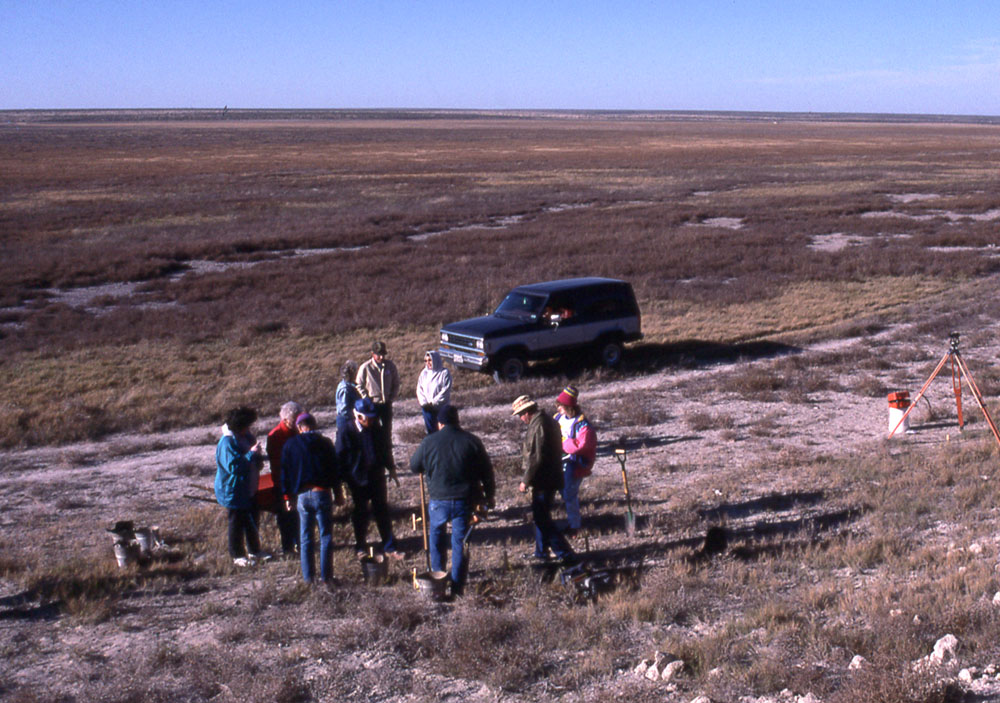
    Field crew meeting at the outset of the 1992 excavations at the Big Lake Bison Kill site. The dry bed of Big Lake stretches for miles in the background. Big Lake is an intermittent saline lake or playa, an uncommon landform on the Edwards Plateau. Photo by Larry Riemenschneider, Concho Valley Archeological Society.

    More details about Big Lake and prehistory, below the fold.

    Read the rest of this entry »


    Insurance experts: Get ready for climate change now

    July 12, 2009

    Climate change denialism is an astounding ball of contradictions and conundrums.

    For example, while most denialists claim to be free-market devotees, they pointedly ignore market indications that climate change is real, aggravated by human actions (and inaction), and that humans can do anything about it.

    Look at the insurance industry.  I’ve noted often that, here in Texas, we pay higher premiums on home insurance because climate change has produced worse weather, which costs insurance companies a lot.  Insurance company actuaries are paid to predict the future, reliably.  If they fail, insurance companies die quickly.

    Weather-related catastrophes, such as wildfires, are posing a serious threat to the insurance industry worldwide. (Photograph source: John McColgan, Bureau of Land Management, Alaska Fire Service.) Caption from Berkeley Lab Research News

    Weather-related catastrophes, such as wildfires, are posing a serious threat to the insurance industry worldwide. (Photograph source: John McColgan, Bureau of Land Management, Alaska Fire Service.) Caption from Berkeley Lab Research News

    The “market” girds itself to fight climate change that governments are not going to move fast enough to prevent.  This will cost you a lot of money.

    A good place to go for information about climate change and how it affects is the Lawrence Berkeley Laboratories, a group that studies the future and is no longer limited (if it ever was) to nuclear future issues.

    Insurance in a Climate of Change, The Greening of Insurance in a Warming World, is loaded with information about insurance industry calculations of what the future is, and how insurance companies might and should react to the changes.

    How relevant are weather-related natural disasters for insurers, and is there any evidence that the situation is worsening?

    Globally, we are seeing about $80 billion/year in weather-related economic losses, of which $20 billion (about a quarter) are insured. This is like a “9/11” every year. Weather-related losses represent about 90% of all natural disaster losses, and the data I just cited do not include an enormous amount of aggregate losses from small-scale or gradual, non-catastrophic events (e.g., lightning, soil subsidence, gradual sea-level rise).

    Inflation-adjusted economic losses from catastrophic events rose by 8-fold between the 1960s and 1990s and insured losses by 17-fold. Losses are increasing faster than insurance premiums. The insured share of total losses has increased dramatically in recent decades, and variability is increasing (a key trouble sign for risk-wary insurers). Weather-related catastrophes have clearly visible adverse effects on insurance prices, and availability. Of particular concern are the so-called “emerging markets” (developing countries and economies in transition”, which already have $375 billion per year in insurance premiums (about 12% of the global market at present, but rising). They are significantly more vulnerable to climate change than are industrialized countries. Emerging markets are the center of growth for the industry, yet they are also the center of vulnerability.

    Increased exposures are surely influenced—and no doubt heavily in some areas—by rising demographic and socioeconomic exposures. Yet, the rise in losses has outpaced population, economic growth, and insurance penetration. The science of “attribution analysis” is still in primitive stages, and thus we cannot yet quantify the relative roles of global climate change and terrestrial human activities. Some have prematurely jumped to the conclusion [PDF] that demographic trends explain the entire rise in observed losses. In the year 2005, three independent refereed <!– –>scientific articles drew linkages between hurricane trends and climate change.

    Denialists claim weather stations are badly-placed, and so we need not worry about climate change since warming can’t accurately be measured — never mind the worldwide rise in temperatures of atmosphere and oceans.   Denialists claim that the greenhouse effect cannot be blamed on carbon dioxide emissions since carbon dioxide is such a small proportion of the gases in the atmosphere, apparently wholly unaware of the greenhouse effect in atmospheric gases, or unaware that only a thin pane of glass makes a greenhouse work.  Denialists claim that polar bears do not decline precipitously, yet, so all wildlife will be unaffected – nevermind the dramatic shifts in migration patterns of birds and migrating mammals, and the dramatic shift in the arrival of spring.  Denialists claim that Boston Harbor has survived 300 years of human development, so all harbors can survive any increase in ocean levels, nevermind the pending disasters of islands sinking out of site and destroying entire nations in the South Pacific, and never mind the drownings in Bengla Desh at every cyclone.

    Most denialists rent apaartments or own homes.  Denying the insurance increases will be more difficult, though I fully expect Anthony Watts and Co. will deny that the insurance company actions and studies of global warming are warranted or accurate.

    Is there any good news in all of this?

    By all means. Insurers need to look no farther than their roots as founders of the original fire departments, early advocates for building codes and fire safety, etc. That is to say that insurers’ history is all about risk management and loss prevention. The same thinking can apply in the case of climate change. Just as insurers fought fire risks through encouraging fire safety, better modeling, and fire suppression, so too can they be part of the climate change solution. This can take many forms, ranging from providing new insurance products (e.g., for carbon trading or energy savings insurance [PDF]), to promoting energy-efficient and renewable technologies [PDF] that also help prevent everyday losses, to engaging in the broader policy discussion on climate change. Insurers can also be part of improving the underlying science of climate change, modeling, and impacts assessment. We maintain an extensive compilation of examples of how leading insurers are stepping into the arena in a constructive manner.

    Alas, there is no insurance against the dithering of climate change denialists.

    Go, with all thy internet getting, get thee wisdom.


    Abitibi restructuring – recycling hangs by a thread

    July 10, 2009

    Texas being Texas, recycling is not a big deal.  Oh, it makes a lot of money where it’s done, but there are cities where officials and citizens are happier making big, nasty landfills, rather than recycling to save money.

    Across Texas one company has set up voluntary recycling deals with schools that both get some recycling done in cities, and provide money to the schools.  That company, Aabitibi, now AbitibiBowater, is in bankruptcy.  In Dallas, schools have been bouncing the recycling bins off of school grounds due to an ordinance that requires the bins to be hidden by fences (they are not that unattractive).

    New guy on watch to finish the restructuring.  Good luck!

    Tip of the old scrub brush to Waste News.


    Godwin’s Law overload: Warming denialist calls water conservation “Nazi”

    June 30, 2009

    You couldn’t sell a fictional story where people are this nutty.

    Go see. The abominable Steve Milloy — a guy so wacky he cannot be parodied (take that, Poe!) — calls water conservation “Nazi.” He complains about a provision in the Waxman-Markey Clean Energy Act that encourages innovation in water conservation devices.

    Milloy flouts Godwin’s Law right off the bat.  You can’t make this stuff up.

    And — may God save us from these people — Milloy has followers.  Check out the graphic here, with Obama portrayed as a marching Brownshirt.  It’s almost too stupid to be racist, but it’s certainly incendiary.  He even admits he thinks saving water is a good idea, and he’d like to have one of the devices complained about. (This guy knows he’s in error — he censors posts that question any part of his rant.) See the ugly meme expand, here.

    Girl Scout/EPA water conservation badge -EPA image

    Girl Scout/EPA water conservation badge -EPA image

    Water conservation equals flag-waving in America, and has done so for a at least a hundred years. Those of us who grew up in the Intermountain West may be a little more attuned to the drive — Hoover Dam, Glen Canyon Dam, Flaming Gorge Dam, the Central Arizona Project, the Central Utah Project, the Colorado River aqueduct that carries water to Los Angeles, it’s impossible to live in the West and not be conscious of water’s value, its precious qualities.

    Today, the many benefits of controlling water in this way are evident in the extensive development that has taken place throughout the West over the past 100 years.  Huge cities have been created and millions of people live, work, and recreate in this desert region.  But, as the West continues to grow, we must face the problem of continually increasing demands on a finite supply of water.  This includes human population needs and the needs of the environment.

    But one doesn’t need to be from the cold northern desert of southern Idaho to figure out that saving water is a good idea.

    Most homeowners would like to save money.  Americans spend between $600 and $1600 for washing machines that cut water usage by up to 75% (we just replaced our two-decades-old Maytag with a water conserving front-loader).  Go to the appliance stores and listen to the conversations.  People who could better afford the $200 models discuss how they will cut costs elsewhere to get the water saving versions — because their water bills are so high.

    Much of of the rest of America works to conserve water out of necessity. Texas cities have mandatory water conservation laws, like Temple, Richwood, Austin and Dallas.  Texas rural areas fight to save water, too.  California cities demonstrate that water conservation works, saving investments in ever-grander and more environmentally-damaging water importation schemes, and allowing for population growth where water shortages would otherwise prohibit new homes.  Water conservation is a big deal across the nation:  In Raleigh, North Carolina; in Seminole County, Florida;  in Nebraska; in the State of Maryland.  An April drive across Wisconsin a few years ago convinced me it is the most waterlogged state in the nation, Louisiana notwithstanding — but even in Wisconsin, wise people work to conserve water for agriculture, one of the state’s leading industries and employers.

    What’s the next step up from Godwin’s Law?  These guys like Milloy and his camp followers can only get crazier, benignly, if they head to the meadow and graze with the cattle.  Crazier non-benignly?  Let’s not go there.

    But let us address the odious comparison to Nazis directly.  In World War II, when freedom was on the line, there was a drive to conserve resources in America.  Americans grew their own vegetables in Victory Gardens.

    Poster encouraging patriotic conservation, for the war effort in World War II

    Poster encouraging patriotic conservation, for the war effort in World War II

    Americans collected scrap metal, iron, copper and aluminum, to be made into war machines to save the world.  Americans conserved rubber and gasoline by restricting automobile use.  There was the famous poster, “When you ride alone, you ride with Hitler.”  Conservation was understood to be a patriotic response to the challenges the nation faced.

    Bill Maher updated the poster with his 2005 book, When You Ride Alone You Ride With Bin Laden. Maher urged civic actions like those that helped the U.S. during World War II, including conservation of gasoline and other resources.   Maher understands that wise use of resources is something a people should strive for, especially when in competition with other nations, either in a hot war or in trade or influence.  Conservation remains a patriotic behavior, and opposing conservation remains a call to support the enemies of America, in war, in trade, in policies.

    Update of the World War II poster, for our times.  Image from Barnes and Noble

    Update of the World War II poster, for our times. Image from Barnes and Noble

    It’s not just a coincidence that Boy Scouts and Girl Scouts (in conjunction with the U.S. EPA for the past several years) learn water conservation as integral parts of their programs, chartered by Congress, to promote civic leadership in America’s youth.  Those groups charged with teaching actual patriotism understand conservation to be a high duty, a high calling, something that all patriots do.

    So, let’s face it.  If you crap on a 6-gallon flushing toilet, you crap with Bin Laden.  When you shower with a non-flow restricting shower head, you shower with Bin Laden.

    Yes, it sounds creepy.  It is.

    You hope Milloy and the other Neobrownshirts* have parents or other family to pull them back from the brink, but then you see Congress.

    Yeah, the Nazis were the Brownshirts, in Germany.  In Italy the fascists wore black shirts.  Brown is generally the opposite of green, in political and business parlance — for example, development of a previously undeveloped piece of property is “greenfield development,” while redevelopment of a previously-developed parcel is “brownfield development.”  Since Milloy is opposed to anything “green,” I think it only fair that his shirt color match his politics.  It’s his choice, after all.

    Well, what about you, Climate Change Skeptics?

    "Well, what about you, Climate Change 'Skeptics?'"


    Jesus would have wept, but He was dehydrated from the heat

    June 30, 2009

    This rather captures it well, don’t you think?

    But if you watched the debate [on climate change fighting legislation in the U.S. House of Representatives] on Friday, you didn’t see people who’ve thought hard about a crucial issue, and are trying to do the right thing. What you saw, instead, were people who show no sign of being interested in the truth. They don’t like the political and policy implications of climate change, so they’ve decided not to believe in it — and they’ll grab any argument, no matter how disreputable, that feeds their denial.

    Indeed, if there was a defining moment in Friday’s debate, it was the declaration by Representative Paul Broun of Georgia that climate change is nothing but a “hoax” that has been “perpetrated out of the scientific community.” I’d call this a crazy conspiracy theory, but doing so would actually be unfair to crazy conspiracy theorists. After all, to believe that global warming is a hoax you have to believe in a vast cabal consisting of thousands of scientists — a cabal so powerful that it has managed to create false records on everything from global temperatures to Arctic sea ice.

    Yet Mr. Broun’s declaration was met with applause.

    Those are the words of Nobel Prize-winning economist Paul Krugman.  If Krugman gets a second Nobel for following the IPCC’s Nobel-winning advocacy, Rep. Broun will cite that as evidence of conspiracy, probably claim it as a conspiracy of “smart, intelligent people.”

    See all of Krugman’s column in the New York Times.


    Clean energy bill needs your help

    June 25, 2009

    Call your Congressman, the person who represents you in the U.S. House of Representatives, and urge a “yea” vote on the comprehensive clean energy bill.

    You can check your representative at several places, or follow the instructions through RePower America, listed below the video from our old friend Al Gore.

    Repower America said in an e-mail:

    Clean energy bill needs our support

    Any moment now, the House will be voting on the boldest attempt to rethink how we produce and use energy in this country. The bill’s passage is not assured. Call your Representative today.

    • Call 877-9-REPOWER (877-9-737-6937) and we’ll connect you to your Representative right after providing you with talking points. (We’re expecting high call volume, and if you are unable to be connected please use our secondary line, 866-590-0971.)
    • When connected to your Representative’s office, just remember to tell them your name, that you’re a voter, and that you live in their district. Then ask them to “vote ‘yes’ on comprehensive clean energy legislation.”

    They’d like you to report your contact, here.

    What?  You haven’t been following the debate?  Here’s what the pro-pollution, give-all-your-money-to-Canada, Hugo Chavez, and the Saudis group hopesHere’s where the anti-pollution, pro-frog and clean environment people say the proposed act is way too weak as it stands.  Here’s the House Energy and Commerce Committee drafts and discussion of the billConsumer Reports analyzed the bill here (and said it can’t be passed into law fast enough despite its flaws).

    Call now.  Pass the word to your friends.  Tell your children to call — their kids deserve better than the path we’re on now.

    More information and discussion:


    $36 million to clean up DDT mess

    June 12, 2009

    One more reminder that DDT is a deadly substance:  EPA announced a program to cap render harmless the largest DDT dump, off the coast of California.

    Jeff Gottlieb writes in The Los Angeles Times:

    The federal Environmental Protection Agency on Thursday proposed spending at least $36 million to clean up the world’s largest deposit of banned pesticide DDT, which lies 200 feet underwater off the Palos Verdes Peninsula.

    Montrose Chemical Corp., which was based near Torrance, released 110 tons of DDT and 10 tons of toxic PCBs into the sewers from 1947 through 1971. The chemicals then flowed into the Pacific.

    What do you think?  A substance that is deadly, makes one of the largest and deadliest Superfund sites in America, and costs $36 million in taxpayer smackaroons just to seal up so it won’t kill again — is it “perfectly safe” as the advocates claim?

    This is one subject you will not see discussed at Steven Milloy’s sites, Junk Science, nor Green Hell.  You won’t find the Chronically Obsessed with Rachel Carson (COWRC) mentioning this clean-up.

    Remind them.

    Public hearings on this plan are scheduled for June 23 and 25.

    Tip of the old scrub brush to Audublog.


    Moab’s uranium tailings, still “going to be moved”

    June 8, 2009

    Has this news story changed at all in the last 30 years?

    You may remember last March when last the Bathtub visited the issue of uranium tailings near Moab, Utah — “soon” to be moved in a multi-million dollar project.

    Still pending — but with more money! At this rate, by 2050, this project will have enough money to buy Utah and force all the residents out.  Then the tailings may not need so urgently to be moved.

    (Actually, if you read the article at Planetsave, it says the tailings are being moved.  Good news.)

    Cool picture, though:

    Caption from Planetsave:  Desert spreads endlessly beyond the horizon, where crystalline azure meets rusted bronze. This is red rock country. Moab, Utah is known for its breathtaking scenery. Red rock arches, labyrinth-like canyons, the clever Colorado River. This paradise permeates the soul and the soil.  But something else sleeps in the soil: uranium tailings.

    Caption from Planetsave: Desert spreads endlessly beyond the horizon, where crystalline azure meets rusted bronze. This is red rock country. Moab, Utah is known for its breathtaking scenery. Red rock arches, labyrinth-like canyons, the clever Colorado River. This paradise permeates the soul and the soil. But something else sleeps in the soil: uranium tailings.


    Is Texas the state most vulnerable to global climate change?

    June 6, 2009

    John Mashey occasionally graces these pages with his comments — a cool, reasoned head on hot issues like global warming/global climate change, despite his history in computers or maybe because of it (which would put the lie to the idea that computer programming explains why so many computer programmers are wacky intelligent design advocates).

    Mashey offered a comment over at RealClimate on a post about hoaxer and science parodist Christopher Monckton — a comment you ought to read if  you think about Texas ever, and especially if you like the place.  It’s comment #413 on that Gigantor blog.

    Monckton wrote a letter to the New York Times and attached to it a graph.  The graph, it turns out, probably would need to be classified in the fiction section of a library or book store, were it a book.  Much discussion occurs, absent any appearance by Monckton himself who does not defend his graphs by pointing to sources that might back what his graphs say, usually.

    In short, the post and the extensive comments shed light on the problems of veracity which plague so many who deny either that warming is occurring, or that air pollution from humans might have anything to do with it, or that humans might actually be able to do anything to mitigate the changes or the damage, or that humans ought to act on the topic at all.

    So I’ve stolen Mashey’s comment lock, stock and barrel, to give it a little more needed highlight.

    If you follow environmental issues much, you probably know Count Christopher Monckton as a man full of braggadocio and bad information on climate.  He is known to have worked hard to hoodwink the U.S. Congress with his claims of expertise and policy legitimacy, claiming to be a member of the House of Lords though he is not (some climate change deniers in Congress appear to have fallen for the tale).  He pops up at denialist conferences, accuses scientists of peddling false information, and he is a shameless self-promoter.

    After much discussion, Mashey turned his attention to claims that Texans don’t know better than Monckton, and other things; Mashey notes that denialists cite Monckton’s performance at a conservative political show in Texas, instead having paid attention to real climate scientists who were meeting just up the road, for free:

    AGW’s impact depends on where you live
    OR
    Texas is Not Scotland, even when a Scottish peer visits

    1) SCOTLAND
    Viscount Monckton lives in the highlands of Scotland (Carie, Rannoch, 57degN, about the same as Juneau, AK, but warmer from Gulf Stream.)

    a) SEA LEVEL, STORMS
    Most of Scotland (esp the highlands) is well above sea level, and in any case, from Post-Glacial Rebound, it’s going up. [Not true of Southern England.]

    b) PRECIPITATION
    Scotland gets lots of regular precipitation. From that, he likely gets ~1690mm or more rainfall/year, noticeably more than Seattle or Vancouver.

    Scotland has complex, variable weather systems, with more rain in West than in East, but has frequent precipitation all year.

    c) TEMPERATURE
    Scotland’s climate would likely be better with substantial warming. See UK Met Office on Scotland, which one might compare with NASA GISS Global Annual Mean Surface Air Temperature Change. Scotland average maximum temperatures are 18-19C in the summer, i.e., in most places it might occasionally get up to 70F, although of course it varies by geography. +3C is no big deal. The record maximum was 32.9C (91F), set in 2003. Maybe there is yet a good future for air-conditioning/cooling vendors.

    If one does a simple linear regression on both sets of annual data, one finds that SLOPE(Scotland) = .0071C/year, SLOPE(world) = .0057C/year, i.e., Scotland is warming slightly faster than the world as a whole.

    d) AGRICULTURE
    The combination of b) and c) is, most likely *good* for agriculture in Scotland. There is plenty of rain, and higher temperatures mean less snow and a longer growing season. Great!

    In addition, the British geoscientist/vineyard archaeologist Richard Selley thinks that while it may be too hot for good vineyards in Southern England by 2080, it will be fine for some areas of Scotland.
    Future Loch Ness Vineyard: great!

    e) OIL+GAS, ENERGY
    Fossil fuel production (North Sea oil&gas) is very important to the Scotland economy. Wikipedia claims oil-related employment is 100,000 (out of total population of about 5M).

    Scotland has not always been ecstatic to be part of the UK.

    2) TEXAS
    The Viscount Monckton spoke for Young Conservatives of Texas, April 28 @ Texas A&M, which of course has a credible Atmospheric Sciences Department. Of course, many of them were unable to hear the Viscount because they were in Austin at CLIMATE CHANGE Impacts on TEXAS WATER, whose proceedings are online. See especially Gerald North on Global Warming and TX Water.

    Monckton delivered his message: “no worries, no problems” which might well fit Scotland just fine, at least through his normal life expectancy.

    The message was delivered to Texans typically in their 20s, many of whom would expect to see 2060 or 2070, and whose future children, and certainly grandchildren, might well see 2100.

    Texas is rather different from Scotland, although with one similarity (oil+gas).

    a) SEA LEVEL, STORMS

    Texas has a long, low coastline in major hurricane territory.
    Brownsville, TX to Port Arthur is a 450-mile drive, with coastal towns like Corpus Christi, Galveston, and Port Arthur listed at 7 feet elevations. The center of Houston is higher, but some the TX coast has subsidence issues, not PGR helping it rise. The Houston Ship Canal and massive amounts of infrastructure are very near sea level. More people live in the Houston metropolitan area + rest of the TX coast than in all of Scotland.

    Of course, while North Sea storms can be serious, they are not hurricanes. IF it turns out that the intensity distribution of hurricanes shifts higher, it’s not good, since in the short term (but likely not the long term), storm surge is worse than sea level rise.

    Hurricane Rita (2005) and Hurricane Ike (2008) both did serious damage, but in some sense, both “missed” Houston. (Rita turned North, and hit as a Category 3; Ike was down to Category 2 before hitting Galveston).

    Scotland: no problem
    TX: problems already

    b) RAINFALL
    Texas is very complex meteorologically, and of course, it’s big, but as seen in the conference mentioned above (start with North’s presentation), one might say:

    – The Western and Southern parts may well share in the Hadley-Expansion-induced loss of rain, i.e., longer and stronger droughts, in common with NM, AZ, and Southern CA. Many towns are dependent on water in rivers that come from the center of the state, like the Brazos.

    – The NorthEast part will likely get more rain. [North’s comment about I35 versus I45 indicates uncertainty in the models.]

    – Rain is likely to be more intense when it happens, but droughts will be more difficult.

    Extreme weather in TX already causes high insurance costs, here, or here.

    Scotland: no problem
    Texas: problems.

    c) TEMPERATURE

    Texas A&M is ~31degN, rather nearer the Equator than 57degN.
    Wikipedia has a temperature chart. It is rather warmer in TX, but is also more given to extremes.

    Scotland: +3C would be dandy,
    Texas: +3C not so dandy.

    d) AGRICULTURE
    Between b) and c), less water in dry places, more water in wet places, more variations in water, and higher temperatures (hence worse evaporation/precipitation difference) are not good news for TX agriculture, or so says Bruce McCarl, Professor of Agricultural Economics at TAMU.

    For audiences unfamiliar with Texas A&M, the “A” originally stood for Agriculture, and people are called Aggies. One might assume that agricultural research is valued.
    Politically, “Aggie-land” would not be considered a hotspot of hyper-liberal folks prone to becoming climate “alarmists”.

    Scotland: warmer, great! Wine!
    Texas: serious stress.

    d) OIL+GAS, ENERGY
    Here, there is more similarity: fossil fuels are economically important.

    On the other hand, Scotland was settled long before the use of petroleum, and while places like the highlands are very sparse, cities like Edinburgh and Glasgow are relatively dense, and many villages are quite walkable. Warmer temperatures mean *lower* heating costs.

    Texas has naturally developed in a very different style, and with forthcoming Peak Oil, this may be relevant. In 2006, according to EIA, Texas was #1 in energy consumption, 5th per-capita (after AK, WY, LA, ND) and uses 2X/capita of states like NY or CA. Some of that is inherent in different climate and industry.

    Sprawling development in a state with water problems, subject to dangerous weather extremes, and already seriously-dependent on air-conditioning, may end being expensive for the residents.

    Scotland: makes money from fossil energy, but it was mostly built without it. Warmer temperatures reduce energy use.
    Texas: already uses ~2.5-3X higher energy/capita, compared to Scotland. Warmer temperatures likely raise energy use.

    3. SUMMARY

    Gerald North’s talk ended by asking:
    “Is Texas the most vulnerable state?”

    That sounds like an expert on trains, hearing one coming in the distance, standing on the tracks amidst a bunch of kids, trying to get them off the tracks before there’s blood everywhere.

    On the other side, someone safely away from tracks keeps telling the kids that experts are wrong, there is no danger, so they can play there as long as they like.

    You will be well informed if you also read Mashey’s comments at #120 and #132.


    Cartoons: Bill Mauldin on DDT

    May 16, 2009

    Bill Mauldin rose to fame drawing cartoons from the fronts during World War II, first as a soldier, and then as the cartoonist for Stars and Stripes.  He won the Pulitzer Prize for cartooning in 1945.  After the war he continued to be a major force in American culture, eventually cartooning for the St. Louis Post-Dispatch and quickly winning a second Pulitzer, and then with the Chicago Sun-Times, with drawings syndicated to other newspapers around the world.

    In 1962 Mauldin turned his pen to DDT and the controversy created in part by Rachel Carson’s best-selling book Silent Spring.

    CREDIT: Mauldin, Bill, artist. Another such victory and I am undone Copyright 1962, Field Enterprises, Inc. Prints and Photographs Division of the Library of Congress.

    CREDIT: Mauldin, Bill, artist. “Another such victory and I am undone” Copyright 1962, Field Enterprises, Inc. Prints and Photographs Division of the Library of Congress.


    History: May 15, 1963, President’s council vindicates Rachel Carson, warns of pesticide dangers

    May 15, 2009

    President John F. Kennedy’s Science Advisory Council (PSAC) studied Rachel Carson’s best-selling book, Silent Spring, checking it for scientific accuracy.  Kennedy read the book himself, but sought expert advice before doing anything.  Meanwhile, DDT manufacturers bankrolled an extensive public relations campaign claiming DDT was safe, and suggesting Carson was less than a careful writer and scientist.

    On May 15, 1963, PSAC reported:  Carson was right. Pesticides were being misused, even abused, and some pesticides like DDT presented significant threats to the environment.  “The Use of Pesticides” recommended increased government scrutiny of the safety and efficacy of pesticides, and vindicated Carson’s reporting of science findings.

    Library of Congress described the event and its import in America’s Library, “Meet Amazing Americans”:

    The Consequences of Silent Spring

    Reading Carson’s book changed many people’s ideas about the environment and inspired some to take action. People wrote to their representatives in congress and asked them to do something about the misuse of pesticides. When several senators created a committee to research environmental dangers, they asked Carson to speak to them about pesticides. Carson recommended that the government regulate and reduce pesticide use, and that it ban the most toxic pesticides. She said that a citizen of the United States had the right “to be secure in his own home against the intrusion of poisons applied by other persons.”

    President Kennedy understood the importance of Carson’s book. He asked his Science Advisory Committee to research Carson’s claims in Silent Spring. In 1963 the Committee released a report called “The Uses of Pesticides.” It supported Silent Spring. Environmental activists continued to push the government to regulate pesticides. Changes in federal law in 1964 required companies to prove that something did not cause harm before they could sell it. In 1972, activists pushed for and won a ban on DDT, the pesticide that started Carson’s research for Silent Spring. And in 1970 the Environmental Protection Agency (EPA) was created “in response to the growing public demand for cleaner water, air and land.” Who knows what the world would be like today if Rachel Carson had not written Silent Spring?

     
    Some radicals argue that Rachel Carson’s legacy is tarnished, that she was in error about DDT, and somehow that translates into many deaths as a result of malaria, as if DDT worked against malaria parasites themselves.  With such a strong propaganda campaign of disinformation plaguing us today, we do well to pause and remember that Carson’s work was subjected to intense, careful scrutiny by scientists from the start.  Carson’s reporting was accurate, and her legacy of environmental protection and saving lives should be celebrated.

    Teaching Resource: Role play simulation, “Advisory Committee on Pesticides 1963,” (see especially the list of historic and scientific resources available for study and for the simulation, from Douglas Allchin).

    Rachel Carson in the ocean in Florida, 1955 - photo, R. G. Schmidt, USFWS

    Rachel Carson in the ocean in Florida, 1955 – photo, R. G. Schmidt, USFWS

    Updates, January 2013:

    More, from 2013:

    Save


    World Malaria Day brings out the DDT-poisoned claims – Beware the ill-informed cynics.

    April 26, 2009

    World Malaria Day is April 25, every year.  It’s not a big deal in the U.S. (but there were several activities this year).  One thing you can count on, however, is the unthinking, often irrational reaction of dozens of columnists and bloggers* who like to think all scientists and health care professionals are idiots, and that government policy makers never consider the lives of their constituents when environmental issues arise.

    Here’s a good example:  At a blog named Penraker, in a post cynically titled “Beware the ‘compassionate’ people,” the author suggests that churches around the world are foolish for sending bednets to Africa to combat malaria, since, the blogger claims, DDT would be quicker, more effective, cheaper, and perfectly safe.

    So  much error, so little time, and even less patience with people who don’t bother to get informed about an issue before popping off on it.

    Penraker wrote:

    Today the loopy “On Faith” pages of the Washington Post reminds us to be compassionate about malaria in Africa.

    It urges the churches of the world to come together and join a campaign that would spread the use of mosquito nets in Africa so that the incidence of malaria can be gradually reduced.

    Nets are a great idea.  They work to reduce malaria by 50% to 85%.  Nets are a simple solution, part of a series of actions that could help eliminate malaria as a major scourge of the world.  The Nothing But Nets Campaign has the endorsement of several major religious sects and the National Basketball Association.  It offers hope.

    Churches uniting to save lives — what could be more spiritual?

    Currently 750 children die EVERY DAY in Nigeria. So the great hearts on the left want to organize another conference. The conference will demonstrate their compassion for this needless death, and it will urge that mosquito nets be distributed more widely in Africa.

    There is only one problem. Nowhere in the article do they mention DDT. DDT is far and away the most effective way to get rid of malaria.

    Why should the article “mention” DDT?  DDT is a deadly poison, an environmental wildcard that once upon a time was thought to offer hope of severely reducing malaria, if it could be applied in enough places quickly enough, before mosquitoes developed resistance to it.  The campaign, coordinated by the World Health Organization, failed.  Agricultural and business interests also latched onto DDT, but they over-used it in sometimes trivial applications.  Mosquitoes quickly developed new genes that made them resistant and immune to DDT.

    DDT can once again play a limited role in fighting malaria.  It can be used in extremely limited amounts, to spray the inside walls of homes, to kill mosquitoes that still land on the walls of a hut after feeding on a human.  But DDT is not appropriate for all such applications, and it is nearly useless in some applications, especially where the species involved is completely immune to DDT.

    DDT was discovered to be deadly.  First European nations banned its use, and then the U.S. banned it.  Continued use after those bans increased the difficulties — manufacturing continued in the U.S. resulted in many nasty Superfund clean-up sites costing American taxpayers billions of dollars when manufacturers declared bankruptcy rather than clean up their plant sites.  The National Academy of Sciences studied DDT, and in 1980 pronounced it one of the most beneficial chemicals ever discovered — but also one of the most dangerous.  NAS said DDT had to be phased out, because the dangers more than offset its benefits.

    The cessation of use of DDT, to protect wildlife and entire ecosystems, proved wise.  In 2007 the bald eagle was removed from the list of endangered species, a recovery made possible only with a ban on DDT.  DDT weakens chicks, especially of top predators, and damages eggs to make them unviable.  Decreasing amounts of DDT in the tissues of birds meant recovery of the eagle, the brown pelican, the peregrine falcon, and osprey.

    Though it was not banned for ill effects on human health, research since 1972 strengthened the case that DDT is a human carcinogen (every cancer-fighting agency on Earth lists it as a “probable human carcinogen”).  DDT and its daughter products have since been discovered to act as endocrine disruptors, doing serious damage to the sexual organs of birds, fish, lizards and mammals.  Oddly, it’s also been discovered to be poisonous to some plants.

    After DDT use against malarial mosquitoes was reduced, malaria stayed low for a while.  Unfortunately, the malaria parasites developed resistance to the pharmaceuticals used to treat humans.  Malaria came roaring back — DDT, an insecticide, was of no use to fight the blood parasite.  Newer, arteminisin-based pharmaceuticals offer hope of reducing the human toll

    Still, with some improvements in delivery of pharmaceuticals, improvements in diagnosis, and improvements in education of affected populations about how they can reduce exposure and prevent mosquito breeding, world wide malaria deaths have been kept below 3 million annually.  Recent programs, helped by munificent organizing from the Bill and Melinda Gates Foundation, and from other charities, have reduced malaria considerably.  With no magic drug on the horizon, with no magic vector control, efforts have been redoubled to use the time-tested methods for beating the disease — reducing exposure to mosquitoes, improving health care, stopping mosquito breeding.  These methods, which ridded the U.S. of the disease very much prior to the discovery of DDT’s insecticidal properties, appear the best bets to beat malaria.

    Once South Africa started using it, the death rate went way down.

    South Africa used DDT constantly from 1946 through about 1996.  Other efforts to control mosquitoes worked until changing climate and political turmoil in nations adjoining South Africa produced malaria and mosquitoes that crossed borders.  South Africa turned to DDT as an emergency  measure; but the other, non-pesticide spraying methods, are credited with helping South Africa reduce malaria.

    It turns out that DDT is much less harmful than we had been led to believe by scare reports early on. People at the Monsanto plant in California worked around the stuff for years with no discernible effects.

    That’s not quite accurate.  Whether DDT seriously crippled workers is still in litigation, a quarter of a century after DDT stopped being manufactured in the U.S. Residual and permanent health damage keep showing up in studies done on workers in DDT production facilities, and on their children.  The Montrose plant in California is a Superfund site, as is the entire bay it contaminated.  In fact, three different bays in California are listed as cleanup sites (was there a Monsanto DDT plant in California?  Which one?).

    To say there were “no discernible effects” simply is unsupportable from research or litigation on the matters.  Such a claim is completely misleading and inaccurate.

    No matter. The compassionate ones don’t dare to mention it. They are ready to let 750 kids die every day, in Nigeria alone. That’s 273,000 a year.

    273,000 kids a year are dying in Nigeria alone. Think about it.

    Rachel Carson warned us that would happen if we didn’t control DDT use to keep it viable to fight malaria.  I’ve been thinking about it for more than 40 years.  The “compassionate” ones you try to ridicule have been fighting malaria in Africa for that entire time.  You just woke up — when are you going to do something to stop a kid from dying?  By the way, slamming environmentalists doesn’t save any kid.

    The CDC says:

    The World Health Organization estimates that each year 300-500 million cases of malaria occur and more than 1 million people die of malaria, especially in developing countries. Most deaths occur in young children. For example, in Africa, a child dies from malaria every 30 seconds. Because malaria causes so much illness and death, the disease is a great drain on many national economies. Since many countries with malaria are already among the poorer nations, the disease maintains a vicious cycle of disease and poverty.

    Still the compassionate ones call for the use of bed netting to keep the kids from getting bit. There is only one obvious problem – kids aren’t in bed all day. Mosquitoes can bite them all day long, and the nets have no effect. So, they are proposing a massively stupid remedy.

    First point on that section:  Did you bother to read the CDC document?  Nowhere do they call for DDT to be used.  Quite the contrary, they note that it doesn’t work anymore:

    Wasn’t malaria eradicated years ago?

    No, not in all parts of the world. Malaria has been eradicated from many developed countries with temperate climates. However, the disease remains a major health problem in many developing countries, in tropical and subtropical parts of the world.

    An eradication campaign was started in the 1950s, but it failed globally because of problems including the resistance of mosquitoes to insecticides used to kill them, the resistance of malaria parasites to drugs used to treat them, and administrative issues. In addition, the eradication campaign never involved most of Africa, where malaria is the most common.

    So, where do you get the gall to claim CDC support for your inaccurate diatribe?  CDC’s documents do not support your outrageous and inaccurate claims for DDT at all.

    Second point, mosquitoes don’t bite all day long, and bednets have proven remarkably effective at stopping malaria.  Mosquitoes — at least the vectors that carry malaria — bite in the evening and night, mostly.  Protecting kids while they sleep is among the best ways to prevent malaria.

    It appears to me that this blogger has not bothered to learn much about malaria before deciding he knows better than the experts, how to fight it.

    Their outrageous and horribly unscientific “religious beliefs” are a firm block to their humanity. No, they just don’t care. No DDT can be used.

    Every “ban” on DDT included a clause allowing use against malaria.  In the U.S. we allowed manufacture of DDT for export after the ban on use in the U.S. (and the ban on use in the U.S. had exceptions).  DDT was never banned for use in any African nation I can find.  DDT is manufactured, today, in India and China.  DDT can be used, even under the POPs treaty.  This blogger, Penraker,  just doesn’t have the facts.

    You get the impression that their compassion is not about solving the problem. Their compassion seems to be about themselves – about proving they are good people by having compassion, rather than eradicating the problem. In fact, it looks like they have a desire to have the malaria epidemic continue, so they can organize little conferences and wring their hands, put together action plans, and call on somebody else to do something about the problem.

    Actually, I get the idea that this blogger wants to whine and pose, and isn’t really concerned about kids with malaria.  He’s getting way too many facts dead wrong.

    Nick Kristof of the New York Times, God bless him, is one of the few liberals to react reasonably to reality:

    Mosquitoes kill 20 times more people each year than the tsunami did, and in the long war between humans and mosquitoes it looks as if mosquitoes are winning.

    One reason is that the U.S. and other rich countries are siding with the mosquitoes against the world’s poor – by opposing the use of DDT.

    “It’s a colossal tragedy,” says Donald Roberts, a professor of tropical public health at Uniformed Services University of the Health Sciences. “And it’s embroiled in environmental politics and incompetent bureaucracies.”

    In the 1950’s, 60’s and early 70’s, DDT was used to reduce malaria around the world, even eliminating it in places like Taiwan. But then the growing recognition of the harm DDT can cause in the environment – threatening the extinction of the bald eagle, for example – led DDT to be banned in the West and stigmatized worldwide. Ever since, malaria has been on the rise.

    …But most Western aid agencies will not pay for anti-malarial programs that use DDT, and that pretty much ensures that DDT won’t be used. Instead, the U.N. and Western donors encourage use of insecticide-treated bed nets and medicine to cure malaria

    Yeah, go read that Kristof article.  He’s a bit off about DDT — but notice especially the date.  It’s the Bush administration he’s complaining about. I thought Penraker was complaining about environmentalists and silly “compassionate” types — but he’s complaining about Bush?  What else isn’t he telling us, or doesn’t he know?

    But isn’t it dangerous?

    But overall, one of the best ways to protect people is to spray the inside of a hut, about once a year, with DDT. This uses tiny amounts of DDT – 450,000 people can be protected with the same amount that was applied in the 1960’s to a single 1,000-acre American cotton farm.

    Is it safe? DDT was sprayed in America in the 1950’s as children played in the spray, and up to 80,000 tons a year were sprayed on American crops. There is some research suggesting that it could lead to premature births, but humans are far better off exposed to DDT than exposed to malaria.

    Indoor Residual Spraying (IRS) is endorsed even by Environmental Defense, the group that first sued to stop broadcast DDT spraying in the U.S.  It’s not environmentalists who oppose the practice, but businessmen, tobacco farmers and cotton farmers in Africa.  Who is Penraker to substitute his judgment for the judgment of Africans, the people on the ground, the people who suffer from malaria?

    Alas, IRS, done right, is expensive.  A treatment with DDT is required twice a year, at about $12 an application when costs of the analysis of the mosquitoes and other circumstances are figured in.  That’s $24/year.  DDT spraying is more than 50% effective in preventing the disease.

    Bednets cost $10, last five years at least, and are about 85% effective at preventing the disease.

    Maybe Africans just want the cheaper, more effective methods used.  Doesn’t that make sense?

    The piece in the Washington Post’s On Faith section is called “Religion from the Heart”

    How ironic.

    All the Washington Post and the New York Times would have to do is highlight that the use of DDT could save a million lives – most of them children, and they would be saved within a year.

    That’s all they would have to do. Keep the spotlight on it, and save a million lives. Instead, they expunge the very idea from their pages, (witness this from the heart stuff)

    I will never understand people who are willing to let millions of people die for the sake of their ideology.

    And I will never understand people who get in a dudgeon, blaming people who are blameless, or worse, blaming people who are actually trying to fix a problem, all while being blissfully misinformed about the problem they complain about.

    Yes, millions of lives could be saved — but not with DDT.  DDT won’t work as a magic potion, and it’s a nasty poison.  Why would anyone urge Africans to waste money, and lives, instead of actually fighting malaria?  Penraker fell victim to the hoaxers who want you to believe Rachel Carson was not accurate (her book was found accurate by specially-appointed panels of scientists), that DDT is a panacea against malaria (it’s not), that environmentalists are stupid  and mean (while they’ve been fighting against malaria for more than 40 years), and that everything you’ve heard from science is wrong.

    Malaria gets a lot of deserved attention from people serious about beating the disease, for millions of good reasons.  Those who are serious about beating malaria don’t whine about DDT.

    And then he brags about his intolerance for the facts.  Whom God destroys, He first makes mad.

    _____________

    Update: Blue Marble isn’t as offensive and obstreperous as others, but equally in error.  How can people be so easily misled from the facts of the matter?


    Texas Forest Expo!

    April 25, 2009

    Are you out near Conroe on Sunday? April 26 is the third (and last) day of Texas Forest Expo 2009 at the Conroe Convention Center.

    It’s free.  It’s kid friendly ( a great place to take Cub Scouts or a group of Boy Scouts working on the Forestry merit badge).  I’d be there if I could.

    Get your name on the mailing list for notice for next year’s expo.