How about another cup of coffee? (Global Warming Conspiracy and Starbucks Cup #289)

June 19, 2013

Encore post from September 17, 2007, and August 2009 — maybe more appropriate today than ever before.

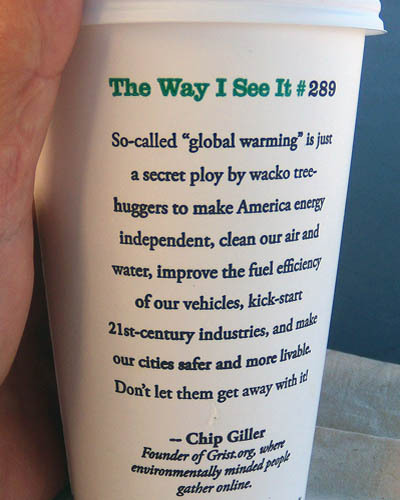
Found this on my coffee cup today (links added here):

The Way I See It #289

So-called “global warming” is just

a secret ploy by wacko tree-

huggers to make America energy

independent, clean our air and

water, improve the fuel efficiency

of our vehicles, kick-start

21st-century industries, and make

our cities safer and more livable.

Don’t let them get away with it!

Chip Giller
Founder of Grist.org, where
environmentally-minded people
gather online.

Starbucks Coffee Cup, The Way I See It #289 (global warming)

Look! Someone found the same cup I found!

I miss those old Starbucks cups — but then, they killed the Starbucks in our town.  I don’t buy the 100 cups of Starbucks coffee I used to get in a year.

More:

Save


Querying the Rachel Carson Critics (who turned out the light?)

June 19, 2013

Another question of mine that will probably never see the light of day.  This group has no answer, so why would they allow the question?

I stumbled across a blog-looking page from the American Council on Science and Health, an industry apologist propaganda site, on World Malaria Day, which was April 25.  You may recognize the name of the group as one of the industry-funded sites that constantly attacks Rachel Carson, and often the World Health Organization, with the unscientific and false claims that environmentalists bannned DDT and thereby condemned millions of Africans to die from malaria — which, ASCH claims, could have easily been eradicated with more DDT poisoning of Africa.

On World Malaria Day, ASCH took note, flirted with the facts (that DDT doesn’t work as it once was thought to work), but then backed away from the facts — that the ban on DDT in the U.S. came years AFTER WHO suspended the malaria eradication campaign in Africa when it was discovered DDT couldn’t kill DDT-adapted mosquitoes, already subject to years of abuse of DDT by agriculture and other industries.  ASCH said:

DDT kills mosquitoes, although not as well as it did 60 years ago. But it also irritates them and repels them, so the small amount sprayed inside homes effectively reduces the transmission of the malarial microbe substantially. The banning of DDT, based upon political anti-chemical bureaucrats and “environmentalists” inspired by Carson’s “Silent Spring” who ran our EPA in 1972, helped to impede the malaria control program led by the UN’s WHO.

Impede?  Impossible for a 1972 ban to have been responsible for the earlier suspension of the WHO campaign, not to mention EPA’s ban ended at the U.S. borders.  So I asked:

Screen capture of query to ACSH on how EPA's ban "impeded" WHO's campaign against malaria, ended years earlier.

Screen capture of query to ACSH on how EPA’s ban “impeded” WHO’s campaign against malaria, ended years earlier.

Ed Darrell Reply

June 19, 2013 at 5:16 am

Your comment is awaiting moderation.

I would be very interested in just how the 1972 ban on DDT in the U.S. “impeded” the UN’s antimalaria campaign, which stopped using DDT heavily seven years earlier, and was suspended in 1969.

After the ban on U.S. use of DDT, all of U.S. manufacture was dedicated to export to Africa and Asia, which greatly increased DDT supplies available there.

How did this impede?

Want to wager a guess as to whether they’ll ever allow the comment to see the light of day at their site, let alone answer it?

More:

Wall of Shame – Sites that continue to spread the pro-DDT hoax as fact:

DDT is good for me advertisement

“DDT is good for me advertisement” from circa 1955.  Photo image from the Crossett Library Bennington College.  This ad today is thought to be emblematic of the propaganda overkill that led to environmental disasters in much of the U.S. and the world.  DDT cleanups through the Superfund continue to cost American taxpayers millions of dollars annually.


Meanwhile, back at the rice paddy, global warming holds families hostage . . .

May 1, 2013

See this United Nations Development Program ten-minute video that, to the wise and concerned, lays out the stakes of delaying action against human-caused climate change.

Without enough funding, NGOs work to help farmers getting hammered in the Southern Philippines, and other places.

In the Southern Philippines, farmers’ lives and the weather are intimately interwoven, but something is changing, now that the rains in Agusan del Norte are too heavy, the sun shines too fiercely. Now there’s hope for poor farmers with the community-based approach monitoring and Weather Index-Based Insurance packages, to warn people when heavy weather is on the way.

Though, I do weary of the astonishing abuse of acronyms in this work-of-the-angels. “WIBI?”

Incidentally, though the phrase doesn’t appear anywhere in this material, this is exactly the sort of work carried on by the UN’s Agenda 21 project.  Doesn’t look subversive to me.

Tip of the old scrub brush to the UNDP and ILO Tweet:

More:

Map of the Philippines with Agusan del Norte h...

Map of the Philippines with Agusan del Norte highlighted. Wikipedia image


Once again, the Earth Day/Lenin hoax trotted out: Earth Day honors Earth, our majestic home — not Lenin (2013 version)

April 22, 2013

This is mostly an encore post, repeated each year on April 22 — sad that it needs repeating.

You could write it off to pareidolia, once. Like faces in clouds, some people claimed to see a link. The first Earth Day, on April 22, 1970, coincided with Lenin’s birthday. There was no link — Earth Day was scheduled for a spring Wednesday. Now, years later, with almost-annual repeats of the claim from the braying right wing, it’s just a cruel hoax.

No, there’s no link between Earth Day and the birthday of V. I. Lenin:

One surefire way to tell an Earth Day post is done by an Earth Day denialist: They’ll note that the first Earth Day, on April 22, 1970, was an anniversary of the birth of Lenin.

Coincidentally, yes, Lenin was born on April 22 (new style calendar; it was April 10 on the calendar when he was born — but that’s a digression for another day).

It’s a hoax. There is no meaning to the first Earth Day’s falling on Lenin’s birthday — Lenin was not prescient enough to plan his birthday to fall in the middle of Earth Week, a hundred years before Earth Week was even planned.

About.com explains why the idea of a link between Earth Day and Lenin is silly:

Does Earth Day Promote Communism?
Earth Day 1970 was initially conceived as a teach-in, modeled on the teach-ins used successfully by Vietnam War protesters to spread their message and generate support on U.S. college campuses. It is generally believed that April 22 was chosen for Earth Day because it was a Wednesday that fell between spring break and final exams—a day when a majority of college students would be able to participate.

U.S. Sen. Gaylord Nelson, the guy who dreamed up the nationwide teach-in that became Earth Day, once tried to put the whole “Earth Day as communist plot” idea into perspective.

“On any given day, a lot of both good and bad people were born,” Nelson said. “A person many consider the world’s first environmentalist, Saint Francis of Assisi, was born on April 22. So was Queen Isabella. More importantly, so was my Aunt Tillie.”

April 22 is also the birthday of J. Sterling Morton, the Nebraska newspaper editor who founded Arbor Day (a national holiday devoted to planting trees) on April 22, 1872, when Lenin was still in diapers. Maybe April 22 was chosen to honor Morton and nobody knew. Maybe environmentalists were trying to send a subliminal message to the national subconscious that would transform people into tree-planting zombies. One birthday “plot” seems just about as likely as the other. What’s the chance that one person in a thousand could tell you when either of these guys were born.

My guess is that only a few really wacko conservatives know that April 22 is Lenin’s birthday (was it ever celebrated in the Soviet Union?). No one else bothers to think about it, or say anything about it, nor especially, to celebrate it.

Gaylord Nelson, Living Green image

Inventor of Earth Day teach-ins, former Wisconsin Governor and U.S. Senator Gaylord Nelson

Wisconsin’s U.S. Sen. Gaylord Nelson, usually recognized as the founder and father of Earth Day, told how and why the organizers came to pick April 22:

Senator Nelson chose the date in order to maximize participation on college campuses for what he conceived as an “environmental teach-in.” He determined the week of April 19–25 was the best bet; it did not fall during exams or spring breaks, did not conflict with religious holidays such as Easter or Passover, and was late enough in spring to have decent weather. More students were likely to be in class, and there would be less competition with other mid-week events—so he chose Wednesday, April 22.

In his own words, Nelson spoke of what he was trying to do:

After President Kennedy’s [conservation] tour, I still hoped for some idea that would thrust the environment into the political mainstream. Six years would pass before the idea that became Earth Day occurred to me while on a conservation speaking tour out West in the summer of 1969. At the time, anti-Vietnam War demonstrations, called “teach-ins,” had spread to college campuses all across the nation. Suddenly, the idea occurred to me – why not organize a huge grassroots protest over what was happening to our environment?

I was satisfied that if we could tap into the environmental concerns of the general public and infuse the student anti-war energy into the environmental cause, we could generate a demonstration that would force this issue onto the political agenda. It was a big gamble, but worth a try.

At a conference in Seattle in September 1969, I announced that in the spring of 1970 there would be a nationwide grassroots demonstration on behalf of the environment and invited everyone to participate. The wire services carried the story from coast to coast. The response was electric. It took off like gangbusters. Telegrams, letters, and telephone inquiries poured in from all across the country. The American people finally had a forum to express its concern about what was happening to the land, rivers, lakes, and air – and they did so with spectacular exuberance. For the next four months, two members of my Senate staff, Linda Billings and John Heritage, managed Earth Day affairs out of my Senate office.

Five months before Earth Day, on Sunday, November 30, 1969, The New York Times carried a lengthy article by Gladwin Hill reporting on the astonishing proliferation of environmental events:

“Rising concern about the environmental crisis is sweeping the nation’s campuses with an intensity that may be on its way to eclipsing student discontent over the war in Vietnam…a national day of observance of environmental problems…is being planned for next spring…when a nationwide environmental ‘teach-in’…coordinated from the office of Senator Gaylord Nelson is planned….”

Nelson, a veteran of the U.S. armed services (Okinawa campaign), flag-waving ex-governor of Wisconsin (Sen. Joe McCarthy’s home state, but also the home of Aldo Leopold and birthplace of John Muir), was working to raise America’s consciousness and conscience about environmental issues.

Lenin on the environment? Think of the Aral Sea disaster, the horrible pollution from Soviet mines and mills, and the dreadful record of the Soviet Union on protecting any resource. Lenin believed in exploiting resources, not conservation.

So, why are all these conservative denialists claiming, against history and politics, that Lenin’s birthday has anything to do with Earth Day?

Can you say “propaganda?”  Can you say “political smear?”

2013 Resources and Good News:

Good information for 2012:

Good information from 2011:

Good information from 2010:

2013 Wall of Shame:

Wall of Lenin’s Birthday Propaganda Shame from 2012:

Wall of Lenin’s Birthday Propaganda Shame from 2011:

Wall of Lenin’s Birthday Propaganda Shame from 2010:

Spread the word.  Have you found someone spreading the hoax, claiming Earth Day honors Lenin instead?  Give us the link in comments.


Rachel Carson/DDT hoaxing from the Ayn Rand Institute

April 21, 2013

Welcome, refugees and truth-seekers from WUWT:  If this site seems a little unusual to you, you should know that at Millard Fillmore’s Bathtub we try to stick to science, and we don’t censor opposing opinions.  Genuinely interested in the DDT/Malaria issue?  See this collection.

______________

A couple of physicists get together in a podcast from the Ayn Rand Institute, Poke in Your Eye to Eye, and demonstrate that they don’t know biology well, they know less about history, but they don’t hesitate to tell whoppers about Rachel Carson and the value of DDT“Silent Spring 50 Years Later [a special Earth Day podcast].

English: An image of the main entrance of Rach...

A better indication of the legacy of Rachel Carson: Schools across America named after the woman, to inspire children to explore science, and to read and write. Here, the main entrance of Rachel Carson Middle School in Herndon, Virginia. (Photo: Wikipedia)

Earth Day must be coming up.  The usual suspects trot out their usual disinformation and hoax campaigns — and it will continue through Earth Day on April 22, International Malaria Day on April 25, through Rachel Carson’s birthday, and probably all summer.

Mencken warned us that hoaxes, once out of the bottle, can’t be put back.  Twain (and others) remind us that whopping falsehoods travel around the world “while truth is getting its boots on.”  Amanda Maxham, who is listed as an astrophysicist at the Rand site, interviewed physicist Keith Lockitch — and they repeat almost all the hoary old false fables invented by Gordon Edwards and Steven Milloy about malaria, DDT, and Rachel Carson.

A few of the errors committed by the polemicists at the Ayn Rand Institute:

  • ‘DDT doesn’t breed mosquitoes more resistant to the stuff, but instead weakens the population through reducing diversity.’  Absolutely wrong.  Turns out the new alleles mosquitoes pick up that makes them resistant and immune to DDT, are ALSO the alleles that make mosquitoes resistant to the whole class of chemicals, and thereby foul up efforts to develop new pesticides.

    Tanzania - Removing DDT

    Cleaning up DDT in Africa: 40 tons of 50 year old DDT were found in Menzel Bourguiba Hospital, Tanzania – FAO photo

  • ‘Rachel Carson didn’t account for the value of DDT in eradicating malaria.’  They start out claiming DDT ended malaria in the U.S. (it didn’t; CDC had won the fight will just mop up operations left, by 1939; DDT wasn’t even available for another seven years), and run through the false claim that DDT alone had almost eradicated malaria from Sri Lanka, but listening to Rachel Carson, the nation stopped spraying and malaria roared back (the nation stopped ALL of its malaria fighting efforts due to costs and civil war; when the fight was taken up again, DDT was not useful; largely without DDT, Sri Lanka has once again nearly wiped out malaria).
  • ‘Because of a lack of DDT use, malaria continues to ravage the world killing a million people a year.’  Actually, malaria is at the lowest level in human history, killing less than a million a year, with great progress being made against the disease using the methods Rachel Carson urged in 1962.  Had we listened to Carson earlier, we could have saved a few million more lives, and perhaps have eradicated malaria already.  Also, it’s important to remember that DDT was never banned in Africa nor Asia; the ban on use of DDT on cotton crops in the U.S. did not cause any increase in malaria anywhere; since the ban on DDT use in the U.S. malaria has constantly declined in incidence and deaths.
  • ‘DDT is very effective because it’s ALSO repellent to mosquitoes, after it ceases to kill them.’  So in the end, they urge the use of a poisonous-to-wildlife, mildly carcinogenic substance, because it repels mosquitoes?  Bednets are more effective, cheaper, not-poisonous to wildlife, and they aren’t even suspected of causing cancer.

Rachel Carson’s life is a model for budding scientists, aspiring journalists, and teachers of ethics.  That so many people spend so much time making up false claims against her, in favor of a deadly toxin, and against science, tells us much more about the subrosa intentions of the claim fakers than about Rachel Carson.

Want the facts about Rachel Carson?  Try William Souder’s marvelous biography from last year, On a Farther Shore.  Want facts on DDT?  Try EPA’s official DDT history online (or look at some of the posts here at Millard Fillmore’s Bathtub). Want the facts about malaria?  Check with the world’s longest running, most ambitious malaria fighting campaign operated by the good people at the World Health Organization, Roll Back Malaria,  or see Sonia Shah’s underappreciated history, The FeverHow malaria has ruled mankind for 500,000 years.

More:

Roll Back Malaria, World Malaria Day logo for 2013

Roll Back Malaria, World Malaria Day logo for 2013

Wall of Shame (hoax spreaders to watch out for this week):


FAA lifted Flight restrictions over Arkansas oil spill

April 6, 2013

Aviation Impact Reform reported the Federal Aviation Administration (FAA) lifted the Temporary Flight Restriction (TFR) covering the area around the oil spill near Mayflower, Arkansas.

Indeed, the Notice to Airmen (NOTAM) is gone from the FAA website.

NOTAMS map of Arkansas on April 6, 2013 -- no restricted areas shown

NOTAMS map of Arkansas on April 6, 2013 — no restricted areas shown

More:


Punchline too brutal for work: Why it is that environmentalists are the real humanitarians (a necessary encore)

March 1, 2013

I wish it weren’t true.  I wish people didn’t appear to be getting stupider, less scientifically literate, and less knowledgeable of history (see Santayana‘s thoughts in the upper right-hand corner of the blog . . .).  My e-mail box is filling today with notes from people claiming environmentalists want to rid the Earth of humans, urging that we should oppose them and let poisoning of our air and water continue . . . oblivious to the irony of the claim coupled with their supposed opposition to the idea.  Here’s the truth, in large part, an encore post from several months ago (I apologize in advance for the necessary profanity):

The fictional but very popular memes that environmentalists hate humans, humanity and capitalism wouldn’t bother me so much if they didn’t blind their believers to larger truths and sensible policies on environmental protection.

One may argue the history of the environmental movement, how most of the originators were great capitalists and humanitarians — think Andrew Carnegie, Laurance Rockefeller, Theodore Roosevelt, Gifford Pinchot, and all the early medical doctors who warned of the dangers of pollution-caused diseases — but it falls on deaf ears on the other sides.

Here’s the 30-second response, from Humon, in cartoon form (or here, at Humon Comics):

First panel of cartoon by Humon at Deviant Art

Mother Gaia explains why environmental protection is important, from Humon at Deviant Art

Facts of life and environmental protection – from Humon at Deviant Art

Tip of the old scrub brush to P. Z. Myers, and Mia, whoever she is.  Myers noted, “Environmentalism is actually an act of self defense.”

More:

Wall of Shame; sites that don’t get it, or intentionally tell the error:

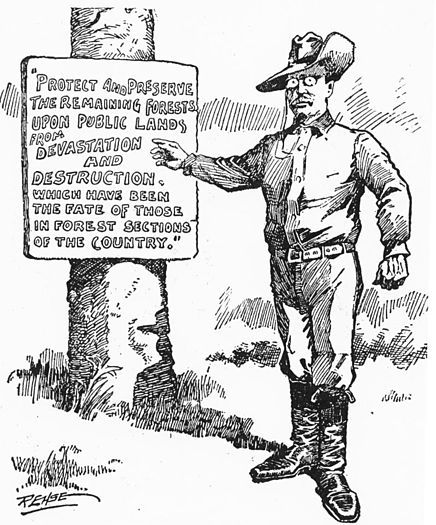
1908 editorial cartoon of President Theodore Roosevelt as “A Practical Forester.”  Source: St. Paul Minnesota “Pioneer Press”. Via GPO's Government Book Talk blog.

1908 Rense editorial cartoon of President Theodore Roosevelt as “A Practical Forester.” Source: St. Paul Minnesota “Pioneer Press”. Via GPO’s Government Book Talk blog.


Hog wild in Texas: Ranchers, guns, and science working against environmental disaster

February 25, 2013

Unusual?  No, this is really a typical marriage of agriculture, government agencies, science and hunters, working on problems of wildlife management, feral hogs in this case.

Notes from Texas Parks & Wildlife:

Feral hogs are running wild across Texas, at great cost to farmers, ranchers, and native wildlife. Hunters are helping, but science may prove critical to controlling the invasion on a broader scale. For more information on feral hogs and feral hog control, visit: http://www.tpwd.state.tx.us/huntwild/…

When it comes to feral hogs, every Texan turns environmentalist.

More:    

English: Sign for Texas Parks and Wildlife Dep...

Sign for Texas Parks and Wildlife Department headquarters – Wikipedia image


Anthony Watts’s political push poll, “Gore or Obama?”

February 9, 2013

Al Gore and Barack Obama together in Detroit, June 2012, Rebecca Cook photo for Reuters, via NBC News photo

Al Gore and Barack Obama don’t appear to be on the opposite side of most issues, especially not climate change. Here they appear together in Detroit, circa June 11, 2012 – Rebecca Cook photo for Reuters, via NBC News photo

Anthony Watts strays farther and further from science with every passing day, and most of his new posts.

At the moment he’s got a doozy of a post, citing a bovine excrement question on a CFACT billboard, and offering a push-poll with three choices designed to push Watts’s preferred political answer, that ‘Obama and Gore go in different directions on global warming and climate change, and maybe they are both wrong.’   The end message Watts pushes is wrong, as you can see in the full texts below.(Morgan, here’s the link so you don’t have to flounder around with Google.)

Who do you believe?

◊  Barack Obama
◊  Neither one
◊  Al Gore

It’s based on these two quote mine products from the CFACT billboard:

WHAT DO YOU BELIEVE?

“Hurricane Sandy is a disturbing sign of things to come.”  — Al Gore, 10/30/2012

“We can’t attribute any particular weather event to global warming.”  — Barack Obama, 11/14/2012

Lying with quotes, demonstrated by CFACT

Propaganda group CFACT’s quote mining billboard, on which Anthony Watts’s push-poll is based.

Watts doesn’t offer a “both correct” choice.  That would be the accurate answer.

Gore’s comment at his blog on October 30, 2012, noted that while we can’t attribute the formation of Sandy to climate change, the effects of the storm were magnified by climate change.  Gore called that “disturbing.”

Obama, noting that while we can’t say for certain that any particular storm is caused entirely from human-created global warming, the long-term effects clearly have human causation and we need to act to stop it.

In short, Gore and Obama take the same side on this issue, the side of science and making sound public policy.  Watts works the old tobacco company strategy, suggesting that wherever studies showing health harms from tobacco differ from each other in the slightest jot or tittle, that means scientists can’t decide whether tobacco is harmful — substitute “human-caused climate change” for tobacco in that argument, and you see what Watts is trying to do.

Meanwhile, the Earth still warms:

Gore’s blog post in full:

Statement on Hurricane Sandy October 30, 2012 : 1:21 PM

This week, our nation has anxiously watched as Hurricane Sandy lashed the East Coast and caused widespread damage–affecting millions. Now more than ever, our neighbors need our help. Please consider donating or volunteering for your local aid organizations.

The images of Sandy’s flooding brought back memories of a similar–albeit smaller scale– event in Nashville just two years ago. There, unprecedented rainfall caused widespread flooding, wreaking havoc and submerging sections of my hometown. For me, the Nashville flood was a milestone. For many, Hurricane Sandy may prove to be a similar event: a time when the climate crisis—which is often sequestered to the far reaches of our everyday awareness became a reality.

While the storm that drenched Nashville was not a tropical cyclone like Hurricane Sandy, both storms were strengthened by the climate crisis. Scientists tell us that by continually dumping 90 million tons of global warming pollution into the atmosphere every single day, we are altering the environment in which all storms develop. As the oceans and atmosphere continue to warm, storms are becoming more energetic and powerful. Hurricane Sandy, and the Nashville flood, were reminders of just that. Other climate-related catastrophes around the world have carried the same message to hundreds of millions.

Sandy was also affected by other symptoms of the climate crisis. As the hurricane approached the East Coast, it gathered strength from abnormally warm coastal waters. At the same time, Sandy’s storm surge was worsened by a century of sea level rise. Scientists tell us that if we do not reduce our emissions, these problems will only grow worse.

Hurricane Sandy is a disturbing sign of things to come. We must heed this warning and act quickly to solve the climate crisis. Dirty energy makes dirty weather.

President Obama’s statement, excerpted from his November 14, 2012, press conference:

THE PRESIDENT:  Mark Landler.  Where’s Mark?  There he is right in front of me.

Q    Thank you, Mr. President.  In his endorsement of you a few weeks ago, Mayor Bloomberg said he was motivated by the belief that you would do more to confront the threat of climate change than your opponent.  Tomorrow you’re going up to New York City where you’re going to, I assume, see people who are still suffering the effects of Hurricane Sandy, which many people say is further evidence of how a warming globe is changing our weather.  What specifically do you plan to do in a second term to tackle the issue of climate change?  And do you think the political will exists in Washington to pass legislation that could include some kind of a tax on carbon?

THE PRESIDENT:  As you know, Mark, we can’t attribute any particular weather event to climate change.  What we do know is the temperature around the globe is increasing faster than was predicted even 10 years ago.  We do know that the Arctic ice cap is melting faster than was predicted even five years ago.  We do know that there have been extraordinarily — there have been an extraordinarily large number of severe weather events here in North America, but also around the globe.

And I am a firm believer that climate change is real, that it is impacted by human behavior and carbon emissions.  And as a consequence, I think we’ve got an obligation to future generations to do something about it.

Now, in my first term, we doubled fuel efficiency standards on cars and trucks.  That will have an impact.  That will take a lot of carbon out of the atmosphere.  We doubled the production of clean energy, which promises to reduce the utilization of fossil fuels for power generation.  And we continue to invest in potential breakthrough technologies that could further remove carbon from our atmosphere.  But we haven’t done as much as we need to.

So what I’m going to be doing over the next several weeks, next several months, is having a conversation, a wide-ranging conversation with scientists, engineers, and elected officials to find out what can — what more can we do to make a short-term progress in reducing carbons, and then working through an education process that I think is necessary — a discussion, a conversation across the country about what realistically can we do long term to make sure that this is not something we’re passing on to future generations that’s going to be very expensive and very painful to deal with.

I don’t know what either Democrats or Republicans are prepared to do at this point, because this is one of those issues that’s not just a partisan issue; I also think there are regional differences.  There’s no doubt that for us to take on climate change in a serious way would involve making some tough political choices.  And understandably, I think the American people right now have been so focused, and will continue to be focused on our economy and jobs and growth, that if the message is somehow we’re going to ignore jobs and growth simply to address climate change, I don’t think anybody is going to go for that.  I won’t go for that.

If, on the other hand, we can shape an agenda that says we can create jobs, advance growth, and make a serious dent in climate change and be an international leader, I think that’s something that the American people would support.

So you can expect that you’ll hear more from me in the coming months and years about how we can shape an agenda that garners bipartisan support and helps move this agenda forward.

Q    Sounds like you’re saying, though, in the current environment, we’re probably still short of a consensus on some kind of attack.

THE PRESIDENT:  That I’m pretty certain of.  And, look, we’re still trying to debate whether we can just make sure that middle-class families don’t get a tax hike.  Let’s see if we can resolve that.  That should be easy.  This one is hard — but it’s important because one of the things that we don’t always factor in are the costs involved in these natural disasters; we just put them off as something that’s unconnected to our behavior right now.  And I think what — based on the evidence we’re seeing, is that what we do now is going to have an impact and a cost down the road if we don’t do something about it.

In context, can you point to any points of conflict between what Al Gore said in October, and what President Obama said a couple of weeks later?  To me it looks as if they’re singing very much from the the same hymnal or songbook, and they’re in harmony, if not unison, especially in what I’ve turned into red-letter text.

Here’s the video of the entire Obama press conference (climate question comes at 42:19 in the video transcript):

More:


“If a tree falls” — Bruce Cockburn

January 20, 2013

Bruce Cockburn (pronounced “coe-burn”), “If a Tree Falls.”  From his 1989 album, “Big Circumstance.”

Canada’s music copyright group SOCAN honored Cockburn in a program last month (all links added here):

The star-studded evening at Toronto’s Roy Thomson Hall is a chance for the Society of Composers, Authors and Music Publishers of Canada to celebrate the best the Canadian music scene has to offer.

Bruce Cockburn performing at the City Stages f...

Bruce Cockburn performing at the City Stages festival in Birmingham, Alabama, United States. Photo: Wikipedia. Some guitar afficianadoes consider Cockburn in the top ranks of guitar wizards. A story we’re working to verify holds a reporter asking Eddie van Halen how it feels to be the world’s best guitarist, to which van Halen is said to have responded: “I don’t know. Ask Bruce Cockburn.”

Cockburn, who has had a 35-year career that produced hits such as Wonderin’ Where the Lions Are and If I Had a Rocket Launcher, will be presented with the SOCAN Lifetime Achievement Award.

Musician Bruce Cockburn gets the lifetime achievement award after 35 years as a singer-songwriter. (Canadian Press)  A Canadian Music Hall of Fame member and 12-time Juno award-winner, Cockburn will be serenaded by Serena Ryder as part of the ceremony.

He’s been around for 35 years, and I don’t have any of his stuff in my library?  How did that happen?

Tip of the old scrub brush to Jim Stanley.

More:


Split in environmental movement? No. Facts still matter

December 21, 2012

Rachel Carson was right in her claims against DDT in Silent Spring, of course, as all subsequent research shows. Drawing by New York Magazine's immortal David Levine.

Rachel Carson was right in her claims against DDT in Silent Spring, of course, as all subsequent research shows. Drawing by New York Magazine‘s immortal David Levine.

Chris Clarke took on Keith Kloor at Pharyngula.  Kloor fell victim to the idea that there is a great split between old “tree-hugger” environmentalists and a newer breed of greens who are willing to work with business and industry to get actual solutions.  Kloor seems to be cheering those he calls “modernists.”

It’s not a new idea, nor is a particularly useful one.  There has long been a minor rift between people who believe it’s impossible to cut deals with polluters, and those who get into the trenches to hammer out or shoot out deals that result in practical legislation.  The group who called for a legislated end to personal automobiles, for example, are still around — but they applaud those who forged the Clean Air Act that drove the invention and development of catalytic converters and cleaned up urban air, even though it left America awash in cars.

Clarke wrote:

Kloor summarizes the better, smarter, more stylish and less embarrassing side’s position thusly:

Modernist greens don’t dispute the ecological tumult associated with the Anthropocene. But this is the world as it is, they say, so we might as well reconcile the needs of people with the needs of nature. To this end, [controversial environmentalist Peter] Kareiva advises conservationists to craft “a new vision of a planet in which nature—forests, wetlands, diverse species, and other ancient ecosystems—exists amid a wide variety of modern, human landscapes.”

That doesn’t seem all that unreasonable on its face, if for no other reason that that it’s currently the best case scenario. You would be extremely hard-pressed to find even the most wilderness-worshipping enviro who disagreed.

In fact, were I to have to rebut Kloor’s whole piece in one sentence, it would be this:  the U.S. non-profit The Wilderness Society, founded by the authors of the Wilderness Act of 1964, is aggressively pushing for industrial development of solar and wind energy generating capacity on intact habitat on the public lands of the American west.

President Lyndon B. Johnson signing the Wilder...

President Lyndon B. Johnson signing the Wilderness Act in 1964 (Photo credit: Wikipedia)

I replied at Pharyngula, noting that the rift Kloor talks about could be exemplified by Rachel Carson and DDT and “modernists” who don’t object to the use of DDT in Indoor Residual Spraying (IRS) to fight malaria — except, those are the same people, working on the same issue.  In short, I sorta agree with Clarke.  There’s no rift, only a lot of misunderstanding.

Heck, if I’m going to that trouble, I may as well capture it here for my indexing purposes.  Here’s my response — I may add links in the body that don’t appear at Pharyngula.

Interesting view of a bit of an inside-baseball (environmental protection politics) issue, but not particularly incisive. Other than its being published at Slate, should we worry about Kloor’s views much?

The piece completely ignores that the views of those he labels “modernists” and “pragmatists” come wholly out of the research demanded by those he ignores in the old movement, whom he unfairly ridicules as hippies.

For example: It’s politically correct (in some circles) today to say (1) Rachel Carson was too strident, and (2) probably wrong about DDT “since it’s (3) not carcinogenic, we now know.” Malaria fighters around the world (4) now have DDT in their arsenal again, this view holds, because (5) pragmatists in the environmental movement finally listened. “(6) Sorry about those ‘unnecessary’ malaria deaths,” some claim the pragmatists would say.

But that view is founded on, grown in, and spreads, historical, legal and scientific error. And the progress made was based on understanding the science, history and law accurately. It’s not that pragmatists finally succeeded where the tree-huggers failed. It’s that the tree-huggers hung in there for 50 years and the world has come around to recognizing good effects, even if it can’t or won’t acknowledge the true heroes who got the work done.

Carson was dead right about DDT. She urged the use of Integrated Vector (Pest) Management (IVM, or IPM) in place of DDT, but she forecasted (in 1962!) that unless DDT use were severely curtailed, it would cease to be useful to fight malaria and other diseases (because, as Carson understood, evolution works, and the bugs evolve defenses to DDT). By 1965, WHO had to end its ambitious campaign to eradicate malaria because, as Carson predicted, mosquitoes in Africa turned up resistant and immune to DDT because of abuse and overuse of the stuff in other applications. Notice, 1965 was seven years BEFORE the U.S. banned DDT use on agricultural crops, and 19 years before the last U.S. DDT manufacturer scurrilously fled to bankruptcy protection to avoid penalties under Al Gore’s SuperFund cleanup bill.

Carson did not claim DDT causes cancer. So the basis of the argument that DDT is “safe for human use” because it doesn’t cause cancer, is an historical non-starter. Research since Carson’s death shows that DDT does indeed cause cancer, though we think its a weak carcinogen in humans. DDT was banned because it’s a deadly poison (else it wouldn’t work!), and it kills for a long time, and it is nonspecific — so it will kill an entire ecosystem before it can eradicate some insect pests. It was in 1971, and it still is.

Photo taken at Rachel Carson's 100th Birthday ...

Photo taken at Rachel Carson’s 100th Birthday celebration at Rachel Carson Homestead in Springdale, Pennsylvania (Photo credit: Wikipedia)

Carson did note that DDT kills birds, in vitro, by incapacitating chicks to thrive, by outright poisoning insect-eating and predatory birds (or anything near the top of the trophic levels) and through a then-mysterious scrambling of reproductive abilities. About ten years after her death, it was discovered DDT also rendered female fowl unable to make competent eggshells, and that provided a fifth path for death for birds.

Much of the research Carson cited formed the foundation for the science-based regulation EPA came up with in late 1971 that ended in the ban on DDT in the U.S. None of those studies has ever been seriously challenged by any later research. In fact, when Discover Magazine looked at the issue of DDT and birds and malaria in 2007, they found more than a thousand peer-review follow-up studies on DDT confirming Carson’s writings.

Over the past decade we’ve seen a few bird species come off of the Endangered Species List. Recovery of at least four top predators should be credited squarely to the ban on crop use of DDT in the U.S, brown pelicans, peregrine falcons, osprey, and bald eagles. 40 years of non-use, coupled with habitat protection and captive breeding programs, brought these birds back. (Five years ago I sat on the lawn of Mt. Vernon and watched a bald eagle cross the Potomac to a snag 100 yards from George Washington’s porch; the director told me they’d been watching several eagles there for a couple of years. 15 years earlier, one nesting pair existed in the whole Potomac region, at a secret site; now tourists are told where to go see them. A friend wrote today he saw a bald eagle in Ft. Worth, Texas. The gains from the DDT ban are real.)

Meanwhile, in Africa and Asia, the war on malaria continued. After the DDT advocates screwed up the malaria eradication program of WHO in the 1960s, progress against malaria continued, but slowed; in the late 1980s malaria flared up in some regions where the malaria parasites themselves had developed resistance to the most commonly-used pharmaceuticals (as Darwin would have predicted, as Carson would have predicted). After struggling to keep malaria from exploding, about 1999 malaria fighters latched on to Integrated Pest Management (IPM), which couples occasional spraying of homes and other residences, even with DDT (which was never banned in Africa or Asia) — but calls for spraying only when it is very effective, and requires that no one pesticide be used to the point that it drives mosquitoes to evolve resistance, and pushes all other means to prevent disease-spreading bug bites.

Largely without DDT (though DDT is not banned), malaria infections fell from peak DDT-use years of 1959 and 1960, from 500 million infections per year, to fewer than 250 million infections today — that’s a decrease of 50%. Phenomenal when we consider the population of the world has doubled in the same time. Deaths dropped from 4 million annually in those peak-DDT-use years to fewer than 800,000 per year today — a decrease of more than 75%. Progress continues, with IPM; bednets now do better, and more cheaply, what DDT used to do but largely cannot anymore — stop the bites. Better medicines, and better educated health care workers, clean up the disease among humans so mosquitoes can’t find a well of infection to draw from.

Notice that at no point was progress made contrary to the “tree-hugger” model, but instead was made at every point because of the tree-hugger model. No compromises enabled the recovery of the bald eagle, but strict enforcement of the environmental laws. No compromises with Rachel Carson’s Silent Spring helped beat malaria, but finally applying what Rachel Carson actually wrote.

Now along comes Kloor to say that Carson and her de facto acolytes block progress, and people who argue for compromise instead have the lighted path to the future?

Let’s review:

  1. Carson was not too strident; in fact the President’s Science Advisory Committee’s report, “Use of Pesticides,” in 1963 called for more immediate and more draconian action than Carson did.
  2. Carson was not wrong about DDT; it is still a deadly poison, and it still kills ecosystems; however, as Carson urged, careful use can provide benefits in a few cases.
  3. Human carcinogenicity was not an issue in DDT’s being banned in the U.S. in 1972, and it’s being only a weak carcinogen now does not rescue DDT from the scientifically-justified ban; we now know DDT is even more insidious, since it acts as an endocrine disruptor in nature, scrambling reproductive organs of fish, amphibians, reptiles and mammals, and probably birds, too.
  4. Malaria fighters always had DDT in their arsenal; no reason to use DDT where it won’t work, nor where it’s harms outweigh its benefits (as the National Academy of Sciences said, in 1970, in a call to get rid of the stuff).
  5. If there were any pragmatists in this story, they abandoned malaria-affected areas of the world years ago and have not returned; they did nothing to help save the birds; to claim they listened is to suggest they did something and can do more. Not sure that’s a case that can be made.
  6. There were not deaths to malaria “unnecessary” due to a ban on DDT which never occurred in Africa or Asia, while DDT was plentiful and cheap to anyone who wanted to use it (still pretty much the case today). Let’s repeat that:  DDT has never been banned in Africa or Asia.  We can’t claim great disease exacerbation when the disease actually was abated so greatly over the period of time in discussion — can’t make that claim and also claim to be honest.

It was the hard-core, wilderness-loving, science-following environmentalists who were responsible for every lick of progress on that issue.

Is DDT unique as an issue? I don’t think so. And I think a fair history of the environmental movement from 1975 to today would point out that it was hard-core, save-the-planet-because-it’s-the-only-home-humans-have types who pulled things out. Do we have great canyons to hike in Colorado and Utah? Yeah, but keeping Exxon from digging up huge portions of those states for a now-failed oil-shale extraction scheme should get some of the credit. Is there wildlife in cities? Sure, but only because we had wilderness areas to protect those species in their darkest hours, and we may need those places again. Do we have other needs for wilderness? Only if we need clean air, clean water, huge sinks for CO2 emissions, and places to dream about so we stay sane and focused, and American (Frederick Jackson Turner was correct enough — Americans are more noble, more creative, wiser and more productive, if we have a frontier and a wild).

Isn’t it required that we compromise on standards to get energy independence, and economic prosperity? Don’t look now, but oil and natural gas production, and exploration, are at highs, under our “tough environmental laws.” If we look around the world, we see that future prosperity is best protected by such laws, even if they sometimes seem to slow some industrial process or other.

New generation of conservationist? Possible only because of the old generation, the Pinchots, Roosevelts (esp. the two presidents), the Lincolns and Grants, the Muirs, the Leopolds, the Bob Marshalls, the Udalls, the Morans, the Douglases (Marjory Stoneman and Justice William, both), the Rockefellers, the Nelsons, the Muskies, the Gores, the Powells, and thousands of others who were then ridiculed for being unpragmatic, and whose methods often required that they not “compromise.” We can’t talk about protecting wilderness today unless the Sierra Club was there to actually do it, earlier. We can’t talk about private efforts, or public-private partnerships, without standing on the ground already protected by the Nature Conservancy. We can’t talk about saving the birds without relying on the history of the Audubon Society. We can’t talk sensibly about protecting humans from cancer or poisons without touching every rhetorical string Rachel Carson plucked.

Get the science right. Keep your history accurate. Read the fine print on the law, and on the pesticide label. Conservation isn’t for the birds, bees, bears, trout and flowers — it’s for humans. That’s news to Kloor? Maybe that’s why his view is skewed.

Progress is made by unreasonable and stubborn people, sometimes? No, Martin Luther King, Jr., said — those are the only people who make progress.

We aren’t going to build a future conservation movement by giving away what has been conserved to now.

More:


Still no ban on DDT: Treaty monitors allow DDT use to continue

December 16, 2012

Real news on a topic like DDT takes a while to filter into the public sphere, especially with interest groups, lobbyists and Astro-Turf groups working hard to fuzz up the messages.

News from the DDT Expert Group of the Conference of the Parties to the Stockholm Convention was posted recently at the Stockholm Convention website — the meeting was held in early December in Geneva, Switzerland.

Stockholm Convention on Persistent Organic Pol...

Logo of the Stockholm Convention on Persistent Organic Pollutants (POPs Treaty) Wikipedia image

In the stuffy talk of international relations, the Stockholm Convention in this case refers to a treaty put into effect in 2001, sometimes known as the Persistent Organic Pollutants Treaty (POPs).  Now with more than 152 signatory nations and 178 entities offering some sort of ratification (not the U.S., sadly), the treaty urges control of chemicals that do not quickly break down once released into the environment, and which often end up as pollutants.  In setting up the agreement, there was a list of a dozen particularly nasty chemicals branded the “Dirty Dozen” particularly targeted for control due to their perniciousness — DDT was one of that group.

DDT can still play a role in fighting some insect-carried diseases, like malaria.  Since the treaty was worked out through the UN’s health arm, the World Health Organization (WHO), it holds a special reservation for DDT, keeping DDT available for use to fight disease.   Six years ago WHO developed a group to monitor DDT specifically, looking at whether it is still needed or whether its special provisions should be dropped.  The DDT Expert Group meets every two years.

Here’s the press release on the most recent meeting:

Stockholm Convention continues to allow DDT use for disease vector control

Fourth meeting of the DDT Expert Group assesses continued need for DDT, 3–5 December 2012, Geneva

Mosqutio larvae, image from WHO

Mosqutio larvae, WHO image

The Conference of the Parties to the Stockholm Convention, under the guidance of the World Health Organization (WHO), allows the use of the insecticide DDT in disease vector control to protect public health.

Mosquito larvae

The Stockholm Convention lists dichlorodiphenyltrichloroethane, better known at DDT, in its Annex B to restrict its production and use except for Parties that have notified the Secretariat of their intention to produce and /or use it for disease vector control. With the goal of reducing and ultimately eliminating the use of DDT, the Convention requires that the Conference of the Parties shall encourage each Party using DDT to develop and implement an action plan as part of the implementation plan of its obligation of the Convention.

At its fifth meeting held in April 2011, the Conference of the Parties to the Convention concluded that “countries that are relying on DDT for disease vector control may need to continue such use until locally appropriate and cost-effective alternatives are available for a sustainable transition away from DDT.” It also decided to evaluate the continued need for DDT for disease vector control at the sixth meeting of the Conference of the Parties “with the objective of accelerating the identification and development of locally appropriate cost-effective and safe alternatives.”

The DDT Expert Group was established in 2006 by the Conference of the Parties. The Group is mandated to assess, every two years, in consultation with the World Health Organization, the available scientific, technical, environmental and economic information related to production and use of DDT for consideration by the Conference of the Parties to the Stockholm Convention in its evaluation of continued need for DDT for disease vector control.

The fourth meeting of the DDT Expert Group reviewed as part of this ongoing assessment:

  1. Insecticide resistance (DDT and alternatives)
  2. New alternative products, including the work of the Persistent Organic Pollutants Review Committee
  3. Transition from DDT in disease vector control
  4. Decision support tool for vector control.

The DDT expert group recognized that there is a continued need for DDT in specific settings for disease vector control where effective or safer alternatives are still lacking. It recommended that the use of DDT in Indoor Residual Spray should be limited only to the most appropriate situations based on operational feasibility, epidemiological impact of disease transmission, entomological data and insecticide resistance management. It also recommended that countries should undertake further research and implementation of non-chemical methods and strategies for disease vector control to supplement reduced reliance on DDT.

The findings of the DDT Expert Group’s will be presented at the sixth meeting of the Conference of the Parties, being held back-to-back with the meetings of the conferences of the parties to the Rotterdam and Basel conventions, from 28 April to 11 May 2013, in Geneva.

Nothing too exciting.  Environmentalists should note DDT is still available for use, where need is great.  Use should be carefully controlled.  Pro-DDT propagandists should note, but won’t, that there is no ban on DDT yet, and that DDT is still available to fight malaria, wherever health workers make a determination it can work.  If anyone is really paying attention, this is one more complete and total refutation of the DDT Ban Hoax.

Rachel Carson’s ghost expresses concern that there is not yet a safe substitute for DDT to fight malaria, but is gratified that disease fighters and serious scientists now follow the concepts of safe chemical use she urged in 1962.

More:


Rachel Carson’s Silent Spring at 50: Catalog of tributes

December 11, 2012

Over the year so many tributes, commentaries, and wild-hare critiques keep pushing Rachel Carson‘s Silent Spring back into our memories, and relevance.  Too many to list and comment on, but I’ll make a list of those I found most informative or useful, and of a couple I found most repugnant.

I’ll update this list from time to time.  I’m using this as a file for my writing as well, but some of this stuff needs to be shared more broadly — and of course, I appreciate corrections and pointers to other good sources.

English: An image of the main entrance of Rach...

Main entrance of Rachel Carson Middle School, Falls Church Public Schools, Herndon, Virginia. (Photo credit: Wikipedia)

A collection:

Good stuff on Carson and Silent Spring:

Informative:

People who don’t get it, are blinded by bias, or never had their mouths washed out with soap:

General news:

More, not categorized:


Rachel Carson biography, On a Farther Shore, one of best books of 2012

December 4, 2012

Kirkus Reviews listed as one of 2012’s top 25 books William Souder’s biography of Rachel Carson, On a Farther Shore.

William Souder, author of On a Farther Shore. MPR  image

William Souder, author of On a Farther Shore. Minnesota Public Radio image

Rachel Carson often gets credit for starting the modern environmental movement.  In highly cynical political times, Carson is under cruel smear attack from people who wish the environmental movement did not exist, and who appear to think that we could poison Africa to prosperity if only we’d use enough DDT, contrary to all scientific work and medical opinion.

Souder’s book, issued on the 50th anniversary of the publication of Carson’s best-known book, Silent Spring, lays out the facts.

Nice to see that book lovers like Souder’s work, too.  Carson’s work was painstakingly accurate as science, but also a wonderful read.  Silent Spring has a larger following among lovers of literature than science, a tribute to her writing ability.  Souder’s book plows both veins, science and writing.

Cover of On a Farther Shore, by William Souder

Cover of On a Farther Shore, by William Souder

In circles serious about science, the environment, human health, and literature, Souder’s book is the book of the 50th anniversary of Silent Spring.  There is irony there.  Pesticide manufacturers mounted a campaign against Silent Spring and Rachel Carson calculated to have cost $500,000 in 1962, when that book was published.  Souder’s book fights propaganda from Astro-turf™ organizations like Africa Fighting Malaria, a pro-DDT group that collects money from chemical manufacturers and anti-environmental political sources for a propaganda campaign that costs well over $500,000/year.  Despite all the paid-shill shouting against Rachel Carson and her work, it is the voice of On a Farther Shore that stands out.

More:


U.S. actions to support Agenda 21: Soil conservation, farm and rural development; no population control, no black helicopters

October 24, 2012

Not sure what Agenda 21 is?  It’s the larger program of the United Nations to pick up where the U.S. Soil Conservation Service left off (SCS is now the U.S. Natural Resources Conservation Service, NRCS).  Erosion control.  Don’t deplete the soils.  Keep water sources clean and flowing.  Use wise plowing practices to prevent another Dust Bowl.  Get Girl Scouts and Boy Scouts and Future Farmers of America and 4-H Clubs to build check dams and plant beneficial trees.

See a quick explanation of Agenda 21 here (courtesy of Grist, here).

Keenan Wynn and a Coke machine, Dr. Strangelove (publicity still?)

Keenan Wynn as Col. Bat Guano, pauses before shooting open a Coke machine to get change to place a call to the President of the United States to save the world, in Stanley Kubrick’s “Dr. Strangelove, Or How I Learned to Stop Worrying and Love the Bomb,” (publicity still?).  Agenda 21 is not like “Dr. Strangelove,” except perhaps in the minds of those poisoned by dramatic over-consumption of Coca-Cola or Monster Cola.

You can’t find that stuff easily on Google, nor Bing, usually.  Instead you’ll find people worrying about black helicopters, the massive, unseen and never-detected UN Army poised to take over U.S. golf courses, and unhinged rants about forced population control, rants worthy of Col. Bat Guano but lacking Kubrick’s and Southern’s and George’s wit or Keenan Wynn‘s sharp delivery.  (Yes, if you hear someone complaining about Agenda 21, you may and perhaps should say, “That’s Bat Guano!”)

Agenda 21 is the umbrella agency under which nations who are members of the UN undertake studies of Earth’s resources, human effects upon those resources, and which makes recommendations about how to save our planet’s resources from depletion.  KyotoRio CopenhagenIPCC.

Agenda 21 is about as milk toast a policy initiative as it is possible to get.  Why all the angst among so-called neo-conservatives and so-called libertarians?  Beats me.  I can only imagine that they have never read any of the documents, know nothing of the issues discussed, and have slept through much of the past 50 years on farm and food production issues.

Should we fear, as Paul Sadler‘s GOP opponent for the Texas U.S. Senate seat does, that Agenda 21 will require Texas to turn over all its golf courses to the UN?  No, we should instead pay attention to what the government has actually done in support of Agenda 21 initiatives — all of which are voluntary under the Agenda 21 program and the UN Charter.  Also, perhaps, we should make sure to vote against anyone who tries to instill fear by misstating what Agenda 21 is, or does, or “requires” (Yeah, you, Ted Cruz — what sort of crazy are you on? and this is why we’re voting for Paul Sadler instead; we need rational people who love Texas more than crazies who speak smack about golf courses and people who golf).

Here’s the White House list of activities to support Agenda 21 in the last four years; can you find the black helicopters and UN takeover of U.S. territory?  No, neither can anyone else:

Policy Initiatives

President Obama’s administration understands that a strong American economy is contingent upon a strong rural economy. Since the creation of the White House Rural Council, the President has made historic investments in rural America designed to drive job growth.  The actions will help ensure the development of a rural economy built to last.  These actions include:

Doubling Small Business Administration (SBA) Investment Funds for Rural Small Businesses
Announced August 2011

The Administration established a rural “carve-out” in the Small Business Investment Company (SBIC) Impact Investment Program that will invest in distressed areas and emerging sectors such as clean energy.  SBA will provide up to a 2:1 match to private capital raised by the fund.  SBA and the U.S. Department of Agriculture (USDA) are committed to partnering to drive $350 million of investment capital through the fund and existing SBICs into rural small businesses over five years, doubling the current rate of investment.

Providing Job Search Information through USDA Field Offices
Announced August 2011

The USDA and Department of Labor (DOL) partnered to offer job training information and better utilize the rural footprint of the USDA field offices across the country to provide them with greater access to job search resources by reducing the driving times and distances for rural customers seeking program information.

Expansion of the National Health Service Corps to Critical Access Hospitals
Announced August 2011

The Department of Health and Human Services (HHS) expanded eligibility for the National Health Service Corps loan repayment program so that Critical Access Hospitals, those with 25 beds or fewer, can recruit new physicians, using student loan repayment incentives.  This program will help hospitals across the country recruit needed staff.  Once a hospital has qualified as a service site, it can then apply for student loan repayment on behalf of its primary care physicians, nurse practitioners, and physician assistants.

Expanding Health Information Technology in Rural Communities
Announced August 2011

USDA and HHS signed an agreement to improve access to capital for rural hospitals and other providers seeking to implement health information technology and expand the health IT workforce in rural communities.

Commercial Aviation Biofuels Partnership
Announced August 2011

The Navy, the Department of Energy, and USDA have joined forces to spur the creation of an advanced biofuels industry that will support commercial aviation, with a pledge of $510 million, over three years, under the Defense Production Act of 1950.

Promoting a Bioeconomy through BioPreferred
Announced February 2012

To support the Administration’s “Blueprint for a Bioeconomy,” the President is utilizing the purchasing power of the Federal government by directing Federal agencies to take additional steps to significantly increase the purchase of biobased products over the next two years, which will create thousands of new rural jobs and drive innovation where biobased products are grown and manufactured. Utilizing the existing BioPreferred program, the Federal government will use its procurement power to increase the purchasing and use of biobased products, promoting rural economic development, creating new jobs, and providing new markets for farm commodities. Biobased products include items like paints, soaps and detergents and are developed from farm grown plants, rather than chemicals or petroleum bases. The biobased products sector marries the two most important economic engines for rural America: agriculture and manufacturing.

Rural Jobs Accelerator
Announced February 2012

The “Rural Jobs Accelerator” will link Federal programs to facilitate job creation and economic development in rural communities by utilizing regional development strategies. The “Rural Jobs Accelerator” will allow multiple agencies to coordinate technical assistance and grant/loan programs so that a consortium of public and private rural entities can have a single access point within the Federal government, allowing for improved access, streamlining of programs, and better leveraging of resources.  USDA and EDA will leverage approximately $14 million in funding, with technical support from Delta Regional Authority, Appalachian Regional Commission, Department of Housing and Urban Development, and the Department of Education.

Development of Rural Health IT Workforce
Announced February 2012

HHS and the DOL signed a memorandum of understanding to link community colleges and technical colleges that support rural communities with available materials and resources to support the training of HIT professionals.  Rural health care providers face challenges in harnessing the benefits of health information technology (HIT) due to limited capital and a workforce that is not trained to work within the expanding field of HIT. Due to lower financial operating margins and limited capital, funds for hiring new staff or training existing staff in HIT implementation and maintenance are often simply not available to rural health care providers.  The Bureau of Labor Statistics estimates that the needed HIT workforce will increase by 20 percent by the year 2016.  A significant part of that growth will come in rural areas, which are served by approximately 2,000 rural hospitals, 3,700 Rural Health Clinics as well as the more than 3,000 Community and Migrant Health Centers that are either located in or serve rural communities.

Timber and National Forest Restoration
Announced  February 2012

USDA’s Forest Service, in conjunction with the White House Rural Council, released a strategy to increase the scale of restoration treatments like forest thinning, reforestation, and other activities to restore and sustain the health of our forests.  In addition to environmental benefits, these activities create jobs in the forest industry which has been hurt significantly by the economic downturn.  The strategy relies on (1) using collaborative approaches to broaden public support for forest restoration; (2) expanding restoration tools like the Collaborative Forest Landscape Restoration Program and stewardship contracting; (3) better targeting budget resources; and (4) streamlining forest planning and analysis without sacrificing quality.

Mortgage Refinancing
Announced February 2012

The Administration announced an initiative to assist rural homeowners refinance their mortgages at lower interest rates through USDA’s Rural Development agency. By reallocating existing funding, at no additional cost to taxpayers, USDA will have almost doubled the amount of funds available to homeowners seeking to lower their mortgage payments or avoid foreclosure.  Under the new allocation, the amount of the $24 billion program dedicated to refinancing will increase from $520 million to $1.1 billion, allowing USDA to meet the growing demand for refinance transactions.

Task Force on Tourism and Competitiveness
Announced January 2012

On January 19, the President signed an Executive Order creating a Task Force charged with developing a National Travel and Tourism Strategy with recommendations for new policies and initiatives to promote domestic and international travel opportunities throughout the United States. The strategy will include recommendations to promote visits to the United States public lands, waters, shores, monuments, and other iconic American destinations, thereby expanding job creation in the United States, as well as tourism opportunities in rural communities. The Task Force is co-chaired by Secretary Salazar and Secretary Bryson, with participation from USDA, other agencies and WH offices.

Advancing Water Quality Conservation across the U.S.
Announced May 2012

The United States Department of Agriculture (USDA) announced the launch of a new National Water Quality Initiative committed to improving one to seven impaired watersheds in every U.S. state and territory. The Initiative is part of the Obama Administration’s White House Rural Council which is working in partnership with farmers, ranchers and forest owners to improve conservation of working lands in rural America. The 157 selected watersheds were identified with assistance from state agencies, key partners, and USDA’s Natural Resources Conservation Service (NRCS) State Technical Committees. NRCS will make available at least $33 million in financial assistance to farmers, ranchers and forest landowners this year to implement conservation practices to help provide cleaner water for their neighbors and communities.

Small Business Administration Investing in Rural Small Businesses
Announced June 2012

The Administration extended more than $400 million in FY 2011 of investments in rural America through the Small Business Investment Company (SBIC) Impact Investment Program, at no cost to taxpayers. Nearly $2 billion in additional funding will be invested by the end of fiscal year 2016. These investments will continue to help finance, grow, expand, and modernize rural small business operations around the country.

MOU to Improve Support in the Colonias
Announced June 2012

The U.S. Department of Agriculture-Rural Development (USDA-RD), Housing and Urban Development, and Department of Treasury’s Community Development Financial Institutions Fund (CDFI) partnered to create the Border Community Capital Initiative. This collaboration is designed to expand access to capital in the U.S/Mexico border region which includes some of the poorest communities in the country. The Memorandum of Understanding (MOU) will provide up to $200,000 to nonprofit and/or tribal financial institutions that serve colonias. This funding will go to increase access to basic necessities such as safe drinking water, adequate sewage systems, and safe, sanitary housing.

U.S Department of Education Investing in Rural Schools
Announced June 2012

Through the national broadband plan, the Obama Administration will leverage the power of technology to overcome distance and increase collaboration to accelerate student achievement in rural schools. The White House Rural Council partnered with the U.S Department of Education to deliver a new online community of practice groups for rural schools. This online tool will create virtual communities of practice for educators to connect to resources, tools, colleagues, experts, and learned activities both within and beyond schools. The Administration is using technology to break down geographic barriers and address rural isolation in education.

Accelerating Broadband Infrastructure Deployment
Announced June 2012

On June 14, 2012 President Obama signed an Executive Order to make broadband construction along Federal roadways and properties up to 90 percent cheaper and more efficient. U.S agencies that manage Federal properties and roads will partner to offer carriers a single approach to leasing Federal assets for broadband deployment. Providing a uniform approach for broadband carriers to build networks will speed the delivery of connectivity to communities, business, and schools in rural America. In order to further expand the nations broadband service, more than 25 cities and 60 national research universities are partnering to form “US Ignite.” US Ignite will create a new wave of services that will extend programmable broadband networks to 100 times the speed of today’s internet. This partnership will improve services to Americans and drive job creation, promote innovation, and create new markets for American business.

Supporting Appalachian Communities
Announced June 2012

Facilitated through the White House Rural Council, the Appalachian Regional Commission (ARC) developed a Livable Communities Initiative. This initiative is a partnership between ARC, the U.S Environmental Protection Agency (EPA), and the U.S Department of Agriculture Rural Development (USDA RD). The initiative provides technical assistance to small rural towns to help them develop and implement strategies for making the communities more livable and competitive. The partnership will focus on expanding transportation choices, supporting thriving and distinctive rural communities by investing in rural town centers, and extending affordable housing opportunities.

There is nothing seriously objectionable in that list of activities.  If you’re an astute, patriotic American, you’ll recognize a lot of actions that strengthen our nation.  Maybe opposition to Agenda 21 is a virus spread by an insect vector — there is no rational explanation for it, certainly.
More:

Highlights from the video, as listed at the White House blog:

Drought Relief: President Obama also toured McIntosh Family Farms in Missouri Valley, Iowa to see drought damage first-hand and offer relief to those being effected. The President announced that the Department of Agriculture will begin to buy up to $170 million worth of pork, chicken, lamb, and catfish. And the President is directing the Department of Defense — which purchased more than 150,000 million pounds of beef and pork in the last year alone — to encourage its vendors to accelerate meat purchases for the military and freeze it for future use.

“Understand this won’t solve the problem. We can’t make it rain,” the President said. “But this will help families like the McIntoshes in states across the country, including here in Iowa. And we’re going to keep doing what we can to help because that’s what we do. We are Americans. We take care of each other.”

To learn more, the Department of Agriculture is collecting resources for farmers, ranchers, and small businesses wrestling with this crisis at USDA.gov/drought. More information still is available at WhiteHouse.gov/drought.

Banner Year for the U.S. Wind Industry: Also this week, the Energy Department and Lawrence Berkeley National Laboratory released a new report highlighting strong growth in America’s wind energy market in 2011 and underscoring the importance of continued policy support and clean energy tax credits to ensure that the U.S. remains a leading producer and manufacturer in this booming global industry.As President Obama has made clear, we need an all-of-the-above approach to American energy and the U.S. wind industry is a critical part of this strategy. In fact, wind energy contributed 32 percent of all new U.S. electric capacity additions last year, representing $14 billion in new investment.

Wall of Shame on Agenda 21; sites that promote the crazies: