Ronald Banks: Keep EPA’s regulation

August 26, 2011

In a letter to the editor of the Leavenworth (Kansas) Times, July 11, 2011, Ronald Banks makes the case simply, succintly and quite accurately, for keeping regulatory agencies that protect our health and the environment:

Ronald Banks
Leavenworth

To the editor:

As an independent, I often find my political opinions “between a rock and a hard place.”

A big concern is cutting or defunding programs or agencies to save money. I can’t say much about SEC, FDA, or any other alphabet agency, except the EPA. As a retired Registered Environmental Manager, I have some experience dealing with those pesky, business-busting regulations.

I would like to persuade the spending hawks to reflect on why the regulations were enacted in the first place. Pesticides were abused and found in our water, air and accumulated in our food as described in the seminal 1962 book, “Silent Spring” by Rachel Carson.  Hazardous waste dumps were uncovered at Love Canal.

A dump site was also found in Leavenworth.  Water contamination as shown in the movie, “Erin Brokovich,” from PG&E plants in California; not to mention BP’s oil spill.  E. coli bacterial contamination in hamburger, produce and water, lead in paint, smog/particulate smoke in the air, acid rain, constant oil/gas/ diesel spills on land and sea, have been caused by ironical business cost-cutting on environmental compliance.

Just today I learned Massey Energy compromised safety in its coal mine accident that killed 29 workers.

Don’t get me wrong, I know environmental up-keep is expensive; but it is a public good that must be placed in the fixed costs of a business.

It is not that this information is not known to be true, most would agree they want safe water, air and food. Maybe a reason is in our own psychology? I have recently learned in the latest “Scientific American Mind” that a study by psychologist Ullrich Ecker showed that “our memory is constantly connecting new facts to old and tying different aspects of a situation together, so that we may still unconsciously draw on facts we know to be wrong to make decisions later,” (p12).

In a more political way we also like to see the other party hurt, it feels so good that the feeling unifies a party, even if it hurts us all. As long as the EPA is cut and you are passionate for the cuts factual consequences of the cuts and the emotional consolidation of cheer-leading, may overshadow the good of not cutting.  Remember, cuts at the top filter down to our state, county and city; our water, air and food.

Face it. If there isn’t someone guarding the environment, we won’t have a safe and clean environment.

So, what I have said above will be a “hard sell” no matter how good my argument. Let’s not jeopardize the nation’s health for lobbied cost-cutting budgetary reasons.

Copyright 2011 Leavenworth Times. Some rights reserved

Do you agree?


Plan to save the spotted owls

August 2, 2011

A lawyer complains in the Wall Street Journal that the plan from the U.S. Fish and Wildlife Service (USFWS) intended to help the endangered spotted owl should be dismissed because, well, the spotted owl is still endangered, and after all, didn’t the spotted owl personally shut down the entire lumber industry in the Northwest?

Well, no, the owl didn’t shut down the mills.

But before we discuss, can we at least read the shorthand version of what USFWS has to say?  Here’s the press release on the plan:

Plan Marks New Route for Recovering Northern Spotted Owl and Promoting Healthy Northwest Forests

Contact:
Janet Lebson
503-231-6179
janet_lebson@fws.gov


The U.S. Fish and Wildlife Service today released a final revised recovery plan for the threatened northern spotted owl, stepping up actions that so far have helped stem but not reverse the old-growth forest raptor’s decline. The revised plan identifies three main priorities for achieving spotted owl recovery:  protecting the best of its remaining habitat, actively managing forests to improve forest health, and reducing competition from barred owls, a native of eastern North America that has progressively moved into the spotted owl’s range in Washington, Oregon, and northern California.

“For more than 20 years, northern spotted owl recovery has been a focal point of broader forest conservation efforts in the Pacific Northwest,” said Robyn Thorson, the U.S. Fish and Wildlife Service’s Pacific Northwest Regional Director. “This revised recovery plan is based on sound science and affirms that the best things we can do to help the spotted owl turn the corner are conserving its habitat, managing the barred owl, and restoring vitality to our forests.”

The U.S. Fish and Wildlife Service will use the recovery plan to work with land managers in the Pacific Northwest such as the U.S. Forest Service and Bureau of Land Management, as well as other federal and non-federal landowners, to advise them on habitat management activities that can benefit the spotted owl and contribute to improved forest health.

Because about 20 million acres of U.S. Forest Service lands and about 2 million acres of Bureau of Land Management lands are potentially affected by recovery plan recommendations, the three agencies worked together on key recommendations related to forest management. Both agencies provided formal letters of support for the plan’s recovery goals.

“This recovery plan is a welcome update to the state of the science surrounding the northern spotted owl,” said Cal Joyner, Deputy Regional Forester for the Pacific Northwest Region of the U.S. Forest Service. “The plan will help us implement a mix of actively managing and protecting habitat to best contribute to conservation and recovery.”

“The recovery plan provides space to develop ecological forestry principles and to actively manage our public forests to achieve the twin goals of improving ecological conditions and supplying timber,” said Ed Shepard, Oregon/Washington State Director for the Bureau of Land Management. “We look forward to continuing our close cooperation with the Fish and Wildlife Service as we put the science from the recovery plan to work in our planning, in evaluating proposed timber projects, and in improving forest health.”

Overarching recommendations in the revised plan include:

  • Conservation of spotted owl sites and high-value spotted owl habitat across the landscape. This means the habitat protections provided under land use plans on federal land will continue to be a focus of recovery, but protection of other areas is likely needed to achieve full success (including some of the lands previously slated for potential timber harvest on federal lands, and possibly non-federal lands in certain parts of the owl’s range where federal lands are limited).
  • Active management of forests to make forest ecosystems healthier and more resilient to the effects of climate change and catastrophic wildfire, disease, and insect outbreaks. This involves an “ecological forestry” approach in certain areas that will restore ecosystem functioning and resiliency. This may include carefully applied prescriptions such as fuels treatment to reduce the threat of severe fires, thinning, and restoration to enhance habitat and return the natural dynamics of a healthy forest landscape. The U.S. Fish and Wildlife Service recommends this approach in areas where it promotes ecosystem function and is in the best long-term interest of spotted owl recovery. The agency also strongly affirms adaptive management principles to continually evaluate and refine active forest management techniques.
  • Management of the encroaching barred owl to reduce harm to spotted owls. Most of the recovery actions the U.S. Fish and Wildlife Service has carried out since finalizing the spotted owl’s 2008 recovery plan deal with the barred owl threat. A major part of this is developing a proposal for experimental removal of barred owls in certain areas to see what effect that would have on spotted owls, and then to evaluate whether or not broad scale removal should be considered. This portion of the 2008 plan was not significantly revised.

“While the new recovery plan has been refined and improved from the 2008 version, the U.S. Fish and Wildlife Service continues to implement the most important recommendations,” said Acting U.S. Fish and Wildlife Service Director Rowan Gould. “We have begun to address the barred owl threat, improved survey protocols, and developed incentives for private landowners to voluntarily participate in recovery actions. We look forward to expanding conservation partnerships to contribute to the spotted owl’s recovery.”

Since the northern spotted owl was listed as threatened under the Endangered Species Act (ESA) 21 years ago, the U.S. Fish and Wildlife Service and recovery partners are benefitting from far more information on what factors most affect its survival and productivity. This includes a broader body of scientific knowledge on the species itself and forest ecosystem dynamics — including variables such as climate change and the role of natural disturbances such as wildfire. Recovery partners also are taking advantage of new science and technology to develop more precise tools for analyzing how different strategies can contribute to recovery.

In addition, land managers have made significant strides in advancing active forest management techniques to promote the health and resilience of forest ecosystems. The recovery plan emphasizes the concept of adaptive management to apply new knowledge and science to those techniques on an ongoing basis. This is a more mainstream approach today than in 1994 when the Northwest Forest Plan was created to address the needs of several forest-dependent species, including the spotted owl, and the region’s timber industry.

The U.S. Fish and Wildlife Service developed a final recovery plan specific to the spotted owl for the first time in 2008. As the agency and recovery partners moved forward in implementing many recommendations in the 2008 plan, the U.S. Fish and Wildlife Service initiated a targeted scientific revision to some portions of that plan after facing legal challenges and critical reviews from leading scientific organizations in the conservation community.

The U.S. Fish and Wildlife Service tapped the knowledge and perspectives of public and private sector experts over the last two years in developing this revised plan, the draft of which was released in September 2010. The agency held more than 30 workshops and meetings with public and private partners throughout the spotted owl’s range to share information, evaluate options, and incorporate valuable input during the revised plan’s development. The U.S. Fish and Wildlife Service accepted public comments on the draft revised plan for a 90-day period and received more than 11,700 comments. In April 2011, the agency released an updated Appendix C, relating to a new habitat modeling tool, for an additional 30-day public comment period and received about 20 public comments.

The revised recovery plan does not include recommendations from the 2008 plan for a new habitat conservation network of “Managed Owl Conservation Areas.” Rather than creating a potentially confusing new land classification, the plan identifies the scientific rationale and parameters for habitat protection and will revise the spotted owl’s designated critical habitat to reflect the latest scientific information about areas essential for the owl’s recovery. Identifying this habitat through the critical habitat process — as the ESA intended — will be more efficient and provide land managers and the public with additional opportunities for review and comment.

For a recovery timeline, Frequently Asked Questions, related information, and the recovery plan itself, visit www.fws.gov/oregonfwo.

America’s fish, wildlife and plant resources belong to all of us, and ensuring the health of imperiled species is a shared responsibility. The Service is working to actively engage conservation partners and the public in the search for improved and innovative ways to conserve and recover imperiled species. To learn more about the Service’s Endangered Species program, go to http://www.fws.gov/endangered/.

The mission of the U.S. Fish and Wildlife Service is working with others to conserve, protect and enhance fish, wildlife, plants and their habitats for the continuing benefit of the American people. We are both a leader and trusted partner in fish and wildlife conservation, known for our scientific excellence, stewardship of lands and natural resources, dedicated professionals and commitment to public service. For more information on our work and the people who make it happen, visit www.fws.gov. Connect with our Facebook page at www.facebook.com/usfws, follow our tweets at www.twitter.com/usfwshq, watch our YouTube Channel at http://www.youtube.com/usfws and download photos from our Flickr page at http://www.flickr.com/photos/usfwshq.

-FWS-

Stay tuned for the response, and my response to the response.

_____________

Oooooh, bonus!  Story in the Daily Astorian says saving the spotted owl habitat also ties up carbon, helping out with the fight against global warming.


Wind power, more than just talk

July 30, 2011

I missed Global Wind Day on June 15 — too much static from the ironically long-winded anti-winders.

Voice of America claims wind power offers great potential.  Climate denialists, used to denying all facts especially if they are hopeful, will deny it any way they think they can.*

These posts are for examples only, and should not be interpreted to mean that the blogs sampled are composed entirely of denials, or that the blog authors and editors are themselves pure denialists — certainly they will deny that.  We will gladly post links to posts at those blogs that promote benefits of harnassing wind energy, if anyone can find them.


Easy energy

July 21, 2011

You can’t buy the poster from Max Temkin anymore — it’s sold out — but the idea remains:

Max Temkin's poster print "Plastic Spoon" - copyright 2011 Max Temkin

Just wash your spoon, eh?

Tip of the old scrub brush to Grist. For the search engines, full text of the poster below the fold.

Read the rest of this entry »


Marxism from Republicans? Sad, but true . . .

July 12, 2011

. . .  Groucho Marxism.

(From Horsefeathers; longer version of entire scene, here.)

The U.S. House of Representatives scheduled a vote today to force light bulb manufacturers to keep manufacturing bulbs the market has rejected — Marxist socialism at its apex! — in order to overturn energy conservation standards signed into law by President George W. Bush in 2007.

ThinkProgress explains:

Lately it seems that the House Republican leadership is against everything that isn’t pre-approved by Big Oil or the Tea Party. Perhaps the most outlandish example of this Groucho Marx approach to public policy is today’s vote on the BULB Act, H.R. 2417. It would repeal the energy efficiency standards for light bulbs established in the Energy Independence and Security Act of 2007, or EISA, P.L. 110-140. It would also prevent California from setting its own light bulb efficiency standards. The original author of the provision is House Energy and Commerce Committee Chair Fred Upton (R-MI), who is now supporting the repeal of his own idea after conservatives attacked it along with other clean energy programs.

EISA, with Rep. Upton’s efficiency measure, passed the House in 2007 by a bipartisan vote of 319-100, with support from 49.7 percent of Republicans who voted and 98 percent of Democratic votes. President George W. Bush signed it into law.

Afterwards, Rep. Upton bragged in a press release, “Upton Measure to Upgrade Energy Efficiency Standards for all Light Bulbs Now Law” . . .

Mark Twain observed that it takes just one man of conscience to stand up to a mob and frustrate stupid mob action.  Fred Upton is not that man of conscience, alas.

Meanwhile, PopVox has a poll on the bill.  Go on over there and vote “no,” meaning you wish to keep the conservation standards.

Tip of the old scrub brush to ThinkProgress via Jennsmom.


Tea partiers: Constipated, now in the dark — what else can they screw up?

July 9, 2011

Life is just a constant bitch for tea partiers.

Rand Paul revealed why he’s full of . . . that certain fecality, shall we say.  He did that in a hearing about light bulbs, and appliances.  Energy conservation gives Rand Paul formication (look it up).

Joker burns money - Warner Brothers publicity still, with Heath Ledger as the Joker

Burning money: Republicans prefer more heat than light, less energy conservation, and the libertarian, self-help yourself to others' money philosophy popularized in recent movies.

But what about efforts to undo the energy conservation bill that practically forces long-lived, low-energy light bulbs on us?  The Tea Party doesn’t like that idea, either.  Michael Patrick Leahy, writing at the blog for Rupert Murdoch’s Broadside Books, explains why he thinks the Tea Party should oppose Fred Upton’s bill to repeal the energy standards Rand Paul castigated.

Basically, none of these guys knows beans about energy, nor much about the technology or science of electricity and lighting — they just like to whine.

Leahy wrote:

Section 3 [of the “Better Use of Light Bulbs Act,” HR 2417] states that “No Federal, State, or local requirement or standard regarding energy efficient lighting shall be effective to the extent that the requirement or standard can be satisfied only by installing or using lamps containing mercury.” This reads to me that Congress is attacking the mercury laden CFL bulbs. The point of the individual economic choice guaranteed in the Constitution, however, is that Congress ought not to favor CFLs over incandescents, just as it ought not to favor incandescents over CFLs. I’m no fan of CFL bulbs personally, but look for CFL manufacturers like GE to make this argument against the bill at every opportunity.

Section 4 of the Act is designed to repeal the light bulb efficiency standards in effect in the State of California since January 1 of this year. The standards are essentially the federal standards that will go into effect January 1, 2012, but moved up a year. While I personally question the legal status of these very specific rules promulgated by the California Energy Commission based on a vague and non-specific 2007 California statute, it seems to me that there are serious Constitutional questions surrounding a Federal law prohibiting a State to establish its own product efficiency standards. While a good argument can be made that the Commerce Clause grants Congress the right to repeal California state regulations, a reasonable argument could be made by opponents of the bill that Congress can’t do this because the state of California is merely establishing local standards, which is its right.

Given these concerns about Sections 3 and 4, what purpose does it serve to include them in the bill? Both raise potential objections to the passage of the bill on the floor of the House if it comes to a vote this week.

Now, granted this is the House of Representatives, and not the Senate where Sen. Paul keeps a chair warmed, occasionally.  Still, is it too much to ask the Tea Party to support the bills it asks for?  Leahy said:

A full and open discussion of these issues in public hearings held by the House Energy and Commerce Committee would have been the right way to begin a legislative process that would have identified and addressed these potential objections. That’s the course that a Committee Chairman seriously committed to repealing the light bulb ban would have taken. Instead, Chairman Upton has followed this secretive, behind closed doors, last minute rushed vote approach.

There was a hearing in the Senate — good enough for most people — and of course, there were hearings on the issue in the House.  The Tea Party was unconscious at the time.  The bill they’re trying to repeal was a model of moderation as touted by the president when it passed, President George W. Bush — and it’s still a good idea to conserve energy and set standards that require energy conservation (the law does not ban incandescent bulbs).

Also, while they’re complaining about the mercury in Compact Fluorescent Light bulbs (CFLs), remember, Dear Reader, they oppose letting our Environmental Protection Agency (EPA) protect you from mercury in your drinking water or the air that you breathe.  Pollution is only worrisome to them if they can use worry as a tool to whine about people making life work without pollution.  A rational person would point out that the mercury released by coal-fired power plants to produce the energy required by repeal of the conservation law would more than equal the mercury from all the CFLs, even were all that mercury to be released as pollution (which it isn’t, if properly disposed of):

8 hours: The amount of time a person must be exposed to the mercury in a CFL bulb to acquire the same mercury level as eating a six-ounce can of tuna, according to Climate Progress’s Stephen Lacey.

Is it too much to ask for reason, circumspection, and a touch of wisdom from these guys?  You’re supposed to drink the tea, Tea Party, not smoke it.

Tucker Carlson’s Daily Caller (can we get on the no-call list?) says Republicans plan to vote for darkness instead of light next Monday.

A wet shake of the old scrub brush in the general direction of Instapundit, who never met a form of pollution he didn’t prefer over clean water or clean air.

_____________

Update:  Mike the Mad Biologist talks sense about the light bulb vote planned by the dim bulbs:

Because it’s not like more efficient light bulbs would be helpful at all:

The American Council on an Energy Efficient Economy says that the standards would eliminate the need to develop 30 new power plants – or about the electrical demand of Pennsylvania and Tennessee combined.

Only Republicans can make the current crop of Democrats look good…

Mike provides more points that make the Upton bill look simultaneously silly and craven:  The current law does not ban incandescent bulbs at all, for example, one manufacturer has introduced two new incandescent bulbs in the past year.  Tea Party Republicans:  No fact left unignored, no sensible solution left undistorted and unattacked.

Also see:


Solar power at your house? “How to do it” graphic

June 28, 2011

While a few (crabs?) argue that solar power will never make a significant contribution to our daily energy budgets in the U.S., others quietly slip the bonds of the grid and go solar.  If solar works, it will work one house at a time.

If you wish to go solar, where do you start?  The Orange County (California) Register provided a great graphic to illustrate some of the considerations a homeowner needs to make, and how much it might cost.

OC Register graphic, how to do solar panels

From the Orange County Register, accessed June 2011 - click for larger image

Orange County, California, is the hotbed of conservative politics, and warming denialism such as it exists in California.  In Orange County, solar power is a question of practicality, and one’s desire to save money on electricity.  It’s in the Home and Garden section of the newspaper, not politics, not business.

Another gift from mainstream media that bloggers don’t equal, yet.

Is a Smart-Meter required for solar, today?


Punchline too brutal for work: Why it is that environmentalists are the real humanitarians

June 21, 2011

The fictional but very popular memes that environmentalists hate humans, humanity and capitalism wouldn’t bother me so much if they didn’t blind their believers to larger truths and sensible policies on environmental protection.

One may argue the history of the environmental movement, how most of the originators were great capitalists and humanitarians — think Carnegie, Laurance Rockefeller, Theodore Roosevelt, Gifford Pinchot, and all the early medical doctors who warned of the dangers of pollution-caused diseases — but it falls on deaf ears on the other sides.

Here’s the 30-second response, from Humon, in cartoon form:

Mother Gaia explains to humans that they will not be missed when they kill themselves off.

Facts of life and environmental protection – from Humon at Deviant Art

Mother Gaia explains why environmental protection is important, from Humon at Deviant Art

Facts of life and environmental protection – from Humon at Deviant Art

Tip of the old scrub brush to P. Z. Myers, and Mia, whoever she is.  Myers noted, “Environmentalism is actually an act of self defense.”


Annals of global warming: Al Gore didn’t invent it, Isaac Asimov explained in 1989

June 8, 2011

Amber Jenkins wrote over at NASA’s site:

I stumbled upon this video earlier today. It’s Isaac Asimov, famous science fiction writer and biochemist, talking about global warming — back in January 1989. If you change the coloring of the video, the facial hair style, and switch out Asimov for someone else, the video could pretty much have been made today.

Asimov was giving the keynote address at the first annual meeting of The Humanist Institute. “They wanted me to pick out the most important scientific event of 1988. And I really thought that the most important scientific event of 1988 will only be recognized sometime in the future when you get a little perspective.”

What he was talking about was the greenhouse effect, which, he goes on to explain, is “the story everyone started talking about [in 1988], just because there was a hot summer and a drought.” (Sound familiar, letting individual weather events drive talk of whether the Earth’s long-term climate is heating up or cooling down??)

The greenhouse effect explains how certain heat-trapping (a.k.a. “greenhouse”) gases in our atmosphere keep our planet warm, by trapping infrared rays that Earth would otherwise reflect back out into space. The natural greenhouse effect makes Earth habitable — without our atmosphere acting like an electric blanket, the surface of the earth would be about 30 degrees Celsius cooler than it is now.

The problem comes in when humans tinker with this natural state of affairs. Our burning of fossil fuels (coal, oil and gas) constantly pumps out carbon dioxide — a heat-trapping gas — into the atmosphere. Our cutting down of forests reduces the number of trees there are to soak up some of this extra carbon dioxide. All in all, our atmosphere and planet heats up, (by about 0.6 degrees Celsius since the Industrial Revolution) with the electric blanket getting gradually thicker around us.

“I have been talking about the greenhouse effect for 20 years at least,” says Asimov in the video. “And there are other people who have talked about it before I did. I didn’t invent it.” As we’ve stressed here recently, global warming, and the idea that humans can change the climate, is not new.

As one blogger notes, Asimov’s words are as relevant today as they were in 1989. “It’s almost like nothing has happened in all this time.” Except that Isaac Asimov has come and gone, and the climate change he spoke of is continuing.

Asimov’s full speech can be seen here.

Scientists have been on the job that long, yes.  Al Gore didn’t invent global warming or climate change, contrary to the working beliefs of much of the “no human warming” crowd.

One of the commenters at Jenkins’ blog put things in perspective:

Jim
January 8, 2011 – 10:22 PST

Interestingly, 1988 was
• the last year that we were not in ecological overshoot
• the last year we were at 350 Parts per million CO2
• the publication date of Joseph Tainter’s he Collapse of Complex Societies http://intersci.ss.uci.edu/wiki/index.php/The_Collapse_of_Complex_Societies


Quote of the moment: Why does the Clean Air Act mention “climate?” – Naomi Oreskes

June 3, 2011

From “The Invention of Lying” at the American Prospect:

This is ultimately about regulation — its’ about the proper role of government — and what we’re seeing in Congress right now is nothing new. We saw it back in the Newt Gingrich years. It’s about gutting the regulatory structure of the federal government and the main agenda now is to gut the EPA. The Supreme Court ruled very clearly that the EPA does have legal authority — not just authority, legal responsibility — to regulate carbon dioxide under the Clean Air Act.

You know, no journalist has ever asked me why the Clean Air Act, signed in 1973, mentions climate.

Q:  Why does the Clean Air Act mention climate?

Thank you. Because people already knew back in the 1960s that pollution could change the climate.

– Naomi Oreskes to Robert S. Eshelman, “The Invention of Lying,” The American Prospect, June 3, 2011


From the Presbyterian Church to environmental activism

June 1, 2011

Potomac Presbyterian Church, Potomac, Maryland, photo by Sarah Beth Hensley

Breeding ground for environmentalists? Potomac Presbyterian Church, Potomac, Maryland, photo by Sarah Beth Hensley, courtesy Potomac Patch

Shouldn’t this make the self-appointed, self-appointed Christians, anti-environmentalists, and global warming . . . um . . . disbelievers howl?

According to an environmental historian I know, the ranks of the Presbyterians have produced many of this country’s well-known environmentalists: John Muir, Rachel Carson, Edward Abbey, the list goes on.

Just think:  Environmentalism as the result of a Christian upbringing?  How could such a thing be?

The fawning John Galt Fan Club will similarly be disamused.  They claim environmentalists come from Stalin and the communists, not from Presbyterians.

What will the neighbors say?

Could it be true?


Pure political smear from Walter Williams, or is there any factoid to back his claim?

April 30, 2011

Walter Williams wrote a column a dozen years ago in which he made some wild claims about Stanford population biologist Paul Ehrlich.

Stanford University Prof. Paul R. Ehrlich - L A Cicero image

What did he really say?  Stanford University Prof. Paul R. Ehrlich – L A Cicero image

Williams wrote:

Paul Ehrlich wrote The Population Bomb, widely read on college campuses during the late sixties.  Ehrlich predicted that there’d be a major food shortage in the U.S. and “in the 1970s . . . hundreds of millions of people are going to starve to death.”  He forecast that 65 million Americans would die of starvation between 1980 and 1989, and that by 1999 the U.S. population would have declined to 22.6 million.  Ehrlich’s predictions about England were worse:  “If I were a gambler, I would take even money that England will not exist in the year 2000.”

Walter Williams, More Liberty Means Less Government:  Our founders knew this well, Hoover Institution Press Publication No. 453, 1999, p. 134

Recently Williams revived that claim for another column, and the revived claim is all over conservative sites.

Steven Goddard, who appears to be making a living on screwing up references to the work of others, though had restricted most of his error to sciency issues like climate change denial, put up a post repeating Williams’ claim.

I imagined Ehrlich might have said something like that, but most likely in one of his “scenarios” like the three much different disaster scenarios he proposed in his 1968 book Population Bomb So I asked Goddard for a reference (pollution and economic scarcity, disease, and food shortages, were the three apocalyptic horsemen Ehrlich wrote about then).

It didn’t occur to me that the quote attributed to Ehrlich was wholly fictitious, but in more than a week of searching, neither Goddard nor Maurizio Moribito commenting at Goddard’s site can find anything even close to what Williams claimed.  I’ve pored through my old copy of Population Bomb, and it’s not there that I can find, not without a much more thorough reading I don’t have time for right now.  (My copy of Ehrlich’s Population, Resources and Environment is buried somewhere here in my bookshelves — that was the textbook Ehrlich wrote, a book used in a population and ecology course I took in the Biology Department at the University of Utah way back when.  It’s also a favorite book for conservatives to quote mine, wringing fantastic mischaracterizations from the early edition or a later one where Ehrlich and his wife were joined by John Holdren, now an adviser to President Obama.)

Dear Readers, help me out:  Did Ehrlich say anything like what Williams via Goddard claims he said, or did Williams pluck this smear from a some unlighted private library?  Was Williams just playing fast and loose with the truth (again)?

Did Ehrlich ever “predict” 65 million deaths from starvation in America in the 1980s?  Can anyone source the quote?

More, strings to follow:  

Even more stuff on the topic:


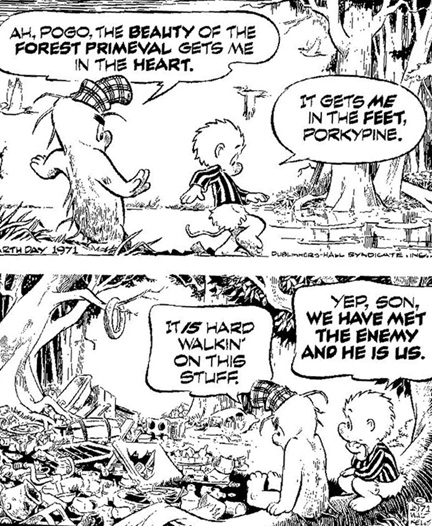
Walt Kelly: “met the enemy, and he is us”

April 23, 2011

Walt Kelly's Pogo cartoon, from Earth Day 1971

Walt Kelly's Pogo daily cartoon strip, from Earth Day 1971

Walt Kelly’s little cartoon possum Pogo turned out to have been a sage observer, and adviser, for much of the 20th century.  This classic cartoon, on the second Earth Day, in 1971, well summarizes the problems of pollution, making historical allusion to that famous message from Master Commandant Oliver Hazard Perry after the Battle of Lake Erie in the War of 1812:  “We have met the enemy and he is us.”

It is a mark of what the internet lacks that I could find just one quick copy of this cartoon on my first search.  All of Kelly’s work should be available, but it’s largely missing from internet searches.  I’m sure this is still under copyright, but I haven’t yet found the information.

_____________

Oh, of course:  The line is too good to have been used just once.  Kelly used the idea for the quote in the forward to a book in the 1950s, and used it on a poster for the first Earth Day.  The famous comic strip followed in 1971.


Pareidolia? No, there’s no link between Earth Day and Lenin

April 23, 2011

This is mostly an encore post — sad that it needs repeating.

You could write it off to pareidolia, once.  Like faces in clouds, some people claimed to see a link.  The first Earth Day, on April 22, 1970, coincided with Lenin’s birthday.  There was no link — Earth Day was scheduled for a spring Wednesday.  Now, years later, with almost-annual repeats of the claim from the braying right wing, it’s just a cruel hoax.

No, there’s no link between Earth Day and the birthday of V. I. Lenin:

One surefire way to tell an Earth Day post is done by an Earth Day denialist: They’ll note that the first Earth Day, on April 22, 1970, was an anniversary of the birth of Lenin.

Coincidentally, yes, Lenin was born on April 22 (new style calendar; it was April 10 on the calendar when he was born — but that’s a digression for another day).

It’s a hoax. There is no meaning to the first Earth Day’s falling on Lenin’s birthday — Lenin was not prescient enough to plan his birthday to fall in the middle of Earth Week, a hundred years before Earth Week was even planned.

My guess is that only a few really wacko conservatives know that April 22 is Lenin’s birthday (was it ever celebrated in the Soviet Union?). No one else bothers to think about it, or say anything about it, nor especially, to celebrate it.

Gaylord Nelson, Living Green image

Inventor of Earth Day teach-ins, former Wisconsin Governor and U.S. Senator Gaylord Nelson

Wisconsin’s U.S. Sen. Gaylord Nelson, usually recognized as the founder and father of Earth Day, told how and why the organizers came to pick April 22:

Senator Nelson chose the date in order to maximize participation on college campuses for what he conceived as an “environmental teach-in.” He determined the week of April 19–25 was the best bet; it did not fall during exams or spring breaks, did not conflict with religious holidays such as Easter or Passover, and was late enough in spring to have decent weather. More students were likely to be in class, and there would be less competition with other mid-week events—so he chose Wednesday, April 22.

In his own words, Nelson spoke of what he was trying to do:

After President Kennedy’s [conservation] tour, I still hoped for some idea that would thrust the environment into the political mainstream. Six years would pass before the idea that became Earth Day occurred to me while on a conservation speaking tour out West in the summer of 1969. At the time, anti-Vietnam War demonstrations, called “teach-ins,” had spread to college campuses all across the nation. Suddenly, the idea occurred to me – why not organize a huge grassroots protest over what was happening to our environment?

I was satisfied that if we could tap into the environmental concerns of the general public and infuse the student anti-war energy into the environmental cause, we could generate a demonstration that would force this issue onto the political agenda. It was a big gamble, but worth a try.

At a conference in Seattle in September 1969, I announced that in the spring of 1970 there would be a nationwide grassroots demonstration on behalf of the environment and invited everyone to participate. The wire services carried the story from coast to coast. The response was electric. It took off like gangbusters. Telegrams, letters, and telephone inquiries poured in from all across the country. The American people finally had a forum to express its concern about what was happening to the land, rivers, lakes, and air – and they did so with spectacular exuberance. For the next four months, two members of my Senate staff, Linda Billings and John Heritage, managed Earth Day affairs out of my Senate office.

Five months before Earth Day, on Sunday, November 30, 1969, The New York Times carried a lengthy article by Gladwin Hill reporting on the astonishing proliferation of environmental events:

“Rising concern about the environmental crisis is sweeping the nation’s campuses with an intensity that may be on its way to eclipsing student discontent over the war in Vietnam…a national day of observance of environmental problems…is being planned for next spring…when a nationwide environmental ‘teach-in’…coordinated from the office of Senator Gaylord Nelson is planned….”

Nelson, a veteran of the U.S. armed services (Okinawa campaign), flag-waving ex-governor of Wisconsin (Sen. Joe McCarthy’s home state, but also the home of Aldo Leopold and birthplace of John Muir), was working to raise America’s consciousness and conscience about environmental issues.

Lenin on the environment? Think of the Aral Sea disaster, the horrible pollution from Soviet mines and mills, and the dreadful record of the Soviet Union on protecting any resource. Lenin believed in exploiting resources, not conservation.

So, why are all these conservative denialists claiming, against history and politics, that Lenin’s birthday has anything to do with Earth Day?

Can you say “propaganda?”

Good information from 2011:

Good information from 2010:

Wall of Lenin’s Birthday Propaganda Shame from 2011:

Wall of Lenin’s Birthday Propaganda Shame from 2010:

Warn people not to be sucked in by the hoax:

Add to FacebookAdd to NewsvineAdd to DiggAdd to Del.icio.usAdd to StumbleuponAdd to RedditAdd to BlinklistAdd to TwitterAdd to TechnoratiAdd to Furl


Only in small towns, where leaders have time to think . . .

April 7, 2011

Years ago when I staffed a U.S. senator’s office, one of my tasks was to look through all the weekly newspapers in the state.    Back then subscriptions were cheap, and most senators would take out a subscription to these weeklies more to flatter the editors and publishers than to read.  We put them to use, first checking to see whether the clipping services were getting all the clips (mostly), and then on a hunch, to see what issues were raging in the state, well below the radar of the big city daily newspapers and broadcast outlets.

You can learn a lot.

Many of those old weekly newspapers are gone, now, victims to local populations that turn over in every recession, and to electronic news gathering services — and to general alienation:  People are not so sure they want to know what their neighbors are up to, these days.  Heck, many people aren’t sure they want to know their neighbors.

My own electronic news gatherers occasionally pull out something to think about from a minor news outlet.  For example, below is an opinion piece out of the Carrboro Citizen from Dan Coleman, a member of the town council in Carrboro, North Carolina.  I gather from the paper it is rather close to Chapel Hill, the home of the University of North Carolina (I haven’t checked a map).

But look at what this guy says.  He questions the wisdom of Adam Smith.  Adam Smith! It appears Coleman wasn’t led astray by all those Adam Smith neckties that were so popular in the Reagan administration.  He questions the true need for profits from corporations, and he wonders if there isn’t a higher duty for a corporation.

How many others like Dan Coleman are there, out there in America, relatively sane on all other accounts, and thinking?

How many bottom lines do we really need?

April 7, 2011 | Posted in: Opinion | 0 Responses

By Dan Coleman

Did you know that Carrboro’s Town Code incorporates a principle devised by Shell Oil? That’s right, the same Shell Oil that has been accused of human rights violations in Nigeria, including summary execution, crimes against humanity, torture, inhumane treatment and ­collaborating in the execution of Nigerian activist Ken Saro-Wiwa. The same Shell Oil that has despoiled the Niger delta and was responsible for the largest freshwater oil spill ever.

With a record like this, it is little wonder that Shell came up with one of the corporate world’s more effective public relations concepts of recent years: the Triple Bottom Line (TBL), also known as People, Planet, Profit. It’s as if Shell was saying, sure you can criticize our environmental and humanitarian record but don’t forget, we have to make a profit.

Efforts to value people have dogged profiteering for over a century. The late 19th and early-to-mid-20th centuries were marked by many thousands of strikes by workers, more than 1,400 in the year 1886 alone. Many of these were met by violent strikebreakers backed up at times by military force. This is a struggle that continues in 2011 in Wisconsin and other states.

William Blake, Biography Online

William Blake

Through the efforts of these men and women, much of value was created: the weekend, workplace-safety standards, health care for workers, vacation and sick leave, etc. And each of these was wrested from the one bottom line that corporate America really cares about.

Despite William Blake offering the image of “dark satanic mills” as far back as 1804, the environmental impacts of industrial capitalism began to be understood with Rachel Carson’s 1962 publication of The Silent Spring. Within a decade, there was Earth Day, the Environmental Protection Agency, the Clean Water Act and much more, each a challenge to the profit-focused priorities of capital.

Given the pre-eminent importance of profit-maximization, it is not surprising that corporations touting the Triple Bottom Line often oppose measures to combat global warming, oppose workers’ rights and oppose regulatory mechanisms to protect the health of people and planet.

History has taught us that Adam Smith was wrong when he offered the justification for prioritizing profit that “by pursuing his own interest [the businessman] frequently promotes that of the society more effectually than when he really intends to promote it.” If Smith were correct, companies like Shell would not have such a devastating impact on society and nature. In part, this impact results from profit being measured in a short timeframe, a year or even a quarter of a year, while sustainability requires a vision spanning, as the Iroquois put it, as much as seven generations.

But Smith was right that profit ought to serve human well-being. Therefore, it must be understood within an ethical system that places people and planet first. This holds true for the vague term “stakeholder value” that some, including Carrboro, use instead of profit. Who are the stakeholders if not people and planet?
The TBL offers nothing to help us navigate the inevitable contradictions between profit on the one hand and people/planet on the other. But, really, why should we have any social or political bottom lines at all?

It was social ecologist Murray Bookchin who bemoaned the cultural turn to the “grubby language” of the market economy, which has “replaced our most hallowed moral and spiritual expressions. We now ‘invest’ in our children, marriages, and relationships. … We live in a world of ‘trade-offs’ and we ask for the ‘bottom line’ of any emotional ‘transaction.’”

There are a variety of frameworks that speak to a more fundamental commitment to the well-being of all life. In an 1854 speech, Chief Seattle offered the notion of a web of life: “Humankind has not woven the web of life. We are but one thread within it. Whatever we do to the web, we do to ourselves.”

Aldo Leopold, in Arizona

Aldo Leopold, in Arizona, Arizona State Parks image

A century after Chief Seattle, Aldo Leopold articulated his land ethic in Sand County Almanac, “A thing is right when it tends to preserve the integrity, stability and beauty of the biotic community. It is wrong when it tends otherwise.” The biotic community, of course, includes humans.

We need the ability to truly place people and planet first and to reject the false, self-serving homilies offered by those who spread pavement and poverty in pursuit of the almighty dollar. Rather than seek simplistic nostrums, we may have to take the time to look hard at each decision, and bring a clear ethical sensibility, like that of Seattle or Leopold, to bear.

Dan Coleman is a member of the Carrboro Board of Aldermen.

Coleman may want to check the provenance of the Chief Seattle quote — but the thought is solid.

What do you think?