June 22, 2010
Remember the Institute for Creation Research?

Institute for Creation Research offices in Texas
This hoary old fundamentalist institution moved from California to Texas, hoping to take advantage of the generally fundie-friendly environment, and continue a practice of granting masters and doctorate degrees in science education to people who would get jobs in schools and teach creationism instead. They had achieved that goal in California with a lawsuit the state regulators rather botched, and by setting up a special accreditation association that would give a pass to the teaching of non-science.
But when they got to Texas, the Texas Higher Education Coordinating Board (THECB) had a couple of alert people who blew the whistle on the process of getting a permit to grant degrees. Real scientists and science educators were brought in to evaluate ICR’s programs. They said the programs were not scientific and do not deserve to be accredited.
THECB stuck to the rules. ICR threatened a lawsuit. THECB stood fast.
ICR sued.
And then God intervened. At God’s instructions ICR filed legal papers so bizarre that they would, by themselves, expose ICR as a wacko group. ICR’s loss came on the merits of their case, which were nil — it was summary judgment against ICR. Summary judgment means that, even with all the evidence decided in favor of the losing party, that party loses on the basis of the law.
The court took note of just how bizarre were the papers ICR filed. Frosting on the cake of embarrassment.
Judge Sam Sparks, in the U.S. District Court for the Western District of Texas, Austin Division, stopped short of admonishing ICR for the briefs, and instead sifted the briefs to find judiciable claims — an act that will probably prevent ICR from getting a friendly hearing in any appeal. Sparks wrote:
Having addressed this primary issue, the Court will proceed to address each of ICRGS’s causes of action in turn, to the extent it is able to understand them. It appears that although the Court has twice required Plaintiff to re-plead and set forth a short and plain statement of the relief requested, Plaintiff is entirely unable to file a complaint which is not overly verbose, disjointed, incoherent, maundering, and full of irrelevant information.
Whom God destroys, He first makes mad.
Sparks ruled ICR has no free exercise right to grant non-science degrees, no free speech right, and no due process claim to grant them, either. ICR lost on every count of their complaint.
More:
_______________

From Babble.com (Do you know who is the cartoonist?)
Spread the word; friends don't allow friends to repeat history.
 4 Comments |
  Creationism, Education, Evolution, Higher education, Jurisprudence, Law, Science, Texas, Texas Citizens for Science | Tagged: Creationism, Education, Evolution, First Amendment, Higher education, Institute for Creation Research, Jurisprudence, Law, Science, Texas, Texas Higher Education Coordinating Board |
  Permalink
 Posted by Ed Darrell
June 14, 2010
Historic irony: On Flag Day in 1943, the U.S. Supreme Court issued its decision in the case of West Virginia vs. Barnette.

Image 1 - Billy Gobitas explained why he would not salute the U.S. flag, November 5, 1935 - Library of Congress collection
The case started earlier, in 1935, when a 10-year-old student in West Virginia, sticking to his Jehovah’s Witness principles, refused to salute the U.S. flag in a state-required pledge of allegiance. From the Library of Congress:
“I do not salute the flag because I have promised to do the will of God,” wrote ten-year-old Billy Gobitas (1925-1989) to the Minersville, Pennsylvania, school board in 1935. His refusal, and that of his sister Lillian (age twelve), touched off one of several constitutional legal cases delineating the tension between the state’s authority to require respect for national symbols and an individual’s right to freedom of speech and religion.
The Gobitas children attended a public school which, as did most public schools at that time, required all students to salute and pledge allegiance to the flag of the United States. The Gobitas children were members of the Jehovah’s Witnesses, a church that in 1935 believed that the ceremonial saluting of a national flag was a form of idolatry, a violation of the commandment in Exodus 20:4-6 that “thou shalt not make unto thee any graven image, nor bow down to them. . . .” and forbidden as well by John 5:21 and Matthew 22:21. On 22 October 1935, Billy Gobitas acted on this belief and refused to participate in the daily flag and pledge ceremony. The next day Lillian Gobitas did the same. In this letter Billy Gobitas in his own hand explained his reasons to the school board, but on 6 November 1935, the directors of the Minersville School District voted to expel the two children for insubordination.
The Watch Tower Society of the Jehovah’s Witnesses sued on behalf of the children. The decisions of both the United States district court and court of appeals was in favor of the right of the children to refuse to salute. But in 1940 the United States Supreme Court by an eight-to-one vote reversed these lower court decisions and ruled that the government had the authority to compel respect for the flag as a key symbol of national unity. Minersville v. Gobitis [a printer’s error has enshrined a misspelling of the Gobitas name in legal records] was not, however, the last legal word on the subject. In 1943 the Supreme Court by a six-to-three vote in West Virginia State Board of Education v. Barnette, another case involving the Jehovah’s Witnesses, reconsidered its decision in Gobitis and held that the right of free speech guaranteed in the First Amendment to the Constitution denies the government the authority to compel the saluting of the American flag or the recitation of the pledge of allegiance.
There had been strong public reaction against the Gobitis decision, which had been written by Justice Felix Frankfurter (1882-1965). In the court term immediately following the decision, Frankfurter noted in his scrapbook that Justice William O. Douglas (1898-1980) told him that Justice Hugo LaFayette Black (1886-1971) had changed his mind about the Gobitis case. Frankfurter asked, “Has Hugo been re-reading the Constitution during the summer?” Douglas replied, “No–he has been reading the papers.”1 The Library’s William Gobitas Papers showcase the perspective of a litigant, whereas the abstract legal considerations raised by Gobitis and other cases are represented in the papers of numerous Supreme Court justices held by the Manuscript Division.
1. Quoted in H. N. Hirsch, The Enigma of Felix Frankfurter (New York: Basic Books, 1981), 152.
John E. Haynes and David Wigdor, Manuscript Division

Second page, Billy Gobitas's explanation of why he will not salute the U.S. flag: "I do not salute the flag not because I do not love my country but I love my country and I love God more and I must obey His commandments." - Library of Congress
Supreme Court justices do not often get a chance to reconsider their decisions. For example, overturning Plessy vs. Ferguson from 1896 took until 1954 in Brown v. Topeka Board of Education. In the flag salute/pledge of allegiance cases Justice Hugo Black had a change of mind, and when a similar case from West Virginia fell on the Court’s doorstep in 1943, the earlier Gobitis decision was reversed.
Writing for the majority, Justice Robert H. Jackson said:
If there is any fixed star in our constitutional constellation, it is that no official, high or petty, can prescribe what shall be orthodox in politics, nationalism, religion, or other matters of opinion, or force citizens to confess by word or act their faith therein. If there are any circumstances which permit an exception, they do not now occur to us.
Jehovah’s Witnesses, and all other Americans, thereby have the right to refuse to say what they and their faith consider to be a vain oath.
And that, boys and girls, is what the First Amendment means.
Resources:
Spread the word; friends don't allow friends to repeat history.
3 Comments | DBQ sources, First Amendment, Flag etiquette, Historic documents, History, Patriotism, Religion, Religious Freedom | Tagged: Advanced Placement, Constitutional Law, DBQ sources, First Amendment, flag, Flag etiquette, History, U.S. Constitution | Permalink
Posted by Ed Darrell
June 3, 2010
August 17, 1790, found U.S. President George Washington traveling the country, in Newport, Rhode Island.
Washington met with “the Hebrew Congregation” (Jewish group), and congregation leader (Rabbi?) Moses Seixas presented Washington with an address extolling Washington’s virtues, and the virtues of the new nation. Seixas noted past persecutions of Jews, and signalled a hopeful note:
Deprived as we heretofore have been of the invaluable rights of free citizens, we now (with a deep sense of gratitude to the Almighty disposer of all events) behold a government erected by the Majesty of the People–a Government which to bigotry gives no sanction, to persecution no assistance, but generously affording to All liberty of conscience and immunities of Citizenship, deeming every one, of whatever Nation, tongue, or language, equal parts of the great governmental machine.

George Washington's reply to the Newport, RI, "Hebrew congregation," August 17, 1790 - Library of Congress image
President Washington responded with what may be regarded as his most powerful statement in support of religious freedom in the U.S. — and this was prior to the ratification of the First Amendment:
It is now no more that toleration is spoken of as if it was the indulgence of one class of people that another enjoyed the exercise of their inherent natural rights. For happily, the government of the United States, which gives to bigotry no sanction, to persecution no assistance, requires only that they who live under its protection should demean themselves as good citizens, in giving it on all occasions their effectual support.
Below the fold, more history of the events and religious freedom, from the Library of Congress.
Read the rest of this entry »
Spread the word; friends don't allow friends to repeat history.
3 Comments | First Amendment, George Washington, Historic documents, History, Religion, Religious Freedom, Separation of church and state | Tagged: Famous quotes, First Amendment, George Washington, Historic documents, History, Quotes, Religious Freedom | Permalink
Posted by Ed Darrell
May 29, 2010
Religious terrorists kidnapped the First Amendment while it was visiting Meadville, Mississippi, last week.
Local resident’s expressed support for the kidnappers.
The teacher whose job was on the block for leading prayers in violation of federal law protecting students from school-imposed religion, was hired back on a technicality: There was no formal, written warning to her that leading prayers is against the law (though it’s in every teacher training program).
The teacher, Alice Hawley, promised to continue to lead prayers in class, in violation of the law.
The newspaper did not ask whether she will follow any laws in her classroom.
On the other hand, one might take some hope that a teacher who flagrantly flouts the law in this case makes the path clear for Texas teachers to flout the standards voted in by the Texas State Soviet of Education, who would nominally be colleagues-in-crucifying to Ms. Hawley. If you can’t fire a teacher for violating the Constitution and rulings of the U.S. Supreme Court, certainly you can’t fire a teacher for teaching history instead of Don McLeroy’s claim that the U.S. Constitution says the federal government can dictate religion to us.
Mississippi: Fighting for its ranking among U.S. states, in educational achievement. (Last place)
Spread the word; friends don't allow friends to repeat history.
2 Comments | Classroom management, First Amendment, Politics, Rampant stupidity, Religion, Religious Freedom, Separation of church and state, Teachers, Teaching, U.S. Constitution | Tagged: Classroom Prayer, Education, First Amendment, Mississippi, Politics, Separation of church and state, U.S. Constitution | Permalink
Posted by Ed Darrell
May 26, 2010
What devilry gets into a tiny few teachers to make them think they alone are immune from the First Amendment?
In a public classroom, teachers are the government. They may not lead prayers, not even if all the students consent.
Down in Meadville, Mississippi, a Franklin County High School teacher, Alice Hawley, lost her teaching contract because she led daily prayers in her classes.
She agreed to stop the illegal practice, and has been invited back.
I understand fans on Facebook have come unglued. I haven’t found that link.
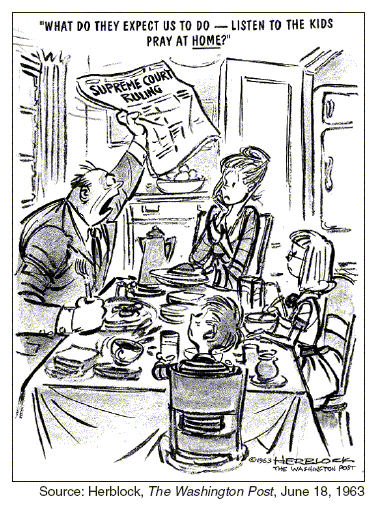
Probably still under copyright - Herblock in the Washington Post, June 18, 1963 (school prayer)
Spread the word; friends don't allow friends to repeat history.
35 Comments | First Amendment, History, School prayer, Teachers, Teaching, U.S. Constitution | Tagged: Classroom Prayer, First Amendment, Freedom of Religion, Law, Religion, School prayer, Teaching, U.S. Constitution | Permalink
Posted by Ed Darrell
May 21, 2010
Or, should that be “Texas State Soviet of Education?”
Steve Schafersman (of Texas Citizens for Science fame) is live blogging for the Texas Observer, here.
Texas Freedom Network blogs it here.
Did I forget to mention that earlier?
More:
Spread the word; friends don't allow friends to repeat history.
2 Comments | Economics, Education, Education reform, History, Social Studies, State school boards, Texas, Texas Citizens for Science, Texas Freedom Network | Tagged: Economics, Education, education standards, First Amendment, Freedom of Religion, History, Social Studies, Texas, Texas Citizens for Science, Texas Freedom Network, Texas State Board of Education, Texas Taliban | Permalink
Posted by Ed Darrell
March 14, 2010
James Madison joined the world on March 16, 1751. Tuesday is the 259th anniversary of his birth.
James Madison University, appropriately, made hoopla during the whole week in 2009. What about this year?
Exhibit: Creating the United States”

David Edwin (1776–1841). James Madison, President of the United States. Engraving after painting by Thomas Sully. Philadelphia: W.H. Morgan, ca.1809–1817. Prints and Photographs Division, Library of Congress (107.01.00)
The Culpepper, Virginia, Star-Exponent, said there will be celebrations at Montpelier, Madison’s mountaintop home a short distance from Charlottesville.
James Madison’s Orange County home offers free admission all day Tuesday in honor of the fourth president’s 259th birthday.
Born 1751 at Port Conway in King George while on a visit to his grandmother, Madison was raised at Montpelier, the oldest of 12 children. He is buried on the grounds of his lifelong home in the family cemetery, site of a special ceremony in honor of his birthday March 16 at 1:30 p.m.
Former Deputy Secretary of Education Eugene Hickock will deliver remarks at the cemetery along with Quantico Marine Corps Base Chief of Staff Col. Thompson Gerke, who will lay a wreath on the fourth president’s grave on behalf of President Barack Obama. Numerous other groups will also honor Madison by placing wreaths on his grave Tuesday.
The U.S. Marine Corps has a long-standing tradition of attending the annual birthday ceremony because of Madison’s connection to the naval force’s founding. As Secretary of State under Thomas Jefferson, Madison recommended sending a squadron of naval ships to fight pirates off the coast of Africa, ultimately leading to their demise by 1805.
As president, Madison again called on the Marines to lead the nation during the War of 1812.
Nice of the Marines to show. Nice of President Obama to send a wreath. Maybe we can understand why Republicans wish to avoid any celebration of Madison.
Resources:
- Calendar of events from Montpelier
- Information about the celebration from the State of Virginia travel office; “Montpelier is the lifelong home of James Madison, Father of the Constitution, architect of the Bill of Rights, and president of the United States. Now that the home’s recent $25 million architectural restoration is complete, visitors can see the progress of “A Presidential Detective Story: Rediscovering the Furnishings and Décor of James and Dolley Madison” through daily guided tours. They can also participate in hands-on activities, and archaeology; stroll the grounds; and take in the many galleries and other attractions on the 2,650-acre estate. To learn more, visit http://www.montpelier.org. Date/Hours: Tuesday, March 16, 2010 (9:00 AM-4:00 PM”
- Steven Waldman’s lament in the Wall Street Journal last year about the lack of respect Madison gets; Waldman overstates Madison’s role in religious freedom barely. Waldman’s right. We should pay more attention to Madison.
- Millard Fillmore’s Bathtub post from last year, featuring the National Guard’s poster honoring National Guardsman Col. James Madison of the Virginia Militia
- My essay on the importance of Madison in America’s founding, “James Madison: Go-to Guy”
- More from the Bathtub: “Meet James Madison”
- MFB post with links to Founders Online
- The Newseum and the First Amendment Center celebrate the 12th annual Freedom of Information Day on March 15, at the Newseum in Washington, D.C.; seminar from 8:30 a.m. to 12:15 p.m.; “What has become of Freedom of Information?”
Spread the word; friends don't allow friends to repeat history.
1 Comment | Bill of Rights, First Amendment, Heroes, History, Human Rights, Icons of history, James Madison, Presidents, Religious Freedom, U.S. Constitution | Tagged: Bill of Rights, Father of the Constitution, First Amendment, founders, History, James Madison, James Madison's Birthday, March 16, Religious Freedom, U.S. Constitution | Permalink
Posted by Ed Darrell
January 11, 2010
Here is a news rundown of stories on the Texas State Board of Education, who have been planning for a year now to mess up social studies standards for Texas public schools, this week.
- Fort Worth Star-Telegram, lots of “strong views” expected at Wednesday’s hearing
- Austin American-Statesman details part of the trouble: Officials at the SBOE have hired a couple of radical religious historical revisionists, David Barton and Peter Marshall, and ignored educators, historians and economists in revising the standards; both are ministers with a history of conflict with historians and educators. Both have called for emphasis on their Christian sects’ beliefs in history classes.
- In an opposite-editorial piece in the Houston Chronicle, Karen Nicholson, the president of the non-partisan Texas League of Women Voters, warns that Texas children will suffer under some of the proposed changes, falling behind students in other states.
- In the San Antonio Express, Veronica Flores-Paniagua argues that Texas’s large Hispanic population has been ignored by the SBOE, and that all Texas kids stand to lose on the current trajectory
- Dallas Morning News story on the power of conservatives at the SBOE, and coming elections
- Victoria (Texas) Advocate story saying LULAC thinks Hispanics are slighted in history standards
- Almost off topic: San Antonio Express story on wheelchair-bound kid, Jonathan Stach, who is not allowed to take advanced physics courses by bizarre state standards interpretation
- David Nalle at Blog Critics
- Texas Tribune note on Don McLeroy
- Washington Monthly feature article on the assault on social studies standards by the Texas SBOE
- Texas Education Agency post on the agenda for Wednesday’s SBOE meeting
Get on your horse and warn Texans: The Idiots are coming to get your good schoolbooks:


Spread the word; friends don't allow friends to repeat history.
5 Comments | Capitalism, Economics, Free market economics, Geography - Economic, Geography - Physical, Geography - Political, History, History Revisionism, Social Studies, State school boards, Texas, Texas Citizens for Science, Texas Education Agency (TEA), Texas Freedom Network, Texas history, Textbook Selection, Textbooks | Tagged: Economics, Education, First Amendment, geography, History, Politics, Religion, Separation of church and state, Social Studies Standards, state board of education, Texas | Permalink
Posted by Ed Darrell
October 7, 2009
As expected, people are finding historical and other errors in David Barton’s critique of the Texas social studies standards.
I noted this in a comment at Texas Freedom Network’s blog, The Insider:
This isn’t exactly an error, but it creeps me out. Barton goes on at length about incorporating the views of a scholar of economics — but he never names the guy, and Barton seems overly affected and concerned about the guy’s residence and Jewishness.
See the section of Barton’s report talking about free enterprise (page 7). The real experts, the social studies teachers and professors whose work the Board appears to have rejected, suggested bringing the economic discussion into the 21st century and use “capitalism” instead of “free enterprise.” This would make the Texas curriculum correlate with the studies in the area done by social scientists, especially economists, and more accurately and precisely describe the system.
That is one reason given for rejecting their work, that the Board doesn’t want to mention capitalism. They don’t want to call capitalism by the name economists use.
But look at Barton’s suggestion. He veers off on a tangent about ethics in capitalism — I would venture that Barton never took any economics courses he can remember, and he’s never read Adam Smith, judging from the nature of his complaint (ethics is very much a discussion in economics). But it just gets weird. He refers to a paper, without citation, by a “Jewish economist” in the “Pacific Northwest.”
Barton doesn’t name the paper. He doesn’t say where it was published, nor offer any other citation by which it might be tracked down. Most creepily, he keeps referring to the “Jewish economist” as if his faith or ethnic background has any relevance, without ever naming the guy.
That isn’t scholarship. He almost makes a good point, but any valuable point is completely overcome by the bigoted lack of scholarship, the mere convention of naming the author of the paper and offering a citation.
Expert? No, certainly not in manifestation. That’s just creepy.
Here is the section I’m talking about:
Comment D: Free-Enterprise & Capitalism
Throughout the TEKS, the term “free enterprise” has been followed by the parenthetical “(free market, capitalism)”.By including the terms capitalism and free-market as synonyms for free-enterprise, perhaps it is now time to consider the merits of an observation concerning capitalism raised by a Jewish economist in the Pacific Northwest.
In previous generations, capitalism and the free-market system was universally operated on the unstated but unanimously assumed foundation of general societal virtue – there was a general set of assumed values and ethics that remained at the basis of transactions.
For example, to this day we assume that when a waiter brings us a glass of water that he did not spit in it before he delivered it to us. We assume that when we get the oil in our car changed that the mechanic actually changed the oil rather than just put a new sticker on the windshield. We make many Golden Rule type assumptions in the operation of the free-market system of capitalism.
When these general societal principles of ethics and morality are observed, the Free Enterprise System works as it should; but when these principles are ignored, the FreeEnterprise System breaks down and produces Bernie Madoff, Kenneth Lay, Jeffrey Skilling, Dennis Kozlowski, John Rigas, Joe Nacchio, Gregory Reyes, James McDermott, Sam Waskal, Sam Israel, Bernie Ebbers, and many others recently convicted of fraud, theft, corruption, and other white collar crimes that bilked clients of billions of dollars. The traditional Free Market System will not operate properly if the guiding premise is the egocentric Machiavellian principle that the end justifies the means.
We are now at a point in our history where we can no longer assume that the previously universally understood ethical basis of the Free Enterprise System will still be observed, understood, or embraced. Therefore, the Jewish economist in the Pacific Northwest has proffered that rather than using “Capitalism,” we instead begin using the term “Ethical Capitalism,” for it captures the historical import of the system and identifies an underlying principle without which the free-enterprise system will not work.
Therefore, I recommend that when we have the phrase “free enterprise (free market, capitalism)” that we instead consider using “free enterprise (free market, ethical capitalism).” It is an accurate recognition of what is one of the unspoken but indispensable elements of the free enterprise system. This change also reinforces the long-standing premise of political philosophers across the centuries that the continuation of a republic is predicated upon an educated and a virtuous citizenry.
Who is he talking about? What is he talking about?
More information:
- Steve Schaffersman, the intrepid force behind Texas Citizens for Science, has a longer exposé of Barton’s odd claims and work to frustrate accurate history in Texas at Schaffersman’s Houston Chronicle hosted blog, EvoSphere. It’s well worth the read, just to see how intricately bizarre and erroneous Barton can be about simple facts of history, and how Barton chooses to misinterpret the Constitution, especially the First Amendment, and how he exaggerates little facts of history into gross distortions of the American story. I regret I failed to note this article here, in the first edition.
- Hey, also check out Steve’s other posts on the most recent SBOE meetings, here, and here.
Spread the word; friends don't allow friends to repeat history.
5 Comments | Economics, Education, Education assessment, First Amendment, History, Politics, Texas, U.S. Constitution | Tagged: Constitution, David Barton, Economics, Education, First Amendment, History, Social Studies, Texas State Board of Education | Permalink
Posted by Ed Darrell
August 30, 2009
Family funerals combine bitter and sweet. A long life well-lived, the grief over loss, getting together with family and friends from eight decades — and then it’s back to work in a jolt.
Trying to stay caught up:
Outrageous insult to Darwin and Constitution in Missouri: Were the parents concerned about the quality of the brass section in the band, or did they really object to a humorous depiction of “the evolution of brass” in 2009, the bicentennial of Darwin’s birth?
They deserve to have their brasses kicked, but the innocent kids don’t.
P. Z. Myers caught the grossest tragedy:
Band parent Sherry Melby, who is a teacher in the district, stands behind Pollitt’s decision. Melby said she associated the image on the T-shirt with Charles Darwin’s theory of evolution.
“I was disappointed with the image on the shirt.” Melby said. “I don’t think evolution should be associated with our school.”
She doesn’t want her school associated with evolution? How about associating the school with the Taliban of Afghanistan? How about associating her school with Homer Simpson’s stupider brother? How about associating her school with backwards thinking, 16th century bad science? How about associating her school with the St. Bartholomew’s Day Massacre and the sort of stupidity that leads religiously-based violence?
Ray Mummert probably got the call to help Sedalia out, and he’s organizing to fight the forces of smart and intelligent people. Comments from residents of Sedalia are shocking in their lack of information, and depressing.
Kids, pay attention in science class: A proud science teacher in Minnesota, and probably some proud parents, too. Tip of the old scrub brush to Pharyngula on this one.
Anybody who complains about this deserves to get their tail kicked with Tom Delay and every Republican who redistricted Texas last time around. (Sen. Ted Kennedy suggested the Massachusetts legislature should allow the governor to appoint a temporary replacement to represent the state in the U.S. Senate in the event of a vacancy, until a special election can be held.)
First Amendment wins again: Kentucky had a law that said the state could be safe from al Quaeda attack only by the grace of God. A judge, noting that it will take a lot of work by a lot of dedicated Kentuckians who deserve credit, and that it’s illegal to make such a claim in law, overturned the law.
Private insurance failed this woman; Medicare would pay for the treatment under some circumstances, but there is no lie opponents to health care reform won’t tell in order to scare people away from the facts. They claim the woman couldn’t be treated under government care, but Medicare pays for the expensive drug in question. Can’t they at least tell the truth?
This is getting depressing. I’m going to go look at mountains.
Spread the word; friends don't allow friends to repeat history.
Leave a Comment » | Death Panels, Education, Religion, Science, Science and faith, Separation of church and state | Tagged: Education, Evolution, First Amendment, H.R. 3200, Health care, Homeland Security, Medicare, Science, Separation of church and state | Permalink
Posted by Ed Darrell
August 19, 2009
Leave a Comment » | Creationism, Darwin, Education, Evolution, Freedom - Political, Intelligent Design, Religious Freedom, Science, Separation of church and state, Teaching, Texas, War on Education, War on Science | Tagged: ACLU, Creationism, Education, Evolution, First Amendment, Intelligent Design, Religion, Science, Separation of church and state, Texas | Permalink
Posted by Ed Darrell
August 17, 2009
August 17, 1790, found U.S. President George Washington traveling the country, in Newport, Rhode Island.
Washington met with “the Hebrew Congregation” (Jewish group), and congregation leader (Rabbi?) Moses Seixas presented Washington with an address extolling Washington’s virtues, and the virtues of the new nation. Seixas noted past persecutions of Jews, and signalled a hopeful note:
Deprived as we heretofore have been of the invaluable rights of free citizens, we now (with a deep sense of gratitude to the Almighty disposer of all events) behold a government erected by the Majesty of the People–a Government which to bigotry gives no sanction, to persecution no assistance, but generously affording to All liberty of conscience and immunities of Citizenship, deeming every one, of whatever Nation, tongue, or language, equal parts of the great governmental machine.
George Washington's reply to the Newport, RI, "Hebrew congregation," August 17, 1790 - Library of Congress image
President Washington responded with what may be regarded as his most powerful statement in support of religious freedom in the U.S. — and this was prior to the ratification of the First Amendment:
It is now no more that toleration is spoken of as if it was the indulgence of one class of people that another enjoyed the exercise of their inherent natural rights. For happily, the government of the United States, which gives to bigotry no sanction, to persecution no assistance, requires only that they who live under its protection should demean themselves as good citizens, in giving it on all occasions their effectual support.
Below the fold, more history of the events and religious freedom, from the Library of Congress.
Read the rest of this entry »
Spread the word; friends don't allow friends to repeat history.
6 Comments | Famous quotes, First Amendment, Freedom - Political, George Washington, Historic documents, History, Religion, Religious Freedom, Separation of church and state, U.S. Constitution | Tagged: August 17 1790, First Amendment, George Washington, History, Liberty, Quotes, Religious Freedom, U.S. Constitution | Permalink
Posted by Ed Darrell
July 31, 2009
Science-based Medicine carried this article yesterday, and several other blogs have joined in. Below is the article Simon Singh wrote for which he is being sued for libel by the professional association for British chiropractors. It’s a good cause, so I’ll stretch it another little while.
Science-based Medicine introduced the article with this:
Last year Simon Singh wrote a piece for the Guardian that was critical of the modern practice of chiropractic. The core of his complaint was that chiropractors provide services and make claims that are not adequately backed by evidence – they are not evidence-based practitioners. In response to his criticism the British Chiropractic Association (BCA) sued Simon personally for libel. They refused offers to publish a rebuttal to his criticism, or to provide the evidence Simon said was lacking. After they were further criticized for this, the BCA eventually produced an anemic list of studies purported to support the questionable treatments, but really just demonstrating the truth of Simon’s criticism (as I discuss at length here).
In England suing for libel is an effective strategy for silencing critics. The burden of proof is on the one accused (guilty until proven innnocent) and the costs are ruinous. Simon has persisted, however, at great personal expense.
This is an issue of vital importance to science-based medicine. A very necessary feature of science is public debate and criticism – absolute transparency.This is also not an isolated incident. Some in the alternative medicine community are attempting to assert that criticism is unprofessional, and they have used accusations of both unprofessionalism and libel as a method of silencing criticism of their claims and practices. This has happened to David Colquhoun and Ben Goldacre, and others less prominent but who have communicated to me directly attempts at silencing their criticism.
This behavior is intolerable and is itself unprofessional, an assault on academic freedom and free speech, and anathema to science as science is dependent upon open and vigorous critical debate.
What those who will attempt to silence their critics through this type of bullying must understand is that such attempts will only result in the magnification of the criticism by several orders of magnitude. That is why we are reproducing Simon Singh’s original article (with a couple of minor alterations) on this site and many others. Enjoy.
Here it is:
Beware the spinal trap
Some practitioners claim it is a cure-all but research suggests chiropractic therapy can be lethal
Simon Singh
The Guardian, Original version published Saturday April 19 2008
Edited version published July 29, 2009
You might be surprised to know that the founder of chiropractic therapy, Daniel David Palmer, wrote that “99% of all diseases are caused by displaced vertebrae”. In the 1860s, Palmer began to develop his theory that the spine was involved in almost every illness because the spinal cord connects the brain to the rest of the body. Therefore any misalignment could cause a problem in distant parts of the body.
In fact, Palmer’s first chiropractic intervention supposedly cured a man who had been profoundly deaf for 17 years. His second treatment was equally strange, because he claimed that he treated a patient with heart trouble by correcting a displaced vertebra.
You might think that modern chiropractors restrict themselves to treating back problems, but in fact some still possess quite wacky ideas. The fundamentalists argue that they can cure anything, including helping treat children with colic, sleeping and feeding problems, frequent ear infections, asthma and prolonged crying – even though there is not a jot of evidence.
I can confidently label these assertions as utter nonsense because I have co-authored a book about alternative medicine with the world’s first professor of complementary medicine, Edzard Ernst. He learned chiropractic techniques himself and used them as a doctor. This is when he began to see the need for some critical evaluation. Among other projects, he examined the evidence from 70 trials exploring the benefits of chiropractic therapy in conditions unrelated to the back. He found no evidence to suggest that chiropractors could treat any such conditions.
But what about chiropractic in the context of treating back problems? Manipulating the spine can cure some problems, but results are mixed. To be fair, conventional approaches, such as physiotherapy, also struggle to treat back problems with any consistency. Nevertheless, conventional therapy is still preferable because of the serious dangers associated with chiropractic.
In 2001, a systematic review of five studies revealed that roughly half of all chiropractic patients experience temporary adverse effects, such as pain, numbness, stiffness, dizziness and headaches. These are relatively minor effects, but the frequency is very high, and this has to be weighed against the limited benefit offered by chiropractors.
More worryingly, the hallmark technique of the chiropractor, known as high-velocity, low-amplitude thrust, carries much more significant risks. This involves pushing joints beyond their natural range of motion by applying a short, sharp force. Although this is a safe procedure for most patients, others can suffer dislocations and fractures.
Worse still, manipulation of the neck can damage the vertebral arteries, which supply blood to the brain. So-called vertebral dissection can ultimately cut off the blood supply, which in turn can lead to a stroke and even death. Because there is usually a delay between the vertebral dissection and the blockage of blood to the brain, the link between chiropractic and strokes went unnoticed for many years. Recently, however, it has been possible to identify cases where spinal manipulation has certainly been the cause of vertebral dissection.
Laurie Mathiason was a 20-year-old Canadian waitress who visited a chiropractor 21 times between 1997 and 1998 to relieve her low-back pain. On her penultimate visit she complained of stiffness in her neck. That evening she began dropping plates at the restaurant, so she returned to the chiropractor. As the chiropractor manipulated her neck, Mathiason began to cry, her eyes started to roll, she foamed at the mouth and her body began to convulse. She was rushed to hospital, slipped into a coma and died three days later. At the inquest, the coroner declared: “Laurie died of a ruptured vertebral artery, which occurred in association with a chiropractic manipulation of the neck.”
This case is not unique. In Canada alone there have been several other women who have died after receiving chiropractic therapy, and Edzard Ernst has identified about 700 cases of serious complications among the medical literature. This should be a major concern for health officials, particularly as under-reporting will mean that the actual number of cases is much higher.
If spinal manipulation were a drug with such serious adverse effects and so little demonstrable benefit, then it would almost certainly have been taken off the market.
—
Simon Singh is a science writer in London and the co-author, with Edzard Ernst, of Trick or Treatment? Alternative Medicine on Trial. This is an edited version of an article published in The Guardian for which Singh is being personally sued for libel by the British Chiropractic Association.
Other venues:
Related material:
Spread the word; friends don't allow friends to repeat history.
2 Comments | Academic freedom, Accuracy, First Amendment, Free press, Free speech, Freedom of the Press, Health care, History, Journalism, Junk science, Jurisprudence, Justice, knowledge, Law, medicine, Science, Weblogs, Woo | Tagged: British Chiropractic Association, British Law, Chiropractic, First Amendment, Free press, Free speech, Journalism, Junk science, libel, Science, Voodoo science, Woo | Permalink
Posted by Ed Darrell
June 14, 2009
Historic irony: On Flag Day in 1943, the U.S. Supreme Court issued its decision in the case of West Virginia vs. Barnette.
Image 1 - Billy Gobitas explained why he would not salute the U.S. flag, November 5, 1935 - Library of Congress collection
The case started earlier, in 1935, when a 10-year-old student in West Virginia, sticking to his Jehovah’s Witness principles, refused to salute the U.S. flag in a state-required pledge of allegiance. From the Library of Congress:
“I do not salute the flag because I have promised to do the will of God,” wrote ten-year-old Billy Gobitas (1925-1989) to the Minersville, Pennsylvania, school board in 1935. His refusal, and that of his sister Lillian (age twelve), touched off one of several constitutional legal cases delineating the tension between the state’s authority to require respect for national symbols and an individual’s right to freedom of speech and religion.
The Gobitas children attended a public school which, as did most public schools at that time, required all students to salute and pledge allegiance to the flag of the United States. The Gobitas children were members of the Jehovah’s Witnesses, a church that in 1935 believed that the ceremonial saluting of a national flag was a form of idolatry, a violation of the commandment in Exodus 20:4-6 that “thou shalt not make unto thee any graven image, nor bow down to them. . . .” and forbidden as well by John 5:21 and Matthew 22:21. On 22 October 1935, Billy Gobitas acted on this belief and refused to participate in the daily flag and pledge ceremony. The next day Lillian Gobitas did the same. In this letter Billy Gobitas in his own hand explained his reasons to the school board, but on 6 November 1935, the directors of the Minersville School District voted to expel the two children for insubordination.
The Watch Tower Society of the Jehovah’s Witnesses sued on behalf of the children. The decisions of both the United States district court and court of appeals was in favor of the right of the children to refuse to salute. But in 1940 the United States Supreme Court by an eight-to-one vote reversed these lower court decisions and ruled that the government had the authority to compel respect for the flag as a key symbol of national unity. Minersville v. Gobitis [a printer’s error has enshrined a misspelling of the Gobitas name in legal records] was not, however, the last legal word on the subject. In 1943 the Supreme Court by a six-to-three vote in West Virginia State Board of Education v. Barnette, another case involving the Jehovah’s Witnesses, reconsidered its decision in Gobitis and held that the right of free speech guaranteed in the First Amendment to the Constitution denies the government the authority to compel the saluting of the American flag or the recitation of the pledge of allegiance.
There had been strong public reaction against the Gobitis decision, which had been written by Justice Felix Frankfurter (1882-1965). In the court term immediately following the decision, Frankfurter noted in his scrapbook that Justice William O. Douglas (1898-1980) told him that Justice Hugo LaFayette Black (1886-1971) had changed his mind about the Gobitis case. Frankfurter asked, “Has Hugo been re-reading the Constitution during the summer?” Douglas replied, “No–he has been reading the papers.”1 The Library’s William Gobitas Papers showcase the perspective of a litigant, whereas the abstract legal considerations raised by Gobitis and other cases are represented in the papers of numerous Supreme Court justices held by the Manuscript Division.
1. Quoted in H. N. Hirsch, The Enigma of Felix Frankfurter (New York: Basic Books, 1981), 152.
John E. Haynes and David Wigdor, Manuscript Division
Second page, Billy Gobitas's explanation of why he will not salute the U.S. flag: "I do not salute the flag not because I do not love my country but I love my country and I love God more and I must obey His commandments." - Library of Congress
Supreme Court justices do not often get a chance to reconsider their decisions. For example, overturning Plessy vs. Ferguson from 1896 took until 1954 in Brown v. Topeka Board of Education. In the flag salute/pledge of allegiance cases Justice Hugo Black had a change of mind, and when a similar case from West Virginia fell on the Court’s doorstep in 1943, the earlier Gobitis decision was reversed.
Writing for the majority, Justice Robert H. Jackson said:
If there is any fixed star in our constitutional constellation, it is that no official, high or petty, can prescribe what shall be orthodox in politics, nationalism, religion, or other matters of opinion, or force citizens to confess by word or act their faith therein. If there are any circumstances which permit an exception, they do not now occur to us.
Jehovah’s Witnesses, and all other Americans, thereby have the right to refuse to say what they and their faith consider to be a vain oath.
And that, boys and girls, is what the First Amendment means.
Resources:
Spread the word; friends don't allow friends to repeat history.
10 Comments | Advanced Placement, DBQ sources, First Amendment, Historic documents, History, Religion, Religious Freedom | Tagged: Advanced Placement Government, DBQ sources, First Amendment, Flag Day, Historic documents, History, Pledge of Allegiance, Religion, Religious Freedom | Permalink
Posted by Ed Darrell




 Millard Fillmore's Bathtub