What Democrats really stand for: “We stand together”

February 10, 2024

Neil Kinnock gave this speech in Wales. It’s true everywhere Democrats run in the U.S. Wherever Kinnock said “Mrs. Thatcher,” replace it with “the Republican Party,” and it still fits, terribly, awesomely, and eye-openingly.

Once upon a time a Democrat was driven from a presidential race for quoting this speech. We need to quote it now, and mean it.

Here it is, from Mr. Kinnock’s own website.

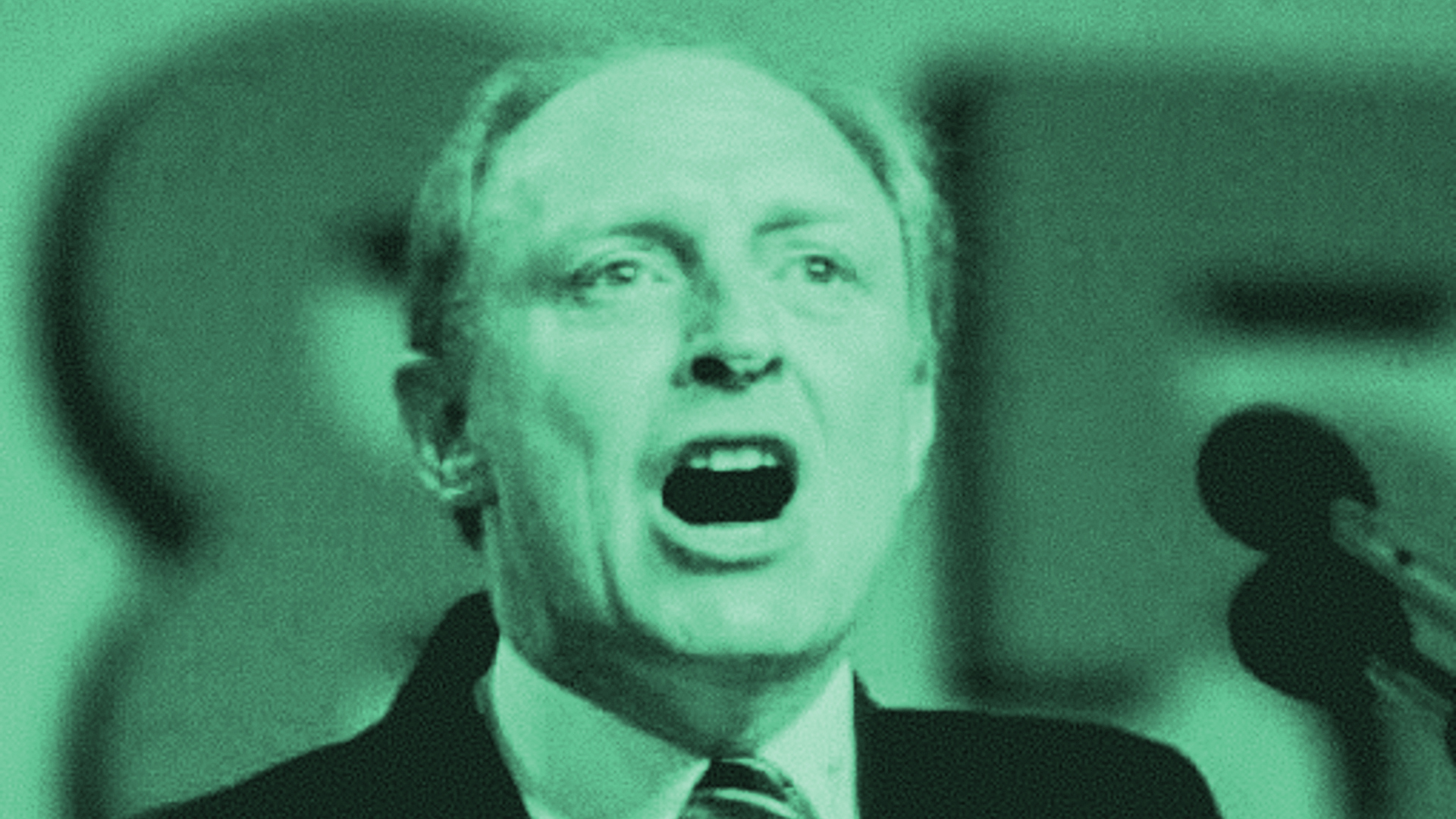
This is an edited version of Neil Kinnock’s speech to the Welsh Labour Party conference in Llandudno, May 15, 1987, in his first election as leader of the Labour Party.
We are democratic socialists. We care all the time. We don’t think it’s a soft sentiment, we don’t think it’s ‘wet’.

We think that care is the essence of strength.

And we believe that because we know that strength without care is savage and brutal and selfish.

Strength with care is compassion – the practical action that is needed to help people lift themselves to their full stature.

That’s real care – it is not soft or weak. It is tough and strong. But where do we get that strength to provide that care?

Do we wait for some stroke of good fortune, some benign giant, some socially conscious Samson to come along and pick up the wretched of the earth?

Of course we don’t.

We cooperate, we collect together, we coordinate so that everyone can contribute and everyone can benefit, everyone has responsibilities everyone has rights. That is how we put care into action. That is how we make the weak strong, that is how we lift the needy, that is how we make the sick whole, that is how we give talent the chance to flourish, that is how we turn the unemployed claimant into the working contributor.

We do it together. It is called collective strength, collective care. And its whole purpose is individual freedom.

When we speak of collective strength and collective freedom, collectively achieved, we are not fulfilling that nightmare that Mrs Thatcher tries to paint, and all her predecessors have tried to saddle us with.

We’re not talking about uniformity; we’re not talking about regimentation; we’re not talking about conformity -that’s their creed. The uniformity of the dole queue; the regimentation of the unemployed young and their compulsory work schemes. The conformity of people who will work in conditions, and take orders, and accept pay because of mass unemployment that they would laugh at in a free society with full employment.

That kind of freedom for the individual, that kind of liberty can’t be secured by most of the people for most of the time if they’re just left to themselves, isolated, stranded, with their whole life chances dependent upon luck!

Why am I the first Kinnock in a thousand generations to be able to get to university? Why is my wife, Glenys, the first woman in her family in a thousand generations to be able to get to university?

Was it because all our predecessors were ‘thick’? Did they lack talent – those people who could sing, and play, and recite and write poetry; those people who could make wonderful, beautiful things with their hands; those people who could dream dreams, see visions; those people who had such a sense of perception as to know in times so brutal, so oppressive, that they could win their way out of that by coming together?

Were those people not university material? Couldn’t they have knocked off all their A-levels in an afternoon?

But why didn’t they get it?

Was it because they were weak? Those people who could work eight hours underground and then come up and play football?

Weak? Those women who could survive eleven child bearings, were they weak? Those people who could stand with their backs and their legs straight and face the people who had control over their lives, the ones who owned their workplaces and tried to own them, and tell them, ‘No. I won’t take your orders.’ Were they weak?

Does anybody really think that they didn’t get what we had because they didn’t have the talent, or the strength, or the endurance, or the commitment?

Of course not. It was because there was no platform upon which they could stand; no arrangement for their neighbours to subscribe to their welfare; no method by which the communities could translate their desires for those individuals into provision for those individuals.

And now, Mrs Thatcher, by dint of privatisation, and means test, and deprivation, and division, wants to nudge us back into the situation where everybody can either stand on their own feet, or live on their knees.

She parades her visions and values, and we choose to contest them as people with roots in this country, with a future only in this country, with pride in this country. People who know that if we are to have and sustain real individual liberty in this country it requires the collective effort of the whole community.

I think of the youngsters I meet. Three, four, five years out of school. Never had a job. And they say to me “Do you think we’ll ever work?”

They live in a free country, but they do not feel free.

I think of the 55-year-old woman I meet who is waiting to go into hospital, her whole existence clouded by pain.

She lives in a free country, but she does not feel free.

I think of the young couple, two years married, living in Mam and Dad’s front room because they can’t get a home. They ask “Will we ever get a home of our own?”

They live in a free country, but they do not feel free.

And I think of the old couple who spend months of the winter afraid to turn up the heating, who stay at home because they are afraid to go out after dark, whose lives are turned into a crisis by the need to buy a new pair of shoes.

They live in a free country – indeed, they’re of the generation that fought for a free country but they do not feel free.

How can they and millions like them – have their individual freedom if there is not collective provision?

How can they have strength if they do not have care?

Now they cannot have either because they are locked out of being able to discharge responsibilities just as surely as they are locked out of being able to exercise rights.

They want to be able to use both.

They do not want feather-bedding, they want a foothold.

They do not want cotton-woolling, they want a chance to contribute.

That is the freedom they want.

That is the freedom we want them to have.

With a tip of the old scrub brush to Dave Weigel on Bluesky Social.


“273 words toward a new nation” – Lincoln’s Gettysburg Address

November 20, 2017

Nicolay copy of the Gettysburg Address; only pre-delivery, holographic copy of the address. Given to Lincoln's secretary, John George Nicolay.

Nicolay copy of the Gettysburg Address; only pre-delivery, holographic copy of the address. Given to Lincoln’s secretary, John George Nicolay.

Librarians have it good, living among books.  Librarians at the Library of Congress have it best, with the amazingly complete collection of books, top-notch scholars, and just plain old curious stuff lying around.

Like copies of Lincoln’s Gettysburg Address.

Garry Wills argues that Lincoln rethought and recast America’s image in that speech, in less than two minutes — though it took a century before the recasting was complete.

The Library of Congress just has the history, and notes the power of the speech overall.

Yes, this is mostly an encore post. Fighting ignorance requires patience.

Yes, this is mostly an encore post. Fighting ignorance requires patience.


He really said it, October 29, 1941: Churchill, ‘never give in’ (Quote of the Moment)

October 29, 2015

The statue of Churchill (1973) by Ivor Roberts-Jones in Parliament Square, London. Wikipedia image. Photo by Eluveitie.

The statue of Churchill (1973) by Ivor Roberts-Jones in Parliament Square, London. Wikipedia image. Photo by Eluveitie.

In late 1941, at the height of Britain’s troubles as the sole surviving, able-to-fight exponent of democratic government in Europe, Winston Churchill paid a visit to his old school, to hear the students sing and join them in song. He was asked to speak.

It was a short speech, wholly extemporaneous, but one phrase went on to become one of the most-quoted parts of any speech ever given, anywhere.

Never give in, never give in, never, never, never, never — in nothing, great or small, large or petty — never give in except to convictions of honour and good sense!

Winston S. Churchill, address to the boys of Harrow School, October 29, 1941.

More:

Yes, this is mostly an encore post. Fighting ignorance requires patience.

Yes, this is mostly an encore post. Fighting ignorance requires patience.


Quote of the Moment, October 29, 1941: Churchill, ‘never give in’

October 29, 2013

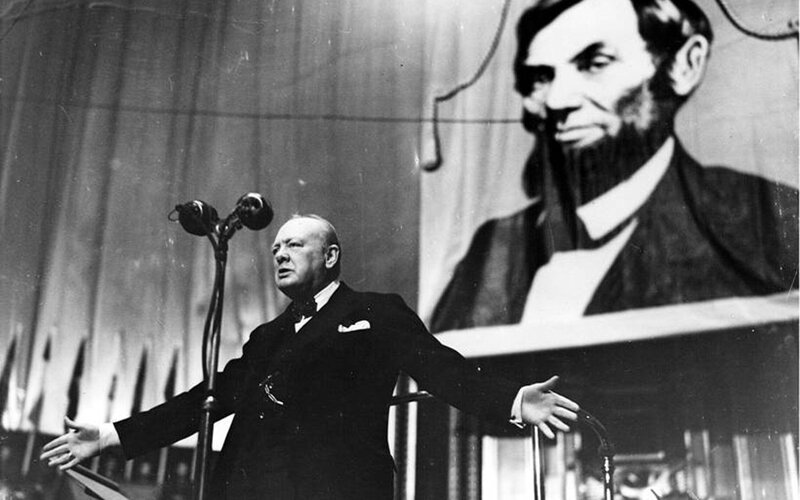
 Churchill speaking at the Albert Hall in London, 1944, at an American Thanksgiving Celebration.  Churchill Centre image

Churchill speaking at the Albert Hall in London, 1944, at an American Thanksgiving Celebration. Churchill Centre image

Never give in, never give in, never, never, never, never — in nothing, great or small, large or petty — never give in except to convictions of honour and good sense!

Winston S. Churchill, address to the boys of Harrow School, October 29, 1941.

More:

(This version may be a re-enactment of the vocal delivery.]

This is much an encore post, from 2007, with material added.


Powerful argument for limiting bullets in a clip: Colorado Sen. Mike Johnston pleads to give victims a chance to escape

March 17, 2013

Here’s one of my nominees for the next editions of Great Speeches of the 21st Century, and Great Speeches in American History.  Sen. Mike Johnston, on March 11, in the Colorado State Senate, spoke against coward, “hollow men,” who commit mass shootings, and how to protect from them:

Notes from YouTube posting:

Published on Mar 12, 2013

March 11, 2013: Sen. Mike Johnston (D-Denver) describes how gun safety legislation, particularly HB 13-1224, can make a difference.

What do you think?

Senator Michael Johnston

Colorado State Senator Michael Johnston – Wikipedia Photo

‘Eleven kids saved in eleven seconds’ seems like a powerful argument, to me.

And this:  “And so the bad news is that at that moment will be outgunned.  The good news is that in America that never means we will be outfought.”

And this:  “The task of taking lives, and the task of saving lives, are fundamentally different endeavors, and they require different tools.”

At about 6:04 into this, listen to Sen. Johnston talk about the “cost of living and loving is that it takes up so much space in our lives.”

Wow.

More:


November 19, 1863 – Gettysburg Address

November 19, 2010

A mostly encore post about today’s anniversary of Lincoln’s speech at Gettysburg.


Prior to 2007, this was the only known photo of Lincoln at Gettysburg, on the day of his address - Library of Congress

Prior to 2007, this was the only known photo of Lincoln at Gettysburg, on the day of his address – Library of Congress

147 years ago today, Abraham Lincoln redefined the Declaration of Independence and the goals of the American Civil War, in a less-than-two-minute speech dedicating part of the battlefield at Gettysburg, Pennsylvania, as a cemetery and final resting place for soldiers who died in the fierce battle fought there the previous July 1 through 3.

Interesting news for 2007: More photos from the Library of Congress collection may contain images of Lincoln. The photo above, detail from a much larger photo, had been thought for years to be the only image of Lincoln from that day. The lore is that photographers, taking a break from former Massachusetts Sen. Edward Everett’ s more than two-hour oration, had expected Lincoln to go on for at least an hour. His short speech caught them totally off-guard, focusing their cameras or taking a break. Lincoln finished before any photographer got a lens open to capture images.

Images of people in these photos are very small, and difficult to identify. Lincoln was not identified at all until 1952:

The plate lay unidentified in the Archives for some fifty-five years until in 1952, Josephine Cobb, Chief of the Still Pictures Branch, recognized Lincoln in the center of the detail, head bared and probably seated. To the immediate left (Lincoln’s right) is Lincoln’s bodyguard, Ward Hill Lamon, and to the far right (beyond the limits of the detail) is Governor Andrew G. Curtin of Pennsylvania. Cobb estimated that the photograph was taken about noontime, just after Lincoln arrived at the site and before Edward Everett’s arrival, and some three hours before Lincoln gave his now famous address.

On-line, the Abraham Lincoln Blog covered the discovery that two more photographic plates from the 1863 speech at Gettysburg may contain images of Lincoln in his trademark stove-pipe hat. Wander over to the story at the USA Today site, and you can see just how tiny are these detail images in relation to the photographs themselves. These images are tiny parts of photos of the crowd at Gettysburg. (The story ran in USA Today last Thursday or Friday — you may be able to find a copy of that paper buried in the returns pile at your local Kwikee Mart.) Digital technologies, and these suspected finds of Lincoln, should prompt a review of every image from Gettysburg that day.

To the complaints of students, I have required my junior U.S. history students to memorize the Gettysburg Address. In Irving I found a couple of students who had memorized it for an elementary teacher years earlier, and who still could recite it. Others protested, until they learned the speech. This little act of memorization appears to me to instill confidence in the students that they can master history, once they get it done.

To that end, I discovered a good, ten-minute piece on the address in Ken Burns’ “Civil War” (in Episode 5). On DVD, it’s a good piece for classroom use, short enough for a bell ringer or warm-up, detailed enough for a deeper study, and well done, including the full text of the address itself performed by Sam Waterson.

Edward Everett, the former Massachusetts senator and secretary of state, was regarded as the greatest orator of the time. A man of infinite grace, and a historian with some sense of events and what the nation was going through, Everett wrote to Lincoln the next day after their speeches:

“I should be glad, if I could flatter myself that I came as near the central idea of the occasion in two hours, as you did in two minutes.”

Interesting note: P. Z. Myers at Pharyngula notes that the Gettysburg Address was delivered “seven score and four years ago.” Of course, that will never happen again. I’ll wager he was the first to notice that odd juxtaposition on the opening line.

Resources for students and teachers:


Lincoln’s Gettysburg Address: “273 words toward a new nation”

September 20, 2010

Librarians have it good, living among books.  Librarians at the Library of Congress have it best, with the amazingly complete collection of books, top-notch scholars, and just plain old curious stuff lying around.

Like copies of Lincoln’s Gettysburg Address.

Garry Wills argues that Lincoln rethought and recast America’s image in that speech, in less than two minutes — though it took a century before the recasting was complete.

The Library of Congress just has the history, and notes the power of the speech overall.


Barbara Jordan

February 12, 2008

Rereading the Gettysburg Address and the Cooper Union speech of Lincoln, I wondered for a few moments whether there are others with similar gifts for words who might be on film or tape. It got me thinking about the vast gulf between religion on the one hand, and faith and justice on the other hand.

Then I got a notice of a link from this post about Barbara Jordan, at Firedoglake.

It’s a nice collection of links, a Barbara Jordan tribute all bundled up ready to unwrap. Sometimes truth does go marching on.

Who since Jordan?

(Thanks to Phoenix Woman at Firedoglake for the post, and for the link here.)

The Cooper Union speech of Lincoln was 148 years ago, on February 27.


Quote of the Moment, October 29, 1941: Churchill, ‘never give in’

April 11, 2007

 Churchill speaking at the Albert Hall in London, 1944, at an American Thanksgiving Celebration.  Churchill Centre image

Churchill speaking at the Albert Hall in London, 1944, at an American Thanksgiving Celebration. Churchill Centre image

Never give in, never give in, never, never, never, never — in nothing, great or small, large or petty — never give in except to convictions of honour and good sense!

Winston S. Churchill, address to the boys of Harrow School, October 29, 1941.