Typewriter of the moment: Theodore Roosevelt at Sagamore Hill

June 11, 2009

He held many jobs, cowboy, police commissioner, governor, military leader, president — but he regarded his profession as “writer.”

Theodore Roosevelt‘s typewriter, a Remington, from his house at Sagamore Hill, New York:

Theodore Roosevelts typewriter from his home at Sagamore Hill - Fish and Wildlife Service, National Digital Image Library

Theodore Roosevelt’s typewriter from his home at Sagamore Hill, New York – Fish and Wildlife Service photo, National Digital Image Library (public domain)

Remington typewriter used by Theodore Roosevelt at his home at Sagamore Hill, New York - US Fish and Wildlife Service, National Digital Library (public domain)

Update, March 16, 2012:  There are two versions of the same photo above, if we’re lucky.  The designator at the National Digital Library has changed at least twice, leaving this post high and dry.  There is another, slightly lower quality version of the photo above.  You’re not seeing double, you’re seeing operational redundancy.

Resources:

Please share this image and information:

Add to FacebookAdd to NewsvineAdd to DiggAdd to Del.icio.usAdd to StumbleuponAdd to RedditAdd to BlinklistAdd to TwitterAdd to TechnoratiAdd to Furl


Obama fans, Democrats: Political stuff clearance sale!

May 31, 2009

Great idea.  Really.  There’s a lot of campaign stuff left over.  Rather than dump it, they’re selling it cheap.

Image from the Obama campaign site, June 2009

Image from the Obama campaign site, June 2009

Government and politics teachers can stock up on the stuff to decorate the room.  AP Government teacher Mrs. Richie, at Duncanville High School had a collection of bumperstickers that went back 30 years before she retired (where did that collection go?)

Or, maybe you just need tote bags to replace the plastic and paper choices the grocery store gives you.  Green up, cheap, at the Obama site!

Over at Republican National Headquarters, they’re having a sale on politicians, I hear. Entire Congressional committee minorities, cheap.  Izzat so?  Not really.  Really?


Maj. Gen. John Logan, one inventor of Memorial Day

May 25, 2009

Maj. Gen. John A. Logan, Union Army, inventor of Memorial Day; Library of Congress photo, Brady National Photographic Art Gallery, between 1860 and 1865

Maj. Gen. John A. Logan, Grand Army of the Republic (Union Army), inventor of Memorial Day; Library of Congress photo, Brady National Photographic Art Gallery, between 1860 and 1865

From American Memory, at the Library of Congress:

In 1868, Commander in Chief John A. Logan of the Grand Army of the Republic issued General Order Number 11 designating May 30 as a memorial day “for the purpose of strewing with flowers or otherwise decorating the graves of comrades who died in defense of their country during the late rebellion, and whose bodies now lie in almost every city, village, and hamlet churchyard in the land.”

The first national celebration of the holiday took place May 30, 1868, at Arlington National Cemetery, where both Confederate and Union soldiers were buried. Originally known as Decoration Day, at the turn of the century it was designated as Memorial Day. In many American towns, the day is celebrated with a parade.

Southern women decorated the graves of soldiers even before the Civil War’s end. Records show that by 1865, Mississippi, Virginia, and South Carolina all had precedents for Memorial Day. Songs in the Duke University collection Historic American Sheet Music, 1850-1920 include hymns published in the South such as these two from 1867: “Kneel Where Our Loves are Sleeping,” dedicated to “The Ladies of the South Who are Decorating the Graves of the Confederate Dead ” and “Memorial Flowers,” dedicated “To the Memory of Our Dead Heroes.”


May 22, 1906: Patent to Wright Bros. for “flying machine”

May 23, 2009

In a drawer in a file box in the U.S. Patent Office in Washington, D.C., is a study in black ink on white paper, lines that resemble those images most of us have of the first Wright Bros. flyer, usually dubbed “Kittyhawk” after the place it first took to the air.

Drawing 1 from patent granted to Orville Wright for a flying machine

Drawing 1 from patent granted to Orville Wright for a flying machine

The patent was issued on May 22, 1906, to Orville Wright, Patent No. 821393, for a “flying machine.”

It makes more sense if you turn the drawing on its side.

Wright Bros. flying machine, from patent drawing

Wright Bros. flying machine, from patent drawing

Why did it take three years to get the patent issued?

Below the fold, the rest of the patent.

Read the rest of this entry »


National Guard history: First African American Medal of Honor

March 18, 2009

From the National Guard Image Gallery: The 54th Massachusetts Volunteer Infantry Regiment was recruited in the spring of 1863 by Governor John Andrew, who had secured the reluctant permission of the War Department to create a regiment of African-American soldiers. Like all Massachusetts Civil War soldiers, the 54ths men were enlisted in the Massachusetts Volunteer Militia. These Guardsmen would serve as a test case for many skeptical whites who believed that blacks could not be good soldiers. The battle that proved they could was fought on Morris Island, at the mouth of Charleston Harbor. Following three days of skirmishes and forced marches with little rest, and 24 hours with no food, the regimental commander, Colonel Robert Gould Shaw, requested the perilous honor of leading the attack of Fort Wagner, a sand and palmetto log bastion. As night fell, 600 men of the 54th advanced with bayonets fixed. Despite withering cannon and rifle fire, the men sustained their charge until they reached the top of the rampart. There, Colonel Shaw was mortally wounded. There, also, Sergeant William Carney, who had earlier taken up the National Colors when the color sergeant had been shot, planted the flag and fought off numerous attempts by the Confederates to capture it. Without support, and faced with superior numbers and firepower, the 54th was forced to pull back. Despite two severe wounds, Sergeant Carney carried the colors to the rear. When praised for his bravery, he modestly replied, I only did my duty; the old flag never touched the ground. Carney was awarded the Medal of Honor for his actions, the first African-American to receive the award. The 54th Massachusetts suffered 270 casualties in the failed assault, but the greater message was not lost: some 180,000 African-American soldiers followed in the footsteps of these gallant Guardsmen, and proved that African-American soldiers could, indeed, fight heroically if given the opportunity.

From the National Guard Image Gallery: Fort Wagner, South Carolina, July 18, 1863; "The Old Flag Never Touched the Ground": The 54th Massachusetts Volunteer Infantry Regiment was recruited in the spring of 1863 by Governor John Andrew, who had secured the reluctant permission of the War Department to create a regiment of African-American soldiers. Like all Massachusetts Civil War soldiers, the 54th's men were enlisted in the Massachusetts Volunteer Militia. These Guardsmen would serve as a test case for many skeptical whites who believed that blacks could not be good soldiers. The battle that proved they could was fought on Morris Island, at the mouth of Charleston Harbor. Following three days of skirmishes and forced marches with little rest, and 24 hours with no food, the regimental commander, Colonel Robert Gould Shaw, requested the perilous honor of leading the attack of Fort Wagner, a sand and palmetto log bastion. As night fell, 600 men of the 54th advanced with bayonets fixed. Despite withering cannon and rifle fire, the men sustained their charge until they reached the top of the rampart. There, Colonel Shaw was mortally wounded. There, also, Sergeant William Carney, who had earlier taken up the National Colors when the color sergeant had been shot, planted the flag and fought off numerous attempts by the Confederates to capture it. Without support, and faced with superior numbers and firepower, the 54th was forced to pull back. Despite two severe wounds, Sergeant Carney carried the colors to the rear. When praised for his bravery, he modestly replied, "I only did my duty; the old flag never touched the ground." Carney was awarded the Medal of Honor for his actions, the first African-American to receive the award. The 54th Massachusetts suffered 270 casualties in the failed assault, but the greater message was not lost: some 180,000 African-American soldiers followed in the footsteps of these gallant Guardsmen, and proved that African-American soldiers could, indeed, fight heroically if given the opportunity.

This is one of a series of artworks describing the history of the National Guard.  A sizable gallery of art covers the first muster of a militia in Salem, Massachusetts, in 1637, through rescue and recovery efforts after Hurricane Katrina in 2005.  Along the way are highlights such as Lexington and Concord, Teddy Roosevelt’s New Mexico Rough Riders in Cuba, including Fort Wagner and the return of General Lafayette.  With some caution on accuracy, these are good for classroom use (the Rough Riders picture shows a man on horseback, but I understand the Rough Riders’ horses had not yet arrived when they stormed up San Juan Hill; it took more than 30 years for Carney to get his medal, etc.).


Imaging the French Revolution

March 4, 2009

How can you tell I’m behind the scope and sequence?

I was just reminded today of how neat this site is:  Imaging the French Revolution. Good stuff comes out of George Mason University from time to time.  This site is part of that stuff.

Place Vendome, in the French Revolution (George Mason U image)

11. Le plus Grand, des Despotes, Renversé par la Liberté (Place Vendôme). [Place Vendôme, The Greatest of Despots Overthrown by Freedom] Source: Museum of the French Revolution 88.170 Medium: Etching and colored wash Dimensions: 17.2 x 24.4 cm Commentary (numbers refer to pages in essays): General analysis – Day-Hickman, 5 Reasonable crowd – Day-Hickman, 2

Oh, also:  Take a look at this site:  Some guy named Frank Smitha has assembled a history of the world, claiming to be trying to avoid bias.  The French Revolution page is a pretty good run down, much more thorough than the average textbook.

Beheading of Louis XVI, via Frank Smitha

The beheading of King Louis XVI, an execution opposed by Thomas Paine, who favored Louis’ exile to the United States – Image from Frank E. Smitha’s Macrohistory and World Report, The French Revolution


Box of surprises

January 29, 2009

HistoryBox.com?

Check it out — there be good stuff.

For example, abundant sources of information and especially images on the history of New York City can be found here.  It’s in directory form, so you may need to click once more to get what you need — but so far, everything I’ve clicked works, and it always seems to go to a good site.

New York state resources, here.

The U.S. history portion is not working yet.


Texas Statehood, December 29, 1845

December 29, 2008

163 years ago today: Rub your pet armadillo’s belly, slaughter the fatted longhorn, crank up the barbecue pit with the mesquite wood, put Willie Nelson and Bob Wills on the mp3 player, put the “Giant” DVD on the television, and raise your glass of Lone Star Beer (or Pearl, or Shiner Bock, or Llano Wine).

Texas was admitted to the union of the United States of America on December 29, 1845.

President Polks Authorization to Affix the Great Seal to Texas Statehood - Texas Memorial Museum, University of Texas at Austin

President Polk's Authorization to Affix the Great Seal to Texas Statehood - Texas Memorial Museum, University of Texas at Austin

The text reads:

I hereby authorize and direct the Secretary of State to affix the Seal of the United States to an authenticated copy of “an act to extend the laws of the United States over the State of Texas and for other purposes” approved Dec. 29, 1845 dated this day, and signed by me and for so doing this shall be his warrant.

James K. Polk
Washington, Dec. 29, 1845

Great Seal of the United States of America - State Archives Division, Texas State Library

Great Seal of the United States of America - State Archives Division, Texas State Library

Resources:


Who invented Santa Claus, and the Night Before Christmas?

December 24, 2008

An encore post from 2007

Thomas Nast invented Santa Claus? Clement C. Moore didn’t write the famous poem that starts out, “‘Twas the night before Christmas, and all through the house . . . ?”

The murky waters of history from Millard Fillmore’s Bathtub soak even our most cherished ideas and traditions.

But isn’t that part of the fun of history?

Santa Claus delivers to Union soldiers, "Santa Claus in Camp" - Thomas Nast, Harper's Weekly, Jan 3, 1863

Thomas Nast’s first published drawing featuring Santa Claus; for Harper’s Weekly, “A Journal of Civilization,” January 3, 1863 Nast portrayed the elf distributing packages to Union troops: “Santa Claus in camp.” Nast (1840-1904) was 23 when he drew this image.

Yes, Virginia (and California, too)! Thomas Nast created the image of Santa Claus most of us in the U.S. know today. Perhaps even more significant than his campaign against the graft of Boss Tweed, Nast’s popularization of a fat, jolly elf who delivers good things to people for Christmas makes one of the great stories in commercial illustration. Nast’s cartoons, mostly for the popular news publication Harper’s Weekly, created many of the conventions of modern political cartooning and modeled the way in which an illustrator could campaign for good, with his campaign against the graft of Tammany Hall and Tweed. But Nast’s popular vision of Santa Claus can be said to be the foundation for the modern mercantile flurry around Christmas.

Nast is probably ensconced in a cartoonists’ hall of fame. Perhaps he should be in a business or sales hall of fame, too.  [See also Bill Casselman’s page, “The Man Who Designed Santa Claus.]

Nast’s drawings probably drew some inspiration from the poem, “Account of a Visit from St. Nicholas,” traditionally attributed to Clement C. Moore, a New York City lawyer, published in 1822. The poem is among the earliest to describe the elf dressed in fur, and magically coming down a chimney to leave toys for children; the poem invented the reindeer-pulled sleigh.

Modern analysis suggests the poem was not the work of Moore, and many critics and historians now attribute it to Major Henry Livingston, Jr. (1748-1828) following sleuthing by Vassar College Prof. Don Foster in 2000. Fortunately for us, we do not need to be partisans in such a query to enjoy the poem (a complete copy of which is below the fold).

The Library of Congress still gives Moore the credit. When disputes arise over who wrote about the night before Christmas, is it any wonder more controversial topics produce bigger and louder disputes among historians?

Moore was not known for being a poet. The popular story is that he wrote it on the spur of the moment:

Moore is thought to have composed the tale, now popularly known as “The Night Before Christmas,” on December 24, 1822, while traveling home from Greenwich Village, where he had bought a turkey for his family’s Christmas dinner.

Inspired by the plump, bearded Dutchman who took him by sleigh on his errand through the snow-covered streets of New York City, Moore penned A Visit from St. Nicholas for the amusement of his six children, with whom he shared the poem that evening. His vision of St. Nicholas draws upon Dutch-American and Norwegian traditions of a magical, gift-giving figure who appears at Christmas time, as well as the German legend of a visitor who enters homes through chimneys.

Again from the Library of Congress, we get information that suggests that Moore was a minor celebrity from a well-known family with historical ties that would make a good “connections” exercise in a high school history class, perhaps (”the link from Aaron Burr’s treason to Santa Claus?”): (read more, below the fold)

Clement Moore was born in 1779 into a prominent New York family. His father, Benjamin Moore, president of Columbia University, in his role as Episcopal Bishop of New York participated in the inauguration of George Washington as the nation’s first president. The elder Moore also administered last rites to Alexander Hamilton after he was mortally wounded in a tragic duel with Aaron Burr.

A graduate of Columbia, Clement Moore was a scholar of Hebrew and a professor of Oriental and Greek literature at the General Theological Seminary in Manhattan. [See comment from Pam Bumsted below for more on Moore.] He is said to have been embarrassed by the light-hearted verse, which was made public without his knowledge in December 1823. Moore did not publish it under his name until 1844.

Tonight, American children will be tucked in under their blankets and quilts and read this beloved poem as a last “sugarplum” before slipping into dreamland. Before they drift off, treat them to a message from Santa, recorded by the Thomas Edison Company in 1922.

Santa Claus Hides in Your Phonograph
By Arthur A. Penn, Performed by Harry E. Humphrey.
Edison, 1922.
Coupling date: 6/20/1922. Cutout date: 10/31/1929.
Inventing Entertainment: The Motion Pictures and Sound Recordings of the Edison Companies

Listen to this recording (RealAudio Format)

Listen to this recording (wav Format, 8,471 Kb)

But Henry Livingston was no less noble or historic. He hailed from the Livingtons of the Hudson Valley (one of whose farms is now occupied by Camp Rising Sun of the Louis August Jonas Foundation, a place where I spent four amazing summers teaching swimming and lifesaving). Livingston’s biography at the University of Toronto site offers another path for a connections exercise (”What connects the Declaration of Independence, the American invasion of Canada, the famous poem about a visit from St. Nick, and George W. Bush?”):

Henry Livingston Jr. was born in Poughkeepsie, New York, on Oct. 13, 1748. The Livingston family was one of the important colonial and revolutionary families of New York. The Poughkeepsie branch, descended from Gilbert, the youngest son of Robert Livingston, 1st Lord of Livingston Manor, was not as well off as the more well-known branches, descended from sons Robert and Philip. Two other descendants of Gilbert Livingston, President George Walker Herbert Bush and his son, President-Elect George W. Bush, though, have done their share to bring attention to this line. Henry’s brother, Rev. John Henry Livingston, entered Yale at the age of 12, and was able to unite the Dutch and American branches of the Dutch Reformed Church. At the time of his death, Rev. Livingston was president of Rutgers University. Henry’s father and brother Gilbert were involved in New York politics, and Henry’s granduncle was New York’s first Lt. Governor. But the law was the natural home for many of Henry’s family. His brother-in-law, Judge Jonas Platt, was an unsuccessful candidate for governor, as was his daughter Elizabeth’s husband, U.S. Supreme Court Justice Smith Thompson. Henry’s grandson, Sidney Breese, was Chief Justice of the Illinois Supreme Court.

Known for his encyclopedic knowledge and his love of literature, Henry Livingston was a farmer, surveyor and Justice of the Peace, a judicial position dealing with financially limited criminal and civil cases. One of the first New Yorkers to enlist in the Revolutionary Army in 1775, Major Henry Livingston accompanied his cousin’s husband, General Montgomery, in his campaign up the Hudson River to invade Canada, leaving behind his new wife, Sarah Welles, and their week-old baby, on his Poughkeepsie property, Locust Grove. Baby Catherine was the subject of the first poem currently known by Major Livingston. Following this campaign, Livingston was involved in the War as a Commissioner of Sequestration, appropriating lands owned by British loyalists and selling them for the revolutionary cause. It was in the period following Sarah’s early death in 1783, that Major Livingston published most of his poems and prose, anonymously or under the pseudonym of R. Ten years after the death of Sarah, Henry married Jane Patterson, the daughter of a Dutchess County politician and sister of his next-door neighbor. Between both wives, Henry fathered twelve children. He published his good-natured, often occasional verse from 1787 in many journals, including Political Barometer, Poughkeepsie Journal, and New-York Magazine. His most famous poem, “Account of a Visit from St. Nicholas,” was until 2000 thought to have been the work of Clement Clarke Moore (1779-1863), who published it with his collected poems in 1844. Livingston died Feb. 29, 1828.

More on Henry Livingston and his authorship of the Christmas poem here.

Thomas Nast, Merry Old Santa Claus, Harper's Weekly, Jan 1, 1881


Our views of Santa Claus owe a great deal also to the Coca-Cola advertising campaign. Coca-Cola first noted Santa’s use of the drink in a 1922 campaign to suggest Coke was a year-round drink (100 years after the publication of Livingston’s poem). The company’s on-line archives gives details:

In 1930, artist Fred Mizen painted a department store Santa in a crowd drinking a bottle of Coke. The ad featured the world’s largest soda fountain, which was located in the department store of Famous Barr Co. in St. Louis, Mo. Mizen’s painting was used in print ads that Christmas season, appearing in The Saturday Evening Post in December 1930.

1936 Coca-Cola Santa cardboard store display

  • 1936 Coca-Cola Santa cardboard store display

Archie Lee, the D’Arcy Advertising Agency executive working with The Coca-Cola Company, wanted the next campaign to show a wholesome Santa as both realistic and symbolic. In 1931, The Coca-Cola Company commissioned Michigan-born illustrator Haddon Sundblom to develop advertising images using Santa Claus — showing Santa himself, not a man dressed as Santa, as Mizen’s work had portrayed him.
1942 original oil painting - 'They Remembered Me'

  • 1942 original oil painting – ‘They Remembered Me’

For inspiration, Sundblom turned to Clement Clark Moore’s 1822 poem “A Visit From St. Nicholas” (commonly called “‘Twas the Night Before Christmas”). Moore’s description of St. Nick led to an image of Santa that was warm, friendly, pleasantly plump and human. For the next 33 years, Sundblom painted portraits of Santa that helped to create the modern image of Santa — an interpretation that today lives on in the minds of people of all ages, all over the world.

Santa Claus is a controversial figure. Debates still rage among parents about the wisdom of allowing the elf into the family’s home, and under what conditions. Theologians worry that the celebration of Christmas is diluted by the imagery. Other faiths worry that the secular, cultural impact of Santa Claus damages their own faiths (few other faiths have such a popular figure, and even atheists generally give gifts and participate in Christmas rituals such as putting up a decorated tree).

For over 100 years, Santa Claus has been a popular part of commercial, cultural and religious life in America. Has any other icon endured so long, or so well?

Add to FacebookAdd to NewsvineAdd to DiggAdd to Del.icio.usAdd to StumbleuponAdd to RedditAdd to BlinklistAdd to TwitterAdd to TechnoratiAdd to Furl

________________________
Below:
From the University of Toronto Library’s Representative Poetry Online

Major Henry Livingston, Jr. (1748-1828)

Account of a Visit from St. Nicholas

1 ‘Twas the night before Christmas, when all thro’ the house,
2 Not a creature was stirring, not even a mouse;
3 The stockings were hung by the chimney with care,
4 In hopes that St. Nicholas soon would be there;
5 The children were nestled all snug in their beds,
6 While visions of sugar plums danc’d in their heads,
7 And Mama in her ‘kerchief, and I in my cap,
8 Had just settled our brains for a long winter’s nap –
9 When out on the lawn there arose such a clatter,
10 I sprang from the bed to see what was the matter.
11 Away to the window I flew like a flash,
12 Tore open the shutters, and threw up the sash.
13 The moon on the breast of the new fallen snow,
14 Gave the lustre of mid-day to objects below;
15 When, what to my wondering eyes should appear,
16 But a miniature sleigh, and eight tiny rein-deer,
17 With a little old driver, so lively and quick,
18 I knew in a moment it must be St. Nick.
19 More rapid than eagles his coursers they came,
20 And he whistled, and shouted, and call’d them by name:
21 “Now! Dasher, now! Dancer, now! Prancer, and Vixen,
22 “On! Comet, on! Cupid, on! Dunder and Blixem;
23 “To the top of the porch! to the top of the wall!
24 “Now dash away! dash away! dash away all!”
25 As dry leaves before the wild hurricane fly,
26 When they meet with an obstacle, mount to the sky;
27 So up to the house-top the coursers they flew,
28 With the sleigh full of Toys — and St. Nicholas too:
29 And then in a twinkling, I heard on the roof
30 The prancing and pawing of each little hoof.
31 As I drew in my head, and was turning around,
32 Down the chimney St. Nicholas came with a bound:
33 He was dress’d all in fur, from his head to his foot,
34 And his clothes were all tarnish’d with ashes and soot;
35 A bundle of toys was flung on his back,
36 And he look’d like a peddler just opening his pack:
37 His eyes — how they twinkled! his dimples how merry,
38 His cheeks were like roses, his nose like a cherry;
39 His droll little mouth was drawn up like a bow.
40 And the beard of his chin was as white as the snow;
41 The stump of a pipe he held tight in his teeth,
42 And the smoke it encircled his head like a wreath.
43 He had a broad face, and a little round belly
44 That shook when he laugh’d, like a bowl full of jelly:
45 He was chubby and plump, a right jolly old elf,
46 And I laugh’d when I saw him in spite of myself;
47 A wink of his eye and a twist of his head
48 Soon gave me to know I had nothing to dread.
49 He spoke not a word, but went straight to his work,
50 And fill’d all the stockings; then turn’d with a jerk,
51 And laying his finger aside of his nose
52 And giving a nod, up the chimney he rose.
53 He sprung to his sleigh, to his team gave a whistle,
54 And away they all flew, like the down of a thistle:
55 But I heard him exclaim, ere he drove out of sight –
56 Happy Christmas to all, and to all a good night.

Harappa and Mohenjodaro sources

October 5, 2008

The Maharajah of Cashmere  The Illustrated London News  December 18, 1875  [From a longer story on the Prince of Wales visit to India in 1875.] With regard to the Maharajah of Cashmere, whose residence and political relations, beneath the Himalayas and in the Valley of the Upper Indus, are very remote from Bombay, we defer any notice of him till the Prince of Wales goes to visit him in Cashmere. The portrait of this Maharajah is from a photograph by Messrs. Bourne and Shepherd, of India.
The Maharajah of Cashmere The Illustrated London News December 18, 1875 (From a longer story on the Prince of Wales visit to India in 1875.) – “With regard to the Maharajah of Cashmere, whose residence and political relations, beneath the Himalayas and in the Valley of the Upper Indus, are very remote from Bombay, we defer any notice of him till the Prince of Wales goes to visit him in Cashmere. The portrait of this Maharajah is from a photograph by Messrs. Bourne and Shepherd, of India.”

World history teachers, bookmark this site:  Harappa.com

It’s a rich site about India and Pakistan, and includes information and images about the Harappa and Mohenjo-Daro civilizations.

Great images for your classrooms, or for your students’ projects.

Tip of the old scrub brush to John Maunu teaching AP World History in Grosse Ile, Michigan.

(Full text of description of site from the Asian Studies WWW Monitor below the fold.)

Read the rest of this entry »


Railroad maps!

September 30, 2008

Atchison, Topeka & Santa Fe Railroad, 1899 - from the Library of Congress

Atchison, Topeka & Santa Fe Railroad, 1899 - from the Library of Congress

American Memory at the Library of Congress features dozens of historic railroad maps of U.S. railroads.

This is a great collection for U.S. history presentations on development of the railroads, or on settlement of the west, in particular.

The Railroad maps represent an important historical record, illustrating the growth of travel and settlement as well as the development of industry and agriculture in the United States. They depict the development of cartographic style and technique, highlighting the achievement of early railroaders. Included in the collection are progress report surveys for individual lines, official government surveys, promotional maps, maps showing land grants and rights-of-way, and route guides published by commercial firms.

Heck, if nothing else, these make great backgrounds for PowerPoint presentations.

Bookmark the site — kids working on projects specific to a state or region should have a field day with these things.


Historic images: Quanah Parker, Last Chief of the Comanches

June 19, 2008

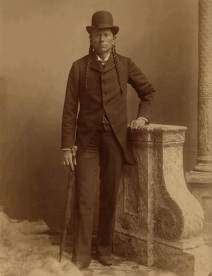
Quanah Parker, photo by Lanney

Quanah Parker, a Kwahadi Comanche chief; full-length, standing in front of tent.
Photographed by Lanney. Public Domain photo.
National Archives, “Pictures of Indians in the United States”

Photographs of Native Americans reside among the publicly and internet available materials of the National Archives. Images can be ordered in sets of slides, or as individual prints, though many are available in quality high enough for PowerPoint works and use on classroom materials. Many of the photos are 19th century.

Quanah Parker stands as one of the larger Native Americans in Texas history. This photo puts a face to a reputation in Texas history textbooks. Texas teachers may want to be certain to get a copy of the photo. His life story includes so many episodes that seem to come out of a Native American version of Idylls of the King that a fiction writer could not include them all, were they not real.

  • Quanah’s mother was part of the famous Parker family that helped settle West Texas in the 1830s. Cynthia Ann Parker was captured in 1836 when Comanches attacked Fort Parker, near present-day Groesbeck, Texas, in Limestone County. (See Fort Parker State Park.) Given a new name, Nadua (found one), she assimilated completely with the Nocona band of Comanches, and eventually married the Comanche warrior Noconie (also known as Peta Nocona). Quanah was their first child, born in 1852.
  • Nadua was captured by a Texas party led by Lawrence Sullivan “Sul” Ross in 1860, in the Battle of Pease River. Noconie, Quanah, and most of the Nocona men were off hunting at the time, and the fact of Nadua’s capture was not realized for some time. Nadua asked to return to the Comanches and her husband, but she was not allowed to do so. When her youngest daughter, who had been captured with her, died of an infection, Nadua stopped eating, and died a few weeks later.
  • Sul Ross was a character in his own right. At the time he participated in the raid that recaptured Cynthia Parker, he was a student at Baylor University (“What do I do on summer breaks? I fight Indians.”) At the outbreak of the Civil War, Ross enlisted in the Confederate Army as a private. Over 135 battles and skirmishes he rose to the rank of Brigadier General, the ninth youngest in the Confederate Army. A successful rancher and businessman back in Texas after the war, he won election as governor in 1887, served two very successful terms (he resolved the Jaybird-Woodpecker War in Fort Bend County, and had to call a special session of the legislature to deal with a budget surplus), refused to run for a third term, and was named president of Texas Agricultural and Mechanical College (Texas A&M) within a few days of stepping down as governor. Ross’s leadership of the college is legendary — students put pennies near a statue of Ross in a traditional plea to pass final exams, among many other traditions. After his death, Texas created Sul Ross State University, in Alpine, Texas, in his honor.
  • Quanah Parker’s father, Noconie, died a short time after his mother’s capture. He left the Nocona band, joined the Destanyuka band under Chief Wild Horse, but eventually founded his own band with warriors from other groups, the Quahadi (“antelope eaters”) (also known as Kwahadi). The Quahadi band grew to be one of the largest and most notorious, always with Quanah leading them. The Quahadis refused to sign the 1867 Medicine Lodge Treaties, and so avoided immediate internment to a reservation. However, dwindling food supplies and increasing opposition forced Quanah to retire to a reservation in 1875, in what is now southwestern Oklahoma. This was the last Comanche band to come to the reservation.
  • Quanah was appointed Chief of all the Comanches.
  • Through investments, Quanah became rich — probably the richest Native American of his time.
  • Quanah hunted with President Theodore Roosevelt.

    Quanah Parker in later life, as a successful businessman. Wikipedia image, public domain

    Quanah Parker in later life, as a successful businessman. Wikipedia image, public domain

  • Rejecting monogamy and Christianity, Quanah founded the Native American Church movement, which regards the use of peyote as a sacrament. Quanah had been given peyote by a Ute medicine man while recovering from wounds he’d suffered in battle with U.S. troops. Among his famous teachings: The White Man goes into his church and talks about Jesus. The Indian goes into his Tipi and talks with Jesus.
  • Photo at right: Quanah Parker in his later life, in his business attire. Photo thought to be in public domain.
  • Bill Neeley wrote of Quanah Parker: “Not only did Quanah pass within the span of a single lifetime from a Stone Age warrior to a statesman in the age of the Industrial Revolution, but he never lost a battle to the white man and he also accepted the challenge and responsibility of leading the whole Comanche tribe on the difficult road toward their new existence.”
  • Quanah Parker died on February 23, 1911. He is buried at Fort Sill Cemetery, Oklahoma, next to his mother and sister.

Quanah Parker’s epitaph reads:

Resting Here Until Day Breaks
And Shadows Fall and Darkness Disappears is
Quanah Parker Last Chief of the Comanches
Born 1852
Died Feb. 23, 1911

Other Resources:

Spread Quanah’s story:

Add to FacebookAdd to NewsvineAdd to DiggAdd to Del.icio.usAdd to StumbleuponAdd to RedditAdd to BlinklistAdd to TwitterAdd to TechnoratiAdd to Furl


Found: Last photo of Ernie Pyle

February 4, 2008

A reporter named Richard Pyle — no relation, he notes — writing for the Associated Press reports that a photograph of Ernie Pyle has surfaced, showing him dead, after he was hit by a Japanese machine gun bullet while reporting on U.S. troops, on the island of Ie Shima, on April 18, 1945.

Photos here, at the Dallas Morning News site. Story here.

Especially in black and white, the photo is not so macabre as to shock. Pyle looks peaceful, asleep, as Richard Pyle wrote. The value is historical. It’s a reminder that reporters, too, put themselves in harm’s way, to inform Americans about the world, providing the information our democratic republic needs to function well.

Remember to vote in your state’s primary elections this year. Deserve their heroism.

Earlier notes on Ernie Pyle:

Read the rest of this entry »


Typewriter of the moment: William Faulkner

June 24, 2007

Faulkner at typewriter, Aug 12, 1954 - AP Photo, ShelfLife

William Faulkner at his typewriter, August 12, 1954, at his home in Oxford, Mississippi. Associated Press photo, via Eons website.

The photo was probably posed; the two books to the left of the typewriter are Faulkner books. Faulkner may have written in a pressed shirt and tie.

Faulkner won the Nobel Prize for Literature in 1950, and delivered a memorable speech about “the human condition” and the importance of art, especially poetry and prose, at his acceptance. His 1954 book, A Fable, won both the National Book Award and the Pulitzer Prize for Fiction, in 1955.

The typewriter is a Royal KHM.

Faulkner was born September 25, 1897 — 2007 marks the 110th anniversary of his birth.

“The past is never dead. It’s not even past.”

—Gavin Stevens

Act I, Scene III, Requiem for a Nun