Stupid birther tricks: Recycled hoaxes

June 16, 2010

Justice Holmes might have said, “Three generations of this imbecilic video is enough!”

Over at GetDClue.com, where the motto is “~*~ Get a clue & wake up! ~*~ The best way to lead a nation astray of its values is to keep it ignorant of its history,” author Lisa DeClue is doing her best to lead the nation astray by planting false history to keep us all ignorant.

Today, this reeker plopped into my e-mail box — it’s a hoax video. Repeat, it’s a hoax:

The only reason Obama wouldn’t want you to see that is because it’s a waste of your time.  It would be laughable were it a high school student history video (I’d flunk it on accuracy and lack of citations).  It’s a hoax from set up to wind down.  It should be put down.

DeClue explains the video was struck down from some site (probably for reasons of taste; this is an assault on good taste and manners, just in the insulting way it assumes the viewer is too stupid to have read a newspaper in the past three years).  It’s now up again on YouTube — a recycled hoax!  This one isn’t nearly as funny nor witty as the Cardiff Giant, however.

DeClue sends out e-mails alerting warning of new posts.

Hello!

I’ve just come across a disturbing video you must watch that supposedly shows Obama’s dossier from the FBI.  Apparently his actions we know about are only the tip of the iceburg and portend badly for Israel, the war on terror and other foreign policy issues.  Not to mention his abuse of our economy and our rights.  Please post your comments on the blog and let’s get a good discussion going!  We need to come up with some ideas, fellow patriots!  Thank you.

Disturbing in its dishonesty, sure.  I took a look.  I sent her an e-mail alerting her to the hoax, and I left this comment at her site:

This is one of the most irresponsible things you’ve ever posted.

How’s the ride with Osama? Or is the White Citizen’s Council? And if a hoax, so easily disprovable, suckers you in so easily, can it be for any reason other than your own nefarious goals?

FBI doesn’t release dossiers on active politicians, nor on active investigations. That’s the first clue that it’s complete bunk.

Occidental College has a special page answering the questions so stupidly asked in the video [now moved here.] (you didn’t bother to look; you didn’t bother to look)

You could call Columbia to confirm Obama’s attendance there. Lots of others have. You could call Harvard. For the sake of Jesus, he was president of the Harvard Law Review. Nobody but students get to write on to the law review, no one but an active student can even run for president of the organization.

Obama’s birth certificate has been vetted much more than the drilling plans of any oil company.

Shame on you for posting this.

Rewind. Reboot. Time to retract.

It’s probably still up.  The true birther fanatics don’t care about getting the facts.  They are desperate to do damage to Obama’s reputation, no matter how false their claims may be.

Ms. DeClue wrote back wondering how I could possibly know it’s a hoax.  Naif.  I wrote back with more hints:

You could call the FBI and ask.  In fact, I recommend it.

I spent a decade in Washington, and among other duties, I staffed the confirmation hearings before the Senate Labor, and occasionally the Senate Judiciary Committee.  I’ve read hundreds of the reports, I’ve been involved in Senate investigations of how the FBI compiles them, and I’ve followed the Freedom of Information issues on the stuff, especially from the Vietnam protests, for years.

But don’t take my word for it.  Check it out for yourself.

See this news story:
http://www.boston.com/news/nation/articles/2010/06/16/kennedys_widow_asked_fbi_not_to_release_personal_files/

[The FBI doesn’t release dossiers on living people.  The claim in this film is that they got the dossier on Obama.  We know that’s false from the get-go.  The Kennedy story shows how a dossier might be released publicly — a process that is not alleged by the hoax videographer.]

See this non-governmental site on how to get your own file (but not the files of others):
http://www.getmyfbifile.com/

Here’s the FBI’s FOIA reading room information:
http://foia.fbi.gov/

How about criminal records on others?  See here:
http://www.fbi.gov/hq/cjisd/fprequest.htm

I’ve listed several sites you can visit in a comment at the post — check them out, to see the education record.  There’s a lot more.

It’s a hoax video.

Sorry you got taken in by it.

What is it with the birthers and other gullibles and hoaxsters around?  Is the trouble we have, with Iraq, Afghanistan, the Gulf of Mexico, the mortgage and housing crisis, the banking crisis, our enormous debts, and a hundred other serious problems, not enough?

But then I listen to Mitch McConnell.  He says he’s not so sure about working to make America energy independent, not when Obama can’t pull a Gandalf and wave the Gulf oil spill away.

Is crazy a virus?

How many errors did you find in that video?  Does it beat Phelim McAleer’s record for errors/minute?

Get on over to Oh, For Goodness Sake, and get some real facts.


Scouts in stained glass: St. Barnabas Church, Heigham

June 16, 2010

Let the light shine through:

South aisle window by Alfred L Wilkinson, 1956, in St. Barnabas Church, Heigham, Norwich.  Photo from Flickr, by Simon K:

Scouts and Girl Guides, at South aisle window by Alfred L Wilkinson, 1956, in St. Barnabas Church, Heigham, Norwich. Photo from Flickr, by Simon K

The photographer has additional photos of window details at his Flickr site.

Just a reminder that 2010 marks the 100th anniversary of Boy Scouting in the United States.


June 15, 1916: Wilson signed the National Charter for the Boy Scouts of America

June 16, 2010

Troop 1, Brownsville, Texas, May 20, 1916 - photo by Robert Runyon (U of Texas image via Library of Congress)

Troop 1, Brownsville, Texas, May 20, 1916 - photo by Robert Runyon (The Center for American History and General Libraries, University of Texas at Austin; via American Memory, Library of Congress)

On June 15, 1916, President Woodrow Wilson signed the law granting a national charter to the Boy Scouts of America, which had been incorporated six years earlier.  The charter is now encoded at 36 USC 309.

The purposes of the corporation are to promote, through organization, and cooperation with other agencies, the ability of boys to do things for themselves and others, to train them in scoutcraft, and to teach them patriotism, courage, self-reliance, and kindred virtues, using the methods that were in common use by boy scouts on June 15, 1916.

Good goals then, good goals now — maybe more important now.

Have you volunteered to be a leader?

Resources (and councils where I’ve Scouted and volunteered):

Tip of the old scrub brush to the Bill of Rights Institute on Facebook.

Brownsville Troop 1, May 20, 1916 - LOC and U of Tex (Am Memory) RUN07730

Click here for a larger view of the Troop 1 of Brownsville, Texas, in 1916

Brownsville Troop 1, May 20, 1916 - LOC and U of Tex (Am Memory) RUN07730

Click here for a larger view of a second photo of Troop 1 of Brownsville, Texas, in 1916


Boy Scouts with wreath, 1924

June 14, 2010

From the digital collections at the Library of Congress:

Boy Scout wreath, 1924 - Library of Congress Digital Collection, National Photo Company Collection

Boy Scout wreath, 1924 - Library of Congress Digital Collection, National Photo Company Collection (Call Number: LC-F8- 28581 (P&P))

Three Boy Scouts and a wreath with the BSA’s fleur de lis, in 1924.  Who are the Scouts?  What was the occasion?  Questions we have in the centennial year of Boy Scouting.

This photo is in the middle of a collection of photos taken at the funeral of President Woodrow Wilson, which was on February 6, 1924.  Was this the Boy Scouts’ tribute to Wilson?  By the way, Wilson is the only president interred in the District of Columbia (Arlington National Cemetery is across the Potomac River, in Virginia).  Wilson’s sarcophagus in in the main chapel of the National Cathedral.

Woodrow Wilson's tomb in the National Cathedral, Washington, D.C.  - Wikimedia image

Woodrow Wilson's tomb in the National Cathedral, Washington, D.C. - Wikimedia image


1943 conflict: Flag, First Amendment’s Establishment Clause

June 14, 2010

Historic irony: On Flag Day in 1943, the U.S. Supreme Court issued its decision in the case of West Virginia vs. Barnette.

Billy Gobitis explained why he would not salute the U.S. flag, November 5, 1935 - Library of Congress collection

Image 1 - Billy Gobitas explained why he would not salute the U.S. flag, November 5, 1935 - Library of Congress collection

The case started earlier, in 1935, when a 10-year-old student in West Virginia, sticking to his Jehovah’s Witness principles, refused to salute the U.S. flag in a state-required pledge of allegiance. From the Library of Congress:

“I do not salute the flag because I have promised to do the will of God,” wrote ten-year-old Billy Gobitas (1925-1989) to the Minersville, Pennsylvania, school board in 1935. His refusal, and that of his sister Lillian (age twelve), touched off one of several constitutional legal cases delineating the tension between the state’s authority to require respect for national symbols and an individual’s right to freedom of speech and religion.

The Gobitas children attended a public school which, as did most public schools at that time, required all students to salute and pledge allegiance to the flag of the United States. The Gobitas children were members of the Jehovah’s Witnesses, a church that in 1935 believed that the ceremonial saluting of a national flag was a form of idolatry, a violation of the commandment in Exodus 20:4-6 that “thou shalt not make unto thee any graven image, nor bow down to them. . . .” and forbidden as well by John 5:21 and Matthew 22:21. On 22 October 1935, Billy Gobitas acted on this belief and refused to participate in the daily flag and pledge ceremony. The next day Lillian Gobitas did the same. In this letter Billy Gobitas in his own hand explained his reasons to the school board, but on 6 November 1935, the directors of the Minersville School District voted to expel the two children for insubordination.

The Watch Tower Society of the Jehovah’s Witnesses sued on behalf of the children. The decisions of both the United States district court and court of appeals was in favor of the right of the children to refuse to salute. But in 1940 the United States Supreme Court by an eight-to-one vote reversed these lower court decisions and ruled that the government had the authority to compel respect for the flag as a key symbol of national unity. Minersville v. Gobitis [a printer’s error has enshrined a misspelling of the Gobitas name in legal records] was not, however, the last legal word on the subject. In 1943 the Supreme Court by a six-to-three vote in West Virginia State Board of Education v. Barnette, another case involving the Jehovah’s Witnesses, reconsidered its decision in Gobitis and held that the right of free speech guaranteed in the First Amendment to the Constitution denies the government the authority to compel the saluting of the American flag or the recitation of the pledge of allegiance.

There had been strong public reaction against the Gobitis decision, which had been written by Justice Felix Frankfurter (1882-1965). In the court term immediately following the decision, Frankfurter noted in his scrapbook that Justice William O. Douglas (1898-1980) told him that Justice Hugo LaFayette Black (1886-1971) had changed his mind about the Gobitis case. Frankfurter asked, “Has Hugo been re-reading the Constitution during the summer?” Douglas replied, “No–he has been reading the papers.”1 The Library’s William Gobitas Papers showcase the perspective of a litigant, whereas the abstract legal considerations raised by Gobitis and other cases are represented in the papers of numerous Supreme Court justices held by the Manuscript Division.

1. Quoted in H. N. Hirsch, The Enigma of Felix Frankfurter (New York: Basic Books, 1981), 152.

John E. Haynes and David Wigdor, Manuscript Division

Second page, Billy Gobitiss explanation of why he will not salute the U.S. flag - Library of Congress

Second page, Billy Gobitas's explanation of why he will not salute the U.S. flag: "I do not salute the flag not because I do not love my country but I love my country and I love God more and I must obey His commandments." - Library of Congress

Supreme Court justices do not often get a chance to reconsider their decisions. For example, overturning Plessy vs. Ferguson from 1896 took until 1954 in Brown v. Topeka Board of Education. In the flag salute/pledge of allegiance cases Justice Hugo Black had a change of mind, and when a similar case from West Virginia fell on the Court’s doorstep in 1943, the earlier Gobitis decision was reversed.

Writing for the majority, Justice Robert H. Jackson said:

If there is any fixed star in our constitutional constellation, it is that no official, high or petty, can prescribe what shall be orthodox in politics, nationalism, religion, or other matters of opinion, or force citizens to confess by word or act their faith therein. If there are any circumstances which permit an exception, they do not now occur to us.

Jehovah’s Witnesses, and all other Americans, thereby have the right to refuse to say what they and their faith consider to be a vain oath.

And that, boys and girls, is what the First Amendment means.

Resources:


Flag Day 2010 – Wave those stars and stripes

June 14, 2010

June 14th marks the anniversary of the resolution passed by the Second Continental Congress in 1777, adopting the Stars and Stripes as the national flag.

Fly your flag today. This is one of the score of dates upon which Congress suggests we fly our flags.

Flag Day 1916, parade in Washington, D.C. - employees of National Geographic Society march - photo by Gilbert Grosvenor

Flag Day 1916, parade in Washington, D.C. - employees of National Geographic Society march - photo by Gilbert Grosvenor

The photo above drips with history. Here’s the description from the National Geographic Society site:

One hundred and fifty National Geographic Society employees march in the Preparedness Parade on Flag Day, June 14, in 1916. With WWI underway in Europe and increasing tensions along the Mexican border, President Woodrow Wilson marched alongside 60,000 participants in the parade, just one event of many around the country intended to rededicate the American people to the ideals of the nation.

Not only the anniversary of the day the flag was adopted by Congress, Flag Day is also the anniversary of President Dwight Eisenhower’s controversial addition of the words “under God” to the Pledge of Allegiance in 1954.

(Text adapted from “:Culture: Allegiance to the Pledge?” June 2006, National Geographic magazine)

The first presidential declaration of Flag Day was 1916, by President Woodrow Wilson. Wilson won re-election the following November with his pledge to keep America out of World War I, but by April of 1917 he would ask for a declaration of war after Germany resumed torpedoing of U.S. ships. The photo shows an America dedicated to peace but closer to war than anyone imagined. Because the suffragettes supported Wilson so strongly, he returned the favor, supporting an amendment to the Constitution to grant women a Constitutional right to vote. The amendment passed Congress with Wilson’s support and was ratified by the states.

The flags of 1916 should have carried 48 stars. New Mexico and Arizona were the 47th and 48th states, Arizona joining the union in 1913. No new states would be added until Alaska and Hawaii in 1959. That 46-year period marked the longest time the U.S. had gone without adding states, until today. No new states have been added since Hawaii, more than 49 years ago. (U.S. history students: Have ever heard of an essay, “Manifest destiny fulfilled?”)

150 employees of the National Geographic Society marched, and as the proud CEO of any organization, Society founder Gilbert H. Grosvenor wanted a photo of his organization’s contribution to the parade. Notice that Grosvenor himself is the photographer.

I wonder if Woodrow Wilson took any photos that day, and where they might be hidden.

History of Flag Day from a larger perspective, from the Library of Congress:

Since 1916, when President Woodrow Wilson issued a presidential proclamation establishing a national Flag Day on June 14, Americans have commemorated the adoption of the Stars and Stripes by celebrating June 14 as Flag Day. Prior to 1916, many localities and a few states had been celebrating the day for years. Congressional legislation designating that date as the national Flag Day was signed into law by President Harry Truman in 1949; the legislation also called upon the president to issue a flag day proclamation every year.

According to legend, in 1776, George Washington commissioned Philadelphia seamstress Betsy Ross to create a flag for the new nation. Scholars debate this legend, but agree that Mrs. Ross most likely knew Washington and sewed flags. To date, there have been twenty-seven official versions of the flag, but the arrangement of the stars varied according to the flag-makers’ preferences until 1912 when President Taft standardized the then-new flag’s forty-eight stars into six rows of eight. The forty-nine-star flag (1959-60), as well as the fifty-star flag, also have standardized star patterns. The current version of the flag dates to July 4, 1960, after Hawaii became the fiftieth state on August 21, 1959.

Fly your flag with pride today.

Elmhurst Flag Day 1939, DuPage County Centennial - Posters From the WPA

Elmhurst Flag Day 1939, DuPage County Centennial - Posters From the WPA

Elmhurst flag day, June 18, 1939, Du Page County centennial / Beauparlant.
Chicago, Ill.: WPA Federal Art Project, 1939.
By the People, For the People: Posters from the WPA, 1936-1943

This is an encore post, from June 14, 2009


Volcanoes, travel plans, and history

June 13, 2010

James is home for the weekend, then back to Wisconsin on Sunday for a summer of physics beyond my current understanding.  He flew home to wish bon voyage to Kenny, who is off to Crete to learn how to teach English, and then (we hope) to find a position teaching English to non-English speakers somewhere in Europe.

I wondered:  What about that volcano erupting in Iceland?

Little worry for the trip over, this weekend.  Longer term?

So I turned to the Smithsonian to find a volcano expert, and came up with this video of  Smithsonian Geologist Liz Cottrell who explains where the eruption of Eyjafjallajökull fits in history, and maybe some — with a lesson in how to pronounce Eyjafjallajökull’s name.

So:

  1. Can teachers figure out how to use this in geography, and in world history?  (Science teachers, you’re on your own.)
  2. Life is a gamble if you live close to a volcano, and sometimes when just happen to be downwind.
  3. In the past couple of hundred years, maybe volcanoes worldwide have been unusually quiet.
  4. As to size of eruptions and the damage potential:  We ain’t seen nothin’ recently!

Tip of the old scrub brush to Eruptions!


Republicans are meeting in Dallas . . .

June 11, 2010

Sounds like the opening line to a good joke, or to a tragedy.

Sara Ann Maxwell sends along this story she found in a comment at Crooks and Liars:

A woman in a hot air balloon realized she was lost. She lowered her altitude and spotted a man in a boat below. She shouted to him, “Excuse me, can you help me? I promised a friend I would meet him an hour ago, but I don’t know where I am.”

The man consulted his portable GPS and replied, “You’re in a hot air balloon, approximately 30 feet above ground elevation of 2,346 feet above sea level. You are at 31 degrees, 14.97 minutes north latitude and 100 degrees, 49.09 minutes west longitude.

“She rolled her eyes and said, “You must be an Obama Democrat.”

“I am,” replied the man. “How did you know?”

“Well,” answered the balloonist, “everything you told me is technically correct. But I have no idea what to do with your information, and I’m still lost. Frankly, you’ve not been much help to me.”

The man smiled and responded, “You must be a Republican.”

“I am,” replied the balloonist. “How did you know?”

“Well,” said the man, “you don’t know where you are or where you are going. You’ve risen to where you are due to a large quantity of hot air. You made a promise you have no idea how to keep, and you expect me to solve your problem. You’re in exactly the same position you were in before we met, but somehow, now it’s my fault.”

The real question you might be asking yourself right now is why was the man in a boat?  You understand, as a map savvy person, that 31 degrees 14.97 minutes North and 100 degrees 49.09 minutes West puts the balloon about 20 miles southwest of San Angelo, Texas, probably still in the city limits of Mertzon, Texas, just off U.S. Highway 67.  He’s a few miles west of any significant boat-supporting body of water.

Check it out for yourself on iTouch Maps.

Don’t let that detract from the joke.  Just consider that the woman was trying to meet up with friends attending the Texas Republican Convention this weekend in Dallas.

Balloon Crash, image from Dave Statter, WUSA9

Balloon Crash, image from Dave Statter, WUSA9


Left out of the textbooks: The Great Cowboy Strike of 1883

June 10, 2010

It wasn’t in the textbooks before, and after the Texas State Soviet of Education finished work on new social studies standards last month, the Great Cowboy Strike of 1883 remains a topic Texas students probably won’t learn.

Unless you and I do something about it.

From University of California at Davis's  Exploring the West Project: Cowboy at work, TX, c. 1905. Library of Congress, Washington, DC. Erwin Smith photo. http://historyproject.ucdavis.edu/khapp.php?SlideNum=2721

From University of California at Davis’s Exploring the West Project: Cowboy at work, TX, c. 1905. Library of Congress, Washington, DC. Erwin Smith photo. http://historyproject.ucdavis.edu/khapp.php?SlideNum=2721

In the history of labor in the U.S., the common story leaves out most of the great foment that actually drove progressive politics between, say, 1865 and 1920.  Union organization attempts, and other actions by workers to get better work hours and work conditions, just get left behind.

Then there is the sheer incongruity of the idea.  A cowboy union? Modern cowboys tend toward conservative politics.  Conservatives like to think of cowboys as solitary entrepreneurs, and not as workers in a larger organization that is, in fact, a corporation, where workers might have a few grievances about the fit of the stirrups, the padding of the saddle, the coarseness of the rope, the chafing of the chaps, the quality of the chuck, or the very real dangers and hardships of simply doing a cowboy’s job well.

Until today, I’d not heard of the Great Cowboy Strike of 1883.

Check it out at the Texas State Historical Association’s Handbook of Texas Online:

COWBOY STRIKE OF 1883. In the two decades after the Civil War the open-range cattle industry dominated the Great Plains, then died and was replaced by closed-range ranching and stock farming. In West Texas during the 1880s new owners, representing eastern and European investment companies, gained control of the ranching industry and brought with them innovations threatening to many ranchhands. Previously, cowboys could take part of their pay in calves, brand mavericks, and even run small herds on their employers’ land. New ranch owners, interested in expanding their holdings and increasing their profits, insisted that the hands work only for wages and claimed mavericks as company property. The work was seasonal. It required long hours and many skills, was dangerous, and paid only an average of forty dollars a month. The ranch owners’ innovations, along with the nature of the work, gave rise to discontent.

In 1883 a group of cowboys began a 2½-month strike against five ranches, the LIT, the LX, the LS, the LE, and the T Anchor,qqv which they believed were controlled by corporations or individuals interested in ranching only as a speculative venture for quick profit. In late February or early March of 1883 crews from the LIT, the LS, and the LX drew up an ultimatum demanding higher wages and submitted it to the ranch owners. Twenty-four men signed it and set March 31 as their strike date. The original organizers of the strike, led by Tom Harris of the LS, established a small strike fund and attempted, with limited success, to persuade all the cowboys in the area of the five ranches to honor the strike. Reports on the number of people involved in the strike ranged from thirty to 325. Actually the number changed as men joined and deserted the walkout.

It was the wrong time to strike.  With a full month remaining before the spring roundup, ranchers had plenty of time to hire scabs and strikebreakers, to replace the striking cowboys.  Some ranches increased wages, but most of them fired the strikers and made the strikers crawl back to beg for jobs.  Santayana’s Ghost is tapping at the chalk board about the potential lessons there.  (You should read the whole article at TSHA’s site.)

It didn’t help that the striking cowboys didn’t have a very large strike fund, nor that they drank a lot of the strike fund up prematurely.

The Great Cowboy Strike, unimpressive as it was, is part of a larger story about labor organizing and progressive politics especially outside the cities in that larger Progressive Era, from the Civil War to just after World War I.  It involves large corporations running the ranches — often foreign corporations with odd ideas of how to raise cattle, and often with absentee ownership who hired bad managers.  The strike talks about how working people were abused in that era, even the supremely independent and uniquely skilled cowboy.  It offers wonderful opportunities to improve our telling the story of this nation, don’t you think?

Resources:

Save


Cynthia Dunbar’s sham marriage of God and politics

June 7, 2010

Tony Whitson’s Curricublog has a rather lengthy, and very troubling, post about Texas State Board of Education member Cynthia Dunbar and her wilder gyrations on the issues of religion in education.  Go read it.  It’s got quotes, it’s got video, and if you don’t find it troubling you’re not paying attention.  There is an astounding smear of  Thomas Jefferson, the Constitution, and the principle of separation of state and church.

There’s a line usually attributed to Euripides, “Whom the gods destroy, they first make mad.”  That’s mad-crazy, not mad-angry.

What’s Dunbar done to upset the gods so?


Dan Valentine – “Call me anti-American”

June 7, 2010

By Dan Valentine

Dear Hattip:

Call me anti-American.

When I was in high school, I entered an essay contest, sponsored by the Veterans of Foreign Wars, called Voice of Democracy.  I wrote about socialism, communism, and capitalism, and how all three were good systems.  With a hundred-or-so people!  Add five or ten more folks to the mix and all three tend to get corrupted.  All three have little or nothing to do with democracy.  I was awarded a prize.

Call me anti-American.

I joined the Navy to avoid going to Vietnam.  My three good friends at the time joined the Army.  They were sent to New Jersey.  The Almighty, She’s got a sense of humor.  I was sent to ‘Nam.

After boot camp, I caught a flight to Guam to catch my assigned ship, the USS Tanner, a survey ship.  It was at sea at the time, steaming from Pearl Harbor.  I caught pneumonia, killing time, in a sudden downpour on Gab-Gab Beach waiting for it.  Sent to the Naval Hospital to recoup.  The wards were filled with Marines, soldiers, sailors, and the like, with major combat wounds.  Some missing an arm; others, a leg.  Pneumonia or not, I was well enough to swing a mop.  So I was given the duty to sweep, swab, and buff the corridors and rooms.  The least I could do.

Call me anti-American.

I recovered, caught my ship.  To Vietnam.  Assigned to deck force.  Hell on earth, in small quarters.  If there’s a Devil, he or she taught boatswain mates all he or she knows.  And then some.

“Just out of boot camp?”  There were a handful of us.  “Welcome to the fleet!”  Initiation time.  One seaman apprentice, while chipping, sanding, and painting the side of the ship, was repeatedly lowered by chortling boatswain mates, down and up, down and up, repeatedly, into the water below, swarming with barracudas.  From that day forward, he was called Screamin’ Wiley.  Another was stripped naked and smeared with butter all over his exposed body, private parts included.  He was forever-after called Butterball.

I was assigned to stand mid-watch in the crow’s nest.  In a wind-storm.  I’m afraid of heights.  How did they know?  Their kind always knows.  Clouds fast-approaching were grumbling, lightning streaks flashing.  I was scared to death.  When the winds got to be too much, they brought me down.  I planted my feet firmly on the deck, smiling, happy as hell.  From then on, I was known as Smiley Face.  When I was first learning to man the helm (it was part of our duties, among others), a boatswain mate would stand nearby and kick me in the butt with his boot–wham!–whenever I went off course the slightest.  “Keep it on course, Smiley Face.”  Wham!  You soon learn to keep on course.

Call me anti-American.

I served two tours in Vietnam.  I was there the night the Tet Offensive began.  Tracer rounds flying.  One night I was standing the starboard or port watch when I thought I saw a swimmer in the water getting closer and closer to the ship.  With explosives?  General quarters!  Boats were lowered and percussion bombs were tossed all night long.  They never found a body.  If there was a swimmer, I like to think he or she is escorting American tourists around, telling them war stories, just as Americans in his or her shoes would.

Call me anti-American.

Another time I was on day-watch when a Vietnamese junk approached.  The Officer of the Deck, bullhorn in hand, warned those on aboard the junk to turn away.  I was told, if need be, to shoot the fellow at the helm, dead, on command.  The junk turned around.  To this day, I don’t know if I could have carried out the order.

Call me anti-American.

In Vietnam I wrote a book of short essays in my off-hours called Military Moods.  (Moments of Truth; Ports of Call; Christmas:  The Loneliest Day of the Year; etc.  One was:  Love Letter to a Country.)

Call me anti-American.

When the Tanner was decommissioned–my book of essays my ticket “outta here!”–I got assigned to the USS Canopus, a submarine tender, which supplied nuclear attack submarines with nuclear missiles to attack with.

I met the ship in Bremerton, WA, and we sailed to GITMO for a month-long series of sea exercises, preparing for future possible attacks, both chemical and nuclear.  As the ship’s journalist, with no duties other than to put out the ship’s newspaper, cruise book, and hometown news releases, I was assigned to save the Old Glory from radiation or chemical exposure.  Officers timed us with a clock-watch.  Drill after drill, I was killed, and I told myself if there ever was an attack, I was not going to die retrieving a piece of cloth.  But, being young at the time, I probably would have.  That’s why they draft nineteen-year olds.  When there is a draft.

Call me anti-American.

In the 80s, I worked for Sen. Orrin Hatch (R-Utah), in Washington, D.C., for half a decade.  Whenever there was a speech to be written “from the heart” (Flag Day, Memorial Day, Fourth of July, Veterans Day, both Washington’s and Lincoln’s birthdays, I was the one called upon to write it.

When a Senate colleague died, Republican or Democrat, I was the one called upon to write the floor statement “from the heart”.  The New York Times picked up one and reprinted parts of it, saying, “Such eloquence is seldom heard on the Chamber floor.”

Call me anti-American.

In the 90s, when my dad died and, later, when my mom died, I had their sealed-ashes placed in Arlington National Cemetery.  My dad–he was wounded on Guadalcanal–would have liked that.

Call me anti-American.

I was in Salt Lake when 9/11 happened.  I had canceled my flight back to New York to see a touring musical at the Capitol Theatre, or I would have been there when it happened.  When I did return, a week later, it just so happened to be the first day the subways were running again.  I caught one into town from the airport.  Dead silence all the way.  No one spoke a word.  Everyone was stunned.

I had moved up to the Upper West Side, two blocks from Lincoln Center, a couple of blocks to Central Park.  My New York ID, though, still listed my first home address there.  On Duane Street in Tribeca, only a stone’s throw away from the Towers.

I showed an armed National Guardsman my ID and walked to where the Towers once stood.  On the way, I stopped to take a look at my former residence.  There was a National Guardsman standing close by the entrance, armed and ready.

Across the street was a firehouse.  The firefighters there were the first to be called to the scene after the first plane hit the first building.  They were lucky.  They didn’t lose a single man or woman.

Further down the street, by Ground Zero, women were having their photos taken, hugging firemen, the nation’s new heroes.

The next day, I seriously thought about going to see an eye doctor.  I could barely see.  It was due to the debris in the air.

One day, shortly after, I paused on a street corner before crossing and motioned for a cabbie, speeding to catch the light before it turned, to continue on by.  He put his foot on the brake and motioned for me to cross.  I motioned for him to drive by.  He motioned for me cross.  Etc.  He was mid-eastern.

Call me anti-American.

Such courtesy between strangers and nationalities lasted, I’d say, less than a week.

Later on, one evening, I stopped for a drink at the Russian Tea Room.  Took a seat at the bar by a couple, sitting speechless and stunned, as everyone in town was.  The two paid their tab and left.  The bartender said, “That was Mel Brooks and Anne Bancroft.”  Elbow to elbow and I hadn’t even noticed.

Now paying some attention, I glanced around to see two older ladies at the end of the bar, enjoying themselves, laughing, drinking champagne.  They looked rather bedraggled.  But lots of folks did that first week or so.  That, and you never know who’s got money and who doesn’t in New York.  They could very well have been ga-zillionaires.

They weren’t.

They didn’t have a dime on ’em.  When they began to depart, without paying, a cocktail waitress blocked their path.  The bartender called the cops.  Two were there just like that!  There was a battle of wills.  Both women started kicking and scratching.  One of the cops had to physically throw one to the floor, cuffing her hands behind her.  He came over to me and asked if he could have my drink.  Sure!  He poured the contents on the scratches on his arm.

Call me anti-American.

March or April, 2010.  In Houston at an ATM drive-thru.  My dearest friend and I.  Waiting behind a souped-up pick-up with dark tinted windows.  On the back bumper, a sticker that read:  f-Obama.

I told my friend, Quick, get a pic of it, along with the license plate, on her cell camera, so we could call some city or county or state or federal agency.  But the vehicle zoomed off.  Scary stuff.  I fear for Obama’s life.

Call me anti-American.

Call me a little twerp, too.  Childish, self-hating, revolting, juvenile, and beyond shame.

I’ve been called worse.  When my son was four or so, he called me a bastard.  Out of the blue.  He’d heard it from his mother’s mum.  A truer statement has probably never been said about me.  I’ve done some terrible things in my life, looking back.  One or two beyond shame.  A good many of us, by the time we reach our 60s, have.

My dearest friend’s step-dad once called me “the stupidest person” he had “ever known” in his “entire life”, glaring at me with pure hatred from across a table at an International Pancake House one morning near NASA.  He was so mad I could see he wanted to take me by the neck and strangle me to death right then and there.  If Bin Laden had been eating pancakes in the booth next to us, her step-dead would have killed me first.  We were talking politics.  He’s a Republican.

But enough already.

Hattip, I wish you well.

Call me anti-American.

[Editor’s note:  View Hattip’s comment here.]


Remembering D-Day, in 2010

June 6, 2010

Encore posts:

D-Day:  66 years ago today

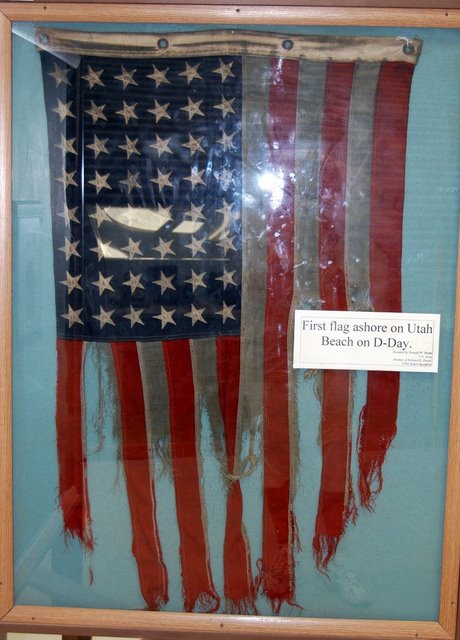
First Flag on Utah Beach, June 6, 1944

First U.S. flag on Utah Beach, Normandy, D-Day, June 6, 1944; Pima Air Museum, Tucson, Arizona

This mostly an encore post. A reader sent an e-mail with a question: Does U.S. law suggest the flying of the U.S. flag on the anniversary of D-Day?

Today is the 66th anniversary of the Invasion of Normandy in World War II, a date generally called D-Day. No, you don’t have to fly your flag. This is not one of the days designated by Congress for flag-flying.

But you may, and probably, you should fly your flag. If you have any D-Day veterans in your town, they will be grateful, as will their spouses, children, widows and survivors. A 22-year-old soldier on the beach in 1944 would be 87 today, if alive. These men and their memories of history fade increasingly fast. Put your flag up. You may be surprised at the reaction.

If you do run into a D-Day veteran, ask him about it. Keep a record of what he says.

First Wave at Omaha:  The Ordeal of the Blue and the Gray by Ken Riley:  Behind them was a great invasion armada and the powerful sinews of war. But in the first wave of assault troops of the 29th (Blue and Gray) Infantry Division, it was four rifle companies landing on a hostile shore at H-hour, D-Day -- 6:30 a.m., on June 6, 1944. The long-awaited liberation of France was underway. After long months in England, National Guardsmen from Virginia, Maryland and the District of Columbia found themselves in the vanguard of the Allied attack. In those early hours on the fire-swept beach the 116th Infantry Combat Team, the old Stonewall Brigade of Virginia, clawed its way through Les Moulins draw toward its objective, Vierville-sur-Mer. It was during the movement from Les Moulins that the battered but gallant 2d Battalion broke loose from the beach, clambered over the embankment, and a small party, led by the battalion commander, fought its way to a farmhouse which became its first Command post in France. The 116th suffered more than 800 casualties this day -- a day which will long be remembered as the beginning of the Allies Great Crusade to rekindle the lamp of liberty and freedom on the continent of Europe.  Image from National Guard Heritage series, from which the caption was borrowed.

"First Wave at Omaha: The Ordeal of the Blue and the Gray" by Ken Riley: Behind them was a great invasion armada and the powerful sinews of war. But in the first wave of assault troops of the 29th (Blue and Gray) Infantry Division, it was four rifle companies landing on a hostile shore at H-hour, D-Day -- 6:30 a.m., on June 6, 1944. The long-awaited liberation of France was underway. After long months in England, National Guardsmen from Virginia, Maryland and the District of Columbia found themselves in the vanguard of the Allied attack. In those early hours on the fire-swept beach the 116th Infantry Combat Team, the old Stonewall Brigade of Virginia, clawed its way through Les Moulins draw toward its objective, Vierville-sur-Mer. It was during the movement from Les Moulins that the battered but gallant 2d Battalion broke loose from the beach, clambered over the embankment, and a small party, led by the battalion commander, fought its way to a farmhouse which became its first Command post in France. The 116th suffered more than 800 casualties this day -- a day which will long be remembered as the beginning of the Allies' "Great Crusade" to rekindle the lamp of liberty and freedom on the continent of Europe. Image from National Guard Heritage series, from which the caption was borrowed.

Quote of the moment: Eisenhower on D-Day

Eisenhower talks to troops of invasion force, June 5 -- before D-Day[Encore post from 2007.]

Soldiers, Sailors, and Airmen of the Allied Expeditionary Force: You are about to embark upon the Great Crusade, toward which we have striven these many months. The eyes of the world are upon you.

Order of the Day, 6 June, 1944 (some sources list this as issued 2 June)

mmm


Who is that woman with Sen. Watkins, Sec. Benson and President Eisenhower?

June 5, 2010

Minor mystery, but still, it nags.

Who is the woman in this photo?  This is a chance to play history detective.

Sen. Arthur V. Watkins, Sec. of Agriculture Ezra Taft Benson, President Eisenhower, and unidentified woman, 9-9-1958, Shipler Photography image via Utah Hist Soc

Utah Sen. Arthur V. Watkins, Sec. of Agriculture Ezra Taft Benson, and President Dwight D. Eisenhower, with unidentified woman, on September 9, 1958. Photo by Shipler Commercial Photography, scanned at Marriott Library from the collection of the Utah Historical Society (which holds the rights).

I stumbled across the photo at the on-line archives of the Utah Historical Society.  At the time of this picture, Watkins was running for re-election in a race he would lose in November, in a three-way vote split, to Democrat Frank E. Moss.  Watkins had run afoul of very conservative Utah politics when he chaired the Senate select committee that investigated Sen. Joseph McCarthy, and recommended censure of McCarthy.

Ezra Taft Benson served as Eisenhower’s Secretary of Agriculture for the full eight years of Eisenhower’s administration.  Benson was an arch conservative, closely affiliated with the extreme right-leaning John Birch Society, which officially regarded Eisenhower as a bit of a traitor. Benson later served as President of the Church of Jesus Christ of Latter-day Saints (LDS, or Mormon).

Oddly, the picture doesn’t identify the woman.  She’s in a wheel chair.  The large stone columns suggest this is a government building, or monument.  The microphone is set at the level of the woman, so obviously she was speaking at this event, whatever it was.  In an election year, such a scene might be played out in the state of the election, Utah — but I suspect it was a Washington, D.C., venue (was Eisenhower in Utah in 1958?).  Shipler Photography was a Utah company, though — what would they be doing in Washington?

Who is that woman?  What was the event?  Where was it?

_______________

Update: Best guess so far:  Louise Lake, a polio victim from Salt Lake City, and “handicapped American of the year” for 1958. See comments.


Encore quote of the moment: George Washington on religious freedom

June 3, 2010

August 17, 1790, found U.S. President George Washington traveling the country, in Newport, Rhode Island.

Washington met with “the Hebrew Congregation” (Jewish group), and congregation leader (Rabbi?) Moses Seixas presented Washington with an address extolling Washington’s virtues, and the virtues of the new nation. Seixas noted past persecutions of Jews, and signalled a hopeful note:

Deprived as we heretofore have been of the invaluable rights of free citizens, we now (with a deep sense of gratitude to the Almighty disposer of all events) behold a government erected by the Majesty of the People–a Government which to bigotry gives no sanction, to persecution no assistance, but generously affording to All liberty of conscience and immunities of Citizenship, deeming every one, of whatever Nation, tongue, or language, equal parts of the great governmental machine.

George Washingtons reply to the Newport, RI, Hebrew congregation, August 17, 1790 - Library of Congress image

George Washington's reply to the Newport, RI, "Hebrew congregation," August 17, 1790 - Library of Congress image

President Washington responded with what may be regarded as his most powerful statement in support of religious freedom in the U.S. — and this was prior to the ratification of the First Amendment:

It is now no more that toleration is spoken of as if it was the indulgence of one class of people that another enjoyed the exercise of their inherent natural rights. For happily, the government of the United States, which gives to bigotry no sanction, to persecution no assistance, requires only that they who live under its protection should demean themselves as good citizens, in giving it on all occasions their effectual support.

Below the fold, more history of the events and religious freedom, from the Library of Congress.

Read the rest of this entry »


So, on June 2, 1924, all American Indians became citizens of the U.S.

June 2, 2010

English colonists, and then citizens of the new United States of America, regarded Native Americans as foreign groups, people of other lands. It’s part of a history of bad relations and bad faith between peoples on this continent that we gloss over with the good relations and good faith.

The whole story is important.  It’s been told, and told well, at the Library of Congress:

On June 2, 1924, Congress enacted the Indian Citizenship Act, which granted citizenship to all Native Americans born in the U.S. The right to vote, however, was governed by state law; until 1957, some states barred Native Americans from voting. In a WPA interview from the 1930s, Henry Mitchell describes the attitude toward Native Americans in Maine, one of the last states to comply with the Indian Citizenship Act:

One of the Indians went over to Old Town once to see some official in the city hall about voting. I don’t know just what position that official had over there, but he said to the Indian, ‘We don’t want you people over here. You have your own elections over on the island, and if you want to vote, go over there.

‘”The Life of Henry Mitchell,”
Old Town, Maine,
Robert Grady, interviewer,
circa 1938-1939.
American Life Histories, 1936-1940

Native Americans During Mathematics Class

Native Americans During Mathematics Class at Indian School, Carlisle, Pennsylvania

Native Americans During Mathematics Class, (detail)
Indian School, Carlisle, Pennsylvania,
Frances Benjamin Johnston, photographer, 1903.
Prints and Photographs Division

Previously, the Dawes Severalty Act (1887) had shaped U.S. policy towards Native Americans. In accordance with its terms, and hoping to turn Indians into farmers, the federal government redistributed tribal lands to heads of families in 160-acre allotments. Unclaimed or “surplus” land was sold, and the proceeds used to establish Indian schools where Native-American children learned reading, writing, and the domestic and social systems of white America. By 1932, the sale of both unclaimed land and allotted acreage resulted in the loss of two-thirds of the 138 million acres that Native Americans had held prior to the Dawes Act.

In addition to the extension of voting rights to Native Americans, the Secretary of the Interior commission created the Meriam Commission to assess the impact of the Dawes Act. Completed in 1928, the Meriam Report described how government policy oppressed Native Americans and destroyed their culture and society.

The poverty and exploitation resulting from the paternalistic Dawes Act spurred passage of the 1934 Indian Reorganization Act. This legislation promoted Native-American autonomy by prohibiting allotment of tribal lands, returning some surplus land, and urging tribes to engage in active self-government. Rather than imposing the legislation on Native Americans, individual tribes were allowed to accept or reject the Indian Reorganization Act. From 1934 to 1953, the U.S. government invested in the development of infrastructure, health care, and education, and the quality of life on Indian lands improved. With the aid of federal courts and the government, over two million acres of land were returned to various tribes.

American Indians of the Pacific Northwest

Salish man
Salish Man Named Paul Challae and Small Child,
Montana,
date unknown.

Salish couple

Salish Man and Woman Sitting on Rocks, Montana (?) (date unknown.)

Salish Man and Woman Sitting on Rocks,
Montana [?],
date unknown. 

Salish Woman and Children

Salish Woman and Children

Salish Woman and Children,
St. Ignatius Mission, Montana.
1924.

American Indians of the Pacific Northwest integrates over 2,300 photographs and 7,700 pages of text relating to Native Americans of two cultural areas of the Pacific Northwest. Many aspects of life and work — including housing, clothing, crafts, transportation, education, and employment, are illustrated in this collection drawn from the extensive holdings of the University of Washington Libraries, the Cheney Cowles Museum/Eastern Washington State Historical Society, and the Museum of History and Industry in Seattle.

And doesn’t that just frost the tar out of the birthers?  Herbert Hoover just five years later chose Charles Curtis to be  his vice presidential candidate, and Curtis served for four years.  Curtis, born in the Kansas Territory before it was a state, came from Native American ancestry.