150 years ago, a book that changed history: Charles Darwin, Origin of Species

November 25, 2009

150 years ago today Charles Darwin’s “big book,” On the Origin of Species, was first published.  The entire publication run of more than a thousand copies sold out within a few days, making it a certified best-seller of its day.

A rare copy of the first edition, found in the loo of an old house, sold at auction at Christie’s for US$172,000.

Olivia Judson’s already got her day-after blog post up at the New York Times site, talking about a key issue in evolution:  Extinction.  She already blogged on the importance of the Big Book.

And the “Origin” changed everything. Before the “Origin,” the diversity of life could only be catalogued and described; afterwards, it could be explained and understood. Before the “Origin,” species were generally seen as fixed entities, the special creations of a deity; afterwards, they became connected together on a great family tree that stretches back, across billions of years, to the dawn of life. Perhaps most importantly, the “Origin” changed our view of ourselves. It made us as much a part of nature as hummingbirds and bumblebees (or humble-bees, as Darwin called them); we, too, acquired a family tree with a host of remarkable and distinguished ancestors.

The reason the “Origin” was so powerful, compelling and persuasive, the reason Darwin succeeded while his predecessors failed, is that in it he does not just describe how evolution by natural selection works. He presents an enormous body of evidence culled from every field of biology then known. He discusses subjects as diverse as pigeon breeding in Ancient Egypt, the rudimentary eyes of cave fish, the nest-building instincts of honeybees, the evolving size of gooseberries (they’ve been getting bigger), wingless beetles on the island of Madeira and algae in New Zealand. One moment, he’s considering fossil animals like brachiopods (which had hinged shells like clams, but with a different axis of symmetry); the next, he’s discussing the accessibility of nectar in clover flowers to different species of bee.

At the same time, he uses every form of evidence at his disposal: he observes, argues, compares, infers and describes the results of experiments he has read about, or in many cases, personally conducted. For example, one of Darwin’s observations is that the inhabitants of islands resemble — but differ subtly from — those of the nearest continents. So: birds and bushes on islands off the coast of South America resemble South American birds and bushes; islands near Africa are populated by recognizably African forms.

Of course you –you cognescenti, you — know Judson is the wit behind Dr. Tatiana’s Sex Advice to All Creation, a thoroughly delightful, funny and scientifically accurate book.  Which brings to my mind this question:  Why are scientists, and especially evolutionary scientists, so funny and charming, in stark contrast to the dull proles of creationism?

And, were he not ill at the time, can you imagine what a fantastic dinner guest Charles Darwin himself would be?

Darwin's hand-drawn "tree of life"

Darwin's hand-drawn "tree of life"

Meanwhile, at PBS, NOVA already featured “Darwin’s Darkest Hour” earlier this year.  NOVA research Gaia Remerowski alerts us to a coming production, “What Darwin Never Knew,” featuring progress made in evolutionary development, “evo-devo.”   Science marches on.

Remerowski illustrated her post with Darwin’s quick, hand drawing of a “tree of life,” a drawing that has become iconic in biology circles — like the one to your right.  This one comes from the website of “Speaking of Faith,” another PBS production that featured Darwin earlier this year.  SOF offered an online tour of some of the work of Darwin, too — other drawings from Darwin’s own hand.  Nice exhibit.

Our country’s advocates for good science education, the National Center for Science Education (NCSE) carried Origin Day greetings and a rundown of a dozen projects commemorating the 150th year of the book, and the 200th anniversary of Darwin’s birth.

Happy Origin Day, indeed.


Rap at the White House: Alexander Hamilton

November 22, 2009

An Obama guest, Lin-Manuel Miranda, pushes the envelope on gangsta rap, and history teaching:

You can’t use that in the classroom, teachers?  Why not?

More:

Wikipedia notes of Miranda:

He is working on a hip-hop album based upon the life of Alexander Hamilton, entitled The Hamilton Mixtape.[5] He recently performed “The Hamilton Mixtape” at the White House Evening of Poetry, Music, and the Spoken Word on May 12, 2009. Accompanied by Alex Lacamoire. [12]

Tip of the old scrub brush to Slashdot.


Add to FacebookAdd to NewsvineAdd to DiggAdd to Del.icio.usAdd to StumbleuponAdd to RedditAdd to BlinklistAdd to TwitterAdd to TechnoratiAdd to Furl


Creationist: Murdering Jews may be preferable to lying to prevent the murder

November 14, 2009

I’m cutting the monster a lot of slack with the headline.

P. Z. Myers publicized the e-mail exchange involving Bodie Hodge, a minor deity at the anti-science, creationist organization Answers in Genesis (AiG).  Myers was nice to the guy, contrary to the usual creationist cartoon of Myers as somehow immoral for being a non-worshipper of gods.  Well, he was nicer than I would have been.  But Myers expects Christians to exhibit no sense of shame, no common sense, and twisted morality.  I expect bettter of them.

A reader posed that age-old question to Hodge:  Is the Christian rule against lying so strong that a Christian should tell Nazi troops where Jewish families are hiding?  Hodge weasels later by saying he hopes he never has to make such a choice, and that he really doesn’t know how he’d act in that situation.  But this comes only after he says that telling  a lie to Nazis to save Jews will get one burned in hell.  And then he goes on to note it’s better to be in good with God than to act morally.

In other words, better to become an accomplice in the murder of Jews than to stand up against murderers.

I don’t get how these charlatans of religion, reason to such a point.

What would Jesus do?  We know.  When the crowd was threatening to stone to death a woman guilty of adultery and she sought refuge with Jesus, Jesus stood up to the mob and saved her life.  Just execution of Biblical law or shelter the accused, Jesus stood against the murder, even murder sanctioned by the religious rules of the community.

We also know that scripture endorses deception from time to time.  You know these AiG clowns are charlatans when they say stupid stuff like this.  Hodge tries to explain away another case of deception by inventing a scenario not found in scripture in which the lie doesn’t get told.

He’s forgotten the story of Jacob and Esau, and how Jacob and his mother conpsired to deceive Isaac in order to steal away Esau’s birthright (Esau and Jacob were twins, by the way).  Jacob got away with the deed, was then blessed by God.  He took a new name:  Israel.  He lived on to be the seed of Judaism, the religion Jesus followed and the foundation of Christianity.

To AiG, it appears that scripture is just a dusty old book, except when they can twist it to support their bigotry.  Here’s irony for you:  The story of Jacob is in Genesis.  You know, as in “Answers in Genesis.”  They don’t even know their own namesake book!

Here in America, as a nation we overcame that morality-or-religion problem with Huck Finn.  The ill-educated young teen, an absentee to grammar, faces the moral decision as he floats down the Mississippi with Jim, an escaped slave who has saved Huck’s life and is in other ways a very good friend.  Huck notes that the preachers are all agreed that Huck’s moral duty is to turn Jim in as an escaped slave, to condemn Jim to a continued life of slavery, should Jim survive the lashing.  Huck Finn puts the dilemma squarely:  Whether to obey God and turn in Jim to the authorities, or to burn in hell and let Jim live the life of a free man.  Huck agonizes, but decides:  He’ll burn in hell rather than give away his friend.

Myers wrote:

As a non-Bible believing amoral godless atheist, my first thought was that this is trivial: you lie your pants off. The ‘crime’ of telling a lie pales into insignificance against the crime of enabling the death of fellow human beings.

According to Bodie Hodge of AiG, though, I’m wrong. The good Christian should reject lies, Satan’s tools, in all circumstances, and should immediately ‘fess up the location of the Jews. He backs it up with Bible quotes, too.

If we love God, we should obey Him (John 14:15). To love God first means to obey Him first–before looking at our neighbor. So, is the greater good trusting God when He says not to lie or trusting in our fallible, sinful minds about the uncertain future?

Consider this carefully. In the situation of a Nazi beating on the door, we have assumed a lie would save a life, but really we don’t know. So, one would be opting to lie and disobey God without the certainty of saving a life–keeping in mind that all are ultimately condemned to die physically. Besides, whether one lied or not may not have stopped the Nazi solders from searching the house anyway.

As Christians, we need to keep in mind that Jesus Christ reigns. All authority has been given to Him (Matthew 28:18), and He sits on the throne of God at the right hand of the Father (Acts 2:33; Hebrews 8:1). Nothing can happen without His say. Even Satan could not touch Peter without Christ’s approval (Luke 22:31). Regardless, if one were to lie or not, Jesus Christ is in control of timing every person’s life and able to discern our motives. It is not for us to worry over what might become, but rather to place our faith and obedience in Christ and to let Him do the reigning. For we do not know the future, whereas God has been telling the end from the beginning (Isaiah 46:10).

Gosh. I never thought of it that way. So…all those Christians who sheltered Jews during WWII are actually burning in hell right now for their sinful wickedness? That is so counterintuitive, it must be true!

One more time we should side with morality, and against creationist distortions of Christianity and morality.

With all the learning they get at that reeking cesspool the creationism museum, you’d think they could demonstrate the moral fiber of a tobacco-chewing, food-stealing, school-cutting runaway teen, Huckleberry Finn.

Full AiG post below the fold (I expect them to strike it down when they rethink; let all Christians pray to God they do rethink).

Add to FacebookAdd to NewsvineAdd to DiggAdd to Del.icio.usAdd to StumbleuponAdd to RedditAdd to BlinklistAdd to TwitterAdd to TechnoratiAdd to Furl

Read the rest of this entry »


Who are those Boy Scouts in 1943?

November 13, 2009

A posed photograph:  Three Boy Scouts, from at least two different units, holding a poster Scouts were distributing about international cooperation in World War II.  They are saluting, and behind them rises the dome of the U.S. Capitol on a brilliantly sunny day.

Boy Scouts at the Capitol, 1943? - Library of Congress image

Caption from the U.S. Senate Historical Office: "Boy Scouts aid the war effort by delivering posters that encourage a united fight for freedom, ca.1943. credit: Library of Congress"

1943?  Who were the Scouts?

The photo is online in the collection of the U.S. Senate Historical Office (a good source of images, by the way).

I just wondered, who are those Scouts, and where are they today?

Boy Scouts assisted war efforts in a lot of ways in a lot of American cities, towns and villages.  Affiliates at the Tom Harbin Scout Museum at Camp Wisdom in Dallas (Circle 10 Council) have papers documenting and detailing massive scrap and paper drives, and a lot of other activities we probably wouldn’t let Scouts get into today.

The three Scouts in the photo wear what appears to be two different neckerchiefs, suggesting they come from at least two different troops or other units.  All three wear the uniform of the Boy Scouts of America, but two of the three look as though they may be immigrants or children of immigrants.

The date given is a “circa 1943.”  But the poster plugs a “United Nations” — could it have been as late as 1945 or 1946 and the official organizing of the United Nations?

What do you think?  What do you know?

Update: Wikimedia puts the date of the poster as 1941Shorpy says the photo is 1943:

“Washington, 1943. “United Nations Fight for Freedom: Colored, white and Chinese Boy Scouts in front of Capitol. They help out by delivering posters to help the war effort.” View full size. 4×5 Kodachrome transparency by John Rous for the Office of War Information. What photo expert out there can tell us about the numbers on these Kodachromes — how and at what point in the manufacturing/ exposure/ developing process they were made, and what they signify.

All those details and not the names of the Scouts?  In comments at Shorpy we also see that the temporary patch for the Scout on the left is for a 1942 campout.  So we know the photo was later than 1941.  The community patch for the Scout on the right says Washington where the city patch should be, with no state patch (if they had separate patches then).  So it’s probably a Washington, D.C. unit — and it’s Troop 11.  Anybody from National Capital Council ever read this site?  Were all three of these Scouts from Troop 11?

I have found, but cannot yet examine, another photo from the same roll of film, showing just the Scout in the middle.

Update 2: This may identify one of the Scouts, with an astounding story:

1941, Boy Scout, poster urging water saving, Anderson Grimes

Caption from CityDesk.net: "July 1941. Local Boy Scout Anderson Grimes in front of the U.S. Capitol building in Washington, D.C., holding a copy of a WPA poster designed for the city’s landmark water conservation program."

That solo Scout is clearly the same one in the first photo, so we have one name:  Anderson Grimes.

But the entire story from CityDesk.net is more amazing, if true:

July 1941. Local Boy Scout Anderson Grimes in front of the U.S. Capitol building in Washington, D.C., holding a copy of a WPA poster designed for the city’s landmark water conservation program. Shortly after this photo was taken, he was to present the poster to local congressman Harford Collins in a brief ceremony. Tragically, Grimes, along with several local reporters and congressional aides, instead found Senator Collins slumped over his desk, dead from a heart attack.

Thirty years later, Grimes ended up serving the same seat in Congress for four terms. He did not die in office.
– RJ White

If true?  I can’t find a listing for a Sen. Harford Collins in the Congressional biography pages, nor for any Member in either house named Anderson Grimes.

More mystery.  Is the Scout even named Anderson Grimes?

Okay, after j. a. higginbotham wrote in, I finally got it:  CityDesk.net is a satire site.  They wrote a phony story to accompany the photograph.

That’s right:  I got hoaxed.

Still looking for information on the Scouts and their troop(s).

Update, November 15: Is the water conservation poster in the version above a PhotoShop addition?  Here’s a photo held by the Library of Congress:

Boy Scout after 1942 showing posters Scouts distributed; photo by John Rous, Library of Congress collection

From Library of Congress: "United Nations Fight for Freedom: Boy Scout in front of Capitol. They help out by delivering posters to help the war effort"

Add to FacebookAdd to NewsvineAdd to DiggAdd to Del.icio.usAdd to StumbleuponAdd to RedditAdd to BlinklistAdd to TwitterAdd to TechnoratiAdd to Furl


50 U.S. Senators missing — can you help find them?

November 13, 2009

No, not current senators — don’t get your ignoble hopes up.

With more than 40,000 photographs and other images, the Senate Historical Office has images of almost all people who have served as members of the U.S. Senate.  5o members are completely absent from the Senate collection, however.

Got any idea where to find images of these guys?  This comes from the Senate Historical Office:

Senators Not Represented in Senate Historical Office Photo Collection

The Senate Historical Office maintains a collection of more than 40,000 still pictures, slides, and negatives. The collection includes photographs and illustrations of most former senators, but to date no photo or other illustration of about fifty members has been found. Below is a list (by state) of U.S. Senators for whom we have no image in our collection. If you have an image, or information that may lead us to an image, please contact the Senate’s photo historian.

__________________________

Alabama: – 2
William Kelly, 1822-1825
John Williams Walker, 1819-1822

Connecticut: – 2
Thaddeus  Betts, 1839-1840
Perry Smith, 1837-1843

Delaware: – 1
Outerbridge Horsey, 1810-1821

Georgia: – 5
William Bellinger Bulloch, 1813-1813
Thomas Willis Cobb, 1824-1828
Alfred Cuthbert, 1835-1843
James Gunn, 1789-1801
Josiah Tattnall, 1796-1799

Kentucky – 1
George Walker, 1814-1814

Louisiana – 3
Eligius Fromentin, 1813-1819
Allan Bowie Magruder, 1812-1813
Robert Carter Nicholas, 1836-1841

Massachusetts – 1
Eli Porter Ashmun, 1816-1818

Maryland – 6
John Henry, 1789-1797
Robert Henry Goldsborough, 1813-1819, 1835-1836
James Lloyd, 1797-1800
William Dunhurst Merrick, 1838-1845
John Selby Spence, 1836-1840
David Stewart, 1849-1850

Mississippi – 4
Robert Huntington Adams, 1830-1830
John Black, 1832-1838
Joseph Williams Chalmers, 1845-1847

New Hampshire – 2
Charles Cutts, 1810-1813
Nahum Parker, 1807-1810

New Jersey: – 3
Jonathan Elmer, 1789-1791
Aaron Kitchell, 1805-1809
James Jefferson Wilson, 1815-1821

New York – 1
Obadiah German, 1809-1815

North Carolina – 4
Timothy Bloodworth, 1795-1801
Jesse Franklin, 1799-1805, 1807-1813
Francis Locke, 1814-1815
James Turner, 1805-1816

Ohio – 3
Stanley Griswold, 1809-1809
Joseph Kerr, 1814-1815
John Smith, 1803-1808

Pennsylvania – 1
Samuel Maclay, 1803-1809

Rhode Island – 7
Nathan Dixon, Sr., 1839-1842
Benjamin Howland, 1804-1809
Henry Frederick Lippitt, 1911-1917
Francis Malbone, 1809-1809
Samuel John Potter, 1803-1804
Joseph Stanton, Jr., 1790-1793
William Sprague, 1842-1844

South Carolina – 1
John Hunter, 1796-1798

Tennessee – 3
Daniel Smith, 1798-1799, 1805-1809
Jesse Wharton, 1814-1815
Jenkin Whiteside, 1809-1811

Vermont – 4
Dudley Chase, 1813-1817, 1825-1831
Nathaniel Chipman, 1797-1803
Jonathan Robinson, 1807-1815
Israel Smith, 1803-1807

_________________________

You just know that somewhere out there, a local museum has a painting of one of these guys.  Or, someone has a painting or drawing of an old-timey guy hanging over a fireplace, a family heirloom that features one of these guys.  I mean, how could a guy like Outerbridge Horsey fail to inspire an artist somewhere?

Do you know of one?  Contact the Senate Historical Office, and let us know here, too.


Fly your flag today: Veterans Day 2009

November 11, 2009

Fly your U.S. flag today — thank a veteran.  We have a lot to thank veterans for, and veterans need a little more appreciation today.

Veterans Day Poster, 2009, U.S. Department of Veterans Affairs

US Veterans Administration tells the history of celebrating Veterans Day on November 11:

World War I – known at the time as “The Great War” – officially ended when the Treaty of Versailles was signed on June 28, 1919, in the Palace of Versailles outside the town of Versailles, France. However, fighting ceased seven months earlier when an armistice, or temporary cessation of hostilities, between the Allied nations and Germany went into effect on the eleventh hour of the eleventh day of the eleventh month. For that reason, November 11, 1918, is generally regarded as the end of “the war to end all wars.”

In November 1919, President Wilson proclaimed November 11 as the first commemoration of Armistice Day with the following words: “To us in America, the reflections of Armistice Day will be filled with solemn pride in the heroism of those who died in the country’s service and with gratitude for the victory, both because of the thing from which it has freed us and because of the opportunity it has given America to show her sympathy with peace and justice in the councils of the nations…”

The original concept for the celebration was for a day observed with parades and public meetings and a brief suspension of business beginning at 11:00 a.m.

The United States Congress officially recognized the end of World War I when it passed a concurrent resolution on June 4, 1926, with these words:

Whereas the 11th of November 1918, marked the cessation of the most destructive, sanguinary, and far reaching war in human annals and the resumption by the people of the United States of peaceful relations with other nations, which we hope may never again be severed, and

Whereas it is fitting that the recurring anniversary of this date should be commemorated with thanksgiving and prayer and exercises designed to perpetuate peace through good will and mutual understanding between nations; and

Whereas the legislatures of twenty-seven of our States have already declared November 11 to be a legal holiday: Therefore be it Resolved by the Senate (the House of Representatives concurring), that the President of the United States is requested to issue a proclamation calling upon the officials to display the flag of the United States on all Government buildings on November 11 and inviting the people of the United States to observe the day in schools and churches, or other suitable places, with appropriate ceremonies of friendly relations with all other peoples.

An Act (52 Stat. 351; 5 U. S. Code, Sec. 87a) approved May 13, 1938, made the 11th of November in each year a legal holiday—a day to be dedicated to the cause of world peace and to be thereafter celebrated and known as “Armistice Day.” Armistice Day was primarily a day set aside to honor veterans of World War I, but in 1954, after World War II had required the greatest mobilization of soldiers, sailors, Marines and airmen in the Nation’s history; after American forces had fought aggression in Korea, the 83rd Congress, at the urging of the veterans service organizations, amended the Act of 1938 by striking out the word “Armistice” and inserting in its place the word “Veterans.” With the approval of this legislation (Public Law 380) on June 1, 1954, November 11th became a day to honor American veterans of all wars.

Later that same year, on October 8th, President Dwight D. Eisenhower issued the first “Veterans Day Proclamation” which stated: “In order to insure proper and widespread observance of this anniversary, all veterans, all veterans’ organizations, and the entire citizenry will wish to join hands in the common purpose. Toward this end, I am designating the Administrator of Veterans’ Affairs as Chairman of a Veterans Day National Committee, which shall include such other persons as the Chairman may select, and which will coordinate at the national level necessary planning for the observance. I am also requesting the heads of all departments and agencies of the Executive branch of the Government to assist the National Committee in every way possible.”

  • Click here for the 2007 poster from the Veterans Administration, or for posters dating back to 1978.
  • Veterans Day Teacher Resource Kit, for lesson plans and activities
  • veteransday09 Google

    Google's 2009 tribute to Veterans Day

    Remind others to fly their flags, too:

    Add to FacebookAdd to NewsvineAdd to DiggAdd to Del.icio.usAdd to StumbleuponAdd to RedditAdd to BlinklistAdd to TwitterAdd to TechnoratiAdd to Furl


    Surely we’ve found everything by now

    November 4, 2009

    Well, no, we haven’t.  Nice little post by a photographer urging people to go look to see what they can find, with a brilliantly concise set of arguments about big things discovered just in the past few years.

    Nice photos, too — go see.


    Jack Kilby, inventor of the computer chip

    November 1, 2009

    KERA Television has a marvelous short film profile of Jack Kilby, who won the Nobel in physics for his invention of what we now call “the computer chip.”

    Late in his life, Jack Kilby holds his first integrated circuit, which is encased in plastic. Photo via Texas Instruments, via Earth & Sky

    Late in his life, Jack Kilby holds his first integrated circuit, which is encased in plastic. Photo via Texas Instruments, via Earth & Sky

    Teachers should check out the film and use it — it’s a great little chapter of Texas history, science history, and U.S. history.  It’s an outstanding explanation of a technological development that revolutionized so much of our daily life, especially in the late 20th century.  At 8 minutes and 37 seconds, the film is ideal for classroom use.

    Alas!  My technology won’t allow embedding the video here, and so far as I can tell it is only available in broadcast on KERA and at KERA’s website.  So, go there and look at it!  If you can download it for use, more power to you — and let us know in comments how you did it.
    [2015 update: Good news! KERA put the film up on YouTube! Teachers, especially Texas history teachers, take note, and copy URL!]

    2009 marks the 50th anniversary of Kilby’s filing for a patent on an integrated circuit.  He’s been honored by the Inventor’s Hall of Fame.  Despite the stupendous value of his invention, Kilby’s name is far from a household name even in North Dallas, home of Texas Instruments. Robert Noyce, who came up with almost exactly the same idea at almost exactly the same moment, is similarly ignored.

    Shouldn’t today’s high school students know about Kilby and Noyce?  Not a class period goes by that I don’t use a device powered by Kilby’s invention; nor does one pass that I don’t have to admonish at least one student for misuse of such a device, such as an iPod, MP3 player, or cell phone.  It’s difficult to think of someone whose invention has greater influence on the life of these kids, hour by hour — but Kilby and his invention don’t get their due in any text I’ve seen.

    It’s a great film — original and clever animation, good interviews, and it features Kilby’s charming daughter, and the great journalist and historian of technology T. R. Reid.  Don’t you agree that it’s much better than most of the history stuff we have to show?

    Texas history standards require kids to pay brief homage to inventors in the 20th century.   Kilby is not named in the standards, however, and so he and his invention are ignored as subjects of history study.  You ought to fix that in your classroom, teachers.

    (Kilby was born and grew up in Great Bend, Kansas — Kansas teachers may want to take note.  According to the KERA film, Kilby was a Boy Scout, making it at least to First Class.)

    TI company video on Kilby featuring interviews from the 1990s, prior to his 2000 Nobel Physics Prize

    Additional Resources

    TI company video on the 2008 50th anniversary of the chip

    Share this post:

    Add to FacebookAdd to NewsvineAdd to DiggAdd to Del.icio.usAdd to StumbleuponAdd to RedditAdd to BlinklistAdd to TwitterAdd to TechnoratiAdd to Furl


    Gilded Age project

    October 27, 2009

    I really like this project, and I wish I’d come across it about a month ago:

    The Gilded Age Class Documentary Project

    The Gilded Age – Class Documentary Project

    Instructors:  Rachel Duffy, Marc Ducharme

    May, 2005

    Adapted from:  The Gilded Age WebQuest – Documenting Industrialization in America

    By: Thomas Caswell and Joshua DeLorenzo

    What do you think?


    Democrats take solid South

    October 25, 2009

    Bob Moser says they can.  He’s talking about how to do it at SMU this week.

    Can’t make it?  Buy the book.

    The William P. Clements Center for Southwest Studies
    and the
    Geurin-Pettus Program in the Department of Political Science
    at Southern Methodist University
    invite you to


    Bob Moser, editor of the Texas Observer and an award-winning political reporter for The Nation, has chronicled Southern politics for nearly two decades.

    In Blue Dixie he argues that the Democratic Party needs to jettison outmoded prejudices about the South if it wants to build a lasting national majority.  With evangelical churches preaching  a more expansive social gospel and a massive left-leaning demographic shift to African Americans, Latinos, and the young, the South is poised for a Democratic revival. Moser shows how a volatile mix of unprecedented economic prosperity and abject poverty are reshaping the Southern vote. By returning to a bold, unflinching message of economic fairness, the Democrats can in in the nation’s largest, most diverse region and redeem themselves as a true party of the people.

    Books will be available for purchase.

    THURSDAY, October 29, 2009

    Noon to 1 pm
    Texana Room, DeGolyer Library
    6404 Hilltop Ln. & McFarlin Blvd
    Bring your own brown bag lunch!

    Better, make it to the lecture, buy the book, listen to Moser and let him autograph it for you.

    For more information, please call 214-768-2526 or email carberry AT smu DOT edu

    Invite a friend to a brown-bag lunch:

    Add to FacebookAdd to NewsvineAdd to DiggAdd to Del.icio.usAdd to StumbleuponAdd to RedditAdd to BlinklistAdd to TwitterAdd to TechnoratiAdd to Furl


    Quote of the moment: Eric Blair (George Orwell) on lies becoming history

    October 25, 2009

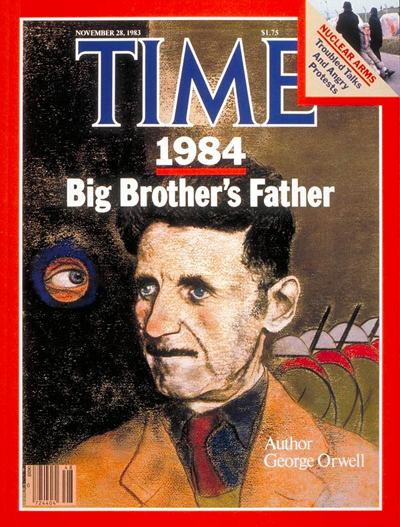
    George Orwell (Eric Blair) on cover of Time Magazine, Novmber 28, 1983

    George Orwell (Eric Blair) on cover of Time Magazine, Novmber 28, 1983

    And if all others accepted the lie which the Party imposed—if all records told the same tale—then the lie passed into history and became truth. ‘Who controls the past’ ran the Party slogan, ‘controls the future: who controls the present controls the past.’

    — George Orwell, 1984

    Tip of the old scrub brush to Kate at The Urban Primate

    If Big Brother is watching, why not let him watch all of us? Spread the word:

    Add to FacebookAdd to NewsvineAdd to DiggAdd to Del.icio.usAdd to StumbleuponAdd to RedditAdd to BlinklistAdd to TwitterAdd to TechnoratiAdd to Furl


    What is a kilosteve? Buy the t-shirt, find out

    October 24, 2009

    You can get your kilosteve t-shirt here.

    Why would you want one?

    Every scientist named Steve should have one -- and so should you!

    Every scientist named Steve should have one -- and so should you! (Front)

    Because it puts you in the company of distinguished scientists who stoutly defend the teaching of good science to children, so they can go on to become great scientists themselves.

    Plus, it’s a poke in the eye to the Texas State Board of Education, none of whom are named Steve, and few of whom would be invited to sign on if they were.

    Here’s the back of the shirt:

    KiloSteve t-shirt, back side.  1,099 total Steves. (Back)

    KiloSteve t-shirt, back side. 1,099 total Steves. (Back)

    A kilosteve is a thousand Steves.

    Creationists fondly distributed a list of scientists who, they claimed, question whether the theory of evolution is accurate.  The anti-science Discovery Institute in Seattle distributed the list starting in about 2001, with a few hundred names.

    To claims that many scientists opposed teaching evolution, NCSE created a list of scientists who support teaching evolution theory — but limiting that list to scientists with the first name “Steve,” or a derivative of Steve.  About 1% of people in the English-speaking world have such a name — so the fact that more scientists named Steve sign the list supporting evolution, than those of all names who sign the list denying it, means that the Discovery Institute list represents less than 1% of all scientists.

    A comparison of the lists is always instructive.  In 2003 I started phoning people listed on the Discovery Institute list; of the first 20 I called, ten denied having signed any petition against evolution.  One demanded his name be removed.  Five made a modest defense of being skeptical of evolution, but none of them were biologists, and none had any publications which questioned any part of evolution in any way.

    NCSE started the project in 2003, not long after the death of Stephen Jay Gould, the staunch defender of science and evolution who was the main witness in the first creationism trial, in Arkansas in 1981.  It’s a fitting memorial to a fine teacher.

    Eugenie Scott heads up NCSE.  In an e-mail this week to members of Texas Citizens for Science, who were discussing the kilosteve shirt, she noted it has already spread overseas.

    Just wanted you to know that when I gave my talk at Cambridge University Tuesday, Steve #800 walked into the lecture room wearing his kilosteve shirt.

    A proud moment!

    (Of course I threw open my arms and said in a cheery voice, “STEVE!!!”)

    It almost makes one wish one’s name were Steve.  (One also may wonder, who is Steve #800?) The shirt’s a great buy, especially considering that for the price of a kilosteve, one actually gets 1.099 kilosteves.  (As of today, there are 1,118 Steves who have signed the list.)

    Tip of the old scrub brush to Pharyngula, which noted the achievement of the kilosteve when it actually happened, and to Texas Citizens for Science, just for the heck of it..

    You came to this blog, and all you got was a plug for a lousy t-shirt; share your displeasure:

    Add to FacebookAdd to NewsvineAdd to DiggAdd to Del.icio.usAdd to StumbleuponAdd to RedditAdd to BlinklistAdd to TwitterAdd to TechnoratiAdd to Furl


    Quote of the moment: DDT causing bed bug problems, Malcolm Gladwell

    October 24, 2009

    English: ID#: 11739 Description: This digitall...

    This digitally-colorized scanning electron micrograph (SEM) revealed some of the ultrastructural morphology displayed on the ventral surface of a bedbug, Cimex lectularius. From this view you can see the insect’s skin piercing mouthparts it uses to obtain its blood meal, as well as a number of its six jointed legs. (Photo credit: Wikipedia)

    Then the Malaysians started to complain about bedbugs, and it turns out what normally happens is that ants like to eat bedbug larvae,” McWilson Warren said. “But the ants were being killed by the DDT and the bedbugs weren’t — they were pretty resistant to it. So now you had a bedbug problem.”

    Malcolm Gladwell, “The Mosquito Killer, New Yorker Magazine, July 2, 2001; Annals of Public Health

    Save


    Tracking down historic typewriters

    October 21, 2009

    By the way, Richard Polt at Xavier University lays it all over this blog in his listings of typewriters used by good authors and famous people.  If you’re looking for more information on the history of typewriters, or if you’re looking for information about an old typewriter you own, Polt’s site is a great place to start:  The Classic Typewriter Page.

    The Flying Oliver, logo of Richard Polts The Classic Typewriter Page

    The Flying Oliver, logo of Richard Polt's The Classic Typewriter Page


    We become the ephemera of history: ‘Only the privileged few of us get to be fossils’

    October 21, 2009

    From “Whose father was he?” a four-part essay on tracking down the story of three children whose photograph was discovered on the corpse of a Union soldier killed at the Battle of Gettysburg, in 1863:

    Perhaps more than any other artifact, the photograph has engaged our thoughts about time and eternity. I say “perhaps,” because the history of photography spans less than 200 years. How many of us have been “immortalized” in a newspaper, a book or a painting vs. how many of us have appeared in a photograph [32]? The Mayas linked their culture to the movements of celestial objects. The ebb and flow of kingdoms and civilizations in the periodicities of the moon, the sun and the planets. In the glyphs that adorn their temples they recorded coronations, birth, deaths. Likewise, the photograph records part of our history. And expresses some of our ideas about time. The idea that we can make the past present.

    The photograph of Amos Humiston’s three children — of Frank, Alice and Fred — allows us to imagine that we have grasped something both unique and universal. It suggests that the experience of this vast, unthinkable war can be reduced to the life and death of one man — by identifying Gettysburg’s “Unknown Soldier” we can reunite a family. That we can be saved from oblivion by an image that reaches and touches people, that communicates something undying and transcendent about each one of us.

    And the footnote, number 32:

    [32] I had an opportunity to visit the fossil collections at the Museum of the Rockies in Bozeman, Montana. It was part of a dinosaur fossil-hunting trip with Jack Horner, the premier hunter of T-Rex skeletons. Downstairs in the lab, there was a Triceratops skull sitting on a table. I picked it up and inserted my finger into the brain cavity. (I had read all these stories about how small the Triceratops brain had to have been and I wanted to see for myself.) I said to Jack Horner, “To think that someday somebody will do that with my skull.” And he said, “You should be so lucky. It’s only the privileged few of us who get to be fossils.”

    See Errol Morris’s whole series, “Whose father was he?” at the New York Times blogs:

  • Whose Father Was He? (Part Five)
  • Whose Father Was He? (Part Four)
  • Whose Father Was He? (Part Three)
  • Whose Father Was He? (Part Two)
  • Whose Father Was He? (Part One)