Marriage rights and civil rights giant, Mildred Loving, 68

May 5, 2008

We learned today that Mildred Loving died Friday in Milford, Virginia.  She was 68.

2007 was the 40th anniversary of the Supreme Court Decision in which she played a key role, Loving vs. Virginia. In that decision, the U.S. Supreme Court ruled that state laws against interracial marriage are unconstitutional.

The romance and marriage of Mildred and Richard Loving demonstrate the real human reasons behind advances in civil rights laws.  They left Virginia to avoid facing prosecution for having gotten married; but when they wanted to be closer to family, they wrote to then-Attorney General Robert F. Kennedy. He referred them to the American Civil Liberties Union, who financed the case to get the law changed.

Richard and Mildred Loving, screen capture photo from HBO documentary,

Richard and Mildred Loving, screen capture photo from HBO documentary, “The Loving Story.”

See the post from last year on the anniversary of the decision. The Associated Press wrote today:

Peggy Fortune [daughter] said Loving, 68, died Friday at her home in rural Milford. She did not disclose the cause of death.

“I want (people) to remember her as being strong and brave yet humble — and believed in love,” Fortune told The Associated Press.

Loving and her white husband, Richard, changed history in 1967 when the U.S. Supreme Court upheld their right to marry. The ruling struck down laws banning racially mixed marriages in at least 17 states.

“There can be no doubt that restricting the freedom to marry solely because of racial classifications violates the central meaning of the equal protection clause,” the court ruled in a unanimous decision.

Her husband died in 1975. Shy and soft-spoken, Loving shunned publicity and in a rare interview with The Associated Press last June, insisted she never wanted to be a hero — just a bride.

“It wasn’t my doing,” Loving said. “It was God’s work.”

Mildred Jeter was 11 when she and 17-year-old Richard began courting, according to Phyl Newbeck, a Vermont author who detailed the case in the 2004 book, “Virginia Hasn’t Always Been for Lovers.”

Richard died in 1975.

History loses another hero.

Update: Just as one more showing of how things have changed, this is the headline of the story of Mrs. Loving’s death in the Fredericksburg, Virginia, Free Lance-Star, the local newspaper in Mrs. Loving’s home county, Caroline County:  “CAROLINE HEROINE DIES

I’ll wager the Virginia headlines were quite not so glowing in 1967.


Call for help: Real story behind the Holocaust?

May 4, 2008

Historians, help me out here. I’ve recently become aware that many creationists have swallowed as accurate Richard Weikart’s book making Darwin complicit in the Nazi Holocaust of World War II.

I have always dismissed Weikart. His claims fly in the face of history recorded by too many reputable and trustworthy hands. Others aren’t concerned with what history really shows, or are simply ignorant of history (candidates for Jay Leno’s “Jaywalking” segment). I am working to assemble what I hope will be a short piece showing the error of Weikart’s claims.

It seems to me there are many holes in the history case Weikart tries to make. And the history case needs to be nailed down, accurately.

Scientists already have responded. The American Academy for the Advancement of Science complains that the scientific inaccuracies in the film muddy the waters between science and religion unfairly and unnecessarily (see video here). The Jewish Anti-Defamation League has complained about the unholy Holocaust claims. Movie reviewers have not been kind to the film, with reviews like the New York Times:

One of the sleaziest documentaries to arrive in a very long time, “Expelled: No Intelligence Allowed” is a conspiracy-theory rant masquerading as investigative inquiry.

Still there are creationists, and other people of faith out there, who grant credence to Weikart’s claims. So we need a clear rebuttal to Weikart’s claims, from the history viewpoint.

The National Center for Science Education has a brief that touches on these arguments; what other sources do you recommend on these specific claims listed below?

Weikart makes six claims (I’ve borrowed here from an article he wrote for American Spectator):

1. Darwin argued that humans were not qualitatively different from animals. The leading Darwinist in Germany, Ernst Haeckel, attacked the “anthropocentric” view that humans are unique and special.

That seems directly contrary to the view of Darwin presented in the better biographies. I don’t recall Darwin ever arguing this point at all. Is Weikart imagining this?

2. Darwin denied that humans had an immaterial soul. He and other Darwinists believed that all aspects of the human psyche, including reason, morality, aesthetics, and even religion, originated through completely natural processes.

Darwin never denied the existence of human souls. While Darwin made rather brilliant arguments for how morality could arise through evolution, going so far as to say that morality is necessary for the survival of a social species such as humans, at no point in his arguing for the natural processes does he deny or disavow the supernatural. Descent of Man will offer Darwin’s work on the rise of morals and art — what other sources would you recommend?

3. Darwin and other Darwinists recognized that if morality was the product of mindless evolution, then there is no objective, fixed morality and thus no objective human rights. Darwin stated in his Autobiography that one “can have for his rule of life, as far as I can see, only to follow those impulses and instincts which are the strongest or which seem to him the best ones.”

Notes from Evil Bender, Creationist quotemining of Darwin: moral relativism edition, has already called out the gross error in Weikart’s claim here — this is quite contrary to what Darwin actually argued and said. But again, there should be a few other sources to rebut Weikart’s claim. Which do you recommend?

4. Since evolution requires variation, Darwin and other early Darwinists believed in human inequality. Haeckel emphasized inequality to such as extent that he even classified human races as twelve distinct species and claimed that the lowest humans were closer to primates than to the highest humans.

Actually, Darwin was a potent advocate of legal equality, for example in his advocacy and support for ending slavery. Weikart’s claim here completely steps away from reality. I admit to not being overly familiar with Haeckel’s work, partly because Haeckel doesn’t represent Darwin, partly because I have just never found the guy’s work particularly interesting or useful. What sources and arguments do you recommend here?

5. Darwin and most Darwinists believe that humans are locked in an ineluctable struggle for existence. Darwin claimed in The Descent of Man that because of this struggle, “[a]t some future period, not very distant as measured by centuries, the civilised races of man will almost certainly exterminate and replace throughout the world the savage races.”

That’s a complete distortion of what Darwin wrote, of course — the NCSE site has a short rebuttal. Darwin was writing of the clash between colonists and natives, largely between Europeans and aboriginals, or between Europeans with guns and aboriginals without them. Key case in point: The Tasmanian “Wars,” which led to the almost complete extinction of native Tasmanians, a sad circumstance Darwin saw on his voyage. Got other sources you recommend?

6. Darwinism overturned the Judeo-Christian view of death as an enemy, construing it instead as a beneficial engine of progress. Darwin remarked in The Origin of Species, “Thus, from the war of nature, from famine and death, the most exalted object which we are capable of conceiving, namely, the production of the higher animals, directly follows.”

This claim is so full of hooey I’m not sure where to start. What do you think? Can you imagine how quickly Darwin would have gotten his shotgun out for some fool who suggests, like Weikart does here, that Darwin was not grieved by the death of Annie? Are you outraged at the butchering of the last paragraph from Origin of Species?

There are a lot of Christians who should know better who have been misled by this claptrap. Will you help me make a brief against Weikart’s claims?

Comments are open. Please chime in.


Happy 75th, Willie Nelson

April 30, 2008

He’s on the cover of Texas Monthly looking like the oldest piece of shoe leather south of the Red River (see photo at right — by Platon).  He was featured in the Dallas Morning News last week for “Red Headed Stranger,” the album that broke the country music mold and made him the monument to iconoclasm that he is.  And there’s a new book on  his life from Joe Nick Patoski:  Willie:  An epic life. Texas Monthly cover photo of Willie Nelson, 5-2008

I’ll wager he’s on the road today, ready to make music.

Willie Nelson turns 75 today.

You oughtta check out:


Cubs’ Rick Monday saved the American flag

April 29, 2008

Odds are high that readers of any blog are too young to remember. Heck, I’d forgotten about it until Matthew Tabor reminded me.

April 25, 1976: Rick Monday, center fielder for the Chicago Cubs, saved the U.S. flag.

Rick Monday snatches the U.S. flag from burning

Get the story from Tabor’s blog. He offers credits to HotAir.com.

Major League Baseball was kind enough to preserve the story, which you may watch below.

Resources:


Heroes of the Underground Railroad

April 26, 2008

How much do you really know about the Underground Railroad, how it worked, and what it meant to slaves in the Americas?

Do you know who Thornton and Ruthie Blackburn were?  Did you know Canada played a key role in the life of the Underground Railroad?

The book is a year old now, and well worth a look: I’VE GOT A HOME IN GLORY LAND, A Lost Tale of the Underground Railroad; Karolyn Smardz Frost, (Farrar, Straus & Giroux, 2007).

Clear review from the New York Times, and the first chapter of the book so you can test drive it before you buy.

Two-fer:  The author is both an archaeologist (the one who did the dig at the Thorntons’ home in Toronto) and a historian.

This book would be a good one for an honors history course or AP history course for which students are required to read a book.


‘Twas the 18th of April in ’75 . . . (Paul Revere’s Ride)

April 19, 2008

Paul Revere — tonight’s the anniversary of his famous ride.

John Copley's painting of Paul Revere

Paul Revere, 1768, by John Singleton Copley (1738-1815)

John Copley painted all the bigwigs of revolutionary Boston, including this portrait of the famous horse-mounted alarm before he turned older and grayer.

And as April 18 is the anniversary of Revere’s ride, April 19 is the anniversary of the “shot heard ’round the world.”

Both events are celebrated in poetry; April is National Poetry Month. This could be a happy marriage for history and English classrooms.

National Poetry Month 2008 poster


Renaissance shadow over contemporary art: Penultimate suppers

April 11, 2008

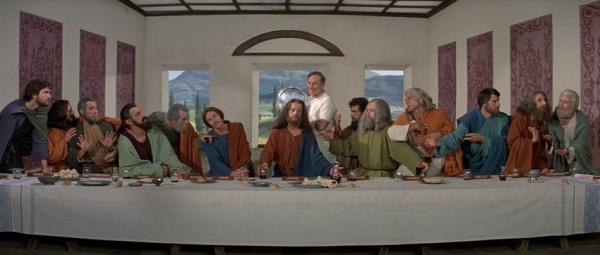
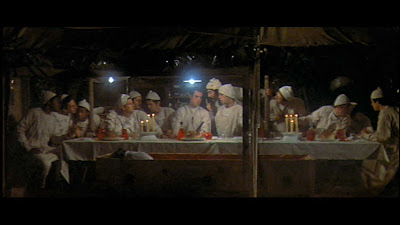
Jeremy Barker at Popped Culture assembled more than 30 versions of contemporary recastings of DaVinci’s painting of “The Last Supper.” There’s the Simpsons version, the cartoon version with Disney and Warner Bros. characters. There’s the Sopranos version, and the Battlestar Galactica version.

For example, the Robert Altman version, from M*A*S*H:

If you need a 20 minute lesson on the influence of Renaissance art on contemporary art, this is one many high school kids may find interesting, if not amazingly historically informative. I suspect there is a great lesson plan hiding in there about 20th century history as reflected in parody art.

It’s a brilliant and subtle demonstration of the power of DaVinci’s art that there are so many copy cat pictures, don’t you think?

I did notice, however, that Barker left out the Mel Brooks version, from “History of the World, Part I.” It may not fit the meme.

Mel Brooks'

Resources:


Why Rats, Lice and History is a great book

April 7, 2008

Gerald Weissman wrote a solid review of Hans Zinsser’s Rats, Lice and History in the journal Emerging Infectious Diseases. The review appeared two years ago, but I just found it.

It’s hard nowadays to reread the work of de Kruif or Sinclair Lewis without a chuckle or two over their quaint locution, but Zinsser’s raffiné account of lice and men remains a delight. Written in 1935 as a latter-day variation on Laurence Sterne’s The Life and Opinions of Tristam Shandy, Zinsser’s book gives a picaresque account of how the history of the world has been shaped by epidemics of louseborne typhus. He sounded a tocsin against microbes in the days before antibiotics, and his challenge remains meaningful today: “Infectious disease is one of the few genuine adventures left in the world. The dragons are all dead and the lance grows rusty in the chimney corner. . . . About the only sporting proposition that remains unimpaired by the relentless domestication of a once free-living human species is the war against those ferocious little fellow creatures, which lurk in dark corners and stalk us in the bodies of rats, mice and all kinds of domestic animals; which fly and crawl with the insects, and waylay us in our food and drink and even in our love”

If you’ve not read Zinsser’s book, this review will give you lots of reasons why you should.  They don’t write history like this for high schools, though they should:

Despite the unwieldy subtitle “Being a study in biography, which, after twelve preliminary chapters indispensable for the preparation of the lay reader, deals with the life history of TYPHUS FEVER,” Rats, Lice and History became an international critical and commercial success. Zinsser’s romp through the ancient and modern worlds describes how epidemics devastated the Byzantines under Justinian, put Charles V atop the Holy Roman Empire, stopped the Turks at the Carpathians, and turned Napoleon’s Grand Armée back from Moscow. He explains how the louse, the ubiquitous vector of typhus, was for most of human history an inevitable part of existence, “like baptism, or smallpox”; its habitat extended from hovel to throne. And after that Murder in the Cathedral, the vectors deserted Thomas à Becket: “The archbishop was murdered in Canterbury Cathedral on the evening of the twenty-ninth of December [1170]. The body lay in the Cathedral all night, and was prepared for burial on the following day…. He had on a large brown mantle; under it, a white surplice; below that, a lamb’s-wool coat; then another woolen coat; and a third woolen coat below this; under this, there was the black, cowled robe of the Benedictine Order; under this, a shirt; and next to the body a curious hair-cloth, covered with linen. As the body grew cold, the vermin that were living in this multiple covering started to crawl out, and, as … the chronicler quoted, ‘The vermin boiled over like water in a simmering cauldron, and the onlookers burst into alternate weeping and laughter …'”

Add to FacebookAdd to NewsvineAdd to DiggAdd to Del.icio.usAdd to StumbleuponAdd to RedditAdd to BlinklistAdd to TwitterAdd to TechnoratiAdd to Furl


Top 25 guitar riffs of all time? This school needs a history class

April 6, 2008

Guitar-X students — from London Tech Music School — picked what they consider to be the top 25 guitar riffs of all time.

You can listen to the top 25 in The Sun’s video below linked to below [I can’t get the video to embed correctly, alas]. The entire list is below that.

The Beeb’s report:

Here’s the full 25 on the list, courtesy of Reuters’ wire:

1. Smoke On The Water – Deep Purple (1973)
2. Smells Like Teen Spirit – Nirvana (1991)
3. Walk This Way – Aerosmith (1975)
4. Purple Haze – Jimi Hendrix (1967)
5. Sweet Child O Mine – Guns N Roses (1987)
6. Paradise City – Guns N Roses (1987)
7. Ace Of Spades – Motorhead (1980)
8. Enter Sandman – Metallica (1991)
9. Under The Bridge – Red Hot Chilli Peppers (1992)
10. Welcome To The Jungle – Guns N Roses (1987)
11. Run To The Hills – Iron Maiden (1982)
12. Walk – Pantera (1992)
13. Johnny Be Goode – Chuck Berry (1958)
14. Back In Black – AC/DC (1980)
15. Immigrant Song – Led Zeppelin (1970)
16. Wake Up – Rage Against The Machine (1992)
17. Highway to Hell – AC/DC (1979)
18. My Generation – The Who (1965)
19. 7 Nation Army – The White Stripes (2003)
20. Born To Be Wild – Steppenwolf (1968)
21. Give It Away – Red Hot Chilli Peppers (1991)
22. Paranoid – Black Sabbath (1970)
23. Voodoo Chile (Slight Return) – Jimi Hendrix (1967)
24. Eye Of The Tiger – Survivor (1982)
25. Money For Nothing – Dire Straits (1984)
(Editing by Paul Casciato)

A spokesman for the school seemed quite proud that a lot of the top 25 are 20 years old; no one who ever listened to rock and roll between 1957 and 2008 will think this list to be perfect, though. There is too much good guitar riffing absent. The Idolator, obviously more current than I, complains:

As you’d expect from a list based on the opinions of young guitar students, you’ve got some Hendrix, some Angus, three from Slash in the Top 10. But two Frusciantes? A Dimebag? A Knopfler?

. . . Duuuuuuude, no “Stone Cold Crazy?” And if you’re going to bother with Jack White, you have to go with “Icky Thump.” Maybe it’s just my patriotism talking, I think an American school would have made a much fiercer list. One with some Kerry King! Some John Petrucci! Some John Mayer!

John Mayer? Things that pass for value these days! (No Steely Dan licks made the list.)

How about the Beatles? No “Ticket to Ride?” How about the Stones, for the love of blues roots: No “Satisfaction?” This can’t be the list ’cause it doesn’t list the same guitar riffs as me!

No Santana? Nothing from Clapton, not even Cream? “Sunshine of Your Love” doesn’t rate over something on that list? “Layla” isn’t mentioned!? What sort of time warp list warping is that! Where is one of the three dozen great riffs from Motown? Duane Allman? How about the Beach Boys and “Surfin’ USA?”

The list seems limited by genre, too. Surely Wes Montgomery or George Benson, or both of them, should be in there. Somebody’s version of “Malagena” ought to be in there.

Comments are wide open, Dear Readers: What guitar riff ought to be in the top 25, that is not included on that list?

Resources:


Typewriter of the moment: Linowriter

April 4, 2008

Linowriter, in the collection of International Printing Museum, Carson, CA

This curious machine is in the collection of the International Museum of Printing in Carson, California. I’ve never been to the museum myself.

The museum’s website describes the machine:

Linowriter, Circa 1920

This typewriter with a linotype keyboard arrangement was sold by the Empire Typefoundry, Buffalo. Very few of these machines were made and today their exact purpose is obscure. Possibly this kind of typewriter was intended for the small newspaper office where the editorial staff also operated the linotype.
(9.5 inches high)

The Linotype machine was the device that mechanically set the type to print the newspaper, generally a very large, noisy machine that mechanically assembled lead slugs of letters, and then cast a lead plate that could be used to print the page.

I wonder:  Do you know of any linotype machines still in use?


Monument to brevity: William Henry Harrison

April 4, 2008

William Henry Harrison died on April 4, 1841, 31 days after his inauguration as president of the United States.

Perhaps during the cold and rainy inauguration, perhaps from a well-wisher, Harrison caught a cold. The cold developed into pneumonia. The pneumonia killed him.

William Henry Harrison, White House portrait Harrison, a Whig, was the first president to die in office. His vice president, John Tyler, was a converted Democrat who abandoned the Whig platform as president.

Harrison won fame pushing Indians off of lands coveted by white settlers in the Northwest Territories. Harrison defeated Tecumseh’s Shawnee tribe without Tecumseh at the Battle of Tippecanoe, then beat Tecumseh in a battle with the English in which Tecumseh died in the War of 1812.

Schoolchildren of my era learned Harrison’s election slogan: “Tippecanoe, and Tyler, too!”

Congress voted Harrison’s widow a payment of $25,000 since he had died nearly penniless. This may be the first example of a president or his survivors getting a payment from the government after leaving office.

In the annals of brief presidencies, there is likely to be none shorter than Harrison’s for a long time. As you toast him today, you can honestly say he did not overstay his White House tenure. Others could have learned from his example.


85 years old, counting the last days

March 30, 2008

I’m talking about Yankee Stadium, of course.

Great behind-the-scences, usually-not-seen tour in still photos and narration,from the New York Times, here.

In New York this summer? You rather owe it to your grandchildren to go see the stadium, don’t you?  Note this is the last year for Shea Stadium, too — better plan an extra day on that trip to the home office in Manhattan.

Confession:  I’ve never been inside the stadium.  Once, on a road trip to New York City, visiting a friend, Mark Wade, we parked in the shadow of the stadium.  Oops — somebody didn’t lock one door.  Two days in the City, parked in a tough neighborhood, with a door wide open, nothing happened to the car.  There’s some magic in that ballpark.

Yankee Stadium, from high above home plate

Yankee Stadium from high in back of home plate; photo from MLB Road Trip.com

Resources:


March 27, 1912: Cherry trees for Washington, D.C.

March 27, 2008

From the Library of Congress:

Potomac Blossoms

Japanese cherry blossoms
View of Washington Monument, Cherry Blossoms and Tidal Basin
Theodor Horydczak, photographer, circa 1920-1950.
Washington as It Was, 1923-1959

On March 27, 1912, First Lady Helen Herron Taft and the Viscountess Chinda, wife of the Japanese ambassador, planted two Yoshino cherry trees on the northern bank of the Potomac River Tidal Basin in Washington, D.C. The event celebrated the Japanese government’s gift of 3,000 trees to the United States. Trees were planted along the Potomac Tidal Basin near the site of the future Jefferson Memorial, in East Potomac Park, and on the White House grounds.

The text of First Lady Taft’s letter, along with the story of the cherry trees, is available from the National Park Service’s official Cherry Blossom Festival Web site. From the opening screen, scroll down to the paragraph beginning, “The history of the cherry trees.”

A lot more, with good links, at the Library of Congress “Today in History” site.


Carnival of historic proportions

March 27, 2008

Lent’s over, Easter’s done — time to carnival once again.

Very good stuff in several different carnivals on history and other subjects we like to peruse and ponder while soaking in Millard Fillmore’s Bathtub.

The passings of those who saw history, commemorated at the 12th Carnival of Military History, at Thoughts on Military History:

Next we have a series of posts commemorating the deaths of veterans who have recently passed away. First, at UKNIWM we have a post about the passing away of the last Scottish veteran of the Spanish Civil War. Second, again at UKNIWM, we have a post on the death of the last French veteran of the First World War. Finally, we have a post at Rantings of a Civil War Historian about the anniversary of the death of Sir Henry Shrapnel, the inventor of the shrapnel artillery shell. [Link on Shrapnel not working]

There’s a whole lesson plan in that paragraph, all of it important and fascinating, and none of it important in your state’s history standards, probably.

A Hot Cup of Joe, appropriately, hosts the Four Stone Hearth #37, the carnival of archaeology — in a strangely futuristic Pulp Science Fiction fashion. Go see the thing just for the pulp sci-fi images, if you must — but as usual there are great gems there. This week our youngest son expressed some exasperation at the short shrift given Angkor Wat in high school texts, which led to a discussion about cultures and histories generally not part of the U.S. canon. Four Stone Hearth features a post at Wanna Be An Anthropologist that digs through Angkor Wat in some depth. I love timely posts.

These things lead off into all sorts of rabbit trails. Wanna Be An Anthropologist also has this post on “Mogollon Snowbirds,” a wry title twist on a very good, deep post on archaeology and anthropology study in the Mogollon Rim area of Arizona. No bit conclusion, but sources you can use, and a great look at what real scientists really do.

We’re all back from spring break in our household, but still appreciative of the Teachers Gone Wild edition of the Carnival of Education (#165), at Bellringers.

New school in Toronto, Kohn Schnier Architects New elementary school in Toronto, Ontario; architecture by Kohn Schnier Architects.

One feature on the Education Carnival midway was this post, “Luddite Lite,” at Teacher in a Strange Land. It’s sharp little spur under my seat, about actually using technology to promote learning for the students, rather than as a crutch for the teacher. But in that blog’s archives, right next door to that post, is this evocative post from a 30-year, in-the-trenches veteran teacher, to my old boss at Education, Checker Finn — a response to one of his posts (which we’ve commented on before). What makes education work? Are you delivering it? Check out both posts.

Oops. Gotta scoot. Lesson plans to tweak.


Movies to make your high school history teacher cry

March 24, 2008

Via Popehat, Yahoo!’s list of the Ten Most Historically Inaccurate MoviesPopehat notes that Mel Gibson is a big player in three of the ten.

There are a lot more to add to the list, I think — pick your favorite Zorro movie, for example.  Or think of the fog at the airport in “Casablanca.”  Especially if one starts picking historical nits in pictures that don’t pretend to portray historical events, the list grows quickly.   Has anyone vetted the years of the song in the soundtrack for “Forrest Gump?”

This list at Cracked.com hangs 11 inaccurate films.  It’s snarkier and much more profane, probably not safe for work or school.  There is a lot of overlap.

Which movies have been left off the lists, other than all of the Texas Chainsaw Massacre movies