Teachers, take a look at this Flash animation about slavery, from the Museum of African Diaspora (MoAD) in San Francisco. Yes, that beautiful, distinctive narrator voice is Maya Angelou — this is a high quality, high-impact presentation.
This MoAD piece, “Slave Narratives,” gives a glimpse of the potential of on-line learning, and what can be done with computers to supercharge a subject. Here slavery is presented as not only a colonial American problem, but is instead carried on through salvery issues in the 21st century. It’s part of the MoAD “Salon,” a site that world geography, world history and U.S. history teachers need to visit right away.
Imagine how it looked like taking a people freedom, torturing them, killing them and moving them far far away from their home. Tears can follow very easily if you just put one picture on your mind how it looked like. Yet, Slave Narrative put thousands of pictures in front of your eyes if you listen to the stories of slaves who lived to write them and share with people that will live after them. Let’s never forget this, because it’s happening today, like some stories from Slave Narratives tell… I love that this site is done in Flash, it is so powerful, it tells a story that we cannot hear a lot… Narrative part not just only justifies use of Flash, whole interactivity makes it great. 5/5
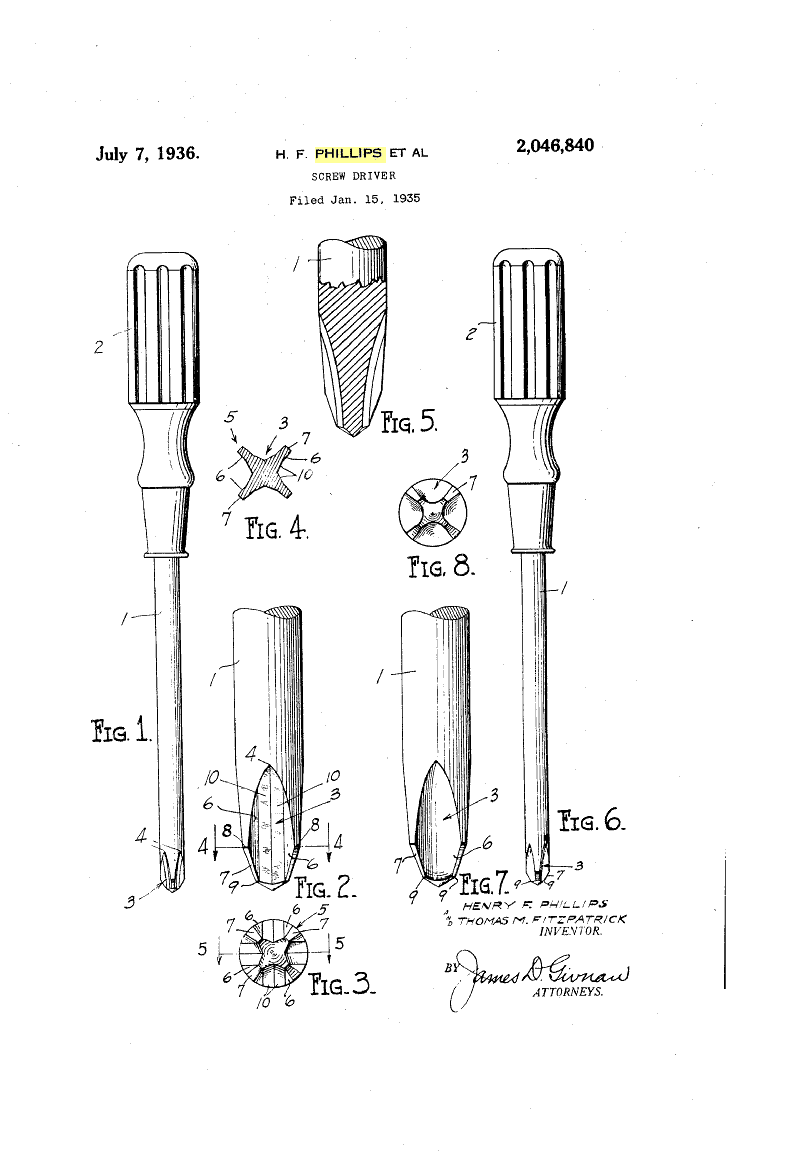
Patent drawings for the Phillips screw and screwdriver, 1936
Only Crook in Town was alerted to the work of Henry F. Phillips by an alert and helpful librarian (well — aren’t they all?). She worries –January 15 is Martin Luther King, Jr., Day, and July 7 is the middle of the summer — what day would be appropriate to celebrate the invention and patenting of the Phillips Screwdriver? (If image above does not display, click the thumbnail picture at the end of the post.)
The Phillips screwdriver came along in time for World War II and the mass assembly of aircraft, and aircraft instrument panels. The Phillips screw head helped aircraft assemblers keep from scratching the black metal of the rest of the panel while securing instruments into the forms.
6. “To only a few chemicals does man owe as great a debt as to DDT… In little more than two decades, DDT has prevented 500 million human deaths, due to malaria, that otherwise would have been inevitable.”
[National Academy of Sciences, Committee on Research in the Life Sciences of the Committee on Science and Public Policy. 1970. The Life Sciences; Recent Progress and Application to Human Affairs; The World of Biological Research; Requirements for the Future.]
In contrast to their citation for the Sweeney hearing record, which leads one away from the actual hearing record, for this citation, the publication actually exists, though it is no longer available in print. It’s available on-line, in an easily searchable format. [I urge you to check these sources out for yourself; I won’t jive you, but you should see for yourself how the critics of Rachel Carson and WHO distort the data — I think you’ll be concerned, if not outraged.] The quote, though troubled by the tell-tale ellipses of the science liar, is accurately stated so far as it goes.
The problems? It’s only part of the story as told in that publication. The National Academy of Science calls for DDT to be replaced in that book; NAS is NOT calling for a rollback of any ban, nor is NAS defending DDT against the claims of harm. The book documents and agrees with the harms Rachel Carson wrote about eight years earlier.
Cover of the electronic version of Life Sciences, the 1970 book looking to future needs in biology and agriculture.
Milloy (and Edwards, he claims), are trying to make a case that the National Academy of Sciences, one of the more reputable and authoritative groups of distinguished scientists in the world, thinks that DDT is just dandy, in contrast to the views of Rachel Carson and environmentalists (who are always cast as stupid and venal in Milloy’s accounts) who asked that DDT use be reduced to save eagles, robins and other songbirds, fish, and other wildlife, and to keep DDT useful against malaria.
First, there is no way that a ban on DDT could have been responsible for 500 million deaths due to malaria. Calculate it yourself, the mathematics are simply impossible: At about 1 million deaths per year, if we assume DDT could have prevented all of the deaths (which is not so), and had we assumed usage started in 1939 instead of 1946 (a spot of 7 years and 7 million deaths), we would have 69 million deaths prevented by 2008. As best I can determine, the 500 million death figure is a misreading from an early WHO report that noted about 500 million people are annually exposed to malaria, I’m guessing a bit at that conclusion — that’s the nicest way to attribute it to simple error and not malicious lie. It was 500 million exposures to malaria, not 500 million deaths. It’s unfortunate that this erroneous figure found its way into a publication of the NAS — I suppose it’s the proof that anyone can err.
Who served the shortest term as a justice on the U.S. Supreme Court?
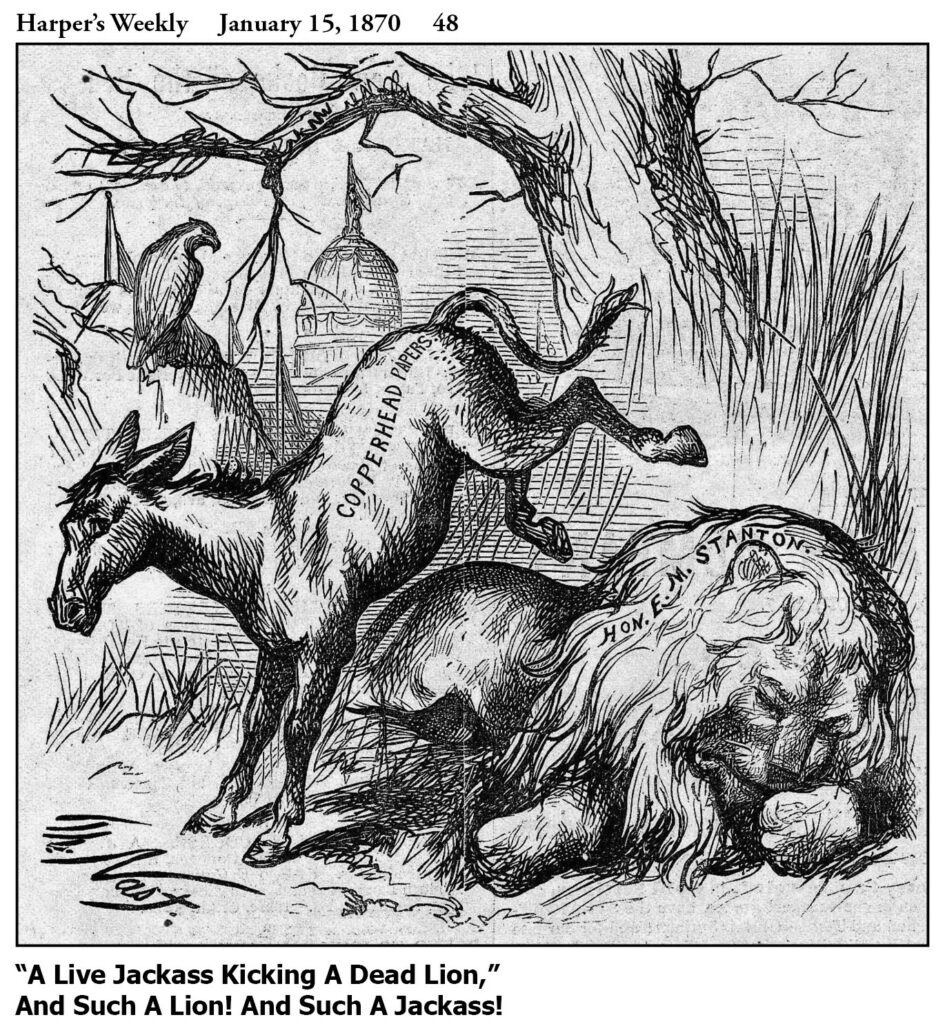
There is a clue in this famous cartoon by Thomas Nast (okay — the cartoon really gives it away, doesn’t it?):
Cartoon depicting Democrats Thomas Nast, Live Jackass kicking a Dead Lion. Edwin Stanton was fired as Secretary of War by President Andrew Johnson, contrary to the Tenure of Office Act, and that action brought on the impeachment and trial of Johnson (who was acquitted by one vote). Later, President U. S. Grant appointed the financially and health ailing Stanton to the Supreme Court. Stanton was confirmed, but went home and died that night, December 24. Stanton’s opponents continued to try to smear him. Nast’s cartoon was the result. Harper’s Bazaar, January 15, 1870
Aptly named, Salvinia molesta threatens to choke Caddo Lake to death. As Caddo Lake is the only natural lake in Texas, and a site of outstanding beauty and great natural treasure, the friends of Caddo Lake are fighting back.
The New York Times features a lengthy story on the lake and the fight to save it in this week’s Science section (July 31, 2007 – Science is part of the Times every Tuesday).
Every Texas social studies teacher should know Caddo Lake and its stories as well as anything else. It’s the stuff memorable classes are made of.
1. It’s the only “natural” lake in Texas, though it is formed by a dam. The “only honest lake in Texas,” in the local lingo. The original lake was formed by a monumental log jam on the Red River, probably trees blown down by a massive hurricane several hundred years ago.
2. Caddo Lake is named after the Caddo Tribe, the tribe whose word for friend, “tejas,” gave the state its name. (See my earlier post on Caddoland.)
3. Caddo Lake straddles what was once “no man’s land,” or the Neutral Territory, a buffer zone between English/French, then American, and Spanish, then Mexican settlements. It was a haven for criminals, scalawags, filibusterers and revolutionaries. The area plays a large role in the decades of fighting to steal Texas from the Spain, and later from Mexico. Texas history is much better understood when one knows the lake.
4. Caddo Lake once was the means to make Jefferson, Texas, a port city. Until Col. Shreveport dynamited the logjam that made the lake in 1873, Jefferson was a bustling center of commerce. Today Jefferson boasts some wonderfully preserved historic remnants of that era, many converted to bed and breakfast inns, a great weekend getaway. Fishing is good, photography is great.
6. The Hughes Tool Company had its beginnings on Caddo Lake, where Howard Hughes, Sr., tested his drill bit, “the rock eater,” designed to cut through mud and rock to where the oil was; this is the home of the fortune that Howard Hughes, Jr., inherited, to build to one of the greatest fortunes in the world. That the younger Hughes was a rake, a mechanical genius, an air pioneer, daring movie producer, and weird as hell only makes the story better. Hughes named his movie production company after the lake, Caddo Productions.
7. When it comes to Texas botany, zoology, and biology in general, Caddo Lake provides the local angle for water quality, water shortages (one proposal is to steal water from the lake for Texas cities far away), wildlife management, and of course, the invasion of exotic species.
8. Everything about this area screams Texas quirkiness. Uncertain, Texas? An often-told story (accurate?) is that when the town applied for a post office, there was a dispute about what to call the town. The fellow who filled out the application wrote “uncertain” in the blank for the town’s name — and that’s how the U.S. Postal Service approved it. Another story holds that the name “Uncertain Landing” caught on because the landing was treacherous mooring for boats. You got a better story about your town’s name? I doubt it.
Whose voice do you hear, really, when you read material that is supposed to be spoken by God? Morgan Freeman is a popular choice — he’s played God at least twice now, racing George Burns for the title of having played God most often in a movie. James Earl Jones?
Statue of Rep. Barbara Jordan at the Austin, Texas airport that bears her name. Photo by Meghan Lamberti, via Accenture.com
For substance as well as tone, I nominate Barbara Jordan’s as the voice you should hear.
When Max Sherman called me to tell me that Barbara was dying and wanted me to speak at this service, I had been reading a story in that morning’s New York Times about the discovery of forty billion new galaxies deep in the inner sanctum of the universe. Forty billion new galaxies to go with the ten billion we already knew about. As I put the phone down, I thought: it will take an infinite cosmic vista to accommodate a soul this great. The universe has been getting ready for her.
Now, at last, she has an amplifying system equal to that voice. As we gather in her memory, I can imagine the cadences of her eloquence echoing at the speed of light past orbiting planets and pulsars, past black holes and white dwarfs and hundreds of millions of sun-like stars, until the whole cosmic spectrum stretching out to the far fringes of space towards the very origins of time resonates to her presence.
Virgotext carried a series of posts earlier in the year, commemorating what would have been Jordan’s 71st birthday on February 21. (Virgotext also pointed me to the Moyers quote, above.)
Now, when the nation seriously ponders impeachment of a president, for the third time in just over a generation, Ms. Jordan’s words have more salience, urgency, and wisdom. It’s a good time to revisit Barbara Jordan’s wisdom, in the series of posts at Virgotext.
The rest of the hearing remarks are all here. It’s a longer clip than the others but honestly, there is not a good place to cut it.
This is Barbara Jordan on the killing floor.
This was a woman who understands history, who illustrates time and again that we are, with every action, with every syllable, cutting the past away from the present.
She never mentions Nixon by name. There is the Constitution. There is the office of the Presidency. But Richard Nixon the president has already ceased to exist. By the time she finishes speaking, he is history.
Rep. Barbara Jordan sitting calmly among tension, at a House Committee meeting (probably House Judiciary Committee in 1974).
Update 2019: Here is the full audio of Barbara Jordan’s speech. It is still salient, and if you listen to it you will understand better what is going on in Congress today.
Joining the elite, top 5% of all Boy Scouts, Walter Hart was awarded his Eagle rank in a ceremony Saturday in Fort Myers, Florida. Walter is 88.
There was a 70+ year delay in Walter’s ceremony — he passed the requirements for the rank, but then went off to fight in World War II before the award was made.
”I’ve been looking forward to this for a long time,” said Hart, who lives in a retirement center in nearby Lehigh Acres.
Scout officials say he may be the oldest person to ever earn the honor.
Hart joined the Cub Scouts in 1928 in Malden, Mass., and earned 23 merit badges during his years as a Boy Scout, scouting officials said. Of the 120 merit badges available, 21 must be earned to qualify for Eagle Scout rank.
It all got set aside when he joined the Navy during World War II and served two years aboard the USS Alfred A. Cunningham.
Last year, he rediscovered some of his old Boy Scout memorabilia, including documents that showed he completed the requirements for his Eagle Scout rank. He contacted the Scouts about receiving his award.
”I think this was something that was always on his mind, but every time he went to go do it, something else came up,” daughter Elizabeth Gatturna said. ”I know how hard he’s tried to get to this point.”
Congratulations, Walter.
Walter Hart, 88, is shown wearing a 2007 Boy Scout uniform with the merit badge sash he used as a youth, prior to World War II. Apart from the not-quite fit, we can tell the sash is his old one because many of the merit badges are in their pre-World War II designs, and the sash shows rank badges for Star Scout and Life Scout; current uniform rules do not allow rank badges on the sash. Under Scout rules, Walter may wear this sash for his Scouting career. Associated Press photo.
Spread the news, please:
Spread the word; friends don't allow friends to repeat history.
Southwest Elementary in Burley, Idaho, existed in a world far, far away from the U.S. space program. We watched rocket launches on black and white television — the orbital launches were important enough my father let me stay home from school to watch, but when he dropped me off, I was in a tiny band of students who actually made it to school. Potato farmers and the merchants who supported them thought the space program was big, big stuff.
By John Glenn’s flight, a three-orbit extravaganza on February 20, 1962, a television would appear in the main vestibule of the school, or in the auditorium, and we’d all watch. There were very few spitballs. Later that year my family moved to Pleasant Grove, Utah.
Toward the end of the Gemini series, television news networks stopped providing constant coverage. The launch, the splashdown, a space walk or other mission highlight, but the nation didn’t hold its breath so much for every minute of every mission. Barry McGuire would sing about leaving the planet for four days in space (” . . . but when you return, it’s the same old place.”), then six days, but it was just newspaper headlines.
The Apollo 1 fire grabbed the nation’s attention again.Gus Grissom, one of the three who died, was one of the original space titans; death was always a possibility, but the U.S. program had been so lucky. Apollo’s start with tragedy put it back in the headlines.
The space program and its many successes made Americans hopeful, even in that dark decade when the Vietnam War showed the bloody possibilities of the Cold War. That darkest year of 1968 — see the box below — closed nicely with Apollo 8 orbiting the Moon, and the famous Christmas Eve telecast from the three astronauts, Frank Borman, Jim Lovell, and William A. Anders. The space program kept us hopeful.
By early 1969 many of us looked forward to the flight of Apollo 11 schedule for July — the space flight that promised to put people on the Moon for the first time in history, the realization of centuries-old dreams.
But, then I got my assignment for Scouting for the summer — out of nearly 50 nights under the stars, one of the days would include the day of the space walk. Not only was it difficult to get televisions into Maple Dell Scout Camp, a good signal would be virtually impossible. I went to bed knowing the next day I’d miss the chance of a lifetime, to watch the first moon landing and walk.
Just after midnight my sister Annette woke me up. NASA had decided to do the first walk on the Moon shortly after touchdown, at an ungodly hour. I’d be unrested to check Scouts in, but I’d have seen history.
Texas Essential Knowledge and Skills (TEKS) lists 11 dates for U.S. history as the touchstones kids need to have: 1609, the founding of Jamestown; 1776, the Declaration of Independence; 1787, the Constitutional Convention; 1803, the Louisiana Purchase; 1861-1865, the American Civil War; 1877, the end of Reconstruction; 1898, the Spanish American War; 1914-1918, World War I; 1929, the Stock Market Crash and beginning of the Great Depression; 1941-1945, World War II; 1957, the launching of Sputnik by the Soviets. Most teachers add the end of the Cold War, 1981; I usually include Apollo 11 — I think that when space exploration is viewed from a century in the future, manned exploration will be counted greater milestone than orbiting a satellite; my only hesitance on making such a judgment is the utter rejection of such manned exploration after Apollo, which will be posed as a great mystery to future high school students, I think.)
* 1968, in roughly chronological order, produced a series of disasters that would depress the most hopeful of people, including: the Pueblo incident, the B-52 crash in Greenland, the Tet Offensive in Vietnam, the nerve gas leak at the Army’s facility at Dugway, Utah, that killed thousands of sheep, Lyndon Johnson’s pullout from the presidential race with gathering gloom about Vietnam, the Memphis garbage strike, the assassination of Martin Luther King, Jr., riots, the Black Panther shoot out in Oakland, the Columbia University student takeover, the French student strikes, the tornadoes in Iowa and Arkansas on May 15, the Catonsville 9 vandalism of the Selective Service office, the sinking of the submarine U.S.S. Scorpion with all hands, the shooting of Andy Warhol, the assassination of Robert F. Kennedy, the Buenos Aires soccer riot that killed 74 people, the Glenville shoot out in Cleveland, the cynicism of the Republicans and the nomination of Richard Nixon and Spiro Agnew, the Warsaw Pact invasion of Czechoslovakia crushing the “Prague Spring” democratic reforms, the Chicago Democratic Convention and the police riot, the brutal election campaign, the Tlatololco massacre of students in Mexico City, Black Power demonstrations by winning U.S. athletes at the Mexico City Olympics, coup d’etat in Panama. Whew!
Spread the word; friends don't allow friends to repeat history.
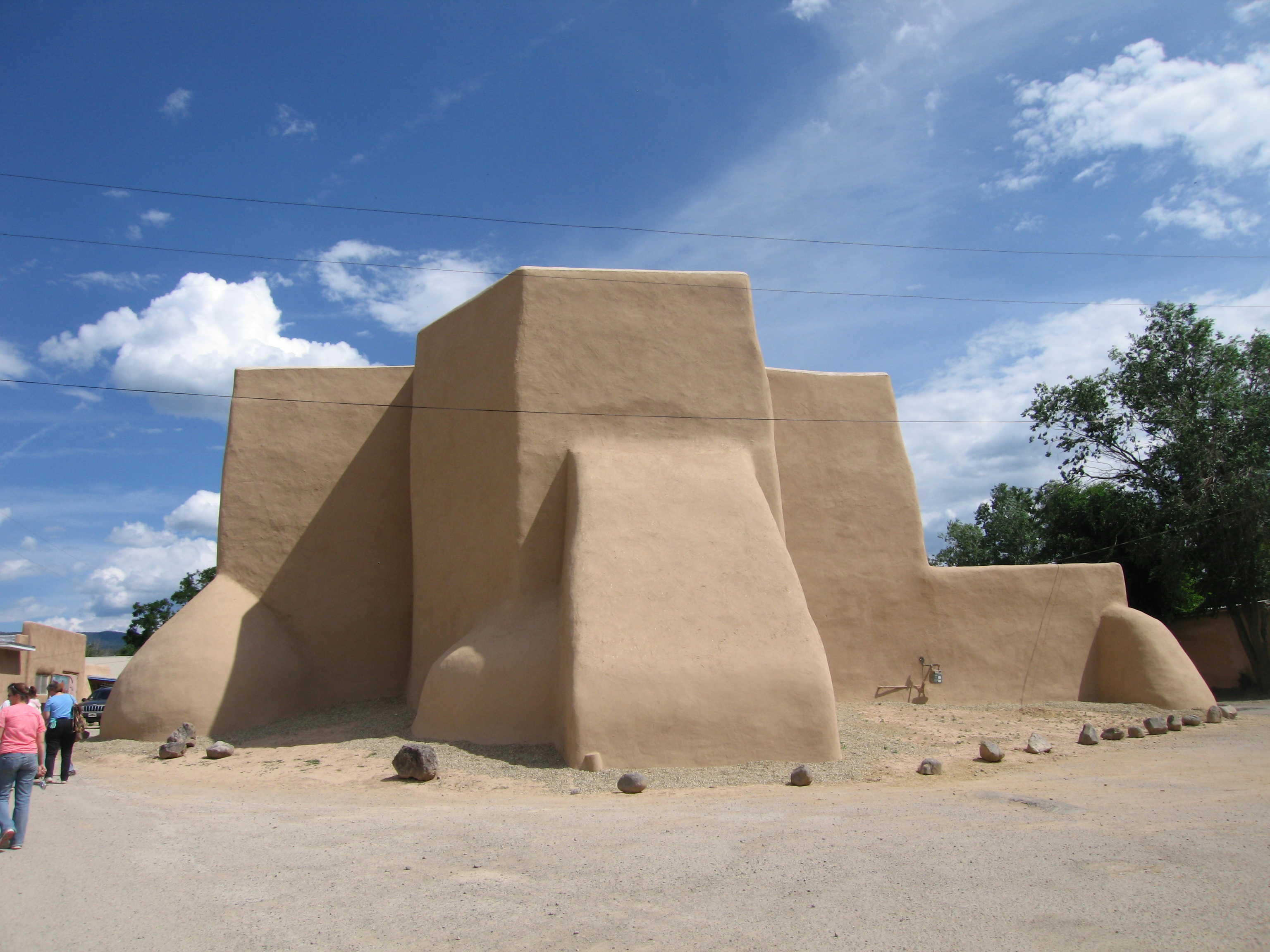
The original adobe construction of the church was completed in 1772 — four years prior to the Declaration of Independence. It is built in the shape of a cross, but structural weaknesses required the addition of buttresses, shown in the photograph — also of adobe.
A bad photograph of the church is almost impossible.
The interior is cool on a hot afternoon. Adobe construction offers significant advantages, even in the 21st century. The church hosts an active congregation, without air conditioning.
Photo: Copyright 2007, Ed Darrell; you may reproduce for educational or non-profit use, so long as attribution is attached. Attribution must be attached.
Welcome, visitors! Please leave a comment, at least tell why you visited, and where you’re from. Thank you.
Spread the word; friends don't allow friends to repeat history.
Every kid should learn this stuff by third grade, but it’s clear from what we see that they don’t.
So here’s a quick review of dos and don’ts for display and behavior toward the U.S. flag on this most flag-worthy of days, the 4th of July. With a few comments.
1. Fly your flag, from sunup to sundown. If you’re lucky enough to have a flagpole, run the flag up quickly. Retire it slowly at sunset. Then go see fireworks.
2. Display flags appropriately, if not flown from a staff. If suspended from a building or a wall, remember the blue field of stars should always be on the right — the “northwest corner” as you look at it. Do not display a flag flat.
3. Salute the flag as it opens the 4th of July parade. In a better world, there would be just one U.S. flag at the opening of the parade, and the entire crowd would rise as it passes them in a great patriotic, emotional wave — civilians with their hands over their hearts, hats off; people in uniform saluting appropriately with hats on. It’s likely that your local parade will not be so crisp. Other entries in the parade will have flags, and many will be displayed inappropriately. A true patriot might rise and salute each one — but that would look silly, perhaps even sillier than those sunshine patriots who display the flag inappropriately. Send them a nice letter this year, correcting their behavior. But don’t be obnoxious about it.
4. Do not display the flag from a car antenna, attached to a window of a car, or attached in the back of a truck. That’s against the Flag Code, which says a flag can only be displayed attached to the right front fender of a car, usually with a special attachment. This means that a lot of the National Guard entries in local parades will be wrongly done, according to the flag code. They defend the flag, and we should not make pests of ourselves about it. Write them a letter commending their patriotism. Enclose the Flag Code, and ask them to stick to it next time. Innocent children are watching.
5. Do not dishonor the flag by abusing it or throwing it on the ground. It’s become popular for a local merchant to buy a lot of little plastic flags and pass them out to parade goers. If there is an advertisement on the flag, that is another violation of the Flag Code. The flag should not be used for such commercial purposes. I have, several times, found piles of these flags on the ground, dumped by tired people who were passing them out, or dumped by parade goers who didn’t want to carry the things home. It doesn’t matter if it’s printed on cheap plastic, and made in China — it is our nation’s flag anyway. Honor it. If it is worn, dispose of it soberly, solemnly, and properly.
That’s probably enough for today. When the Flag Desecration Amendment passes — if it ever does — those parade float makers, National Guard soldiers, and merchants, can all be jailed, perhaps. Or punished in other ways.
Until that time, our best hope is to review the rules, obey them, and set examples for others.
Have a wonderful 4th of July! Fly the flag. Read the Declaration of Independence out loud. Love your family, hug them, and feed them well. That’s part of the Pursuit of Happiness that this day honors. It is your right, your unalienable right. Use it wisely, often and well.
Image: Flag flying in front of the U.S. Capitol. If from a photo, this flag is probably one on one of the buildings of the Library of Congress. It is a Library of Congress photo.
Spread the word; friends don't allow friends to repeat history.
Okay. I’ve had five or six people send me links to a YouTube video of Ron and Kay Rivoli singing “Press One for English.” Ha. Ha.
It’s a rant about language accommodations. Some Americans, free marketeers for the most part, get all buggy when confronted with a free market in language choices. America is becoming more global, marketing more goods in more places, and getting visited by more people. This growth in commerce brings things like American Airlines’ Spanish language reservations center (Who would have thought? When they can make reservations in Spanish, Spanish speakers buy a lot more airplane tickets.)
And Ron and Kay Rivoli put these fears into a song. Funny.
Can we talk? Can I pick a bone? Ron and Kay Rivoli insult the U.S. flag. They may not mean to do it, they may have done it unthinkingly — but that’s the problem with the whole rant: It’s all unthinking.
Here are the flag insults:
44 seconds into the video three servicemen are shown saluting the U.S. flag, displayed with the flag of California and the POW-MIA flag. Contrary to the Flag Code and good flag etiquette, the U.S. flag is in the center, rather than to its own right. A center display would be acceptable if the center flag pole were higher than the others — but in this case the U.S. flag’s pole is lower than the other two. Two flag insults at once.
At 2:59 into the video, the flag is shown as cut into an agricultural field of some kind. The Flag Code specifies that the flag is never to be displayed flat. The flag should fly free. Since this flag is cut into a crop on the ground, it cannot be displayed properly. Further, it is generally considered poor etiquette to make representations of the flag out of things other than cloth.
This is all highly ironic. At 1:37 into the video, a scroll of the famous Theodore Roosevelt quote on English as the only language scrolls by. “We have room for but one flag, the American flag,” Roosevelt said (oops — there goes the POW-MIA flag). “We have room but for one language, and that is the English language,” Roosevelt continues.
They use the flag they insult as a model for going for one language? This makes no sense.
Do I pick nits? No, I think that every educated American should know the flag code, and should avoid insult to the U.S. flag at least, if not honor it correctly. I am not pedantic about a lot of things, but this is one.
Ron and Kay Rivoli, you owe America and its flag apologies. Get straight with the flag, before you ask me to insult the traditional languages and free enterprise heritage of our nation. If you want my support, don’t tread on the American flag when you ask it.
The Rivolis owe apologies to the U.S. flag. Will we see it?
Spread the word; friends don't allow friends to repeat history.
Looking at the odd campaign against the reputation of Rachel Carson, conducted largely by a group of corporate-paid, political scalawags, one will eventually come across a site named JunkScience.com, which has as a motto, “All the junk that’s fit to debunk.”
EPA history caption: Rachel Carson’s Silent Spring led to banning DDT and other pesticides. [EPA iimage]
How is this action described at JunkScience.com?
You wouldn’t quite recognize the events — and I doubt you could verify other oddities the JunkScience.com site claims:
17. Extensive hearings on DDT before an EPA administrative law judge occurred during 1971-1972. The EPA hearing examiner, Judge Edmund Sweeney, concluded that “DDT is not a carcinogenic hazard to man… DDT is not a mutagenic or teratogenic hazard to man… The use of DDT under the regulations involved here do not have a deleterious effect on freshwater fish, estuarine organisms, wild birds or other wildlife.”
[Sweeney, EM. 1972. EPA Hearing Examiner’s recommendations and findings concerning DDT hearings, April 25, 1972 (40 CFR 164.32, 113 pages). Summarized in Barrons (May 1, 1972) and Oregonian (April 26, 1972)]
18. Overruling the EPA hearing examiner, EPA administrator Ruckelshaus banned DDT in 1972. Ruckelshaus never attended a single hour of the seven months of EPA hearings on DDT. Ruckelshaus’ aides reported he did not even read the transcript of the EPA hearings on DDT.
[Santa Ana Register, April 25, 1972]
19. After reversing the EPA hearing examiner’s decision, Ruckelshaus refused to release materials upon which his ban was based. Ruckelshaus rebuffed USDA efforts to obtain those materials through the Freedom of Information Act, claiming that they were just “internal memos.” Scientists were therefore prevented from refuting the false allegations in the Ruckelshaus’ “Opinion and Order on DDT.”
I propose to Fisk much of the list of 100 claims against Carson (which is really a list over 100 items now), in a serial, spasmodic fashion. I’ll post my findings here, making them generally available to internet searches for information on Rachel Carson and DDT. Below the fold, I’ll start, with these three specious claims listed above.
In West Berlin, President John F. Kennedy delivers the famous speech in which he declares, “Ich bin ein Berliner.” Meaning literally “I am a citizen of Berlin,” the statement shows U.S. solidarity with democratic West Berlin, surrounded by communist territory.
Or, until that account is unsuspended by the forces supporting Donald Trump: Follow @FillmoreWhite, the account of the Millard Fillmore White House Library
We've been soaking in the Bathtub for several months, long enough that some of the links we've used have gone to the Great Internet in the Sky.
If you find a dead link, please leave a comment to that post, and tell us what link has expired.
Thanks!
Retired teacher of law, economics, history, AP government, psychology and science. Former speechwriter, press guy and legislative aide in U.S. Senate. Former Department of Education. Former airline real estate, telecom towers, Big 6 (that old!) consultant. Lab and field research in air pollution control.
My blog, Millard Fillmore's Bathtub, is a continuing experiment to test how to use blogs to improve and speed up learning processes for students, perhaps by making some of the courses actually interesting. It is a blog for teachers, to see if we can use blogs. It is for people interested in social studies and social studies education, to see if we can learn to get it right. It's a blog for science fans, to promote good science and good science policy. It's a blog for people interested in good government and how to achieve it.
BS in Mass Communication, University of Utah
Graduate study in Rhetoric and Speech Communication, University of Arizona
JD from the National Law Center, George Washington University


 Posted by Ed Darrell




![EPA history caption: Rachel Carson's Silent Spring led to banning DDT and other pesticides. [EPA iimage]](https://i0.wp.com/www2.epa.gov/sites/production/files/aboutepa/history/images/form5.jpg)





 Millard Fillmore's Bathtub
