History text accuracy: Okinawa mass suicides

October 25, 2007

Controversy surrounds history textbooks all over the world. Texans may be a bit more sensitive to the issues while the Texas Education Agency is revising curricula, but others are even more sensitive – such as Turkey, where controversy over the Armenian Genocide threatens to derail Turkey’s 40-year project to join the European Union; Japan, where citizens and other nations protest failures to mention harms done to people by the Japanese Imperial Army during World War II; and even Europe in general, where controversy surrounds efforts to find a unifying, Europe-wide culture.

History is important in our relations with other nations. With increasing globalization, it becomes ever more important that all citizens have basic understanding of their local history, their national history, and world history, if only to avoid the social faux pas in socializing with people from other nations.

The issue is hot in Japan right now. Okinawa, a formerly independent kingdom annexed by Japan in the 19th century (did you know that?), hosted the biggest protest demonstration the island prefecture has ever seen, earlier this month – a protest over the changing of a few words in Japanese school history texts, removing the responsibility for mass suicides on Okinawa from the Japanese Imperial Army.

A story in the New York Times describes the anguish felt by Okinawans:

Brainwashed by Japanese Imperial Army soldiers into believing that victorious American troops would rape all the local women and run over the men with their tanks, Mr. Kinjo and others in his village here in Okinawa thought that suicide was their only choice. A week before American troops landed and initiated the Battle of Okinawa in March 1945, Japanese soldiers stationed in his village gave the men two hand grenades each, with instructions to hurl one at the Americans and then to kill themselves with the other.

Most of the grenades failed to explode. After watching a former district chief break off a tree branch and use it to kill his wife and children, Mr. Kinjo and his older brother followed suit.

”My older brother and I struck to death the mother who had given birth to us,” Mr. Kinjo said in an interview at the Naha Central Church, where he is the senior minister. ”I was wailing of course. We also struck to death our younger brother and sister.”

Mr. Kinjo agreed to tell his story again because the Japanese government is now denying, in new high school textbooks, that Okinawans had been coerced by Imperial troops into committing mass suicide.

The proposed changes to the school textbooks — the deletion of a subject, the change to the passive voice — amounted to just a couple of words among hundreds of pages. But the seemingly minor grammatical alterations have led to swelling anger in the Okinawa islands in Japan, cresting recently in the biggest protest here in at least 35 years and stunning the Japanese government.

How should texts deal with such issues?

China and Korea also protested the rewrite. Hot button issues involve the Japanese invasion and taking of Nanking in 1937, generally known to western historians as “the rape of Nanking;” Japanese treatment of Prisoners of War (POWs), including the Bataan Death March in the Philippines, what amounted to slave labor using POWs in Japan, and Korean women impressed into service as prostitutes to the Japanese Army, at what are euphemistically called “comfort stations.”

Texas history standards writers may benefit from taking a look at some of these other controversies, in other places. These lessons can apply to Texas and U.S. history, where Anglo and European colonist treatment of aboriginal natives is certainly an issue, but also to subjects such as biology and the treatment of evolution, health and the treatment of preventing sexually-transmitted diseases, and environmental science, and the treatment of pollution and climate change issues.


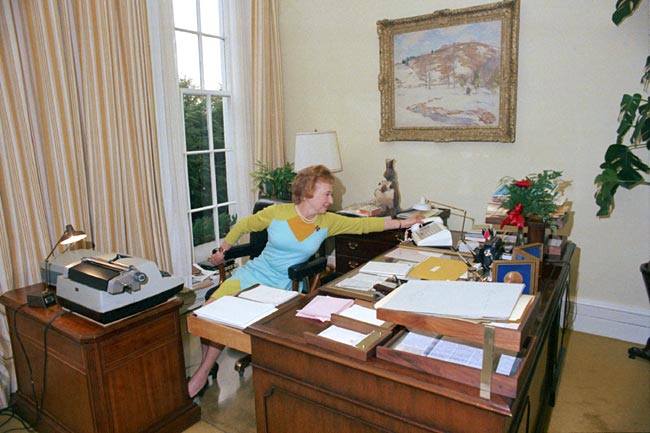
Typewriter of the moment: White House, Rosemary Woods

October 22, 2007

Rosmary Woods shows how she might have erased Nixon tapes

President Richard Nixon’s secretary, Rosemary Woods, demonstrates how she thought she might have accidentally erased 18-1/2 minutes of tape, when she reached to answer her phone and her foot extended to the “erase” footpedal, in 1974.

Ms. Woods’s typewriter is an electric, as best I can make out, an IBM. (Update, May 21, 2008: Ben Batchelor of etypewriters.com dropped by in comments to say it’s an IBM Model D Executive. Thanks, Ben!)

Good resource discovered in getting this image: The Watergate Files, presented by the Gerald R. Ford Presidential Library (at the University of Texas site). Image from the Gerald R. Ford Presidential Library.

Tip of the old scrub brush to Dr. Pamela Bumsted.


History of public health victories in the U.S.

October 19, 2007

I wish U.S. history texts for public schools would invest more in the history of public health practice in the U.S.  Much of our prosperity can be traced to good public health practices — the wide availability of generally safe drinking water, effective systems to remove sewage and garbage, and other work to diminish illness.

So, in quick note form pirated directly from the Centers for Disease Control (CDC) (and because this has been hanging fire in my “to edit” box for way too long), here are some public health achievements I think the textbook editors need to consider for the next editions: 

Ten Great Public Health Achievements — United States, 1900-1999

  • Vaccination
  • Motor-vehicle safety
  • Safer workplaces
  • Control of infectious diseases
  • Decline in deaths from coronary heart disease and stroke
  • Safer and healthier foods
  • Healthier mothers and babies
  • Family planning
  • Fluoridation of drinking water
  • Recognition of tobacco use as a health hazard

More internet friendly version here, with links to articles on each one:

http://www.cdc.gov/od/oc/media/tengpha.htm

Here are the details.

Much more available. Here is a site, with a good section talking about careers in public health (for those career planning courses out there). Here’s a similar, less wowee site from the American Schools of Public Health (ASPH). Ethics issues here.

I include the links — there is no reason you can’t add this to your courses, especially in the sections that meet the standards on discussion of achievements of technology.  Surely these are technological achievements of great merit.


Come see Texas’ new canyon!

October 9, 2007

Canyon Lake Gorge, Gorge website photo

Having a brand new canyon is sort of a once in a lifetime experience. It might even be more rare than that.

Texas’s Canyon Lake Gorge opened to the public last week — a gorge, a canyon, that was carved out over a couple of days in 2002 when flood waters charging over an overtaxed dam cut through soft soils and soft rock to expose millions of years of sediments. Dinosaur footprints were exposed by the flood, too.

A torrent of water from an overflowing lake sliced open the earth in 2002, exposing rock formations, fossils and even dinosaur footprints in just three days. Since then, the canyon has been accessible only to researchers to protect it from vandals, but on Saturday it opens to its first public tour.

“It exposed these rocks so quickly and it dug so deeply, there wasn’t a blade of grass or a layer of algae,” said Bill Ward, a retired geology professor from the University of New Orleans who started cataloging the gorge almost immediately after the flood.

The mile-and-a-half-long gorge, up to 80 feet deep, was dug out from what had been a nondescript valley covered in mesquite and oak trees. It sits behind a spillway built as a safety valve for Canyon Lake, a popular recreation spot in the Texas Hill Country between San Antonio and Austin.

The reservoir was built in the 1960s to prevent flash flooding along the Guadalupe River and to assure the water supply for central Texas. The spillway had never been overrun until July 4, 2002, when 70,000 cubic feet of water gushed downhill toward the Guadalupe River for three days, scraping off vegetation and topsoil and leaving only limestone walls.

Canyon Lake is southwest of Austin, almost due west from San Marcos about 20 miles. The lake backed up from a 1960 flood control project dam built by the U.S. Army Corps of Engineers — the new Canyon Lake Gorge is managed jointly by the Corps and the Guadalupe-Blanco River Authority.

Watch carefully, dear reader: Creationists will soon start to claim that the rapid cutting of this canyon verifies a young age for all canyons, and shows that the Earth’s geology can indeed be very young. But that claim will gloss over the fact that while the gorge was cut quickly, it was cut through sediments that took millions or billions of years to lay down. The Associated Press reports problems with such a hypothesis:

The sudden exposure of such canyons is rare but not unprecedented. Flooding in Iowa in 1993 opened a limestone gorge behind a spillway at Corvalville Lake north of Iowa City, but that chasm, Devonian Fossil Gorge, is narrower and shallower than Canyon Lake Gorge.

Neither compares to the world’s most famous canyon. It took water around 5 million to 6 million years to carve the Grand Canyon, which plunges 6,000 feet at its deepest point and stretches 15 miles at its widest.

The more modest Canyon Lake Gorge still displays a fault line and rock formations carved by water that seeped down and bubbled up for millions of years before the flooding.

Some of the canyon’s rocks are punched with holes like Swiss cheese, and the fossils of worms and other ancient wildlife are everywhere. The rocks, typical of the limestone buried throughout central Texas, date back “111 million years, plus or minus a few hundred thousand years,” Ward said.

Six three-toed dinosaur footprints offer evidence of a two-legged carnivore strolling along the water. The footprints were temporarily covered with sand to protect them as workers reinforced the spillway, but they’ll be uncovered again eventually, Rhoad said.

Tours for the new gorge are booked for the next six months. Details on how to reserve space can be found at the website of the Gorge Preservation Society (GPS).


Origins of secular education in New York

October 8, 2007

Mary L. Dudziak at Legal History Blog reports a new article on the rise of secular education:

Ian C. Bartrum, Vermont Law School, has posted a new article, The Origins of Secular Public Education: The New York School Controversy, 1840-1842. It is forthcoming in the NYU Journal of Law & Liberty.

The abstract from SSRN:

Abstract:
As the title suggests, this article explores the historical origins of secular public education, with a particular focus on the controversy surrounding the Catholic petitions for school funding in nineteenth-century New York City. The article first examines the development of Protestant nonsectarian common schools in the northeast, then turns to the New York controversy in detail, and finally explores that controversy’s legacy in state constitutions and the Supreme Court. It is particularly concerned with two ideas generated in New York: (1) Bishop John Hughes’ objection to nonsectarianism as the “sectarianism of infidelity”; and (2) New York Secretary of State John Spencer’s proposed policy of “absolute non-intervention” in school religion. The article traces these ideas through the 1960s school prayer decisions, where they appear as Justice Stewart’s objections to “the religion of secularism,” and the general contention that disestablishment requires only that the government not favor one religion over another. In the process, it examines the conceptual problems that arise when we try to enforce religious neutrality by exclusion, rather than inclusion. Ultimately, the article concludes that the Court chose exclusive neutrality, not because it best served the constitutional mandate, but because it forwarded a social policy – begun with the common schools – that treats public schools as nationalizing institutions. Thus, I contend that the Court has chosen to promote cultural assimilation over authentic freedom of conscience.

Yeah, that ought to provoke some discussion.


Sputnik’s 50th

October 4, 2007

America woke up on October 4, 1957.

Sputnik, model hanging in Smithsonian Air & Space Museum

The Union of Soviet Socialist Republics (USSR) launched the world’s first artificial satellite into orbit. After successfully putting the shiny ball into orbit, the Soviets trumpeted the news that Sputnik traced the skies over the entire planet, to the shock of most people in the U.S. (Photo of the model in the Smithsonian’s Air & Space Museum in Washington, D.C.)

New Scientist magazine’s website provides significant details about how awake America became, including very good coverage of the Moon landings that were nearly a direct result of Sputnik’s launch — without Sputnik, the U.S. probably wouldn’t have jump started its own space program so, with the creation of NASA and the drive for manned space flight, and without the space race President John F. Kennedy probably wouldn’t have made his dramatic 1961 proposal to put humans on the Moon inside a decade.

Sputnik really did change the world.

Much of the progress to the 1969 Moon landing could not have occurred without the reform of education and science prompted by the Soviets’ triumph. With apathetic parents and the No Child Left Behind Act vexing U.S. education and educators from both sides, more than nostalgia makes one misty-eyed for the National Defense Education Act (NDEA), a direct product of Sputnik-inspired national ambition. Coupled with the GI Bill for veterans of World War II and Korea, NDEA drove U.S. education to be the envy of the world, best in overall achievement (and also drove creationists to try to block such improvements).

(Today NDEA gets little more than a footnote in real historyWikipedia’s entry is short and frustrating, the U.S. Department of Education gives little more. Educators, you have got to tell your history.)

Texas Essential Knowledge and Skills (TEKS) lists 1957 as among the dozen dates students need to know in U.S. history, for Sputnik. It is the only date Texas officials list for U.S. history that is really an accomplishment by another nation. (The first time I encountered this requirement was in a meeting of social studies teachers gearing up for classes starting the following week. The standards mention the years, but not the events; I asked what the event was in 1957 that we were supposed to teach, noting that if it was the Little Rock school integration attempt, there were probably other more memorable events in civil rights. No one mentioned Sputnik. It was more than two weeks before I got confirmation through our district that Sputnik was the historic event intended. Ouch, ouch, ouch!)

Sputnik was big enough news to drive Elvis Presley off the radio, at least briefly, in southern Idaho. My older brothers headed out after dinner to catch a glimpse of the satellite crossing the sky. In those darker times — literally — rural skies offered a couple of meteoroids before anyone spotted Sputnik. But there it was, slowly painting a path across our skies, over the potato fields, over the Snake River, over America.

Sputnik’s launch changed our lives, mostly for the better.

Resources:

Phil Plait at Bad Astronomy provides a series of links teachers can rely on for good information, especially if you’re composing a lesson plan quickly.

New Scientist’s broad range of coverage of the space race, up to the current drive to go to Mars, is well worth bookmarking.

google_sputnik.gif

Google’s anniversary logo, in use today only, gets you to a good compilation of sources.

Fifty nano-satellites launched in honor of the 50th anniversary of Sputnik.

NASA’s history of the event. You can listen to a .wav recording of the telemetry signal from the satellite there, too.

How will you mark the anniversary?

[More links below the fold.]

Read the rest of this entry »


Petraeus vs. Westmoreland

September 22, 2007

Santayana’s ghost sends links: The Horse’s Mouth via The Good Democrat.

Who are these guys? What did they say?

Gen. William Westmoreland, circa 1967

Gen. David Petraeus, 2007

Left, Gen. William Westmoreland, testifying before Congress, circa 1967; right, Gen. David Petraeus, testifying to the Senate Committee on Foreign Relations, September 11, 2007


1872 Mining Act – Amend it now?

September 20, 2007

Sherffius cartoon on Bush administration mining regulations

Few people know about the law. Since 1872, mineral extraction from the public lands of the United States has been governed by a law designed to make it easy for miners to get minerals out. The law is essentially unchanged, though some mining operations are now bound by other laws to protect the environment and other uses of public lands, such as grazing, tourism, scientific study, wood production, grazing, wildlife management and hunting.

The Senate Committee on Energy and Natural Resources opens hearings on reforming the law next Thursday, September 27. The hearing will be webcast, most likely.

The House of Representatives has already had a couple of field hearings.

Watch your claims!

Resources:


Science history slips away: Ralph Alpher and Big Bang

September 20, 2007

Looking for something else in an old newspaper, I came across a small obituary for Ralph Alpher. Alpher died August 12, 2007, in Austin, Texas, at the home of his son, Dr. Victor S. Alpher.

Ralph Alpher, physicist who co-hypothesized the Big Bang

Ralph Alpher, physicist who co-hypothesized the Big Bang

Ralph Alpher gave us the Big Bang. We let him slip away, almost unnoticed. Odds are you don’t recall ever hearing of Alpher. Here’s your mnemonic: The alphabet paper.

In 1948, as a graduate student under George Gamow at the George Washington University, Alpher and Robert Herman of Johns Hopkins laid the groundwork for what would become Big Bang theory, calculating how matter could arise in the Universe. Gamow, exhibiting the sense of humor for which physicists are famous, listed the authors of the paper as Alpher, Bethe, Gamow and Herman — a play on the Greek alphabet’s first three letters (alpha, beta, gamma), and a joke invoking the name of the great physicist Hans Bethe. Bethe liked the joke, consulted on the paper, and the theory of Big Bang was published.

Ralph Alpher, in Florida, 2006; Alpher home page

The name “Big Bang” was applied a few years later; Sir Frederick Hoyle and his colleagues favored a “steady state” universe, and at the time both hypotheses could accurately predict most of what was observed, and neither could be disproven. Hoyle, hoping to poke ridicule at the competing hypothesis, belittled it as “a big bang.” The name stuck. The name misleads the unwary; the theory posits a rapid expansion at the beginning of the universe and time, but not an explosion, per se.

Alpher wrote the mathematical model; the model predicted Big Bang, and specifically, it predicted the cosmic background radiation that would have been left over; it was this background radiation, the “echo” of Big Bang, that Arno Penzias and Robert Wilson stumbled across in 1965. Robert H. Dicke had invested several years in trying to discover this signature, and had to explain to Penzias and Wilson what they had found. Penzias and Wilson won the Nobel Prize for their discovery; Dicke, Alpher, Herman and Gamow, did not get Nobel Prizes. This is generally regarded as one of the great miscarriages of justice in Nobel Prize awards, not that Penzias and Wilson did not deserve an award, but that the chief theorists and the man who unveiled the discovery were overlooked.

This is another story of rejection leading to great discovery; it is also a rather sad story of a momentous achievement, mostly overlooked through the years.

Alpher was the son of Jewish émigrés from the Russian pogroms. His high school achievements merited a scholarship to the Massachusetts Institute of Technology, in 1937. MIT had a rule at the time that scholarship recipients could not work outside the school. Alpher assisted his father in building houses in the Washington, D.C. area; the family had little money, and Alpher would be unable to pay room and board without working. Discussions with MIT broke down — the offer of a scholarship was withdrawn, according to most accounts when MIT discovered he was a Jew. As so many great people of the post World War II era, he enrolled at the George Washington University.

At GWU, Alpher found Gamow as a mentor, and much of the rest is history.

The New York Times:

The paper reported Dr. Alpher’s calculations on how, as the initial universe cooled, the remaining particles combined to form all the chemical elements in the world. This elemental radiation and matter he dubbed ylem, for the Greek term defining the chaos out of which the world was born.

The research also offered an explanation for the varying abundances of the known elements. It yielded the estimate that there should be 10 atoms of hydrogen for every one atom of helium in the universe, as astronomers have observed.

Months later, Dr. Alpher collaborated with Robert Herman of the Applied Physics Laboratory at Johns Hopkins University on a paper predicting that the explosive moment of creation would have released radiation that should still be echoing through space as radio waves. Astronomers, perhaps thinking it impossible to detect any residual radiation or still doubting the Big Bang theory, did not bother to search.

The Alpher-Bethe-Gamow paper, or αβγ paper, as explained by the American Institute of Physics:

When Alpher and Gamow prepared a paper on the subject, Gamow mischievously added the name of the noted nuclear physicist Hans Bethe to the list of authors so it would be called the “Alpher-Bethe-Gamow paper,” mimicking the “alpha-beta-gamma” of the first letters of the Greek alphabet. Unknown to Gamow, Bethe was a reviewer for the journal to which Gamow submitted the article. Bethe took it in good humor, later explaining, “I felt at the time that it was rather a nice joke, and that the paper had a chance of being correct, so that I did not mind my name being added to it.” Gamow also urged Herman to change his name to Delter to match delta, the next letter in the Greek alphabet. Despite Herman’s refusal, in a paper in a major scientific journal Gamow referred to “the neutron-capture theory…developed by Alpher, Bethe, Gamow and Delter.” Not least among his notable characteristics was his sense of humor.

Alpher continued in this work for a time, but joined General Electric’s labs in the 1950s. When he retired from GE, in 1986 he joined the faculty at Union College in Schenectady, New York, and taught there until 2004.

Alpher was largely overlooked for awards even while his theory was big news in astronomy and physics for the last 40 years of the 20th century. I regret that I was wholly unaware he was in Austin; how many other great contributors to science and history live among us, unrecognized, uncelebrated, and their stories unrecorded?

Alpher, Herman and Gamow - and the famous Cointreau bottle

Photo caption from AIP: A 1949 composite picture with Robert Herman on the left, Ralph Alpher on the right, and George Gamow in the center, as the genie coming out of the bottle of “Ylem,” the initial cosmic mixture of protons, neutrons, and electrons from which the elements supposedly were formed. [The Cointreau bottle from which the three drank a toast upon the acceptance of the paper, is now in the collection of the Smithsonian Institution.]

Alpher was an Eagle Scout. I wonder whether anyone has a history of his time in Scouting?

While the Nobel Prize eluded Alpher, he collected a host of other prestigious awards and honors. Earlier this year, President Bush announced that Alpher had been awarded the National Medal of Science, which is administered by the National Science Foundation and is the highest honor for science.

. . . [T]he citation reads in part:

“For his unprecedented work in the areas of nucleosynthesis, for the prediction that universe expansion leaves behind background radiation, and for providing the model for the Big Bang theory.”

Note from George Gamow, on confirmation of Big Bang Gamow’s humor again on display — an undated note from Gamow upon the confirmation of the Big Bang, with a punny reference to Steady State backer Sir Frederick Hoyle. Image from the American Institute for Physics.

Online sources for Ralph Alpher:

More:

Help others hear the echo:

Add to FacebookAdd to NewsvineAdd to DiggAdd to Del.icio.usAdd to StumbleuponAdd to RedditAdd to BlinklistAdd to TwitterAdd to TechnoratiAdd to Furl


Starbucks controversy: The Way I See It #289 (global warming)

September 17, 2007

Found this on my coffee cup today:

The Way I See It #289

So-called “global warming” is just

a secret ploy by wacko tree-

huggers to make America energy

independent, clean our air and

water, improve the fuel efficiency

of our vehicles, kick-start

21st-century industries, and make

our cities safer and more livable.

Don’t let them get away with it!

Chip Giller
Founder of Grist.org, where
environmentally-minded people
gather online.

Starbucks Coffee Cup, The Way I See It #289

Add to FacebookAdd to NewsvineAdd to DiggAdd to Del.icio.usAdd to StumbleuponAdd to RedditAdd to BlinklistAdd to TwitterAdd to TechnoratiAdd to Furl

Save


Stone of Destiny and Ian Hamilton

September 17, 2007

For U.S. students there is an uncomfortable nexus between mythology of the Arthurian style legend, Biblical mythology and history, and British history that fascinates me. The Stone of Destiny has a provenance stretching back 5,000 years to the Jewish patriarch Jacob, and which features a blog by one of the last men to steal the stone — with several stops along the way to open the story to trickery, hoaxes and uncertainty. It’s a fabulous story that too few people know.

Ian Hamilton, as pictured in his blog's masthead

And, as I noted, one of the last men to steal the thing is blogging away on politics today — on the topic of Iraq and how we treat our veterans, for example. Is history great, or what?

This is a long way of getting to recommending Ian Hamilton’s blog for an interesting read, which we’ll do below the fold, after a bit of history.

Read the rest of this entry »


DDT as snake oil

September 15, 2007

“It’ll cure what ails ya!”

emergency-dvd-cover-51cea8wqbkl_aa240_.jpg

My first year in college, we spent Saturday nights watching “Emergency!” I don’t recall now whether it was on NBC or ABC, but after we saw it once, we were all hooked, Al, Ben and me.

No, it wasn’t great drama. An hour-long drama about paramedics in Los Angeles probably has a lot of potential — this wasn’t that drama. Jack Webb, of “Dragnet” fame, directed. It had a cast amazing for its “how-did-HE- get-there” quality: Bobby Troup, the jazz pianist and composer of “Route 66″ (” . . . get your kicks on . . .”) played a doctor; his wife, jazz vocalist Julie London, played a nurse. Loved Julie London. Beautiful, but she had all the acting chops of David Janssen (“the man of a thousand faces” of “The Fugitive” fame). Martin Milner was there, too — he actually starred earlier in NBC’s “Route 66” which featured Corvettes, but not Bobby Troupe’s hit song (go figure) — and so was Kevin Tighe and Randolph Mantooth. And Robert Fuller, and Kent McCord. Whew!

For undergraduate college students, the show was a riot. We noticed early on that the script writers were defibrillator happy. Every time the paramedic truck showed up, the first thing off was the defibrillator. Heart attacks seemed to be a big problem in LA at the time — maybe Jack Webb’s own mortality subconsciously sneaking into the scripts — so the defib unit got a lot of use.

But it also came out at all the wrong times. Drowning victim? Defibrillator first, THEN artificial respiration. Poison victim? Defib. Auto accident? Defibrillate the victim, THEN worry about the spurting, arterial bleeding (if it’s spurting, is the defib necessary?). Classic kitten in the tree? Defib the tree, THAT will get that kitten down. Read the rest of this entry »


Making history class interesting: A lesson plan

September 12, 2007

Getting kids to dive into history can be a chore — but a chore well worth the effort.

Here’s what it might look like, if the kids dive in:

ON the kind of humid summer day that sends visitors to Washington running for cool cover, not even free air-conditioning could lure more than a trickle of tourists into the art museums lining the National Mall.

But 35 miles south at the National Museum of the Marine Corps near Quantico, Va., visitors in a virtual boot camp tested their mettle against drill instructors and their marksmanship on an M-16 laser-rifle range.

Up the Potomac at Mount Vernon, crowds spilled onto a four-acre replica of George Washington’s working farm, while inside the Revolutionary War Theater the rumble of cannons and the cold prick of snow falling overhead lent verisimilitude to the re-enactment of his troops crossing the Delaware River.

And at the International Spy Museum in downtown Washington, visitors with $16 advance tickets snaked out the door as they waited their turn to practice fantasy espionage, complete with assumed identities, pen cameras, shoe phones and the kind of super-spy cars Q might have dreamed up for 007.

Admit it. Learning about history has rarely been so much fun.

You’re not close to Quantico, nor to Washington, D.C.?  How about you get your kids to invent a museum.

The New York Times collaborates with Columbia University’s Bank Street College of Education to produce lesson plans based on stories from the Times, every week day.

You may subscribe to get a lesson plan to your e-mail box every dayOr you can track them down at the Times’ website.

Below the fold, without editing, I list the lesson plan sent out September 10, as an example.  Sounds like a good day in class, to me.

Read the rest of this entry »


Fun history: Great blunders, literature division

September 12, 2007

People in literature are different from you and me.

University of Texas history professor David Oshinsky pulled back the curtain on some of the biggest blunders in the history of literature, in an article for the New York Times a couple of days ago: “No Thanks, Mr. Nabokov.”

He documents rejection letters that, in retrospect, perhaps publisher Alfred A. Knopf would rather had not been written — despite the fact that Knopf was enormously successful otherwise. For example, about a book on teen-aged angst:

In the summer of 1950, Alfred A. Knopf Inc. turned down the English-language rights to a Dutch manuscript after receiving a particularly harsh reader’s report. The work was “very dull,” the reader insisted, “a dreary record of typical family bickering, petty annoyances and adolescent emotions.” Sales would be small because the main characters were neither familiar to Americans nor especially appealing. “Even if the work had come to light five years ago, when the subject was timely,” the reader wrote, “I don’t see that there would have been a chance for it.”

Knopf wasn’t alone. “The Diary of a Young Girl,” by Anne Frank, would be rejected by 15 others before Doubleday published it in 1952. More than 30 million copies are currently in print, making it one of the best-selling books in history.

The goof examples roll out of the files:

Nothing embarrasses a publisher more than the public knowledge that a literary classic or a mega best seller has somehow slipped away. One of them turned down Pearl Buck’s novel “The Good Earth” on the grounds that Americans were “not interested in anything on China.” Another passed on George Orwell’s “Animal Farm,” explaining it was “impossible to sell animal stories in the U.S.A.” (It’s not only publishers: Tony Hillerman was dumped by an agent who urged him to “get rid of all that Indian stuff.”)

Thousands of high school students would agree with the difficulty of selling animal stories.

Oshinsky is working from the files of Knopf, recently donated to the Harry Ransom Humanities Research Center (HRC) at the University of Texas, in Austin. University libraries push and shove each other to get troves of private correspondence, and the HRC has worked to get special grants to help things along. Sometimes these treasures lie buried in library archives. In this case, a grant from the National Endowment for the Humanities helped fund the cataloging operation.

And Oshinsky, who won the Pulitzer for his book Polio: An American Story, has done a bit of history mining. The few nuggets of history gold he reveals in the newspaper will be “classic examples” of why authors, and students and people in the pews of a church, should keep trying in the face of adversity. You’ll see these examples in Readers Digest and inspirational speeches for years to come, count on it.

Literature teachers should find these quotes useful in comforting students who don’t like the classics they are assigned to read. Preachers will find them useful for a variety of reasons. Others of us will like them for the goofiness, and sheer acidity of harsh criticism that, often, proved wrong. We’re Americans; we like it when the underdog wins, and when the pundits get so exactly wrong.

More examples from Oshinsky’s article, below the fold.

Read the rest of this entry »


Pete Seeger: Standing taller than his critics

September 10, 2007

Some people can’t let go of the past, and like the greedy chimpanzee who grasps the rice in the jar, and then is trapped when he cannot pull out his fist nor will he give up his prize to save his freedom, they trap themselves out of a good life.

Like this fellow, whose father’s dislike of an old political position of Pete Seeger kept them both from a good concert. He appears to agree with his father, though, thinking that somehow Seeger is responsible for the evils of Stalinism, and complaining that Seeger was tardy in making note of the fact that Stalin was evil. And Instapundit’s Glenn Reynolds agrees, profanely, and inaccurately, as I’ll explain below the fold. But heed this warning: I’m explaining at length.

Get a life, people! Pete Seeger did.

Read the rest of this entry »