Chess games of the rich and famous: Hugh Laurie and Stephen Fry

June 18, 2015

Fry and Laurie go back a lot farther than you may have expected.

Hugh Laurie and Stephen Fry play chess in Fry’s rooms at Cambridge. Chessbase.com photo

Hugh Laurie and Stephen Fry play chess in Fry’s rooms at Cambridge, 1980. Chessbase.com photo

Stephen Fry’s Wikipedia entry explains, Fry “secured a place at Queens’ College, Cambridge, where he studied English literature. While at university, Fry became involved with the Cambridge Footlights, where he met his long-time collaborator Hugh Laurie. As half of the comic double act Fry and Laurie, he co-wrote and co-starred in A Bit of Fry & Laurie, and took the role of Jeeves (with Laurie playing Wooster) in Jeeves and Wooster.”


June 15: Should we fly the flag for Arkansas statehood?

June 15, 2015

Arkansas statehood day is June 15 — Arkansas became the 25th state in 1836. Arkansas residents fly their U.S. flags today in commemoration of the event, the 179th anniversary.

U.S. and Arkansas flags fly at the State Capitol; image from the Arkansas Secretary of State.

U.S. and Arkansas flags fly at the State Capitol; image from the Arkansas Secretary of State.

But I see in news reports stories about how the actual law passed a couple of days earlier, though news didn’t get to Arkansas until about July 4.  Is June 15 the real Arkansas statehood day?

What say you, Arkansas historians? Can you explain it?

We’re flying our flags anyway, for National Flag Week, which is celebrated the week in which Flag Day occurs, June 14.

More:


Happy birthday, President George H. W. Bush, 91

June 11, 2015

Former President George H. W. Bush was born on June 12, 1924, in Milton, Massachusetts.

Former President George H. W. Bush, at 86. Portrait by Platon, via PBS

Former President George H. W. Bush, at 86. Portrait by Platon, via PBS

Happy birthday!

Undated photo of former President George H. W. Bush by Allison Slomowitz, AP, via Houston Chronicle

Undated photo of former President George H. W. Bush by Allison Slomowitz, AP, via Houston Chronicle


Leader to the bone: Eisenhower’s astonishing D-Day leadership example, “Blame . . . is mine alone”

June 6, 2015

It is a model of leadership, an example more leaders should follow — though few do. It’s one more example of the high caliber leadership Dwight Eisenhower demonstrated throughout his life. In it’s imperfections, handwritten, it should take your breath away.  Eisenhower was a leader down to the bone.

So again, today, on the 71st anniversary of the D-Day invasion, we remember.

Eisenhower's unused statement on the failure of D-Day

Eisenhower’s contingency statement, in case D-Day failed – image from the National Archives

This quote actually isn’t a quote. It was never said by the man who wrote it down to say it. It carries a powerful lesson because of what it is.

In preparing for the D-Day invasion, Supreme Allied Commander Dwight Eisenhower carefully contemplated what would happen if the invasion failed.  What if the Germans repulsed the Allies, and no foothold was established to re-take the main body of Europe from the Germans?

Ike’s answer is a model of leadership:  He would take the blame.  Regardless what happened, Ike took full responsibility for the failure, giving credit to the soldiers who would have sacrificed in vain, perhaps their lives.

The Bathtub recently posted Gen. Dwight Eisenhower’s “order of the day” to the troops about to conduct the Allied invasion of Normandy — D-Day — to establish the toehold in Europe the Allies needed to march to Berlin, and to end World War II in Europe. As a charge to the troops, it was okay — Eisenhower-style words, not Churchill-style, but effective enough. One measure of its effectiveness was the success of the invasion, which established the toe-hold from which the assaults on the Third Reich were made.

eisenhower-with-paratrooper-eve-of-d-day.jpg

Photo shows Eisenhower meeting with troops of the 101st Airborne Division, 502nd Parachute Infantry Regiment, on the eve of the invasion. It was these men whose courage he lauded.

When Eisenhower wrote his words of encouragement to the troops, and especially after he visited with some of the troops, he worried about the success of the operation. It was a great gamble. Many of the things the Allies needed to go right — like weather — had gone wrong. Victory was not assured. Defeat strode the beaches of Normandy waiting to drive the Allies back into the water, to die.

Eisenhower wrote a second statement, a shorter one. This one was directed to the world. It assumed the assault had failed. In a few short sentences, Eisenhower commended the courage and commitment of the troops who, he wrote, had done all they could. The invasion was a chance, a good chance based on the best intelligence the Allies had, Eisenhower wrote. But it had failed.

The failure, Eisenhower wrote, was not the fault of the troops, but was entirely Eisenhower’s.

He didn’t blame the weather, though he could have. He didn’t blame fatigue of the troops, though they were tired, some simply from drilling, many from war. He didn’t blame the superior field position of the Germans, though the Germans clearly had the upper hand. He didn’t blame the almost-bizarre attempts to use technology that look almost clownish in retrospect — the gliders that carried troops behind the lines, sometimes too far, sometimes killing the pilots when the gliders’ cargo shifted on landing;  the flotation devices that were supposed to float tanks to the beaches to provide cover for the troops (but which failed, drowning the tank crews and leaving the foot soldiers on their own); the bombing of the forts and pillboxes on the beaches, which failed because the bombers could not see their targets through the clouds.

There may have been a plan B, but in the event of failure, Eisenhower was prepared to establish who was accountable, whose head should roll if anyone’s should.

Eisenhower took full responsibility.

Our landings in the Cherbourg-Havre area have failed to gain a satisfactory foothold and I have withdrawn the troops. My decision to attack at this time and place was based upon the best information available. The troop, the air [force] and the navy did all that bravery and devotion to duty could do. If any blame or fault attaches to the attempt, it is mine alone.

Who in the U.S. command would write such a thing today?  Who else in history would have written such a thing?  Is there any indication that Julius Caesar, Alexander the Great, Attila the Hun, Genghis Khan, or any other commander of a great army in  a world-turning invasion, considered how to save and perhaps salve the reputation of his troops, though they had failed?

Leadership is more than just positive thinking.

  • The message may also be viewed here. Yes, it’s incorrectly dated July 5 — should have been June 5.  In history, little is perfect.  We can excuse his slip of the pen, considering what else he had on his mind.


More:

General Eisenhower speaks with members of the ...

Another  angle of the meeting with the troops:  General Eisenhower speaks with members of the 101st Airborne Division on the evening of 5 June 1944.  Wikipedia image

This is mostly an encore post.


June 1: Fly your flags today in Kentucky and Tennessee for Statehood Day

June 1, 2015

Our laws on flag flying encourage citizens to fly U.S. flags on specific dates, and on the date of statehood of the state in which a citizen lives.

Kentucky joined the union on June 1, 1792, the 15th state.  Tennessee joined four years later, on June 1, 1796, becoming the 16th state.

Fly your flags today in Kentucky and Tennessee — or wherever Kentuckians or Tennesseeans may be — in honor of statehood.

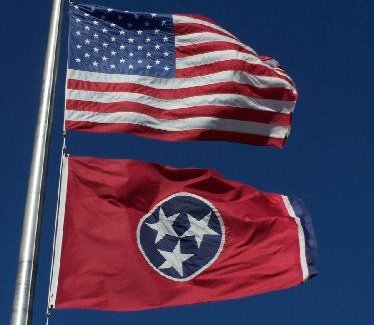
U.S. and Tennessee flags flying together on one staff.  Photo by J. Stephen Conn

U.S. and Tennessee flags flying together on one staff. Photo by J. Stephen Conn

Kentucky's state flag, by Gage Skidmore

Kentucky’s state flag features a Native American and European colonist standing together, and the state motto, “United We Stand, Divided We Fall.” Photo by Gage Skidmore

Kentucky’s admission to the union pushed the U.S. flag to 15 stars and 15 stripes.   President George Washington signed the law that authorized the U.S. flag be expanded to 15 stripes in early 1794.  I’ve not pinned down the history of what happened next.  So far as I know there was no law expanding the flag to 16 stripes, and in 1818, Congress said the flag would be 13 stripes, and stars equal to the number of states.

A 15-striped Star-spangled Banner that flew over Fort McHenry in Baltimore Harbor in 1814 and inspired Francis Scott Key to write the poem that is now the lyric to our national anthem.  President James Monroe signed the 13-stripe law in 1818.

What happened in between?  I suspect there are a lot of 15-stripe flags, but it wouldn’t surprise me to find a 16-stripe flag somewhere.  A variety of stars-and-stripes flags cropped up, which the 1818 law was intended to squelch.

Residents of the Bluegrass State and the Volunteer State should fly their flags today, in honor of their state’s having joined the union on June 1.

More:

http://twitter.com/hoyosplacido3/status/604008354571259904


Yes, this is mostly an encore post. Fighting ignorance requires patience.

Yes, this is mostly an encore post. Fighting ignorance requires patience. And repetition.


On what dates should we fly the flag in June?

May 31, 2015

Betsy Ross house in Philadelphia, by tradition the birthplace of Old Glory.

Betsy Ross house in Philadelphia, about 1900, by tradition the birthplace of Old Glory. “Happy Flag Day from Shorpy! Detroit Publishing Co. glass negative.” Image via Shorpy. Betsy Ross House is a traditional site for Philadelphia’s celebration of Flag Day.

June holds only two days designated for flying the U.S. flag out of the specific days mentioned in the U.S. Flag Code, and six statehood days, when residents of those states should fly their flags.  Plus, there is National Flag Week.

Two Flag Code-designated days:

  • Flag Day, June 14
  • Fathers Day, third Sunday in June (June 21)

Several states celebrate statehood. New Hampshire, Virginia, Arkansas, Kentucky, Tennessee and West Virginia celebrate statehood; Kentucky and Tennessee share the same date.

  • Kentucky, June 1 (1792, 15th state)
  • Tennessee, June 1 (1796, 16th state)
  • Arkansas, June 15 (1836, 25th state)
  • West Virginia, June 20 (1863, 35th state)
  • New Hampshire, June 21 (1788, 9th state), and
  • Virginia, June 25 (1788, 10th state)

Additionally, Congress passed a resolution designating the week in which June 14th falls as National Flag Week, and urging that citizens fly the flag each day of that week.  In 2015 that would the week of June 14, which falls on Sunday, through June 20.

Nine designations covering 10 separate days, listed chronologically:

  1. Kentucky and Tennessee statehood, June 1
  2. Flag Day, June 14; National Flag week, June 14 to 20
  3. Arkansas statehood, June 15 (duplicating National Flag Week)
  4. West Virginia statehood, June 20 (also duplicating National Flag Week)
  5. Fathers Day, June 21
  6. New Hampshire statehood, June 21 (duplicating Fathers Day)
  7. Virginia statehood, June 25

Tip of the old scrub brush to Mike’s Blog Rounds at Crooks and Liars — thanks for the plug!


May 29, Rhode Island Statehood Day; fly your flags in Providence

May 29, 2015

https://upload.wikimedia.org/wikipedia/commons/thumb/0/0d/Independent_Man_Providence_Capitol.JPG/800px-Independent_Man_Providence_Capitol.JPG

The Independent Man stands atop the Rhode Island State House in Providence. Photo by Lgalbi; Public Domain via Wikimedia Commons

May 29 is statehood day for Rhode Island, the 13th of the original colonies to join the union.

It’s interesting history to me. Rhode Island was rogue enough at the time — many called it “Rogues’ Island” — the colony sent no delegates to the convention in Philadelphia that wrote the Constitution.  One may wonder why the delegates even bothered to include the colony in the process. But, they did.

Not that it mattered to creation of the United States.  New Hampshire was the 9th state to ratify the document, on June 21, 1788, making it effective under the rules.  Rhode Island did not ratify the Constitution until May 29, 1790 — two years after the Constitution took effect, and about a year after the new government started operation and inaugurated George Washington the first president.  Rhode Island joined the nation already steaming along.

Rear of Rhode Island's Capitol, flying the Rhode Island state flag to the left, and the U.S. and POW flags on the right.  (Just try to find photos of the U.S. and Rhode Island flags together . . . please.)

Rhode Island State Capitol, north facade, by Garrett A. Wollman; bostonradio.org via Wikimedia. Rhode Island’s state flag flies to the left, and the U.S. and POW flags on the right. (Just try to find photos of the U.S. and Rhode Island flags together . . . please.)

Does Rhode Island celebrate Statehood Day? I don’t know. Historian Laureate Patrick T. Conley wrote a column for the Providence Journal revealing that Rhode Island was, like Texas, an independent republic for a time. This news won’t rest well with Texans. Other Rhode Island celebrations may occur, but they’re tough to learn about.

More:


Rachel Carson’s 108th birth anniversary

May 27, 2015

Rachel Carson, the great biologist and author, was born on May 27, 1907.

Last year, Google’s Doodle featured Ms. Carson, and the crazy, ill-informed, hoaxing and hoaxed right wing, came unglued.

Less flap this year, but I suspect it’s only because there’s been no great public recognition of the date.  Hoaxsters who insist DDT was always safe, or that banning DDT on cotton crops in Arkansas and Texas somehow caused malaria in Africa, or that Idi Amin became a great fan of Rachel Carson and stopped spraying DDT in Uganda to save American eagles, or other similarly silly-but-vicious things, or who just hate anything to do with protecting the environment, usually erupt on Earth Day, World Malaria Day, and Rachel Carson’s birthday.

Not much on her birthday this year (but stay tuned).

Meanwhile, our country’s sober liberal conscience, The Nation, looks back at their review of Silent Spring, and does a little cringing. Probably not necessary:

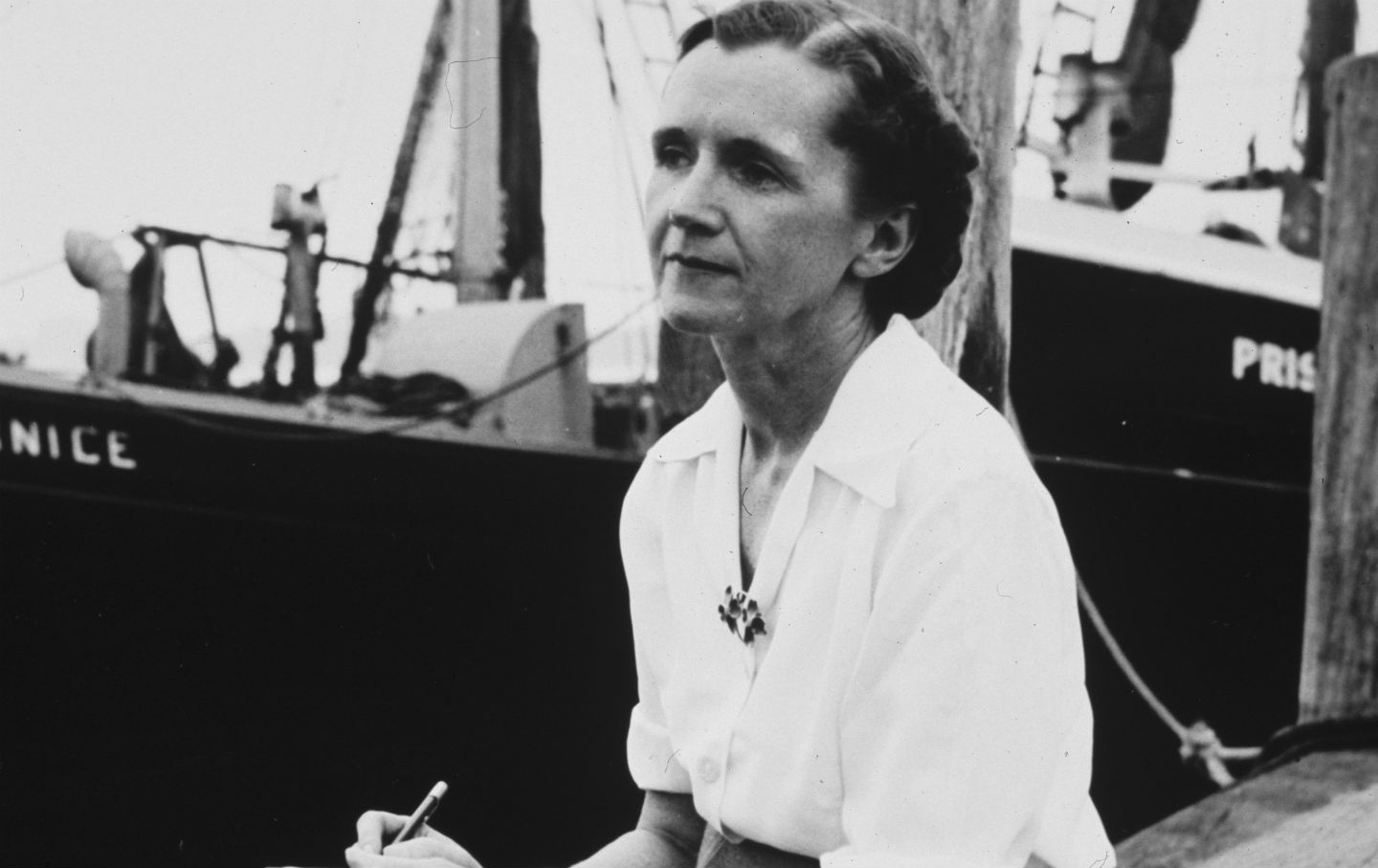
Rachel Carson, date unknown. (US Department of Agriculture) - via The Nation

Rachel Carson, date unknown. (US Department of Agriculture) – via The Nation

It is difficult not to cringe at the sight of the headline to the following review of Rachel Carson’s groundbreaking book, Silent Spring—“Man and Other Pests”—given that it was a review of what was then probably the most influential intellectual contribution by an American woman to date.

Miss Carson is indignant about the unexpected effects of our thoughtless broadcasting of pesticides. She writes persuasively, for she has taken great pains to gather and check her facts. Parts of the book were published in The New Yorker magazine last summer, and immediately provoked wide interest, discussion and controversy. This reaction will undoubtedly intensify with the publication of the book. No one is in a better position than Miss Carson to arouse the indignation of the public and the conscience of the chemical industry, and it may well be that she has made a real contribution to our salvation.

[At The Nation, you can read the entire review quoted from above.]

Happy birthday, Ms. Carson.  You have become a hero to thinking people, conservationists, scientists and women everywhere.

You’ll be pleased to know the American symbol, the bald eagle, is back from extinction’s verge, along with the brown pelican, peregrine falcons and osprey.  You’d be surprised to know that, despite gross abuse of DDT in the 1950s and 1960s that caused mosquitoes all over the world to carry alleles resistance and immunity, DDT was saved from complete worthlessness by a reduction in use, and is still used in a few places today, indoors to protect wildlife, to fight malaria.  You were right about DDT.

You were right about fighting malaria, too.  You said in Silent Spring we should use integrated pest management to battle the mosquitoes that provide a site for part of the life cycle of the malaria parasites, and who then spread the disease.  When DDT failed the malaria eradication campaign in the 1960s, malaria fighters were left with little else. Malaria deaths have plunged, from the 4 million to 5 million per year you knew, to fewer than 500,000 per year now.  Worldwide, we’ve cut malaria deaths 45% just since 1999, when a group of non-governmental organizations and the World Health Organization formally adopted integrated pest management as the best way to fight the disease, and began distributing mosquito nets in a big way.

You were right, Rachel Carson. Humanity is a part of nature, and if we fight nature we end up fighting and killing ourselves.

More:

One of my favorites from Gus Arriola (also appearing at the DDT Chronicles):

Save


Memorial Day 2015 – Fly your flag today

May 25, 2015

U.S. flags flying at the Dallas-Fort Worth National Cemetery, for Memorial Day 2015. Photo by Ed Darrell. Please use.

U.S. flags flying at the Dallas-Fort Worth National Cemetery, for Memorial Day 2015. Photo by Ed Darrell. Please use.

Fly your flag today for Memorial Day.

On Memorial Day, flags should be flown at half-staff until noon, then raised to full staff (and retired at sunset).

Just a reminder: When posting a flag to half-staff, it should be raised with gusto to full staff, then slowly lowered to the half-staff position.  On Memorial Day, when changing the flag’s position at noon, simply raise the flag briskly to full staff.  At retirement, the flag should be lowered in a stately fashion.

U.S. flags flying at the Dallas Fort Worth National Cemetery, for Memorial Day 2015.  You may use this photo.

U.S. flags flying at the Dallas Fort Worth National Cemetery, for Memorial Day 2015. You may use this photo.


89 years ago, May 23, 1926: Mencken confessed Fillmore bathtub hoax, “any facts . . . got there accidentally”

May 23, 2015

Reasons for my annual observance of a moment of silence, here on May 23, for the failed confession of Mr. Mencken should be obvious to even a sleepy reader.  Alas, annually the need grows to call attention to the dangers of hoaxing, as hoaxes particularly in the political life of the U.S. grow in number, in viciousness, and in the numbers of gullibles suckered.  Here, again, is our annual reading of the confession with a few photographs and new links thrown in for easy learning:

May 23, 1926, H. L. Mencken‘s newspaper column confessed his hoax of nine years earlier — he had made up whole cloth the story of Millard Fillmore‘s only accomplishment being the installation of a plumbed bathtub in the White House (in the 1850s known as the Executive Mansion).

H. L. Mencken, America's "wittiest defender of liberty," according to a story in the resurrected American Mercury. Image from American Mercury.

H. L. Mencken, America’s “wittiest defender of liberty,” according to a story in the resurrected American Mercury. Image from American Mercury.

Alas, the hoax cat was out of the bag, and the hoax information still pollutes the pool of history today.

Text of Mencken’s confession, from the Museum of Hoaxes:

Melancholy Reflections

On Dec. 28, 1917, I printed in the New York Evening Mail, a paper now extinct, an article purporting to give the history of the bathtub. This article, I may say at once, was a tissue of absurdities, all of them deliberate and most of them obvious…

This article, as I say, was planned as a piece of spoofing to relieve the strain of war days, and I confess that I regarded it, when it came out, with considerable satisfaction. It was reprinted by various great organs of the enlightenment, and after a while the usual letters began to reach me from readers. Then, suddenly, my satisfaction turned to consternation. For these readers, it appeared, all took my idle jocosities with complete seriousness. Some of them, of antiquarian tastes, asked for further light on this or that phase of the subject. Others actually offered me corroboration!

But the worst was to come. Pretty soon I began to encounter my preposterous “facts” in the writings of other men. They began to be used by chiropractors and other such quacks as evidence of the stupidity of medical men. They began to be cited by medical men as proof of the progress of public hygiene. They got into learned journals. They were alluded to on the floor of congress. They crossed the ocean, and were discussed solemnly in England and on the continent. Finally, I began to find them in standard works of reference. Today, I believe, they are accepted as gospel everywhere on earth. To question them becomes as hazardous as to question the Norman invasion.

* * *

And as rare. This is the first time, indeed, that they have ever been questioned, and I confess at once that even I myself, their author, feel a certain hesitancy about doing it. Once more, I suppose, I’ll be accused of taking the wrong side for the mere pleasure of standing in opposition. The Cincinnati boomers, who have made much of the boast that the bathtub industry, now running to $200,000,000 a year, was started in their town, will charge me with spreading lies against them. The chiropractors will damn me for blowing up their ammunition. The medical gents, having swallowed my quackery, will now denounce me as a quack for exposing them. And in the end, no doubt, the thing will simmer down to a general feeling that I have once more committed some vague and sinister crime against the United States, and there will be a renewal of the demand that I be deported to Russia.

I recite this history, not because it is singular, but because it is typical. It is out of just such frauds, I believe, that most of the so-called knowledge of humanity flows. What begins as a guess — or, perhaps, not infrequently, as a downright and deliberate lie — ends as a fact and is embalmed in the history books. One recalls the gaudy days of 1914-1918. How much that was then devoured by the newspaper readers of the world was actually true? Probably not 1 per cent. Ever since the war ended learned and laborious men have been at work examining and exposing its fictions. But every one of these fictions retains full faith and credit today. To question even the most palpably absurd of them, in most parts of the United States, is to invite denunciation as a bolshevik.

So with all other wars. For example, the revolution. For years past American historians have been investigating the orthodox legends. Almost all of them turn out to be blowsy nonsense. Yet they remain in the school history books and every effort to get them out causes a dreadful row, and those who make it are accused of all sorts of treasons and spoils. The truth, indeed, is something that mankind, for some mysterious reason, instinctively dislikes. Every man who tries to tell it is unpopular, and even when, by the sheer strength of his case, he prevails, he is put down as a scoundrel.

* * *

As a practicing journalist for many years, I have often had close contact with history in the making. I can recall no time or place when what actually occurred was afterward generally known and believed. Sometimes a part of the truth got out, but never all. And what actually got out was seldom clearly understood. Consider, for example, the legends that follow every national convention. A thousand newspaper correspondents are on the scene, all of them theoretically competent to see accurately and report honestly, but it is seldom that two of them agree perfectly, and after a month after the convention adjourns the accepted version of what occurred usually differs from the accounts of all of them.

Political boss Harry M. Daugherty (later Attor...

Political boss Harry M. Daugherty (later Attorney General of the United States), left, with Senator Warren G. Harding (later President of the United States) at Harding’s home in Marion, Ohio during the 1920 presidential campaign. (Photo credit: Wikipedia)

I point to the Republican convention of 1920, which nominated the eminent and lamented Harding. A week after the delegates adjourned the whole country believed that Harding had been put through by Col. George Harvey: Harvey himself admitted it. Then other claimants to the honor arose, and after a year or two it was generally held that the trick had been turned by the distinguished Harry M. Daugherty, by that time a salient light of the Harding cabinet. The story began to acquire corroborative detail. Delegates and correspondents began to remember things that they had not noticed on the spot. What the orthodox tale is today with Daugherty in eclipse, I don’t know, but you may be sure that it is full of mysterious intrigue and bold adventure.

Ambassador Myron T. Herrick was part of the U....

Ambassador Myron T. Herrick was part of the U.S. delegation to the International Chamber of Commerce which sailed on Kroonland in 1920. (Photo credit: Wikipedia)

What are the facts? The facts are that Harvey had little more to do with the nomination of Harding than I did, and that Daugherty was immensely surprised when good Warren won. The nomination was really due to the intense heat, and to that alone. The delegates, torn by the savage three cornered fight between Lowden, Johnson, and Wood, came to Saturday morning in despair. The temperature in the convention hall was at least 120 degrees. They were eager to get home. When it became apparent that the leaders could not break the deadlock they ran amuck and nominated Harding, as the one aspirant who had no enemies. If any individual managed the business it was not Harvey or Daugherty, but Myron T. Herrick. But so far as I know Herrick’s hand in it has never been mentioned.

* * *

English: Jack Dempsey and Georges Carpentier i...

Jack Dempsey and Georges Carpentier in arena before fight at Boyle’s Thirty Acres. (Photo credit: Wikipedia)

I turn to a more pleasant field — that of sport in the grand manner. On July 2, 1921, in the great bowl at Jersey City, the Hon. Jack Dempsey met M. Carpentier, the gallant frog. The sympathy of the crowd was overwhelmingly with M. Carpentier and every time he struck a blow he got a round of applause, even if it didn’t land. I had an excellent seat, very near the ring, and saw every move of the two men. From the first moment Dr. Dempsey had it all his own way. He could have knocked out M. Carpentier in the first half of the first round. After that first half he simply waited his chance to do it politely and humanely.

Yet certain great newspapers reported the next morning that M. Carpentier had delivered an appalling wallop in the second round and that Dr. Dempsey had narrowly escaped going out. Others told the truth, but what chance had the truth against that romantic lie? It is believed in to this day by at least 99.99 per cent of all the boxing fans in Christendom. Carpentier himself, when he recovered from his beating, admitted categorically that it was nonsense, but even Carpentier could make no headway against the almost universal human tendency to cherish what is not true. A thousand years hence schoolboys will be taught that the frog had Dempsey going. It may become in time a religious dogma, like the doctrine that Jonah swallowed the whale. Scoffers who doubt it will be damned to hell.

The moral, if any, I leave to psycho-pathologists, if competent ones can be found. All I care to do today is to reiterate, in the most solemn and awful terms, that my history of the bathtub, printed on Dec. 28, 1917, was pure buncombe. If there were any facts in it they got there accidentally and against my design. But today the tale is in the encyclopedias. History, said a great American soothsayer, is bunk.

[Emphasis in that last paragraph added here.]

Mencken’s confession gets much less attention than it deserves.  In a just world, this essay would be part of every AP U.S. history text, and would be available for printing for students to read individually in class and to discuss, debate and ponder.  Quite to the contrary, state legislatures today debate whether to require teaching of the hoax that disastrous climate change is not occurring, only 45% of Americans claim to know better for certain; more legislatures work hard to devise ways to insert hoaxes against biology (evolution and human reproduction, notably), astronomy and physics (Big Bang), history and even education (Islam is a root of socialist thought, President Obama is not Christian, weapons of mass destruction were found in Iraq after the U.S. invasion, teachers are socialists).

In 2013, the governing body of the Boy Scouts of America voted on whether to allow homosexual boys to be Scouts — as if an 8-year-old kid joining Cub Scouts knows enough about sex and love, and sex predation, to threaten the Constitution of the U.S. if we allow him to learn how to put alphabet macaroni onto a board spelling out “Mom,” or to learn how to carve an automobile out of a block of wood and race it on a closed-course track.  The so-called Family Research Council (FRC) has conducted a campaign of vicious hoaxes against the measure, even going so far as to purloin official logos of the Boy Scouts to suggest they speak for BSA.  The hoax has millions of victims, they claim.

Meanwhile, in Washington, D.C., GOP Members of Congress call for investigations into wrongdoing evidenced in e-mails between the White House and State Department and CIA, over the attack on the U.S. diplomatic mission in Benghazi, Libya, and the death of Ambassador Chris Stevens.  To hear the GOP describe it, you’d never know that the GOP opposed President Obama’s actions to save the city of Benghazi from destruction by dictator Muammar Gadhafy a few months before, that the GOP slashed the security budget for all U.S. diplomatic missions, leaving Ambassador Stevens underprotected, that the GOP was opposed to much of the work of Ambassador Stevens, or that the incriminating e-mails were hoaxed up by GOP Congressional staff.  [This paragraph was written two years ago; still oddly valid in 2015.]

Other hoaxes that plague our nation, national security, and freedom from fear:

  • Texans fret that President Obama will invade Texas and annex it into the United States of America.
  • Many business lobbyists scream that rogue scientists cooked up global warming, and tell us that all of us frogs will know when the water is too warm, and can leap to safety later.
  • Any Google or Bing search turns up high dudgeon ne’er-do-gooders who scream that we need to bring back DDT to beat malaria, Ebola, West Nile virus and tooth decay, though DDT has always been available to fight disease-carrying insects, and it won’t work against Ebola, and it’s inappropriate against West Nile.
  • Et cetera.
  • Et cetera.
  • Et cetera.

If you see pale faces among the GOP Congressional staff or the FRC this morning, it may be because the ghost of H. L. Mencken appeared to them last night to give them hell.  We could hope.

More:

Yes, this is mostly an encore post. Fighting ignorance requires patience.

Yes, this is mostly an encore post. Fighting ignorance requires patience, and repetition of the facts.


Fly your flags May 23 for statehood in South Carolina and Wisconsin

May 23, 2015

Two states on the same day?

Not exactly.

South Carolina achieved statehood on May 23, 1788, according to the date the state’s people ratified the Constitution. South Carolina was number eight; the Constitution became effective on the ninth ratification.

Wisconsin joined the union in 1848 — but it did name its capital city after James Madison, the Father of the Constitution.

Same day, 60 years apart.

Residents of a state are urged to fly the U.S. flag on the state’s anniversary of entering the union.

U.S. and South Carolina flags. Fox News file photo

U.S. and South Carolina flags. Fox News file photo

Judging by what’s available in on-line news, it appears both South Carolina and Wisconsin don’t have plans to celebrate statehood much, in 2015.

Is this a litmus test?  Will only true patriots fly their flags in the two states?

Or after National Maritime Day on May 22, and with Memorial Day on May 25, are citizens suffering from flag-flying fatigue?

U.S. and Wisconsin flags fly at the Wisconsin Capitol Building in Madison. Wisconsin Legislature image.

U.S. and Wisconsin flags fly at the Wisconsin Capitol Building in Madison. Wisconsin Assembly image.

Here in Texas, Rotary Clubs offer a service to put flags up on flag-flying days, for an annual fee. Boy Scout groups and others service organizations take routes to deliver flags on poles; on weekends, flags go up on Friday, and come down at the end of the holiday, Monday night in this case.

Heck, that covers National Maritime Day, Wisconsin and South Carolina Statehood Days, and Memorial Day (without the half-staff exercise).

A patriot could get lost in all this flag flying.


Powers of Ten – Charles and Ray Eames’ brilliant, before-its-time film

May 23, 2015

Images from

Images from “Powers of Ten,” 1977 edition. From IconEye

AMNH’s “The Known Universe” is a cool film. Putting up that last post on the film, I looked back and noted that when I had previously written about the brilliant predecessor films from Charles and Ray Eames, “Powers of Ten,” the Eames films were not freely available on line.

That’s been fixed.

I like to use films like this as warmups to a year of history, and as a reminder once we get into studying the history of space exploration, of just how far we’ve come in understanding the universe, and how big this place is.

Of course, that means wer are just small parts.

The Eames’s genius showed the scale of things, from a couple picnicking in a park, to the outer reaches of the universe, and then back, zooming into the innermost reaches of a human down to the sub-atomic level.

There’s a series of these films; this one, published on YouTube by the Eames Office, was done in 1977, one of the later versions.

How can you use this in class, teachers? (I recommend buying it on DVD, as I did; better sound and pictures, generally.)

Film information:

Uploaded on Aug 26, 2010

Powers of Ten takes us on an adventure in magnitudes. Starting at a picnic by the lakeside in Chicago, this famous film transports us to the outer edges of the universe. Every ten seconds we view the starting point from ten times farther out until our own galaxy is visible only a s a speck of light among many others. Returning to Earth with breathtaking speed, we move inward- into the hand of the sleeping picnicker- with ten times more magnification every ten seconds. Our journey ends inside a proton of a carbon atom within a DNA molecule in a white blood cell. POWERS OF TEN © 1977 EAMES OFFICE LLC (Available at http://www.eamesoffice.com)

At the Eames Office Youtube site, you may find the film in with Mandarin Chinese, German, and Japanese translations (no Spanish?).  If you’re unfamiliar with the work of this couple — you would recognize much of the stuff they designed, I’m sure — check out a short film on an exhibit on Ray Eames (which has concluded, sadly):

More:

The very recognizable, famous Eames Chair, from Herman Miller. Ideally, you can sit in your Eames Chair while watching

The very recognizable, famous Eames Chair and Ottoman, from Herman Miller. Ideally, you can sit in your Eames Chair while watching “Powers of Ten.” Herman Miller image.


109 years ago, May 22, 1906: Patent to Wright Bros. for “flying machine”

May 22, 2015

In a drawer in a file box in the U.S. Patent Office in Washington, D.C., is a study in black ink on white paper, lines that resemble those images most of us have of the first Wright Bros. flyer, usually dubbed “Kittyhawk” after the place it first took to the air.

Drawing 1 from patent granted to Orville Wright for a flying machine

Drawing 1 from patent granted to Orville Wright for a flying machine

The patent was issued on May 22, 1906, to Orville Wright, Patent No. 821393, for a “flying machine.”

It makes more sense if you turn the drawing on its side.

Wright Bros. flying machine, from patent drawing

Wright Bros. flying machine, from patent drawing

With the patent, the Wrights had legal means to protect their idea so they could commercially develop it.  Turns out, however, that the fight to get the patent, and subsequent fights to protect it, may have prevented them from fully realizing the commercial success they could have had.  Lawrence Goldstone, the author of that article, details the history at much greater length in his 2014 book, Birdmen: The Wright Brothers, Glenn Curtiss, and the Battle to Control the Skies. 

Why did it take three years to get the patent issued?

Below the fold, the rest of the patent.

Read the rest of this entry »


Merchant mariners bring us the world; fly your flag for National Maritime Day, May 22

May 22, 2015

SS Savannah, first U.S. merchant steam ship to complete an Atlantic crossing, having set sail on May 22, 1819.  gCaptain image

SS Savannah, first U.S. merchant steam ship to complete an Atlantic crossing, having set sail on May 22, 1819. gCaptain image

You’ve got your flag up already? Good.

Most people don’t even know about National Maritime Day, May 22 — let alone President Obama issued a proclamation to fly the U.S. flag in honor of merchant marines.

USS Slater Color Guard member Art Dott of Colonie carries the American flag Sunday during the presentation of the colors at the start of a National Maritime Day ceremony on the boat in Albany. Dott, a culinary specialist chief, is a 350year member of the Navy Reserve. ( Philip Kamrass / Times Union)

From the Albany, New York, Times-Union, 2011: USS Slater Color Guard member Art Dott of Colonie carries the American flag Sunday during the presentation of the colors at the start of a National Maritime Day ceremony on the boat in Albany. Dott, a culinary specialist chief, is a 35-year member of the Navy Reserve. ( Philip Kamrass / Times Union)


National Maritime Day is a United States holiday created to recognize the maritime industry. It is observed on May 22, the date in 1819 that the American steamship Savannah set sail from Savannah, Georgia on the first ever transoceanic voyage under steam power. The holiday was created by the United States Congress on May 20, 1933.

President Obama’s proclamation:

Presidential Proclamation – National Maritime Day, 2015

NATIONAL MARITIME DAY, 2015

– – – – – – –

BY THE PRESIDENT OF THE UNITED STATES OF AMERICA

A PROCLAMATION

For over two centuries, proud mariners have set sail in defense of our people and in pursuit of opportunity.  Through periods of conflict and times of peace, our Nation has relied on the United States Merchant Marine to transport goods to and from our shores and deliver troops and supplies around the world.  On National Maritime Day, we honor the women and men who take to the seas to boost our economy and uphold the values we cherish.

Our Nation is forever indebted to the brave privateers who helped secure our independence, fearlessly supplying our Revolutionary forces with muskets and ammunition.  Throughout history, their legacy has been carried forward by courageous seafarers who have faithfully served our Nation as part of the United States Merchant Marine — bold individuals who emerged triumphant in the face of attacks from the British fleet in the War of 1812, and who empowered the Allied forces as they navigated perilous waters during World War II.  Today, patriots who share their spirit continue to stand ready to protect our seas and the livelihoods they support.

Ninety percent of the world’s commerce moves by sea, and businesses across our country rely on domestic and international trade every day.  Helping to protect our vital shipping routes, Merchant Mariners are critical to our effort to combat piracy and uphold the maritime security on which the global supply chain relies.  And in times of war or national emergency, they bolster our national security as a “fourth arm of defense.”  Whether transporting commercial goods or military equipment, battling tough weather or enemy fire, they strive and sacrifice to secure a brighter future for all Americans.  On this day, we reaffirm the importance of their contributions and salute all those who serve this noble cause.

The Congress, by a joint resolution approved May 20, 1933, has designated May 22 of each year as “National Maritime Day,” and has authorized and requested the President to issue annually a proclamation calling for its appropriate observance.

NOW, THEREFORE, I, BARACK OBAMA, President of the United States of America, do hereby proclaim May 22, 2015, as National Maritime Day.  I call upon the people of the United States to mark this observance and to display the flag of the United States at their homes and in their communities.  I also request that all ships sailing under the American flag dress ship on that day.

IN WITNESS WHEREOF, I have hereunto set my hand this twentieth day of May, in the year of our Lord two thousand fifteen, and of the Independence of the United States of America the two hundred and thirty-ninth.

BARACK OBAMA

More:


Homestead Act of 1862: Socialist land giveaway that appealed to free-market Americans, then and now

May 21, 2015

We passed an important anniversary in American history this week.  I’m not sure anyone noted it.

I am constantly amazed at how much of our history gets ignored in conservative politics, especially with regard to the role the government played in stimulating development of the nation with subsidies and give-aways.  What would America be without the Homestead Act?

A family off to find and settle their homestead, 1886. Photo from the National Archives

A family off to find and settle their homestead, 1886. Photo from the National Archives

History and demographics of the United States were forever changed when the Homestead Act became law early in the administration of President Abraham Lincoln, on May 20, 1862.

With Congress paralyzed and unable to act to do even minor good things now, it’s astonishing to think how the Congress of 1862 could do so much to open the American west, in the middle of the American Civil War.  Perhaps Congress was able to act because legislators from the South were absent, and did not oppose progress.

In any case, the Homestead Act encouraged Americans who lacked property, or who wanted to go west, to strike out for the western territories and states, to make a new life, to found new towns, cities and farms, and fulfill the nation’s “manifest destiny.”

The bill that became the Homestead Act, H.R. 125, in the 37th Congress, 1862. Image from the U.S. National Archives

The bill that became the Homestead Act, H.R. 125, in the 37th Congress, 1862. Image from the U.S. National Archives

Here’s the history from the National Archives:

The notion that the United States government should give free land titles to settlers to encourage westward expansion became popular in the 1850s. During that time the U.S. House of Representatives passed numerous homestead bills but southern opposition in the Senate prevented enactment. In 1860, during the 36th Congress, the Senate narrowly passed a homestead act but President James Buchanan vetoed it and the Senate failed its override attempt.

When the 37th Congress convened for its brief summer session in 1861, now without members from seceded states, it was preoccupied with Civil War-related legislation. The House took up briefly the homestead issue in December but postponed further consideration of it until the following February. The House finally passed the Homestead Act on February 28, 1862 by the large margin of 107 to 16. The act worked its way through the Senate until May 6, 1862 when it passed easily by a vote of 33 to 7. After a few minor changes in conference committee—which both houses agreed to without controversy—Congress sent the final legislation to President Abraham Lincoln who signed the act into law on May 20, 1862.

The Homestead Act encouraged western migration by providing settlers with 160 acres of land in exchange for a nominal filing fee. Among its provisions was a five-year requirement of continuous residence before receiving the title to the land and the settlers had to be, or in the process of becoming, U.S. citizens. Through 1986, when the last claim was made in Alaska, the Homestead Act distributed 270 million acres of land in the United States making it arguably one of the most far-reaching pieces of legislation in American history.

More:

Much of this post has appeared at Millard Fillmore’s Bathtub before; the Homestead Act deserves commemoration.