Stars smile on climbers at El Capitan

January 7, 2015

Nice photo forwarded from the Wilderness Society.

Wilderness Society Tweeted: Stars over Yosemite's El Capitan (in honor of @kjorgeson & @tommycaldwell1). Have a good night!  (Photo by Justin Kern, flickr)

Wilderness Society Tweeted: Stars over Yosemite’s El Capitan (in honor of @kjorgeson & @tommycaldwell1). Have a good night! (Photo by Justin Kern, flickr)

Actually, this photo probably is not from the past few days, when Kevin Jorgeson and Tommy Caldwell worked to free climb the rock — but the Milky Way is there if they care to look!

Not just the whole world is watching — the whole universe shines down.

(Have you been following their climbing exploits?)

More:


Graveside commemoration for Millard Fillmore’s birthday in Buffalo, January 7

January 6, 2015

Are you going to the graveside event in Buffalo, New York, for Millard Fillmore’s birthday?

Press release from the University of Buffalo:

Millard Fillmore’s Buffalo legacy to be recognized at commemoration

A plaque commemorating Millard Fillmore hangs on a gate in front of the grave site in Forest Lawn Cemetery.

By Sue Ann Wuetcher

December 30, 2014

“Millard Fillmore’s imprint on Buffalo’s development into a leading U.S. city of the 19th century is unparalleled and his legacy today remains truly vibrant.”
– William J. Regan, director of special events,University at Buffalo

BUFFALO, N.Y. – If Millard Fillmore, the much-maligned 13th president of the United States, were alive today, he might tell you he has a lot to be proud of.

Fillmore helped establish UB — serving as the university’s first chancellor from 1847 until his death in 1874 —and he played a major role in founding numerous cultural, civic and community organizations in Buffalo and Erie County, among them the Buffalo History Museum, the Buffalo & Erie County Public Library and Buffalo General Medical Center.

He also was instrumental in framing the charter that transformed the village of Buffalo into the city of Buffalo, and as a four-term congressman, secured funding to enlarge the Buffalo Harbor and expand the Erie Canal.

Fillmore’s “legacy organizations” will be well represented at the annual commemoration of Fillmore’s birthday, the 50th year UB has organized the annual program.

The ceremony will take place at 10 a.m. Jan. 7 — the 215th anniversary of Fillmore’s birth — at Fillmore’s gravesite in Forest Lawn Cemetery.

“In celebrating 50 years of planning this event, we thought it would be fitting to include all the organizations that can trace their roots back to Millard Fillmore,” says William J. Regan, director of special events. “Millard Fillmore’s imprint on Buffalo’s development into a leading U.S. city of the 19th century is unparalleled and his legacy today remains truly vibrant as these organizations continue to define and lead Buffalo in so many ways.”

The roster of organizations Fillmore touched is impressive, Regan says, and includes the Albright-Knox Art Gallery, The Buffalo Club, the Buffalo Public Schools, Buffalo Science Museum, the law firm Hodgson Russ LLP and the SPCA serving Erie County, as well as the history museum, public library, Buffalo General and, of course, UB.

Representatives of these organizations — Provost Charles F. Zukoski will represent UB — will give short tributes to Fillmore and present a community wreath to be placed on Fillmore’s grave. Wreaths also will be presented by the White House and Forest Lawn. Col. Kevin Rogers, inspector general of the 107th Airlift Wing of the New York Air National Guard based at the Niagara Falls Air Base, will place the White House wreath on behalf of President Obama.

Robert Goller, Town of Aurora historian, will deliver the memorial address and provide an account of Fillmore’s early days. Although he was born in Moravia, Cayuga County, Fillmore started his law practice in East Aurora and built a house there for himself and his wife, Abigail.

Following the gravesite ceremony, a reception sponsored by Forest Lawn and the Buffalo Club will be held in the new Margaret L. Wendt Archive and Resource Center in Forest Lawn.

The tradition to honor Fillmore dates back to 1937. From 1937 until 1965, the commemoration was staged by the city of Buffalo and the Buffalo Board of Education. The annual ceremonies were administered by Irving R. Templeton, a 1909 graduate of UB, who scheduled two programs annually on or near Jan. 7 — one in City Hall and one in Forest Lawn.

The responsibility of planning the commemoration shifted to UB when Templeton died in 1965. Although UB participated in the Fillmore birthday commemoration during Templeton’s stewardship, the university took over the ceremony and made it a community event starting in 1966.

The ceremony is open to all members of the UB and broader Western New York communities. Registration is encouraged at www.ubevents.org/event/mf2015

– See more at: http://www.buffalo.edu/news/releases/2014/12/043.html#sthash.dqcO3WTO.dpuf

No bathtub races this year, that I have found.

Do you know of any other commemorations of Fillmore’s birthday?


January 6: New Mexico flies U.S. flags for Statehood Day

January 6, 2015

President William Howard Taft signing the bill that made New Mexico a state, in 1912. (Other people in the photo, I have not yet identified). Image from OldPicture.com

President William Howard Taft signing the bill that made New Mexico a state, in 1912. (Other people in the photo, I have not yet identified). Image from OldPicture.com

New Mexico became the 47th member of the Union on January 6, 1912.  New Mexicans should fly their U.S. flags today in honor of statehood, the U.S. Flag Code urges.

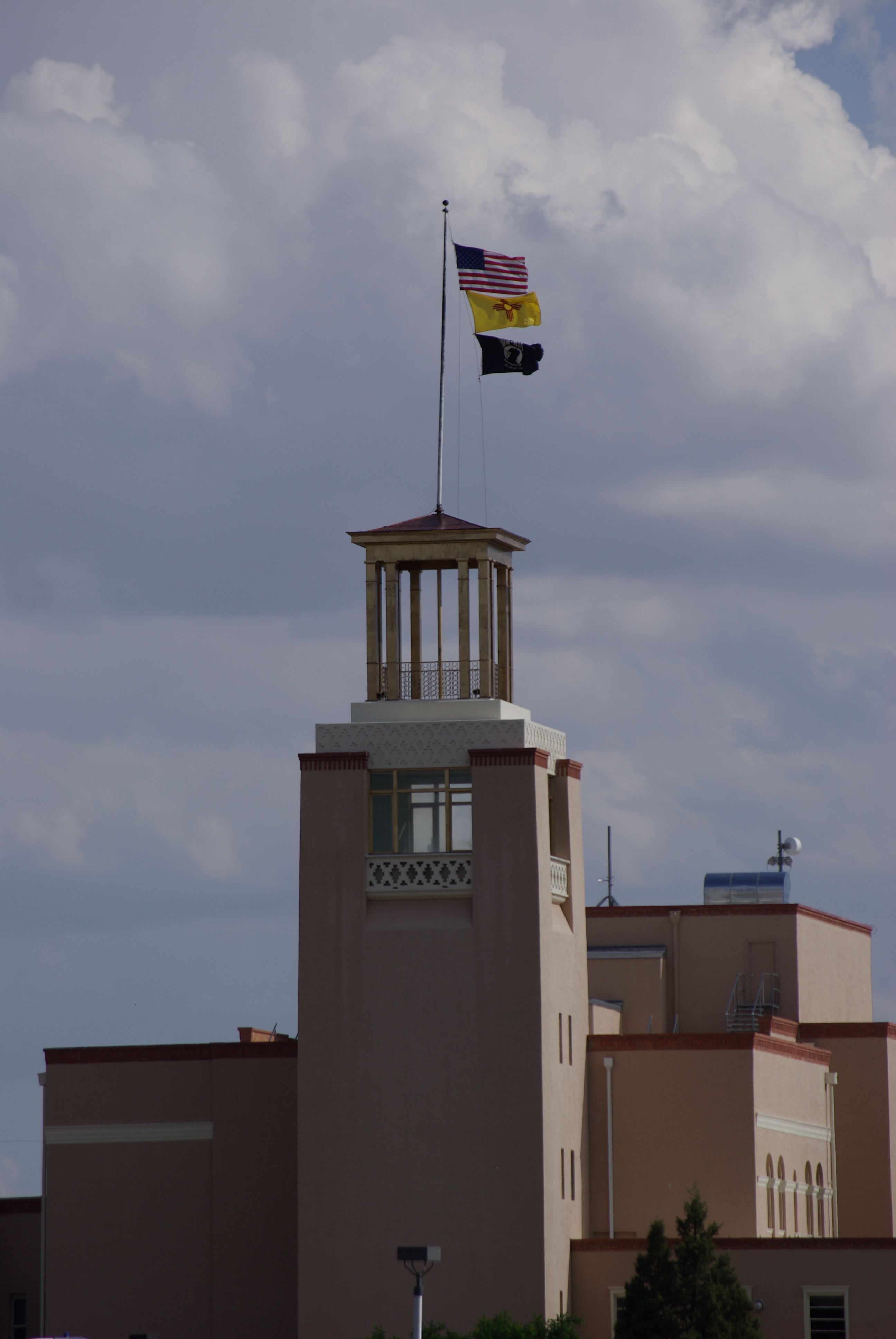
U.S. and New Mexico flags fly from the state education administration building in Santa Fe, 2014

U.S. and New Mexico flags fly from the state education administration building in Santa Fe, 2014. The third flag is the U.S. POW/MIA flag.

I don’t think Statehood Day is a big deal in New Mexico.  New Mexicans love art, though, and statehood and history of the land and the peoples who live there are celebrated throughout Santa Fe and New Mexico.  The New Mexico Art Museum features a lot about history.

The New Mexico State Capitol is one of the more unique in the U.S. There is no grand dome. Instead, the building is a large, circular structure, a giant kiva, honoring New Mexico’s ancient residents and ancestors.

We toured the Capitol in July. It features a massive collection of art by and about New Mexico, and is worth a stop as one would intend to visit any great art museum.

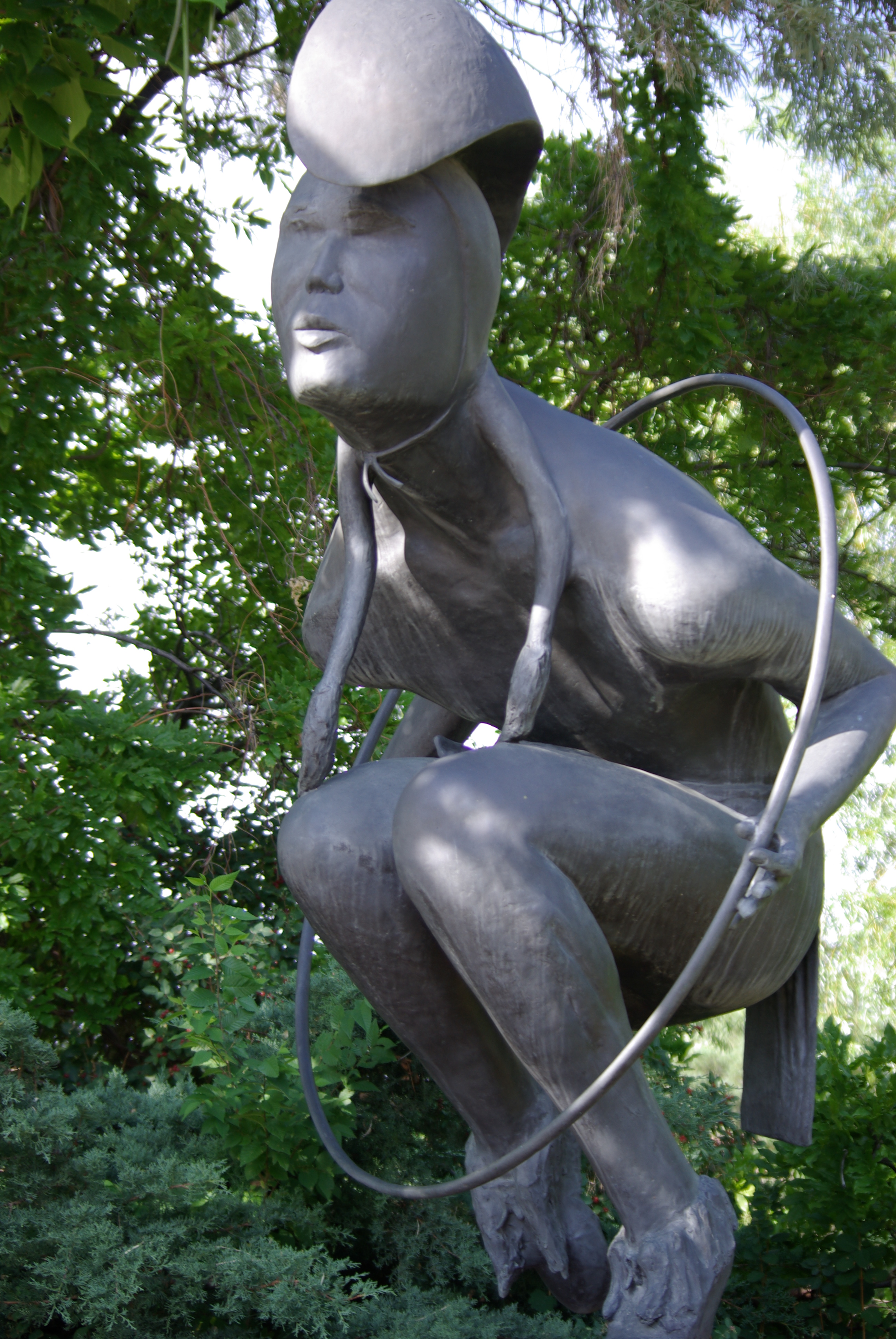
"Emergence," a representation of the creation of the present Earth and people, by Michael A. Naranjo, 2000. Part of the massive collection of New Mexico Art at the State Capitol -- this one outside the building itself.

“Emergence,” a representation of the creation of the present Earth and people, by Michael A. Naranjo, 2000. Part of the massive collection of New Mexico Art at the State Capitol — this one outside the building itself.

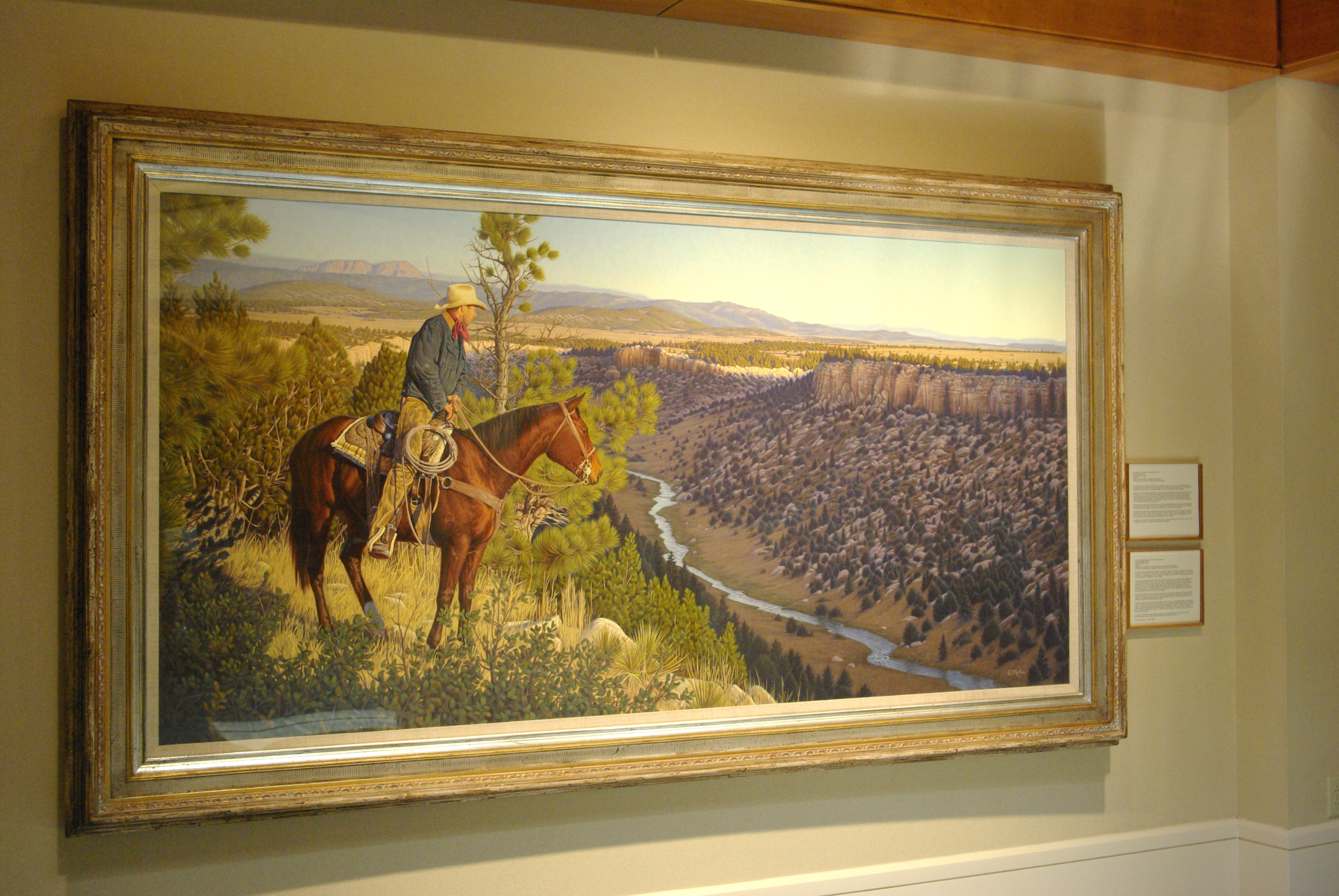
Simple Pleasures of New Mexico, acrylic by Gary Morton, 1992

Simple Pleasures of New Mexico,  stunning painting in acrylic by Gary Morton, 1992

If you’re in Santa Fe, plan to spend a half of a day, at least, looking at the Capitol and its art collections.  There are more than 400 pieces on display, sculpture, paintings, mixed media, and more.  It’s a world class gallery, free for the browsing.  Much of the art packs a powerful emotional punch, too, such as the sculpture outside the building honoring the vanished native tribes of North America.

Happy statehood, New Mexico.

More: 

USPS stamp honoring the centennial of New Mexico's statehood, in 2012. The stamp features a representation of the beauty of the state found in its desert hills and mountains.  VirtualStampClub.com

USPS stamp honoring the centennial of New Mexico’s statehood, in 2012. The stamp features a representation of the beauty of the state found in its desert hills and mountains. VirtualStampClub.com


Four Freedoms: FDR’s January 6, 1941 speech inspires us, 74 years later

January 6, 2015

Franklin Roosevelt delivered a State of the Union address to Congress on January 6, 1941, that would at least bend history, if not change it.  In the last part of the speech he mentioned four freedoms which, he said, are worth going to war to preserve, protect and extend.

Now we call it the Four Freedoms speech.  Today is the 74th anniversary of his delivery.  Do our students even study this any more?

_____________

I found a photo that reminded me of Norman Rockwell‘s “Freedom from Want,” and wrote about it.

Then I ran into a tweet from Texas educator Bonnie Lesley:

That in turn led to an Alternet post, displayed at Reader Supported News (RSN), by a guy who claims that, compared to 1941 and the progress made on the Four Freedoms, all four of them are in danger, in America, today.

Could that be right?  In was in his State of the Union address in January 1941 that Roosevelt described the four freedoms he said the U.S. should work to secure around the world — this was clearly a philosophical foundation-laying for going to war on the side of Britain, and against Germany, in the World War that was already raging, but which the U.S. had managed to stay out of for five years in Asia and two years in Europe.

Near the end of the speech on January 6, 1941, Roosevelt explained why freedom needed to be fought for, what was important to us, as Americans in the freedom of others in other nations.  This was 10 months before Pearl Harbor.  The United States counted itself officially “neutral” in World War II, already raging in Asia and Europe — the Battle of Britain was already over.  Anyone who seriously thought the U.S. would be able to stay out of the war probably lived in deep denial (much as denialists of today on a number of topics).  Roosevelt was working furiously to get support to Great Britain, and had already started the wheels to cut off U.S. supplies of war materials, including petroleum, to the Japanese empire.  (Odd to remember the U.S. was the largest exporter of petroleum then.)

Roosevelt knew he had to establish a philosophy to follow to merit defense of freedom, if, or when as he expected, war would draw the U.S. in, or an attack would trap the nation with need of a very quick response. In his State of the Union to the newly-elected Congress, at the start of his third term, Roosevelt talked in modern language about just what the U.S. stands for, and what the U.S. should be willing to fight for.

Here is an excerpt of the speech, the final few paragraphs:

I have called for personal sacrifice, and I am assured of the willingness of almost all Americans to respond to that call. A part of the sacrifice means the payment of more money in taxes. In my budget message I will recommend that a greater portion of this great defense program be paid for from taxation than we are paying for today. No person should try, or be allowed to get rich out of the program, and the principle of tax payments in accordance with ability to pay should be constantly before our eyes to guide our legislation.

If the Congress maintains these principles the voters, putting patriotism ahead of pocketbooks, will give you their applause.

In the future days, which we seek to make secure, we look forward to a world founded upon four essential human freedoms.

Norman Rockwell's

Norman Rockwell’s “Freedom from Fear,” 1943 painting based on FDR’s 1941 State of the Union address, “The Four Freedoms.” This painting was used on posters urging Americans to buy War Bonds.

The first is freedom of speech and expression — everywhere in the world.

The second is freedom of every person to worship God in his own way everywhere in the world.

The third is freedom from want, which, translated into world terms, means economic under- standings which will secure to every nation a healthy peacetime life for its inhabitants — everywhere in the world.

The fourth is freedom from fear, which, translated into world terms, means a world-wide reduction of armaments to such a point and in such a thorough fashion that no nation will be in a position to commit an act of physical aggression against any neighbor — anywhere in the world.

That is no vision of a distant millennium. It is a definite basis for a kind of world attainable in our own time and generation. That kind of world is the very antithesis of the so-called “new order” of tyranny which the dictators seek to create with the crash of a bomb.
To that new order we oppose the greater conception — the moral order. A good society is able to face schemes of world domination and foreign revolutions alike without fear.

Since the beginning of our American history we have been engaged in change, in a perpetual, peaceful revolution, a revolution which goes on steadily, quietly, adjusting itself to changing conditions without the concentration camp or the quicklime in the ditch. The world order which we seek is the cooperation of free countries, working together in a friendly, civilized society.

This nation has placed its destiny in the hands and heads and hearts of its millions of free men and women, and its faith in freedom under the guidance of God. Freedom means the supremacy of human rights everywhere. Our support goes to those who struggle to gain those rights and keep them. Our strength is our unity of purpose.

To that high concept there can be no end save victory.
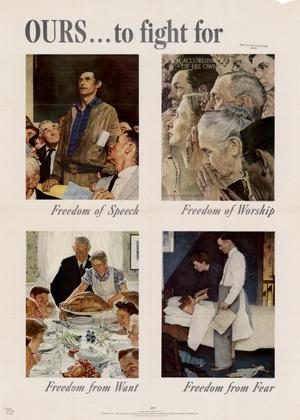
War Bonds poster showing all of Rockwell's

Posters showing all four of Rockwell’s paintings also were printed for the War Bonds Drive. Image from the digital collection of the libraries at the University of North Texas

This speech inspired Norman Rockwell to create a series of paintings in tribute to the four freedoms, which paintings were used as posters for War Bond drives.

Paul Bucheit argues we’re losing those four freedoms, which we as a nation fought to secure, in the Pacific, in the Atlantic, in Africa, Europe and Asia:

The 2013 version shows how our freedoms have been diminished, or corrupted into totally different forms.

  • Freedom from want? Poverty keeps getting worse. . .
  • Freedom from fear? The new Jim Crow. . .
  • Freedom of worship? Distorted by visions of the Rapture. . .
  • Freedom of speech? No, surveillance and harassment. . .

Mr. Bucheit offers longer explanations.  I don’t think I agree completely, but I’m interested in your opinion:  Are we losing the Four Freedoms we fought for?

Tip of the old scrub brush to Bonnie Lesley, @EdFocus on Twitter.

More:

Herblock cartoon, August 13, 1951, whatever happened to freedom from fear?

“Say, whatever happened to ‘Freedom from Fear?'” Herblock cartoon in the Washington Post, August 13, 1951, on McCarthyism and the hunt for communists in government jobs. CJR290 image; click image for more information.


Yes, this is mostly an encore post.  Fighting ignorance requires patience.

Yes, this is mostly an encore post. Fighting ignorance requires patience.


Remember the day Utah flew the flag backwards, to honor the Union?

January 4, 2015

In 2013, Holly Munson at the Constitution Center wrote up a piece about Utah’s perhaps odd path to statehood, certainly complementary to my reminder that you could fly your flags on January 4, to honor Utah’s statehood, under the U.S. Flag Code.  Munson’s piece was distributed on Yahoo! News.

Yes, this is mostly an encore post. Fighting ignorance requires patience.

Yes, this is mostly an encore post. Fighting ignorance requires patience.  Remembering history takes constant reminders.

Her report is very solid, even though brief, and interesting.  Utah history is nothing if not a convoluted path to statehood through what amounted to a civil war, the Mexican War, the discovery of gold in California, the transcontinental railroads, mining and immigration, Indian wars, old west shootouts, rampant environmental destruction with sheep grazing and mineral extraction and smelting, union strife, astonishing agricultural applications, and a lot of books written from tens of thousands of Mormon pioneer journals — Mormonism appears to be impossible without ink and paper and time to write.

Go read her story.

What caught my eye was the George W. Reed photograph of the Salt Lake City Temple of the Church of Jesus Christ of Latter-day Saints — the LDS, or Mormon church.  The Temple and the Tabernacle, also in the photo, both have their own unique architectural histories, and quirks that make them noteworthy purely from architecture.  (This George W. Reed should not be confused with the Civil War Medal of Honor winner, George W. Reed)

Reed was an early photographer for newspapers in Salt Lake City, and he took some wonderful photos for posterity.  He was also a founder of the leading non-Mormon paper in the state, The Salt Lake Tribune.  At points in its history, it’s been known as an anti-Mormon paper.  The University of Utah’s library holds about five dozen of his photos in their collection, indexed electronically if not quite available yet; there Reed is described:

A pioneer in the development of Utah newspapers, George Reed was originally employed by the Deseret News and in 1871 helped in establishing the Salt Lake Tribune. His photographs include nineteenth century views of Salt Lake City, individuals at Reed’s Avenue home, Wasatch Resort in Little Cottonwood Canyon, and a photograph of the American flag hung on the Salt Lake Temple in 1896 to commemorate Utah’s statehood.

In the collection of Utah State University, in Logan, Reed has yet more papers.  There we get a bit more of his history:

A pioneer in Utah journalism, George W. Reed was born in London, England, on April 7, 1833. He emigrated to Utah in 1862 and became manager of the Deseret News, a position he held until 1871 when he founded the Salt Lake Tribune. In 1882, after a decade at the Tribune, Reed sold his interest in the paper to P. H. Lannan. He married Elizabeth Tuddenham in 1866 and passed away December 1, 1909.

U.S. flag on the Mormon Temple, at Utah statehood in 1896

The Mormon Temple in Salt Lake City, Utah, draped with a U.S. flag in 1896, commemorating the completion of Utah’s statehood campaign when President Grover Cleveland declared Utah a member of the Union. Photo by George W. Reed; Reed worked for the Deseret News, and helped found the Salt Lake Tribune. I do not know whether this photo was published in either paper.  From the George W. Reed Collection, University of Utah Libraries.

Yes, you’re right!  That flag is backwards.  Well, it’s backwards according to the modern U.S. Flag Code, which specifies that when hung from a building, the flag’s union should always be in the viewer’s upper left corner (“northwest” corner were it a standard map).  In the photograph, the union is in the opposite corner.  No, we know the photo is not reversed, because it accurately portrays the location of the Tabernacle, to the west and slightly south of the Temple.

(From what platform did Reed get that photo?  I’ll have to check to be sure it was there in 1896, but I’m thinking he shot from the Salt Lake County Building; it’s a distance, though.  A photographic historical mystery!)
But we hear the protests:  The U.S. Flag Code did not exist in 1896!  How can that be a violation of a code that did not exist?

That’s right, too.

That is an indication that the traditions of flag display that some people get riled up about, that many people think we should amend the Constitution to protect, are new inventions more than old traditions.  Flag code violations are legion by well-meaning citizens celebrating the flag and patriotism, and rare by anyone with any malignant motives.

After a 49-year fight for statehood, through wars with the U.S., fighting with the U.S. forces in Mexico, the administrations of several presidents and 25 different U.S. Congresses, and pledges to change the rules of the church to ban polygamy and put that ban in the state constitution,  the people of Utah, especially the Mormon officials, were not trying to insult America by displaying the flag incorrectly.  Somebody said ‘fly the flag from the Temple,’ and some engineer or custodian got it done.  By 1896, most of the First Amendment litigation done in the U.S. had involved whether Mormons could keep their marriage policies (Mormons lost).  There was no intent to violate any rule of separation of church and state — nor would that be considered a violation today.  Churches may fly the nation’s flag with all the approval that suggests; it’s the government which may not fly a church’s flag.

Finally, there is no grand story in the flag’s being flown backwards.  It’s just one of those historical footnotes that mark the changing mores of the times, in this case, for standards of how to fly the U.S. flag.

Perhaps Utah history textbooks should make note of the day the U.S. flag was flown, backwards, to honor statehood.

More, and related resources:


Utah at 119 years: Fly your flag today for Utah statehood, January 4, 1896

January 4, 2015

Utah Capitol, with flags

South entrance (main) to the Utah State Capitol, with U.S. and Utah flags flying on the single flag poll, and the snow-dusted Wasatch Mountains in the background. Utah State Law Library photo.

Utah joined the Union on January 4, 1896.  It had been a 49-year slog to statehood for Deseret, the Mormon settlement in the Desert.  The size had been pared down, so it would not be the biggest state, incorporating parts of what is now Nevada, Arizona, Oregon, Idaho, Colorado and New Mexico.  New capitals had been tried and cast aside (Fillmore, Utah).  Democratic Party rule was broken when LDS church authorities went door-to-door, calling every other family to the Republican Party, and party parity.  The Mormon Church abandoned polygamy, and adopted a state constitution that gave the vote to women.

Finally, Utah became the 45th state.

You may fly your U.S. flag today for Utah statehood, especially if you’re in Utah.

Happy birthday, Utah!  119 years old today.

More:

U.S. flag in Capitol Reef NP

U.S. flag flying at Capitol Reef National Park, in Utah. Photo by longyang0369, via Flickr

Much of this material appeared here before; this is an annual event, after all.


January 3, 1959: Welcome, Alaska, and the 49-star flag — 55 years ago

January 3, 2015

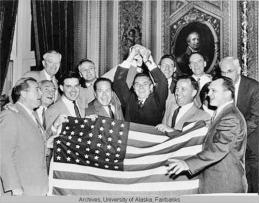
Alaska Territorial Gov. Bob Bartlett in center, with the 49-star flag (Bartlett was one of Alaska's first U.S. senators).

Alaska Territorial Gov. Bob Bartlett in center, with the 49-star flag (Bartlett was one of Alaska’s first U.S. senators).

The great service at the New York Times site, the Learning Network, notes the 1959 Dwight Eisenhower proclamation of Alaska as the 49th state, and the unveiling of the 49-star flag:

On Jan. 3, 1959, President Dwight Eisenhower signed a proclamation admitting Alaska to the Union as the 49th state. The New York Times noted that the signing included the unveiling of the new 49-star American flag.

The land that became Alaska came into U.S. possession in 1867, when William Seward, secretary of state under President Andrew Johnson, negotiated a deal to buy the 586,000-square-mile area from Russia for $7.2 million, less than 2 cents per acre. Seward’s decision was ridiculed in the American press, who saw no potential in the vast, inhospitable and sparsely populated area.

For decades after its purchase, Alaska was derided as “Seward’s folly” or “Seward’s icebox.” This opinion changed in 1896 with the discovery of gold in the neighboring Yukon Territory, which spurred tens of thousands of people to head to Alaska in search of gold. The gold rush also brought about a boom in mining, fishing and trapping.

Though the first statehood bill had been presented to Congress in 1916, there was little desire in either Alaska or Washington for Alaskan statehood until after World War II. During the war, the U.S. established multiple military bases to resist Japan’s attacks on Alaska’s Aleutian Islands and prevent a potential invasion of the mainland. The military activity, along with the completion of a major highway from Montana, led to a large population growth.

In 1946, Alaskans voted in favor of statehood in a referendum and Alaskan delegates began to lobby Congress for statehood. After years of debate, Congress voted in June 1958 to admit Alaska.

Eight months after Alaska’s admission, on Aug. 21, 1957 [should be 1959, no?], Hawaii became the 50th state. The 49-star remained in place until the following July 4, when it was replaced by the now-familiar 50-star flag.

49-star flags were produced only until August 1959, so there are few of them around.  I love this photo of the unveiling of the flag with President Eisenhower:

President Eisenhower and Quartermaster General MG Andrew T. McNamara, with 49-star flag - image from QM foundation

“Quartermaster General MG Andrew T. McNamara and President Eisenhower examine new 49 star flag” – image and caption from the Quartermaster Foundation. (Who are the other two people?  The guy on the right looks to me a bit like is Pennsylvania’s Sen. Hugh Scott.)

It had been about 47 years since the previous state admission (Arizona); people became aware that no law set what the flag should look like.  President Eisenhower issued a directive.

How did the nation survive for 170 years without firm, decisive and conclusive orders on what the flag should look like?  Isn’t it a great story that we went so long without law setting the requirements?

Alaska's state flag design came from 13-year old Benny Benson.

Alaska’s state flag design came from 13-year old Benny Benson. Benny Benson holding the Alaska flag at the Jesse Lee Home, Seward, Alaska. ASL-P01-1921, Alaska State Library-Historical Collections.


Alaska’s state flag came from the imagination of a 13-year-old Aleut, Benny Benson, winning a contest to design the state’s flag.  Alaska’s flag stands out in any display of U.S. state flags.

Yes, this is mostly an encore post.  Fighting ignorance requires patience.

Yes, this is mostly an encore post. Fighting ignorance requires patience.


Fly your U.S. flags on these dates in January

January 3, 2015

Flag House in 1936, 844 East Pratt & Albemarle Streets (Baltimore, Independent City, Maryland) (cropped). Image courtesy of the federal HABS—Historic American Buildings Survey of Maryland.

Flag House in 1936, where Mary Pickersgill sewed the garrison-sized, 15-star flag that flew over Fort McHenry at the Battle of Baltimore in 1814; one of the sites where the U.S. flag may be flown 24 hours. The house is at 844 East Pratt & Albemarle Streets (Baltimore, Independent City, Maryland). Cropped image courtesy of the federal HABS—Historic American Buildings Survey of Maryland.

January is loaded with flag flying dates, when we add in statehood days, dates those states are invited to fly their U.S. flags.

In January, the U.S. Flag Code urges citizens to fly flags on these dates:

  • New Year’s Day, January 1, a federal holiday
  • Martin Luther King’s Birthday, a federal holiday on the third Monday of January; that date is January 18, in 2014; King’s actual birthday is January 19, and you may fly your flag then, too
  • Inauguration Day, January 20, the year after election years (next one in 2017)
  • January 2, Georgia Statehood Day
  • January 3, Alaska Statehood Day
  • January 4, Utah Statehood Day
  • January 6, New Mexico Statehood Day
  • January 9, Connecticut Statehood Day
  • January 26, Michigan Statehood Day
  • January 29, Kansas Statehood Day

You may fly your flag any other day you wish, too; flags should not be flown after sundown unless they are specially lighted, or at one of the few places designated by Congress or Presidential Proclamation for 24-hour flag flying.  According to Wikipedia’s listing, those sites include:

  • Fort McHenry, Baltimore, Maryland (Presidential Proclamation No. 2795, July 2, 1948).
  • Flag House Square, Albemarle and Pratt Streets, Baltimore, Maryland (Public Law 83-319, approved March 26, 1954).
  • Marine Corps War Memorial (Iwo Jima Memorial), Arlington, Virginia (Presidential Proclamation No. 3418, June 12, 1961).
  • Lexington Battle Green, Lexington, Massachusetts (Public Law 89-335, approved November 8, 1965).
  • White House, Washington, D.C. (Presidential Proclamation No. 4000, September 4, 1970).
  • Washington Monument, Washington, D.C. (Presidential Proclamation No. 4064, July 6, 1971, effective July 4, 1971).
  • Any port of entry to the United States which is continuously open (Presidential Proclamation No. 413 1, May 5, 1972).
  • Grounds of the National Memorial Arch in Valley Forge State Park, Valley Forge, Pennsylvania (Public Law 94-53, approved July 4, 1975).

December 31, 2014: Bright Idea Day, anniversary of the Day the Lights Went On

December 31, 2014

Between Christmas and New Year’s Day, here at Millard Fillmore’s Bathtub we celebrate a variety of historically holy days.  December 31, by tradition, is Bright Idea Day, the anniversary of the day Thomas Edison demonstrated for the public a working light bulb, in 1879.

100,000 people gather in Times Square, New York City, tonight, and millions more around the world, in festivities for the new year made possible by the work of Thomas Alva Edison.

Here it is, the invention that stole sleep from our grasp, made clubbing possible, and launched 50,000 cartoons about ideas:

The light bulb Thomas Edison demonstrated on December 31, 1879, at Menlo Park, New Jersey - Wikimedia image

The light bulb Thomas Edison demonstrated on December 31, 1879, at Menlo Park, New Jersey – Wikimedia image (GFDL)

The light bulb. It’s an incandescent bulb.

It wasn’t the first bulb. Edison a few months earlier devised a bulb that worked with a platinum filament. Platinum was too expensive for mass production, though — and Edison wanted mass production. So, with the cadre of great assistants at his Menlo Park laboratories, he struggled to find a good, inexpensive filament that would provide adequate life for the bulb. By late December 1879 they had settled on carbon filament.

Edison invited investors and the public to see the bulb demonstrated, on December 31, 1879.

Thomas Edison in 1878, the year before he demonstrated a workable electric light bulb. Library of Congress image

Thomas Edison in 1878, the year before he demonstrated a workable electric light bulb. CREDIT: Thomas Edison, head-and-shoulders portrait, facing left, 1880. Prints and Photographs Division, Library of Congress. Reproduction number LC-USZ62-98067

Edison’s successful bulb indicated changes in science, technology, invention, intellectual property and finance well beyond its use of electricity. For example:

  • Edison’s Menlo Park, New Jersey, offices and laboratory were financed with earlier successful inventions. It was a hive of inventive activity aimed to make practical inventions from advances in science. Edison was all about selling inventions and rights to manufacture devices. He always had an eye on the profit potential. His improvements on the telegraph would found his laboratory he thought, and he expected to sell the device to Western Union for $5,000 to $7,000. Instead of offering it to them at a price, however, he asked Western Union to bid on it. They bid $10,000, which Edison gratefully accepted, along with the lesson that he might do better letting the marketplace establish the price for his inventions. Other inventive labs followed Edison’s example, such as the famous Bell Labs, but few equalled his success, or had as much fun doing it.  (Economics teachers:  Need an example of the marketplace in action?)
  • While Edison had some financial weight to invest in the quest for a workable electric light, he also got financial support, $30,000 worth, from some of the finance giants of the day, including J. P. Morgan and the Vanderbilts who established the Edison Light Company.
  • Edison didn’t invent the light bulb — but his improvements on it made it commercial. “In addressing the question ‘Who invented the incandescent lamp?’ historians Robert Friedel and Paul Israel list 22 inventors of incandescent lamps prior to Joseph Wilson Swan and Thomas Edison. They conclude that Edison’s version was able to outstrip the others because of a combination of three factors: an effective incandescent material, a higher vacuum than others were able to achieve (by use of the Sprengel pump) and a high resistance lamp that made power distribution from a centralized source economically viable.”
  • Edison’s financial and business leadership acumen is partly attested to by the continuance of his organizations, today — General Electric, one of the world’s most successful companies over the past 40 years, traces its origins to Edison.

Look around yourself this evening, and you can find a score of ways that Edison’s invention and its descendants affect your life. One of the more musing effects is in cartooning, however. Today a glowing lightbulb is universally accepted as a nonverbal symbol for ideas and inventions. (See Mark Parisi’s series of lightbulb cartoons, “Off the Mark.”)

Even with modern, electricity-saving bulbs, the cartoon shorthand hangs on, as in this Mitra Farmand cartoon.

Fusilli has an idea, Mitra Farmand, Fuffernutter

Brilliant cartoon from Mitra Farmand, Fuffernutter

Or see this wonderful animation, a video advertisement for United Airlines, by Joanna Quinn for Fallon — almost every frame has the symbolic lightbulb in it.

Electrification of America, and the consequent spread of electric lighting and electrical machines to make domestic and industrial life more productive, and the spread of great public works to enable these and other inventions to spread, were made possible by a people roughly united in advancing progress, what historians now call “the progressive agenda” and the great advances of the Progressive Era.

Could we get such agreement among workers, corporate bosses and many levels of government today? When we celebrate anniversaries, like the demonstration of the light bulb, we celebrate the united polity that made such things possible, too.

Other resources:

Patent drawing for Thomas Edison's successful electric lamp. Library of Congress

Thomas Edison’s electric lamp patent drawing and claim for the incandescent light bulb CREDIT: “New Jersey–The Wizard of Electricity–Thomas A. Edison’s System of Electric Illumination,” 1880. Prints and Photographs Division, Library of Congress. Reproduction Number LC-USZ62-97960.

Yeah, this is mostly an encore post. ‘Tis the season for tradition, especially good, wise tradition.

Even More, in 2012 and 2013:


December 30, Hubble Day 2014: Look to the stars for our future

December 30, 2014

[Today is actually the day!  You may fly your flag if you choose.  This is the traditional Millard Fillmore’s Bathtub Hubble Day post.]

Lift a glass of champagne today in tribute to Edwin Hubble and his great discovery. Not sure what to call it — Hubble Day, Looking Up Day, Endless Possibilities Day — whatever, this is the anniversary of Edwin Hubble’s announcement that he had discovered the universe is much, much larger than anyone had imagined, containing far more stars than anyone had dared guess.

It’s a big universe out there.

Ultraviolet image of the Andromeda Galaxy. Wired caption: Photo: Edwin Hubble’s 1920s observations of Andromeda (whose ultraviolet spectrum is rendered here) expanded our notions of the size and nature of a universe that is itself expanding. Galaxy Evolution Explorer image courtesy NASA.

Ultraviolet image of the Andromeda Galaxy. Wired caption: “Photo: Edwin Hubble’s 1920s observations of Andromeda (whose ultraviolet spectrum is rendered here) expanded our notions of the size and nature of a universe that is itself expanding. Galaxy Evolution Explorer image courtesy NASA.”

So, today is a good day to celebrate the universe in all it’s glory – December 30.

On December 30, 1924, Edwin Hubble announced he’d discovered other galaxies in distant space. Though it may not have been so clear at the time, it meant that, as a galaxy, we are not alone in the universe (whether we are alone as intelligent life is a separate question). It also meant that the universe is much, much bigger than most people had dared to imagine.

90 years ago today.

I keep trying to get people to celebrate.

In 2008 for Hubble Day, Wired picked up on the story (with a gracious link to 2007’s post here at the Bathtub). Wired includes several links to even more information, a good source of information. See Wired’s 2009 post here.

Hubble was the guy who showed us the universe is not only bigger than we imagined, it’s probably much bigger and much more fantastic than we can imagine. (See J. B. S. Haldane’s “queerer” quote.) Hubble is the guy who opened our imaginations to the vastness of all creation.

Hubble’s work would have been impossible without the earlier work of one of the great, unsung women of science, Henrietta Leavitt, as Wired explained:

He trained the powerful new 100-inch telescope at Mount Wilson in Southern California on spiral nebulae. These fuzzy patches of light in the sky were generally thought to be clouds of gas or dust within our galaxy, which was presumed to include everything in the universe except the Magellanic Clouds. Some nebulae seemed to contain a few stars, but nothing like the multitudes of the Milky Way.

Hubble not only found a number of stars in Andromeda, he found Cepheid variable stars. These stars vary from bright to dim, and a very smart Harvard computationist named Henrietta Leavitt had discovered in 1912 that you could measure distance with them. Given the brightness of the star and its period — the length of time it takes to go from bright to dim and back again — you could determine how far away it is.

Hubble used Leavitt’s formula to calculate that Andromeda was approximately 860,000 light years away. That’s more than eight times the distance to the farthest stars in the Milky Way. This conclusively proved that the nebulae are separate star systems and that our galaxy is not the universe.

How does one celebrate Hubble Day? Here are some suggestions:

  • Easier than Christmas cards: Send a thank-you note to your junior high school science teacher, or whoever it was who inspired your interest in science. Mrs. Hedburg, Mrs. Andrews, Elizabeth K. Driggs, Herbert Gilbert, Mr. Willis, and Stephen McNeal, thank you.
  • Rearrange your Christmas/Hanukkah/Eid/KWANZAA lights in the shape of the Andromeda Galaxy — or in the shape of any of the great photos from the Hubble Telescope (Andromeda Galaxy pictured above; Hubble images here)

    A few of the images from the Hubble Telescope

    A few of the images from the Hubble Telescope

  • Go visit your local science museum; take your kids along – borrow somebody else’s kids if you have to (take them along, too); this year, in Dallas, you can visit the Perot Museum of Nature and Science — it’s a doozy
  • Spend two hours in your local library, just looking through the books on astronomy and the universe
  • Write a letter to your senators and congressman; tell them space exploration takes a minuscule portion of our federal budget, but it makes us dream big; tell them we need to dream big, and so they’d better make sure NASA is funded well.  While you’re at it, put in a plug for funding Big Bird and the rest of public broadcasting, too.  Science education in this nation more and more becomes the science shows on NPR and PBS, watched by kids who learned to read and think by watching Big Bird.
  • Anybody got a good recipe for a cocktail called “The Hubble?” “The Andromeda?” Put it in the comments, please.  “The Hubble” should have bubbles in it, don’t you think?  What was it the good monk said?  He was working to make great wine, but goofed somewhere, and charged the wine with another dose of yeast.  When he uncorked the very first bottle of what would come to be called champagne, Benedictine Monk Dom Pierre Perignon said “I am drinking stars!”  Only in French.  In any case, a Hubble cocktail should have bubbles, some of Perignon’s stars.

The encore post, from 2007:

December 30, 1924, Edwin Hubble announced the results of his observations of distant objects in space.

PBS

Edwin Hubble

In 1924, he announced the discovery of a Cepheid, or variable star, in the Andromeda Nebulae. Since the work of Henrietta Leavitt had made it possible to calculate the distance to Cepheids, he calculated that this Cepheid was much further away than anyone had thought and that therefore the nebulae was not a gaseous cloud inside our galaxy, like so many nebulae, but in fact, a galaxy of stars just like the Milky Way. Only much further away. Until now, people believed that the only thing existing outside the Milky Way were the Magellanic Clouds. The Universe was much bigger than had been previously presumed.

Later Hubble noted that the universe demonstrates a “red-shift phenomenon.” The universe is expanding. This led to the idea of an initial expansion event, and the theory eventually known as Big Bang.

Hubble’s life offered several surprises, and firsts:

Hubble was a tall, elegant, athletic, man who at age 30 had an undergraduate degree in astronomy and mathematics, a legal degree as a Rhodes scholar, followed by a PhD in astronomy. He was an attorney in Kentucky (joined its bar in 1913), and had served in WWI, rising to the rank of major. He was bored with law and decided to go back to his studies in astronomy.

In 1919 he began to work at Mt. Wilson Observatory in California, where he would work for the rest of his life. . . .
Hubble wanted to classify the galaxies according to their content, distance, shape, and brightness patterns, and in his observations he made another momentous discovery: By observing redshifts in the light wavelengths emitted by the galaxies, he saw that galaxies were moving away from each other at a rate constant to the distance between them (Hubble’s Law). The further away they were, the faster they receded. This led to the calculation of the point where the expansion began, and confirmation of the big bang theory. Hubble calculated it to be about 2 billion years ago, but more recent estimates have revised that to 20 billion years ago.

An active anti-fascist, Hubble wanted to joined the armed forces again during World War II, but was convinced he could contribute more as a scientist on the homefront. When the 200-inch telescope was completed on Mt. Palomar, Hubble was given the honor of first use. He died in 1953.

“Equipped with his five senses, man explores the universe around him and calls the adventure Science.”

That news on December 30, 1924, didn’t make the first page of the New York Times. The Times carried a small note on February 25, 1925, that Hubble won a $1,000 prize from the American Academy for the Advancement of Science.

(Does anyone have a suitable citation for that video? Where did it come from? Who produced it? Is there more somewhere?)

Happy Hubble Day! Look up!

Resources:

Hubble Space Telescope - NASA image

Hubble Space Telescope, working homage to Edwin Hubble – NASA image

Even More Resources:

Andromeda as we can see it today. Wikimedia image: The Andromeda Galaxy is a spiral galaxy approximately 2.5 million light-years away in the constellation Andromeda. The image also shows Messier Objects 32 and 110, as well as NGC 206 (a bright star cloud in the Andromeda Galaxy) and the star Nu Andromedae. This image was taken using a hydrogen-alpha filter.

Andromeda as we can see it today. Wikimedia image: The Andromeda Galaxy is a spiral galaxy approximately 2.5 million light-years away in the constellation Andromeda. The image also shows Messier Objects 32 and 110, as well as NGC 206 (a bright star cloud in the Andromeda Galaxy) and the star Nu Andromedae. This image was taken using a hydrogen-alpha filter.


Texas Statehood, December 29, 1845 – 169 years ago

December 29, 2014

It’s Texas Statehood day, the 169th anniversary of Texas joining the Union — or as some Texans prefer, the anniversary of Texas’s making America great.

According to the U.S. flag code, people should fly their U.S. flags on their state’s statehood day.

Not many Texans are, if any. Can you find someone honoring statehood day?

texas our texas

U.S. and Texas flags at the Texas Capitol – photo: jmtimages

169 years ago today: Rub your pet armadillo’s belly, slaughter the fatted longhorn, crank up the barbecue pit with the mesquite wood, put Willie Nelson and Bob Wills on the mp3 player, put the “Giant” DVD on the television, and raise your glass of Big Red, Dr. Pepper, or Lone Star Beer (or Pearl, or Shiner Bock, or Llano Wine).

U.S. Flag Code rules urge flying the U.S. flag on the anniversary of a state’s joining the Union — even as much as that will frost the tiny band of desperate Texas secessionists.  (Will the secessionists fly the Texas flag at half-staff?)

Texas was admitted to the union of the United States of America on December 29, 1845.

President Polk's authorization to affix Great Seal of the U.S. to Texas Statehood documents

President Polk’s Authorization to Affix the Great Seal to Texas Statehood documents – Texas Memorial Museum, University of Texas at Austin

The text of Polk’s message:

I hereby authorize and direct the Secretary of State to affix the Seal of the United States to an authenticated copy of “an act to extend the laws of the United States over the State of Texas and for other purposes” approved Dec. 29, 1845 dated this day, and signed by me and for so doing this shall be his warrant.

James K. Polk
Washington, Dec. 29, 1845

Seal of the U.S. affixed to Texas Statehood Proclamation

Great Seal of the United States of America, affixed to the Texas Statehood Proclamation – image from State Archives Division, Texas State Library

Resources:

More:

The Texas Ranger Museum took note of the day (no, not the baseball Rangers):

Yes, this is mostly an encore post.  Fighting ignorance requires patience.

Yes, this is mostly an encore post. It is an annual event, after all. And, fighting ignorance requires patience and persistence.


Iowans fly flags: Iowa Statehood, December 28, 1846

December 27, 2014

Iowans may fly their flags today in celebration of the anniversary of Iowa statehood.  Iowa’s admission to the Union came on December 28, 1846; Iowa was the 29th state admitted.

“Millions of acres. Iowa and Nebraska. Land for sale on 10 years credit by the Burlington & Missouri River R. R. Co. at 6 per ct interest and low prices.” Poster advertising land in Iowa, circa 1872, from the Burlington & Missouri River Railroad Co. – Library of Congress Printed Ephemera Collection; Portfolio 134, Folder 13; via Wikipedia

The Flag Code, 4 USC §6 (d), notes that the U.S. flag may be flown on “the birthdays of States (date of admission),” in addition to the other score of dates specifically written into law.

Randy Olson photo of flags at rodeo in Spencer, Iowa, 1996

American Flag, Spencer, Iowa, 1996caption from the National Geographic Society: A man rolls up U.S. flags at the end of the Clay County Fair in Spencer, Iowa. “Although the population of Spencer is only about 12,000, the fair draws some 300,000 visitors. Once a year, rising from the endless flatness of the Iowa countryside, a crowd forms—to stroll, to hear big country music acts like the Statler Brothers, to sell a grand champion boar, to buy a new silo.” (Photographed on assignment for, but not published in, “County Fairs,” October 1997, National Geographic magazine) Photograph by Randy Olson; copyright National Geographic Society

More:

Yes, this is mostly an encore post.  Fighting ignorance requires patience.

Yes, this is mostly an encore post. Fighting ignorance requires patience.


Smashing December 27: Carry Nation’s “temperance” campaign came to Wichita, 114 years ago

December 27, 2014

Carry Nation is a character Texas students should be learning about, but there is rarely more than a paragraph’s mention of her in the usual high school history texts.  Students guided by smart teachers might find more about Ms. Nation, the Women’s Christian Temperance Union, the Temperance Movement in general as it played out against the Progressive era, the creation and passage of the 16th Amendment to the Constitution, authorizing an income tax, and the imposition of Prohibition after the passing of the 18th Amendment.

They’re all linked together in what I regard as a fascinating series of stories.

Two days after Christmas 1900, Carry Nation attacked the bar at the Carey Hotel in Wichita, Kansas, the town she was living in at the time, and exploded into history.

From Kansas Memory:  A photograph showing the Carey Hotel Bar in Wichita, Kansas after Carry Nation threw rocks to break the mirror during a temperance protest, December 27, 1900.  Kansas Historical Foundation

From Kansas Memory: A photograph showing the Carey Hotel Bar in Wichita, Kansas after Carry Nation threw rocks to break the mirror during a temperance protest, December 27, 1900. Kansas Historical Foundation

(Did I mention she was a school teacher at the time?)

Dickinson, Kansas Marshal Benham escorting Carry Nation out of a saloon, or fight, probably in 1901.  Photo from the Dickinson County Historical Society

Dickinson, Kansas Marshal Benham escorting Carry Nation out of a saloon, or fight, probably in early 1901, a few days after her attack on the saloon in the Carey Hotel in Wichita. Photo from the Dickinson County Historical Society

This part of the story below is completely cribbed from the Library of Congress’s “Today in History” feature, which you should be reading at least daily (Those guys do great work, and I usually can’t top it):

Temperance

From the Library of Congress:

From the Library of Congress: “Strike for the Cause of Temperance,” Words by A.W. Carr, music by W. F. Heath, 1878. Music for the Nation: American Sheet Music 1870-1885

Strike For The Cause Of Temp’rance,
Wield In Your Mightiest Blow…”Strike for the Cause of Temperance,”
Words by A.W. Carr, music by W. F. Heath, 1878.
Music for the Nation: American Sheet Music 1870-1885

On December 27, 1900, Carry Nation brought her campaign against alcohol to Wichita, Kansas, when she smashed the bar at the elegant Carey Hotel. Earlier that year, Nation had abandoned the nonviolent agitation of the Woman’s Christian Temperance Union in favor of direct action that she called “hatchetation.” Since the Kansas Constitution prohibited alcohol, Nation argued that destroying saloons was an acceptable means of battling the state’s flourishing liquor trade.

Born in Kentucky in 1846, Carry Amelia Moore accompanied her family to Missouri in the 1850s. Her first husband, a physician, died of alcohol-related illness early in their marriage, leaving her to support herself, her young daughter, and her mother-in-law. Carry earned a teaching certificate and taught primary school for four years, before losing her position. At this point, according to her autobiography, she prayed that she would find a suitable husband. In 1877, she met and married David Nation–in just six weeks.

Arriving in Kansas in the 1890s, she became active in mainstream temperance organizations. The failure of Kansas authorities to enforce the ban on alcohol initially rallied some support for Nation’s attacks. However, her extreme methods and unladylike behavior ultimately distanced Nation from state and national temperance societies.

Eventually, state fairs and medicine show tours became Nation’s pulpit and source of financial security. Dressed in stark black and white, she promulgated her equally unambiguous views against liquor, tobacco, fraternal orders, and excessive fashion. Freeman Willis of New Hampshire encountered her on the state fair circuit. He later recalled the incident for a WPA interviewer:

The Belknap County Fair at Laconia was a great time for Dr. Greene. He had Carrie Nation…yes, hatchet and all…out there, once, for advertising. He spent a pile of money on advertising. And while Carrie was there the town was hers…as much of it as Dr. Greene’s money could buy.”An Old Yankee Innkeeper; His Story,” New Hampshire
Henry H. Pratt, interviewer, ca. 1938-39.
American Life Histories: Manuscripts from the Federal Writers’ Project, 1936-1940

Yet, Nation’s celebrity was based more on her notoriety as a hatchet-wielding saloon buster than for an appreciation of her cause. Willis recounts that he saw Nation a second time at the Buffalo State Fair. There, she complained, “they don’t believe…a lot of them don’t…that I’m the real Carrie Nation. They think I’m a fake…dressed up to imitate Carrie. I wish you’d tell them I am the real Carrie.”

Many nineteenth- and early twentieth-century reformers supported the prohibition of alcohol. Suffragists such as Elizabeth Cady Stanton often urged adoption of temperance legislation. Lacking legal rights to their property, their wages, and even their children, women’s lives in the nineteenth century were easily devastated if the men they depended on “took to drink.”

Learn more about Carry Nation and the movement to prohibit alcohol in the United States:

More:

Carry Nation and her hatchet. Photo from the Kansas Historical Society

Carry Nation and her hatchet. Photo from the Kansas Historical Society


December 27, Great Beginnings Day 2014: Darwin, Apollo, and more

December 27, 2014

December 27 is one of those days — many of us are off work, but it’s after Boxing Day, and it’s not yet on to New Year’s Eve or Day. We should have celebrated, maybe.

It’s the end of the year, and yet it is also a day of great beginnings.

We should celebrate December 27 as a day of portent: A good embarkation, and a good, safe end to a nation-encouraging trip to almost touch the Moon.

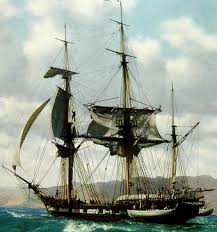
HMS Beagle, Darwin's ship

HMS Beagle, on a voyage of discovery

On December 27, 1831, Charles Darwin and H.M.S. Beagle set sail on an around-the-world voyage of discovery that would change all of science, and especially biology, forever.

December 27 1831
After a few delays, H.M.S. Beagle headed out from Plymouth with a crew of 73 under clear skies and a good wind. Darwin became sea-sick almost immediately.

Darwin never fully overcame his seasickness, but he fought it well enough to become the single greatest collector of specimens in history for the British Museum and British science, a distinction that won him election to science societies even before his return from the trip — and cemented his life in science, instead of in the church.

Darwin’s discoveries would have revolutionized biology in any case. But, in analyzing what he had found, a few years later and with the aid of experts at the British Museum, Darwin realized he had disproved much of William Paley’s hypotheses about life and its diversity, and that another, more basic explanation was possible. This led to his discovery of evolution by natural and sexual selection.

Mini-sheet from the Royal Mail honoring Darwin's discoveries in the Galapagos Islands

Mini-sheet from the Royal Mail in 2009 honoring Darwin’s discoveries in the Galapagos Islands

On December 27, 1968, Apollo 8 splashed down after a successful and heartening trip to orbit the Moon. The three crewmen, Commander Frank Borman, James A. Lovell, Jr., and William A. Anders, had orbited the Moon, a very important milestone in the methodological race to put humans on the Moon (which would be accomplished seven months later).

1968 was a terrible year for the U.S., with the North Korean capture of the U.S.S. Pueblo, assassinations of Rev. Martin Luther King, Jr., and Sen. Robert F. Kennedy during the presidential campaign, riots in dozens of American cities, nasty political conventions with riots at the Democratic Convention in Chicago, a contentious and bitter election making sore the nation’s divide over Vietnam policy, and other problems. On Christmas Eve, Borman, Lovell and Anders broadcast from orbit around the Moon, a triumphant and touching moment for the Apollo Program and Americans around the world. Their safe return on December 27 raised hopes for a better year in 1969.

Motherboard.tv has a great write up from Alex Pasternack, especially concerning the famous photo taken a few days prior to splashdown:

In 1968, NASA engineers were scrambling to meet President Kennedy’s challenge to land a man on the moon by decade’s end. Because delays with the lunar module were threatening to slow the Apollo program, NASA chose to change mission plans and send the crew of Apollo 8 all the way to the moon without a lunar module.

Exactly 43 [46] years ago, the three astronauts of Apollo 8 became the first humans to orbit another celestial object. As they came around the dark side of the Moon for the third time, Frank Borman, the commander, finally turned their capsule around. And then they saw the Earth.

Borman: Oh my God! Look at that picture over there! Here’s the Earth coming up. Wow, is that pretty.
Anders: Hey, don’t take that, it’s not scheduled.
Borman: (laughing) You got a color film, Jim?
Anders: Hand me that roll of color quick, will you…

One of the resulting photos taken by Anders on a Hasselblad camera became one of the world’s most iconic images.

As Bill Anders recalls it:

I just happened to have one with color film in it and a long lens. All I did was to keep snapping… It’s not a very good photo as photos go, but it’s a special one. It was the first statement of our planet Earth and it was particularly impressive because it’s contrasted against this startling horizon . . . After all the training and studying we’d done as pilots and engineers to get to the moon safely and get back, [and] as human beings to explore moon orbit, what we really discovered was the planet Earth.

Plan to raise a glass today, December 27, 2012, to Great Beginnings Day for the human race. December 27 is a day we should remember, for these achievements. (But if you’re raising a glass, consider Carrie Nation, too!)

Also on December 27:

More:

This is an encore post.

Yes, this is an encore post. Defeating ignorance takes patience and perseverance.


Best editorial quote ever: “Yes, Virginia, there is a Santa Claus” It must be so, it was in the New York Sun

December 23, 2014

“Papa says, ‘If you see it in the Sun, it’s so.'”

Do we, you and I in 2014, stand as witnesses to the end of newspapers in America?  In recent months we’ve seen body blows to the New Orleans Times-Picayune, the San Diego Union, and The Cleveland Plain Dealer, and others.

It’s been a grand history. Newspapering gave us great leaders like Benjamin Franklin. Newspapering gave us wars, like the Spanish-American War. Newspapering gave us Charlie Brown, Ann Landers, the Yellow Kid, Jim Murray, Red Smith, Thomas Nast (and Santa Claus), the Federalist Papers, Watergate, Herblock, news of Vietnam and Pearl Harbor, Neil Armstrong on the Moon, the Pentagon Papers, and coupons to save money on laundry soap.

It’s been a curious history, too. An 1897 editorial vouching for Santa Claus rates as the most popular editorial of all time, according to the Newseum in Washington, D.C.  That’s 115 years ago, and that’s quite some staying power.

Francis Pharcellus Church, probably about 1860

The man who saved Christmas, at least for Virginia O’Hanlon, Francis Pharcellus Church, probably about 1860 – Wikipedia image

In autumn, 1897, 8-year-old Virginia O’Hanlon of 115 West 95th Street in New York, wrote to the New York Sun with this simple question:

“Please tell me the truth; is there a Santa Claus?”

In the age of Yellow Journalism, the fiercely competitive Sun‘s editors turned the letter to Francis Pharcellus. He responded to little Virginia on September 21, 1897:

Yes, Virginia, there is a Santa Claus.”

Church’s brother, William Conant Church, owned and published the newspaper. Both had followed their father into the news business. They co-founded The Army-Navy Journal in 1863, and went on to a series of journalistic collaborations. Francis was 58 years old when he answered Virginia’s letter. (He died at age 67, in 1906.)

The New York Sun held down the conservative corner in New York journalism at the time, versus the New York Times and the New York Herald-Tribune. But it also had an interesting history, to a blogger intrigued by hoaxes. In 1835 the paper published a series of six newspaper stories falsely attributed to Sir John Herschel, a well-known astronomer, claiming to describe a civilization on the Moon — the Great Moon Hoax. The discovery was credited to a new, very powerful telescope.

In 1844 the paper published a hoax written by Edgar Allen Poe, the Balloon Hoax. Under a pseudonym, Poe wrote that a gas balloon had crossed the Atlantic in three days.

The Sun also featured outstanding reporting. A 1947 and 1948 series about crime on the docks of New York City won a Pulitzer Prize for writer Malcolm Johnson. That series inspired Elia Kazan’s 1954 movie On the Waterfront starring Marlon Brando, Rod Steiger, Eva Marie Saint, Karl Malden and Lee J. Cobb.

The New York Sun ceased publication in 1950.

For all of its history, the Sun and the Churches are most remembered for that defense of belief in Santa Claus.

Virginia O'Hanlon, about the age of 8

Virginia O’Hanlon, about the age of 8, when she wrote to The New York Sun’s editors to inquire about the veracity of the Santa Claus story.

Virginia O’Hanlon grew up, graduated from Hunter College, got a masters at Columbia, and earned a Ph.D. from Fordham Univeresity. She taught in the New York City Public School system, from which she retired in 1959. She died in 1971.

Birth of tradition

Columbia University was Church’s alma mater, as well as O’Hanlon’s. Her letter and his response get a reading each year at the Yule Log Ceremony at Columbia College, along with the poem “A Visit from St. Nicholas.” Animated, live-acting, and other television productions have been mounted in 1974, 1991, and 2009.

Is there a Santa Claus? Did Church write a credible defense? The text of the letter and answer, below the fold.

More:  

Read the rest of this entry »