In 2022, we may need this post more, to put up with anti-science backlash to the urgency of global heating, the threat of COVID-19, and still, to the defeat of Donald Trump.
Like faces in clouds, some people claimed to see a link. The first Earth Day, on April 22, 1970, coincided with Lenin’s birthday. There was no link — Earth Day was scheduled for a spring Wednesday, when the greatest number of college students would be on campus.
Google Doodle for Earth Day 2021
Now, years later, with almost-annual repeats of the claim from the braying right wing, it’s just a cruel hoax. It’s as much a hoax on the ill-informed of the right, as anyone else. Many of them believe it.
No, there’s no link between Earth Day and the birthday of V. I. Lenin:
One surefire way to tell an Earth Day post is done by an Earth Day denialist: They’ll note that the first Earth Day, on April 22, 1970, was an anniversary of the birth of Lenin.
Coincidentally, yes, Lenin was born on April 22, on the new style calendar; it was April 10 on the calendar when he was born — one might accurately note that Lenin’s mother always said he was born on April 10.
It’s a hoax. There is no meaning to the first Earth Day’s falling on Lenin’s birthday — Lenin was not prescient enough to plan his birthday to fall in the middle of Earth Week, a hundred years before Earth Week was even planned.
Does Earth Day Promote Communism?
Earth Day 1970 was initially conceived as a teach-in, modeled on the teach-ins used successfully by Vietnam War protesters to spread their message and generate support on U.S. college campuses. It is generally believed that April 22 was chosen for Earth Day because it was a Wednesday that fell between spring break and final exams—a day when a majority of college students would be able to participate.
U.S. Sen. Gaylord Nelson, the guy who dreamed up the nationwide teach-in that became Earth Day, once tried to put the whole “Earth Day as communist plot” idea into perspective.
“On any given day, a lot of both good and bad people were born,” Nelson said. “A person many consider the world’s first environmentalist, Saint Francis of Assisi, was born on April 22. So was Queen Isabella. More importantly, so was my Aunt Tillie.”
April 22 is also the birthday of J. Sterling Morton, the Nebraska newspaper editor who founded Arbor Day (a national holiday devoted to planting trees) on April 22, 1872, when Lenin was still in diapers. Maybe April 22 was chosen to honor Morton and nobody knew. Maybe environmentalists were trying to send a subliminal message to the national subconscious that would transform people into tree-planting zombies. One birthday “plot” seems just about as likely as the other. What’s the chance that one person in a thousand could tell you when either of these guys were born.
My guess is that only a few really wacko conservatives know that April 22 is Lenin’s birthday (was it ever celebrated in the Soviet Union?). No one else bothers to think about it, or say anything about it, nor especially, to celebrate it.
Certainly, the Soviet Union never celebrated Earth Day. Nor was Lenin any great friend of the environment. He stood instead with the oil-drillers-without-clean-up, with the strip-miners-without-reclamation, with the dirty-smokestack guys. You’d think someone with a bit of logic and a rudimentary knowledge of history could put that together.
Inventor of Earth Day teach-ins, former Wisconsin Governor and U.S. Senator Gaylord Nelson
The REAL founder of Earth Day, Wisconsin’s U.S. Sen. Gaylord Nelson, usually recognized as the founder and father of Earth Day, told how and why the organizers came to pick April 22:
Senator Nelson chose the date in order to maximize participation on college campuses for what he conceived as an “environmental teach-in.” He determined the week of April 19–25 was the best bet; it did not fall during exams or spring breaks, did not conflict with religious holidays such as Easter or Passover, and was late enough in spring to have decent weather. More students were likely to be in class, and there would be less competition with other mid-week events—so he chose Wednesday, April 22.
After President Kennedy’s [conservation] tour, I still hoped for some idea that would thrust the environment into the political mainstream. Six years would pass before the idea that became Earth Day occurred to me while on a conservation speaking tour out West in the summer of 1969. At the time, anti-Vietnam War demonstrations, called “teach-ins,” had spread to college campuses all across the nation. Suddenly, the idea occurred to me – why not organize a huge grassroots protest over what was happening to our environment?
I was satisfied that if we could tap into the environmental concerns of the general public and infuse the student anti-war energy into the environmental cause, we could generate a demonstration that would force this issue onto the political agenda. It was a big gamble, but worth a try.
At a conference in Seattle in September 1969, I announced that in the spring of 1970 there would be a nationwide grassroots demonstration on behalf of the environment and invited everyone to participate. The wire services carried the story from coast to coast. The response was electric. It took off like gangbusters. Telegrams, letters, and telephone inquiries poured in from all across the country. The American people finally had a forum to express its concern about what was happening to the land, rivers, lakes, and air – and they did so with spectacular exuberance. For the next four months, two members of my Senate staff, Linda Billings and John Heritage, managed Earth Day affairs out of my Senate office.
Five months before Earth Day, on Sunday, November 30, 1969, The New York Times carried a lengthy article by Gladwin Hill reporting on the astonishing proliferation of environmental events:
“Rising concern about the environmental crisis is sweeping the nation’s campuses with an intensity that may be on its way to eclipsing student discontent over the war in Vietnam…a national day of observance of environmental problems…is being planned for next spring…when a nationwide environmental ‘teach-in’…coordinated from the office of Senator Gaylord Nelson is planned….”
Nelson, a veteran of the U.S. armed services (Okinawa campaign), flag-waving ex-governor of Wisconsin (Sen. Joe McCarthy’s home state, but also the home of Aldo Leopold and birthplace of John Muir), was working to raise America’s consciousness and conscience about environmental issues.
Humor at The ObamaCrat: “Time reported that some suspected the date was not a coincidence, but a clue that the event was ‘a Communist trick,’ and quoted a member of the Daughters of the American Revolution as saying, ‘subversive elements plan to make American children live in an environment that is good for them.'” God forbid!
About.com, “Is Earth Day a communist plot?”; “U.S. Sen. Gaylord Nelson, the guy who dreamed up the nationwide teach-in that became Earth Day, once tried to put the whole “Earth Day as communist plot” idea into perspective.”On any given day, a lot of both good and bad people were born,” Nelson said. “A person many consider the world’s first environmentalist, Saint Francis of Assisi, was born on April 22. So was Queen Isabella. More importantly, so was my Aunt Tillie.”
Mike Ciandella campaigns for Pinocchios at CNS (Lenin asked for “days of service” to honor his birthday? Yeah, and those cans of dehydrated water have been recalled because the water they make isn’t wet.)
Do you know why Earth Day is April 22? (gds44.wordpress.com) [This blog appears not to accept any dissenting views . . . funny, Leninist tactics from a guy who claims not to like Lenin.]
Rich Kozlovich at Paradigms and Demographic; Kozlovich repeats these fantastic lies, without even bothering to hint at any backup: “There is one factor that is known. This whole green stuff was imposed in Nazi Germany and in Soviet Russia and their views are virtually identical to the views of modern greenies and it is a reasonable assumption to think they were inspirational to the green movement of today; who have morphed into the step child of socialism. I think it is fair to question any denials on their part, in that their denials can be being likened to cow flatulence. Back to today.” [Editor’s note: Complete and utter balderdash.]
Wall of Lenin’s Birthday Propaganda Shame from 2010:
David Zeimer, writing in The Wisconsin Law Journal (This guy is particularly nutty. He notes the successes of cleaning up the air and water in and around Milwaukee, and then claims that clean air and water are false goals. Nuts.)
One of the ways you know Earth Day is innocently timed is that the FBI investigated it; in 1970, the FBI investigated hippies, but not organized crime. Go figure.
Don Surber may be as nutty as Zeimer, above — he notes words of concern from 1970, then dismisses the progress that resulted because people worked to change things; clean air is bad, to him, I guess
It’s cruel to people who want to fly U.S. flags often, but only on designated flag-flying dates. (April is also National Poetry Month, so it’s a good time to look up poetry references we should have committed to heart).
For 2022, these are the three dates for flying the U.S. flag; Easter is a national date, the other two are dates suggested for residents of the states involved.
One date, nationally, to fly the flag. That beats March, which has none (in a year with Easter in April and not March). But March has five statehood days, to April’s two.
Take heart! You may fly your U.S. flag any day you choose, or everyday as many people do in Texas (though, too many do not retire their flags every evening . . .).
April usually sees the opening of Major League Baseball’s season — some teams jumped into March in 2018. In this photo, U.S. Navy sailors assigned to the USS Bonhomme Richard practice for the San Diego Padres’ opening day flag ceremony in San Diego on April 5, 2011. The ship sent nearly 300 volunteers to unfurl an 800-pound U.S. flag that covered the entire field. The Bonhomme Richard was in dry-dock for maintenance and upgrades. Defense Department photo via Wikimedia.
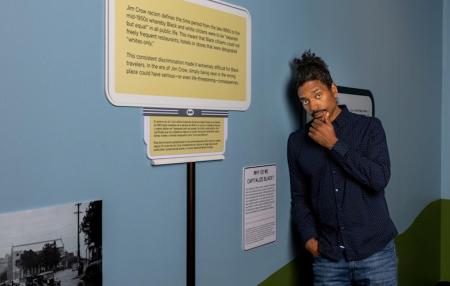
Professor Frederick Gooding at the display he curated on “The Green Book,” at the Fort Worth Museum of Science and History, 2022
A museum display DFW school kids should get out to see, “The Green Book,” at the Fort Worth Museum of Science and History.
Press release from Texas Christian University tells the story well.
Gooding Works to Make History Accessible
February 10, 2022
TCU professor is curator of The Green Book, an exhibit launching this month at the Fort Worth Museum of Science and History.
One of the ultimate freedoms is that of the open road – the simple act of driving a car when or wherever you want to go. But in Jim Crow America, a road trip for Black travelers was far from liberating. In fact, a drive outside of the neighborhood was dangerous, especially in the South.
“Imagine that it’s the 1950s. You are Black and your children are in the back seat of your car and you’re going on a trip,” said Frederick Gooding Jr., Dr. Ronald E. Moore Honors Professor of Humanities. “Think how much of a threat it was to find a safe place to eat and sleep in terms of avoiding humiliation or violence. Even a gas station could be a risky proposition. You needed a resource for your family’s safety and protection because the stakes were so high.”
That resource was the Negro Motorist Green Book, published from the 1930s until 1966, a mere two years after the 1964 Civil Rights Act financially penalized racial segregation for the first time. The handbook provided a state-by-state list of hotels, service stations, restaurants and other establishments considered safe for Black travelers.
The associate professor of African-American studies and chair of TCU’s Race & Reconciliation Initiative, Gooding is now helping to share the story about the book and its originator, Victor Hugo Green. The Fort Worth Museum of Science and History approached Gooding to be chief curator of its new exhibition, “Fort Worth and the Green Book: Black Travelers Navigating Racism in Mid-Century Texas,” opening Feb. 11.
While the 2018 Academy Award-winning movie Green Book may have introduced the same title to many Americans, Gooding notes that the exhibit certainly takes a different path.
“Whether you’re 6 or 60, this exhibit will help set the tone for how bizarre and befuddling it was for African Americans to have to navigate a Jim Crow society and to heighten awareness of our relative progress,” Gooding said. “It’s been a treat to be part of the creation process as well as provide an opportunity for exposure.”
Morgan Rehnberg, the museum’s project leader, said it was clear that Gooding would be an ideal partner.
“His scholarship on race and culture, as well as his leadership at TCU in addressing the university’s history with race, has given him a unique perspective on Fort Worth,” Rehnberg said. “It’s been tremendously fun to see his enthusiasm shine into every aspect of the exhibition.”
After receiving a grant, the museum acquired the materials for the exhibit. As a historian, Gooding looked for ways to make it accessible.
“We started from scratch in creating a balanced exhibit that has many layers. That helps to bring The Green Book to life, and there’s something for everyone,” he said “It’s been an interesting ride looking to reconcile introducing people to a topic while providing them with enough tools to discover the truth for themselves.”
The exhibit is expected to be seen by close to 300,000, including many school groups, before it’s taken down in August. In conjunction with the exhibit, Gooding will present as part of the museum’s lecture series Feb. 21. His “Navigating the Road to Reconciliation” talk will explore how to leverage a multiplicity of voices and support the principles of reconciliation. For visitor information, visit Fort Worth Museum of Science and History.
Lesson is, we need to act now. The faster and harder we can act to block global heating, the greater chance we have of saving a place for humans on this planet without massive loss.
Beinecke Library at Yale is a repository for Rachel Carson’s papers, and much more.
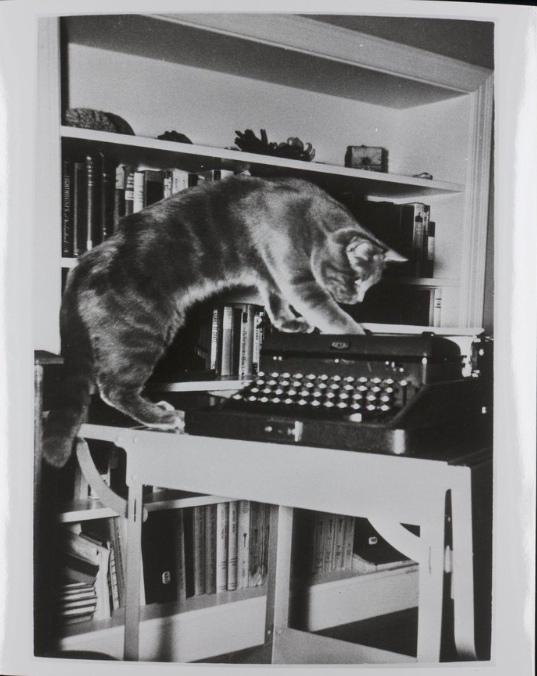
Including this beguiling photo of Rachel Carson’s cat investigating the typewriter on which she wrote Silent Spring.
Maybe the cat is trying to find where all those beautifully-crafted words came from. Even decades before the internet, cats tortured their humans in the humans’ offices. Royal Typewriter in Rachel Carson’s Maryland house.
Researchers into Rachel Carson should check the on-line holdings of the Beinecke Library.
Thomas Nast may have done as much as Abraham Lincoln to invent the Republican Party.
Nast’s illustration for Harper’s Weekly for the issue of December 31, 1864, expressed his great desire for an end to the Civil War, and offered a vision of what could happen when arms were put down.
Harper’s Weekly, December 31, 1864. Nast portrayed Lincoln’s hope that the union could be saved. The insets show events that had not yet happened when the illustration was published, including the surrender by Robert E. Lee to U. S. Grant.
As the Union military advanced across the South in December 1864, making Confederate defeat seem to be only a matter of time, artist Thomas Nast drew a holiday illustration betokening mercy for the vanquished and sectional reconciliation for the nation. Under the Christmas proclamation of “Peace on Earth and Good Will Toward Men,” President Abraham Lincoln is the gracious host who generously welcomes the Confederates—President Jefferson Davis, General Robert E. Lee, and state governors—in from the cold, and gestures for them to return to their rightful seats at the sumptuous feast of the states. Seated at the table are the governors of the Union states, and on the wall behind them appear portraits of leading Union generals.
Framing the main banquet scene are four circular insets that convey the message that if the Confederacy will lay down its arms, surrender unconditionally, and be contrite, then the Union will be merciful and joyously welcome them back into the fold. Viewing them clockwise from the upper-left, the symbolic figure of Victory, backed by the American Eagle, offers the olive branch of peace to a submissive Confederate soldier; the forgiving father from the biblical parable embraces his wayward son, whose sorrow for his past rebellion prompts the father to honor his son with a celebratory dinner; under the tattered American flag, the ordinary soldiers of the Union and Confederacy reunite happily as friends and brothers after the Confederate arms and battle standards have been laid on the ground; and, General Robert E. Lee, the Confederate commander, bows respectfully and offers his sword in unconditional surrender to General Ulysses S. Grant, the commander of the Union troops. In the lower-center is a scene from a holiday table at which a Northern family drinks a toast to the Union servicemen.
While Nast could be partisan, as in his portrayal of Democrats as mules kicking down a barn, or Republicans as noble elephants, and Nast could be subject to bigotry, as in his frequent jabs at Catholics and his portrayal of Irish immigrants as near-gorillas, much of his work in illustration for Harper’s and other publications offered a vision of a much better America which welcomed everyone — as his later portrayal of “Uncle Sam’s Thanksgiving” in 1869 demonstrated.
We could use more Republicans, and newspapermen, like the hopeful Nast, today (leave the bigotry behind).
Yes, this is an encore post. Defeating ignorance takes patience and perseverance.
Spread the word; friends don't allow friends to repeat history.
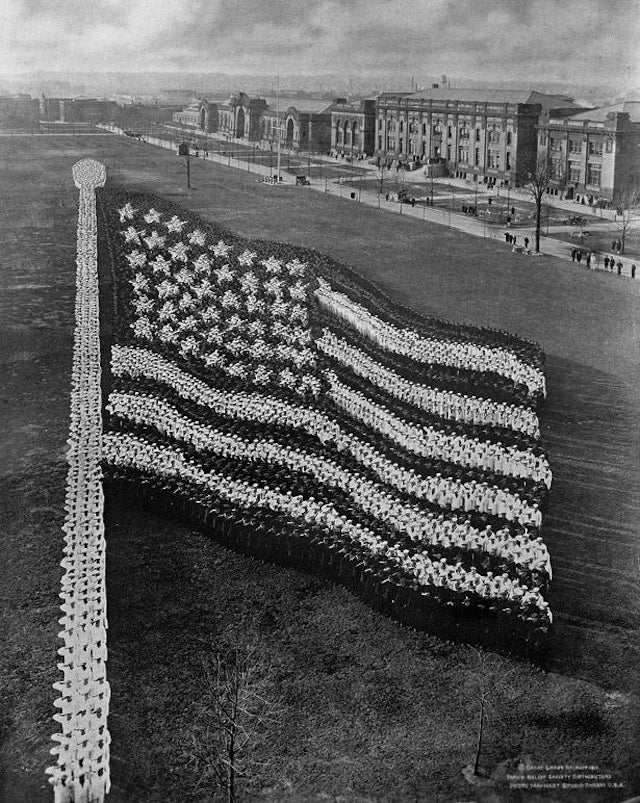
A “living flag” composed of 10,000 sailors, or “Blue Jackets at Salute,” by the Mayhart Studios, December 1917; image probably at the Great Lakes training facility of the Navy. Gawker media image
November offers several flag flying days, especially in years when there is an election.
But December may be the month with the most flag-flying dates, when we include statehood days.
December 25 is Christmas Day, a federal holiday, and one of the score of dates designated in the Flag Code. If you watch your neighborhood closely, you’ll note even some of the most ardent flag wavers miss posting the colors on this day, as they do on Thanksgiving and New Years and Easter.
Other dates?
Nine states attained statehood in December! People in those states should fly their flags (and you may join them). Included in this group is Delaware, traditionally the “First State,” called that because it was the first former England colony to ratify the U.S. Constitution:
Illinois, December 3 (1818, 21st state)
Delaware, December 7 (1787, 1st state)
Mississippi, December 10 (1817, 20th state)
Indiana, December 11 (1816, 19th state)
Pennsylvania, December 12 (1787, 2nd state)
Alabama, December 14 (1819, 22nd state)
New Jersey, December 18 (1787, 3rd state)
Iowa, December 28 (1846, 29th state)
Texas, December 29 (1845, 28th state)
December 15 is Bill of Rights Day, marking the day in 1791 when the Bill of Rights was declared ratified; but though this event generally gets a presidential proclamation, there is no law or executive action that requires flags to fly on that date, for that occasion.
Eleven flag-flying dates in December. Does any other month have as many flag flying opportunities?
Have I missed any December flag-flying dates? 11 events on 10 days (Delaware’s statehood falls on the anniversary of the Pearl Harbor attack).
Here’s a list of the 10 days to fly the flag in December 2021, under national law, in chronological order:
Delaware, December 7 (1787, 1st state) (shared with Pearl Harbor Remembrance Day)
Mississippi, December 10 (1817, 20th state)
Indiana, December 11 (1816, 19th state)
Pennsylvania, December 12 (1787, 2nd state)
Alabama, December 14 (1819, 22nd state)
New Jersey, December 18 (1787, 3rd state)
Christmas Day, December 25
Iowa, December 28 (1846, 29th state)
Texas, December 29 (1845, 28th state)
Fly your flag with respect, for the flag, for the republic it represents, and for all those who sacrificed that it may wave on your residence.
Appropriate to a snowy December. “The Barn on Grayson-New Hope Road [Lawrenceville, Georgia]. This barn with its old truck and ever-present American flag, is often the subject of photographs and paintings by the locals.” Photo and copyright by Melinda Anderson
Save
Save
Yes, this is an encore post. Defeating ignorance takes patience and perseverance. Plus, I like these photos.
Spread the word; friends don't allow friends to repeat history.
Our traditional Thanksgiving post wishing for peace:
November 1869, in the first year of the Grant administration — and Nast put aside his own prejudices enough to invite the Irish guy to dinner, along with many others. (Nast tended not to like Catholics, and especially Irish Catholics.)
In a nation whose emotions are still raw from a divisive election, a year of protest for the right to live, a year of too-long-continued deadly plague, unwarranted, horrifying assaults on police officers, not to mention daily horrors reported from Venezuela, Central America, East Timor and Indonesian New Guinea, Syria, Belarus, Asia and the Middle East, could there be a better or more timely reminder of what we’re supposed to be doing?
A Millard Fillmore’s Bathtub tradition: Uncle Sam’s Thanksgiving. History teachers should use the image — and if you’re teaching history at home to students working hard to avoid getting ill, you should use it, too. If you’re teaching in Texas . . . well, there’s something here to make everyone angry, but anger is allowed under the new history censorship rules, right?
(Click for a larger image — it’s well worth it.)
Thomas Nast’s “Uncle Sam’s Thanksgiving,” 1869 – Ohio State University’s cartoon collection, and HarpWeek
“Uncle Sam’s Thanksgiving Dinner” marks the highpoint of Nast’s Reconstruction-era idealism. By November 1869 the Fourteenth Amendment, which secures equal rights and citizenship to all Americans, was ratified. Congress had sent the Fifteenth Amendment, which forbade racial discrimination in voting rights, to the states and its ratification appeared certain. Although the Republican Party had absorbed a strong nativist element in the 1850s, its commitment to equality seemed to overshadow lingering nativism, a policy of protecting the interests of indigenous residents against immigrants. Two national symbols, Uncle Sam and Columbia, host all the peoples of the world who have been attracted to the United States by its promise of self-government and democracy. Germans, African Americans, Chinese, Native Americans, Germans, French, Spaniards: “Come one, come all,” Nast cheers at the lower left corner.
One of my Chinese students identified the Oriental woman as Japanese, saying it was “obvious.” Other friends say both are Chinese. Regional differences. The figure at the farthest right is a slightly cleaned-up version of the near-ape portrayal Nast typically gave Irishmen.
If Nast could put aside his biases to celebrate the potential of unbiased immigration to the U.S. and the society that emerges, maybe we can, too.
Hope your Thanksgiving week is good; hope you have good company and good cheer, turkey or not, traveling or not, company or not. Stay safe. Happy Thanksgiving 2021. And of course, remember to fly your flag, to show you agree with Nast’s inclusive Thanksgiving.
More: Earlier posts from Millard Fillmore’s Bathtub
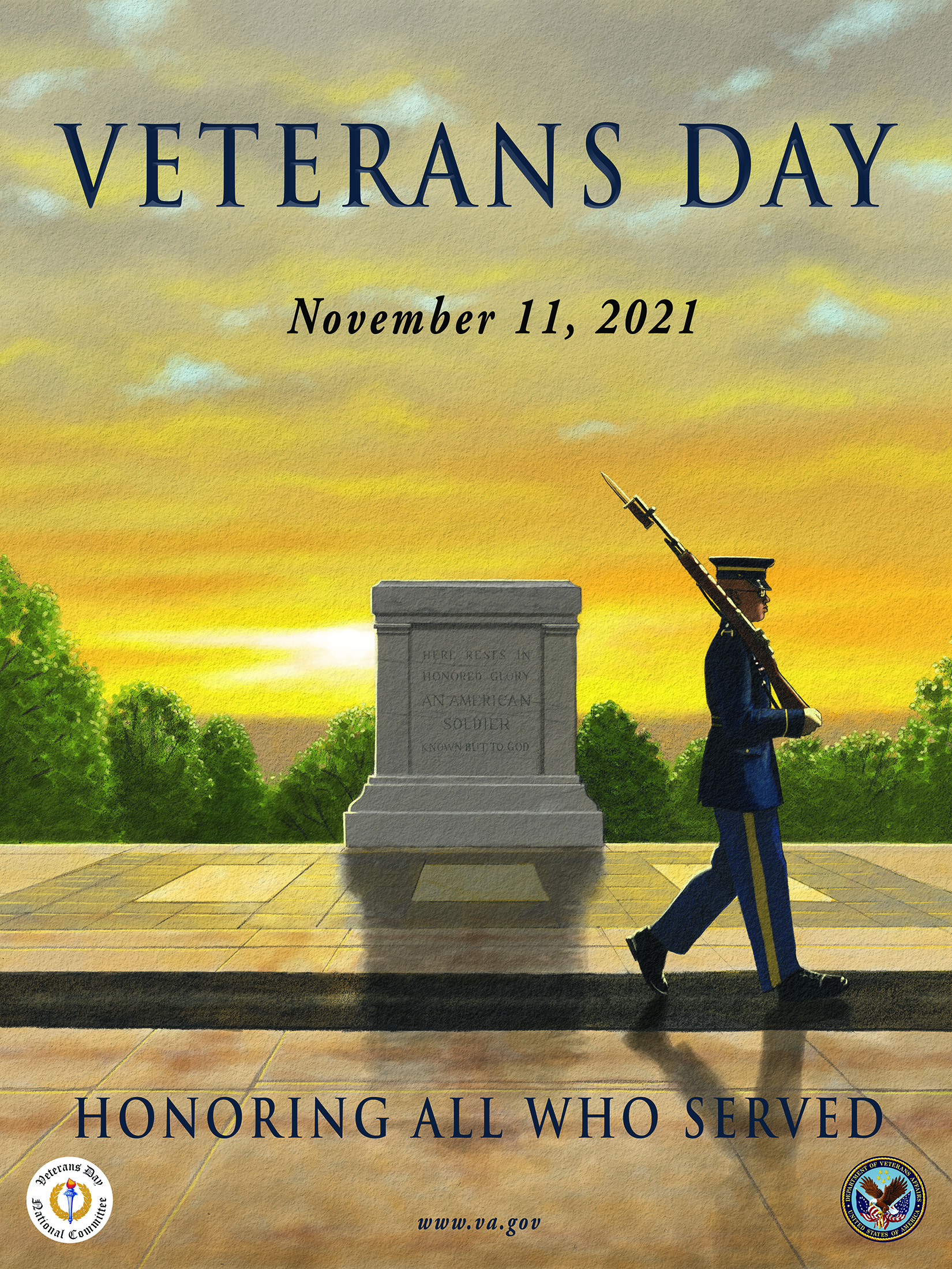
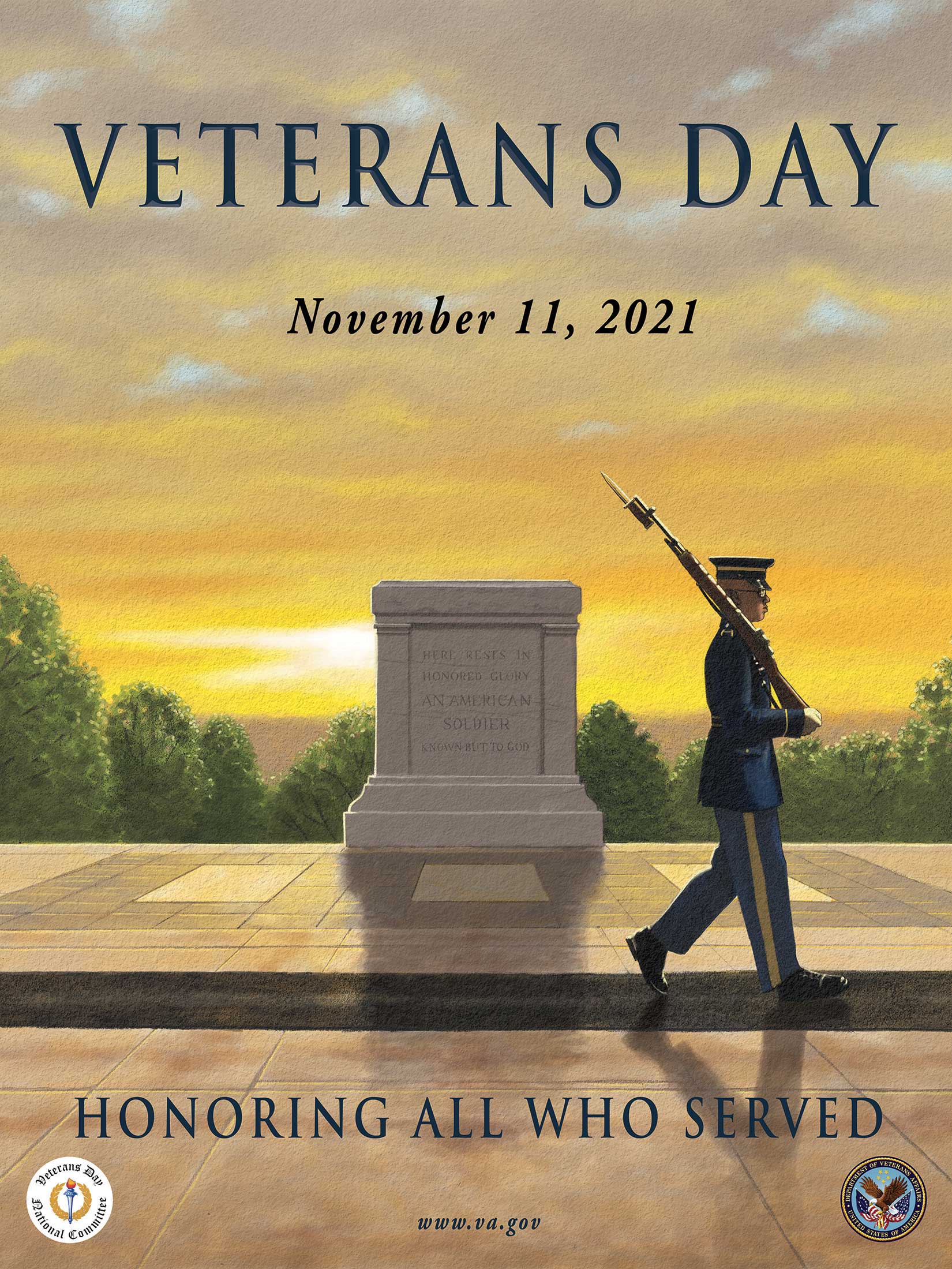
We fly our flags today, November 11, to honor all veterans, an extension and morphing of Armistice Day, which marked the end of World War I. The Armistice took effect on November 11, 1918.
For several reasons including mnemonic, the treaty called for an end to hostilities on the “11th hour of the 11th day of the 11th month” of 1918. Your state’s history standards probably list that phrase somewhere, but the history behind it is what students really find interesting.
The Allied powers signed a ceasefire agreement with Germany at Rethondes, France, at 11:00 a.m. on November 11, 1918, bringing the war later known as World War I to a close.
President Wilson proclaimed the first Armistice Day the following year on November 11, 1919, with the these words: “To us in America, the reflections of Armistice Day will be filled with solemn pride in the heroism of those who died in the country’s service and with gratitude for the victory, both because of the thing from which it has freed us and because of the opportunity it has given America to show her sympathy with peace and justice in the councils of the nations…” Originally, the celebration included parades and public meetings following a two-minute suspension of business at 11:00 a.m.
Between the world wars, November 11 was commemorated as Armistice Day in the United States, Great Britain, and France. After World War II, the holiday was recognized as a day of tribute to veterans of both wars. Beginning in 1954, the United States designated November 11 as Veterans Day to honor veterans of all U.S. wars. British Commonwealth countries now call the holiday Remembrance Day.
Online holdings of the National Archives and Records Administration (NARA) provide rich sources of information on America’s military, and on veteran’s day. NARA leans to original documents a bit more than the Library of Congress. For Veterans Day 2016, NARA featured an historic photo form 1961:
NARA caption: President John F. Kennedy Lays a Wreath at the Tomb of the Unknown Soldier as part of Veterans Day Remembrances, Arlington National Cemetery, Arlington, Virginia, 11/11/1961 Series: Robert Knudsen White House Photographs, 1/20/1961 – 12/19/1963. Collection: White House Photographs, 12/19/1960 – 3/11/1964 (Holdings of the @jfklibrary)
(Well, actually it’s for everyone. But teachers love those kinds of links, especially AP history teachers who need documents for “Document-Based Questions” (DBQs).
On one page, the Veterans Administration makes it easy for teachers to plan activities; of course, you need to start some of these weeks before the actual day:
Nine events spread over seven different days come with urgings to fly the U.S. flag in November: Six states celebrate statehood, Veterans Day falls always on November 11, and Thanksgiving Day on November 25.
Cub Scouts carry the U.S. flag in the Houston, Texas, Thanksgiving parade. Unknown year; image from Greater Houston Moms
Did I say eight? 2021 is an election year in many states, like Texas; we fly flags at polling places on election day, so that makes nine events. You may fly your flag at home on election day, too.
Two states, North Dakota and South Dakota, celebrate their statehood on the same date, and that’s the date of elections in 2021. Washington’s statehood day falls on Veterans Day, November 11 — so there are only six days covering nine events.
In calendar order for 2021, these are the seven days:
North Dakota statehood day, November 2 (1889, 39th or 40th state)
South Dakota statehood day, November 2 (1889, 39th or 40th state) (shared with North Dakota)
Election day, November 2 (several states)
Montana statehood day, November 8 (1889, 41st state)
Veterans Day, November 11
Washington statehood day, November 11 (1889, 42nd state) (shared with Veterans Day)
Oklahoma statehood day, November 16 (1907, 46th state)
North Carolina statehood day, November 21 (1789, 12th state)
Thanksgiving Day, fourth Thursday in November (November 25 in 2021)
Most Americans will concern themselves only with Veterans Day and Thanksgiving Day. Is flying the U.S. flag for statehood day a dying tradition?
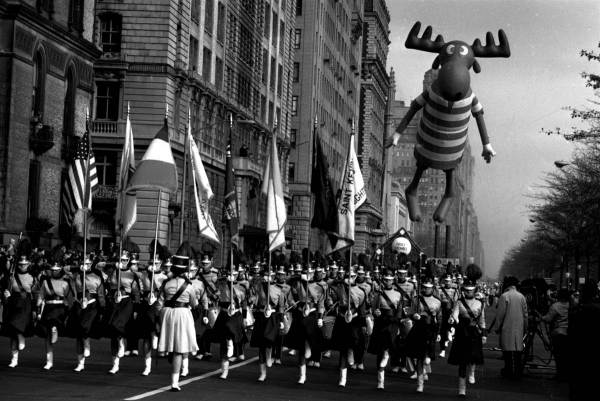
Color guard carries U.S. flag, closely followed Bullwinkle the Moose, in Macy’s Thanksgiving Day Parade, unknown year. HistoryDaily.org image
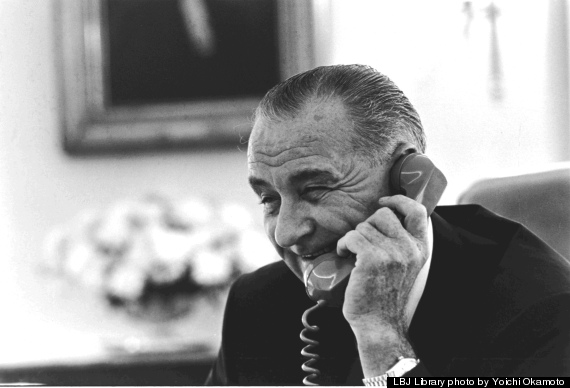
President Lyndon Johnson on the telephone, White House, September 10, 1965. LBJ Library photo by Yoichi Okamoto.
President Lyndon Baines Johnson was born August 27, 1908. One of the most active, ambitious and controversial presidents, he competes with James Madison for the title of “best legislator” among presidents. Today is his 113th birthday.
Several groups in Texas and Washington celebrate LBJ’s birthday each year, an event he always liked to keep festive, partly because he had a huge ego, and partly because he just loved a good time with friends and cake.
A running whine on Twitter and Facebook: ‘Can you name anything government ever got right?’
One such occasion was July 20, 1969, when humans first put foot on the Moon.
It’s a day to remember history. Do you remember that day, the first time humans landed on the Moon?
God knows we could use more Americans to have faith in the good intentions of NASA scientists today; we could use more dreams like those NASA gave us then, too.
Southwest Elementary in Burley, Idaho, existed in a world far, far away from the U.S. space program. We watched rocket launches on black and white televisions — the orbital launches were important enough my father let me stay home from school to watch, but when he dropped me off at school, I was in a tiny band of students who actually made it to school. Potato farmers and the merchants who supported them thought the space program was big, big stuff, worth missing school.
By John Glenn’s flight, a three-orbit extravaganza on February 20, 1962, a television would appear in the main vestibule of the school, or in the auditorium, and we’d all watch. There were very few spitballs. Later that year my family moved to Pleasant Grove, Utah.
Toward the end of the Gemini series, television news networks stopped providing constant coverage. The launch, the splashdown, a space walk or other mission highlight, but the nation didn’t hold its breath so much for every minute of every mission. Barry McGuire would sing about leaving the planet for four days in space (” . . . but when you return, it’s the same old place.“), then six days, but it was just newspaper headlines.
The Apollo 1 fire grabbed the nation’s attention again.Gus Grissom, one of the three who died, was one of the original space titans; death was always a possibility, but the U.S. program had been so lucky. Apollo’s start with tragedy put it back in the headlines.
The space program and its many successes made Americans hopeful, even in that dark decade when the Vietnam War showed the bloody possibilities of the Cold War. That darkest year of 1968 — see the box below — closed nicely with Apollo 8 orbiting the Moon, and the famous Christmas Eve telecast from the three astronauts, Frank Borman, Jim Lovell, and William A. Anders. The space program kept us hopeful.
By early 1969 many of us looked forward to the flight of Apollo 11 scheduled for July — the space flight that promised to put people on the Moon for the first time in history, the realization of centuries-old dreams.
Then I got my assignment for Scouting for the summer. Out of nearly 50 nights under the stars, one of the days would include the day of the space walk. Not only was it difficult to get televisions into Maple Dell Scout Camp, a good signal would be virtually impossible. I went to bed Sunday night knowing the next day I’d miss the chance of a lifetime, to watch the first moon landing and walk.
Just after midnight my sister Annette woke me up. NASA decided to do the first walk on the Moon shortly after touchdown, at an ungodly hour. I’d be unrested to check Scouts in, but I’d have seen history.
Texas Essential Knowledge and Skills (TEKS) used to list 11 dates for U.S. history as the touchstones kids need to have: 1609, the founding of Jamestown; 1776, the Declaration of Independence; 1787, the Constitutional Convention; 1803, the Louisiana Purchase; 1861-1865, the American Civil War; 1877, the end of Reconstruction; 1898, the Spanish American War; 1914-1918, World War I; 1929, the Stock Market Crash and beginning of the Great Depression; 1941-1945, World War II; 1957, the launching of Sputnik by the Soviets. Most teachers used to add the end of the Cold War, 1991; I usually included Apollo 11 — I think that when space exploration is viewed from a century in the future, manned exploration will be counted greater milestone than orbiting a satellite; my only hesitance on making such a judgment is the utter rejection of such manned exploration after Apollo, which will be posed as a great mystery to future high school students, I think.)
Happy to report the Texas State Board of Education has caught on. TEKS dates now include 1968 and assassination of Rev. Dr. Martin Luther King, Jr., 1969 and Apollo 11, plus the terrorist attacks on the World Trade Center in 2001 and the 2008 election of Barack Obama as president.
* Why 1968 was such a tough year, in roughly chronological order: 1968 produced a series of disasters that would depress the most hopeful of people, including: the Pueblo incident, the B-52 crash in Greenland, the Tet Offensive in Vietnam, the nerve gas leak at the Army’s facility at Dugway, Utah, that killed thousands of sheep, Lyndon Johnson’s pullout from the presidential race with gathering gloom about Vietnam, the Memphis garbage strike, the assassination of Martin Luther King, Jr., riots, the Black Panther shoot-out in Oakland, the Columbia University student takeover, the French student strikes, the tornadoes in Iowa and Arkansas on May 15, the Catonsville 9 vandalism of the Selective Service office, the sinking of the submarine U.S.S. Scorpion with all hands, the shooting of Andy Warhol, the assassination of Robert F. Kennedy, the Buenos Aires soccer riot that killed 74 people, the Glenville shoot-out in Cleveland, the cynicism of the Republicans and the nomination of Richard Nixon and Spiro Agnew, the Warsaw Pact invasion of Czechoslovakia crushing the “Prague Spring” democratic reforms, the Chicago Democratic Convention and the police riot, the brutal election campaign, the Tlatololco massacre of students in Mexico City, Black Power demonstrations by winning U.S. athletes at the Mexico City Olympics, coup d’etat in Panama. Whew!
Then there are those happy masses who know him for his historical work, recovering the works of Johann Sebastian Bach’s final and most wayward child, P. D. Q. Bach.
One need not be a classical music fan to appreciate much of the humor in Schickele’s work. But if one is familiar with classical music and the tropes of critics and artists, there will be added nuances and fits of laughter.
Shickele has spent his life having a great time in music, and spreading cheer. A life well lived.
Happy birthday!
Tip of the old bathtub-hardened conductor’s baton to Eric Koenig.
Or, until that account is unsuspended by the forces supporting Donald Trump: Follow @FillmoreWhite, the account of the Millard Fillmore White House Library
We've been soaking in the Bathtub for several months, long enough that some of the links we've used have gone to the Great Internet in the Sky.
If you find a dead link, please leave a comment to that post, and tell us what link has expired.
Thanks!
Retired teacher of law, economics, history, AP government, psychology and science. Former speechwriter, press guy and legislative aide in U.S. Senate. Former Department of Education. Former airline real estate, telecom towers, Big 6 (that old!) consultant. Lab and field research in air pollution control.
My blog, Millard Fillmore's Bathtub, is a continuing experiment to test how to use blogs to improve and speed up learning processes for students, perhaps by making some of the courses actually interesting. It is a blog for teachers, to see if we can use blogs. It is for people interested in social studies and social studies education, to see if we can learn to get it right. It's a blog for science fans, to promote good science and good science policy. It's a blog for people interested in good government and how to achieve it.
BS in Mass Communication, University of Utah
Graduate study in Rhetoric and Speech Communication, University of Arizona
JD from the National Law Center, George Washington University


 Posted by Ed Darrell















 Millard Fillmore's Bathtub