November 24 is Origin of Species Day 2014

November 24, 2014

November 24, 2014, marks the 155th anniversary of a day that quietly changed all of science, should have changed much of theology, and brought much of the world into the future, though many people don’t know it yet.

On November 24, 1859, Charles Darwin’s book was published, On the Origin of Species.

Title page, 1859 edition of Darwin's Origin of Species - University of Sydney/Wikimedia image

Title page, 1859 edition of Darwin’s Origin of Species – image from the University of Sydney via Wikimedia image

How to celebrate?  You could read a summary of Ernst Mayr’s shorthand version of Darwin’s theory, and understand it really for the first time  (I hope not the first time, but there are a lot of people who really don’t understand what Darwin said — especially among critics of evolution):

[The Five (5) Facts or Observations, and Two Inferences of Evolution Theory]

Darwin’s theory of evolution is based on key facts and the inferences drawn from them, which biologist Ernst Mayr summarised as follows:[3]

  • Every species is fertile enough that if all offspring survived to reproduce the population would grow (fact).
  • Despite periodic fluctuations, populations remain roughly the same size (fact).
  • Resources such as food are limited and are relatively stable over time (fact).
  • A struggle for survival ensues (inference).
  • Individuals in a population vary significantly from one another (fact).
  • Much of this variation is inheritable (fact).
  • Individuals less suited to the environment are less likely to survive and less likely to reproduce; individuals more suited to the environment are more likely to survive and more likely to reproduce and leave their inheritable traits to future generations, which produces the process of natural selection (inference).
  • This slowly effected process results in populations changing to adapt to their environments, and ultimately, these variations accumulate over time to form new species (inference).
Darwin's original sketch of a "tree of life," from Darwin's journals

Charles Darwin’s 1837 sketch, his first diagram of an evolutionary tree from his First Notebook on Transmutation of Species (1837) on view at the the Museum of Natural History in Manhattan. Interpretation of handwriting: “I think case must be that one generation should have as many living as now. To do this and to have as many species in same genus (as is) requires extinction . Thus between A + B the immense gap of relation. C + B the finest gradation. B+D rather greater distinction. Thus genera would be formed. Bearing relation” (next page begins) “to ancient types with several extinct forms.”  Wikimedia image

This is mostly an encore post — hey, it’s a history blog — with tips of the old scrub brush justified to Larry Moran and P. Z. Myers, and especially the recently retired Eugenie Scott, and the National Center for Science Education.

More:


History of physics, in four minutes

November 22, 2014

Isaac Newton and a friendly bird, on the verge of discovery; still from the film,

Isaac Newton and a friendly bird, on the verge of discovery; still from the film, “Physics,” by Asa Lucander.

History teachers, physics teachers, you should use this film.

In amusing animation — perhaps a throwback to earlier animations, but good and amusing — produced by Åsa Lucander @ 12foot6, for the television Science Club series on BBC2, hosted by Dara O Briain (who does the narration).

Credits:

Physics – Short animation, which was part of the Science Club series on BBC2 hosted by Dara O Briain,
© BBC

Directed by: Åsa Lucander @ 12foot6
Produced by: 12foot6
Art&Design: Åsa Lucander
Additional Art: Marc Moynihan
Stop Motion & Compositing: Julia Bartl
Animation: Kim Alexander, Marc Moynihan, Anna Fyda, Barry Evans, Lucy Izzard, Simon Testro, Phoebe Halstead, Michael Towers
Sound: Laura Coates

For my money, this should be a valuable classroom tool.  In four short minutes the film covers most of the really great advances in physics, suitably for world history or U.S. history.  It’s clear enough in its presentation that physics students should find it a useful review.  Or more likely, they’ll understand what we’ve been trying to teach them, for the first time.

Science gets left out of history courses way too easily.  Here’s a quick way to stick it back in.

Tip of the old scrub brush to Fast Company, where I found the film and details.  Fast company also created this 3 second excerpt, in MP4 format, which you may find useful somewhere:


From the University of Chicago news archives: Obama’s students speak

November 20, 2014

Six years into his presidency, Barack Obama still gets me a few odd — usually very, very odd — inquiries about his real history.

Today I got another inquiry asking why anyone would believe Obama taught at the University of Chicago Law School. ‘After all, he wasn’t a real professor. Don’t you find it odd we never hear from his students? Maybe it’s because he didn’t have any.’ [Yes, I’ve edited out the snark and insults, and corrected the spelling.]

It pains me that these hoaxes continue.  I don’t condemn the gullible for having differing views, but I do resent that these discussions keep us from serious discussions of real policy.  I am troubled that so many people would condemn legislation we need based on their erroneous view that President Obama is somehow made illegitimate by history.  You’d think they’d have learned from “The Devil and Daniel Webster” that we should deal with the devil, even, to improve our nation and the heritage of good laws we build on. Or perhaps they could have learned from the history of World War II, when we allied our nation with Joseph Stalin’s Soviet Union in order to defeat a more menacing evil.

Santayana’s Ghost is troubled, too, I’m sure.

We straighten the record as often as necessary.  If we don’t make corrections in these errors, the errors will be repeated, and the devastating results of peoples’ believing the hoaxes will be multiplied.

First, yes, Obama was an instructor in Constitutional Law at the University of Chicago Law School.  More accurately, he was a Lecturer, and then Senior Lecturer — but at Chicago that does not imply less-than-professorial adjuncts.  Instead, it suggests these are high-functioning, well-respected professionals who pause from careers of great power to instruct students.

The law school put up a page on their website with the answers to the most-asked questions:

Statement Regarding Barack Obama 

The Law School has received many media requests about Barack Obama, especially about his status as “Senior Lecturer.”

From 1992 until his election to the U.S. Senate in 2004, Barack Obama served as a professor in the Law School. He was a Lecturer from 1992 to 1996. He was a Senior Lecturer from 1996 to 2004, during which time he taught three courses per year. Senior Lecturers are considered to be members of the Law School faculty and are regarded as professors, although not full-time or tenure-track. The title of Senior Lecturer is distinct from the title of Lecturer, which signifies adjunct status. Like Obama, each of the Law School’s Senior Lecturers has high-demand careers in politics or public service, which prevent full-time teaching. Several times during his 12 years as a professor in the Law School, Obama was invited to join the faculty in a full-time tenure-track position, but he declined.

That should answer serious inquiries, and even most snarky questions.  It won’t.  Dear Reader, you may wish to bookmark this site, and the University of Chicago site, for future, quick reference and rebuttal.

As with most other hoaxes involving Barack Obama’s birth, education, higher education and career, serious journalists and writers for justly-proud schools and organizations already sought out people who knew Obama before he became famous.  Claims that these interviews do not exist are hoaxes, as are the claims based on the imagined absence of these stories.

What did Obama’s students think of him, and why don’t we hear from them?  Apparently they thought he was a great instructor; we don’t hear from them because critics are Google-challenged, or just too nasty to admit the information is out there. For example, this is from The Record Online, the alumni magazine of the law school:

From the Green Lounge to the White House

Author:  Robin I. Mordfin

When Barack Obama arrived at the Law School in 1991, faculty and students alike sensed that he had a bright future ahead of him. As the first African American president of the Harvard Law Review, he was clearly an accomplished scholar with a fine mind and his choice of careers. And once he began teaching, his strong oratorical skills and his ability to communicate complex ideas made his political ambitions appear credible.

Craig Cunningham, ’93, one of the President’s first students and a supporter of his teacher’s political ambitions, felt that Obama was brilliant, talented, and had the potential to be a great leader. But Cunningham was also concerned about Obama’s political future.

“I did expect him to run for office, because I would hang around after class and we would talk about the state senate,” Cunningham explains. “But after he lost the congressional race to Bobby Rush I thought he was moving too fast, that he should slow down and not run for a different office for a while because he was trying to do too much at one time. And Chicago politics were not going to allow him to do
that. I was worried. And I was really surprised when he told me he was going to run for U.S. Senate.”

Douglas Baird, the Harry A. Bigelow Distinguished Service Professor of Law and former Dean, shared Cunningham’s concern that winning the seat was a long shot for Obama.

“I remember having a cup of coffee with him when he said he was thinking of running for the U.S. Senate, and I looked at him straight in the eye and said, ‘Don’t do it, you’re not going to win.’”

The future President came to the attention of the Law School when Michael McConnell, ’79, a professor at the Law School at the time who is now a federal judge on the Tenth Circuit Court of Appeals, told then-Dean Baird about an impressive editor at the Harvard Law Review who was doing an excellent job editing McConnell’s submission. Baird reached out to Obama and asked him about teaching. Having already made plans to write a book on voting rights after graduation, Obama refused the offer. So Baird took a different approach and offered him a Law and Government Fellowship, which would allow him to work on his book and would perhaps lead him to develop an interest in teaching. Obama accepted the offer and began the fellowship in the fall of 1991. At that time, he also practiced civil rights, voting rights, and employment law as well as real-estate transactions and corporate law as an attorney with Miner,
Barnhill & Galland, a position he held until his election to the U.S. Senate in 2005.

Though the intended voting rights book ultimately shifted focus and became Dreams from My Father, Baird’s plans for moving Obama into the classroom played out as expected. By 1993, Obama was teaching Current Issues in Racism and the Law—a class he designed—and added Constitutional Law III in 1996.

“In Con Law III we study equal process and due process. He was incredibly charismatic, funny, really willing to listen to student viewpoints—which I thought was very special at Chicago,” says Elysia Solomon, ’99. “There were so many diverse views in the class and people didn’t feel insecure about voicing their opinions. I thought that he did a really good job of balancing viewpoints.”

“When I walked into class the first day I remember that we—meaning the students I knew—thought we were going to get a very left-leaning perspective on the law,” explains Jesse Ruiz, ’95. “We assumed that because he was a minority professor in a class he designed. But he was very middle-of-the-road. In his class we were very cognizant that we were dealing with a difficult topic, but what we really got out of that class was that he taught us to think like lawyers about those hard topics even when we had
issues about those topics.”

Over time, Obama developed a reputation for teaching from a nonbiased point of view. He was also noted for widening the legal views of his students.

“I liked that he included both jurisprudence and real politics in the class discussions,” says Dan Johnson-Weinberger, ’00.

“Lots of classes in law school tend to be judge-centric and he had as much a focus on the legislative branch as the judicial branch. That was refreshing.”

From 1992 to 1996, Obama was classified as a lecturer. In 1996, after he was elected to the state senate, he became a Senior Lecturer, a title customarily assigned to judges and others with “day jobs” who teach at the school.

While the comments the administration heard from students about Obama were that he had a marvelous intellectual openness and an ability to explore ideas in the classroom, he was not the subject of enormous student discussion.

“Most students were not that focused on Barack during the years I was there,” says Joe Khan, ’00. “For example, every year the professors would donate their time or belongings to the law school charity auction. Professor Obama’s donation was to let two students spend the day with him in Springfield, where he’d show them around the state senate and introduce them to the other senators. People
now raise thousands of dollars to be in a room with the man, but my friend and I won the bid for a few hundred bucks.”

“I knew he was ambitious, but at that point in time at the Law School there were so many people on the faculty that you knew weren’t going to be professors for the rest of their lives,” Solomon explains. “We had [Judge] Abner Mikva and Elena Kagan and Judge Wood and Judge Posner. There is a very active intellectual life at the Law School and this melding of the spheres of academics and the real world is very cool. It’s what attracts teachers and students to the school.”

Unsurprisingly, though, he was of greater interest to the minority students on campus. “I don’t think most people know his history,” Ruiz says, “but when he became the first African American president of the Harvard Law Review it was a national story. I remembering reading the story and thinking I gotta go to law school!”

“We African American students were very aware of him because at the time there really weren’t a lot of minority professors at the Law School,” Cunningham explains, “and we really wanted him to be a strong representation for the African American students. We wanted him to live up to the pressures and reach out to other ethnic minorities. And we were also very excited about possibly having an African American tenure-track professor at the Law School.”

But a tenure-track position was not to be, although not because of a lack of interest on the part of the Law School. It was apparent that while Obama enjoyed teaching and savored the intellectual give-and-take of the classroom, his heart was in politics.

“Many of us thought he would be a terrific addition to the faculty, but we understood that he had other plans,” explains David Strauss, Gerald Ratner Distinguished Service Professor. “Although I don’t think any of us imagined that things would work out the way they did.” And while students like Cunningham wanted him to continue to a tenure-track position, others were expecting a promising
and accomplished political career.

“I was into state politics while I was at the Law School, so I am one of the few alums who knew the President as both a legislator and as a teacher,” notes Johnson-Weinberger.

“I thought he would continue as a successful politician. But I never would have guessed that he would be our President.”

During his tenure in the state senate, Obama continued to teach at the Law School, some nights traveling straight up from evening sessions at the State House to his classroom.

“But the students never thought of him as a part-timer,” Strauss adds. “They just thought of him as a really good teacher.”

In 1996, Obama ran for, and won, the Thirteenth District of Illinois state senate seat, which then spanned Chicago South Side neighborhoods from Hyde Park–Kenwood to South Shore and west to Chicago Lawn. Then in 2000 he ran for, and lost, the Democratic nomination for Bobby Rush’s seat in the U.S. House of Representatives.

“He was very demoralized at that point and would not have recommended a career in public service to anyone,” Ruiz says. “He had suffered a setback, he was facing a lot of struggles in Springfield, and it was a hard lifestyle traveling back and forth to Springfield. We sat at lunch and he talked about how if he had joined a big firm when he graduated he could have been a partner. We did a lot of what if. But
then he decided to run for U.S. Senate. And the rest is history.”

And history it is. Since he first came to the attention of Douglas Baird, Barack Obama has gone from being the first African American president of Harvard Law Review to being the first African American President of the United States.

He came to the Law School and taught hundreds of students to think like lawyers and the students helped him to sift and think through myriad complex legal issues. In other words, even as President Obama left a lasting impression on the Law School and its students, that same environment helped to shape the man who became President Obama.


With the possible exception of Theodore Roosevelt, never before in history have we elected a president who had published two best-selling memoirs before running for the office (I’m not certain about Teddy; most of his writing came after he left the White House, but he well may have had a memoir published before he ran on his own in 1904).  Could Obama’s critics at least bother to get a copy of either of his books, to see whether he covered their questions there?

Yes, that would indeed require that they question in good faith.  That may be too high a standard.


Ghosts do talk: JFK’s advice to Barack Obama

November 18, 2014

Didn’t sleep well over the weekend.  Maybe I should have gone camping with the Scouts in the cold at Camp Wisdom — I always sleep better out of doors, in a tent.

But I fell asleep waiting for the weather forecast, wading through another round of news in which, it seems, Santayana’s Ghost is telling us too many people, especially conservatives, did not study history adequately.  We may have to repeat some of the ugly lessons of history.

Does anyone remember the SS St. Louis?  No one remembers when the braceros from Mexico flooded over the border to take up the hoes and plows, and harvest buckets, when our men were at war beating back a Fascist horde?  No one remembers the difficulty America had getting war materials from one coast where it was stockpiled, to the other coast where it was needed, and Dwight Eisenhower’s doubling down on the national debt to build a road system that would sustain us in war?

No one remembers?

It wasn’t Santayana who shook me awake, though.  It wasn’t the Spanish-born Harvard professor, but a Boston-born Harvard student, with that Boston Brahmin accent.

“Can you get a message to Mr. Obama?” he asked me.

I blinked. I didn’t speak.

Dickens didn’t get it quite right, I thought.  I can close my eyes and this apparition disappears.

But I couldn’t close my eyes.

“The torch isn’t burned out.  If there is not a willing torch bearer to take it up, it can’t be passed,” he said.

I wondered what in the hell he was talking about.  I  heard a horse’s galloping hooves and a warning.  It was after midnight I assumed; I couldn’t make out the warning.  Was that the same Boston accent?

“There’s a dark path still ahead. He’ll have to run it on his own, for a while longer.”

A podium appeared, and the apparition stepped behind it, and smiled.  I almost recognized the room. A luncheon. Reporters.  I found myself in that balcony upstairs where I’d often sat during my tour of DC, having not paid for the lunch (Orrin Hatch always pinched pennies). Late again, I missed the introduction.

His chin held high, he stared straight at me.  My midnight ideas notebook was open to a blank page, and I fumbled for a pen. Did I imagine that gibberish squeal that an audio tape makes when it’s rewound?

I missed some joke.  The audience below me laughed.  The apparition, more solid than before but faded in color, nodded as I understood he meant I should take notes. If it was a dream, surely his voice would not be so clear. He looked briefly at his notes, smiled, then got a serious look on his face as he surveyed the crowd.

The modern presidential campaign covers every issue in and out of the platform from cranberries to creation. But the public is rarely alerted to a candidate’s views about the central issue on which all the rest turn. That central issue — and the point of my comments this noon — is not the farm problem or defense or India. It is the presidency itself.

Cranberries?  It’s close to Thanksgiving.  Oh!  The cranberry scare!  I remember that Thanksgiving we swore off the things.  Some pesticide issue — I was a child — I strained to recall the details.  We lived in Burley, Idaho, then.  It must have been the early 1960s.  Some message about pesticides? I wondered.

Of course a candidate’s views on specific policies are important, but Theodore Roosevelt and William Howard Taft shared policy views with entirely different results in the White House. Of course it is important to elect a good man with good intentions, but Woodrow Wilson and Warren G. Harding were both good men with good intentions; so were Lincoln and Buchanan; but there is a Lincoln Room in the White House and no Buchanan Room.

Campaigns. We just ended one. Does this guy know what he’s talking about?  How weary we are?

The history of this Nation — its brightest and its bleakest pages — has been written largely in terms of the different views our Presidents have had of the Presidency itself. This history ought to tell us that the American people in 1960 have an imperative right to know what any man bidding for the Presidency thinks about the place he is bidding for, whether he is aware of and willing to use the powerful resources of that office; whether his model will be Taft or Roosevelt, Wilson or Harding.

Not since the days of Woodrow Wilson has any candidate spoken on the presidency itself before the votes have been irrevocably cast. Let us hope that the 1960 campaign, in addition to discussing the familiar issues where our positions too often blur, will also talk about the presidency itself, as an instrument for dealing with those issues, as an office with varying roles, powers, and limitations

During the past 8 years, we have seen one concept of the Presidency at work. Our needs and hopes have been eloquently stated — but the initiative and follow-through have too often been left to others. And too often his own objectives have been lost by the President’s failure to override objections from within his own party, in the Congress or even in his Cabinet.

The American people in 1952 and 1956 may have preferred this detached, limited concept of the Presidency after 20 years of fast-moving, creative Presidential rule. Perhaps historians will regard this as necessarily one of those frequent periods of consolidation, a time to draw breath, to recoup our national energy. To quote the state of the Union message: “No Congress . . . on surveying the state of the Nation, has met with a more pleasing prospect than that which appears at the present time.”

Unfortunately this is not Mr. Eisenhower’s last message to the Congress, but Calvin Coolidge’s. He followed to the White House Mr. Harding, whose sponsor declared very frankly that the times did not demand a first-rate President. If true, the times and the man met.

But the question is what do the times — and the people — demand for the next 4 years in the White House?

They demand a vigorous proponent of the national interest — not a passive broker for conflicting private interests. They demand a man capable of acting as the commander in chief of the Great Alliance, not merely a bookkeeper who feels that his work is done when the numbers on the balance sheet come even. They demand that he be the head of a responsible party, not rise so far above politics as to be invisible — a man who will formulate and fight for legislative policies, not be a casual bystander to the legislative process.

Today a restricted concept of the Presidency is not enough. For beneath today’s surface gloss of peace and prosperity are increasingly dangerous, unsolved, long postponed problems — problems that will inevitably explode to the surface during the next 4 years of the next administration — the growing missile gap, the rise of Communist China, the despair of the underdeveloped nations, the explosive situations in Berlin and in the Formosa Straits, the deterioration of NATO, the lack of an arms control agreement, and all the domestic problems of our farms, cities, and schools.

This administration has not faced up to these and other problems. Much has been said — but I am reminded of the old Chinese proverb: “There is a great deal of noise on the stairs but nobody comes into the room.”

The President’s state of the Union message reminded me of the exhortation from “King Lear” but goes: “I will do such things — what they are I know not . . . but they shall be the wonders of the earth.”

In the decade that lies ahead — in the challenging revolutionary sixties — the American Presidency will demand more than ringing manifestoes issued from the rear of the battle. It will demand that the President place himself in the very thick of the fight, that he care passionately about the fate of the people he leads, that he be willing to serve them, at the risk of incurring their momentary displeasure.

Whatever the political affiliation of our next President, whatever his views may be on all the issues and problems that rush in upon us, he must above all be the Chief Executive in every sense of the word. He must be prepared to exercise the fullest powers of his office — all that are specified and some that are not. He must master complex problems as well as receive one-page memorandums. He must originate action as well as study groups. He must reopen channels of communication between the world of thought and the seat of power.

Ulysses Grant considered the President “a purely administrative officer.” If he administered the government departments efficiently, delegated his functions smoothly, and performed his ceremonies of state with decorum and grace, no more was to be expected of him. But that is not the place the Presidency was meant to have in American life. The President is alone, at the top — the loneliest job there is, as Harry Truman has said.

If there is destructive dissension among the services, he alone can step in and straighten it out — instead of waiting for unanimity. If administrative agencies are not carrying out their mandate — if a brushfire threatens some part of the globe — he alone can act, without waiting for the Congress. If his farm program fails, he alone deserves the blame, not his Secretary of Agriculture.

“The President is at liberty, both in law and conscience, to be as big a man as he can.” So wrote Prof. Woodrow Wilson. But President Woodrow Wilson discovered that to be a big man in the White House inevitably brings cries of dictatorship.

So did Lincoln and Jackson and the two Roosevelts. And so may the next occupant of that office, if he is the man the times demand. But how much better it would be, in the turbulent sixties, to have a Roosevelt or a Wilson than to have another James Buchanan, cringing in the White House, afraid to move.

Nor can we afford a Chief Executive who is praised primarily for what he did not do, the disasters he prevented, the bills he vetoed — a President wishing his subordinates would produce more missiles or build more schools. We will need instead what the Constitution envisioned: a Chief Executive who is the vital center of action in our whole scheme of Government.

This includes the legislative process as well. The President cannot afford — for the sake of the office as well as the Nation — to be another Warren G. Harding, described by one backer as a man who “would when elected, sign whatever bill the Senate sent him — and not send bills for the Senate to pass.” Rather he must know when to lead the Congress when to consult it and when he should act alone.

Having served 14 years in the legislative branch, I would not look with favor upon its domination by the Executive. Under our government of “power as the rival of power,” to use Hamilton’s phrase, Congress must not surrender its responsibilities. But neither should it dominate. However large its share in the formulation of domestic programs, it is the President alone who must make the major decisions of our foreign policy.

That is what the Constitution wisely commands. And even domestically, the President must initiate policies and devise laws to meet the needs of the Nation. And he must be prepared to use all the resources of his office to ensure the enactment of that legislation — even when conflict is the result.

By the end of his term Theodore Roosevelt was not popular in the Congress — particularly when he criticized an amendment to the Treasury appropriation which forbade the use of Secret Service men to investigate Congressmen.

And the feeling was mutual, Roosevelt saying: “I do not much admire the Senate because it is such a helpless body when efficient work is to be done.”

And Woodrow Wilson was even more bitter after his frustrating quarrels. Asked if he might run for the Senate in 1920, he replied: “Outside of the United States, the Senate does not amount to a damn. And inside the United States the Senate is mostly despised. They haven’t had a thought down there in 50 years.”

But, however bitter their farewells, the facts of the matter are that Roosevelt and Wilson did get things done — not only through their Executive powers but through the Congress as well. Calvin Coolidge, on the other hand, departed from Washington with cheers of Congress still ringing in his ears. But when his World Court bill was under fire on Capitol Hill he sent no message, gave no encouragement to the bill’s leaders, and paid little or no attention to the whole proceeding — and the cause of world justice was set back.

To be sure, Coolidge had held the usual White House breakfasts with congressional leaders — but they were aimed, as he himself said, at “good fellowship,” not a discussion of “public business.” And at his press conferences, according to press historians, where he preferred to talk about the local flower show and its exhibits, reporters who finally extracted from him a single sentence — “I’m against that bill” — would rush to file tongue-in-cheek dispatches claiming that: “President Coolidge, in a fighting mood, today served notice on Congress that he intended to combat, with all the resources at his command, the pending bill . . .”

But in the coming months we will need a real fighting mood in the White House — a man who will not retreat in the face of pressure from his congressional leaders — who will not let down those supporting his views on the floor. Divided Government over the past 6 years has only been further confused by this lack of legislative leadership. To restore it next year will help restore purpose to both the Presidency and the Congress.

The facts of the matter are that legislative leadership is not possible without party leadership, in the most political sense — and Mr. Eisenhower prefers to stay above politics (although a weekly news magazine last fall reported the startling news, and I quote, that “President Eisenhower is emerging as a major political figure”). When asked early in his first term, how he liked the “game of politics,” he replied with a frown that his questioner was using a derogatory phrase. “Being President,” he said, “is a very great experience . . . but the word ‘politics’ . . . I have no great liking for that.”

But no President, it seems to me, can escape politics. He has not only been chosen by the Nation — he has been chosen by his party. And if he insists that he is “President of all the people” and should, therefore, offend none of them — if he blurs the issues and differences between the parties — if he neglects the party machinery and avoids his party’s leadership — then he has not only weakened the political party as an instrument of the democratic process — he has dealt a blow to the democratic process itself.

I prefer the example of Abe Lincoln, who loved politics with the passion of a born practitioner. For example, he waited up all night in 1863 to get the crucial returns on the Ohio governorship. When the Unionist candidate was elected, Lincoln wired: “Glory God in the highest. Ohio has saved the Nation.”

But the White House is not only the center of political leadership. It must be the center of moral leadership — a “bully pulpit,” as Theodore Roosevelt described it. For only the President represents the national interest. And upon him alone converge all the needs and aspirations of all parts of the country, all departments of the Government, all nations of the world.

It is not enough merely to represent prevailing sentiment — to follow McKinley’s practice, as described by Joe Cannon, of “keeping his ear so close to the ground he got it full of grasshoppers.” We will need in the sixties a President who is willing and able to summon his national constituency to its finest hour — to alert the people to our dangers and our opportunities — to demand of them the sacrifices that will be necessary. Despite the increasing evidence of a lost national purpose and a soft national will, F.D.R.’s words in his first inaugural still ring true: “In every dark hour of our national life, a leadership of frankness and vigor has met with that understanding and support of the people themselves which is essential to victory.”

Roosevelt fulfilled the role of moral leadership. So did Wilson and Lincoln, Truman and Jackson and Teddy Roosevelt. They led the people as well as the Government — they fought for great ideals as well as bills. And the time has come to demand that kind of leadership again.

And so, as this vital campaign begins, let us discuss the issues the next President will face — but let us also discuss the powers and tools with which we must face them.

For we must endow that office with extraordinary strength and vision. We must act in the image of Abraham Lincoln summoning his wartime Cabinet to a meeting on the Emancipation Proclamation. That Cabinet ha[d] been carefully chosen to please and reflect many elements in the country. But “I have gathered you together,” Lincoln said, “to hear what I have written down. I do not wish your advice about the main matter — that I have determined for myself.”

And later, when he went to sign, after several hours of exhausting handshaking that had left his arm weak, he said to those present: “If my name goes down in history, it will be for this act. My whole soul is in it. If my hand trembles when I sign this proclamation, all who examine the document hereafter will say: ‘He hesitated.'”

But Lincoln’s hand did not tremble. He did not hesitate. He did not equivocate. For he was the President of the United States.

It is in this spirit that we must go forth in the coming months and years.

There was applause.  Am I waking up? I wondered. My apparition stepped from behind the podium and the scene vanished as if Stephen Spielberg and George Lucas were cutting from one Indiana Jones adventure to the next.  Are my eyes even open?

The hand on my shoulder gripped firmly.  “You don’t even have to update the years. Just pass the message.”

I turned, but there was nothing, just the Charlie Rose theme quietly chirping from the television. That’s not even the channel I’d fallen asleep to.

‘Lincoln’s hand didn’t tremble?’  I remembered the story. That’s a story Doris Kearns Goodwin told about Lincoln.  I can find that story, see if what I scribbled in my dozing note-taking makes any sense.

I Googled it this morning.  It wasn’t Goodwin I found telling the story, nor her words the ghost had spoken.

More rum in the kefir eggnog next time.

More:

Senator John F. Kennedy speaking at the National Press Club in Washington, D.C., on January 14, 1960. (Henry Burroughs/AP) (Via The Atlantic)

Senator John F. Kennedy speaking at the National Press Club in Washington, D.C., on January 14, 1960. Photo by Henry Burroughs/AP (Via The Atlantic)


Politician’s phrase went viral, perhaps not as he hoped

November 17, 2014

Mexico’s Attorney General said he’s had enough.

(Reuters) – After weeks fielding questions about the abduction and apparent massacre of 43 trainee teachers by corrupt police in league with drug gang members, Mexico’s Attorney General Jesus Murillo has had enough.

He’s not the only one.

  Mexico's Attorney General Jesus Murillo Karam listens to a question during a news conference in Mexico City November 7, 2014.  Credit: Reuters/Tomas Bravo

Reuters caption: Mexico’s Attorney General Jesus Murillo Karam listens to a question during a news conference in Mexico City November 7, 2014. Credit: Reuters/Tomas Bravo

Facing a grilling over the details of the case, which has sent shockwaves across Mexico and triggered outrage at impunity, Murillo sought to wrap up a news conference on Friday evening, arching his eyebrows with the aside “Ya me canse”, or “I’ve had enough”.

The phrase came shortly after he told the press that the trainee teachers were apparently incinerated by drug gang henchmen and their remains tipped in a garbage dump and a river.

Murillo’s words have gone viral, with #YaMeCanse and #estoycansado (I’m tired) among the most trending hashtags on Twitter in Mexico.

Protesters who have railed against the government’s handling of the case sprayed the phrase “I’ve had enough .. of fear” on the entrance of the Attorney General’s office overnight.

Many Tweeters said that like Murillo, they were tired – but of impunity, injustice and corrupt politicians.

Some tweeted that if Murillo was so tired, he should resign.

That was over a week ago.

What’s happened since then?

In no particular order:

Protesters at Mexico City's National Palace Pedro Mera/Xinhua/ZUMA. Via Mother Jones

Protesters at Mexico City’s National Palace Pedro Mera/Xinhua/ZUMA. Via Mother Jones

http://twitter.com/anticorrupcion_/status/534340781633728512

http://twitter.com/emcgillivray/status/534393553792024577

http://twitter.com/RobertMoose/status/534385990027472896

Image from Fox News Latino

Image from Fox News Latino (photo actually prior to Mexico Attorney General’s press conference)

http://twitter.com/NYCActivism/status/533979023450603520

http://twitter.com/AnonymousGlo/status/533894430001233920

David De La Paz/Xinhua/ZUMA, via Mother Jones

David De La Paz/Xinhua/ZUMA, via Mother Jones

I wonder:

  • Who has had enough?
  • Enough of what?
  • Demonstrations are worldwide; it’s not an Arab Spring, but some of these actions are eerily similar to events in the summer of 1968.  Do we sit on the cusp of significant change?
  • Do parallels exist between the loss of the 43 students in Mexico, and the loss of one man in Ferguson, Missouri?
  • Do these events have any effect on, or are they affected by, education reform efforts in the U.S.?  Other political events in the U.S.?
  • What are we to make of these events?
  • Is this enough? Ya basta? #YaMeCanse?
  • What should we do, individually, and together?
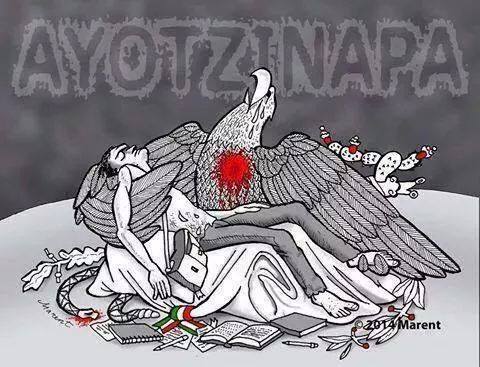
Cartoon by Marent

Cartoon by Marent


54 years ago today, Ruby Bridges went to school

November 14, 2014

American Experience reminds us:

On November 14, 1960, 6-year-old Ruby Bridges walked into William J. Frantz Elementary School in New Orleans.

It was just last September 8 we wished Ms. Bridges a happy 60th birthday.  What follows it the post I put up then, happy to have an excuse to repeat historic photos, great art from a great American painter, and remind students of history.  September’s post follows.

You don’t recognize her there?

How about in Norman Rockwell’s illustration?

“The Problem We All Live With,” Norman Rockwell, 1964; oil on canvas, Norman Rockwell Museum, Stockbridge, Massachusetts

Ruby Bridges with President Barack Obama, in 2011:

President Obama and Ruby Bridges viewing Normal Rockwall's painting, "The Problem We All Live With," at the White House in 2011. Photo by Pete Souza, public domain.

President Obama and Ruby Bridges viewing Normal Rockwall’s painting, “The Problem We All Live With,” at the White House in 2011. Photo by Pete Souza, public domain.

Ms. Bridges tells some of her story:


November dates for flag flying

November 14, 2014

Already in November we’ve passed two of the month’s dates for which we are urged to fly the U.S. flag, election day, the first Tuesday after the first Monday in November by law (flag dates including local elections on whatever date, especially at polling places), and Veterans Day, or Armistice Day, on November 11, commemorating the date set for the armistice of World War I.

What could be left?

According to the U.S. Flag Code, 4 USC 1, sec. 6, we should fly the flag on all national holidays, which includes Thanksgiving, though most patriots are busier with turkey baking, football and family that day.

Several states entered the union in November; citizens and residents of those states fly the U.S. flag on those statehood days.

Most states would hope you’d fly the state’s flag on its statehood day, too.  But how many people actually have a state flay for their own state?  (We have a Texas flag; Texas may be the most state-flag-flying state; we also have a Maryland flag, which used to make for great displays when we flew both flags at our Maryland home.)

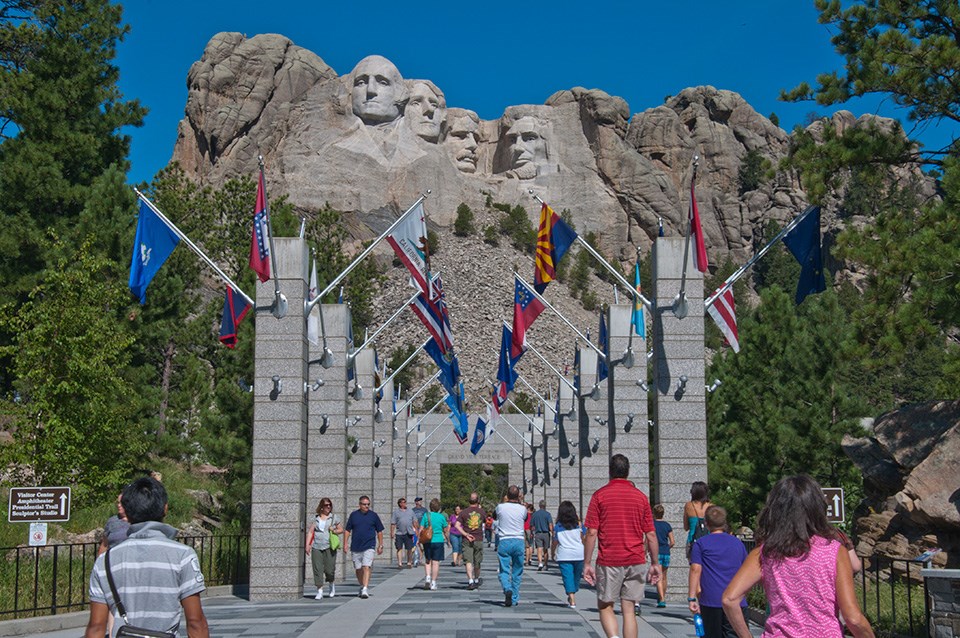
Avenue of the Flags at the Mt. Rushmore National Monument. National Park Service photo.

Avenue of the Flags at the Mt. Rushmore National Monument. Displayed are flags of all 50 states, plus territories, commonwealths and the federal district of the United Sates. National Park Service photo.

This year you may have missed a few already:

  • North Dakota, November 2 (1889, the  39th or 40th state), the same day as
  • South Dakota, November 2 (1889, the  39th or 40th state)
  • Montana, November 8 (1889, the 41st state)
  • Washington, November 11 (1889, the 42nd state) (but, hey, you were already flying your flag, right, Washingtonians?)

You can still catch two states’ statehood days:

  • Oklahoma, November 16 (1907, the 46th state)
  • North Carolina, November 21 (1789, the 12th state)

Veterans Day 2014 – Fly your flag today

November 11, 2014

Veterans Day in the U.S. falls on November 11, the date of the armistice that ended hostilities in World War I.  Under the U.S. flag code, and specific presidential proclamations, it is one of those days U.S. residents get called to fly their flags.

Veterans Day poster for 2014, from the U.S. Veterans Administration

Veterans Day poster for 2014, from the U.S. Veterans Administration

President Barack Obama issues a proclamation on Veterans Day every year.

Presidential Proclamation — Veterans Day, 2014

VETERANS DAY, 2014
– – – – – – –
BY THE PRESIDENT OF THE UNITED STATES OF AMERICA

A PROCLAMATION

Since the birth of our Nation, American patriots have stepped forward to serve our country and defend our way of life.  With honor and distinction, generations of servicemen and women have taken up arms to win our independence, preserve our Union, and secure our freedom.  From the Minutemen to our Post-9/11 Generation, these heroes have put their lives on the line so that we might live in a world that is safer, freer, and more just, and we owe them a profound debt of gratitude.  On Veterans Day, we salute the Soldiers, Sailors, Airmen, Marines, and Coast Guardsmen who have rendered the highest service any American can offer, and we rededicate ourselves to fulfilling our commitment to all those who serve in our name.

Today, we are reminded of our solemn obligation:  to serve our veterans as well as they have served us.  As we continue our responsible drawdown from the war in Afghanistan and more members of our military return to civilian life, we must support their transition and make sure they have access to the resources and benefits they have earned.  My Administration is working to end the tragedy of homelessness among our veterans, and we are committed to providing them with quality health care, access to education, and the tools they need to find a rewarding career.  As a Nation, we must ensure that every veteran has the chance to share in the opportunity he or she has helped to defend.  Those who have served in our Armed Forces have the experience, skills, and dedication necessary to achieve success as members of our civilian workforce, and it is critical that we harness their talent.

Across our country, veterans who fought to protect our democracy around the globe are strengthening it here at home. Once leaders in the Armed Forces, they are now pioneers of industry and pillars of their communities.  Their character reflects our enduring American spirit, and in their example, we find inspiration and strength.

This day, and every day, we pay tribute to America’s sons and daughters who have answered our country’s call.  We recognize the sacrifice of those who have been part of the finest fighting force the world has ever known and the loved ones who stand beside them.  We will never forget the heroes who made the ultimate sacrifice and all those who have not yet returned home.  As a grateful Nation, let us show our appreciation by honoring all our veterans and working to ensure the promise of America is within the reach of all who have protected it.

With respect for and in recognition of the contributions our service members have made to the cause of peace and freedom around the world, the Congress has provided (5 U.S.C. 6103(a)) that November 11 of each year shall be set aside as a legal public holiday to honor our Nation’s veterans.

NOW, THEREFORE, I, BARACK OBAMA, President of the United States of America, do hereby proclaim November 11, 2014, as Veterans Day.  I encourage all Americans to recognize the valor and sacrifice of our veterans through appropriate public ceremonies and private prayers.  I call upon Federal, State, and local officials to display the flag of the United States and to participate in patriotic activities in their communities. I call on all Americans, including civic and fraternal organizations, places of worship, schools, and communities to support this day with commemorative expressions and programs.

IN WITNESS WHEREOF, I have hereunto set my hand this seventh day of November, in the year of our Lord two thousand fourteen, and of the Independence of the United States of America the two hundred and thirty-ninth.

BARACK OBAMA

More:


A Scout camp absorbed William McKinley’s boyhood home

November 5, 2014

From the photo archives of the Boston Public Library, we get this postcard:

Scout camp with home of Wm McKinley, circa 1940 post card from Boston PL

Post card from the archives of the Boston Public Library: “Boyhood Home of President Wm. McKinley, Lisbon, Ohio. Now Part of Columbiana County Boy Scout Reservation. Built in 1808.

From the Boston Library’s Flickr files, we learn a little more:

Boston Public Library

Boyhood home of President Wm. McKindley, Lisbon, Ohio. Now part of Columbiana County Boy Scout Reservation, built in 1808

File name: 06_10_016732
Title: Boyhood home of President Wm. McKinley, Lisbon, Ohio. Now part of Columbiana County Boy Scout Reservation, built in 1808
Created/Published: Tichnor Bros. Inc., Boston, Mass.
Date issued: 1930 – 1945 (approximate)
Physical description: 1 print (postcard): linen texture, color; 3 1/2 x 5 1/2 in.
Genre: Postcards
Subjects: Historic buildings

Notes:
Collection: The Tichnor Brothers Collection
Location: Boston Public Library, Print Department
Rights: No known restrictions

Is this historic building still part of a Scout camp?

According to Buckeye Council, BSA, the home is still part of what is now Camp McKinley.  It’s the home of the camp ranger.

Camp McKinley is located in Columbiana County, near Lisbon, Ohio. The 300 acre camp has been owned and operated by the Boy Scouts of America since 1934.

Camp McKinley is the Buckeye Council’s most historic camp. The modern history of the area began back in 1807 when Ohio was a new state of only three years. Gideon Hughes, a local businessman, built a blast furnace in “new Lisbon” to supply the needs of the settlers heading west. The remains of the Rebecca Furnace are still visible on the camp property. Mr. Hughes also built a stone “mansion” across from his furnace. The house, known as the McKinley homestead, was the home of President William McKinley’s grandparents for a number of years. President McKinley no doubt spent many summers wandering the hills of the present Camp McKinley. The Stone House is now the residence of the Camp Ranger.

President McKinley slept here, as a boy.

Scout camp ranger’s house does not seem to you to be a respectful enough use of a president’s boyhood home?  Buckeye Council has preserved the home at least in its exterior appearance.

Another of McKinley’s boyhood homes is now a bank parking lot.


Babe Ruth and a Circle 10 Council, BSA, Boy Scout, 1929

November 4, 2014

1929 photo of Babe Ruth, with Robert W. Johnsey, a Dallas Boy Scout.

1929 photo of Babe Ruth, with Robert W. Johnsey, a Dallas Boy Scout.

An old library photo?

A Facebook page called Traces of Texas posted this photo, with this explanation:

Babe Ruth and a Dallas boy scout, In 1929, the era’s most famous, revered, and idolized American sportsman, George Herman “Babe” Ruth, came to Dallas to speak on behalf of the Circle Ten Council and promote scouting to local businessmen. After delivering a rousing speech to a packed house, a Dallas Morning News photographer asked him for a picture. The Babe motioned to a Scout to join him. And for young Robert W. Johnsey, that must have been the highlight of his life.

Where did Traces of Texas get those details, and the photo?

I can find data bases that list a Robert W. Johnsey from Dallas, born in 1916, and dying in Dallas in 1995.  Without paying the fat fees demanded, I learn that one database said he died having never married.  Right age, but is that the right guy?

Then I find notes for a France Ray Mead Johnsey at Find A Grave.  It says she died in 2004, preceded in death by her husband Robert, who died in 1995.

Interesting little mysteries.

Anybody Remember  a Robert W. Johnsey from Dallas, Texas?  Can you give us more details?

Babe Ruth returned to Dallas in 1947. Dallas Observer noted:  On July 6, 1947, it was announced that George Herman Ruth would be coming to Dallas on July 9. The occasion: an appearance during a double-header at Rebel Stadium in Oak Cliff on behalf of the American Legion junior baseball program. That Wednesday would be known, according to the ad that ran on Page Four of The Dallas News, as Babe Ruth Day in Dallas, featuring

Babe Ruth returned to Dallas in 1947. Dallas Observer noted: On July 6, 1947, it was announced that George Herman Ruth would be coming to Dallas on July 9. The occasion: an appearance during a double-header at Rebel Stadium in Oak Cliff on behalf of the American Legion junior baseball program. That Wednesday would be known, according to the ad that ran on Page Four of The Dallas News, as Babe Ruth Day in Dallas, featuring “the immortal and beloved” ballplayer who’d been gravely ill only six months earlier. Tickets for his appearance at the ballpark ran one dollar, 30 cents for students.


Voting in Fort Worth? Drop into the Amon Carter, see how campaigns worked in 1844

November 4, 2014

Election day art — well, this is campaign art, but part of that American tradition of highlighting the public nature of elections and campaigns.

Caption from the Dallas Morning News:  James Henry Beard’s The Illustrious Guest, depicting Henry Clay on the campaign trail in 1844, is on loan to the Amon Carter Museum of American Art.

Caption from the Dallas Morning News: James Henry Beard’s The Illustrious Guest, depicting Henry Clay on the campaign trail in 1844, is on loan to the Amon Carter Museum of American Art.

Yes, there’s Henry Clay — maybe the man most-expected to become president who never did.  No, your high school history class probably didn’t cover Clay well, and most don’t today, either.  Advanced Placement and International Baccalaureate classes may give him part of what he is due.

But there he is, campaigning in 1844, out on the road.  Actually, he’s at the hotel, reading a newspaper — and everyone else stares.  Some people bring their children to see the
Great Clay.

It was Clay’s third run at the presidency, at to be his last.  He ran on the Whig Party ticket, a party that would crash and burn within the decade, sinking from electoral politics forever.  (Millard Fillmore would be last Whig President, ascending from the vice presidency on the death of Zachary Taylor; Taylor was the last elected Whig President.) Clay was amply qualified on paper, and in the minds of most people, to be president.

Henry Clay, Sr. (April 12, 1777 – June 29, 1852) was an American lawyer, politician, and skilled orator who represented Kentucky in both the United States Senate and House of Representatives. He served three different terms as Speaker of the House of Representatives and was also Secretary of State from 1825 to 1829. He lost his campaigns for president in 1824, 1832 and 1844.

In 1824, he ran behind Andrew Jackson and John Quincy Adams. In what Jackson later called the Corrupt Bargain, when no candidate got a majority in the electoral college, and the election went to the House of Representatives (where each state gets one vote!), Clay pulled out, and let it be known that he favored Adams, who had run behind Jackson.  Adams was elected, and appointed Clay to be Secretary of State, the most common stepping stone to the presidency. (Was there a deal cut between Adams and Clay? No evidence can ever quash the suspicions of Jackson and his supporters.)

In 1832, older, wiser, from the Senate and as founder of the Whig Party, Clay ran and lost to Jackson, who won his second term.

In 1844 Clay was 67 years old.  The presidency was open.  Clay sought to walk the fence between groups who favored abolishing slavery, and groups who insisted slavery was necessary for the economy.  He opposed annexing new lands to the U.S., in order to preserve the balance between slave and non-slave states in Congress, especially the Senate.  James K. Polk, a young protege of Andrew Jackson, was chiefly unknown.  But Polk endorsed the idea of the nation’s “manifest destiny,” meaning he supporting annexing lands, sorting out slave/non-slave issues later.  Polk didn’t talk about his views on slavery in territories, and that was enough to mollify anti-slave forces in the party; but Polk was a slave holder, and that encouraged partisans on the other side to believe he’d favor them.  Polk won 49.5% of the popular vote, Clay 48.1%; Clay captured 170 electoral votes when 138 were needed to win.

Clay was, no doubt, more hopeful at the time the painting conveys.

Notice Clay seems to travel alone.  There is not gaggle of reporters, no clutch of campaign aides.  There is no one to fetch the great man a newspaper so he can remain cloistered in his hotel room. It was, in all ways, a much different time.  Voting in the election itself ran for a month, from early November to early December.  How that would have frustrated the television networks!

The painting, on loan to and on display in Fort Worth’s Amon Carter Museum, came to light due to an owner’s bringing it to the Antiques Road Show of PBS, in 2008.  Amon Carter’s curators, always alert to American art and art of the west, worked to get it on display.  That story is told nicely by University of Texas at Dallas art historian Rick Brettell in the Dallas Morning News.

The painting represents the well-dressed — note the red silk living of his top coat — Sen. Henry Clay from Kentucky in the middle of a common tavern during his final run for office. He is at a stop on the campaign trail — his luggage is piled up on the right — and is catching up on the news in front of a stove. The tavern itself is respectable, and one small child, representing the future, looks intently at Clay, while two women and another child peep in curiously from the door. The entire painting projects an air of democratic common sense.

The painting actually focuses on the class differences between Clay and his constituents and represents the great politician as being out of touch with “the American people” — lost in his paper. Clay was a member of the American party that was dominant in the early 19th century and was called the Democratic-Republican Party. He had become a Whig long before the 1844 election, which he lost to James Polk.

With his beautiful clothes and his disdain for those around him, he is as out of touch as many of today’s politicians with their wealthy backers and super-PACS. What we learn from this trenchant analysis of 19th-century politics is that history does repeat itself. Interestingly, Clay, as a slave owner, opposed the annexation of Texas to the republic, a major issue in the election of 1844, for fear that it would exacerbate the debate about slavery then raging in America. How right he was.

Had Clay won instead, would Texas be a part of the U.S. today? Something to ponder on election day 2014 — or to visit, if you’re voting in Fort Worth.

More:


Election day art of Norman Rockwell, and the unpredictability of elections

November 4, 2014

Can’t let election day go by without at least noting this great, undersung painting by Normal Rockwell, “Election Day (1944)”:

Norman Rockwell, Election Day, 1944, watercolor and gouache, 14 x 33 1/2 in., Museum purchase, Save-the-Art fund, 2007.037.1.

Norman Rockwell, Election Day, 1944, watercolor and gouache, 14 x 33 1/2 in., Museum purchase, Save-the-Art fund, 2007.037.1.

Remember when people used to dress up to go to the polls?

In 1944 President Franklin Roosevelt ran for an unprecedented fourth term.  Most Americans did not know it, but he was deathly ill at the time.  He dropped Vice President Henry Wallace from his ticket — some argue it was a mutual disaffection at that time — and selected the relatively unknown young Missouri U.S. Sen. Harry S Truman for the vice president’s slot.

In November 1944, D-Day was known to be a successful invasion, and most Americans hoped for a relatively speedy end to World War II in both Europe and the Pacific.  Within the next ten months, the nation would endure the last, futile, desperate and deadly gasp of the Third Reich in the Battle of the Bulge, the liberation of Berlin in April 1945, and end of the war in the European Theatre on May 8; the Battle of Leyte Gulf, the Philippines Campaign, and the bloody, crippling battles of Iwo Jima and Okinawa in the Pacific Theatre, and then the first use of atomic weapons in war, at Hiroshima and Nagasaki (and we hope, the last use).

Voters in Cedar Rapids could not have known that.  They did not know that, regardless their vote for FDR or his Republican challenger, New York Gov. Thomas Dewey, Harry S Truman would be president within six months, nor that the entire world would change in August 1945.

This painting captures a time of spectacular moment, great naivity, and it pictures the way history got made.

For a 2007 exhibition, the Cedar Rapids Museum of Art offered this history:

Norman Rockwell: Fact & Fiction

September 12, 2009 – January 3, 2010

In 2007, the citizens of Cedar Rapids rallied together to purchase a series of watercolors destined for the auction block in New York. These five watercolors, by acclaimed 20th century American artist Norman Rockwell, depicted scenes associated with an election day and were created specifically for the November 4, 1944 issue of the Saturday Evening Post. To complete the Post commission, Rockwell traveled to a quintessential Midwestern town, Cedar Rapids, to study local citizens as models for his series of images.

In the 65 years since his visit, numerous anecdotes and stories have arisen about the artist’s time in Cedar Rapids and the creation of this work. This exhibition uses these five, newly conserved and restored watercolors and a related oil painting from the Norman Rockwell Museum, along with numerous photographs taken by local photographer Wes Panek for Rockwell, to investigate the many facts and fictions associated with Rockwell’s visit and this set of watercolors.

Norman Rockwell: Fact & Fiction has been made possible in part by Rockwell Collins, Candace Wong, and local “Friends of Norman Rockwell.” General exhibition and educational support has been provided by The Momentum Fund of the Greater Cedar Rapids Community Foundation.

Friends of Norman Rockwell: Wilma E. Shadle, Howard and Mary Ann Kucera, Jean Imoehl, Ben and Katie Blackstock, Marilyn Sippy, Chuck and Mary Ann Peters, Phyllis Barber, Ann Pickford, Anthony and Jo Satariano, Barbara A. Bloomhall, Virginia C. Rystrom, Jeff and Glenda Dixon, Robert F. & Janis L. Kazimour Charitable Lead Annuity Trust, Fred and Mary Horn, Mrs. Edna Lingo, John and Diana Robeson, Jewel M. Plumb, Carolyn Pigott Rosberg, Mr. and Mrs. Robert J. Buchacek, Dan and Anne Pelc, Mary Brunkhorst, and John and Diana Robeson.

I am amused and intrigued that this scene also closely resembles the scene when I voted in Cheverly, Maryland, in 1984 — down to the dog in the picture.  Oh, and most of the women didn’t wear dresses, none wore hats, and I was the only guy in the room with a tie.

Roosevelt won the 1944 election in an electoral college landslide, 432 to 99, but Dewey won Iowa, and we might assume Dewey won Cedar Rapids, too.

And that Truman guy?  Rockwell came back to the topic of elections four years later, when Truman was running for election to the office he’d filled for nearly four years, with another classic, American election portrayal.

“Election Day,” by Norman Rockwell, 1948

More:


Yes, this is an encore post.

Yes, this is mostly an encore post.


Election Day 2014: Fly your flag, and VOTE!

November 4, 2014

Saint Louis Art Museum, St. Louis, Missouri George Caleb Bingham (American, 1811–1879). The County Election, 1852. Oil on canvas. 38 x 52 in. (96.5 x 132.1 cm). Gift of Bank of America.

The County Election, 1852. Saint Louis Art Museum, St. Louis, Missouri George Caleb Bingham (American, 1811–1879).  Oil on canvas. 38 x 52 in. (96.5 x 132.1 cm). Gift of Bank of America.

Every polling place should be flying the U.S. flag today.  You may fly yours, too.  In any case, if you have not voted already, go vote today as if our future depends upon it, as if our nation expects every voter to do her or his duty.

Today the nation and world listen to the most humble of citizens.  Speak up, at the ballot box.

Did you notice?  In George Caleb Bingham’s picture, there are no U.S. flags.  You may fly yours anyway.

The whole world is watching.

More:

Yes, this is an encore post.

Yes, this is an encore post. I really like Bingham’s painting.


Oh, look: EPA ordered DDT to be used to fight malaria in 1972!

October 29, 2014

U.S. Environmental Protection Agency did not start a “worldwide ban” on using DDT to fight malaria. EPA instead lifted a court imposed ban on use of the pesticide to fight disease.

At least a couple of times a week I run into someone who claims that environmentalists are evil people, led by Rachel Carson (who, they say, may be as evil as Stalin, Hitler and Mao put together), and that their hysteria-and-n0t-fact-based “worldwide ban” on DDT use led to tens of millions of people dying from malaria.

Each point of the rant is false.

air pollution control activities in the Four Corners area of the U.S., in the 1970s -- soon after the agency completed its hearings and rule making on the pesticide DDT.  EPA photo.

EPA Administrator William Rucklshaus during an airplane tour of air pollution control activities in the Four Corners area of the U.S., in the 1970s — soon after the agency completed its hearings and rule making on the pesticide DDT. EPA photo.

But lack of truth to claims doesn’t stop them from being made.

Serious students of history know better, of course.  Federal agencies, like EPA, cannot issue orders on science-based topics, without enough hard science behind the order to justify it.  That’s the rule given by courts, inscribed in law for all agencies in the Administrative Procedure Act (5 USC Chapter 5), and required of EPA specifically in the various laws delegating authority to EPA for clean air, clean water, toxics clean up, pesticides, etc.   Were an agency to issue a rule based on whim, the courts overturn it on the basis that it is “arbitrary and capricious.”  EPA’s 1972 ban on DDT use on certain crops was challenged in court, in fact — and the courts said the science behind the ban is sufficient.  None of that science has been found faulty, or the DDT manufacturers and users would have been back in court to get the EPA order overturned.

Reading the actual documents, you may discover something else, too:  Not only did the EPA order apply only to certain crop uses, not only was the order restricted to the jurisdiction of the EPA (which is to say, the U.S., and not Africa, Asia, nor any area outside U.S. jurisdiction), but the order in fact specifically overturned a previously-imposed court ruling that stopped DDT use to fight malaria.

That’s right: Bill Ruckelshaus ordered that use of DDT fight malaria is okay, in the U.S., or anywhere else in the world.

Quite the opposite of the claimed “worldwide ban on DDT to fight malaria,” it was, and is, an order to allow DDT to be used in any disease vector tussle.

How did the ranters miss that?

Here are the relevant clauses from the 1972 order, from a short order following a few pages of explanation and justification:

Administrator’s Order Regarding DDT

Order. Before the Environmental Protection Agency. In regard: Stevens Industries, Inc., et al. (Consolidated DDT Hearings). I.F.&R. Docket No. 83 et al.

In accordance with the foregoing opinion, findings and conclusions of law, use of DDT on cotton, beans (snap, lima and dry), peanuts, cabbage, cauliflower, brussel sprouts, tomatoes, fresh market corn, garlic, pimentos, in commercial greenhouses, for moth-proofing and control of bats and rodents are hereby canceled as of December 31, 1972.

Use of DDT for control of weevils on stored sweet potatoes, green peppers in the Del Marva Peninsula and cutworms on onions are canceled unless without 30 days users or registrants move to supplement the record in accordance with Part V of my opinion of today. In such event the order shall be stayed, pending the completion of the record, on terms and conditions set by the Hearing Examiner: Provided, That this stay may be dissolved if interested users or registrants do not present the required evidence in an expeditious fashion. At the conclusion of such proceedings, the issue of cancellation shall be resolved in accordance with my opinion today.

Cancellation for uses of DDT by public health officials in disease control programs and by USDA and the military for health quarantine and use in prescription drugs is lifted. [emphasis added]

In order to implement this decision no DDT shall be shipped in interstate commerce or within the District of Columbia or any American territory after December 31, 1972, unless its label bears in a prominent fashion in bold type and capital letters, in a manner satisfactory to the Pesticides Regulation Division, the following language:

  1. For use by and distribution to only U.S. Public Health Service Officials or for distribution by or on approval by the U.S. Public Health Service to other Health Service Officials for control of vector diseases;
  2. For use by and distribution to the USDA or Military for Health Quarantine Use;
  3. For use in the formulation for prescription drugs for controlling body lice;
  4. Or in drug; for use in controlling body lice – to be dispensed only by physicians. [emphasis added]

Use by or distribution to unauthorized users or use for a purpose not specified hereon or not in accordance with directions is disapproved by the Federal Government; This substance is harmful to the environment.

The Pesticides Regulation Division may require such other language as it considers appropriate.

This label may be adjusted to reflect the terms and conditions for shipment for use on green peppers in Del Marva, cutworms on onions, and weevils on sweet potatoes if a stay is in effect.

Dated: June 2, 1972

William D. Ruckelshaus

[FR Doc.72-10340 Filed 7-6-72; 8:50 am]
Federal Register, Vol. 37, No. 131 – Friday, July 7, 1972 pp. 13375-13376

Here is the entire order, in .pdf format. ddt-ruckelshaus order

More:


Millard Fillmore and middle school: Enough for a sit-com set in Buffalo?

October 28, 2014

Buzz in Buffalo, New York, is that there may be a sit-com coming, set in Buffalo, about education — the kids and teachers at Millard Fillmore Middle School.

Potential cast for a potential sitcom situated in Millard Fillmore's hometown, Buffalo, New York

Potential cast for a potential sitcom situated in Millard Fillmore’s hometown, Buffalo, New York

Seriously?   A reporter for Buffalo Rising, Newell Nussbaumer, wrote:

Do you remember the last time that Buffalo had a sitcom “based” here? Do you recall what the name of the show was? It was Jesse – a show that ran for a couple of years (1998-1999). Since that time there has not been a show “set in” the city of Buffalo. But Jordan Imiola wants to change that. Jordan is currently a screenwriter in LA, who lives and breathes Buffalo, as does his girlfriend. They are huge Sabres and Bills backers, and do their part to expound Buffalo’s virtues whenever they are able. Sometimes they do that by frequenting Buffalo backers bars, and sometimes they simply wear it on their sleeves (both of them sport Buffalo tattoos).

Now Jordan wants to put Buffalo back on the map via a new sitcom that takes place in this city. “The new TV comedy is called “Get Educated.” It’s a Feel Good Comedy similar to “Modern Family” and “The Office,” but it takes place in Millard Fillmore Middle School. It focuses on teachers and students. Growing up, my Grandpa took me to Millard Fillmore’s Birthday Party every year at the Roycroft Inn in East Aurora so that’s what inspired the school name. Also, my mom, Uncle Dave, and Aunt Laurie taught in Western NY schools for years. My mom and Aunt were faculty members of the Cheektowaga-Sloan district where I went to school K – 10. And my Uncle Dave taught at the Stanley G. Falk School and now teaches in the city of Buffalo.”

This is the age of the internet:  You may contribute to the production of the series, at IndiGoGo.

At Buffalo Rising, one commenter paid homage to a teacher at the real Millard Fillmore Junior High School in Buffalo, years ago:

buffalorr10 hours ago
“Millard Fillmore Middle School”–It was named Millard Fillmore Jr. High when it opened in the early sixties. Located on Appenheimer St. off Fillmore Ave. next to the now demolished Kensington Heights projects. My Alma Mater class of ’66. There was an amazing teacher there, Mrs. Stallings, a black woman who for many of the white kids that lived in our all white neighborhood at the time, was the first contact we’d ever had with a person of color. She was so strict that no one dared not turn in their homework or disrupt the classroom. We all ended up with a 90 point or higher grade upon leaving her class along with the feeling that she was one of the best educators we’d ever had. I think that could be material for an interesting TV show.

Okay, I’d watch that.

(Hey, is there a photo of the old Millard Fillmore Jr. High on the internet?)