Quote of the moment, 70th anniversary: Eisenhower’s astonishing D-Day leadership example, “Blame . . . is mine alone”

June 6, 2014

It is a model of leadership, an example more leaders should follow — though few do. It’s one more example of the high caliber leadership Dwight Eisenhower demonstrated throughout his life. In it’s imperfections, handwritten, it should take your breath away.

So again, today, on the 70th anniversary of the D-Day invasion, we remember.

Eisenhower's unused statement on the failure of D-Day

Eisenhower’s contingency statement, in case D-Day failed – image from the National Archives

This quote actually isn’t a quote. It was never said by the man who wrote it down to say it. It carries a powerful lesson because of what it is.

In preparing for the D-Day invasion, Supreme Allied Commander Dwight Eisenhower carefully contemplated what would happen if the invasion failed.  What if the Germans repulsed the Allies, and no foothold was established to re-take the main body of Europe from the Germans?

Ike’s answer is a model of leadership:  He would take the blame.  Regardless what happened, Ike took full responsibility for the failure, giving credit to the soldiers who would have sacrificed in vain, perhaps their lives.

The Bathtub recently posted Gen. Dwight Eisenhower’s “order of the day” to the troops about to conduct the Allied invasion of Normandy — D-Day — to establish the toehold in Europe the Allies needed to march to Berlin, and to end World War II in Europe. As a charge to the troops, it was okay — Eisenhower-style words, not Churchill-style, but effective enough. One measure of its effectiveness was the success of the invasion, which established the toe-hold from which the assaults on the Third Reich were made.

eisenhower-with-paratrooper-eve-of-d-day.jpg

Photo shows Eisenhower meeting with troops of the 101st Airborne Division, 502nd Parachute Infantry Regiment, on the eve of the invasion. It was these men whose courage he lauded.

When Eisenhower wrote his words of encouragement to the troops, and especially after he visited with some of the troops, he worried about the success of the operation. It was a great gamble. Many of the things the Allies needed to go right — like weather — had gone wrong. Victory was not assured. Defeat strode the beaches of Normandy waiting to drive the Allies back into the water, to die.

Eisenhower wrote a second statement, a shorter one. This one was directed to the world. It assumed the assault had failed. In a few short sentences, Eisenhower commended the courage and commitment of the troops who, he wrote, had done all they could. The invasion was a chance, a good chance based on the best intelligence the Allies had, Eisenhower wrote. But it had failed.

The failure, Eisenhower wrote, was not the fault of the troops, but was entirely Eisenhower’s.

He didn’t blame the weather, though he could have. He didn’t blame fatigue of the troops, though they were tired, some simply from drilling, many from war. He didn’t blame the superior field position of the Germans, though the Germans clearly had the upper hand. He didn’t blame the almost-bizarre attempts to use technology that look almost clownish in retrospect — the gliders that carried troops behind the lines, sometimes too far, sometimes killing the pilots when the gliders’ cargo shifted on landing;  the flotation devices that were supposed to float tanks to the beaches to provide cover for the troops (but which failed, drowning the tank crews and leaving the foot soldiers on their own); the bombing of the forts and pillboxes on the beaches, which failed because the bombers could not see their targets through the clouds.

There may have been a plan B, but in the event of failure, Eisenhower was prepared to establish who was accountable, whose head should roll if anyone’s should.

Eisenhower took full responsibility.

Our landings in the Cherbourg-Havre area have failed to gain a satisfactory foothold and I have withdrawn the troops. My decision to attack at this time and place was based upon the best information available. The troop, the air [force] and the navy did all that bravery and devotion to duty could do. If any blame or fault attaches to the attempt, it is mine alone.

Who in the U.S. command would write such a thing today?  Who else in history would have written such a thing?  Is there any indication that Julius Caesar, Alexander the Great, Attila the Hun, Genghis Khan, or any other commander of a great army in  a world-turning invasion, considered how to save and perhaps salve the reputation of his troops, though they had failed?

Leadership is more than just positive thinking.

  • The message may also be viewed here. Yes, it’s incorrectly dated July 5 — should have been June 5.  In history, little is perfect.  We can excuse his slip of the pen, considering what else he had on his mind.


More:

General Eisenhower speaks with members of the ...

Another  angle of the meeting with the troops:  General Eisenhower speaks with members of the 101st Airborne Division on the evening of 5 June 1944.  Wikipedia image

This is mostly an encore post.


Typewriter of the moment: Bill Moyers

June 6, 2014

From Moyers’s Facebook feed: Happy 80th Birthday, Bill Moyers! Here he is at 16 years old as a cub reporter at the Marshall News Messenger newspaper in Marshall, Texas, the town (pop. 25,000) where he grew up

A newsroom Royal. A lot of good writers started out on those.

Moyers went astray after a while, and got a divinity degree and ordination in Dallas, at Southwest Theological Seminary — but Lyndon Johnson had been watching him before at the University of Texas and University of North Texas, and snatched him up as a press aide.

You probably know Moyers from Public Television.  Yesterday was his 80th birthday — he was born June 5, 1934, in Hugo, Oklahoma.

More:


Chester Nez tells his story, life as a Code Talker

June 4, 2014

From the Navajo Codetalkers website:

Published on Sep 25, 2012

This documentary film was researched, photographed, edited and produced by students of Winona State University (Winona, Minnesota) and Diné College (Tsaile, Arizona, Navajo Nation) during summer 2012. It contains stories Chester Nez of Chichiltah, New Mexico, told the students during several hours of interviews about his life. Chester is the last surviving member of The Original 29 Navajo Code Talkers who were recruited in 1942 to create a code using the Navajo language for use in the battlefield so the South Pacific. Chester and the rest of The Original 29 then took the code they created into battle. This documentary film is archived at the Navajo Nation Museum, Navajo Nation Library, Winona State University Library, and Diné College Library, and will be archived at the Smithsonian Institution’s National Museum of the American Indian. The film is part of the Navajo Oral History project, a multi-year collaboration between the Winona State University Mass Communication Department and Diné College– The official Tribal College of the Navajo Nation.


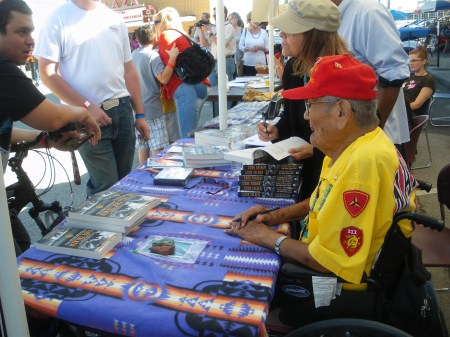
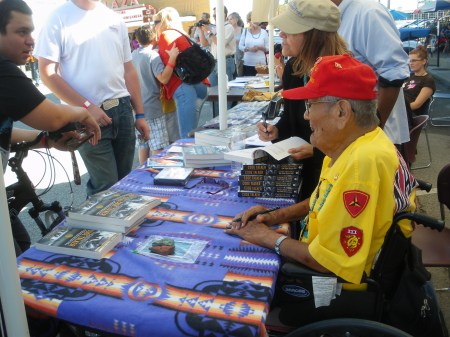
Chester Nez told his story, for all the Code Talkers, often.  I last met him in 2012, when he was in Carrollton, Texas, telling the story and selling his books.

Navajo Code Talker, Marine Chester Nez, signing copies of his book, Carrollton, Texas Oct 14 2012

Navajo Code Talker, Marine Cpl. Chester Nez, signing copies of his book Code Talkers, in  Carrollton, Texas, October 14, 2012


Chester Nez, last surviving Navajo Code Talker from World War II, has died

June 4, 2014

Chester Nez saved America, but couldn’t tell anyone about it for decades.  His work was ignored.

He lived to see some recognition for the work he and his fellow Code Talkers did.

There are many morals to his tale, particularly appropriate now as we wind down two wars.


Navajo Code Talker, Marine Chester Nez, signing copies of his book, Code Talker, in Carrollton, Texas, October 14, 2012; photo by Ed Darrell

Navajo Code Talker, Marine Chester Nez in the yellow shirt, signing copies of his book, Code Talker, in Carrollton, Texas, October 14, 2012; photo by Ed Darrell

Mr. Nez died this morning, Wednesday, June 4, at his home in Albuquerque, New Mexico.  He was 93.

Others are saying:

More:


Does “Twitchy” really just mean “knee jerk?” Correcting the record, deflecting the hoaxes, propaganda and Mau-Mauing about Rachel Carson and DDT

June 1, 2014

Or is there any “knee” in that at all? Maybe it’s just jerk.

You know the drill. Someone says something nice about Rachel Carson’s great work. Someone on the right can’t stand that a scientist gets spoken of well, comes unglued, and spills every lie about Rachel Carson anyone can find, including the big lie, that “millions of kids died unnecessarily because DDT was banned because Rachel Carson lied about DDT, which is really a lot like sugar water to humans and all other living things.”

For the record, each of those claims is false; in reverse order:

  1. DDT is toxic to almost all living things, a long-lived and potent poison (which is why DDT was used to kill harmful insects and other vermin). While bed bugs and mosquitoes have evolved resistance and total immunity to the stuff, few other creatures have.
  2. Rachel Carson told all the truth about DDT that was known at the timeHer accuracy was confirmed by a panel of the nation’s top scientists, who reviewed her work for errors, and federal policy for usefulness and safety.  Since the 1962 publication of Silent Spring, and since Carson’s untimely death from cancer in 1964, we’ve learned that DDT is a carcinogen (though, we hope, a weak one); we’ve learned that DDT is an endocrine disruptor that fouls up sex organs and sexual maturity in more animals than anyone can count, including humans; and we’ve learned that  DDT causes birds to lay eggs with shells so thin the chicks cannot survive, even if the DDT doesn’t kill the chick outright.
  3. Carson didn’t urge a ban on DDT, nor did it happen until eight years after her death.  As I explain below, Carson fought to stop DDT abuses, to preserve DDT’s utility in the fight against disease.  She lost that fight, and as a resul tof DDT abuse by DDT advocates, the World Health Organization (WHO) had to scrap it’s ambitious program to eradicate malaria from the Earth — just as the campaign got to tropical areas of Africa.  DDT was banned for crops in the U.S. (health uses have never been banned here), after two different federal courts ordered EPA to do something because under the existing law they’d be required to ban DDT completely if EPA didn’t act, and after a rather adversary administrative law hearing that lasted nine months, featured testimony and document submissions from more than 30 DDT manufacturers, and compiled a record of DDT’s benefits and harms nearly 10,000 pages long.  It was science that got DDT banned, not Rachel Carson’s great writing.
  4. Almost every year since EPA banned DDT use on crops in the U.S., worldwide malaria deaths dropped, from peak-DDT use years (circa 1958-1963) levels of approximately 4 million deaths per year, to 2013’s approximately 627,000 deaths.  It’s unfair and grotesquely inaccurate to claim a reduction in deaths of about 84% is, instead, an increase.  Malaria was not close to eradication in 1965 when WHO stopped its campaign on the ground, nor in 1969 when WHO officially abandoned eradication as a goal, nor in 1972 when the U.S. banned DDT use in the U.S., and dedicated all U.S. production of DDT to export, mostly for fighting insects that cause disease.

In short, Rachel Carson is exactly as the history books present her, a very good scientist with a special gift for communicating science issues.

That’s exactly the stuff that galls the hell out of self-proclaimed conservatives, especially those who know they are the smartest person in any room, even an internet chat room with a few million people in it.  Say something good about a scientist, and they know that statement must be false, and what’s more  “. . .  let’s see, there should be something bad about this guy on Google . . . um, yeah . . . yessss! here, Lyndon Larouche’s magazine has some guy I’ve never heard of, but he’s smarter than any librul because he agrees with my bias! Take THAT you scurvy dog!”  And in short order they’ve scooped up all five or six nuts who said bad stuff about Rachel Carson and cross-cited each other, and they’ve copied the links to the three articles on the internet that obscure groups like CEI and AEI and Heritage have paid to raise in the Google searches, and . . .

Done deal.  “Good scientist!  Heh! No one will listen to old Rachel Carson any more!”

Unless good people stand up to the reputation lynch mobs, and stop them.  That’s why I’m telling you, so you’ll have the stuff you need to stand up.  I’m hoping you will stand up.

Shortly after dawn on May 27, Twitchy rose out of the mucky water and lobbed some mud balls at Google and especially Rachel Carson.  Twitchy is an interesting site.  It’s mostly composed of Tweets that support conservative causes and are snarky enough earn a snicker.  In short, there is no fact checking, and biases are preferred — whatever is the imagined conservative bias of the day (oddly enough, never is conservation of soil, water, nor human life ever a conservative-enough issue . . . but I digress).

It’s the nervous twitch of a knee-jerk mind and knee-jerk political mentality.

Twitchy opened up with a straightforward salvo from IowaHawk.

Note that, above, and again below, WHO records show that there were no “millions of malaria victims” of Rachel Carson.  IowaHawk, David Burge,  assumes — without a whit of real information — that DDT was the key to beating malaria, and so after the EPA ban on DDT, malaria must have risen, and so there must have been millions who died unnecessarily. Challenge the guy to put evidence to any part of that chain, and he’ll demur, probably suggest you’re mentally defective, and cast aspersions on what he assumes your political stand to be.  Or, he’ll ignore the challenge in hopes everybody will forget.   And another person will retweet Burge’s disinformative bit of propaganda — no facts, but what sounds like a nasty charge at someone who is presumed to be a liberal.  Burge’s erroneous Tweet had 504 retweets when I wrote this on June 1, great impact.

Eh. Truth wins in a fair fight, Ben Franklin said.  [I’m pretty sure it was Franklin; I’m still sourcing it, and if you have a correction, let me know!]

At length, more people chime in . . . and the level of misinformation in that discourse makes me crazy.

Occasionally I’ll drop in a correction, often a link to contrary information.  Then the abuse is astonishing. This conservative “hate information” machine is ugly.

CDC image of a child sleeping under an insecticide treated bednet (ITN) to prevent bites from malaria-carrying mosquitoes.

CDC image and caption: How do insecticide-treated nets work? People sleep under ITNs during the time when the mosquitoes that spread malaria like to feed. The insecticide on the nets helps reduce the numbers of mosquitoes that enter the house and works to kill the ones that do enter. In this way, the ITN protects the person or people sleeping under the net. If large numbers of people in the community sleep under an ITN, the numbers of mosquitoes, as well as their lifespan, will be reduced. When this happens, all members of the community receive some protection, whether or not they own or use an ITN.

From the Wellcome Trust malaria page, an explanation for why it's so important to stop bites in the home, at night, and why it's generally not necessary to kill mosquitoes out of doors, in daylight.

[Image link failed] From the Wellcome Trust malaria page, an explanation for why it’s so important to stop bites in the home, at night, and why it’s generally not necessary to kill mosquitoes out of doors, in daylight.

Sometimes I unload.  I was on hold for a more than an hour on a couple of phone calls that day.  Some guy working the handle OmaJohn took great exception to something I said — I think his complaint was that thought I knew what I was talking about — and of course, he knew better!  How dare I refer to facts!

Here’s my response.  I think OmaJohn may have gotten the message, or rethought the thing.

But others haven’t.

I list his statements, indented; my responses are not indented.  Links will be added as I can.  All images are added here.

Rachel Carson is still right, still a great scientist and an amazing writer.  DDT is still poisonous, still banned for agricultural use in the U.S., and still not the answer to “how do we beat malaria.”

OmaJohn said (double indent), and I responded (single indent):

Always with the crow’s lofty view to try and cherry-pick facts to paint a valid conclusion.

I wouldn’t know, Mr. Corvus. I’ve been looking at DDT professionally for science and policy, and as a hobby, and for law and history courses, for more than 30 years. I’m rather drowning in studies and statistics. A crow might be able to find some information that contradicts Rachel Carson’s writings and EPA’s rulings — but it’s not evident in this data ocean. You see some of those cherries? Do they outweigh the ocean they float in?

I do like how you use blogs to justify your condescension, though. [He complaining that I offered links to answers here, at this blog; how brazenly wrong of me to study an issue!]

I think your denigration of people who actually study a subject is ill-advised behavior. Research papers are printed on paper, just like comic books. It’s up to us to use the information to form cogent ideas about history, science, and make good policy as a result. The blogs I cite are often written by experts in the field — see especially Bug Girl, Tim Lambert and John Quiggen — and they most often provide links to the original sources.

(I gather you didn’t bother to read to see what was actually there. Your loss.)

I don’t like what appears to be your view that your non-informed opinion of something you really know little about is as valid as the work of people who devote their lives to getting the facts right. In the long run, your life depends on their winning that game, and always has.

Without having read a lot, I took a gander at a few of the folks ‘on the other side’ on this, and I was Jack’s complete lack of surprise to see you in here with your head high, throwing around blog references and talking down to people.

Much as you are talking down to me, from your position has head muckraker? I see.

I’m not sure what you mean by “folks on the other side.” If you mean on the other side of Rachel Carson, please note that in 52 years not a single science source she listed has ever been found to be in error, or fading as a result of changing science. Discover Magazine took a look at this issue in 2007, concluding Carson was right, and DDT use should be restricted as it was then and remains. The author wrote this, about claims that Carson erred on damage to birds from DDT:

In fact, Carson may have underestimated the impact of DDT on birds, says Michael Fry, an avian toxicologist and director of the American Bird Conservancy’s pesticides and birds program. She was not aware that DDT—or rather its metabolite, DDE—causes eggshell thinning because the data were not published until the late 1960s and early 1970s. It was eggshell thinning that devastated fish-eating birds and birds of prey, says Fry, and this effect is well documented in a report (pdf) on DDT published in 2002 by the Department of Health and Human Services’ Agency for Toxic Substances and Disease Registry (ATSDR). The report, which cites over 1,000 references, also describes how DDT and its breakdown products accumulate in the tissues of animals high up on terrestrial and aquatic food chains—a process that induced reproductive and neurological defects in birds and fish.

Don’t take my word for it. Go read for yourself. Check out PubMed, and read the first 50 citations you find on DDT and birds, the first 20 on DDT and human health, the first 50 on DDT and malaria. Check out the recent good books on the issue — William Souder’s great biography of Carson last year, On a Farther Shore, or Sonia Shah’s wonderful biography of malaria, [The Fever, How malaria has ruled humankind for 500,000 years].

Get real facts, in other words. Don’t talk down to people who might know what they’re talking about.

You wrote:

DDT use was officially stopped in most countries (perhaps all, I’ve not read anything I’d tout as even remotely conclusive, but I’ve not spent a substantial amount of time on this issue), but quickly (within a decade) was brought back to common use.

You should compost that, but it’s too green to do anything but foul things up indoors, here.

DDT was banned first in Sweden in 1971, then in the U.S. in 1972 — the U.S. ban was on crop use, only. About the only use that actually fell under that ban was cotton crops.

A few other European nations banned DDT.

DDT has never been banned in China, India, nor most of Asia, nor in any nation in Africa. Some African nations stopped using it when it stopped being effective; some African nations stopped using it when DDT runoff killed off food fishes and several thousands starved to death.

The World Health Organization never stopped using DDT, though its dramatic decline in effectiveness, especially in Africa, was key to the collapse and abandonment of WHO’s campaign to eradicate malaria. WHO stopped that campaign in 1965, and officially killed it off at the 1969 WHO meetings. You’ll note that was years before the 1972 ban in the U.S. — so the claims that the U.S. ban prompted a WHO to act is also false just on calendar terms.

If you check with the Wellcome Trust, they have several papers and PowerPoint presentations on the problems with malaria in Mexico, Central and South America — where DDT has been used constantly since 1948, with no ban. Unfortunately, malaria came back. Resistance to DDT in mosquitoes is real, and if malaria is not cured in the humans while the populations are temporarily knocked down, when the mosquitoes come back, they will find those humans with malaria, withdraw some of the parasites from that human, incubate them to the next part of the life cycle, and start a plague within a couple of weeks.

So, no, DDT was never banned in most places. There is a treaty, the Persistent Organic Pollutants Treaty (POPs), which names DDT as one of the dirtiest pollutants in the world. Though every other pollutant on the list is severely restricted or completely banned, DDT has a special carve out (Addenda D, if I recall correctly) which says DDT may be used by any nation to fight any vector-borne disease.

All a nation need do is send a letter to WHO explaining that it plans to use DDT, and when.

And, no, DDT was not brought back in haste to make up for a lack of the stuff.

Not sure where you’re getting your history, but it’s not exactly square with what’s happened.

That’s a pretty huge, expensive policy shift — twice.

Would have been, had it been done as you described. Not so.

There was a lot of pressure to make those changes.

So in the fight on Malaria, I think that scientists and bureaucrats generally agree that DDT plays an important role, particularly after seriously slowing or stopping use for a substantial amount of time.

Read the POPs treaty — go to the WHO site and you can still get some of the deliberative papers.

For almost all uses, DDT has much better alternatives available today.

Malaria is a special case because humans screwed up the eradication campaign, first, by abusing DDT and creating DDT resistance in the mosquitoes, and second, by completely abandoning most other parts of the program when DDT crapped out.

DDT doesn’t cure malaria. All it does is temporarily knock down the mosquitoes that carry the parasite through part of its life cycle. Better medical care is a very important part of beating the disease, and as in the U.S., improving housing cuts malaria rates dramatically, especially with windows that are screened roughly from sundown to early morning.

DDT is one of 12 chemicals WHO approves for use in Indoor Residual Spraying (IRS), in areas where there are outbreaks of the disease. If any one chemical were used alone, it would be ineffective within months, or weeks.

When tobacco farmers in Uganda sued to stop DDT spraying in the early years of the 21st century, WHO issued a press release saying it still believes in DDT. Well, WHO always did. But as of 2010, DDT’s effectiveness is even less, and many nations use only the other 11 chemicals for IRS against malaria.

DDT is still there, if it works, and if it helps; bednets alone are more than double the effectiveness of DDT in preventing malaria. We could probably phase out DDT completely without anyone noticing. DDT is not a panacea. There is no shortage of DDT anywhere today. No one dies for a lack of DDT — though many may die from a lack of bednets or appropriate medical care, problems DDT cannot touch

I believe that Rachel Carson championed her cause very successfully. I believe there was sizeable, if not perfectly tangible, fallout that would only be measurable in human livesand misery thanks to her efforts. And in the end, things were as they should have been, despite her best efforts to force them where they
shouldn’t be.

I see. You don’t know what Rachel Carson said about DDT.

Carson said that DDT was — in 1962 — a pesticide without a clear replacement. She said it was absolutely critical to the then-existing WHO campaign to fight malaria.

And because of that, she urged that use of DDT on crops, or to kill cockroaches, or to kill flies at picnic sites, be stopped — because unless it were stopped, the overuse could not fail to leak into the rest of the ecosystem. Mosquitoes would quickly develop resistance to DDT — that had been a key problem in Greece in 1948, and Carson cites several other places where anti-typhus and anti-malaria campaigns were scuttled when the insects started eating DDT — and once that resistance developed, Carson said, beating malaria would be set back decades at a minimum, and maybe centuries.

She wrote that in 1962.

Fred Soper was the super mosquito fighter in the employ of the Rockefeller Foundation who developed the DDT-based malaria eradication program. He was loaned to WHO to take the campaign worldwide. Soper thought Carson was too tough on DDT in her book, but he had already calculated that DDT resistance would develop by 1975. He had just more than a dozen years to eliminate malaria, he wrote. (This is chronicled in Malcom McDowell’s 2001 profile of Soper in The New Yorker; you can read it at McDowell’s website.)

WHO’s campaign had mopped up pockets of malaria left in temperate zone nations; he had massive successes in sub-tropical nations, and he was poised to strike at the heart of malaria country, in equatorial Africa, in 1963.

The first campaign launched there fizzled completely. When they captured some mosquitoes, they found the mosquitoes were highly resistant to DDT already. Turns out that farmers in Africa wanted spotless fruit, too, and were using tons of DDT to get it.

For the health workers, what that meant was they had no tool at all to knock down mosquitoes even temporarily, to then finish the medical care, housing improvement and education components of the malaria eradication campaign.

It is also true that many of those nations had unstable governments. Soper’s formula required that 80% of the homes in an affected area be treated. That required highly trained, very devoted workers, and a willing population. Those things were difficult to find in nations with unstable governments, or worse, civil war. So there were other complicating factors. But Soper had faced those, and beaten them, behind the Iron Curtain, in Asia, in the Pacific and in South America.

When DDT quit on him, as Carson predicted it would without official action to save its potency, Soper called it quits.

Soper ended his campaign without approaching most of equatorial Africa in 1965. WHO officially ended the program in 1969.

Carson died in 1964. She would have been saddened that DDT stopped working in the malaria fight so early. She had written about it occurring in some future year — she probably knew of Soper’s calculation in the 1970s.

The public relations smear campaign against Carson, costing the chemical companies $500,000, generated some doubt among the public, but the President’s Science Advisory Council published its report saying Carson was accurate on the science, and calling for immediate action against DDT — in 1963.

It was 7 years after her death that EPA was organized, and 8 years before EPA moved against DDT.

Carson pleaded for a dramatic reduction in unnecessary DDT use — to make spotless apples, for example — in order to save people from malaria.

What did you think she said? What things were back where they should have been — poor kids dying of malaria is as it should be?

We could have done better, had we listened to Rachel Carson in 1962.

You’ve offered nothing that logically refutes those conclusions.

You should have read those blogs.

More:

  • David Burge, Iowahawk, whose post started the Twitchy twitches, several years ago revealed that a young boy his family had been sponsoring in Africa through a private charity, had died from malaria.  Death from malaria is a tragic reality.  Burge urged people to speak out for more DDT, and to donate money to Africa Fighting Malaria.  Readers of my blog may recall that AFM is the astro-turf organization founded by Roger Bate years ago, from all appearance to pay Roger Bate to say nasty things about Rachel Carson.  We could find on their IRS 990 form no evidence that the organization does anything to fight malaria, anywhere.  One might wonder how much anti-malaria activity Roger Bate’s $100,000/year salary would have purchased, in any of the several years he headed the non-help group, or since.  Adding insult to tragedy, Burge noted at his blog that “environmental groups” opposed Indoor Residual Spraying in Africa, and especially the use of DDT.  But it turns out that the chief opposition at that time came from tobacco growers and tobacco organizations — the groups from whom Roger Bate solicited money to start up AFM.  Wouldn’t it be easier just to stick with the facts?
  • If you want to do something, to save a life from malaria, send $10 to Nothing But Nets.  In stark contrast to AFM, NbN sends almost all its money to buy bednets to give away to people in malaria-endemic areas of Africa.  While AFM ridicules nets, they are much more effective at preventing malaria than IRS, especially IRS with DDT alone.  Nets are much cheaper, too.  NbN acts in partnership with the NBA and the United Methodist Church in the United States, and is one of the most upstanding charities anywhere.  They do not say nasty things about Rachel Carson — probably wouldn’t if they thought to, because they are so busy fighting malaria.

Yes, malaria is still a plague; it’s not Rachel Carson’s fault, and your saying so probably kills kids

May 30, 2014

May 27’s Google Doodle honoring Rachel Carson brought out a lot of those people who have been duped by the anti-Rachel Carson hoaxers, people who are just sure their own biased views of science and the politics of medical care in the third world are right, and Carson, and the people who study those issues, are not.

So comes “The Federalist,” what appears to me to be a reactionary site, which yesterday got great readership for a story from Bethany Mandel.  Mandel tells a story of a child in Cambodia suffering from malaria.  The suffering is horrible and the child most likely died.  It’s a tragic story of poverty and lack of medical care in the third world.

Erroneously, Mandel up front blames the suffering all on Rachel Carson, in a carp about the Google Doodle.

Here was my quick response between bouts in the dentist’s chair yesterday [links added here]:

[Bethany Mandel wrote:] Using faulty science, Carson’s book argued that DDT could be deadly for birds and, thus, should be banned. Incredibly and tragically, her recommendations were taken at face value and soon the cheap and effective chemical was discontinued, not only in the United States but also abroad. Environmentalists were able to pressure USAID, foreign governments, and companies into using less effective means for their anti-malaria efforts. And so the world saw a rise in malaria deaths.

Don’t be evil?

Start by not telling false tales.

1.  Carson presented a plethora of evidence that DDT kills birds.  This science was solid, and still is.

2.  Carson did not argue DDT should be banned.  She said it was necessary to fight disease, and consequently uses in the wild, requiring broadcast spraying, should be halted immediately.

3.  Scientific evidence against DDT mounted up quickly; under US law, two federal courts determined DDT was illegal under the Federal Insecticide, Fungicide, and Rodenticide Act; they stayed orders to ban the chemical pending hearings under a new procedure at the new Environmental Protection Agency.

EPA held hearings, adversary proceedings, for nine months. More than 30 DDT manufacturers were party to the hearings, presenting evidence totaling nearly 10,000 pages.  EPA’s administrative law judge ruled that, though DDT was deadly to insects, arachnids, fish, amphibians, reptiles, birds and mammals, the labeled uses proposed in a new label (substituted at the last moment) were legal under FIFRA — indoor use only, and only where public health was concerned.  This labeling would allow DDT to remain on sale, over the counter, with few penalties for anyone who did not follow the label.  EPA took the label requirements, and issued them as a regulation, which would prevent sales for any off-label uses.  Understanding that this would be a severe blow to U.S. DDT makers, EPA ordered U.S. manufacture could continue, for the export markets — fighting mosquitoes and malaria being the largest export use.

This ruling was appealed to federal courts twice; in both cases the courts ruled EPA had ample scientific evidence for its rule.  Under U.S. law, federal agencies may not set rules without supporting evidence.

4.  DDT was banned ONLY for agriculture use in the U.S.  It was banned in a few European nations.  [Addition, December 30, 2014: In fact, the U.S. action against DDT by EPA specifically called for DDT use in any fight against a vector borne disease, like malaria.]

5.  DDT has never been banned in Africa or Asia.

6.  USAID’s policy encouraged other nations to use U.S.-made DDT, consistent with federal policy to allow manufacture for export, for the benefit of U.S. business.

7.  U.S. exports flooded markets with DDT, generally decreasing the price.

Fred Soper, super malaria fighter, whose ambitious campaign to erase malaria from the Earth had to be halted in 1965, before completion, when DDT abuse bred mosquitoes resistant and immune to DDT.

Fred Soper, super malaria fighter, whose ambitious campaign to erase malaria from the Earth had to be halted in 1965, before completion, when DDT abuse bred mosquitoes resistant and immune to DDT.

8.  Although WHO had been forced to end its malaria eradication operation in 1965, because DDT abuse had bred mosquitoes resistant to and immune to DDT, and though national and international campaigns against malaria largely languished without adequate government funding, malaria incidence and malaria deaths declined.  Especially after 1972, malaria continued a year-over-year decline with few exceptions.

Note that the WHO campaign ended in 1965 (officially abandoned by WHO officials in 1969), years before the U.S. ban on DDT.

Every statement about DDT in that paragraph of [Mandel’s] article, is wrong.

Most important, to the purpose of this essay, malaria did not increase.  Malaria infections decreased, and malaria deaths decreased.

I’m sure there are other parts of the story that are not false in every particular.  But this article tries to make a case against science, against environmental care — and the premise of the case is exactly wrong.  A good conclusion is unlikely to follow.

Mandel was hammered by the full force of the anti-Rachel Carson hoaxers.  I wonder how many children will die because people thought, “Hey, all we have to do is kill Rachel Carson to fix malaria,” and so went off searching for a gun and a bullet?

You are not among them, are you?

Update: This guy, a worshipper of the Breitbart, seems to be among those who’d rather rail against a good scientist than lift a finger to save a kid from malaria. If you go there, Dear Reader, be alert that he uses the Joe Stalin method of comment moderation:  Whatever you say, he won’t allow it to be posted.  Feel free to leave comments here, where we practice First Amendment-style ethics on discussion.


Memorial Day 2014: Fly your flag, with proper etiquette

May 26, 2014

Caption from Wikipedia:  Pearl Harbor, Hawaii (May 31, 2004) - Sailors assigned to ships based at Pearl Harbor bring the flag to half-mast over the USS Utah Memorial on Ford Island in honor of Memorial Day May 31, 2004. U.S. Navy photo

Caption from Wikipedia: Pearl Harbor, Hawaii (May 31, 2004) – Sailors assigned to ships based at Pearl Harbor bring the flag to half-mast over the USS Utah Memorial on Ford Island in honor of Memorial Day May 31, 2004. U.S. Navy photo

Monday, May 26, 2014, is Memorial Day in the U.S.  It’s the day we honor soldiers who died, either fighting to defend the nation, or after.

Because it honors the dead, the flag-flying rules differ slightly.

If you’re flying your flag from a staff that allows raising and lowering, the flag should be posted at half-staff in the morning at sunrise.  At noon, the flag goes to full-staff position.

Usual flag-raising rules apply: Going up the staff, the flag rises briskly.  Coming down, it sinks slowly.

Before going to the half-staff position to honor the dead, the flag should be raised briskly to the top of the pole, and then brought down slowly to half-staff. At noon, again, the flag rises briskly.  And at retreat, at sundown, the flag comes down slowly.

Most Americans have a flag that attaches to the wall of a residence, or in other ways is not capable of raising and lowering.  In that case, simply post the the flag.

More: 


Insta-Millard: Golden Gate Bridge 50th anniversary, May 24, 1987

May 23, 2014

http://twitter.com/HistoryInPix/status/461388480757899264

Happy anniversary, Golden Gate Bridge — opened 77 years ago.

My father was there. In 1937, I mean, not 1987.

Got a link to your favorite picture of the Golden Gate Bridge?

More: 

Golden Gate Bridge from the Pacific side, from Lands End, looking into San Francisco Bay. Wikipedia image.

Golden Gate Bridge from the Pacific side, from Lands End, looking into San Francisco Bay. Wikipedia image.


U.S. spends $38 billion on foreign aid? (Not nearly enough)

May 22, 2014

Glenn Beck got all worked up over this chart, as if it revealed some great, cardinal sin:

Chart on foreign aid as a part of the U.S. budget, from http://www.financedegreecenter.com/foreign-aid/

Chart on foreign aid as a part of the U.S. budget, from http://www.financedegreecenter.com/foreign-aid/

FinanceDegreeCenter.com is a mysterious organization that does no-one-really-will-say what on the internet.  A few months ago I got a series of e-mails from the group, telling that they were changing their name from an earlier iteration and claiming my links to one of their charts jeopardized all the good work they did for people seeking higher education, merely by accurately citing where I got the chart.  That sounded fishy, so I asked them what they did, really, and I got a barrage of e-mails . . .

I think they get paid to steer people to for-profit, on-line schools.  That doesn’t mean their charts are inaccurate, though it does mean I don’t post them without a lot of checking first (this is the first one I’ve posted since then).

Which is a long way of saying, Beck sure has crumby sources.

Bad as the source may be, the information isn’t far off.  But there’s the problem.

Beck’s audience probably believes, as Beck has told them, that the U.S. pays way too much in foreign aid.  Polls repeatedly show most people think we spend anywhere from ten times to a hundred times what we do.  A great little article with charts at the Washington Post explained:

The poll result that seems to most frustrate budget analysts is the apparent belief among Americans that foreign aid is a huge cost to the federal government. The latest poll that my colleague Ezra Klein cites finds that the average American thinks the United States spends 28 percent of the federal budget on aid to foreign governments — more than the country spends on Social Security or Medicare or defense.

In reality, we spend only 1 percent on foreign aid.

This gap between perception and reality is ridiculously large. That’s depressing, but it also presents an opportunity. The case that 28 percent of the budget should go to foreign aid is very strong. And if Americans already think we give that much — well, the least we could do is accommodate them!

We don’t spend enough.  Yes, we spend $38 billion.  That’s less than 1% of total U.S. outlays, and it’s been declining as a share of our Gross National Income and Gross Domestic Product since 1960.

Glenn Beck gets outraged, and shouts away, “$38 billion,” hoping that his shouting will make the number appear larger than it is.  He thinks, and says, it’s too much.

$38 billion?  Less than 1% of the budget.  Less than one penny of every dollar.

As a nation, the U.S. does not spend enough on foreign aid.  We should spend more.

Think of the good that could be done, if our nation actually did increase foreign aid to equal 25% of the federal budget (without taking it out of the hides of poverty-struck, homeless newborn babies and baby ducks as GOP legislators would insist).  How would the world be different?

More, and resources: 


Free land! May 20, 1862, the Homestead Act remade America

May 20, 2014

A family off to find and settle their homestead, 1886. Photo from the National Archives

A family off to find and settle their homestead, 1886. Photo from the National Archives

History and demographics of the United States were forever changed when the Homestead Act became law early in the administration of President Abraham Lincoln, on May 20, 1862.

With Congress paralyzed and unable to act to do even minor good things now, it’s astonishing to think how the Congress of 1862 could do so much to open the American west, in the middle of the American Civil War.  Perhaps Congress was able to act because legislators from the South were absent, and did not oppose progress.

In any case, the Homestead Act encouraged Americans who lacked property to strike out for the western territories and states, to make a new life, to found new towns, cities and farms, and fulfill what some call the nation’s “manifest destiny.”

The bill that became the Homestead Act, H.R. 125, in the 37th Congress, 1862. Image from the U.S. National Archives

The bill that became the Homestead Act, H.R. 125, in the 37th Congress, 1862. Image from the U.S. National Archives

Here’s the history from the National Archives:

The notion that the United States government should give free land titles to settlers to encourage westward expansion became popular in the 1850s. During that time the U.S. House of Representatives passed numerous homestead bills but southern opposition in the Senate prevented enactment. In 1860, during the 36th Congress, the Senate narrowly passed a homestead act but President James Buchanan vetoed it and the Senate failed its override attempt.

When the 37th Congress convened for its brief summer session in 1861, now without members from seceded states, it was preoccupied with Civil War-related legislation. The House took up briefly the homestead issue in December but postponed further consideration of it until the following February. The House finally passed the Homestead Act on February 28, 1862 by the large margin of 107 to 16. The act worked its way through the Senate until May 6, 1862 when it passed easily by a vote of 33 to 7. After a few minor changes in conference committee—which both houses agreed to without controversy—Congress sent the final legislation to President Abraham Lincoln who signed the act into law on May 20, 1862.

The Homestead Act encouraged western migration by providing settlers with 160 acres of land in exchange for a nominal filing fee. Among its provisions was a five-year requirement of continuous residence before receiving the title to the land and the settlers had to be, or in the process of becoming, U.S. citizens. Through 1986, when the last claim was made in Alaska, the Homestead Act distributed 270 million acres of land in the United States making it arguably one of the most far-reaching pieces of legislation in American history.

More:

Much of this post has appeared at Millard Fillmore’s Bathtub before; the Homestead Act deserves commemoration.


Fly your flag May 17, 2014, for Armed Forces Day

May 17, 2014

Poster for Armed Forces Day 2014. Download images, here.

Poster for Armed Forces Day 2014. Download images, here.

Armed Forces Day is the third Saturday in May, May 17th in 2014.

New machines on the poster this year!

See President Obama’s proclamation of Armed Forces Day 2014 here.

A bit of history, as we’ve noted earlier:  After President Truman’s administration brought the management of the armed forces under the umbrella of one agency, the Department of Defense, Truman moved also to unite what had been a separate day of honor for each of the branches of the military, into one week capped by one day for all uniformed defense services.

On August 31, 1949, Secretary of Defense Louis Johnson announced the creation of an Armed Forces Day to replace separate Army, Navy and Air Force Days. The single-day celebration stemmed from the unification of the Armed Forces under one department — the Department of Defense. Each of the military leagues and orders was asked to drop sponsorship of its specific service day in order to celebrate the newly announced Armed Forces Day. The Army, Navy and Air Force leagues adopted the newly formed day. The Marine Corps League declined to drop support for Marine Corps Day but supports Armed Forces Day, too.

In a speech announcing the formation of the day, President Truman “praised the work of the military services at home and across the seas” and said, “it is vital to the security of the nation and to the establishment of a desirable peace.” In an excerpt from the Presidential Proclamation of Feb. 27, 1950, Mr. Truman stated:

Armed Forces Day, Saturday, May 20, 1950, marks the first combined demonstration by America’s defense team of its progress, under the National Security Act, towards the goal of readiness for any eventuality. It is the first parade of preparedness by the unified forces of our land, sea, and air defense.

Celebrations like Armed Forces Day offer good opportunities to promote history. I suspect that the day’s coming always in the middle of May suppresses some of the teaching moment value, as teachers make a final push for end of course tests, finals, and in high schools, for graduation — and as many colleges are already out for the summer. Good materials are available that can be sprinkled throughout a course.

Photograph of President Truman and other digni...

President Truman and other dignitaries on the reviewing stand during an Armed Forces Day parade, (left… – NARA – 200222 (Photo credit: Wikipedia) (Is that Eisenhower on the left?)

For example, this list of world-wide events at the first Armed Forces Day, in 1950, gives a good picture of four years into the Cold War, and would make a good warm-up exercise or even an entire lesson, or offer opportunities for projects:

The first Armed Forces Day came at a time of increased world tensions, political volatility and communist aggression. Some notable events that marked America’s first Armed Forces Week were as follows:

  • Bolivian police broke up “alleged” revolutionary communist-led general strike in LaPaz.
  • Two U. S. government buildings in Canton, China were taken over by the Chinese Communist Government. The buildings were U. S. property acquired prior to the Communist takeover.
  • The Burmese Army recaptured the city of Prome, a strategic communist-rebel stronghold.
  • Nicaraguans elect General Anastasio Somoza to a regular six-year term as president.
  • French and West German governments expected to talk shortly on the merger of the coal and steel industries of the two countries.
  • Communist China lifted the ban on daylight shipping along the Yangtze River due to the decline of Nationalist air activity.
  • Norway receives first US military aid in the form of two Dakota planes.
  • U. N. Secretary General Trygive Lie seeks West’s acceptance of Red China in the U. N.
  • Iran announced close range news broadcasts to the Soviet Union with $56,000 worth of Voice of America equipment.
  • Cuba celebrated the 48th anniversary of the establishment of its republic.
  • The Red Cross celebrated its 69th birthday.
  • Britain ended rationing of all foods except meats, butter, margarine, and cooking fat.
  • The U. S. Congress voted to extend the draft. “A Bill to extend registration and classification for the Draft until June 24, 1952 passed the House 216-11.”
  • The Allied Command announced it would “ease” the burden of occupation on Austria and would name civilian high commissioners to replace present military high commissioners.
  • Soviet authorities in Berlin withdrew travel passes of the U.S. and British military missions stationed at Potsdam in the Soviet zone of occupation.
  • The Soviets returned 23 East German industrial plants to East German authorities. The plants had been producing exclusively for the benefit of reparations to the USSR.
  • Twenty-eight Soviet vessels, consisting of tugs, trawlers, and supply ships remained in the English Channel as the Western Alliance prepared for air and naval maneuvers. Observers noted that many of them carried rollers at their sterns for trawling nets although no nets were visible.
  • Pravda denounced Armed Forces Day, calling it the militarization of the United States. “The hysterical speeches of the warmongers again show the timeliness of the appeal of the Permanent Committee of Peace Partisans that atomic weapons be forbidden.”
  • Western Powers renewed their promise to help Mid-Eastern states resist communism. They also announced an agreement to sell arms to Israel as well as to the Arabs.

Veterans Day honors veterans of wars, and those who served in the past; Memorial Day honors people who died defending the nation; Armed Forces Day honors those men and women serving today.  Service with two wars, in an “all volunteer” military, is a rough go, especially in times of federal budget cuts.  Say a good word about active duty military on Saturday, will you?

Armed Forces Day 1952, DOD Archives photo

A photo from Defense archives, of Armed Forces Day 1952 — also on May 17; DOD caption: QUOTING BENJAMIN FRANKLIN – Servicemen and women comprise this poster, which features cautionary words of Benjamin Franklin. (AFD-1952) [Franklin quote:  Let us beware of being lulled into a dangerous security, and of being weakened by internal contentions and divisions . . . of neglect in military exercises and discipline, and in providing stores of arms and munitions of war, for . . . the expenses required to prevent war are much lighter than those that will, if not prevented, be necessary to maintain it.  Benjamin Franklin, 1784.  Franklin’s words were in a letter to Charles Thomson, the Secretary of the 2nd Continental Congress, on May 13, 1784, written from his station in Passy, France.]

More:


Brown vs. Topeka Board of Education, and Herblock’s cartoon

May 17, 2014

Note the inscription on the bell.  It’s the Liberty Bell.  The inscription comes from the Bible.

Cartoons like this make racists and so-called conservatives nervous, very, very nervous.


Guns to protect against U.S. government? Constitution doesn’t protect that

May 16, 2014

Today, May 16, 2014, a group of yahoos promises 10 million armed Americans will descend on Washington to force changes in government, maybe depose the President, and have other yahoo fun squealing tires, drinking beer, and scaring good folks with the guns they wave.

They’ll be lucky to have a thousand people show up and politely decline to run afoul of the District of Columbia’s gun laws and the concomitant prison time.

If they stay out of jail, it won’t be because the Constitution protects them.

Yes, the Second Amendment says they have — and you and I have — a right to “keep and bear arms.”

Yahoos, true to their yahoo ways, really don’t read the Constitution thoroughly.  Otherwise, I suspect they’d be more circumspect.

Article III, Section 3, of the Constitution defines using those arms against the government, levying war against the U.S., as “treason.”

Treason against the United States, shall consist only in levying war against them, or in adhering to their enemies, giving them aid and comfort. No person shall be convicted of treason unless on the testimony of two witnesses to the same overt act, or on confession in open court.

Neither the First Amendment nor the Second Amendment excuses treason.

How will today turn out in Washington?  There may be some traffic tie-ups.  There always are. Anything out of the ordinary, though?  Not if citizens use common sense, and stick to the Constitution that protects their protests.

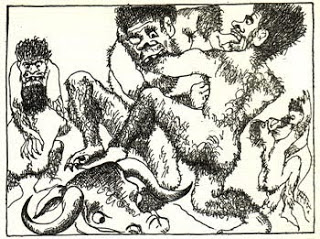
Yahoos, in one of their nicer portrayals from the 1947 edition of Gulliver's Travels.  Image from Wordmall.

Yahoos, in one of their nicer portrayals from the 1947 Crown edition of Gulliver’s Travels; drawing by Luis Quintanilla. Image from Wordmall.

Update:  As of Friday afternoon, the rally fizzled.  Organizers blamed the rain.  Proof that rain falls on the unjust, too?

More:


Photo of the moment: India brilliantly demonstrating the error of Mao Zedong

May 12, 2014

You remember the quote, don’t you?

Every Communist must grasp the truth; “Political power grows out of the barrel of a gun.”

Mao Zedong, “Problems of War and Strategy” (November 6, 1938), Selected Works, Vol. II, p. 224.

Here is the 21st century response from India:

A man shows off his finger, marked with ink, to show he's voted in India's elections, 2014.   WSJ image

A man shows off his finger, marked with ink, to show he’s voted in India’s elections, 2014. WSJ Tweet: India’s weeks-long federal elections come to a close. Photos from the polling place: http://trib.al/SekkQd2 (EPA)

In a democratic regime, political power grows from the finger that rings the doorbell or dials the phone to invite a neighbor to vote, and to that same finger marking the ballot in the voting place.  In the 21st century, democratic revolutions are slower, cause less bloodshed, but are more deeply rooted in the will of the people, and last longer in the deep reforms they bring to a nation.

The finger is mightier than the gun.

Mao is dead.  Even his nation turns towards capitalism, and eventually, to personal political freedom.

O, Tempora! O, Mores!

To which I would add (hoping I get the grammar correct!):  Novae viae veteres malis eius conterendos.  Spes et patientia superare tyrannidis.  (New ways crush the old bad habits. Hope and determination overcome tyranny.)

Afterthought:   When Malcolm X preached “The Ballot or the Bullet,” he advocated the ballot. He knew.


Bob Reitz remembers Dallas — this afternoon!

May 10, 2014

Caption from the Dallas Morning News blogs:  This aerial photo shows the Casa View shopping village and the surrounding area in 1957, three years after Bob Reitz moved into the neighborhood with his family at age 7. Reitz is presenting a talk titled

Caption from the Dallas Morning News blogs: This aerial photo shows the Casa View shopping village and the surrounding area in 1957, three years after Bob Reitz moved into the neighborhood with his family at age 7. Reitz is presenting a talk titled “A Time We Once Shared” from 2 to 4 p.m. Saturday at Dallas’ White Rock Hills Branch Library. File 1957 / Staff Photo

Steve Blow writes columns for the local section of the Dallas Morning News Wednesday he featured one of our veteran Scouters from Wisdom Trail District here in the southwest corner of Dallas County.

Dallas and Scout historian Bob Reitz - Photo by Ed Darrell

Dallas and Scout historian Bob Reitz

Bob Reitz is also the curator of the Jack Harbin Boy Scout Museum at Camp Wisdom, a surprisingly great store of Scout history.  Among many other things he does well, Bob is a historian of great stories.

This afternoon, May 10, he’s telling stories of Dallas in his growing up years in the “middle-middle class” neighborhood of Casa View, east of downtown.  Bob’s got two hours (it will seem like one or less) at the White Rock Hills Branch Library, starting at 2:00 p.m. (9150 Ferguson Rd, 75228 (map))

You ought to go.

Below the fold, Steve Blow’s column, should it disappear from the DMN site.

Read the rest of this entry »