May 6, 1882: Race and immigration policy collide

May 6, 2014

Today is the anniversary* of our nation’s first** law generally governing immigration.

It’s a history we should work to change, to put behind us, to move away from.

Congress passed the Chinese Exclusion Act, which barred Chinese immigrants from the United States for 10 years.

1882 Chinese Exclusion Act, page 1 - National Archives

1882 Chinese Exclusion Act, page 1 – National Archives

1882 Chinese Exclusion Act, page 2 - National Archives

1882 Chinese Exclusion Act, page 2 – National Archives

We cannot paint over this part of history.  The Chinese Exclusion Act was racist in intent, and racist in content.

What should we learn from it?  Among justifications for the law were claims that immigrants from China were taking jobs from citizens, especially in California.  Chinese workers imported to build the Transcontinental Railroads sought new employment once the routes were built.

Reality probably differed a lot.  Chinese entrepreneurs, with money they had earned working on the railroads, established news businesses.  Yes, a lot of Chinese were getting jobs.  They were mostly new jobs, in new businesses, boosting the economy and creating more jobs.  That came to an almost-screeching halt.

Did America learn?  This law was renewed, then made permanent — not really fixed until World War II, when China was an ally in the War in the Pacific, against Japan.  Even then, it wasn’t a good fix.

The law was repealed by the Magnuson Act in 1943 during World War II, when China was an ally in the war against imperial Japan. Nevertheless, the 1943 act still allowed only 105 Chinese immigrants per year, reflecting persisting prejudice against the Chinese in American immigration policy. It was not until the Immigration Act of 1965, which eliminated previous national-origins policy, that large-scale Chinese immigration to the United States was allowed to begin again after a hiatus of over 80 years.

Can we learn from this history, for immigration reform now? Santayana’s Ghost wonders.

How much is resistance to immigration reform based on racism, the sort of racism that kills the U.S. economy?

The Chinese Exclusion Act proved to be an embarrassment for Uncle Sam:  “A Skeleton in His Closet,” by L.M. Glackens, published in Puck magazine on Jan. 3, 1912. Uncle Sam holding paper “Protest against Russian exclusion of Jewish Americans” and looking in shock at Chinese skeleton labeled “American exclusion of Chinese” in closet. Image from NorthwestAsianWeekly.com

The Chinese Exclusion Act proved to be an embarrassment for Uncle Sam: “A Skeleton in His Closet,” by L.M. Glackens, published in Puck magazine on Jan. 3, 1912. Uncle Sam holding paper “Protest against Russian exclusion of Jewish Americans” and looking in shock at Chinese skeleton labeled “American exclusion of Chinese” in closet. Image from NorthwestAsianWeekly.com

____________

*    I note the image says it was approved by President Chester Alan Arthur (who had succeeded to office after President James Garfield was assassinated a year earlier).  The New York Times calls May 6 the anniversary of Congress’s passing the law; if Arthur signed in on May 6, it was probably passed a few days earlier.  May 6 would be the anniversary of its signing into law.

**  The Chinese Exclusion Act was preceded by the Page Act of 1875, which prohibited immigration of “undesirable” people.  Who was undesirable?  “The law classified as undesirable any individual from China who was coming to America to be a contract laborer, any Asian woman who would engage in prostitution, and all people considered to be convicts in their own country.”  It was not applicable to many immigrants.  The Page Act was named after its sponsor, Rep. Horace F. Page of California.

This is based on, and borrows from, an earlier post at MFB.

More:


Gun nuts twisting the words of President Kennedy

May 4, 2014

Here’s the full text of President Kennedy’s statement on President Franklin D. Roosevelt’s birthday in 1961, urging Americans to join Kennedy in making things better, including enlisting in the military, from the Kennedy Library [links added here]:

January 29, 1961

This year, the celebrations of Roosevelt Day has special significance for Democrats everywhere; for we celebrate not only the triumphs of the past but the opportunities of the future.

Twenty-eight years ago Franklin Roosevelt assumed the leadership of a stricken and demoralized nation. Poverty, distress and economic stagnation blanketed the land. But it was not long before the great creative energies of the New Deal had lifted American from its despair and set us on the path to new heights of prosperity, power and greatness.

Today America is the richest nation in the history of the world. Our power and influence extend around the globe. Yet the challenges and dangers which confront us are even more awesome and difficult than those that face Roosevelt. And we too will need to summon all the energies of our people and the capacities of our leaders if America is to remain a great and free nations — if we are to master the opportunities of the New Frontier.

The dimensions of out problems overwhelm the imagination. At home millions are unemployed and the growth of our economy has come to a virtual halt. Abroad, we are faced with powerful and unrelenting pressure which threaten freedom in every corner of the globe, and with military power so formidable that it menaces the physical survival of our own nation.

To meet these problems will require the efforts not only of our leaders or of the Democratic Party–but the combined efforts of all of our people.; No one has a right to feel that, having entrusted the tasks of government to new leaders in Washington, he can continue to pursue his private comforts unconcerned with American’s challenges and dangers. For, if freedom is to survive and prosper, it will require the sacrifice, the effort and the thoughtful attention of every citizen.

In my own native state of Massachusetts, the battle for American freedom was begun by the thousands of farmers and tradesmen who made up the Minute Men — citizens who were ready to defend their liberty at a moment’s notice. Today we need a nation of minute men; citizens who are not only prepared to take up arms, but citizens who regard the preservation of freedom as a basic purpose of their daily life and who are willing to consciously work and sacrifice for that freedom. The cause of liberty, the cause of American, cannot succeed with any lesser effort.

It is this effort and concern which makes up the New Frontier. And it is this effort and concern which will determine the success or failure not only with Administration, but of our nation itself. [emphasis added]

Source: White House Central Subject Files, Box 111, “FDR”.

Other Information Sources:

“Know your Lawmakers,” Guns Magazine, April 1960.
Letter to President John F. Kennedy from the NRA,” [NRAcentral.com].
“New Minute Men Urged by Kennedy,” The New York Times, 30 January, 1961, pg. 13.
“Kennedy Says U.S. Needs Minute Men,” Los Angeles Times, 30 January, 1961, pg. 4.
“Minutemen’s Soft-Sell Leader: Robert B. DePugh,” The New York Times, 12 November 1961, pg. 76.

It seems to me that Kennedy was not asking yahoos to take up arms against the government, but was instead asking Americans to “ask not what your country can do for you; ask what you can do for your country.”  Specifically in the last paragraph, he noted his call was to join in the New Frontier efforts his administration pushed.
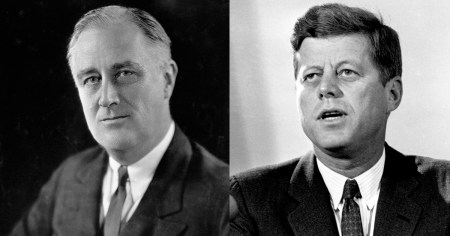
FDR, left, and JFK: Kennedy took the opportunity of Roosevelt's birth anniversary in 1961, January 29, to urge Americans to volunteer to serve the nation, to serve as the Minutemen did, voluntarily, where the nation needs help, and in support of the nation. Image from Ring of Fire Network

FDR, left, and JFK: Kennedy took the opportunity of Roosevelt’s birth anniversary in 1961, January 29, to urge Americans to volunteer to serve the nation, to serve as the Minutemen did, voluntarily, where the nation needs help, and in support of the nation. Image from Ring of Fire Network

If you’re not much a student of history, you may have forgotten about Kennedy’s New Frontier.  As presidents before him, with the Square Deal (Teddy Roosevelt, 1904), the New Deal (FDR, 1933), and the Fair Deal (Truman, 1949), Kennedy sought a shorthand term to apply to much of his program of changes.  In his speech accepting the nomination of the Democratic Party to run for president, he called this a New Frontier.

For I stand tonight facing west on what was once the last frontier. From the lands that stretch three thousand miles behind me, the pioneers of old gave up their safety, their comfort and sometimes their lives to build a new world here in the West. They were not the captives of their own doubts, the prisoners of their own price tags. Their motto was not “every man for himself” –but “all for the common cause.” They were determined to make that new world strong and free, to overcome its hazards and its hardships, to conquer the enemies that threatened from without and within.

Today some would say that those struggles are all over–that all the horizons have been explored–that all the battles have been won– that there is no longer an American frontier.

But I trust that no one in this vast assemblage will agree with those sentiments. For the problems are not all solved and the battles are not all won–and we stand today on the edge of a New Frontier–the frontier of the 1960’s–a frontier of unknown opportunities and perils– a frontier of unfulfilled hopes and threats.
[emphasis added]

Woodrow Wilson’s New Freedom promised our nation a new political and economic framework. Franklin Roosevelt’s New Deal promised security and succor to those in need. But the New Frontier of which I speak is not a set of promises–it is a set of challenges. It sums up not what I intend to offer the American people, but what I intend to ask of them. It appeals to their pride, not to their pocketbook–it holds out the promise of more sacrifice instead of more security.

But I tell you the New Frontier is here, whether we seek it or not. Beyond that frontier are the uncharted areas of science and space, unsolved problems of peace and war, unconquered pockets of ignorance and prejudice, unanswered questions of poverty and surplus. It would be easier to shrink back from that frontier, to look to the safe mediocrity of the past, to be lulled by good intentions and high rhetoric–and those who prefer that course should not cast their votes for me, regardless of party.

But I believe the times demand new invention, innovation, imagination, decision. I am asking each of you to be pioneers on that New Frontier. My call is to the young in heart, regardless of age–to all who respond to the Scriptural call: “Be strong and of a good courage; be not afraid, neither be thou dismayed.”

For courage–not complacency–is our need today–leadership–not salesmanship. And the only valid test of leadership is the ability to lead, and lead vigorously. A tired nation, said David Lloyd George, is a Tory nation–and the United States today cannot afford to be either tired or Tory.

Kennedy famously challenged Americans to stand up for service to the nation in his inaugural speech, and when he founded the Peace Corps, asking Americans to give up two or three years to work, peacefully, in other lands to promote progress there. Kennedy called Americans to share his vision, and to work for change, for a better America.

What were specifics of the New Frontier agenda?   Kennedy pushed a broad range of programs, many turned into laws in his brief term; Kennedy aimed to change America in economics, taxation, labor, education, welfare, civil rights, housing, unemployment, health, equal rights for women, environment, agriculture, crime and defense.   In each of these areas Kennedy sought to build on the legacies of Franklin D. Roosevelt and Harry Truman — in ways that conservatives today become apoplectic just thinking about.

Kennedy pushed for a higher minimum wage with built-in step increases over time not keyed to inflation.  He called for more taxcuts for the poor, coupled with targeted tax incentives to get businesses to spend their cash to create jobs.  Kennedy favored changes in law to give unions greater say in corporate expansion, tougher protection for workers from firing, and he extended collective bargaining to federal workers.  Kennedy called for expansion of federally-funded loans and scholarships for college students, and he started a program to use federal money to put technology into classrooms at the elementary and secondary levels.  Kennedy expanded unemployment and welfare benefits, and got a 20% increase in Social Security benefits.

Kennedy’s New Frontier called for sweeping changes in the way government protects the rights and welfare of all citizens.

Did Kennedy actually call for armed militias to fight government “over-reach” or expansion?

What do you think?  When a proponent of getting guns to protect himself against the U.S. government, by killing agents of the U.S. government (we must imagine), cites a part of Kennedy’s statement from 1961 as supporting arming individual citizens, is he being honest?

Please tell us what you think, in comments. Your opinion counts.

Poster from Americanfirearms.org; the quoate from Kennedy is accurate, but did Kennedy mean what this group wants us to think it means?

Poster from Americanfirearms.org; the quote from Kennedy is accurate, but did Kennedy mean what this group wants us to think it means?

Kennedy appears to have been fond of the image of the Minutemen at Lexington and Concord, trained militia from citizen volunteers, who started the path to American independence from Britain.  He invoked that image earlier, as senator from Massachusetts, in a speech honoring the Polish hero Casimir Pulaski, at a Pulaski Day Dinner in Milwaukee, Wisconsin on October 17, 1959:

We pay tribute to Casimir Pulaski tonight by honoring a great American of Polish descent, Clem Zablocki.  For he has demonstrated, in Washington and Wisconsin, the same courage and conscience, the same zeal for liberty, the same tireless patience and determination to help all who call for help.  He is a great Congressman – not only from Wisconsin – but of the United States . . .

But we also think of Casimir Pulaski tonight because his beloved Poland has once again fallen victim to a foreign power.  The independence for which he fought against the Russians at Czestochowa has been once again suppressed – and once again by the Russians.  Were he alive tonight, the hero of Savannah and Charleston would weep for his homeland – and we, inwardly or outwardly according to our custom, weep with him.

But weeping is not enough.  We know it is not enough.  And yet, while we give vent to our feelings of resentment and outrage, we are also caught up in a feeling of frustration.  What can we do about the situation in the satellites?  How can we help those liberty-loving peoples regain their liberty, without subjecting them to even more cruel repression – or subjecting the world to an even more disastrous war?  How can we let them know their fate is not forgotten – that we have not abandoned them to be – like the Irish of 1647 considered themselves when Owen Roe O’Neill was poisoned – “sheep without a shepherd when the snow shuts out the sky?”

This is the dilemma we face, as both last month and next year the President and Premier Khrushchev are pictured together in the press on both sides of the Iron Curtain.  And this is the dilemma with which this Administration has been confronted, in trying to make good on its tarnished promises of a new “liberation” policy.  For this is no longer an age when minutemen with muskets can make a revolution.  Hungary, we know, is not Cuba – and neither is Poland.  Mr. Khrushchev is not to be overthrown like Mr. Batista.  Brave bands of young men and women may be able to stop a few tanks – but street barricades and home-made hand grenades cannot long stand against a modern army and an atomic air force. [emphasis added]

The facts of the matter are that – no matter how bitter some feelings may be, or how confident some are of a victorious war for liberation – freedom behind the Iron Curtain and world peace are actually inextricably linked.  For if war should ever break out, the control and occupation of Eastern Europe would certainly be even more rigid and repressive than it is today.  That is why, in the days of upheaval in 1956, when Poland could have turned to violent rebellion as Hungary did, Cardinal Wyszynski kept advising his people that the condition of Polish freedom was peace.  Many scoffed – many thought him faint-hearted.  But by following his advice, Poland has now attained at least a measure of national independence and at least a relaxation of Communist rule.  Forced collectivization of the farmers has ceased and most of the collectives were dissolved – religious freedom has been restored in considerable degree – and freedom of speech is returning.

No one says that land of ancient freedom is once more free again.  But if Poland had not accepted this half-way house to freedom, it could have been, as Prime Minister Gomulka warned, wiped off the map of Europe.  If the present emphasis on a thaw in the Cold War should end and tensions rise again, the present good relations between Poland and the United States would undoubtedly cease, the growing contacts between the Polish people and the West would be cut off, and the present degree of freedom of speech and religion in Poland would prove to be short-lived.  On the other hand, if a real thaw develops and Soviet-American relations improve, the prospects for the continuation and perhaps the expansion of this limited degree of Polish freedom are good.  So, in a real sense, the condition for Polish freedom is peace.
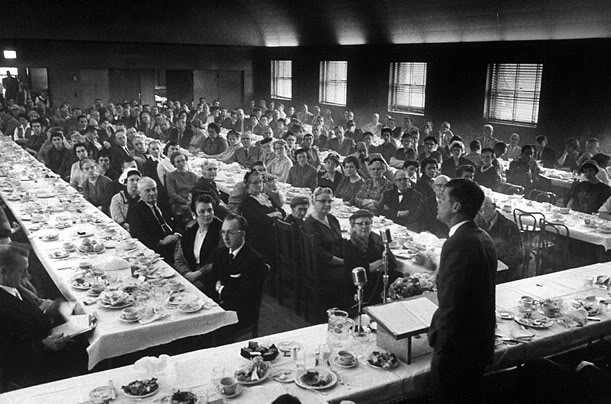
President Kennedy addressing a Wisconsin group during the 1960 presidential campaign.  (Do you have more details?)

President Kennedy addressing a Wisconsin group during the 1960 presidential campaign. (Do you have more details?) Photo by Robert W. Kelley//Time Life Pictures/Getty Images

One does not get the sense that President Kennedy was urging citizens to establish their own arsenals, contrary to the actions of the Minutemen at Lexington and Concord, nor to take up arms against the U.S. government.

Who would suggest that’s what Kennedy meant?  Oh, yeah:  AmericanFirearms.org.

More:

Page one of a speech text then-Sen. John Kennedy delivered regarding why America arms, on March 9, 1960, in Mauston, Wisconsin. JFK Library image

Page one of a speech text then-Sen. John Kennedy delivered regarding why America arms, on March 9, 1960, in Mauston, Wisconsin. JFK Library image


Can America afford to be great anymore? Many say, “no”

May 1, 2014

A friend posted this on Facebook:

“As of today our total national debt is roughly $17 1/2 trillion. Of that number nearly $12 1/2 trillion is publicly owed. Can you even get your mind around it?”

To which I responded:

As a portion of GDP, our national debt was much greater in 1946.

So, the Congress did what it had to do.

Congress borrowed money to educate millions of returning veterans, and to subsidize their homes. The greatest education aid and housing aid programs in history, both in the GI Bill.

Poster honoring the Marshall Plan, to rebuild Europe after World War II -- on borrowed money.

Poster honoring the Marshall Plan, to rebuild Europe after World War II — on borrowed money.

Congress borrowed money to give it away to our allies in World War II, to rebuild their industrial capabilities, on the assumption that an ally with a strong industrial base and good economy is stronger, and can come to our aid if and when we need it.

Congress borrowed money to give it away to our enemies in World War II, to rebuild their industrial capabilities, because a nation with a good economy and health trade tends to stay out of war. Those nations became our allies.

Congress borrowed to build the greatest road system in history, connecting nearly every corner of America — under the pretense that such a road system would allow us to move troops and armaments quickly from coast to coast in event of a defense emergency.

Congress borrowed to finance space exploration, to go to the Moonbecause, you know, it’s hard.

Congress borrowed to build a library in every county in America, and fill it with books — so that if there were ever nuclear war, everybody who survived would be close to the information necessary to rebuild civilization.

Congress borrowed to build the world’s greatest air transportation system, with airports for sport, business and commercial aviation all over the place.

Congress borrowed to build sewer systems and water systems, doubling down on public health service spending, to prevent disease and make health people.

Funny things happened. Our economy boomed. The world economy boomed. Millions of new jobs were created, filled by people who paid whopping taxes. And the debt sorta melted away.
___________

When I hear people complain about our national debt, and how we as Americans must stop spending money, I hear them saying, “We cannot afford to be great anymore. Our time as the world’s leading economy and leading democracy has passed. It will be a lot cheaper for the nation to curl into a national fetal position, and then taxes won’t be so high.”

That’s what I hear the GOP saying, when they urge tax cuts for the rich, while taking away food stamps from the families of our military deployed overseas.  (Can you imagine anything like that happening during World War II? Not even “interned” families of soldiers went hungry.)

In 1946 — and in 1948, 1950, 1952, 1956, 1960, 1962, 1964, 1968, and other election years — there were plenty of Americans who said “we can’t afford the Marshall Plan; we can’t afford foreign aid; we can’t afford to build all these roads; we can’t afford to go to the Moon; we can’t afford to pay for college (or other schooling) for all these veterans/students.”

What would America look like, had leaders listened to those people, and then NOT borrowed the money to build America?  What would the world look like?

I don’t think George Washington spent 8 years at war to curl into the fetal position and give up.

Am I wrong?

The future of an America that is afraid to be great, even if we need to borrow money to do it? (Image from Brogan Knight)

The future of an America that is afraid to be great, even if we need to borrow money to do it? (Image from Brogan Knight)


Insta-Millard: Greenspan explains why and how Fed is accountable

April 30, 2014

A group of people, including a lot of the acolytes of Ron Paul, claim the Federal Reserve Bank system is a renegade organization, unaccountable to anyone.

Alan Greenspan, by the late, very great David Levine

Alan Greenspan, by the late, very great David Levine

Turns out that Ron Paul actually had the guts to ask Fed Chair Alan Greenspan about that.  Greenspan’s answer is worth watching, and hearing.

It was on CSPAN-2, so you probably didn’t see it.  Not the sort of thing Fox likes to run over, and over, and over again, to distraction.

Still looking for  video of Greenspan explaining the annual Fed audits that Ron Paul claims don’t exist . . .

http://twitter.com/StephanieKelton/status/450353383136698368


April 30, 1789: George Washington’s first inauguration as President of the U.S.

April 30, 2014

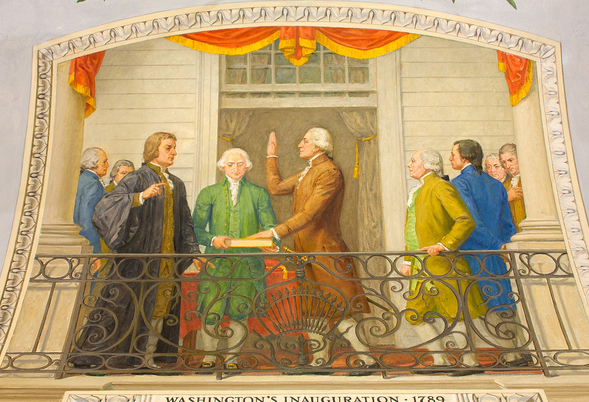
Mural by Allyn Cox in the U.S. Capitol depicts George Washington taking the oath of office in 1789 on the balcony of Federal Hall in New York City. Architect of the Capitol photograph

Mural by Allyn Cox in the U.S. Capitol depicts George Washington taking the oath of office in 1789 on the balcony of Federal Hall in New York City. Architect of the Capitol photograph

Not on March 4, as the Constitution specified, because Congress had not been able to organize itself to count the ballots of the electoral college, but on April 30, 1789, George Washington met with the U.S. Senate on the second floor of a building now called Federal Hall; then to the balcony, where Robert Livingston, Chancellor of the State of New York, administered the oath of office to Washington.  Washington put his left hand on a Bible borrowed from St. John’s Masonic Hall — there were no Bibles to be found in Federal hall where the First Congress was meeting.

That’s how it started.

The Library of Congress Today in History feature links to a wealth of resources for scholars and teachers:

Father of Our Country

George Washington

Detail from Gilbert Stuart’s unfinished portrait of George Washington, from the collections of the Library of Congress.

George Washington [detail],
Gilbert Stuart, artist.
Prints & Photographs Online Catalog

On April 30, 1789, George Washington delivered his first inaugural address to a joint session of Congress, assembled in Federal Hall in the nation’s new capital, New York City. The newly-elected president delivered the speech in a deep, low voice that betrayed what one observer called “manifest embarrassment.” Washington had not sought the office of president and was humbled by the request to serve.

Aside from recommending constitutional amendments to satisfy citizens demanding a Bill of Rights, Washington confined his address to generalities. He closed by asking for a “divine blessing” on the American people and their elected representatives. In delivering his address, Washington went beyond the constitutional requirement to take an oath of office and thus established a precedent that has been followed since by every elected president.

Two weeks before his inauguration, Washington had made an emotional speech to the citizens of his hometown, Alexandria, Virginia. He expressed regret at leaving his Mount Vernon estate where he had retired, and stated: “no earthly consideration, short of a conviction of duty, could have prevailed upon me to depart from my resolution,’never more to take any share in transactions of a public nature.'” The reluctant leader served two terms in office.

To learn more about George Washington, explore the following American Memory resources:

More:


Dialogue in the early years of the Dark Ages

April 28, 2014

Poetry on current issues from Devona Wyant.  Wait; is it historic?

(Soldiers involved in the Desert Rock training exercise watching the mushroom cloud from the Dog detonation, Operation Buster-Jangle;  Coporal Alexander McCaughey, U.S. Army Photographic Signal Corps)

(Soldiers involved in the Desert Rock training exercise watching the mushroom cloud from the Dog detonation, Operation Buster-Jangle; Coporal Alexander McCaughey, U.S. Army Photographic Signal Corps) (Illustration added here)

Dialogue in the early years of the Dark Ages

“Old woman, are you awake? Tell my friend here
about the past like you told me. He don’t believe me.”

“What would you like to hear?
About the old forests that stretched for miles?
The wetlands that filtered and gave shelter?
The hundreds of species now lost?
Would you believe we once played outside
without sun block, without protective clothing?
Maybe you want to hear about what it was like
when you could worship as you believed or
not worship at all, without fear, without hiding,
without losing status, without losing your job.
I remember a time when you didn’t need papers
to travel, when you didn’t have your mail read.
I remember when your neighbors didn’t turn
you in if you said you hated a government policy.
I remember when you could gather to protest,
when you could speak out, write letters to the papers.
I remember when there were three classes, not
just the haves and have nots.
I remember when the very poor could
get help if they were very sick or if they were hungry.
I remember when we were considered a beacon of hope,
when we protected those who were oppressed.
I remember when every one could vote and each
vote was counted and mattered.
I even remember when people didn’t live in fear.”

“Are you putting me on Man? She lies! If all those
things were true, why are the old ones the only ones who know?
why isn’t it in the history books?”

“Young man, wait. I’ll be moving on soon or I may just
disappear as so many have. If you never see me again,
remember this at least.
Those who rule, not only make history, they invent it.”

Devona Wyant

Hey, it’s still National Poetry Month.  How are you celebrating? What poems are you reading?

An old woman who tells stories.  Photo by the Library of Congress.

An old woman who tells stories. Photo by the Library of Congress. (Main Reading Room)


A lot of people reading Piketty — the right ones? Enough to matter?

April 23, 2014

An article in the Washington Post calls Thomas Piketty’s book, Capital in the Twenty-first Century, a “runaway best seller.”

Have you read it?

Thomas Piketty - Professor of Economics, Paris School of Economics; photo from The Next Deal

Thomas Piketty – Professor of Economics, Paris School of Economics; photo from The Next Deal

Are you aware of the contents?

Are the right people reading it — especially GOP Members of Congress whose minds need to be changed?  Or, are enough people reading it to make a difference in American politics?

There are presses cranking it out in the United States, India and Britain, and the book is in at least its fourth run. Even though the book was already a hit in its native France, it’s now taking off among English readers around the world, said Donnelly. She expects that sales in China, Hong Kong and Japan will also soon follow.

Piketty, already widely cited for his work on income inequality, has clearly touched a nerve. The book argues that the underlying mechanisms of capitalism tend towards massive inequality. Piketty argues that the era between 1930 and 1975 — often hailed for the way in which wealth was broadly shared — was actually a departure from the norm. That period of economic growth, he says, was the result of unusual circumstances like World War II, a global depression and the government’s actions in the aftermath of those events: strong policies raising taxes and increasing regulation. But now, with many of those policies rolled back, societies are reverting back to extreme inequality.

What do you think, read it or not?

More:


2014: STILL, again, Earth Day/Lenin hoax trotted out: Earth Day honors Earth, our majestic home — not Lenin

April 22, 2014

This is mostly an encore post, repeated each year on April 22 — sad that it needs repeating.

You could write it off to pareidolia, once. Like faces in clouds, some people claimed to see a link. The first Earth Day, on April 22, 1970, coincided with Lenin’s birthday. There was no link — Earth Day was scheduled for a spring Wednesday. Now, years later, with almost-annual repeats of the claim from the braying right wing, it’s just a cruel hoax.

No, there’s no link between Earth Day and the birthday of V. I. Lenin:

One surefire way to tell an Earth Day post is done by an Earth Day denialist: They’ll note that the first Earth Day, on April 22, 1970, was an anniversary of the birth of Lenin.

Coincidentally, yes, Lenin was born on April 22 (new style calendar; it was April 10 on the calendar when he was born — one might accurately note that Lenin’s mother always said he was born on April 10).

It’s a hoax. There is no meaning to the first Earth Day’s falling on Lenin’s birthday — Lenin was not prescient enough to plan his birthday to fall in the middle of Earth Week, a hundred years before Earth Week was even planned.

About.com explains why the idea of a link between Earth Day and Lenin is silly:

Does Earth Day Promote Communism?
Earth Day 1970 was initially conceived as a teach-in, modeled on the teach-ins used successfully by Vietnam War protesters to spread their message and generate support on U.S. college campuses. It is generally believed that April 22 was chosen for Earth Day because it was a Wednesday that fell between spring break and final exams—a day when a majority of college students would be able to participate.

U.S. Sen. Gaylord Nelson, the guy who dreamed up the nationwide teach-in that became Earth Day, once tried to put the whole “Earth Day as communist plot” idea into perspective.

“On any given day, a lot of both good and bad people were born,” Nelson said. “A person many consider the world’s first environmentalist, Saint Francis of Assisi, was born on April 22. So was Queen Isabella. More importantly, so was my Aunt Tillie.”

April 22 is also the birthday of J. Sterling Morton, the Nebraska newspaper editor who founded Arbor Day (a national holiday devoted to planting trees) on April 22, 1872, when Lenin was still in diapers. Maybe April 22 was chosen to honor Morton and nobody knew. Maybe environmentalists were trying to send a subliminal message to the national subconscious that would transform people into tree-planting zombies. One birthday “plot” seems just about as likely as the other. What’s the chance that one person in a thousand could tell you when either of these guys were born.

My guess is that only a few really wacko conservatives know that April 22 is Lenin’s birthday (was it ever celebrated in the Soviet Union?). No one else bothers to think about it, or say anything about it, nor especially, to celebrate it.

Gaylord Nelson, Living Green image

Inventor of Earth Day teach-ins, former Wisconsin Governor and U.S. Senator Gaylord Nelson

Wisconsin’s U.S. Sen. Gaylord Nelson, usually recognized as the founder and father of Earth Day, told how and why the organizers came to pick April 22:

Senator Nelson chose the date in order to maximize participation on college campuses for what he conceived as an “environmental teach-in.” He determined the week of April 19–25 was the best bet; it did not fall during exams or spring breaks, did not conflict with religious holidays such as Easter or Passover, and was late enough in spring to have decent weather. More students were likely to be in class, and there would be less competition with other mid-week events—so he chose Wednesday, April 22.

In his own words, Nelson spoke of what he was trying to do:

After President Kennedy’s [conservation] tour, I still hoped for some idea that would thrust the environment into the political mainstream. Six years would pass before the idea that became Earth Day occurred to me while on a conservation speaking tour out West in the summer of 1969. At the time, anti-Vietnam War demonstrations, called “teach-ins,” had spread to college campuses all across the nation. Suddenly, the idea occurred to me – why not organize a huge grassroots protest over what was happening to our environment?

I was satisfied that if we could tap into the environmental concerns of the general public and infuse the student anti-war energy into the environmental cause, we could generate a demonstration that would force this issue onto the political agenda. It was a big gamble, but worth a try.

At a conference in Seattle in September 1969, I announced that in the spring of 1970 there would be a nationwide grassroots demonstration on behalf of the environment and invited everyone to participate. The wire services carried the story from coast to coast. The response was electric. It took off like gangbusters. Telegrams, letters, and telephone inquiries poured in from all across the country. The American people finally had a forum to express its concern about what was happening to the land, rivers, lakes, and air – and they did so with spectacular exuberance. For the next four months, two members of my Senate staff, Linda Billings and John Heritage, managed Earth Day affairs out of my Senate office.

Five months before Earth Day, on Sunday, November 30, 1969, The New York Times carried a lengthy article by Gladwin Hill reporting on the astonishing proliferation of environmental events:

“Rising concern about the environmental crisis is sweeping the nation’s campuses with an intensity that may be on its way to eclipsing student discontent over the war in Vietnam…a national day of observance of environmental problems…is being planned for next spring…when a nationwide environmental ‘teach-in’…coordinated from the office of Senator Gaylord Nelson is planned….”

Nelson, a veteran of the U.S. armed services (Okinawa campaign), flag-waving ex-governor of Wisconsin (Sen. Joe McCarthy’s home state, but also the home of Aldo Leopold and birthplace of John Muir), was working to raise America’s consciousness and conscience about environmental issues.

Lenin on the environment? Think of the Aral Sea disaster, the horrible pollution from Soviet mines and mills, and the dreadful record of the Soviet Union on protecting any resource. Lenin believed in exploiting resources, not conservation.

So, why are all these conservative denialists claiming, against history and politics, that Lenin’s birthday has anything to do with Earth Day?

Can you say “propaganda?”  Can you say “political smear?”

2014 Resources and Good News:

2013 Resources and Good News:

Good information for 2012:

Good information from 2011:

Good information from 2010:

2014’s Wall of Shame:

2013 Wall of Shame:

Wall of Lenin’s Birthday Propaganda Shame from 2012:

Wall of Lenin’s Birthday Propaganda Shame from 2011:

Wall of Lenin’s Birthday Propaganda Shame from 2010:

Spread the word.  Have you found someone spreading the hoax, claiming Earth Day honors Lenin instead?  Give us the link in comments.


April 19, 1775: Battle at Concord Bridge

April 19, 2014

Battle at Concord Bridge, April 19, 1775; National Guard Heritage Painting

Battle at Concord Bridge, April 19, 1775; National Guard Heritage Painting by Dominick D’Andrea.

For a story of the battle, and why the National Guard considers this part of its history, check out this story by Amelia Meyer at the National Guard Educational Foundation.

More:


Darwin’s death, April 19, 1882, and his legacy today

April 19, 2014

This is an encore post.

We shouldn’t pass April 19 — a day marked by significant historic events through the past couple hundred years — without remembering that it is also the anniversary of the death of Darwin.

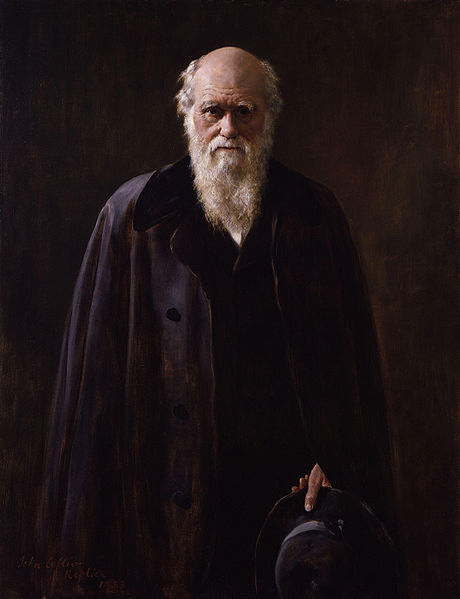
Charles Darwin in 1881, by John Collier

Charles Darwin in 1881, portrait by John Collier; after a Collier painting hanging in the Royal Society

Immortality?  Regardless Darwin’s religious beliefs (I’ll argue he remained Christian, thank you, if you wish to argue), he achieved immortality solely on the strength of his brilliant work in science. Of course he’s best known for being the first to figure out that natural and sexual selection worked as tools to sculpt species over time, a theory whose announcement he shared with Alfred Russel Wallace, who independently arrived at almost exactly the same theory but without the deep evidentiary backup Darwin had amassed.

But had evolution turned out to be a bum theory, Darwin’s other works would have qualified him as one of the greatest scientists of all time, including:

Darwin's theory set out a sequence of coral re...

Darwin’s theory set out a sequence of coral reef formation around an extinct volcanic island, becoming an atoll as the island and ocean floor subsided. Courtesy of the U.S. Geological Survey (Photo credit: Wikipedia)

US Geological Survey graphic demonstrating how coral atolls form on the sinking remains of old volcanic sea mounts, as Darwin described. Wikimedia commons image

  • World’s greatest collector of biological samples:  During his five years’ voyage on HMS Beagle, Darwin collected the largest collection of diverse plant and animal life ever by one person (I believe the record still stands); solely on the strength of his providing actual examples to the British Museum of so much life in so many different ecosystems worldwide, before he was 30 Darwin won election to the Royal Society.  (His election was engineered partly by friends who wanted to make sure he stayed in science, and didn’t follow through on his earlier plan to become a preacher.)
  • Geology puzzle solver:  Coral atolls remained a great geological mystery.  Sampling showed coral foundations well below 50 feet deep, a usual limit for coral growth.  In some cased old, dead coral were hundreds of feet deep.  In the South Pacific, Darwin looked at a number of coral atolls, marvelous “islands” that form almost perfectly circular lagoons.  Inspired partly by Lyell’s new encyclopedic review of  world geology, Darwin realized that the atolls he saw were the peaks of volcanic mounts.  Darwin hypothesized that the volcanoes grew from the ocean floor to the surface, and then the islands were colonized by corals.  The round shape of the volcano gave the atoll its shape.  Then the volcanic mounts eroded back, or sank down, and corals continued to grow on the old foundations.  It was a perfectly workable, natural explanation for a long-standing geologic puzzle.  (See Darwin’s monograph, Structure and Distribution of Coral Reefs.)
  • Patient watcher of flowers:  Another great mystery, this time in biology, concerned how vines twined themselves onto other plants, rocks and structures.  Darwin’s genius in designing experiments shone here:  He put a vine in his study, and watched it.  Over several hours, he observed vine tendrils flailing around, until they latched on to something, and then the circular flailing motion wrapped the tendril around a stick or twig. Simple observation, but no one had ever attempted it before.  (See On the Movements and Habits of Climbing Plants.)
  • Champion of earthworms, and leaf mould:  Darwin suspected the high fertilizer value of “leaf mould” might be related to the action of earthworms.  Again, through well-designed experiments and simple observation, Darwin demonstrated that worms moved and aerated soil, and converted organic matter into even richer fertilizer. (See The Formation of Vegetable Moulds Through the Action of Worms.)
  • Creation of methodological science:  In all of this work, Darwin explained his processes for designing experiments, and controls, and made almost as many notes on how to observe things, as the observations themselves.  Probably more than any other single man, Darwin invented and demonstrated the use of a series of processes we now call “the scientific method.”  He invented modern science.

Any of those accomplishments would have been a career-capping work for a scientist.  Darwin’s mountains of work still form foundations of geology and biology, and are touchstones for genetics.

Born within a few hours of Abraham Lincoln on February 12, 1809, Darwin survived 17 years longer — 17 extremely productive years.  Ill through much of his life with mystery ailments, perhaps Chaga’s Disease, or perhaps some other odd parasite or virus he picked up on his world travels, Darwin succumbed to heart disease on April 19, 1882.

More:


Historian David McCullough: What is the value of education?

April 17, 2014

Historian David McCullough works on his vintage, historic Royal typewriter. Photo by Dorie McCullough Lawson. via Levenger Press.

Historian David McCullough works on his vintage, historic Royal typewriter. Photo by Dorie McCullough Lawson. via Levenger Press.

Branch banks of the Federal Reserve work hard to provide economic education; alas, in the era of state standards requiring “teach to the test,” a lot of this stuff goes unused.

What is the value of education?  The Dallas Branch of the Fed had historian David McCullough in for consultations; they asked him on video, and here’s his response.

“We must be an educated people. We cannot be a productive, original, innovative society if we aren’t educated.”

For more information, visit the Dallas Fed’s website.

6,645


Remembering the worst ever U.S. industrial accident, 1947: 576 dead at Texas City

April 16, 2014

April 16 marks the 67th anniversary of the Texas City Disaster.

It’s a day Texans, and all Americans should note.  It’s an event we need to remember, because every point of the disaster is something we forget at our very great peril.  Thinking such a disaster could not happen again, and failing to train for these same conditions, contributed to the disaster last year in West, Texas.

67 years ago, in the harbor at Texas City, a large cargo ship being loaded with tons of ammonium nitrate caught fire and exploded, setting fire to other nearby ships, one of which exploded, devastating much of the town. In all, 576 people died in Texas City on April 16 and 17, 1947.

View of Texas City from across the bay, in Galveston, April 16, 1947

View of Texas City from Galveston, across the bay, after the explosion of the French ship SS Grandchamp, April 16, 1947. Photo from International Association of Fire Fighters Local 1259

The incident also produced one of the most famous tort cases in U.S. history, Dalehite vs. United States, 346 U.S. 15 (1953). (Here is the Findlaw version, subscription may be required.)

The entire Texas City fire department was wiped out, 28 firefighters in all. The International Association of Fire Fighters, Local 1259 has a website dedicated to the history of the disaster, with a collection of some powerful photographs.

More below the fold. Read the rest of this entry »


Anniversary of Paul Revere’s ride, in the middle of National Poetry Month 2014

April 16, 2014

This is mostly an encore post.  Is there a good reason Paul Revere made his ride in the middle of National Poetry Month

Teachers, I’m posting this a couple of days early.  You may want to get copies of the poems for your U.S. history and literature classes. 

You may want to note that the Boston Marathon is traditionally run on Freedom Day in Massachusetts — the day that commemorates the ride of the patriots’ warning that Gen. Gage’s army was on the move, and of the battles at Lexington and Concord, the next day. 

_____________

April 18 and 19. Do the dates have significance? Paul Revere's ride, from Paul Revere House

Among other things, April 19 is the date of the firing of the “shot heard ’round the world,” the first shots in the American Revolution. On April 19, 1775, American Minutemen stood to protect arsenals they had created at Lexington and Concord, Massachusetts, against seizure by the British Army then occupying Boston.

April is National Poetry Month. What have we done to celebrate poetry?

What have we done to properly acknowledge the key events of April 18 and 19, 1775? Happily, poetry helps us out in history studies. Or it can do.

In contrast to my childhood, when we as students had poems to memorize weekly throughout our curriculum, modern students too often come to my classes seeming wholly unaware that rhyming and rhythm are used for anything other than celebrating materialist, establishment values obtained sub rosa. Poetry, to them, is mostly rhythm, certainly not for polite company, and never for learning.

Poetry has  slipped from our national curriculum, dropped away from our national consciousness.  No national test adequately covers poetry, not in English, not in social studies — certainly not in math or science.

That is one small part of the reason that Aprils in the past two decades turned instead to memorials to violence, and fear that violence will break out again. We have allowed darker ideas to dominate April, and especially the days around April 19.

You and I have failed to properly commemorate the good, I fear. We have a duty to pass along these cultural icons, as touchstones to understanding America.

So, reclaim the high ground. Reclaim the high cultural ground.

Read a poem today. Plan to be sure to have the commemorative reading of “Paul Revere’s Ride” in your classes on April 18 or 19, and “The Concord Hymn” on April 19.

We must work to be sure our heritage of freedom is remembered, lest we condemn our students, our children and grandchildren to having to relearn these lessons of history, as Santayana warned.

Texts of the poems are below the fold, though you may be much better off to use the links and see those sites, the Paul Revere House, and the Minuteman National Historical Park.

Read the rest of this entry »


Boy Scouts greet Col. Theodore Roosevelt, St. Paul, Minnesota, 1932

April 13, 2014

Interesting photograph.

1932 photograph of U.S. Army Col. Theodore Roosevelt III, being greeted in St. Paul, Minnesota by a group of Boy Scouts.  Minnesota Historical Society collection.

1932 photograph of U.S. Army Col. Theodore Roosevelt III, being greeted in St. Paul, Minnesota by a group of Boy Scouts. Minnesota Historical Society collection.

Found it at the site of the Minnesota Historical Society.

Col. Roosevelt, the son of President Theodore Roosevelt, is nearly center, in civilian clothes.  He would go on to command troops at the Battle of Normandy on D-Day, winning the Medal of Honor, awarded posthumously.  His father would later be awarded the Medal of Honor.  Is this the only father-son MoH duo?

MHS records identify Col. Roosevelt and 13 other people in the photo, mostly the Scouts; alphabetically, they are:  Baker, Curtis; Baker, Robert (brothers?); Haas, Frank; Hagman, R. J.; Jungwirth, Robert A.; Kehne, Clyde; Menz, C. J.; Nyman, David; Polanick, Alexander; Robertson, Donald; Roosevelt, Theodore [III]; Sommers, Charles; Torgerson, Gordon; White, Charles.

It would be interesting to know what the event was in 1932 that brought Roosevelt to St. Paul.  It would be interesting to know what happened to those Scouts.

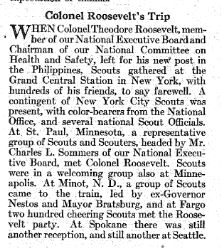
Update: Mr. Higginbotham found an account of Roosevelt’s trip in the April 1932 issue of Boys’ Life (see comments).  Roosevelt was on his way to the Philippines, where he served as Governor-General, a post held earlier by William Howard Taft, Leonard Wood, and Henry L. Stimson, among others.  Roosevelt was a member of the National Board of Boy Scouts of America; Scouts saw him off from New York, and greeted him at stops all the way to Seattle, where he boarded ship for the Philippines.

Account of Col. Theodore Roosevelt III's trip from New York to Seattle, in 1932 -- with Scouts meeting him at almost every stop.  Boys' Life, April 1932, page 58.

Account of Col. Theodore Roosevelt III’s trip from New York to Seattle, in 1932 — with Scouts meeting him at almost every stop. Boys’ Life, April 1932, page 58.


Feynmanmobile

April 8, 2014

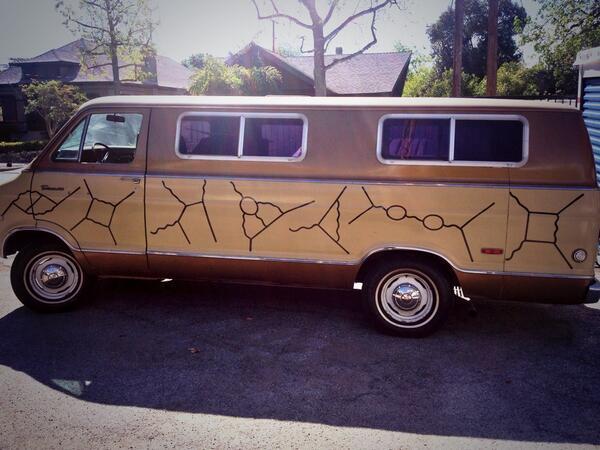
Richard Feynman had a van.  It was decorated with Feynman Diagrams.

And now, it’s been restored.

Which of the diagrams would the Physics Commissioner have used to flash onto the clouds to summon Feynman, do you suppose?  Would Feynman ever have a sidekick?  What would the sidekick’s name be?

From a Tweet by Michael Shermer:  Feynman's van with quantum diagrams restored thanks to Seamus Blackley Ralph Leighton Edward Tufte. RF would approve! pic.twitter.com/L5vOPHLRw0

From a Tweet by Michael Shermer: Feynman’s van with quantum diagrams restored thanks to Seamus Blackley Ralph Leighton Edward Tufte. RF would approve! pic.twitter.com/L5vOPHLRw0

More:  

Full Tweet below the fold.

Read the rest of this entry »