August 6: Hiroshima atomic bomb, 68 years ago today

August 6, 2013

A-Bomb Dome in Hiroshima, Japan

A-Bomb Dome in Hiroshima, Japan Wikipedia image

As a Utah Downwinder, I fight depressing ideas every August 6, and August 9.

The first atomic bomb used in war was dropped by my nation on August 6, 1945.  The second, on August 9.  Hiroshima, then Nagasaki, were the targets.

I know the arguments, both ways.  I feel certain my Uncle Leo B. Stewart’s life was saved by the bombs — and the lives of probably two or three million more Americans, and five or ten million Japanese.  And still I am troubled.

I’m troubled that there seems to be so little attention paid to the anniversary in the U.S.  Year by year, it gets tougher to get news out of remembrance ceremonies in Japan.  Here are some Twitter notes on the day.  I may be back with more, later.

http://twitter.com/TimHarford/status/364792998275448835

This comes from a pseudo-Truman, but it’s an accurate reflection of the angst Truman went through; once he made the decision, he did not have doubts that it was the right one.

Fortunately, in 68 years since, no other nuclear device has ever been used in war. May we have a planet that never sees their use in war, again.

More:


Annals of global warming: 2012 hits top 10 hottest years

August 6, 2013

NOAA’s article on the State of the Climate released today:

2012 was one of the 10 warmest years on record globally

The end of weak La Niña, unprecedented Arctic warmth influenced 2012 climate conditions

August 6, 2013

State of the Climate in 2012 - report cover.

The 2012 State of the Climate report is available online.
(Credit: NOAA)

Worldwide, 2012 was among the 10 warmest years on record according to the 2012 State of the Climate report released online today by the American Meteorological Society (AMS). The peer-reviewed report, with scientists from NOAA’s National Climatic Data Center in Asheville, N.C., serving as lead editors, was compiled by 384 scientists from 52 countries (highlights, full report). It provides a detailed update on global climate indicators, notable weather events, and other data collected by environmental monitoring stations and instruments on land, sea, ice, and sky.

“Many of the events that made 2012 such an interesting year are part of the long-term trends we see in a changing and varying climate — carbon levels are climbing, sea levels are rising, Arctic sea ice is melting, and our planet as a whole is becoming a warmer place,” said Acting NOAA Administrator Kathryn D. Sullivan, Ph.D. “This annual report is well-researched, well-respected, and well-used; it is a superb example of the timely, actionable climate information that people need from NOAA to help prepare for extremes in our ever-changing environment.”

Conditions in the Arctic were a major story of 2012, with the region experiencing unprecedented change and breaking several records. Sea ice shrank to its smallest “summer minimum” extent since satellite records began 34 years ago. In addition, more than 97 percent of the Greenland ice sheet showed some form of melt during the summer, four times greater than the 1981–2010 average melt extent.

Temperature in 2012 compared to the 1981-2010 average.

Temperature in 2012 compared to the 1981-2010 average. Credit: NOAA Climate.gov, based on NCDC data. See more.

The report used dozens of climate indicators to track and identify changes and overall trends to the global climate system. These indicators include greenhouse gas concentrations, temperature of the lower and upper atmosphere, cloud cover, sea surface temperature, sea-level rise, ocean salinity, sea ice extent and snow cover. Each indicator includes thousands of measurements from multiple independent datasets.

Highlights:

  • Warm temperature trends continue near Earth’s surface: Four major independent datasets show 2012 was among the 10 warmest years on record, ranking either 8th or 9th, depending upon the dataset used. The United States and Argentina had their warmest year on record.
  • La Niña dissipates into neutral conditions:  A weak La Niña dissipated during spring 2012 and, for the first time in several years, neither El Niño nor La Niña, which can dominate regional weather and climate conditions around the globe, prevailed for the majority of the year.
  • The Arctic continues to warm; sea ice extent reaches record low: The Arctic continued to warm at about twice the rate compared with lower latitudes. Minimum Arctic sea ice extent in September and Northern Hemisphere snow cover extent in June each reached new record lows. Arctic sea ice minimum extent (1.32 million square miles, September 16) was the lowest of the satellite era. This is 18 percent lower than the previous record low extent of 1.61 million square miles that occurred in 2007 and 54 percent lower than the record high minimum ice extent of 2.90 million square miles that occurred in 1980. The temperature of permafrost, or permanently frozen land, reached record-high values in northernmost Alaska. A new melt extent record occurred July 11–12 on the Greenland ice sheet when 97 percent of the ice sheet showed some form of melt, four times greater than the average melt this time of year.
  • Antarctica sea ice extent reaches record high: The Antarctic maximum sea ice extent reached a record high of 7.51 million square miles on September 26. This is 0.5 percent higher than the previous record high extent of 7.47 million square miles that occurred in 2006 and seven percent higher than the record low maximum sea ice extent of 6.96 million square miles that occurred in 1986.
  • Sea surface temperatures increase: Four independent datasets indicate that the globally averaged sea surface temperature for 2012 was among the 11 warmest on record.  After a 30-year period from 1970 to 1999 of rising global sea surface temperatures, the period 2000–2012 exhibited little trend. Part of this difference is linked to the prevalence of La Niña-like conditions during the 21st century, which typically lead to lower global sea surface temperatures.
  • Ocean heat content remains near record levels: Heat content in the upper 2,300 feet, or a little less than one-half mile, of the ocean remained near record high levels in 2012. Overall increases from 2011 to 2012 occurred between depths of 2,300 to 6,600 feet and even in the deep ocean.
  • Sea level reaches record high: Following sharp decreases in global sea level in the first half of 2011 that were linked to the effects of La Niña, sea levels rebounded to reach record highs in 2012. Globally, sea level has been increasing at an average rate of 3.2 ± 0.4 mm per year over the past two decades.
  • Ocean salinity trends continue: Continuing a trend that began in 2004, oceans were saltier than average in areas of high evaporation, including the central tropical North Pacific, and fresher than average in areas of high precipitation, including the north central Indian Ocean, suggesting that precipitation is increasing in already rainy areas and evaporation is intensifying in drier locations.

    Sea ice concentration reached a new record low in mid-September 2012.

    Sea ice concentration reached a new record low in mid-September 2012. Credit: NOAA Climate.gov, based on NSIDC data. See more.

  • Tropical cyclones near average: Global tropical cyclone activity during 2012 was near average, with a total of 84 storms, compared with the 1981–2010 average of 89. Similar to 2010 and 2011, the North Atlantic was the only hurricane basin that experienced above-normal activity.
  • Greenhouse gases climb: Major greenhouse gas concentrations, including carbon dioxide, methane, and nitrous oxide, continued to rise during 2012. Following a slight decline in manmade emissions associated with the global economic downturn, global CO2 emissions from fossil fuel combustion and cement production reached a record high in 2011 of 9.5 ± 0.5 petagrams (1,000,000,000,000,000 grams) of carbon , and a new record of 9.7 ± 0.5 petagrams of carbon  is estimated for 2012. Atmospheric CO2 concentrations increased by 2.1 ppm in 2012, reaching a global average of 392.6 ppm for the year. In spring 2012, for the first time, the atmospheric CO2concentration exceeded 400 ppm at several Arctic observational sites.
  • Cool temperature trends continue in Earth’s lower stratosphere: The average lower stratospheric temperature, about six to ten miles above the Earth’s surface, for 2012 was record to near-record cold, depending on the dataset. Increasing greenhouse gases and decline of stratospheric ozone tend to cool the stratosphere while warming the planet near-surface layers.

The 2012 State of the Climate report is peer-reviewed and published annually as a special supplement to the Bulletin of the American Meteorological Society. This year marks the 23rd edition of the report, which is part of the suite of climate services NOAA provides to government, the business sector, academia, and the public to support informed decision-making. The full report can be viewed online.

NOAA’s mission is to understand and predict changes in the Earth’s environment, from the depths of the ocean to the surface of the sun, and to conserve and manage our coastal and marine resources. Join us on FacebookTwitter and our other social media channels.

More:


“Damn the torpedoes” Day, Battle of Mobile Bay, August 5, 1864

August 5, 2013

Julius O. Davidson's painting (published by Louis Prang) of the Battle of Mobile Bay, August 5, 1864.

Julius O. Davidson’s painting (published by Louis Prang) of the Battle of Mobile Bay, August 5, 1864.

Especially with the excellent help of Tom Petty, whose 1979 album “Damn the Torpedoes” propelled him to stardom, the phrase “Damn the torpedoes!” remains one of the most used out of history.

Just try to find someone who can tell you who first said it, and what the circumstances were. It’s a sign that history instruction is not what it should be on some matters.

August 5 marks the 149th anniversary of the Battle of Mobile Bay in 1864, when the Union Navy under the command of Admiral David Farragut took Mobile from Confederate forces.

U.S. Heritage Protection Services — a division of the National Park Service — gives a straight up, unemotional description of the fight, which was a key victory for the Union, shutting down much of the Confederacy’s ability to trade with foreign nations and supply its army:

Photograph from circa 1855-1865 of then-Rear Admiral David Glasgow Farragut, the commander of the Union forces at the Battle of Mobile Bay, and the man to who is attributed the famous line,

Photograph from circa 1855-1865 of then-Rear Admiral David Glasgow Farragut, the commander of the Union forces at the Battle of Mobile Bay, and the man to who is attributed the famous line, “Damn the Torpedoes!”

Other Names: Passing of Forts Morgan and Gaines

Location: Mobile County and Baldwin County

Campaign: Operations in Mobile Bay (1864)

Date(s): August 2-23, 1864

Principal Commanders: Adm. David G. Farragut and Maj. Gen. Gordon Granger [US]; Adm. Franklin Buchanan and Brig. Gen. Richard L. Page [CS]

Forces Engaged: Farragut’s Fleet (14 wooden ships and 4 monitors) and U.S. army forces near Mobile [US]; Buchanan’s Flotilla (3 gunboats and an ironclad), Fort Morgan Garrison, Fort Gaines Garrison, and Fort Powell Garrison [CS]

Estimated Casualties: 1,822 (US 322; CS 1,500)

Description: A combined Union force initiated operations to close Mobile Bay to blockade running. Some Union forces landed on Dauphin Island and laid siege to Fort Gaines. On August 5, Farragut’s Union fleet of eighteen ships entered Mobile Bay and received a devastating fire from Forts Gaines and Morgan and other points.  After passing the forts, Farragut forced the Confederate naval forces, under Adm. Franklin Buchanan, to surrender, which effectively closed Mobile Bay. By August 23, Fort Morgan, the last big holdout, fell, shutting down the port. The city, however, remained uncaptured.

Results(s): Union victory

World War I recruiting poster showing Admiral David Farragut lashed to the mast of his ship, and offering the quote for which Farragut is famous.

World War I recruiting poster showing Admiral David Farragut lashed to the mast of his ship, and offering the quote for which Farragut is famous. Image from the collection of the Library of Congress, via Wikipedia

Nota bene:

  • Was Farragut lashed to the rigging? Wikipedia’s listing:An anecdote of the battle that has some dramatic interest has it that Farragut was lashed to the mast during the passage of Fort Morgan. The image it brings to mind is of absolute resolve: if his ship were to be sunk in the battle, he would go down with her. The truth is more prosaic; while he was indeed lashed to the rigging of the mainmast, it was a precautionary move rather than an act of defiance. It came about after the battle had opened and smoke from the guns had clouded the air. In order to get a better view of the action, Farragut climbed into Hartford‘s rigging, and soon was high enough that a fall would certainly incapacitate him and could have killed him. Seeing this, Captain Drayton sent a seaman aloft with a piece of line to secure the admiral. He demurred, saying, “Never mind, I am all right,” but the sailor obeyed his captain’s orders, tying one end of the line to a forward shroud, then around the admiral and to the after shroud.[50]Later, when CSS Tennessee made her unsupported attack on the Federal fleet, Farragut climbed into the mizzen rigging. Still concerned for his safety, Captain Drayton had Flag-Lieutenant J. Crittenden Watson tie him to the rigging again.[51] Thus, the admiral had been tied to the rigging twice in the course of the battle.
  • Did Farragut actually say, “Damn the torpedoes, full speed ahead?  Mobile Bay had been mined by the Confederates, to hold off exactly the sort of Union attack Farragut mounted. Mines, in that time, were known as “torpedoes,” not the underwater-missiles made famous by World War II movies.  Farragut had an iron-clad ship, Tecumseh, under his command leading the attack; legend holds that other ships slowed to allow Tecumseh to cross them and move ahead.  Farragut asked why the attack was slowing, and upon hearing that they feared torpedoes (mines), he later was reputed to have said “Damn the torpedoes,” and urged moving at all speed.  Did he say, “full speed ahead?”  Accounts differ on that, even in legend.  In one version he shouted to the ship Brooklyn, “Go ahead!”  That’s unlikely in the din of sailing, coupled with the din of battle.  Another account has him shouting (vainly) to the Hartford, “Four bells, Captain Drayton.”  Yet another version, that almost makes sense, has him shouting to the Metacomet, which was lashed to the Hartford’s side, “Go ahead, Jouett, full speed.”  The entire quote must be listed as attributed, and the only part most versions agree on is “Damn the torpedoes.”  A World War I recruiting poster probably inscribed the quote into history (see the poster in this post).  Alas, Tecumseh hit a torpedo early in the battle, and sank, killing most of its crew.
  • Political importance:  Coupled with Gen. William Tecumseh Sherman‘s March Across Georgia, and the Fall of Atlanta, the Battle of Mobile Bay gave credence to the idea that the fortunes of the Civil War had turned in the Union’s favor.  This victory probably contributed greatly to the re-election of President Abraham Lincoln against opponents who urged simply ending the war without victory.
  • Mobile Bay was an important port? Mobile Bay stands as a monument to poor soil conservation practices, today.  Maps of the battle show a much larger bay than exists today; since 1864, silting from the river has filled in the bay, making it much less useful, and much less important to shipping.
H. H. Lloyd & Co's 1861 map of Mobile Bay, Alabama

1861 map of Mobile Bay: “H.H. Lloyd & Co’s Campaign Military Charts Showing The Principal Strategic Places Of Interest. Engraved Expressly To Meet A Public Want During The Present War. Compiled From Official Data By Egbert L. Viele, Military and Civil Engineer; and Charles Haskins. Published Under The Auspices Of The American Geographical And Statistical Society. Entered … 1861 by H.H. Lloyd & Co. H.H. Lloyd & Co’s Military Charts. Sixteen Maps On One Sheet.”

LandSat image of Mobile Bay, from NASA, 2003 (via Wikipedia)

LandSat image of Mobile Bay, from NASA, 2003 (via Wikipedia).  The Northern Bay is almost completely silted in by the Mobile River and others.

Whether Admiral David G. Farragut actually said, “Damn the torpedoes!” the phrase remains an often-used quotation to urge action in the face of uncertainty, hopefully, to victory.  Farragut’s forces won the Battle of Mobile Bay on August 5, 1864, a key maritime battle of the Civil War.  Whatever he said, it must have been inspiring.

More:


Fly your flags on August 1 in Colorado: Statehood day

August 1, 2013

August 1 is the anniversary of the day in 1876 when Colorado was proclaimed a member of the union, the 38th state in the United States.

U.S. and Colorado flags flutter from the same flagpole.  Denver Library image

U.S. and Colorado flags flutter from the same flagpole. Denver Library image

According to Colorado newspaperman and politician Jerry Koppel, Colorado’s path to statehood started in 1864, in an attempt to get another Republican state to boost Abraham Lincoln’s re-election chances.  Coloradans rejected the proposed constitution in a plebiscite, however, which pushed the effort into the next Lincoln administration — which, sadly, a month into Lincoln’s new term, became the Andrew Johnson administration.

High politics:  Colorado’s path to statehood was not straight.  While Colorado was not frustrated so often nor so long as Utah, proposed laws to bring the state into the union were vetoed twice by President Andrew Johnson.  History from the Andrew Johnson National Historical Site in Greenville, Tennessee:

Colorado Statehood

First Veto:

1. There was such a small population in the area, Johnson felt Colorado would fare better as a territory without the added taxation of statehood.

2. Also due to the small population, Colorado would have only one representative to speak for the people in Congress. (New York, on the other hand, had thirty-one).

3. Johnson felt the citizens of Colorado were not prepared for, and not all wanted, statehood. Johnson wanted to hold a census or an election there first. This would ascertain the number of people in the area, as well as find out what their strongest desire was.

Second veto:

1. Johnson didn’t agree with the Edmunds Amendment which said that Nebraska and Colorado had to give equal suffrage to blacks and whites as a statehood condition. Johnson felt this was unconstitutional because Congress couldn’t regulate a state’s franchise, and the people had not been allowed to vote on it.

2. After holding a census, Johnson felt the population was still too small for statehood.

NOTE: In addition, Johnson did not feel right about adding new states to the Union when the Confederate States had not yet been readmitted to the Union and were still unrepresented.

Congress sustained the veto.

Jerome B. Chaffee. Library of Congress descrip...

Jerome B. Chaffee, one of Colorado’s first U.S. Senators, and the man who earlier pushed through Congress the law admitting Colorado into the Union. Library of Congress description: “Chaffee, Hon. J.B. of Colorado” (Photo credit: Wikipedia)

Colorado Republican and millionaire Jerome Chaffee, serving as the Colorado Territory delegate to Congress, managed to get a statehood bill passed in 1875, in the second term of President Ulysses S Grant; Grant signed the law.   Colorado drafted a state constitution that passed muster, Coloradans approved it, and President Grant declared Colorado the 38th state on July 1, 1876.  Chaffee was elected one of the first U.S. Senators from Colorado by the new state legislature.  In an odd footnote, President Grant’s son, Ulysses S Grant, Jr., married Chaffee’s daughter Fannie in 1881.  In 1875, Chaffee claimed 150,000 people lived in the state, but most historians think that figure was inflated; the 1880 census counted 194,000 people, but some historians doubt that count was accurate.

No doubt there are at least that many people in Colorado today.  Several counties in the northeast corner of the state recently got together to explore the possibility of separating from Colorado to form their own state.  Does the political cauldron in Colorado ever cool?

More:

An American flag hangs in front of a burning structure in the Black Forest, a thickly wooded rural region north of Colorado Springs, Colo. Authorities reported early Saturday that 473 houses had been incinerated.  Air Force photo

One of the more dramatic images from Colorado in recent years, courtesy the U.S. Air Force. Captioned in the Las Vegas Review-Journal, June 15, 2013: An American flag hangs in front of a burning structure in the Black Forest, a thickly wooded rural region north of Colorado Springs, Colo. Authorities reported early Saturday that 473 houses had been incinerated.

PRCA Rodeo in Steamboat Springs, Colorado; photo from SeaSweetie's Pages

PRCA Rodeo in Steamboat Springs, Colorado; photo from SeaSweetie’s Pages


Happy birthday, Bugs Bunny! 73 today

July 27, 2013

On July 27, 1940, Bugs Bunny burst onto screens across the nation in his first Warner Bros. cartoon, “A Wild Hare.”

Lobby card for "A Wild Hare," Warner Bros, via Wikimedia

Lobby card for “A Wild Hare,” Warner Bros, via Wikimedia

Still wondering who was it said this.  Can you help me pin down the source?

Bugs Bunny is who we hope to be, but Daffy Duck is who we secretly fear we are.

Happy birthday, Bugs!

More: 

The first on-screen appearance of Bugs Bunny, ...

The first appearance of Bugs Bunny as Bugs Bunny — 1940’s “A Wild Hare,” starring Bugs Bunny and Elmer Fudd.
Wikipedia image, from an unrestored version of the cartoon.


July 26: Happy birthday, George Bernard Shaw

July 26, 2013

George Bernard Shaw standing in the snow. (Actually, at Niagara-on-the-Lake, site of an annual Shaw festival) Wikipedia image

George Bernard Shaw standing in the snow. (Actually, at Niagara-on-the-Lake, site of an annual Shaw theater festival) Wikipedia image

Rather like a ghost of a ghost of Shakespeare, George Bernard Shaw occupies one of those uncomfortable seats in history:  Everybody knows the name, few people know anything about him, and though his work shapes our culture, probably fewer can tell you how, or why.

George Bernard Shaw shaking his head while looking at his bust, done by Sigismund de Strobl (Today in Literature)

Caption from Today in Literature: Shaw shaking his head while looking at his bust, done by Sigismund de Strobl (Photo from TinL, too)

Today in Literature sent out a note:

George Bernard Shaw was born in Dublin on this day in 1856 — “fifty years to soon,” according to his calculations, and as if from another planet: “Whether it be that I was born mad or a little too sane, my kingdom was not of this world.”

Shaw portrays his parents as wildly divergent oddballs, their only shared emotion being a feeling of disinterested neutrality towards their offspring: “We as children had to find our own way in a household where there was neither hate nor love.” Mother’s habit of “lavishing indifference” upon him granted Shaw objectivity, and taught him to keep people at arm’s length — close enough to be moved by them, distant enough to be moved only to a quip, a quarrel, or a cause. And Dad was “a model father” because his ruinous enthusiasms for alcohol and tobacco inspired the son to abstain from both.

If, as Shaw claimed, “drink and lunacy were minor specialities” in his clan, then perhaps the spirit of detachment ran in the family too. Shaw seemed to think so: “Fortunately I have a heart of stone,” he wrote in 1939, “else my relations would have broken it long ago.” Biographer Michael Holroyd, concurring that the Shaws were an odd bunch, tells the final years and moments of one madcap uncle this way:

Uncle Barney was an inordinate smoker as well as a drunkard. Frequently drunk by dawn, he lived a largely fuddled life until he was past fifty. Then, relinquishing alcohol and tobacco simultaneously, he passed the next ten years of his life as a teetotaler, playing an obsolete wind instrument called an ophicleide. Towards the end of this period, renouncing the ophicleide* and all its works, he married a lady of great piety, took off his boots and fell completely silent. He was carried off to the family asylum where, “impatient for heaven,” he discovered an absolutely original method of committing suicide … involving as it did an empty carpet bag. However, in the act of placing this bag on his head, Uncle Barney jammed the mechanism of his heart in a paroxysm of laughter, which the merest hint of his suicidal technique never failed to provoke among the Shaws — and the result was that he died a second before he succeeded in killing himself.

Can you name any of Shaw’s works?  Which of them have you read, or seen performed?

What’s your favorite Shaw story?  Which of your favorite Shaw stories are untrue, or hoaxes?

______________

* The ophicleide is not well known today; it’s similar to the sudophone.

More:

George Bernard Shaw in 1899, at 43.

George Bernard Shaw in 1899, at 43. Most photos show Shaw as an old man — he should, perhaps, be remembered more as a young rake. Wikimedia image.  Shaw said, “The liar’s punishment is, not in the least that he is not believed, but that he cannot believe anyone else.” Quintessence of Ibsenism, 1891, “The Two Pioneers.”


July 24 – Arrival Day: The journey’s not over until you get there

July 24, 2013

There’s a lot of encore material here — I think about this in the middle of the summer, and July 24 is a good day to commemorate arrivals: It’s Arrival Day.

July 24 – almost the end of the month, but not quite.  In Utah, July 24 is usually a state holiday, to celebrate the date in 1847 that the Mormon refugees arrived in Salt Lake Valley and began to set up their agriculture and schools.  In Salt Lake City, bands from across the state and floats from many entities form the “Days of ’47” Parade.  When I marched with the Pleasant Grove High School Viking Band, the route was  5 miles.  We had only one band uniform, for winter — I lost nearly 10 pounds carrying a Sousaphone.

When the Mormons got to Salt Lake, after a couple of months’ trekking across the plains (then known as “The Great American Desert,” the Great Basin and the Mojave being little known), and after being on the run for well over a year, they got right down to priorities.  Summer was nearly gone, and crops had to be planted quick.  Within a couple of weeks, the Mormons had dammed local streams to create irrigation systems to grow what they could before fall (this is, popularly, the first major crop irrigation set up in America); they’d started to lay out plans for settlements, with straight streets based on Cartesian-plane grids:  The first serious community planning?  And they began construction of schools, knowing education to be one of the most important attributes in the foundation of free societies, a position Mormons have reneged on recently in Utah.  Water, communities, schools.

Maybe spending a few weeks struggling across a prairie and risking your life focuses you on the important stuff.  How would it improve America if we put more people on a bus to Omaha, put them out there, and said, “Hike to Salt Lake City from here.”

They’d focus.  Can we start with Paul Ryan, John Boehner and Mitch McConnell?

Ah, the good old days!

July 24 features a number 0f other arrivals, too.

From various “Today in History” features, AP, New York Times, and others:

Buzz Aldrin walks on the moon, July 20, 1969

Buzz Aldrin walks on the moon, July 20, 1969 (Photo credit: Wikipedia)

July 24, 1969: Apollo 11 returned to the Earth, and splashed down in the Pacific Ocean, Michael Collins, Buzz Aldrin and Neil Armstrong — Aldrin and Armstrong having landed on the Moon.  In our celebrations of Apollo 11, and in our remembrances of President Kennedy, we may forget, though young kids rarely miss it, that Kennedy didn’t just say ‘Let’s put a guy on the Moon by 1970.’  Getting back safely was a key part of the challenge.

First, I believe that this nation should commit itself to achieving the goal, before this decade is out, of landing a man on the moon and returning him safely to the earth. No single space project in this period will be more impressive to mankind, or more important for the long-range exploration of space; and none will be so difficult or expensive to accomplish

On July 24, 1969, the crew of Apollo 11 returned, safely.

July 24, 1847: A larger contingent of Mormons, refugees from a literal religious war in Illinois and Missouri, entered into the Salt Lake Valley under the leadership of Brigham Young, who famously said from his wagon sick-bed, “This is the place; drive on!”

Mormon Tabernacle Choir, and organ

Would there be a Mormon Tabernacle Choir, and organ, had the Mormons settled somewhere other than Utah? Wikipedia photo

July 24, 1866: Tennessee became the first of the Confederate States, the former “state in rebellion,” to be readmitted fully to the Union, following the end of the American Civil War. (Does Tennessee celebrate this anniversary in any way?)

July 24, 1911:  On July 24, 1911, American archeologist Hiram Bingham arrived at Machu Picchu in Peru.  We still don’t know all the reaons the Incas built that city on the top of very high mountains.  Cell service was not a factor.

July 24, 2005: Lance Armstrong won his seventh consecutive Tour de France bicycle race. Little did we know then, the journey wasn’t over. (Lance Armstrong is no relation to Neil Armstrong.  Did I need to point that out?)

English: Cropped image of Richard Nixon and Ni...

Nixon advance man William Safire claimed later than he’d set up the famous “debate” between Eisenhower’s Vice President Richard Nixon and Soviet Communist Party Premier Nikita Khrushchev, at the American National Exhibition in Moscow, 1959. Nixon argued that the technology on display made better the lives of average Americans, not just the wealthiest. (Photo credit: Wikipedia)

July 24, 1959: Visiting Moscow, USSR, to support an exhibit of U.S. technology and know-how, Vice President Richard Nixon engaged Soviet Communist Party Secretary and Premier Nikita Khruschev in a volley of points about which nation was doing better, at a display of the “typical” American kitchen, featuring an electric stove, a refrigerator, and a dishwasher.  Khruschev said the Soviet Union produced similar products; Nixon barbed  back that even Communist Party leaders didn’t have such things in their homes, typically, but such appliances were within the reach of every American family.  It was the “Kitchen Debate.”

Try explaining this to high school U.S. history students.  The textbooks tend to avoid this story, because it stops the class.  That’s a sign it should be used more, I think.  Does the Common Core even touch it?

Nixon’s arrival as a major political force in the Cold War grew clear from this event.  The pragmatic stakes of the Cold War were drawn in stark contrast, too.  It’s interesting to ponder that microwave ovens were not part of the exhibit.

Cover of Time Magazine, July 22, 1974, explaining the showdown between President Richard Nixon and the Special Prosecutor, playing out in the U.S. Supreme Court. Image copyright by Time Magazine.

July 24, 1974: In U.S. vs. Nixon, The U.S. Supreme Court ruled unanimously that President Richard Nixon had to turn over previously-secret recordings made of conversations in the White House between Nixon and his aides, to the special prosecutor appointed to investigate the Watergate affair and cover-up.  Nixon would resign the presidency within two weeks, the only president to leave office by resignation.

July 24, 1975: An Apollo spacecraft splashed down after a mission that included the first link-up of American and Soviet spacecraft.  (The Apollo mission was not officially numbered, but is sometimes called “Apollo 18″ — after Apollo 17, the last trip to the Moon.)

More information:

Hoping not to arrive painfully on touchdown:

Ogden, Utah, Pioneer Days Rodeo Friday, July 19, 2013.  Photo by Brian Nicholson

Bareback rider Jerad Schlegel of Burns, Colorado, clings to his horse as it falls to the dirt during a re-ride at the Ogden Pioneer Days Rodeo Friday, July 19, 2013. Photo by Brian Nicholson (go see his blog)


Ted Cruz shows off his ignorance of free enterprise history with bad joke on garage startups

July 22, 2013

Oh, come on, Ted Cruz!

It’s a snarky enough Tweet — and it would even produce a smile from me — if it weren’t so inaccurate, historically.

Robert Scoble Leads the Way into the HP Garage

Robert Scoble Leads the Way into the HP Garage in Palo Alto, California (Photo credit: bragadocchio) Could Ted Cruz find Palo Alto?

Businesses starting in garages?

It’s too early to tell, but the past five years probably haven’t been great for garage startups.  Not for lack of Obama’s trying, mind you.  But there’s no demand.

On the other hand, Reagan didn’t do anything to push garage startups, either.

The two most famous garage startups are probably Hewlett Packard, and Apple.  H-P got started in 1939 — FDR’s administration (how’s that for being 180 degrees wrong, Ted?)  Apple got going late in 1976, in the last months of the Ford administration.  It did well enough in the Carter years to be a player by 1980, the year before Reagan took office.

So Reagan had nothing to do with those two.

Other startups?

An odd little site ambitiously titled Retire @21 lists ten garage startups — both Apple, and H-P, and eight others; as listed at that site, in alphabetical order:

  1. Amazon — Jeff Bezos founded Amazon in his garage in Bellevue, Washington, in 1994, the Clinton administration.
  2. Apple — 1976 founding in Los Altos, California, by Steve Wozniak and Steve Jobs — Ford and Carter administrations.
  3. Disney — 1923 in Los Angeles by Walt and Roy Disney; Warren G. Harding was president until  his death on August 2, 1923; he was succeeded by his Vice President, Calvin Coolidge.
  4. Google — “As Stanford Graduate students, Larry Page and Sergey Brin started what’s now known as Google from Susan Wojcicki’s garage in September 1998.”  Clinton administration.
  5. Harley-Davidson — Founded in a garage in north Milwaukee, Wisconsin, in 1903, by William S. Harley and Arthur Davidson — Teddy Roosevelt’s first term.
  6. Hewlett-Packard — “In 1939, Bill Hewlett and Dave Packard founded HP in Packard’s garage with an initial investment of $538.  Their first product was an audio oscillator and one of their first customers was Walt Disney, who purchased eight oscillators to develop the sound system for the movie Fantasia.”  Franklin Roosevelt’s second term.
  7. Lotus Cars — “In 1948, at the age of 20, Anthony Colin Bruce Chapman started Lotus Cars by building the first Lotus racing car in stables behind The Railway Hotel in Hornsey, North London. Chapman used a 1930s Austin Seven and a power drill to build the Lotus Mark I.”  In London — Truman in the U.S., but more rationally, Clement Attlee was Prime Minister in England, the Labour Party’s standard bearer.
  8. Maglite — Tony Maglica, a Croation who emigrated to the U.S. in 1950, made precision metal machines parts in Los Angeles, incorporated Mag Instrument in 1974 and released his first, signature flashlight in 1979.  Nixon and Ford were presidents in 1974; Jimmy Carter was president in 1979.
  9. Mattel — Harold “Matt” Matson and Elliot Handler incorporated in 1945, selling picture frames out of a garage somewhere in Southern California.  They used scraps from the frames to make doll houses, and found a whole new business.  FDR was president until April 12, 1945; Harry Truman succeeded to the office when FDR died.
  10. Yankee Candle Company — Michael Kittredge started making candles in his mother’s garage in South Hadley, Massachusetts, before he graduated from high school, in 1969, during the Nixon administration.  He moved out sometime in 1974.

Ten of the most famous garage startups — none of them starting in the Reagan administration.  Can Ted Cruz name a garage entrepreneur who started out in the Reagan years?  I doubt it.

Maybe more to the point, can he describe what the Reagan administration did that would have made the climate better for entrepreneurs?  Reagan’s administration was particularly lackadaisical about small business and entrepreneurs, on the best days, and outright hostile on the worst.  When Reagan’s first head of the Small Business Administration announced he was resigning and moving on, SBA staff held a massive going away party, without inviting the guy — he was that much disliked by the small business advocates.

I imagine these past five years have not been happy ones for small business startups.  Banks aren’t lending money, and investors want bigger ponds to fish in.  But there’s absolutely no accuracy to the comparison Cruz made in his Tweet.  Especially on the Ronald Reagan side, the Reagan years were good for General Dynamics and Lockheed Martin, and other defense contractors, but not particularly good for garage entrepreneurial startups, as the list of the top such startups show.  They weren’t Reagan-era miracles.

Cruz probably doesn’t remember.  He was ten years old when Ronald Reagan assumed office.

Sen. Ted Cruz at a May 9, 2013, Senate Judiciary Committee hearing on immigration - New York Times photo by Doug Mills

Sen. Ted Cruz at a May 9, 2013, Senate Judiciary Committee markup on immigration reform — showing the same attitude he has shown to funding aid for small businesses and garage startups. New York Times photo by Doug Mills, via Dallas Morning News. During the markup the committee rejected Cruz’s proposal to make it tougher for immigrants to become citizens.

Please don’t forget it was Ronald Reagan who tried to kill ARPANET, and was stopped by young Congressman Al Gore, who argued it could someday be an “information superhighway.”  Cruz wasn’t out of high school, then.  Al Gore sneezes better business ideas and  better support for business startups than Ted Cruz ever will.

Starting out in a garage to build a giant company is a great concept, the later-20th century Horatio Alger story — but unrealistic, as Watts Martin explained at Coyote Tracks:

The romantic notion is the unknown garage startup, the Apple of 1977, but garage startups only succeed in industries that are garage-sized when they start. Once they do succeed, they’re not going to be mad enough to bet everything on futuristic visions—after all, now they have something to lose. You wouldn’t have caught HP or Dell or Microsoft announcing the iPad. After it was announced, Apple was roundly mocked in the press for it.

And the fact is, Republicans especially in this current Congress — including Ted Cruz — have been hostile to almost anything that would help a garage startup in a new field.  Bad economies do not produce a plethora of entrepreneurial success.  Only the tough survive.

Ted Cruz never meets an up escalator that he doesn't think about how to stop.

Ted Cruz never meets an up escalator that he doesn’t think about how to stop. Getty Images via NBCLatino

For example, Cruz has voted against almost every bill with a beneficial small business impact to come before the Senate since he was sworn in.  He’s voted against student loan relief — startups have relied on highly-educated and technically educated  new graduates for years.  Cruz voted against confirmation of small business advocate Chuck Hagel to be Secretary of Defense.  Cruz voted to sustain the money sequestering that cut Small Business Administration loans and other aid to small businesses across the government.  Cruz voted against the Agriculture bill, with aid to small farmers.  Yeah, I know — he’s against regulation.  Can you name any garage startup that’s been stopped by the Dodd-Frank Act, or any EPA regulation?  No, they don’t exist.

The Tweet?  Not only does Cruz get the history dead wrong, it suggests he supports small business — and there’s no evidence of that on the record.  It’s a toss-away punch line for a stump speech — but in less than 140 characters it gets history wrong at both ends, and makes a mockery of small business and entrepreneur support from the federal government.

Ronald Reagan’s presidency wasn’t all that good for small, entrepreneurial startups; Obama’s hasn’t been that bad, especially if we subtract the anti-business actions of the GOP (odd as that is).  Cruz doesn’t remember, probably never knew, and he’s no big friend of entrepreneurs, either.

More:

http://twitter.com/obx4me/status/358616294561550337


Annals of global warming: Climate change hammers the Adelie penguins

July 22, 2013

Adelie penguins struggle to survive changes in their nesting and feeding sites caused by warming air and waters around Antarctica

Adelie penguins struggle to survive changes in their nesting and feeding sites caused by warming air and waters around Antarctica

New, very short film from the E. O. Wilson Biodiversity Foundation highlights threats to Adelie penguins from climate change, already.  Actor and conservation activist Harrison Ford narrated “Ghost Rookeries, Climate Change and the Adelie Penguin.”

Details from the Biodiversity Foundation at their YouTube site:

Published on Jun 26, 2013

“Ghost Rookeries,” narrated by actor, conservationist, and member of the E.O. Wilson Biodiversity Foundation (EOWBF) Board of Advisors Harrison Ford, conveys the story of the Adelie Penguin, whose habitat—and thus the biodiversity of all of Antarctica—is being threatened by real-time environmental changes.

“The consequences of a loss of biodiversity could encompass everything from altering key Antarctic marine food chains to the loss of species that may hold cures to cancer,” writes Dr. James McClintock, whose recent book, ‘Lost Antarctica: Adventures in a Disappearing Land’ (Palgrave/MacMilllan, 2012), forms the basis of “Ghost Rookeries.”

The E.O. Wilson Biodiversity Foundation (EOWBF) and the Association of Zoos and Aquariums (AZA) will be embarking on an exciting new initiative beginning in the summer of 2013. Beginning with “Ghost Rookeries: Climate Change and the Adelie Penguin” (4 minutes, 2013), short videos produced by the EOWBF will be shown at select AZA-accredited zoos and aquariums located in the United States. With the vast reach of AZA-accredited zoos and aquariums, “Ghost Rookeries” and future videos will be seen by millions of visitors.

Dr. Paula Ehrlich, President and CEO of the EOWBF, calls “Ghost Rookeries” and the partnership with AZA “. . . a wonderful way to engage audiences about the importance of preserving our biological heritage through story. The Adelie Penguin is an iconic story, a symbol, of the real-time effect of climate change on biodiversity.”

“Ghost Rookeries” was produced by the E.O. Wilson Biodiversity Foundation, with the University of Alabama at Birmingham, and the the Tennessee Aquarium.

This film looks at a small part of the Adelie penguin population, on Torgerson Island, near Palmer Station.  This population symbolizes the difficulties of dealing with climate change, or even knowing what the effects will be.  Critics of pollution control to stop climate change argue that populations of all animals and plants will adapt.  Indeed the last decade saw a rise in total numbers of Adelies across Antarctic waters, and Gentoo penguins have set up new colonies to avoid warming air and waters.

More careful watchers note problems, though.  Warming air, and decreasing hard ice, brings more snow — nominally good, if one assumes the snow turns to ice.  In this case, the snows are brief, and they melt quickly.  It’s the cold meltwater that kills the chicks, drowning them.  This may be counterintuitive, or even ironic,  that warming causes a cold water seabird to drown, or die of hypothermia.  Nature is stranger than we can imagine, and often strange enough that it defies the understanding of scientifically-dilettante politicians.

Generally the loss of ice is the biggest problem for penguins; specific populations face entirely different threats, however, depending on the local effects of climate change.

Dr. Jim McClintock, in Antarctica.  A professor at the University of Alabama-Birmingham

Dr. Jim McClintock, in Antarctica. A professor at the University of Alabama-Birmingham, he wrote Antarctica Lost, upon which the film about the Adelie penguins is based.

The film is a short project based off of the work of Dr. Jim McClintock, an almost-legendary Antarctic researcher based out of the University of Alabama at Birmingham (UAB).  McClintock published a book on his work last year that deals with many different aspects of climate change in the Southern Ocean and its continental land mass, Lost Antarctica, Adventures in a Disappearing Land.

More:


Typewriter of the moment: Superman’s (1950s television)

July 20, 2013

Stumbled across this photo of Superman typing away:

Superman typing.

Superman typing. Is that a Remington? (George Reeves played Superman in the television series that ran from 1952 to 1958, “The Adventures of Superman.”)

I’m pretty sure it’s a Remington, a manual  (if you can tell differently, please let me know).  Superman’s “alter ego” was Clark Kent, whose job in the comics and this television series was as a reporter for the Daily Planet, the newspaper for Metropolis.

Do you think the typewriters on Krypton used a QWERTY keyboard?  How did Superman deal with typographical errors, in the time before Correcting Selectrics?


Humanity’s hope for the future: A giant leap for mankind on July 20, 1969

July 20, 2013

It’s a day to remember history.  Do you remember that day, the first time humans set foot on the Moon?

(This is based on an earlier post.)

Southwest Elementary in Burley, Idaho, existed in a world far, far away from the U.S. space program. We watched rocket launches on black and white televisions — the orbital launches were important enough my father let me stay home from school to watch, but when he dropped me off at school, I was in a tiny band of students who actually made it to school. Potato farmers and the merchants who supported them thought the space program was big, big stuff.

By John Glenn’s flight, a three-orbit extravaganza on February 20, 1962, a television would appear in the main vestibule of the school, or in the auditorium, and we’d all watch. There were very few spitballs. Later that year my family moved to Pleasant Grove, Utah.

Toward the end of the Gemini series, television news networks stopped providing constant coverage. The launch, the splashdown, a space walk or other mission highlight, but the nation didn’t hold its breath so much for every minute of every mission. Barry McGuire would sing about leaving the planet for four days in space (” . . . but when you return, it’s the same old place.”), then six days, but it was just newspaper headlines.

The Apollo 1 fire grabbed the nation’s attention again. Gus Grissom, one of the three who died, was one of the original space titans; death was always a possibility, but the U.S. program had been so lucky. Apollo’s start with tragedy put it back in the headlines.

The space program and its many successes made Americans hopeful, even in that dark decade when the Vietnam War showed the bloody possibilities of the Cold War. That darkest year of 1968 — see the box below — closed nicely with Apollo 8 orbiting the Moon, and the famous Christmas Eve telecast from the three astronauts, Frank Borman, Jim Lovell, and William A. Anders. The space program kept us hopeful.

By early 1969 many of us looked forward to the flight of Apollo 11 schedule for July — the space flight that promised to put people on the Moon for the first time in history, the realization of centuries-old dreams.

But, then I got my assignment for Scouting for the summer — out of nearly 50 nights under the stars, one of the days would include the day of the space walk. Not only was it difficult to get televisions into Maple Dell Scout Camp, a good signal would be virtually impossible. I went to bed knowing the next day I’d miss the chance of a lifetime, to watch the first moon landing and walk.

Just after midnight my sister Annette woke me up. NASA had decided to do the first walk on the Moon shortly after touchdown, at an ungodly hour. I’d be unrested to check Scouts in, but I’d have seen history.

And so it was that on July 20, 1969, Neil Armstrong became the first human to set foot on the Moon: “A small step for a man, a giant leap for mankind,” was what he meant to say in a transmission that was famously garbled (at least he didn’t say anything about jelly doughnuts).

P. Z. Myers says he remembers a lawnmower going somewhere. It must have been very bright in Seattle. (Thanks for the reminder, P.Z., and a tip of the old scrub brush to you.)

2013 will mark the 44th anniversary.

Texas Essential Knowledge and Skills (TEKS) lists 11 dates for U.S. history as the touchstones kids need to have: 1609, the founding of Jamestown; 1776, the Declaration of Independence; 1787, the Constitutional Convention; 1803, the Louisiana Purchase; 1861-1865, the American Civil War; 1877, the end of Reconstruction; 1898, the Spanish American War; 1914-1918, World War I; 1929, the Stock Market Crash and beginning of the Great Depression; 1941-1945, World War II; 1957, the launching of Sputnik by the Soviets. Most teachers add the end of the Cold War, 1981; I usually include Apollo 11 — I think that when space exploration is viewed from a century in the future, manned exploration will be counted greater milestone than orbiting a satellite; my only hesitance on making such a judgment is the utter rejection of such manned exploration after Apollo, which will be posed as a great mystery to future high school students, I think.)

* 1968, in roughly chronological order, produced a series of disasters that would depress the most hopeful of people, including: the Pueblo incident, the B-52 crash in Greenland, the Tet Offensive in Vietnam, the nerve gas leak at the Army’s facility at Dugway, Utah, that killed thousands of sheep, Lyndon Johnson’s pullout from the presidential race with gathering gloom about Vietnam, the Memphis garbage strike, the assassination of Martin Luther King, Jr., riots, the Black Panther shoot out in Oakland, the Columbia University student takeover, the French student strikes, the tornadoes in Iowa and Arkansas on May 15, the Catonsville 9 vandalism of the Selective Service office, the sinking of the submarine U.S.S. Scorpion with all hands, the shooting of Andy Warhol, the assassination of Robert F. Kennedy, the Buenos Aires soccer riot that killed 74 people, the Glenville shoot out in Cleveland, the cynicism of the Republicans and the nomination of Richard Nixon and Spiro Agnew, the Warsaw Pact invasion of Czechoslovakia crushing the “Prague Spring” democratic reforms, the Chicago Democratic Convention and the police riot, the brutal election campaign, the Tlatololco massacre of students in Mexico City, Black Power demonstrations by winning U.S. athletes at the Mexico City Olympics, coup d’etat in Panama. Whew!

More, from Millard Fillmore’s Bathtub:

And even more:


Postage stamp tempest: Why can’t the U.S. have scandals like this?

July 15, 2013

Hey, David Dewhurst:  Do you really think the women who opposed your oppression of them were out of line?  None of them has said you must lick her derriére.

Here’s how they do it in Europe; from The Guardian:

Femen-inspired postage stamp angers French right

Designers say youthful depiction of Marianne for new stamp was partially inspired by Femen founder Inna Shevchenko

You know enough about France from your world history class to know that the nation has, for decades, used an image of a woman as their symbol of liberty (“liberté“).  For obscure reasons, the French have come to call their Liberty, Marianne.  Her image appears on coins, stamps, and wherever else an image can be used.  Most often an artist uses a beautiful French woman — Catherine Deneuve was the model for years — but about as often the name of the model is more obscure.  This is the first time anyone has said a non-French woman might be the model, though the woman named is living in France now, as a refugee from the Ukraine.

Francois Hollande at the unveiling of the new Marianne stamp. Photograph: Francois Mori/AFP/Getty Images

Francois Hollande at the unveiling of the new Marianne stamp. Photograph: Francois Mori/AFP/Getty Images


It was supposed to be a straightforward new postage stamp to mark François Hollande’s presidency: a more youthful depiction of Marianne, the feminine symbol of the French Republic, reflecting the Socialist president’s promise to help the younger generation.

Instead, the portrait has sparked a spat on the political right after one of its designers said it was partially inspired by Inna Shevchenko, a leading member of the feminist activist group Femen.

The designers, David Kawena and Olivier Ciappa, had previously said their inspirations ran from the Renaissance to French comic strips and Japanese manga. But after the stamp’s launch on Sunday, Ciappa tweeted: “For all those who are asking who the model was for Marianne, it’s a mix of several women, but above all Inna Shevchenko, founder of Femen.”

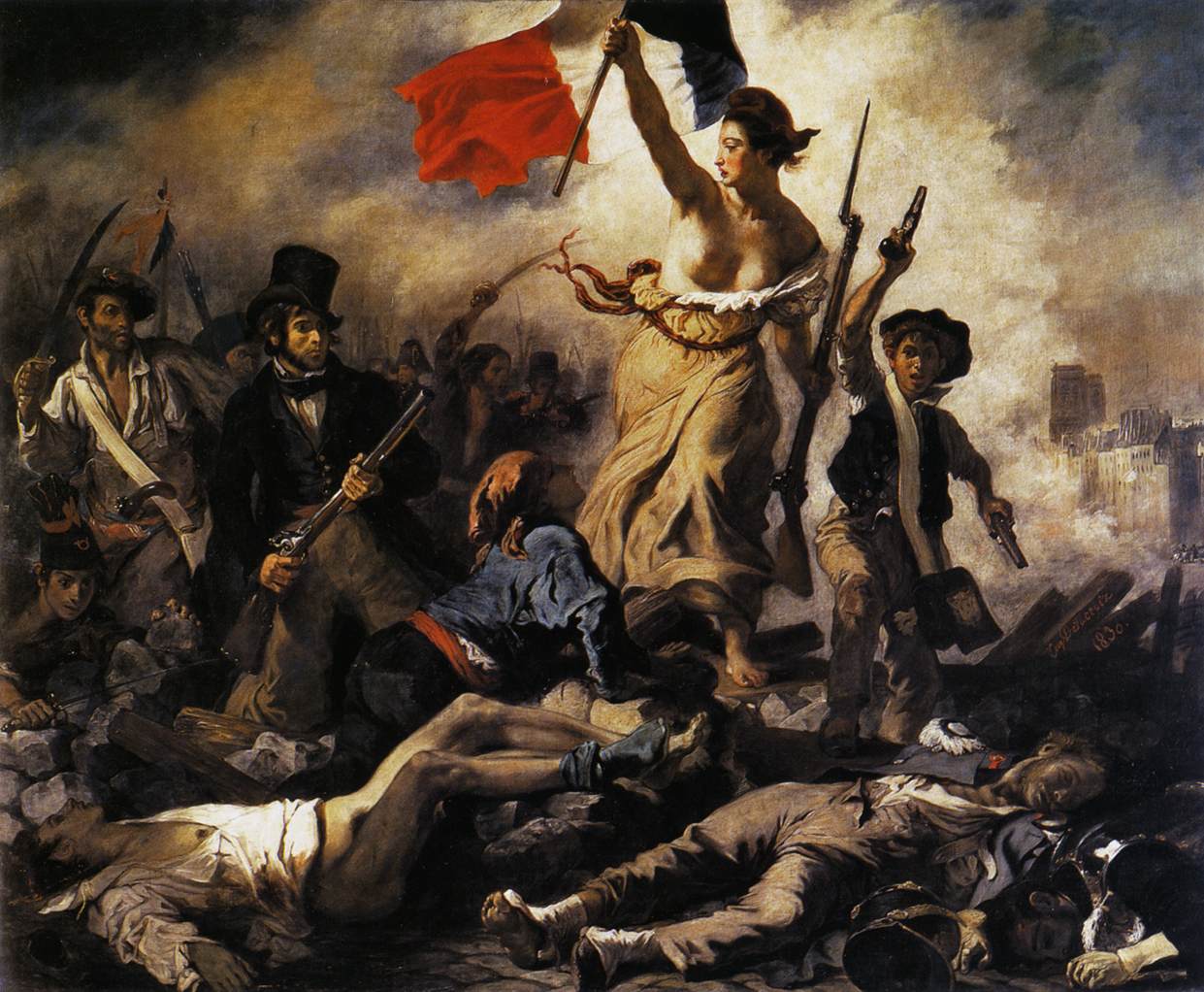
Probably the most famous image comes from the painting by Eugene Delacroix, Liberty Leading the Nation:

Eugene Delcroix's paiting, Liberty Leading the Nation,

Eugene Delacroix’s paiting, Liberty Leading the Nation, commemorating the 1830 uprising against the French King. That’s “Marianne” holding the flag.

That painting is in a division of the Louvre; it was defaced just this past February, in an odd September 11 protest, by a wacko who insisted the attacks on the World Trade Center and the United States were government-sponsored.   But I digress.

Christine Boutin, a former minister under Nicolas Sarkozy and founder of the Christian Democrat party, tweeted her disgust and her party called for a boycott of “this outrageous stamp”, saying it was an attack “on the dignity of women and the sovereignty of France” and should immediately be withdrawn.

Inna Shevchenko, a member of the women's rights group Femen. Photograph: Charles Platiau/Reuters

Inna Shevchenko, a member of the women’s rights group Femen. Photograph: Charles Platiau/Reuters

Femen, which often stages topless street protests, was started in Ukraine but is now based in Paris after Shevchenko was granted political asylum following outrage at her felling of a giant cross in Ukraine in support of the Russian band Pussy Riot.

Femen’s most high-profile protests in France have targeted the street demonstrations against same-sex marriage. It also recently staged an anti-fascist protest in Notre Dame cathedral and attempted to ambush the French president at an airshow.

Ciappa, whose exhibition of photographs of imagined gay couples was vandalised in Paris the anti same-sex marriage protests, wrote on Facebook on Monday that he had received “messages of threats and hatred” against him on Twitter, “some violent and some funny, such as Christine Boutin’s call to boycott my stamp”.

Yeah, but here’s the money line:

Shevchenko tweeted: “Femen is on French stamp. Now all homophobes, extremists, fascists will have to lick my ass when they want to send a letter.”

Several French artists have designed different Mariannes for French stamps, but this is thought to be the first inspired in part by a woman who isn’t French.

I have some bad news, perhaps, for U.S radical right-wing wackoes:  I understand that the model for the French symbol of Liberty, Marianne, was really Texas State Sen. Wendy Davis.   The artist was seeking a model who demonstrated the French ideal of a woman standing up to lead her nation against the supposed juggernaut of Fascist oppression and repression.  President Hollande is fearful of noting that, however, because he doesn’t want Texas Gov. Rick Perry to make a trip to France to poach businesses to move to Texas.

Texas State Sen. Wendy Davis reading documents at her Senate desk, in the photo perhaps used as a model for the new Marianne.

Texas State Sen. Wendy Davis reading documents at her Senate desk, in the photo perhaps used as a model for the new Marianne.

Hollande doesn’t fear any businesses would actually relocate from France to Paris; he just doesn’t want to waste any good French cheese or wine on a visiting Rick Perry.

In other Austin rumors, according to my sources at the groseille à l’oignon,  the Texas Republic asked France for rights to the image for their own anti-State of Texas postage stamps just to tick off Rick Perry and the FBI, and the Texas Tea Party is considering using Marianne as their image on their stationery, posters and bumper stickers.  If only they knew.

In the end, we have an entirely pointless, postage stamp tempest, with an artist sneaking in as a model a topless protester to play the role of the top-slipping symbol of French liberty, and typical French insouciance in arguments.  You know darn well that Harry Reid would love to use that line Ms. Schevchenko Tweeted — and so would Wendy Davis, and Rick Perry, and Joe Biden, and even Orrin Hatch.

Maybe all they have to do is pose topless, protesting some infringement on freedom.  Would they do that, even for freedom?

More:

Delcroix's painting on display in Lens, France, earlier in 2013.  Foreign Policy image.

Delcroix’s painting on display in Lens, France, earlier in 2013. Foreign Policy image.

The 2008 version of Marianne, under President Sarkozsy.

The 2008 version of Marianne, under President Sarkozsy. This is the immediate predecessor of the 2013 version.

1945 version of Marianne

From Stampboards.com: “Marianne” is a national emblem of France and an allegory of Liberty and Reason. She has been portrayed in various ways on a number of stamps issued by France over the years, often wearing a Phrygian cap, symbolic of Liberty. Here is an image of a stamp featuring my favorite version of her: the “Grande Marianne de Gandon,” designed and engraved by Pierre Gandon, and issued by France on March 12, 1945, Scott No. 556, Y&T No. 733.

Bust of Marianne sculpted by Théodore Doriot, in the French Senate.

Bust of Marianne sculpted by Théodore Doriot, in the French Senate.


Again: Why do we worry about global warming? It ain’t the climate, it’s the people

July 15, 2013

This is almost entirely an encore post, repeated for the benefit of the millions who missed it the first time who make fools of themselves when they argue we don’t need to save trees.  It’s not about trees.

Kids hiking in a forest. These are the humans environmentalists worry about, these four, and a few billion like them.  Photo from American Forests.

Kids hiking in a forest. These are the humans environmentalists worry about, these four, and a few billion like them. Photo from American Forests.

Alun Salt gave great advice about not bothering to engage idiots, pigs, denialists or trolls (here, among other places).  He said I should avoid lengthy answers to blogs that have little audience.

This is probably one of those occasions.

But in a running attempt to stimulate serious thought at a denialist blog, I got a question that has been rather common, and a question which indicates the deep serious misunderstanding denialists and even some well-meaning, overly-skeptical sensible people have:

Why worry about  climate change, since the climate is changing all the time?  Especially, why are people like Al Gore urging that we stop climate change, when CO2 has no great direct effect on human health?  Shouldn’t environmentalists be cheering climate change on, since it’s a “natural process?”

The answer is lost on the other blog, as Mr. Salt predicted it would be.  But since I’ve gotten some version of the question repeatedly in the last month, I may as well repeat the answer here, for the record.

The short answer to why we worry about climate change is that, as with almost all environmental protection, we are worried first about the quality of life of humans, and ultimately about the ability of human life to survive at all.

Here’s the question put to me there:

Ed I’m a little confused. I thought we were talking about the effect of co2 on the climate not the effect of co2 on human health. Co2 is not a toxic gas and would have no effect on human health. The fact that humans weren’t around when co2 was 10-20 times higher has absolutely nothing to do with its effect on climate.
Ed there was no runaway greenhouse effect [link added here] or climate catastrophe. The planet was fine during the phanerazoic. There is actually a lack of co2 in the atmopshere comapred to that time.

Here’s my answer, with a few more links than their format would allow:

No, you’re not a little confused.  You’re a lot confused, greatly misinformed, and not thinking hard.

We worry about CO2’s effects on climate only because we worry about the future of humanity.  Many of us who have children and wish them the same blessings of having children and grandchildren, have thought through the truth of the matter that we don’t possess and rule the Earth for ourselves, but instead act only as stewards for future generations.

No Earth, no humans; but at the same time, no habitable Earth, no humans.  In the long run, Earth doesn’t care.  It’ll do fine — without humans.

We can’t damage the planet.  We can only damage its habitability for humans.

I don’t know what sort of dystopian Randian future you and other Do Nothings hope for, but it’s a future contrary to human life, American values, and all known religions.

We’re talking about the future of humans.  I tell “skeptics,” “If you don’t care, butt out.  You’ll be dead in the short run anyway, but that’s no reason to stand in the way of action not to ensure a livable planet for our grandchildren.”

You also fail to understand chemistry, pollution, and how the world works.  CO2 is indeed a toxic gas.  For about a century now we’ve had indoor air standards that require air circulation to keep CO2 down below concentrations of about 500 5000 ppm [see comments], because at that level it starts to have dramatic effects on humans working.  It clouds their thinking and causes drowsiness.  CO2 is a conundrum, in that it is also necessary to trigger mammalian breathing.  If CO2 drops too low, we don’t take in enough oxygen and may pass out.  Too much oxygen in place of CO2 is a problem in that regard.  A substance can be both essential and a  pollutant, at the same time. (This has vexed food safety experts for years, especially after the 1958 Delaney Clause; substances we know to be essential nutrients can be carcinogenic, in the same concentrations, or in the same concentrations with a slight twist in chemical formula — how do we regulate that stuff?)

English: Main symptoms of carbon dioxide toxic...

Main symptoms of carbon dioxide toxicity (See Wikipedia:Carbon_dioxide#Toxicity). References: Toxicity of Carbon Dioxide Gas Exposure, CO2 Poisoning Symptoms, Carbon Dioxide Exposure Limits, and Links to Toxic Gas Testing Procedures By Daniel Friedman – InspectAPedia Davidson, Clive. 7 February 2003. “Marine Notice: Carbon Dioxide: Health Hazard”. Australian Maritime Safety Authority. Model: Mikael Häggström. To discuss image, please see Template talk:Häggström diagrams (Photo credit: Wikipedia)

CO2 is toxic in much greater proportions — it was a CO2 cloud that killed thousands in Cameroon 30 years ago or so, if you know history.

Clearly you did not know that we’ve regulated indoor CO2 for decades.  Clearly you haven’t looked at the medical journals‘ discussion on CO2 — and I’ll wager you’d forgotten the Cameroon incident, if you ever knew about it.

CO2 is a toxic gas (the dose is the poison); CO2 has dramatic effects on human health — too little and we die, too much and we die.

The fact that humans were not around when CO2 was much higher is exactly the point.  That was presented here, as it is in most venues, as support for a claim that we don’t need to worry about CO2 pollution.  Well, that’s right — if we don’t care about a habitable Earth.  But when CO2 was higher, life for humans was impossible.

I think it’s reckless to run an experiment on what would happen with higher CO2 levels, using the entire planet as a testing place, and testing the hypotheses on just how much CO2 will kill us all off, and how.

How about a control group, at least?

In the past, massive CO2 created massive greenhouse effects that would devastate us today — not as a toxic gas, but as a result of the warming that greenhouse gases do.

Let us understand the physical conundrum of CO2 here:  Without the greenhouse effect from the human-historic levels of CO2, this would be an ice planet.  Our lives today depend on the greenhouse effects of CO2.

Consequently, anyone who claims there is no greenhouse effect fails to understand physics, chemistry, biology and history.  (Heck, throw in geology, too.)  Life would be impossible but for the greenhouse effect.  Life is impossible without water, too, but you can’t live totally surrounded by water.

Can it be true that there can never be too much of a good effect, with regard to greenhouse gases?  Ancient Greek ideas of “all things in moderation” applies here.  We need a Goldilocks amount of CO2 in our atmosphere — not to much, not too little; not too hot, not too cold.

To the extent that higher CO2 levels didn’t produce a total runaway greenhouse effect, as some hypothesize exists on Venus, we know that was due to other feedbacks.  Early on, for example, CO2 began to be reduced by photosynthesizing life.  Animal life today would be impossible but for that occurrence.  Few if any modern chordates could breathe the very-low oxygen atmosphere of the early Earth, and live.  Those feedbacks and limiting situations do not exist today.

Greenhouse Effect

Greenhouse Effect. Wikipedia image

So now we face a double or triple whammy.  The reduction in CO2 in the air was accomplished through a couple billion years of carbon sequestration through plants.  In fact, a lot of carbon was sequestered in carbon-rich fossils, stuff we now call coal and oil.  Oxygen replenishment was accomplished with massive forests, and healthy oceans, with a great deal of photosynthesis.  This created a rough CO2 equilibrium (with fluctuations, sure) that existed we know for at least the last 50,000 years, we’re pretty sure for the last 100,000 years (we know that from carbon-dating calibration exercises).

Today we have removed fully 30% of the forests that used to replenish oxygen and lock up a lot of CO2 (some estimates say 50% of the forests are gone); modern plant communities cannot pluck CO2 out fast enough.  Plus, we’re releasing a lot of that old, sequestered carbon in coal and oil — at rates unprecedented in human history.

Will more CO2 warm the planet?  We know from the fact that the planet is warm enough for life, that more CO2 will warm the planet more.  Anyone who says differently does not know physics and chemistry, nor history.

Is there anything that can stop that effect?  Sure — healthy, massive forests, and healthy oceans.  Reducing carbon emissions could help a lot, too.  But we’re committed for about a century.  CO2 in the atmosphere doesn’t fall to the ground like particulate pollution.  it drifts until it is incorporated into something else, either through photosynthesis or other chemical reactions.  It takes a mole of CO2 a couple of centuries to come out of the air.  We’re stuck with elevated and elevating CO2 regardless our actions, for a century or two, even if we are wildly successful in reining in emissions and creating sequestration paths.

What happens when CO2 levels get higher than 350 ppm?  History, physics and chemistry tells us glaciers will melt, rainfall patterns will alter dramatically, sea levels will rise, carbon will be absorbed by the seas in increasing amounts (causing acidification — simple chemistry).  [See the counter in the right column of this blog; by July 2013, CO2 temporarily climbed above 400 ppm in a spike, and rested dangerously close to 400 ppm constantly.]

It’s a very exciting experiment.  The entire human race is at stake. How much CO2 will it take to produce the effects that kill us all?  It’s likely that changing rainfall patterns and rising sea levels will produce wars over resources, long before CO2 itself starts being physically toxic.  That’s what the Pentagon’s big thinkers say.  That’s what the Chinese big thinkers say, which is why they are working to reduce emissions even without an enforceable treaty.

As experiments go, I think it’s immoral to use humans in experimentation without getting their consent, and without passing the entire experiment through the Institutional Review Board to make sure the experiment is useful, necessary, and done ethically.

Do you have those consent statements?  All seven billion of them?  Have you got approval from the research overseers of the institution?

If you don’t have permission to proceed with this progeny-killing experiment, why do you propose to proceed?  Many people believe that, if the courts on Earth don’t get us, a higher court will.

How will you plead wherever the call to justice is delivered?

More:


July 10, 1850, Millard Fillmore succeeds to the presidency

July 10, 2013

Millard Fillmore was elected vice president largely because he was on the ticket with the very popular Gen. Zachary Taylor, hero of the Mexican War.

About 15 months into his presidency, President Taylor took ill  after presiding over July 4 festivities in blazing heat.  He died on July 9, 1850; Vice President Millard Fillmore took the oath as president the next day, and served out the term.  163 years ago today, Millard Fillmore served his first day as President.

Millard Fillmore in an 1850 lithograph by Francis DAvignon after a photograph by Matthew Brady (unclear if this was before or after his ascending to the presidency) - Library of Congress image

Millard Fillmore in an 1850 lithograph by Francis D’Avignon after a photograph by Matthew Brady (unclear if this was before or after his ascending to the presidency) – Library of Congress image

Taylor had encouraged New Mexico and California to draw up state constitutions, which would have disallowed slavery in those states.  To southern leaders who threatened secession, Taylor promised to personally lead the army that would hold the union together by force, and personally hang those who had proposed rebellion.

Fillmore had presided over the Senate during months of furious debate on issues that always seemed to come down to slavery.  Because he didn’t hold to the views of the Whig Party which had elected the Taylor-Fillmore ticket, even more than Taylor had strayed, the cabinet resigned.  Fillmore appointed Daniel Webster as Secretary of State, and proceeded to push for compromise on issues to avoid war.  His machinations helped get California admitted as a free state, but left New Mexico as a territory.  His support of the Fugitive Slave Act alienated even more Whigs, and by 1852 the Whigs refused to nominate Fillmore for a term of his own.  He left office in 1853, succeeded by Franklin Pierce.

Fillmore’s greatest accomplishment as president, perhaps, was his sending a fleet of ships to Japan to force that nation to open up to trade from the U.S.  The political furor over the Fugitive Slave Act, the Missouri Compromise, and other issues around slavery, tend to eclipse the memory of the good that Fillmore did.

Nota bene:  Controversy surrounded the death of Taylor.  Because he had threatened southern secessionists and incurred anger from several other groups, from the time of his death there were rumors he had been poisoned with arsenic.  Officially, the cause of death was gastroenteritis; popular accounts note that he had, in the heat of July, drunk milk and eaten cherries and cucumbers.  Certainly strep, staph or other bacteria in the milk could have created a problem.  In 1991 a team led by George Washington University Law Professor James Starrs exhumed Taylor’s body from his Louisville, Kentucky burial plot, and tested his remains for arsenic at the Oak Ridge National Laboratory.  Analysis presented to the Kentucky medical examiner indicated arsenic levels way too low for a poisoning victim.

[This is an encore post, in parts.]

More:

"An Available Candidate: The One Qualific...

“An Available Candidate: The One Qualification for a Whig President”. Political cartoon about the 1848 presidential election which refers to Zachary Taylor or Winfield Scott, the two leading contenders for the Whig Party nomination in the aftermath of the Mexican-American War. Published by Nathaniel Currier in 1848, digitally restored. (Photo credit: Wikipedia)  Despite the cynicism of many , Zachary Taylor won the Whig Party nomination, and the presidency.  Taylor died just over a year after his inauguration.


History of America, or art in America, or American art, or . . .

July 9, 2013

Brilliant piece from Grant Snider — history teachers, this should be a poster in your classroom, no?  Art teachers?

Grant Snider's

Grant Snider’s “American Art, exploring a country through its paintings”

In the course of a junior-level, high school U.S. history class, students should experience each of these works, and many others.  This is one whimsical way to work with serious and uplifting material, no?

Mr. Snider has a short essay — inspiring — and the information on each of the works he portrays, at the Modern Art site (I’ve added links below, here).

Since that formative vacation, the art museum is always one my of first stops in visiting a new city. In the comic above, I’ve curated my ideal collection of 20th-century American art. Here’s a list of works in order of appearance:

Jasper Johns, “Flag”

Edward Hopper,Morning Sun

Ellsworth Kelly, “Red Blue Green”

Wayne Thiebaud, “Refrigerator Pie”

Grant Wood, “Young Corn”

Roy Lichtenstein, “Whaam!”

Stuart Davis, “Colonial Cubism”

Andy Warhol, “Campbell’s Soup Cans”

George Bellows, “Dempsey and Firpo”

Jackson Pollock, “Autumn Rhythm”

Georgia O’Keeffe, “Sky Above Clouds III”

What are your favorite American art works, and what do they portray or demonstrate that you like?

More: