Darwin’s death, April 19, 1882

April 20, 2013

We shouldn’t get out of April 19 — a day marked by significant historic events through the past couple hundred years — without remembering that it is also the anniversary of the death of Darwin.
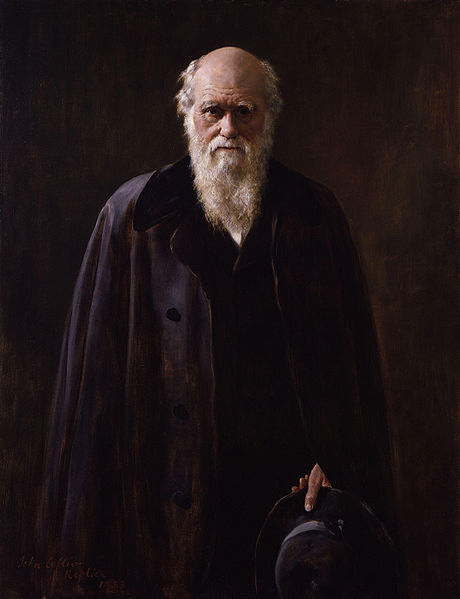
Charles Darwin in 1881, by John Collier

Charles Darwin in 1881, portrait by John Collier; after a Collier painting hanging in the Royal Society

Immortality?  Regardless Darwin’s religious beliefs (I’ll argue he remained Christian, thank you, if you wish to argue), he achieved immortality solely on the strength of his brilliant work in science. Of course he’s best known for being the first to figure out that natural and sexual selection worked as tools to sculpt species over time, a theory whose announcement he shared with Alfred Russel Wallace, who independently arrived at almost exactly the same theory but without the deep evidentiary backup Darwin had amassed.

But had evolution turned out to be a bum theory, Darwin’s other works would have qualified him as one of the greatest scientists of all time, including:

Darwin's theory set out a sequence of coral re...

Darwin’s theory set out a sequence of coral reef formation around an extinct volcanic island, becoming an atoll as the island and ocean floor subsided. Courtesy of the U.S. Geological Survey (Photo credit: Wikipedia)

US Geological Survey graphic demonstrating how coral atolls form on the sinking remains of old volcanic sea mounts, as Darwin described. Wikimedia commons image

  • World’s greatest collector of biological samples:  During his five years’ voyage on HMS Beagle, Darwin collected the largest collection of diverse plant and animal life ever by one person (I believe the record still stands); solely on the strength of his providing actual examples to the British Museum of so much life in so many different ecosystems worldwide, before he was 30 Darwin won election to the Royal Society.  (His election was engineered partly by friends who wanted to make sure he stayed in science, and didn’t follow through on his earlier plan to become a preacher.)
  • Geology puzzle solver:  Coral atolls remained a great geological mystery.  Sampling showed coral foundations well below 50 feet deep, a usual limit for coral growth.  In some cased old, dead coral were hundreds of feet deep.  In the South Pacific, Darwin looked at a number of coral atolls, marvelous “islands” that form almost perfectly circular lagoons.  Inspired partly by Lyell’s new encyclopedic review of  world geology, Darwin realized that the atolls he saw were the peaks of volcanic mounts.  Darwin hypothesized that the volcanoes grew from the ocean floor to the surface, and then the islands were colonized by corals.  The round shape of the volcano gave the atoll its shape.  Then the volcanic mounts eroded back, or sank down, and corals continued to grow on the old foundations.  It was a perfectly workable, natural explanation for a long-standing geologic puzzle.  (See Darwin’s monograph, Structure and Distribution of Coral Reefs.)
  • Patient watcher of flowers:  Another great mystery, this time in biology, concerned how vines twined themselves onto other plants, rocks and structures.  Darwin’s genius in designing experiments shone here:  He put a vine in his study, and watched it.  Over several hours, he observed vine tendrils flailing around, until they latched on to something, and then the circular flailing motion wrapped the tendril around a stick or twig. Simple observation, but no one had ever attempted it before.  (See On the Movements and Habits of Climbing Plants.)
  • Champion of earthworms, and leaf mould:  Darwin suspected the high fertilizer value of “leaf mould” might be related to the action of earthworms.  Again, through well-designed experiments and simple observation, Darwin demonstrated that worms moved and aerated soil, and converted organic matter into even richer fertilizer. (See The Formation of Vegetable Moulds Through the Action of Worms.)
  • Creation of methodological science:  In all of this work, Darwin explained his processes for designing experiments, and controls, and made almost as many notes on how to observe things, as the observations themselves.  Probably more than any other single man, Darwin invented and demonstrated the use of a series of processes we now call “the scientific method.”  He invented modern science.

Any of those accomplishments would have been a career-capping work for a scientist.  Darwin’s mountains of work still form foundations of geology and biology, and are touchstones for genetics.

Born within a few hours of Abraham Lincoln on February 12, 1809, Darwin survived 17 years longer — 17 extremely productive years.  Ill through much of his life with mystery ailments, perhaps Chaga’s Disease, or perhaps some other odd parasite or virus he picked up on his world travels, Darwin succumbed to heart disease on April 19, 1882.

More:


Anniversary of Paul Revere’s ride, in the middle of National Poetry Month

April 18, 2013

This is mostly an encore post.  Is there a good reason Paul Revere made his ride in the middle of National Poetry Month

_____________

April 18 and 19. Do the dates have significance? Paul Revere's ride, from Paul Revere House

Among other things, April 19 is the date of the firing of the “shot heard ’round the world,” the first shots in the American Revolution. On April 19, 1775, American Minutemen stood to protect arsenals they had created at Lexington and Concord, Massachusetts, against seizure by the British Army then occupying Boston.

April is National Poetry Month. What have we done to celebrate poetry?

What have we done to properly acknowledge the key events of April 18 and 19, 1775? Happily, poetry helps us out in history studies. Or it can do.

In contrast to my childhood, when we as students had poems to memorize weekly throughout our curriculum, modern students too often come to my classes seeming wholly unaware that rhyming and rhythm are used for anything other than celebrating materialist, establishment values obtained sub rosa. Poetry, to them, is mostly rhythm, certainly not for polite company, and never for learning.

Poetry has  slipped from our national curriculum, dropped away from our national consciousness.  No national test adequately covers poetry, not in English, not in social studies — certainly not in math or science.

That is one small part of the reason that Aprils in the past two decades turned instead to memorials to violence, and fear that violence will break out again. We have allowed darker ideas to dominate April, and especially the days around April 19.

You and I have failed to properly commemorate the good, I fear. We have a duty to pass along these cultural icons, as touchstones to understanding America.

So, reclaim the high ground. Reclaim the high cultural ground.

Read a poem today. Plan to be sure to have the commemorative reading of “Paul Revere’s Ride” in your classes on April 18 or 19, and “The Concord Hymn” on April 19.

We must work to be sure our heritage of freedom is remembered, lest we condemn our students, our children and grandchildren to having to relearn these lessons of history, as Santayana warned.

Texts of the poems are below the fold, though you may be much better off to use the links and see those sites, the Paul Revere House, and the Minuteman National Historical Park.

Read the rest of this entry »


‘Twas the 18th of April in ’75 . . . (Paul Revere’s Ride, 243rd anniversary)

April 18, 2013

The annual reminder:

Paul Reveretonight’s the anniversary of his famous ride.

John Copley's painting of Paul Revere

Paul Revere, 1768, by John Singleton Copley (1738-1815)

John Copley painted all the bigwigs of revolutionary Boston, including this portrait of the famous horse-mounted alarm before he turned older and grayer.

And as April 18 is the anniversary of Revere’s ride, April 19 is the anniversary of the “shot heard ’round the world.”

Both events are celebrated in poetry; April is National Poetry Month. This could be a happy marriage for history and English classrooms.

Teachers, this is your cue to break out the Longfellow and Emerson and Whitman, and tie them together in the thread that runs from the French and Indian War clearly through the American Civil War, and we might hope, to today.  Give the kids some culture to get their mental juices flowing for the tests.

National Poetry Month 2013 poster

More:


Belated Happy birthday, Mr. Jefferson

April 16, 2013

Sometimes I think tax day was pushed back to April 15 just to foul up everybody’s plans for Thomas Jefferson‘s birthday.

New statue to Thomas Jefferson at the University of Virginia at Wise. Dedicated in 2013.  Sculptor was Edward Hlavka.

New statue to Thomas Jefferson at the University of Virginia at Wise. Dedicated in 2013. Sculptor was Edward Hlavka.

Jefferson was born on April 13, 1743, and I miss the anniversary almost every year — like I did this year.

Oh, well.  Next year in Charlottesville.

Jefferson’s birthday should be a holiday, don’t you think?  Religious Freedom Day, or Public Education Day, or Self-evident Truths Day — something to honor Thomas Jefferson.

A while back, Catherine Sherman wonderfully explained why we should celebrate Jefferson’s birthday.  Go see.

Tom was 270, in 2013.

More:


So-called conservatives out of their minds — still, but moreso: 3 reasons not to fear ‘Brave New World’

April 11, 2013

You can’t make up this kind of crazy.  This guy’s been Tweeting this to everyone he can find on Twitter:

Seriously?  Hatcheries for children?

Isaac Asimov‘s great off-the-cuff essay one why 1984 wouldn’t be like 1984 is sort of a prototype of the sort of take-down of dystopias one finds in literary and historical circles.  (Once I had a link to a version of the essay, but it’s buried in the bowels of the internet now.)

First edition cover

Is this where we are going, so rapidly in this handbasket? First edition cover, Aldous Huxley’s Brave New World – Wikipedia image

But it never makes the true crazies see the light.  They can’t see contrary evidence.

Asimov’s essay noted Orwell’s lack of foresight in simple things, and human things.  In Orwell’s Big Brother dystopia, Winston Smith couldn’t get razor blades or shoe laces, indicators of the economic failures of Big Brother.  Asimov wrote that, in reality,  he used an electric razor, and wore slip-on shoes.  Blades and laces were foreign to his world, too, but not evidence of dystopia; instead, they were evidence of changing fashion and innovation. Orwell thought Big Brother would watch everyone with electronics.  We learned that people as a mass, who use phones, especially cell phones, and the internet, put out too much information in total for a Big Brother to make sense of it, absent other indicators — and that even when hints of wrong-doing turn up, the bureaucracies tend to prevent quick action, or any action at all.  (See the report of the 9/11 Commission.)

One wishes Asimov were alive to do a take-down of the Brave New World fears.  One also suspects those living in fear of Huxley wouldn’t understand the takedown.

Huxley himself gave it away.  Nothing in scientific discoveries has altered Huxley’s errors of prediction (if he was “predicting” and not simply fantasizing).

So, here are three reasons a rational human should not fear we are on the verge of Brave New World, as Huxley scared us all:

  1. Huxley’s dead, and out of date.  Huxley died 50 years ago (on November 22, 1963, coincidentally enough — Sam Theissen with find some omen in that; superstition can’t be stamped out of those who refuse to learn).  Huxley’s premises, his assumptions about society, don’t work in a modern world.  Huxley’s imaginings were almost pre-modern science.  His story doesn’t imagine electricity on the Navaho or Hopi or Apache reservations.  He didn’t foresee Interstate Highways, nor even Route 66, and America’s love affair with travel and the automobile.  He didn’t see the rise of broadcast television and radio, nor rock ‘n roll, nor especially did he see the cultural effects of popular radio on U.S., British or world politics.  Huxley assumes a Soviet-style dictatorship can work.  We know better.  We have Solzhenitsyn.  We had Sakharov protesting in the Soviet Union, and Oppenheimer protesting in the U.S.  That should also remind us that Huxley missed nuclear power.  Huxley simply missed most of the technology and especially culturally-affective technology that makes a Brave New World impossible.
  2. Human hatcheries don’t work.  Hatcheries work for fish; we’ve been unable to make them work for most birds.  Critically, they don’t work for humans, nor for any other complex mammalian — nor chordate, in the ways Huxley describes the embryoes being programmed for certain kinds of intelligence and physical traits.  Oddly, that seems to be the focus of Thiessen’s fears — but the technology simply doesn’t work.
  3. Sex is fun. Huxley’s story required that sex and procreation be done away with.  Oh, there was some sex — but procreative sex is presented as a shameful character flaw, like patricide, embezzling or drug dealing.  Brave New World is frustrated, in the 20th century, by the backseats of cars and the simple fact that sex is so much fun.  Raising kids is fun, too, and valued by adults the world over, a value that got much more expression after World War II.

It’s difficult to imagine kids in high school reading Brave New World without giggling, and without noting the difficulties of the story now (try to get a high school kid to believe Superman used phone booths . . .).

Sam Thiessen is convinced civilization will collapse — he’s written books about it.  I wonder about people who miss the ultimately fatal flaw of Huxley’s story, that humans love one another, and humans like to have sex.  Those who fear Huxley’s book is a forecast, I think, either don’t get enough sex, or don’t know how.

The things are going with current witch hunts, Texas teachers who use Huxley’s book should look out — Thiessen and his fellow travelers will soon accuse them of indoctrinating students in the stuff, instead of warning them against it.  After all, Thiessen seems to have missed the warnings himself.

I’d wager that in other rants, self-titled conservatives and libertarians like Thiessen rail at the usual-suspect decline in morals, including a lot of actions shocking to them, caused by the fact that most people find sex really fun.  Does it not make sense that they’d take a step back, and see that the behavior they claim disgusts them, also makes possible the broken future they fear?

Oblivious to this odd balance of freedoms, they then campaign to end the immorality they see, never thinking that by doing so they advance the dystopia they claim to fear.  What a tangled web we weave when first we practice to misperceive.

More:

A note about the title of the book:

O wonder!
How many goodly creatures are there here!
How beauteous mankind is! O brave new world,
That has such people in’t.

  ♦ William Shakespeare, The Tempest, Act V, Scene I; spoken by Miranda


Millard Fillmore waxes on

April 5, 2013

Millard Fillmore at Madame Tussaud's, D.C.

President Millard Fillmore, as displayed at Madame Tussaud’s Wax Museum, Washington, D.C.; photo from About.com

Ever on the lookout for images of Millard Fillmore, I found this photo at About.com.  This is the “wax” sculpture of Fillmore displayed at Madame Tussaud’s Wax Museum – D.C.

Is it art?

More:


Monument to brevity: Remembering William Henry Harrison

April 4, 2013

(There are a few minutes left in April 4, at least in the Central Time Zone.  Bad day for posting, here.)

William Henry Harrison died on April 4, 1841, 31 days after his inauguration as president of the United States.

Perhaps during the cold and rainy inauguration, perhaps from a well-wisher, Harrison caught a cold. The cold developed into pneumonia. The pneumonia killed him.

William Henry Harrison, circa 1813, painted by Rembrandt Peale.  Naitonal Portrait Gallery

William Henry Harrison, circa 1813, painted by Rembrandt Peale. National Portrait Gallery

Harrison, a Whig, was the first president to die in office. His vice president, John Tyler, was a converted Democrat who abandoned the Whig platform as president.

Harrison won fame pushing Indians off of lands coveted by white settlers in the Northwest Territories. Harrison defeated Tecumseh’s Shawnee tribe without Tecumseh at the Battle of Tippecanoe, then beat Tecumseh in a battle with the English in which Tecumseh died in the War of 1812.

Schoolchildren of my era learned Harrison’s election slogan: “Tippecanoe, and Tyler, too!”

Congress voted Harrison’s widow a payment of $25,000 since he had died nearly penniless. This may be the first example of a president or his survivors getting a payment from the government after leaving office.

In the annals of brief presidencies, there is likely to be none shorter than Harrison’s for a long time. As you toast him today, you can honestly say he did not overstay his White House tenure. Others could have learned from his example.

This is an encore post, from 2008; new links added.

More:


CSCOPE chart Glenn Beck doesn’t want you to see

April 2, 2013

. . . because he screwed it up.

Thanks to Morgan Freeberg over at House of Eratosthenes — shows he’s a fair player (I doubt he’s got much sympathy with the CSCOPE project).

Here’s the chart Glenn Beck, or perhaps his partner-in-calumny David Barton, appears to have mis-identified, the one that no one else who joined his witch-hunt bandwagon bothered to read:

CSCOPE chart on economics

CSCOPE chart on rise of economic systems in the 19th century that critics claim, erroneously, promotes socialism and Marxism. This is copyrighted material, posted here in the interests of correcting false claims. Will CSCOPE complain?

I’m not sure which episode of “The Blaze” this appeared on in the fuzzy version in my earlier post (anyone know?); but it’s clear that it’s been grotesquely mischaracterized by CSCOPE critics.  Think about a Texas high school kid; the readings say communism prohibits private property ownership.  Given that, how do you think a Texas high school student — generally a sophomore for  world history —  would answer the questions in the “Communism” box:

What about Private Property?

How much government control?

(Say it ain’t so, Glenn Beck:  Did David Barton really complain that Texas’s curriculum puts the family at the the foundation of our culture, and our government?  (Yes, he did.)  He fought to get that in; is Barton on drugs, or depressed, or drunk?  If so, get him help.  If not, he’s corrupt.)

More, from the rational world:

More from the irrational world, the Wall of Shameful reporting:

English: Cropped from a photo of a group of pr...

Cropped from a photo of a group of predominantly anti-Glenn Beck protesters holding home-made placards in Beck’s hometown of Mt. Vernon, Washington, outside the venue where Beck received the ceremonial key to the town. Even his home town people don’t believe him. Photo via Wikipedia


Over 65? Why go on? Pete Seeger shows us

April 2, 2013

Intrigued to learn our old friend Pete Seeger signed up for a Twitter account — years ago.  Pete tweets regularly.

He’s an encouragement to all of us.  He boasts that there is no group he has ever refused to sing for, and in his typical humility, he claims that he can get any group to join, so they do all the heavy lifting.

Pete keeps up a schedule of concerts, most for causes.  He sails with the sloop Clearwater, campaigning for clean water on the Hudson River (much accomplished) and community efforts to change things for the better.  As you will see below, he pulls his own when raising the sails.    He cuts his own wood to heat the house he built.

Pete will be 94 on May 3, 2013.

Why does he keep on going?  He might be telling us, from this 2012 recording.

More:  

English: This graphic was used for the cover o...

Cover of Pete Seeger’s single release (same photo on an album). The banjo features Pete’s traditional “This machine surrounds hate and forces it to surrender,” a twist on a sticker famously seen on his old friend Woody Guthrie’s guitar. Wikipedia image


I get email (sorta): How long could U.S. survive without a president?

March 31, 2013

A brilliant and vexing former student, Bryan Sabillon, asked a question — on Facebook:

Remember how you said America can’t go two hours without a president? What’s the worst that can happen if it just so happens to take three-four hours? Or is it uneventful?

Interesting question — to me, at least, and maybe even to Bryan.  Here’s my response, with a few links added:

Did I say that? (Some context would be nice. No I don’t remember saying that.)

Technically, can’t happen now with the 25th Amendment and succession laws; if a president dies, another is there, probably without regard to swearing in.

A few historical examples suggest no big problem; these are nullified if missiles are in the air at that moment, though:

1. When Tyler succeeded Harrison 1 (first death of president in office), John Tyler was more than 24 hours out of Washington. Worse, many people thought that while the duties of the president fell to the VP under the Constitution, that should be a temporary condition settled by a special election. Despite all this uncertainty, nothing bad happened in the interim.

U.S. Sen. David Rice Atchison, from Missouri; photo by Matthew Brady

U.S. Sen. David Rice Atchison, from Missouri; photo taken by photographer Mathew Brady at the United States Capitol at Washington, D.C., March 1849. Courtesy of the Beinecke Rare Book & Manuscript Library, Yale University, via Wikipedia. Photo taken the same month some say Atchison was acting President, for one day.

2. On March 4, 1849, [James K.] Polk’s term expired. But it was Sunday, and incoming Pres. Zachary Taylor refused to be inaugurated on Sunday. So did incoming VP Millard Fillmore. Some argue that David Rice Atchison, the President Pro Tempore of the Senate and then-third in line for the presidency under the laws then existing, was president for one day. He didn’t claim that, but in any case, spent most of the day sleeping, as the outgoing Senate had been working late for several previous nights. Some argue that because the Senate had adjourned sine die on its last session, not even Atchison was president. In any case, nothing happened.

President of the Senate Vice President Chester...

Official Senate bust, President of the Senate, Vice President Chester A. Arthur (it’s a bust; he was not really that pallid) Photo from Wikipedia

3. When [James] Garfield was shot, he did not die immediately, but hung on for more than a month before infection took him. Vice President Chester A. Arthur did not assume duties of president, nor did anyone else, in that period. A lot of stuff got delayed, but no big deal. Government continued during the long dying process, and until Arthur was sworn in.

4. Similarly, when [William] McKinley was shot, they thought he’d survive. VP Teddy Roosevelt took off to hunt in the Adirondacks. When McKinley took a turn for the worse, guides had to be dispatched to find Teddy climbing a mountain (Mt. Marcy); by the time he got to Buffalo, McKinley had been dead for several hours. Nothing of consequence happened as a result of there being no president on hand (and they were in Buffalo, New York, not Washington, anyway).

5. Woodrow Wilson suffered a stroke on October 2, 1919, that left him blind in one eye and unable to walk. He was kept out of the presence of the VP and cabinet for months; when he finally returned to cabinet meetings in 1920, he was clearly unable to function as president. It’s an interesting case with his second wife essentially taking over the office under the guise of intermediary and care giver to the president. This one may have had some consequences – the Senate never did ratify the Treaty of Versailles, for which Wilson was campaigning when he was stricken, and so the U.S. never joined the League of Nations, dooming it to failure years later as World War II erupted. But perhaps Wilson couldn’t have gotten it ratified had he been fully active, anyway. Perhaps Wilson could have influenced the election of 1920, which Warren G. Harding won (who would die of a heart attack in San Francisco, making Calvin Coolidge president). But all of that is pure conjecture.

6. The funniest (in retrospect) was when Ronald Reagan was shot. At a press conference at the White House as Reagan was being prepped for surgery, a reporter asked some cabinet officials “who is in charge?” Perhaps reacting too much to the question as a challenge to whether the government was leaderless and vulnerable, Secretary of State Al Haig grabbed the microphone and said “I’m in charge here!” In reality, Vice President George H. W. Bush was in full communication mode of the modern presidency; control of the “football,” the nuclear strike code case which accompanies the president at all times, could have been an issue, but was not.

President Obama waving

President Obama at an airport; the Marine in the background looks to be carrying the “nuclear football.” Photo from Cryptome (Is this an AP photo? Anyone know?)

Under the 25th Amendment and the Succession Act, it’s difficult to imagine how the U.S. could be without a president at any time; the confusion around the death or disability of a president offers a window of a de facto gap, but that should last only minutes under the procedures and precautions now in effect (some of which we saw on 9/11).

Worst that could happen now? If missiles were incoming, and confusion over who has control of the football went on for more than 10 minutes, a retaliatory strike could be late in getting launched. It takes about 15 minutes for intercontinental ballistic missiles to get to their downward path, or to register on known radar, so a ten minute delay might be encouraging to a Russia that hoped to knock out the U.S. before a retaliatory strike could occur; but that’s probably not realistic. And, even that would be of no great consequence if the secret “missile net” many people think the U.S. has, actually exists.

Is this a class question, or are you involved in some odd drinking game again?

(Update:  Sheesh.  Turns out he just saw “Olympus Has Fallen,” and wondered.

Everyone knows we’re really safe, so long as Morgan Freeman is anywhere near the presidency, even Speaker of the House.)

(Anyone else seen the movie?  Is it a scenario not already contemplated under the 25th Amendment?)

More:

Voice of America video on Al Haig’s life, featuring the famous quote:


Historic images, encore: Quanah Parker, Last Chief of the Comanches

March 25, 2013

Glenn Frankel at the University of Texas wrote a book about the John Ford movie, “The Searchers.” It’s release, and stories about it, should remind us of the history of Quanah Parker, the last great, chief of the Comanches.  “The Searchers” was loosely based on a true story, the kidnapping of Cynthia Ann Parker, by Comanches, and her subsequent life with the tribe, and her recapture by white relatives.  She had married in the tribe — Quanah Parker was her son.

Back in June 2008 I posted this:

Quanah Parker, photo by Lanney

Quanah Parker, a Kwahadi Comanche chief; full-length, standing in front of tent.
Photographed by Lanney. Public Domain photo.
National Archives, “Pictures of Indians in the United States”

Photographs of Native Americans reside among the publicly and internet available materials of the National Archives. Images can be ordered in sets of slides, or as individual prints, though many are available in quality high enough for PowerPoint works and use on classroom materials. Many of the photos are 19th century.

Quanah Parker stands as one of the larger Native Americans in Texas history. This photo puts a face to a reputation in Texas history textbooks. Texas teachers may want to be certain to get a copy of the photo. His life story includes so many episodes that seem to come out of a Native American version of Idylls of the King that a fiction writer could not include them all, were they not real.

  • Quanah’s mother was part of the famous Parker family that helped settle West Texas in the 1830s. Cynthia Ann Parker was captured in 1836 when Comanches attacked Fort Parker, near present-day Groesbeck, Texas, in Limestone County. (See Fort Parker State Park.) Given a new name, Nadua (found one), she assimilated completely with the Nocona band of Comanches, and eventually married the Comanche warrior Noconie (also known as Peta Nocona). Quanah was their first child, born in 1852.
  • Nadua was captured by a Texas party led by Lawrence Sullivan “Sul” Ross in 1860, in the Battle of Pease River. Noconie, Quanah, and most of the Nocona men were off hunting at the time, and the fact of Nadua’s capture was not realized for some time. Nadua asked to return to the Comanches and her husband, but she was not allowed to do so. When her youngest daughter, who had been captured with her, died of an infection, Nadua stopped eating, and died a few weeks later.
  • Sul Ross was a character in his own right. At the time he participated in the raid that recaptured Cynthia Parker, he was a student at Baylor University (“What do I do on summer breaks? I fight Indians.”) At the outbreak of the Civil War, Ross enlisted in the Confederate Army as a private. Over 135 battles and skirmishes he rose to the rank of Brigadier General, the ninth youngest in the Confederate Army. A successful rancher and businessman back in Texas after the war, he won election as governor in 1887, served two very successful terms (he resolved the Jaybird-Woodpecker War in Fort Bend County, and had to call a special session of the legislature to deal with a budget surplus), refused to run for a third term, and was named president of Texas Agricultural and Mechanical College (Texas A&M) within a few days of stepping down as governor. Ross’s leadership of the college is legendary — students put pennies near a statue of Ross in a traditional plea to pass final exams, among many other traditions. After his death, Texas created Sul Ross State University, in Alpine, Texas, in his honor.
  • Quanah Parker’s father, Noconie, died a short time after his mother’s capture. He left the Nocona band, joined the Destanyuka band under Chief Wild Horse, but eventually founded his own band with warriors from other groups, the Quahadi (“antelope eaters”) (also known as Kwahadi). The Quahadi band grew to be one of the largest and most notorious, always with Quanah leading them. The Quahadis refused to sign the 1867 Medicine Lodge Treaties, and so avoided immediate internment to a reservation. However, dwindling food supplies and increasing opposition forced Quanah to retire to a reservation in 1875, in what is now southwestern Oklahoma. This was the last Comanche band to come to the reservation.
  • Quanah was appointed Chief of all the Comanches.
  • Through investments, Quanah became rich — probably the richest Native American of his time.
  • Quanah hunted with President Theodore Roosevelt.

    Quanah in European-American business attire.

    Quanah in European-American business attire. (Photo credit: Wikipedia)

  • Rejecting monogamy and Christianity, Quanah founded the Native American Church movement, which regards the use of peyote as a sacrament. Quanah had been given peyote by a Ute medicine man while recovering from wounds he’d suffered in battle with U.S. troops. Among his famous teachings: The White Man goes into his church and talks about Jesus. The Indian goes into his Tipi and talks with Jesus.
  • Photo at right: Quanah Parker in his later life, in his business attire. Photo thought to be in public domain.
  • Bill Neeley wrote of Quanah Parker: “Not only did Quanah pass within the span of a single lifetime from a Stone Age warrior to a statesman in the age of the Industrial Revolution, but he never lost a battle to the white man and he also accepted the challenge and responsibility of leading the whole Comanche tribe on the difficult road toward their new existence.”
  • Quanah Parker died on February 23, 1911. He is buried at Fort Sill Cemetery, Oklahoma, next to his mother and sister.

Quanah Parker’s epitaph reads:

Resting Here Until Day Breaks
And Shadows Fall and Darkness Disappears is
Quanah Parker Last Chief of the Comanches
Born 1852
Died Feb. 23, 1911

Other Resources:

Resources new in 2013:


Renaissance shadow over contemporary art: Penultimate suppers (an encore)

March 24, 2013

It’s that Easter season among western Christian sects; this is Holy Week, which commemorates Jesus’s final entry into Jerusalem and the events leading Jesus’s crucifixion.

Our congregation will stage a “living” Last Supper a la da Vinci, which got me to thinking about the painting, which reminded me of this post from years ago; some minor updating, and I’ve added a new version I found from ABC’s series, “Lost,” which was in the middle of its run when I posted this originally in 2008:

Jeremy Barker at Popped Culture assembled more than 30 versions of contemporary recastings of DaVinci’s painting of “The Last Supper.” There’s the Simpsons version, the cartoon version with Disney and Warner Bros. characters. There’s the Sopranos version, and the Battlestar Galactica version.

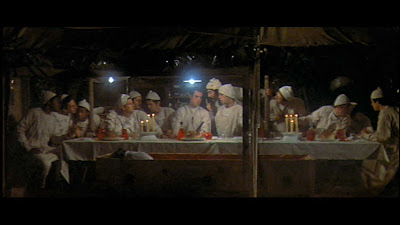
For example, the Robert Altman version, from M*A*S*H:

Last Supper, M*A*S*H style

Last Supper, M*A*S*H style

If you need a 20 minute lesson on the influence of Renaissance art on contemporary art, this is one many high school kids may find interesting, if not amazingly historically informative. I suspect there is a great lesson plan hiding in there about 20th century history as reflected in parody art.

It’s a brilliant and subtle demonstration of the power of DaVinci’s art that there are so many copy cat pictures, don’t you think?

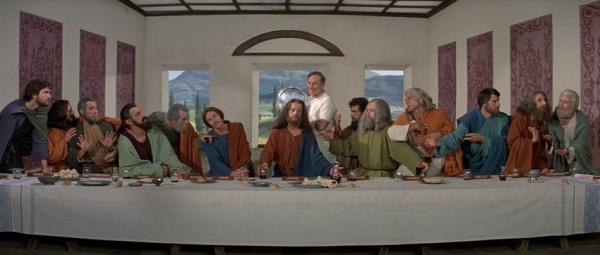
I did notice, however, that Barker left out the Mel Brooks version, from “History of the World, Part I.” It may not fit the meme.

Mel Brooks'

“Last Supper” as portrayed in Mel Brooks’s “History of the World, Part I”

Finally, looking today I found this “Lost” version of the Last Supper at Art is Everywhere, showing the meme is live and well.

“Lost” Last Supper; probably a publicity still, found at Art is Everywhere.

Do you have favorite parodies or homages of the Last Supper left off of these lists of 31 different versions?  By all means, list them in comments, with links if you have them.

Resources:

Resources added in 2013:


Madison’s birthday celebration at Montpelier

March 21, 2013

At the Belle Grove Bed and Breakfast blog we get a nice report and lots of photos from the James Madison birthday celebration last Saturday at Montpelier, Madison’s mountain retreat and home in Virginia.

Wreaths at James Madison's grave on his birthday, March 16, 2013

Wreaths in honor of James Madison’s birthday, March 16, 2013, at his grave site at Montpelier, Virginia. Photos by Michelle and Brett Darnell, Belle Grove Plantation B&B

Best report I’ve seen — go over there and give it a read and view.

James Madison U President James Alger,

James Alger, President of James Madison University, delivered an address, “Return to James Madison.” Montpelier CEO Kat Imhof sits to his immediate right. Photos by the Darnells

James Madison University’s President Jonathan Alger delivered an address, “Return to Madison.”  I’m hoping someone still has a copy in electronic form that we can get hold of.

More:

15 May 2011Montpelier, VirginiaThrough a basem...

View from a basement window at James Madison’s Montpelier near Barboursville, Virginia, storm clouds clear and the Blue Ridge Mountains come into view (2011) (Photo by gsputrich)


Vivid imagination at the Anti-Defamation League

March 21, 2013

Students of history will notice inaccuracies in this video right away.

They are dreams, an imagining of the great “if only.”

Santayana’s Ghost looks on, hoping we’ll get the message, remember history, and act accordingly.

“Imagine a World Without Hate,” from the ADL.

Join ADL in our Centennial Year as we Imagine a World Without Hate™, one where the hate crimes against Martin Luther King, Anne Frank, Matthew Shepard and others did not take place. Support us in the fight against bigotry and extremism by sharing this inspirational video and taking the pledge to create a world without hate at http://www.adl.org/imagine.

Imagine a World Without Hate™. We Do. Join Us.

Tip of the old scrub brush to Pat Carrithers and Upworthy.  Pat writes in to remind us of the great John Greenleaf Whittier poem, “Maud Muller”:

“For of all sad words of tongue or pen,
The saddest are these: “It might have been!”

More:

English: Photo of American poet John Greenleaf...

American poet John Greenleaf Whittier’s study at his home in Amesbury, Massachusetts. Scanned from The Works of John Greenleaf Whittier: illustrated with steel portraits and photogravures by John Greenleaf Whittier, edited by Elizabeth Hussey Whittier. Published by Houghton, Mifflin and Company, 1892. Item notes: v. 7 (Photo credit: Wikipedia)


Annals of global warming: No, polar bears are not “fine” — suffer from loss of sea ice

March 20, 2013

Press release from The Journal of Animal Ecology (links added here):

For polar bears, it’s survival of the fattest

One of the most southerly populations of polar bears in the world – and the best studied – is struggling to cope with climate-induced changes to sea ice, new research reveals. Based on over 10 years’ data the study, published in the British Ecological Society‘s Journal of Animal Ecology, sheds new light on how sea ice conditions drive polar bears’ annual migration on and off the ice.

Led by Dr. Seth Cherry of the University of Alberta, the team studied polar bears in western Hudson Bay, where sea ice melts completely each summer and typically re-freezes from late November to early December. “This poses an interesting challenge for a species that has evolved as a highly efficient predator of ice-associated seals,” he explains. “Because although polar bears are excellent swimmers compared with other bear species, they use the sea ice to travel, hunt, mate and rest.”

Polar bear and two cubs wait for ice to reform

Caption from EurekAlert: An adult female polar bear wearing a GPS-satellite linked collar with her two 10-month-old cubs waits for the sea ice to re-form onshore in western Hudson Bay, Manitoba, Canada. Photo Copyright Andrew Derocher, Univeristy of Alberta.

Polar bears have adapted to the annual loss of sea ice by migrating onto land each summer. While there, they cannot hunt seals and must rely on fat reserves to see them through until the ice returns.

Dr. Cherry and colleagues wanted to discover how earlier thawing and later freezing of sea ice affects the bears’ migration. “At first glance, sea ice may look like a barren, uniform environment, but in reality, it’s remarkably complex and polar bears manage to cope, and even thrive, in a habitat that moves beneath their feet and even disappears for part of the year. This is an extraordinary biological feat and biologist still don’t fully understand it,” he says.

From 1991-97 and 2004-09, they monitored movements of 109 female polar bears fitted with satellite tracking collars. They tagged only females because males’ necks are wider than their heads, so they cannot wear a collar. During the same period, the team also monitored the position and concentration of sea ice using satellite images.

“Defining precisely what aspects of sea ice break-up and freeze-up affect polar bear migration, and when these conditions occur, is a vital part of monitoring how potential climate-induced changes to sea ice freeze-thaw cycles may affect the bears,” he says.

The results reveal the timing of polar bears’ migration can be predicted by how fast the sea ice melts and freezes, and by when specific sea ice concentrations occur within a given area of Hudson Bay.

According to Dr. Cherry: “The data suggest that in recent years, polar bears are arriving on shore earlier in the summer and leaving later in the autumn. These are precisely the kind of changes one would expect to see as a result of a warming climate and may help explain some other studies that are showing declines in body condition and cub production.”

Recent estimates put the western Hudson Bay polar bear population at around 900 individuals. The population has declined since the 1990s, as has the bears’ body condition and the number of cubs surviving to adulthood.

Young polar bear challenged by lack of sea ice, Andrew Derocher photo

Caption from EurekAlert: This is a subadult polar bear on a lake on the shores of Hudson Bay in Manitoba, Canada in November waiting for the sea ice to re-form. Copyright Andrew Derocher, Univeristy of Alberta.

Because polar bears’ main food source is seals, and these are hunted almost exclusively on sea ice, the longer bears spend on land, the longer they must go without energy-rich seals. “Climate-induced changes that cause sea ice to melt earlier, form later, or both, likely affect the overall health of polar bears in the area. Ultimately, for polar bears, it’s survival of the fattest,” says Dr. Cherry.

He hopes the results will enable other scientists and wildlife managers to predict how potential climate-induced changes to sea ice freeze-thaw cycles will affect the ecology, particularly the migration patterns, of this iconic species.

###

Seth Cherry et al (2013). ‘Migration phenology and seasonal fidelity of an Arctic marine predator in relation to sea ice dynamics’, doi: 10.1111/1365-2656.12050, is published in the Journal of Animal Ecology on Wednesday 20 March 2013.

More: