Colorado legislature says ‘bring the USS Pueblo home’

February 4, 2010

It’s a story about a series of the grandest and bravest hoaxes by U.S. soldiers held in extremely hostile enemy prisons.  Coloradans, especially those from the city of Pueblo, the namesake of the ship, have not forgotten.

U.S.S. Pueblo, moored in Pyongyang, Peoples Republic of Korea - Wikipedia image

U.S.S. Pueblo, moored in Pyong Yang, Peoples Republic of Korea where the North Koreans try to exploit their capture of the ship by offering tours - Wikipedia image

Spurred by its members from Pueblo, the Colorado state legislature passed a resolution on Monday asking the U.S. government to ask North Korea to return the U.S.S. Pueblo to the U.S.  The spyship was captured, probably illegally, in 1968 with Capt. Lloyd Bucher and his crew, with the loss of one crewman’s life in the capture skirmish.

North Korea (more formally known as the Peoples Republic of Korea or PRK) held Bucher and his crew eleven months in that tragic year of 1968.  The crew were tortured, but PRK finally agreed to release them in December.

During their capture the crew had signed hoax confessions that, while wildly embarrassing to the PRK, got the crew in hot water when they returned to the U.S.

Millard Fillmore’s Bathtub officially and formally approves of any legislative action honoring the captain and crew of the Pueblo, and would like to see the ship returned.

Earlier stories on the Pueblo and its capture:

An account in Korea Times suggests North Korea seized the Pueblo simply to save face after a disastrous attempt to assassinate the president of South Korea.

The entire story about the legislative resolution, from the Pueblo Chieftan, is below the fold.

Read the rest of this entry »


Wattsupgate: Denialists claim all knowledge is wrong

January 31, 2010

It really is that bad.  Climate science denialists now attack any information simply for not being what they want it to be.  Lysenko’s Ghost smiles broadly.

Anthony Watts is just the most prominent of the bloggers making hoax charges of error and worse in the fourth report from the Intergovernmental Panel on Climate Change (IPCC), because of a footnote that cites a rock climbing magazine.

Here’s the trouble for Watts:  There is no indication that the citation is in error in any way.  Watts’s move is more fitting of King George III’s campaign against Ben Franklin’s lightning rods, the prosecution of John Peter Zenger, the pre-World War II campaign against Einstein’s work because he was born a Jew, or the hoary old Red Channels campaign against Texas history told by John Henry Faulk.  It’s as bad as the Texas State Board of Education’s attack on Brown Bear, Brown Bear, What Do You See? Watts’ and others’ complaint is simply that Climbing magazine’s story on the worldwide retreat of glaciers suitable for climbing is not published in a juried science journal.

In other words, they indict the science, not because it’s wrong — they have no evidence to counter it — but because it’s too American Patriot correct Jewish left Texan mistakenly thought to be political well-known, too accessible, (small “d”) democratically-reported.

And of course, any comment that points that out at Watts’s blog goes into long-term “moderation,” keeping it from the light of day in the best tradition of the Crown’s defense of Gov. Cosby’s misadministration of New York (see “John Peter Zenger”).  Watts said in a quote that should have been attributed to the Daily Telegraph:

The IPCC’s remit is to provide an authoritative assessment of scientific evidence on climate change.

In its most recent report, it stated that observed reductions in mountain ice in the Andes, Alps and Africa was being caused by global warming, citing two papers as the source of the information.

However, it can be revealed that one of the sources quoted was a feature article published in a popular magazine for climbers which was based on anecdotal evidence from mountaineers about the changes they were witnessing on the mountainsides around them.

The other was a dissertation written by a geography student, studying for the equivalent of a master’s degree, at the University of Berne in Switzerland that quoted interviews with mountain guides in the Alps.

The revelations, uncovered by The Sunday Telegraph, have raised fresh questions about the quality of the information contained in the report, which was published in 2007.

It comes after officials for the panel were forced earlier this month to retract inaccurate claims in the IPCC’s report about the melting of Himalayan glaciers.

By those standards, Watts’s own readers should eschew his blog — it’s not peer reviewed science by any stretch, and Watts isn’t an established authority in climate science (he’s not even working for an advanced degree).  Consistency isn’t a virtue or concern among climate change denialists.  Watt’s entire modus operandi is much more anecdotal than the story in Climbing, which was written by a physicist/climber who studies climate change in the world’s mountains.

And did you notice?  They’re whining about research done by a scientist in pursuit of a degree, complaining about the second citation.  That’s the exaclty kind of research that they claim the magazine article is not.  Their complaint is, it appears, that a scientist in pursuit of education is not the right “kind” of person to do climate research. It’s the chilling sort of bigotry that we spent so much time in the 20th century fighting against.  In the 21st century, though, it appears one can still get away with demonizing knowledge, education and research, part of the campaign to indict “elitism,” the same sort of elitism aspired to by America’s founders.  Too much of the criticism against scientists involved in documenting global warming is the cheap bigotry the critics claim to find in science, falsely claimed in my view.

Topsy-turvy.

And the glaciers?  Yeah, the evidence tends to show they are in trouble.  Those Himalayan glaciers?  The IPCC report was accurate in everything except the speed at which the glaciers decline — they should be with us for another three centuries, not just 50 years, if we can reduce warming back to 1990s levels (oddly, denialists rarely deal with the facts of accelerating warming, preferring to point to a local snowstorm as a rebuttal of all knowledge about climate).

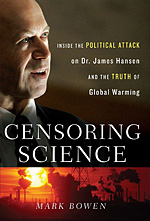
Oh, and the research?  The author of the story in Climbing magazine is Mark Bowen.  Dr. Bowen’s Ph.D. is in physics from MIT. He’s a climber, and he researches climate change on the world’s highest mountains.  His 2005 book, Thin Ice, focused tightly on what we can learn about climate from the world’s highest mountains.   Bowen is the expert Anthony Watts would like to be.

Cover of Mark Bowen's book defending climate science, "Censoring Science."

Cover of Mark Bowen’s book defending climate science, “Censoring Science.”

Bowen’s newest book:  Censoring Science:  Inside the political attack on James Hansen and the truth of global warming. Watts doesn’t want anyone to read that book.  It is easy to imagine Watt’s s attack is, he hopes, pre-emptive, against Bowen’s book.

I’ll wager Watts hasn’t read the article in Climbing, and didn’t know who Bowen was when he launched his attack, though.  The denials of bias coming out of the denialists’ camp will be interesting to watch.

Let the denialists roll out the rope far enough, they’ll inevitably hang themselves.

More:

Do something for freedom: Spread the news

Add to FacebookAdd to NewsvineAdd to DiggAdd to Del.icio.usAdd to StumbleuponAdd to RedditAdd to BlinklistAdd to TwitterAdd to TechnoratiAdd to Furl


Monckton lies over the ocean

January 28, 2010

Christopher Monckton continues his “No Tern Left Unstoned, No Lie Left Untold” tour of Australia, trotting out all the old falsehoods about DDT — did he continue to falsely blame President John Kennedy and Jackie Kennedy for malaria?

Does he know malaria is spread by mosquitoes, and not Kennedys?


DDT propaganda machine

January 23, 2010

Media Check carries edited excerpts from a book by Daniel Gutstein from last year, Not A Conspiracy Theory: How Business Propaganda Hijacks Democracy (Key Porter, 2009) by Donald Gutstein, Key Porter (2009).

In the excerpted chapter Gutstein details how nefarious interest groups conspired to ruin the reputation of Rachel Carson and environmental protection activists with false claims about DDT and environmentalist aims.

The problem with the coverage of the DDT issue and with the eco-imperialism charge is that they are based on falsehoods that the media did not investigate. Former CBC-TV National News anchor Knowlton Nash once said that “…our job in the media… is to… provide a searchlight probing for truth through the confusing, complicated, cascading avalanche of fact and fiction.” In this case, the media let their audiences down; fiction prevailed over fact.

Despite what the pro-DDT organizations alleged, DDT was not banned for use in mosquito control and could continue to be used in 25 countries in malarial regions. In these countries, limited amounts of DDT can be sprayed on the inside walls of houses to combat malaria-carrying mosquitoes. “The environmental community is collaborating with the World Health Organization to ensure that the phase-out of the remaining uses of DDT does not undermine the battle against malaria and the well-being of people living in malarial zones,” the United Nations Environmental Programme reported when the treaty came into force.

Has anyone read the book?  Has anyone seen it?  (So what if it’s aimed at Canada?)

More thoughts:  Years ago, when Jan Brunvand first achieved some fame cataloging urban myths, it occurred to me that his books should be required reading in the very first survey classes in journalism school.   Maybe they should be required reading in political science, rhetoric, and philosophy, too.

Gutstein’s book would be a good reader for a class on reporting, or investigative reporting, or science reporting, or political reporting.  I’m not sure where it would fit in to a science curriculum, but I wish more scientists came out of undergraduate years aware that they can get hammered by these hoax-selling, axe-grinding disinformation machines.  All those reports about how Rachel Carson is the “murderer of millions?”  They coarsen dialog, they misinform, disinform and malinform the public.  They do great disservice to citizenship and voters, and ultimately, to our democratic institutions.

It’s not enough to have a counter, good-information plan.  These people must be convinced to stop.

More:


Monckton’s profiteering: Climate denialists rake in the money

January 19, 2010

Bizarre as it may seem, the imagined profiteering of environmentalists has becoma favorite complaint of global warming deniers.  Ignoring the fact that he’s on the board of Apple Computers and a very savvy investor, and ignoring the facts of his donation of proceeds he gets from lectures, deniers claim Al Gore has gotten rich off of warning people about global warming.

They even complain when researchers get grants to study the stuff, as if the researchers were buying Maseratis and taking vacations to the Caribbean on the money.

How could they think that?

Might it be because the deniers really are pulling in high dollar, luxury fees to campaign against the science?  Christopher Monckton, warming denialist extraordinaire, is touring Australia.  Comes this little slip of public relations:

During this tour, Lord Monckton will be chaperoned by wealthy mining consultant and geologist Professor Ian Plimer. Lord Monckton will also be getting a fee of $20,000 and all his travel and accommodation – somewhere in the region of $100,000 – will be paid for.

Who might be paying for Monckton’s tour?* China?  India?  We don’t know, but following Monckton’s lead, we might hope that the western intelligence agencies are investigating Monckton to see just what he’s up to.

$120,000 to make up political smears that damage national policies and science?  Mencken would be ashamed.

More:

_____________

* It’s a paraphrase of Monckton, who evilly worried about funding for climate research and ill-funded environmental groups, “Goodness knows where they get it from!  Foreign governments, possibly!  I don’t know!  I haven’t looked.  But it’s certainly an alarming question:  Are the environmental movements being backed by China or India so they won’t have to compete with us for natural resources because we will have shut our industry down.  It’s a question that the security services, I hope, are looking at, because it certainly worries me.”

Malaria, DDT and internet myth: Lecture at University of Iowa on January 19

January 14, 2010

Do we have any readers in Iowa City?  Near Iowa City?

A presentation on the history of malaria and DDT, and the recent use and abuse of those stories to flog environmentalists and others on the internet, is set for the Hardin Library for Health Sciences at the University of Iowa in Iowa City, on January 19, 2010 (next Tuesday).

If you’re there, can you snap a couple of pictures to send, and get any handouts, and write up a piece about it?

Here is the press notice on-line:

Presentation on the History of Malaria and DDT

The University of Iowa History of Medicine Society invites you to hear Patrick T. O’Shaughnessy, PhD, Associate Professor, Department of Occupational and Environmental Health, University of Iowa, speak on “Malaria and DDT: the History of a Controversial Association” on Tuesday, January 19th, 5:30 to 6:30, room 2032 Main Library. [in Iowa City, Iowa.]

Dr. O’Shaughnessy observes:  ”Although it helped prevent millions of cases of malaria after its widespread use in the 1950’s, the pesticide DDT was banned from use in the United States and fell out of favor as an agent to reduce cases of malaria around the world. This history of the events associated with the effort to eradicate malaria, as well as the environmental movement that led to the ban on DDT, will center on the story of a story that incorporated both issues and grew into a modern myth still seen in books and multiple websites today.”

The session is free and open to the public.  Light refreshments will be served.

Hardin Library for the Health Sciences stands on the campus in Iowa City.

Hardin Library for the Health Sciences
600 Newton Road
Iowa City, IA 52242-1098

319-335-9871

The Hardin Library for the Health Sciences is located on Newton Road, directly north of the University of Iowa Hospitals and Clinics and approximately 1/2 mile east of Carver-Hawkeye Arena.  Go here for directions and more information.

Maybe I’m not the only bothered by the usual abuse of history and science on the issues of DDT and malaria.

Update: Tim Lambert notes at Deltoid that O’Shaughnessy is the guy who wrote what may be the definitive work on the famous — or infamous — Borneo Cat Drop. If you live in or near Iowa City, this lecture may be a wise investment of time.  High school teachers, your students could benefit, too.


Happy Birthday, Milly!

January 7, 2010

Millard Fillmore was born January 7, 1800. Had he lived, Millard Fillmore would be 210 years old today, and probably very cranky, and looking for a good book to read.

Millard Fillmore (unknown artist, circa 1840) - National Portrait Gallery

Millard Fillmore (unknown artist, circa 1840) - National Portrait Gallery

Would you blame him for being cranky?  He opened Japan to trade.  He got from Mexico the land necessary to make Los Angeles a great world city and the Southern Pacific a great railroad, without firing a shot.  Fillmore promoted economic development of the Mississippi River.  He managed to keep a fractious nation together despite itself for another three years.  Fillmore let end the practice of presidents using slaves to staff the White House (then called “the President’s Mansion”).

Then in 1852 his own party refused to nominate him for a full term, making him the last Whig to be president.  And to add insult to ignominy, H. L. Mencken falsely accused him of being known only for adding a bathtub to the White House, something he didn’t do.

As Antony said of Caesar, the good was interred with his bones — but Millard Fillmore doesn’t even get credit for whatever evil he might have done:  Fillmore is remembered most for being the butt of a hoax gone awry, committed years after his death.  Or worse, he’s misremembered for what the hoax alleged he did.

Even beneficiaries of his help promoting the Mississippi River have taken his name off their annual celebration of the eventFillmore has been eclipsed, even in mediocrity (is there still a Millard Fillmore Society in Washington?).

Happy birthday, Millard Fillmore.

Millard Fillmore was a man of great civic spirit, a man who answered the call to serve even when most others couldn’t hear it at all.  He was a successful lawyer, despite having had only six months of formal education (a tribute to non-high school graduates and lifelong learning).  Unable to save the Union, he established the University of Buffalo and the Buffalo and Erie County Historical Society.  And, it is said of him, that Queen Victoria said he was the most handsome man she had ever met.

A guy like that deserves a toast, don’t you think?

Resources:


Speaking of Texas education policy

January 5, 2010

Moon landing and wrestling in America

from Funnyjunk

This is a troubling piece of humor.  From Funnyjunk.


Chris Rock: Funny, but wrong in his slam of medical science

January 1, 2010

I usually like Chris Rock’s comedy. He’s profane, so you can’t use it in class. But he’s often quite witty while exposing  key problems of society.

I bumped into a YouTube video of a few minutes of Rock’s rant against doctors and science at an odd site called HealthNoob.com. On the one hand, Rock is ripping off Voltaire and others from the 18th century who noted that doctors of that time rarely cured anyone — without antibiotics and a very incomplete understanding of the human body and diseases, how could they?

On the other hand, the idea that physicians don’t want to cure people gained considerable traction among African Americans over the past 40 years, especially fueled by comedians like Dick Gregory who, God bless him otherwise, thought most of the medical establishment conspired against African Americans at every turn. Rock builds on that platform. This is not a good trend. Especially to the extent that wrong views of medicine discourage African Americans from seeking health care that could prevent serious disease until it’s too late, spreading disinformation does no one any good.

Past that, such comedy encourages crazies to crawl out of the woodwork and spread even more disinformation. For example, in the comments at HealthNoob.com, some wag claims that DDT caused polio in the 1930s, apparently ignorant of the fact that DDT was not available for use until after 1939, and not available for use on farms until 1946.  This is grotesque urban legend.

Here’s Rock’s rant, below (not safe for work or school due to profanity); below that, the response I left at HealthNoob.com (which is “in moderation” as I write this).

Give us your views in comments, will you? Is Rock way off base? Is his comedy routine here more damaging than funny?

At HealthNoob.com, I responded:

January 1st, 2010 at 10:46 pm

This conversation is certainly deteriorating.

A couple of observations:

Polio is caused by a virus. No one is sure exactly where it came from, or why it wasn’t more widespread prior to the 20th century. It well may be that it was around, but harmless, until a 20th century mutation caused it to become deadly. In any case, we know it’s a virus, and that’s why and how the vaccines worked against it. It’s not caused by chemical exposure, though some exposures may insult human immune systems and make some people more prone to get the disease the virus causes.

2. We know it wasn’t DDT, too. DDT was not available for use against insects by anyone prior to 1942. Polio was rampant before then (my brother caught polio in 1939). DDT was not available for use outside the military prior to 1946.

3. Diseases cured by medical care? Streps and bacterial infections, including tuberculosis (save for the drug-resistant kinds). Leukemia. Measles, almost. Polio wasn’t counted as eradicated until very recently (if at all). Goiter and iodine deficiency ($0.15 per ton of salt to “iodize” it, and cure goiter; the cheapest public health action ever).

4. Do you want to know how good cures work? The American Dental Association pushed for fluoridation to help prevent and cure dental caries. It worked fantastically. Now dentists spend more time fixing other stuff, and dental caries is basically a disease of the past — except for those people who don’t take care of their teeth or have some other special weakness to decay. Of course, were Rock to do something on that, he’d probably complain that fluoride causes disease instead of prevents it.

5. Ever heard of Voltaire? In the 18th century, he noted that doctors never cure anyone, but just hold the hand of the patient until the patient gets better, or dies. That changed with the advent of antibiotics. Interesting to hear Chris Rock rip off Voltaire.


A neglected, “Neglected Anniversary” – Mencken, Fillmore and the bathtub

December 29, 2009

Otherwise occupied, I nearly forgot:  92 years ago yesterday, on December 28, 1917, this column by H. L. Mencken was published in The New York Evening Mail:

A Neglected Anniversary

Mencken on April 7, 1933 - end of low-alcohol beer - Baltimore Sun Photo

H. L. Mencken at approximately 12:30 a.m., April 7, 1933, at the Rennert Hotel, corner of Saratoga and Liberty Streets, 17 years later, not neglecting a sudsy anniversary - Baltimore Sun photo

On December 20 there flitted past us, absolutely without public notice, one of the most important profane anniversaries in American history, to wit, the seventy-fifth anniversary of the introduction of the bathtub into These States. Not a plumber fired a salute or hung out a flag. Not a governor proclaimed a day of prayer. Not a newspaper called attention to the day.

True enough, it was not entirely forgotten. Eight or nine months ago one of the younger surgeons connected with the Public Health Service in Washington happened upon the facts while looking into the early history of public hygiene, and at his suggestion a committee was formed to celebrate the anniversary with a banquet. But before the plan was perfected Washington went dry (This was war-time Prohibition, preliminary to the main catastrophe. — HLM), and so the banquet had to be abandoned. As it was, the day passed wholly unmarked, even in the capital of the nation.

Bathtubs are so common today that it is almost impossible to imagine a world without them. They are familiar to nearly everyone in all incorporated towns; in most of the large cities it is unlawful to build a dwelling house without putting them in; even on the farm they have begun to come into use. And yet the first American bathtub was installed and dedicated so recently as December 20, 1842, and, for all I know to the contrary, it may still be in existence and in use.

Curiously enough, the scene of its setting up was Cincinnati, then a squalid frontier town, and even today surely no leader in culture. But Cincinnati, in those days as in these, contained many enterprising merchants, and one of them was a man named Adam Thompson, a dealer in cotton and grain. Thompson shipped his grain by steamboat down the Ohio and Mississippi to New Orleans, and from there sent it to England in sailing vessels. This trade frequently took him to England, and in that country, during the ’30s, he acquired the habit of bathing.

The bathtub was then still a novelty in England. It had been introduced in 1828 by Lord John Russell and its use was yet confined to a small class of enthusiasts. Moreover, the English bathtub, then as now, was a puny and inconvenient contrivance — little more, in fact, than a glorified dishpan — and filling and emptying it required the attendance of a servant. Taking a bath, indeed, was a rather heavy ceremony, and Lord John in 1835 was said to be the only man in England who had yet come to doing it every day.

Thompson, who was of inventive fancy — he later devised the machine that is still used for bagging hams and bacon — conceived the notion that the English bathtub would be much improved if it were made large enough to admit the whole body of an adult man, and if its supply of water, instead of being hauled to the scene by a maid, were admitted by pipes from a central reservoir and run off by the same means. Accordingly, early in 1842 he set about building the first modern bathroom in his Cincinnati home — a large house with Doric pillars, standing near what is now the corner of Monastery and Orleans streets.

There was then, of course, no city water supply, at least in that part of the city, but Thompson had a large well in his garden, and he installed a pump to lift its water to the house. This pump, which was operated by six Negroes, much like an old-time fire engine, was connected by a pipe with a cypress tank in the garret of the house, and here the water was stored until needed. From the tank two other pipes ran to the bathroom. One, carrying cold water, was a direct line. The other, designed to provide warm water, ran down the great chimney of the kitchen, and was coiled inside it like a giant spring.

The tub itself was of new design, and became the grandfather of all the bathtubs of today. Thompson had it made by James Cullness, the leading Cincinnati cabinetmaker of those days, and its material was Nicaragua mahogany. It was nearly seven feet long and fully four feet wide. To make it water-tight, the interior was lined with sheet lead, carefully soldered at the joints. The whole contraption weighed about 1,750 pounds, and the floor of the room in which it was placed had to be reinforced to support it. The exterior was elaborately polished.

In this luxurious tub Thompson took two baths on December 20, 1842 — a cold one at 8 a.m. and a warm one some time during the afternoon. The warm water, heated by the kitchen fire, reached a temperature of 105 degrees. On Christmas day, having a party of gentlemen to dinner, he exhibited the new marvel to them and gave an exhibition of its use, and four of them, including a French visitor, Col. Duchanel, risked plunges into it. The next day all Cincinnati — then a town of about 100,000 people — had heard of it, and the local newspapers described it at length and opened their columns to violent discussions of it.

The thing, in fact, became a public matter, and before long there was bitter and double- headed opposition to the new invention, which had been promptly imitated by several other wealthy Cincinnatians. On the one hand it was denounced as an epicurean and obnoxious toy from England, designed to corrupt the democratic simplicity of the Republic, and on the other hand it was attacked by the medical faculty as dangerous to health and a certain inviter of “phthisic, rheumatic fevers, inflammation of the lungs and the whole category of zymotic diseases.” (I quote from the Western Medical Repository of April 23, 1843.)

The noise of the controversy soon reached other cities, and in more than one place medical opposition reached such strength that it was reflected in legislation. Late in 1843, for example, the Philadelphia Common Council considered an ordinance prohibiting bathing between November 1 and March 15, and it failed of passage by but two votes. During the same year the legislature of Virginia laid a tax of $30 a year on all bathtubs that might be set up, and in Hartford, Providence, Charleston and Wilmington (Del.) special and very heavy water rates were levied upon those who had them. Boston, very early in 1845, made bathing unlawful except upon medical advice, but the ordinance was never enforced and in 1862 it was repealed.

This legislation, I suspect, had some class feeling in it, for the Thompson bathtub was plainly too expensive to be owned by any save the wealthy; indeed, the common price for installing one in New York in 1845 was $500. Thus the low caste politicians of the time made capital by fulminating against it, and there is even some suspicion of political bias in many of the early medical denunciations. But the invention of the common pine bathtub, lined with zinc, in 1847, cut off this line of attack, and thereafter the bathtub made steady progress.

The zinc tub was devised by John F. Simpson, a Brooklyn plumber, and his efforts to protect it by a patent occupied the courts until 1855. But the decisions were steadily against him, and after 1848 all the plumbers of New York were equipped for putting in bathtubs. According to a writer in the Christian Register for July 17, 1857, the first one in New York was opened for traffic on September 12, 1847, and by the beginning of 1850 there were already nearly 1,000 in use in the big town.

After this medical opposition began to collapse, and among other eminent physicians Dr. Oliver Wendell Holmes declared for the bathtub, and vigorously opposed the lingering movement against it in Boston. The American Medical Association held its annual meeting in Boston in 1849, and a poll of the members in attendance showed that nearly 55 per cent of them now regarded bathing as harmless, and that more than 20 per cent advocated it as beneficial. At its meeting in 1850 a resolution was formally passed giving the imprimatur of the faculty to the bathtub. The homeopaths followed with a like resolution in 1853.

But it was the example of President Millard Fillmore that, even more than the grudging medical approval, gave the bathtub recognition and respectability in the United States. While he was still Vice-President, in March, 1850, he visited Cincinnati on a stumping tour, and inspected the original Thompson tub. Thompson himself was now dead, but his bathroom was preserved by the gentlemen who had bought his house from the estate. Fillmore was entertained in this house and, according to Chamberlain, his biographer, took a bath in the tub. Experiencing no ill effects, he became an ardent advocate of the new invention, and on succeeding to the Presidency at Taylor’s death, July 9, 1850, he instructed his secretary of war, Gen. Charles M. Conrad, to invite tenders for the construction of a bathtub in the White House.

This action, for a moment, revived the old controversy, and its opponents made much of the fact that there was no bathtub at Mount Vernon, or at Monticello, and that all the Presidents and other magnificoes of the past had got along without any such monarchical luxuries. The elder Bennett, in the New York Herald, charged that Fillmore really aspired to buy and install in the White House a porphyry and alabaster bath that had been used by Louis Philippe at Versailles. But Conrad, disregarding all this clamor, duly called for bids, and the contract was presently awarded to Harper & Gillespie, a firm of Philadelphia engineers, who proposed to furnish a tub of thin cast iron, capable of floating the largest man.

This was installed early in 1851, and remained in service in the White House until the first Cleveland administration, when the present enameled tub was substituted. The example of the President soon broke down all that remained of the old opposition, and by 1860, according to the newspaper advertisements of the time, every hotel in New York had a bathtub, and some had two and even three. In 1862 bathing was introduced into the Army by Gen. McClellan, and in 1870 the first prison bathtub was set up at Moyamensing Prison, in Philadelphia.

So much for the history of the bathtub in America. One is astonished, on looking into it, to find that so little of it has been recorded. The literature, in fact, is almost nil. But perhaps this brief sketch will encourage other inquirers and so lay the foundation for an adequate celebration of the centennial in 1942.

(Text courtesy of Poor Mojo’s Almanac(k))

The entire history was a hoax composed by Mencken.

Even conservative wackoes appreciate the column.

Content with his private joke, Mencken remained silent about the hoax until a follow-up article, “Melancholy Reflections,” appeared in the Chicago Tribune on May 23, 1926, some eight years later. This was Mencken’s confession. It was also an appeal for reason to the American public.

His hoax was a joke gone bad. “A Neglected Anniversary” had been printed and reprinted hundreds of times in the intervening years. Mencken had been receiving letters of corroboration from some readers and requests for more details from others. His history of the bathtub had been cited repeatedly by other writers and was starting to find its way into reference works. As Mencken noted in “Melancholy Reflections,” his “facts” “began to be used by chiropractors and other such quacks as evidence of the stupidity of medical men. They began to be cited by medical men as proof of the progress of public hygiene.” And, because Fillmore’s presidency had been so uneventful, on the date of his birthday calendars often included the only interesting tidbit of information they could find: Fillmore had introduced the bathtub into the White House. (Even the later scholarly disclosure that Andrew Jackson had a bathtub installed there in 1834—years before Mencken claimed it was even invented—did not diminish America’s conviction that Fillmore was responsible.)

(No, dear reader, probably not correct; surely John Adams brought a bathtub with him when he moved into the White House, then called the President’s Mansion.  Plumbing, hot water, and finally hot water to a bathtub in the president’s residence, were installed between 1830 and 1853, as best I can determine.)

Mencken wrote an introduction to the piece in a later bookA Mencken Chrestomathy (Alfred A. Knopf, 1949):

The success of this idle hoax, done in time of war, when more serious writing was impossible, vastly astonished me. It was taken gravely by a great many other newspapers, and presently made its way into medical literature and into standard reference books. It had, of course, no truth in it whatsoever, and I more than once confessed publicly that it was only a jocosity . . .  Scarcely a month goes by that I do not find the substance of it reprinted, not as foolishness but as fact, and not only in newspapers but in official documents and other works of the highest pretensions.

There’s a moral to the story:  Strive for accuracy!

So, Dear Reader, check for accuracy, and question authority.

Resources:

Warn others of the hoax!

Add to FacebookAdd to NewsvineAdd to DiggAdd to Del.icio.usAdd to StumbleuponAdd to RedditAdd to BlinklistAdd to TwitterAdd to TechnoratiAdd to Furl


Obama’s well-qualified cabinet: Conservatives hoaxed by “J. P. Morgan” chart that verifies prejudices

November 26, 2009

Barack Obama’s cabinet is highly qualified on almost every score.  It’s the first cabinet to feature someone who has already received a Nobel prize in the field (Teddy Roosevelt as head of his own cabinet excepted).  Obama pulled highly qualified people from a lot of important positions, from both major parties, and from across the nation.

Conservatives, religiously believing Obama’s administration cannot be allowed to succeed, erupted in bluster this past week when a chart mysteriously cited to an unfound (by me) “J. P. Morgan study” claimed Obama’s cabinet has less that 10% who have private sector experience[See updates at bottom of post.]

“No business people!” the bloggers splutter.  “However can the government function?”

Chart claiming to be from J. P. Morgan, hoaxing experience of Obama cabinet, underestimating by 7 times

Chart claimed by American Enterprise Institute to be from J. P. Morgan, hoaxing experience data of Obama cabinet, underestimating by 700%

Gullibles rarely ask good questions, so we don’t need to bother with an answer to the question, if it’s a stupid question.  And in order to determine whether it’s a stupid question, we ought to ask whether the chart has any resemblance to reality.

According to the White House website:

The Cabinet includes the Vice President and the heads of 15 executive departments — the Secretaries of Agriculture, Commerce, Defense, Education, Energy, Health and Human Services, Homeland Security, Housing and Urban Development, Interior, Labor, State, Transportation, Treasury, and Veterans Affairs, as well as the Attorney General.

Six others have “cabinet-rank” status:  White House Chief of Staff Rahm Emanuel, EPA Administrator Lisa Jackson, OMB Director Peter Orzag, U.S. Trade Representative Ronald Kirk, U.S. Ambassador to the United Nations Susan Rice, and Council of Economic Advisors Chair Christina Romer.

Vice President, plus 15 executive department heads, plus six others:  22 people.

If only 10% had private sector experience, that would be 2.2 of them.  Each of the 22 people comprises about 4.5% of the cabinet.  Two of them with private experience would be 9% of the cabinet.  Three with private experience would reveal the chart to be in error.  Would it be possible to create a cabinet of 22 people and have only two of them with private experience?

The bullshit detectors in the bloggers’ minds should have been clanging like crazy when they saw that chart.

No one has cited any methodology for the chart, so I figure it was created on a napkin by interns for the American Enterprise Institute at lunch, and it took off before anyone could check the claims made for accuracy.  I’m a bit reluctant to blame it on J. P. Morgan, but maybe AEI can provide the interpleader to pin the blame on that private sector organization — which would be one more demonstration that private sector experience may not be all that AEI tries to crack it up to be.  Before counting, I guessed that Obama’s cabinet has more like 50% with private sector experience; it turns out to be more like 80%.  So the question now becomes, how and why did the chart originator discount real private-sector experience?

The “J. P. Morgan” chart from AEI is a hoax.  Here’s the cabinet, listed in succession order, with their private sector experience; members were listed from the White House website; biographical data were taken from Wikipedia, supplemented by official departmental biographies:

  • Vice President Joe Biden – Private experience:  Yes.  4.5% of the cabinet.  Biden’s father worked in the private sector his entire life — unsuccessfully for a critical period.  Biden attended a private university’s law school (Syracuse), and operated a successful-because-of-property-management law practice for three years before winning election to the U.S. Senate.  (I regard a campaign as a private business, too — and Biden’s first campaign was masterful entrepreneurship.)
  • Secretary of State Hillary Rodham Clinton – Private experience:  Yes, significant.  9% of the cabinet.  Extremely successful private practice lawyer in Arkansas for the Rose Law Firm, one of the “Top 100 Lawyers” in a classically dog-eat-dog business.
  • Secretary of Treasury Tim Geithner – Private experience:  Yes, significant.  13.6% of the cabinet (The chart’s error is established in the first three people checked — surely no one bothered to make a serious count of the cabinet in compiling the chart.) Geithner traveled with world with his Ford Foundation-employed father.  He graduated from private universities, with an A.B. from Dartmouth and an M.A. in economics from Johns Hopkins.  Starting his career, he worked three years in the private sector with Kissinger Associates.  After significant positions at Treasury and State Departments, he again ventured into the private sector with the Council on Foreign Relations; from there he moved to the Federal Reserve Bank of New York — in what is at worst a semi-public organization.  Running a Federal Reserve Branch is among the most intensive jobs one can have in private sector economics and management.   If an analyst at a bank named after J. P. Morgan didn’t understand that, one wonders just what the person does understand.
  • Secretary of Defense Robert Gates – Private sector experience:  Yes, at high levels.  18% of the cabinet.  Bob Gates spent a career with the Central Intelligence Agency, finally as Director of Central Intelligence, an executive level position with no equal in private enterprise.  He retired in 1993, and then worked in a variety of university positions, and joined several different corporate boards; in 1999 he was appointed interim Dean of the George W. Bush School of Government and Public Service at Texas A&M, and was appointed President of Texas A&M in 2002, where he served until his appointment as Secretary of Defense in 2006.
  • Attorney General Eric H. Holder, Jr – Private sector experience:  Yes, significant.  23% of the cabinet, total.  After a sterling career in the Justice Department, as a Ronald Reagan appointment to be a federal judge, as a U.S. Attorney, and again at the Justice Department, Holder spent eight years representing high profile private clients at Covington  &  Burling in Washington, D.C.  His clients included the National Football League, the giant pharmaceutical company Merck, and Chiquita Brands, a U.S. company with extensive international business.
  • Secretary of Interior Kenneth L. Salazar – Private sector experience: Yes.  27% of Obama cabinet.  Besides a distinguished career in government, as advisor and Cabinet Member with Colorado Gov. Roy Romer, Salazar was a successful private-practice attorney from 1981 to 1985, and then again from 1994 to 1998 when he won election as Colorado’s Attorney General.  As Senator, Salazar maintained a good voting record for a Republican business-supporting senator; Salazar is a Democrat.  Salazar’s family is in ranching, and he is usually listed as a “rancher from Colorado,” with life experience in the ranching business at least equal to that of former Supreme Court Justice Sandra Day O’Conner.
  • Secretary of Agriculture Thomas J. Vilsack – Private sector experience:  Yes, significant.  32% of Obama cabinet.  Vilsack spent 23 years in private practice as an attorney, 1975 to 1998, while holding not-full-time elective offices such as mayor and state representative.  He joined government as Governor of Iowa in 1998, and except for two years, has been in employed in government since then.
  • Secretary of Commerce Gary F. Locke – Private sector experience:  Yes, significant.  36% of Obama cabinet.  As near as I can determine, Locke was in private law practice from 1975 through his election as Executive in King County in 1993 (is that a full-time position?).  He was elected Governor of Washington in 1996.  After leaving office in 2005, he again worked in private practice with Davis Wright Tremaine, LLP, until 2009.  22 years in private practice, three years as Executive of King County, eight years as Governor of Washington.
  • Secretary of Labor Hilda L. Solis – Private sector experience:  Yes, but I consider it insignificant.  36% of Obama cabinet with private sector experience, 4.5% without.  Solis’s father was a Teamster and union organizer who contracted lead poisoning on the job; her mother was an assembly line worker for Mattel Toys.  She overachieved in high school and ignored her counselor’s advice to avoid college, and earned degrees from Cal Poly-Pomona and USC.  She held a variety of posts in federal government before returning to California to work for education and win election to the California House and California Senate, and then to Congress.
  • Secretary of  Health and Human Services Kathleen Sebelius – Private sector experience:  Yes, significant.  41% of Obama cabinet with private sector experience, 4.5% without.  Former Kansas Governor Kathleen Sebelius worked in the private sector for 12 years, at least nine years as director and lobbyist for the Kansas Association for Justice (then Kansas Trial Lawyers Association).  One might understand why the American Enterprise Institute would not count as “business experience” a career built on reining in insurance companies, as Sebelius did as a lobbyist and then elected Kansas Insurance Commissioner.
  • Secretary of  Housing and Urban Development Shaun L.S. Donovan – Private sector experience:  Yes, only 4 years, but significant because it bugs AEI analysts so much.  45% of cabinet with private sector experience, 4.5% without.  With multiple degrees from Harvard University in architecture and public administration, Donovan was Deputy Assistant Secretary of HUD for Multifamily Housing during the Clinton Administration; and he was Commissioner of the New York City Department of Housing Preservation and Development (HPD).  In the private sector, he worked for the Community Preservation Corporation, a non-profit in New York City, and he worked for a while finding sources to lend to people to buy “affordable housing” in the city, a task perhaps equal to wringing blood from a block of granite.
  • Secretary of  Transportation Raymond L. LaHood – Private sector experience:  No (not significant); school teacher at Holy Family School in Peoria, Illinois.  [As a teacher, I’m not sure that teaching should count as government experience, but it’s not really private sector stuff, either.  Education isn’t as wasteful as for-profit groups.]  45% of cabinet with private sector experience, 9% without.  Ironically, it is the Republican former Representative who pulls down the private sector experience percentage in the Obama cabinet.
  • Secretary of Energy Steven Chu – Private sector experience:  Yes, extremely significant.  50% of cabinet with private sector experience, 9% without.  Chu worked at Bell Labs, where he and his several co-workers carried out his Nobel Prize-winning laser cooling work, from 1978 to 1987.  Having won a Nobel for private sector work, I think we can count his private sector experience as important.  Chu also headed the Lawrence Livermore National Laboratory, which is seeded by a government contract to a university but must operate as a very highly-regulated business.  (I’ll wager Chu is counted as “no private sector experience,” which demonstrates the poverty of methodology of the so-called “J. P. Morgan” study AEI claims.)
  • Secretary of Education Arne Duncan – Private sector experience:  Yes, significant.  55% of cabinet with private sector experience, 9% without.  Duncan earned Academic All-American honors in basketball at Harvard.  His private sector is among the more unusual of any cabinet member’s, and more competitive.  Duncan played professional basketball: “From 1987 to 1991, Duncan played professional basketball in Australia with the Eastside Spectres of the [Australian] National Basketball League, and while there, worked with children who were wards of the state. He also played with the Rhode Island Gulls and tried out for the New Jersey Jammers.”  Since leaving basketball he’s worked in education, about four years in a private company aiming to improve education.
  • Secretary of Veterans Affairs Eric K. Shinseki – Private sector experience:  Yes, but to give AEI and “Morgan” a chance, we won’t count it.  55% of cabinet with private sector experience, 13.6% without.  Shinseki is a retired, four-star general in the army, a former Chief of the Joint Chiefs of Staff.  While Shinseki served on the boards of a half-dozen corporations, all of that service was in the six years between his official retirement and his appointment as Secretary of Veterans Affairs.
  • Secretary of Homeland Security Janet A. Napolitano – Private sector experience:  Yes, significant.  59% of cabinet with private sector experience, 13.6% without.  After a brilliant turn in law school at the University of Virginia, and a clerking appointment with a federal judge, Napolitano joined the distinguished Phoenix firm Lewis & Roca, where she practiced privately for nine years before Bill Clinton appointed her U.S. Attorney for Arizona.  AEI probably doesn’t want to count her private sector experience because, among other irritations to them, she was the attorney-advisor to Prof. Anita Hill during her questioning by the Senate Judiciary Committee on the issue of Clarence Thomas’s nomination to be Associate Justice of the Supreme Court.
  • White House Chief of Staff Rahm I. Emanuel – Private sector experience:  Yes, significant.  64% of cabinet with private sector experience, 13.6% without.  Emanuel’s major private sector experience is short, but spectacular.  “After serving as an advisor to Bill Clinton, in 1998 Emanuel resigned from his position in the Clinton administration and became an investment banker at Wasserstein Perella (now Dresdner Kleinwort), where he worked until 2002. In 1999, he became a managing director at the firm’s Chicago office. Emanuel made $16.2 million in his two-and-a-half-year stint as a banker, according to Congressional disclosures. At Wasserstein Perella, he worked on eight deals, including the acquisition by Commonwealth Edison of Peco Energy and the purchase by GTCR Golder Rauner of the SecurityLink home security unit from SBC Communications.”  J. P. Morgan and AEI wish that Emanuel had not had such smashing success is such a short time.
  • Environmental Protection Agency Administrator Lisa P. Jackson – Private sector experience:  No, significant.  64% of cabinet with private sector experience, 18% without.  Despite a brilliant career cleaning up environmental messes, with EPA and the New Jersey State government, Jackson has negligible private sector experience.  She was a brilliant student, valedictorian in high school and honors graduate in chemical engineering.
  • Office of Management & Budget Director Peter R. Orszag – Private sector experience:  Yes, short but significant.  68% of cabinet with private sector experience, 18% without.  Orszag is the youngest member of the cabinet, but he had a brilliant academic career (Princeton, London School for Economics) and a series of tough assignments in the Clinton Administration.  During the Bush years he founded an economic consulting firm, and sold it, and worked with McKinsey and Company, mostly on health care financing (he’s a member of the National Institute of Medicine in the National Academies of Science).
  • U.S. Trade Representative Ambassador Ronald Kirk – Private sector experience:  Yes, long and significant.  73% of cabinet with private sector experience, 18% without.  Son of a postal worker, Ron Kirk used academic achievement to get through law school.  He practiced privately for 13 years, interspersed with a bit of political work, before being appointed Texas Secretary of State in 1994 — the office that most businesses have most of their state regulatory action with.  About a year later he ran for and won election as Mayor of Dallas, considered a major business post in Texas.  Re-elected by a huge margin in 1999, he resigned to run for the U.S. Senate in 2002.  After losing (to John Cornyn), Price took positions with Dallas and then Houston law firms representing big businesses, especially in government arenas.
  • U.S. Ambassador to the United Nations Ambassador Susan Rice – Private sector experience:  Yes.  77% of cabinet with private sector experience, 18% without.  Rice was a consultant with McKinsey and Co., sort of the ne plus ultra of private sectorness, for a while before beginning her climb to U.N Ambassador.
  • Council of Economic Advisors Chair Christina Romer – Private sector experience:  Yes, but academic.  We won’t count it to make AEI out to be less of a sucker.  77% of cabinet with private sector experience, 23% without significant private sector experience.  Dr. Romer’s chief appointments have been academic, and at a public university, though her education was entirely private.  A specialist in the Great Depression and economic data gathering, she’s highly considered by her colleagues, and is a past-president of the American Economic Association.

All totaled, Obama’s cabinet is one of the certifiably most brainy, most successful and most decorated of any president at any time.  His cabinet brings extensive and extremely successful private sector experience coupled with outstanding and considerable successful experience in government and elective politics.

AEI’s claim that the cabinet lacks private sector experience is astoundingly in error, with 77% of the 22 members showing private sector experience — according to the bizarre chart, putting Obama’s cabinet in the premiere levels of private sector experience.  The chart looks more and more like a hoax that AEI fell sucker to — and so did others (von Mises Institute, Wall Street Blips, League of Ordinary Gentlemen, Volokh Conspiracy, Econlib).

Others bitten by Barnum’s Law:

  • Coyote Blog — stepped right into the punch:  “Ever get that feeling like the Obama White House doesn’t have a clue as to what it takes to actually run a business, make investments, hire people, sell a product, etc?”
  • Say Anthing
  • [Update — when did this guy erupt?] The Daily Mush, mushing the name of the author here, among nearly almost everything else.

Important update:  Thanks to the comment of Jake, below, I found this article in Forbes, by J. P. Morgan Michael Cembalest, chief investment officer for J. P. Morgan. In notes to the article Cembalest reports on his methodology:

A variety of sources were consulted for this analysis, including the Miller Center of Public Affairs at the University of Virginia. In the rankings, I did not include prior private-sector experience for the following positions: Postmaster General; Navy; War; Health, Education & Welfare; Veterans Affairs; and Homeland Security. In the rankings, private-sector experience at a law firm counts for a 33% score, which I think is very generous. My wife strongly suggested raising this to 50%, but I refused.

Cembalest doesn’t reveal much.  Does he include all cabinet-level posts outside the few he excluded?  Why did he exclude Navy and War, but not Defense?  Why would he exclude Homeland Security, with such obvious and extensive hits on private enterprise (think airlines and rail and ships)?  If no Homeland Security, why not exclude Transportation, too?

I’m particularly perturbed by his exclusion of lawyers.  If lawyers are excluded, why not investment bankers?  Lawyers are more directly engages in day-to-day competitive enterprise — and certainly most lawyers have more experience in hiring, firing, and as a commenter notes, “product placement” and advertising, than investment bankers.

In the end, Cembalest doesn’t provide enough details of his methdology, but we can see it’s a quick-and-very-dirty count, not much different from a SWAG.  I’m dying to see how Cembalest dealt with Energy Secretary Chu’s winning a Nobel from his work at Bell Labs, a bastion and symbol of private enterprise power and strength — or rather, how I suspect it was discounted in Cembalest’s counting.  And I wonder how his method dealt with the academic careers of George P. Shultz and Henry Kissinger, and the law career of James P. Baker III.  [end of update]

Update #2, March 16, 2010: I failed to post this last fall, for which I owe an apology to you, Dear Reader, and to Michael Cembalest.

About a week after I posted this I got a late afternoon call from Michael Cembalest.  It was a courtesy call.  He said he was striking the chart and the post from his website and recalling the newsletter.  We had a pleasant discussion, he explaining that it was originally, as he had said in Forbes, a Thanksgiving dinner table conversation.  He wrote about it on a slow investment week, meant to be a humorous barb to thought.  The experience and outlook of cabinet secretaries is indeed a good topic of conversation (how different would history have been had Herbert Hoover had anyone other than the filthy rich Andrew Mellon as his Secretary of Treasury, someone who hurt with the Depression and might not have had the personal wealth to survive any downturn no matter how long).  Mr. Cembalest explained that he had intended to count only those secretaries with a dog in the jobs fight — so Sec. of State Clinton wouldn’t count, for example — but he agreed that any methodology should be more clear than he indicated, and not so dodgy as it had become in internet discussions.

At that point, he felt, any serious point was irretrievable.  So he took the post down.

I’ve left this one up because I think it had spread too far by that time to call it back.  See the stories of Mencken’s hoax about putting a bathtub in the White House, and you may understand my reasoning.

Astounding update, July 23, 2010: Neil Boortz spread the hoax on his blog this morning. There is no end to a hoax, once, it’s out of the bag.

Help the truth catch up to the hoax:

Add to FacebookAdd to NewsvineAdd to DiggAdd to Del.icio.usAdd to StumbleuponAdd to RedditAdd to BlinklistAdd to TwitterAdd to TechnoratiAdd to Furl

Save


Who are those Boy Scouts in 1943?

November 13, 2009

A posed photograph:  Three Boy Scouts, from at least two different units, holding a poster Scouts were distributing about international cooperation in World War II.  They are saluting, and behind them rises the dome of the U.S. Capitol on a brilliantly sunny day.

Boy Scouts at the Capitol, 1943? - Library of Congress image

Caption from the U.S. Senate Historical Office: "Boy Scouts aid the war effort by delivering posters that encourage a united fight for freedom, ca.1943. credit: Library of Congress"

1943?  Who were the Scouts?

The photo is online in the collection of the U.S. Senate Historical Office (a good source of images, by the way).

I just wondered, who are those Scouts, and where are they today?

Boy Scouts assisted war efforts in a lot of ways in a lot of American cities, towns and villages.  Affiliates at the Tom Harbin Scout Museum at Camp Wisdom in Dallas (Circle 10 Council) have papers documenting and detailing massive scrap and paper drives, and a lot of other activities we probably wouldn’t let Scouts get into today.

The three Scouts in the photo wear what appears to be two different neckerchiefs, suggesting they come from at least two different troops or other units.  All three wear the uniform of the Boy Scouts of America, but two of the three look as though they may be immigrants or children of immigrants.

The date given is a “circa 1943.”  But the poster plugs a “United Nations” — could it have been as late as 1945 or 1946 and the official organizing of the United Nations?

What do you think?  What do you know?

Update: Wikimedia puts the date of the poster as 1941Shorpy says the photo is 1943:

“Washington, 1943. “United Nations Fight for Freedom: Colored, white and Chinese Boy Scouts in front of Capitol. They help out by delivering posters to help the war effort.” View full size. 4×5 Kodachrome transparency by John Rous for the Office of War Information. What photo expert out there can tell us about the numbers on these Kodachromes — how and at what point in the manufacturing/ exposure/ developing process they were made, and what they signify.

All those details and not the names of the Scouts?  In comments at Shorpy we also see that the temporary patch for the Scout on the left is for a 1942 campout.  So we know the photo was later than 1941.  The community patch for the Scout on the right says Washington where the city patch should be, with no state patch (if they had separate patches then).  So it’s probably a Washington, D.C. unit — and it’s Troop 11.  Anybody from National Capital Council ever read this site?  Were all three of these Scouts from Troop 11?

I have found, but cannot yet examine, another photo from the same roll of film, showing just the Scout in the middle.

Update 2: This may identify one of the Scouts, with an astounding story:

1941, Boy Scout, poster urging water saving, Anderson Grimes

Caption from CityDesk.net: "July 1941. Local Boy Scout Anderson Grimes in front of the U.S. Capitol building in Washington, D.C., holding a copy of a WPA poster designed for the city’s landmark water conservation program."

That solo Scout is clearly the same one in the first photo, so we have one name:  Anderson Grimes.

But the entire story from CityDesk.net is more amazing, if true:

July 1941. Local Boy Scout Anderson Grimes in front of the U.S. Capitol building in Washington, D.C., holding a copy of a WPA poster designed for the city’s landmark water conservation program. Shortly after this photo was taken, he was to present the poster to local congressman Harford Collins in a brief ceremony. Tragically, Grimes, along with several local reporters and congressional aides, instead found Senator Collins slumped over his desk, dead from a heart attack.

Thirty years later, Grimes ended up serving the same seat in Congress for four terms. He did not die in office.
– RJ White

If true?  I can’t find a listing for a Sen. Harford Collins in the Congressional biography pages, nor for any Member in either house named Anderson Grimes.

More mystery.  Is the Scout even named Anderson Grimes?

Okay, after j. a. higginbotham wrote in, I finally got it:  CityDesk.net is a satire site.  They wrote a phony story to accompany the photograph.

That’s right:  I got hoaxed.

Still looking for information on the Scouts and their troop(s).

Update, November 15: Is the water conservation poster in the version above a PhotoShop addition?  Here’s a photo held by the Library of Congress:

Boy Scout after 1942 showing posters Scouts distributed; photo by John Rous, Library of Congress collection

From Library of Congress: "United Nations Fight for Freedom: Boy Scout in front of Capitol. They help out by delivering posters to help the war effort"

Add to FacebookAdd to NewsvineAdd to DiggAdd to Del.icio.usAdd to StumbleuponAdd to RedditAdd to BlinklistAdd to TwitterAdd to TechnoratiAdd to Furl


Does Michelle Obama have the largest staff of any First Lady? No . . .

October 27, 2009

You probably have gotten the e-mail that claims Michelle Obama has the largest staff of any First Lady.  Either you dismissed it as great sour grapes, or you may have given it a moment’s consideration before hitting delete.

Did you wonder whether the charge is true?  Mudflats, the great blog from Alaska, tracked down the sources.  Mudflats’ discoveries are well worth the read.  You may want to bookmark that site for the next time you get the e-mail.  You know there will be a next time.

Wall of shame:  Sites that pass on the gossip as fact

Tip of the old scrub brush to Dr. Bumsted.


What’s a journalist’s duty? Limbaugh ignores warning signs, punks himself

October 25, 2009

Millard Fillmore’s bathtub came out of a hoax story written in 1917 by one of America’s greatest cynics and writers, H. L. Mencken. Mencken lived to regret that he ever wrote the piece, after it was cited as fact by encyclopedias and critics of Fillmore’s presidency.

Mencken’s story holds a moral, a lesson for all critics of the American scene, and especially anyone who comments on political figures:  Verify everything.

Ernest Hemingway put it best, if crudely:   “The most essential gift for a good writer is a built-in, shock-proof, shit detector. This is the writer’s radar and all great writers have had it.”*

If a writer or reporter doesn’t have one of those devices built-in, he is likely to find himself up to his chin in it after having failed to detect it in time to avoid the plunge.

Rush Limbaugh is in it up to his chin right now, after following Michael Ledeen off the dock.

Faithful readers here — all dozen of ’em — may remember last January when we spotlighted a hoax at a blog called Jumping in Pools; the author claimed President Obama had ordered members our armed forces to take an oath of allegiance to Obama in place of their regular oath to the nation.

Orson Welles was on to something with his “War of the Worlds” broadcast.  In fact, after that first night of panic, the same script was used on other occasions, and people still got suckered in.  (Listen to the RadioLab feature on this phenomenon — it’s wonderful.)

It’s almost as if people were going around with signs on their backs that say “Lie to me, baby!”  Only, the people put the signs on their shirts and blouses themselves.

For whatever ill-thought, malicious reason, somebody invented an absolutely unbelievable hoax that President Obama asked the Pentagon to have military people swear allegiance to him, instead of the nation. Jumping in Pools posted it.

Jumping in Pools also listed it as satire, in tags.

But the hoax sucked in the gullible all over the web.

Limbaugh?  Ledeen?  Y’all would do well to read this blog, Millard Fillmore’s Bathtub.  You might have recognized the name of the blog, Jumping in Pools, that carried that phantasmagorical story about Barack Obama’s student essay, finally being released in part to Time Magazine’s Joe Klein.

Yahoo!’s Buzz Up explained the story, with links you ought to check out:

It must have seemed so perfect. An obscure blogger unearths some pages of President Obama’s college thesis. The report supposedly comes from big-time journalist Joe Klein of Time magazine. And the thesis has some real gems: like Obama’s disdain for the Constitution.

The whole thing was nothing more than a satirical post on a humor blog. But Rush Limbaugh, who quoted from the supposed thesis on his radio show, sure wasn’t laughing. Here’s how it went down.

An unknown blogger picked up on a made-up post meant as a joke, which claimed that Joe Klein had gotten his hands on 10 pages of student Obama’s college thesis. Rush Limbaugh jumped on it, which immediately sparked Web searches on “obama thesis.”

Supposedly titled “Aristocracy Revisited,” the excerpt revealed the president had “doubts” about the “so-called founders.” Juicy. Except not true. Limbaugh discovered halfway through his show that he’d been had, but defended himself by saying basically the thesis felt true. Listen in to Rush’s mea sorta culpa.

Joe Klein finally jumped in, and called the report “nonsense” on his Swampland blog, and the blogger who thought the hoax was real also apologized.

Michael Ledeen writing at Pajamas Media was that “blogger who thought the hoax was real.”

Ledeen had the good grace to apologize (and in doing so reveal that he really should have been much more en garde):

The hoax/satire was written in August, so it’s not connected to any current event.  I cam across it on Twitter, read the blog, found it interesting, and posted on it.  I failed to notice that one of the tags was “satire.”

So he got me, and lots of others. It worked because it’s plausible.  I’ve done satirical pieces myself, and I know how they can take off.  I once wrote one that said that Bill Casey did not die, and was hiding in a bunker under the St Andrews golf course from which he was running Mikhail Gorbachev.  I thought it was obviously satirical, but it went like wildfire all over the world.  And that was in the days before the Internet.

So I should have picked up some hint, but I didn’t.  Shame on me.

But Limbaugh?  He railed on for more than half an hour on the evils of Obama revealed in the completely fictional essay; and then when he was alerted to the fact that it was a hoax, he didn’t apologize.  He said he was suckered in because the hoax was plausible, and Obama might have done such a thing.

“I know Obama thinks it,” Limbaugh said, purporting to channel the guy he despises only too openly.

I’m trying to suppress it, but Limbaugh’s actions remind me mightily of an old Cheech and Chong routine.  One wonders what Obama’s more rabid critics would not grant credence to.

Wall of Shame

What would Hemingway have reported?

Other thoughts:

  • Jonathan Last’s article for the Templeton Foundation’s In Character Journal wonders about how we choose what to believe, and whom.  The Dallas Morning News carried the article in the “Points” section this morning, but it’s not up on their website; look at the article at the Templeton Foundation site.

________
* I’m convinced he said it. I’m relying here on Elizabeth Dewberry’s contribution to The Cambridge Companion to Ernest Hemingway, “Hemingway’s Journalism and the Realist Dilemma,” on page 25.  She cites to an interview, but I’ve misplaced the rest of that note for the moment, and for some odd reason the page with the citation isn’t included on Google Books (the pain of internet research, to get to the information you need out of the haystack, and find that particular needle has been intentionally removed).  Read Dewberry, though, for a much longer and informative discussion about hoaxes and fakery in journalism, which is the problem discussed in this post.

Don’t let your friends be bamboozled, pass the word:


Add to FacebookAdd to NewsvineAdd to DiggAdd to Del.icio.usAdd to StumbleuponAdd to RedditAdd to BlinklistAdd to TwitterAdd to TechnoratiAdd to Furl


Naomi Oreskes: The lecture Lord Monckton slept through, which he hopes you will not see

October 23, 2009

Here’s another example of where historians show their value in science debates.

Naomi Oreskes delivered this lecture a few years ago on denialism in climate science.  Among other targets of her criticism-by-history is my old friend Robert Jastrow.  I think her history is correct, and her views on the Marshall Institute and denial of climate change informative in the minimum, and correct on the judgment of the facts.

You’ll recognize some of the names:  Jastrow, Frederick Seitz, S. Fred Singer, and William Nierenberg.

Oreskes details the intentional political skewing of science by critics of the serious study of climate warming.  It’s just under an hour long, but well worth watching.  Dr. Oreskes is Professor of History in the Science Studies Program at the University of California at San Diego.  The speech is titled “The American Denial of Global Warming.”

If Oreskes is right — and I invite you to check her references thoroughly, to discover for yourself that her history and science are both solid — Lord Monckton is a hoaxster.  Notice especially the references after the 54 minute mark to the tactic of claiming that scientists are trying to get Americans to give up our sovereignty.

Nothing new under the sun.

“Global warming is here,  and there are almost no communists left,” Oreskes said.

Nudge your neighbor:

Add to FacebookAdd to NewsvineAdd to DiggAdd to Del.icio.usAdd to StumbleuponAdd to RedditAdd to BlinklistAdd to TwitterAdd to TechnoratiAdd to Furl