Hoax complaints against presidential candidates are old ideas. In 1796, Alexander Hamilton paid newspaper editors to print stories saying Thomas Jefferson was atheist. It was a minor theme in that campaign, but after John Adams’ political fortunes foundered on the Alien and Sedition Acts, among other missteps, Hamilton stepped up the attacks in the election of 1800.
Jefferson’s great biographer, Dumas Malone, estimates that by election day, fully half the American electorate believed Jefferson was atheist. Jefferson made a perfect target for such a charge — staunch advocate of religious freedom, he thought it beneath the dignity of a politician to answer such charges at all, so he did not bother to deny them publicly. Ministers in New England told their congregations they would have to hide their Bibles because, as president, Jefferson would send troops to confiscate them.
In a warning to hoaxers, we might hope, Americans elected Jefferson anyway.
Such nefariousness plagues campaigns today, still. Boone Pickens, who helped fund the Swiftboat Veterans’ calumny against war hero John Kerry, has an offer to pay $1 million to anyone who can show the charges false. In a replay of Holocaust denial cases, Pickens refuses to accept any evidence to pay the award, last week turning away the affidavits of the men who were present at the events.
Matthew Most of the Washington Post wrote a lengthy piece in yesterday’s paper, “An attack that came out of the ether,” on the research done by a woman at the Institute for Advanced Study in Princeton, New Jersey, on the origins of the internet hoax that Barack Obama is a Muslim — a rumor so potent that Georgetown University Prof. Edward Luttwak repeated it in a New York Times op-ed article, without the fact checkers catching it (the Times consulted five scholars of Islam who all agreed the foundation for the claim is incorrect).
Danielle Allen has tracked the rumor back to its sources, in a failed campaign against Obama in Illinois and a candidate who admittedly was looking for mud, and one constant sniper at FreeRepublic.com. It’s impressive sleuthing, and the article would be a good departure for study of how media affect campaigns in a government or civics class.
The “how to” list is really very short:
Pick an area of a candidate’s life that is not well known. As the Hamilton campaign against Jefferson demonstrates, it’s useful if the candidate does not feature the issue in official biographies, and more useful if the candidate doesn’t respond. Michael Dukakis let several issues slide in his campaign for the presidency, saying that he didn’t think the public would be misled. The public was waiting for a rebuttal.
It helps if there is a factoid that is accurate in the rumor. Obama’s father was Muslim. Most Americans were receptive to the false claim that in Islam, a child is considered Muslim unless there is a conversion. A part of the rumor claims Obama was never baptized Christian. Of course, no one has asked to see John McCain’s baptismal papers. One wonders whether a rumor about McCain’s not being born inside the U.S. could get similar traction among voters (McCain was born in Panama while his father was serving in the Panama Canal Zone in the Navy; children of U.S. citizens are automatically U.S. citizens regardless where they are born. The issue was litigated during Barry Goldwater’s candidacy in 1964, since Goldwater was born in Arizona before Arizona was a state.)
According to the Post story: [A] search showed that the first mention of the e-mail on the Internet had come more than a year earlier. A participant on the conservative Web site FreeRepublic.com posted a copy of the e-mail on Jan. 8, 2007, and added this line at the end: “Don’t know who the original author is, but this email should be sent out to family and friends.”
Allen discovered that theories about Obama’s religious background had circulated for many years on the Internet. And that the man who takes credit for posting the first article to assert that the Illinois senator was a Muslim is Andy Martin.
Martin, a former political opponent of Obama’s, is the publisher of an Internet newspaper who sends e-mails to his mailing list almost daily. He said in an interview that he first began questioning Obama’s religious background after hearing his famous keynote speech at the 2004 Democratic National Convention.
Repeat the claim, as often as possible, to audiences that are inflamed by it. No one would dare make such a claim before an audience of Democratic delegates from the Texas 23rd Senatorial District Democratic Convention, almost 80% of whom were black — at least not at the convention. However, flyers making the charge might show up on windows of cars parked during church services at Christian churches where delegates attend. A speaker at the Republican convention for the same district might not be hooted down. This rumor of Obama’s faith went to right-wing forums known for rumor hospitality, notably Free Republic. In forums at that site, rumors frequently appear to be judged on just how damaging they might be if true, not on their veracity.
“Stop the World! I Want to Get Off!” won a Tony Award on Broadway in 1963. It was a musical play about a fellow who overreached. With book and lyrics by Leslie Bricuse and Anthony Newly, it spawned a string of hit popular songs: “What Kind of Fool Am I?” “Gonna Climb a Mountain,” “Once in a Lifetime,” and “Mumbo Jumbo” among them.
Oh, why not: Update, here’s Sammy Davis, Jr., singing “What Kind of Fool Am I?”:
How can one know that history and not think of it, when looking at the current Louisiana legislature? What kind of fools are they, indeed? Louisiana would like the world to stop, so they can get off.
Progress and science so much offend the Louisiana legislature that they have carved out what they hope is an exception so teachers can avoid hard science on issues like reproduction (cloning), evolution, and that pesky weather stuff that ransacked New Orleans, global warming. Sitting on Gov. Bobby Jindal’s desk right now is the enrolled version of S. B. 733, the misnamed “Science Education Act,” which gives teachers and local school districts the right to deviate from state curriculum and science texts in those three areas.
Why not the Big Bang and other cosmology? Why not gravity? Why not algebra? It may be that Louisiana’s preachers don’t know about those areas of science. Shhhhh! Don’t tell them!
A few observations.
First, having been slapped down by federal courts repeatedly when they’ve tried to introduce religion into science classes before, the legislature seems to have learned not to say much, in hopes that federal courts will have difficulty determining the religious intentions behind the bill. In 1987, in the case of Edwards v. Aguillard, federal courts didn’t even get to trial. They simply took the statements of the legislators as to their religious intentions.
This time around, the bill is being passed without debate at all.Legislators obviously hope that if they say nothing, they can’t be held responsible for anything. Better to keep your mouth closed and be thought a fool than to open it and remove all doubts — and obviously, there is hope among Louisiana creationists that federal courts won’t be able to use their closed-mouthedness as to evidence their foolishness. Well, they may want to consider that intelligent design has been ruled religious dogma by a federal court, already.
Second, the legislature’s learnings seem limited to bellicose speeches. The courts have repeatedly struck down Louisiana’s yearnings to teach creationism, both statewide, and repeatedly in the Tangipahoa Parish schools, which tried warning labels on textbooks and a variety of other methods, losing in court each time. It’s not just the ravings of the legislators that get up the dander of the courts. When the laws that come out of the ravings offend the Constitution, especially the First Amendment, the courts have struck them down. It’s not enough to just play at being non-offensive: The actions of the legislature must also not violate the Constitution. They appear not to have figured that one out. (More remedial con law courses coming up? Perhaps.)
The state should just let science be taught. Sneaking religion in does no good for the students, and it’s no secret that’s what they’re doing.
Third, the bill wasn’t drafted by people with much experience drafting legislation, running schools, or defending the Constitution. The bill could be used in some districts to teach nothing but evolution. It opens the door for anything a local school board decides might be science in three specific areas, cloning, evolution and global warming. Fruitcake groups like Ken Ham’s “Answers in Genesis” will rush to produce materials noting the accuracy of Hanna-Barbera’s “Flintstones.” Kids could be allowed to watch cartoons and call it science. In contrast, teachers who don’t understand the science in the first place will probably have few sources to turn to for good science information. Maybe one way to kill the law would be to point out that this thing opens the door wide for the theology of the Flying Spaghetti Monster (may his noodly appendage . . . well, you know).
On Dec. 28, 1917, the New York Evening Mail published “A Neglected Anniversary,” a facetious essay by H.L. Mencken supposedly recounting the history of bathtubs in America. (For example, Mencken “claimed” the first American bathtub made its debut in the Cincinnati home of grain dealer Adam Thompson on Dec. 20, 1842, and that the first White House bathtub was installed in 1851 at the order of President Millard Fillmore.)
Really? Hoaxes are good things? Politicians make fair game?
Nuts.
Part of the problem comes from the way the questions plop out at people on that quiz. Any national polling firm can give us chapter and verse on the need to phrase questions and potential answers just so, so that they do not mislead the people questioned into making an answer choice they would not normally make. Any teacher can tell you that phrasing of questions and answer choices can affect the way students perform on a test.
So, let’s rephrase the quiz. How about a hoax quiz that makes Hillary look good? I’ll wager not one of the blogs that runs the earlier hoax would dare to run this quiz:
_________________________
American Free Enterprise: Who said it?
A little history lesson: If you don’t know the answer make your best guess. Answer all the questions before looking at the answers. Who said it?
1) “We’re going to take things away from you on behalf of the common good.”
A. Abraham Lincoln
B. Alexander Hamilton
C. Andrew Jackson
D. None of the above
2) “It’s time for a new beginning, for an end to government of the few, by the few, and for the few…and to replace it with shared responsibility for shared prosperity.”
A. Ronald Reagan
B. Franklin D. Roosevelt
C. Jesus
D. None of the Above
3) “(We)…can’t just let business as usual go on, and that means something has to be taken away from some people.”
A. Herbert Hoover
B. Theodore Roosevelt
C. Rudolph Giuliani
D. None of the above
4) “We have to build a political consensus and that requires people to give up a little bit of their own…in order to create this common ground.”
A. Winston Churchill
B. Sam Houston
C. Lincoln
D. None of the above
5) “I certainly think the free-market has failed.”
A. Ludwig von Mises
B. Milton Friedman
C. Herbert Hoover
D. None of the above
6) “I think it’s time to send a clear message to what has become the most profitable sector in (the) entire economy that they are being watched.”
A. Alan Greenspan
B. Ben Bernanke
C. Teddy Roosevelt
D. None of the above
On the road for a day and a half. Here is an encore post from last October, an issue that remains salient, sadly, as creationists have stepped up their presence in Texas before the next round of biology textbook approvals before the Texas State Board of Education. I discuss why intelligent design should not be in science books.
Flying pig image from Flying Pig Brewery, Everett, Washington. (Late brewery? Has it closed?)
[From October 2006]: We’re talking past each other now over at Right Reason, on a thread that started out lamenting Baylor’s initial decision to deny Dr. Francis Beckwith tenure last year, but quickly changed once news got out that Beckwith’s appeal of the decision was successful.
I noted that Beckwith’s getting tenure denies ID advocates of an argument that Beckwith is being persecuted for his ID views (wholly apart from the fact that there is zero indication his views on this issue had anything to do with his tenure discussions). Of course, I was wrong there — ID advocates have since continued to claim persecution where none exists. Never let the facts get in the way of a creationism rant, is the first rule of creationism.
Discussion has since turned to the legality of teaching intelligent design in a public school science class. This is well settled law — it’s not legal, not so long as there remains no undisproven science to back ID or any other form of creationism.
Background: The Supreme Court affirmed the law in a 1987 case from Louisiana, Edwards v. Aguillard (482 U.S. 578), affirming a district court’s grant of summary judgment against a state law requiring schools to teach creationism whenever evolution was covered in the curriculum. Summary judgment was issued by the district court because the issues were not materially different from those in an earlier case in Arkansas, McLean vs. Arkansas (529 F. Supp. 1255, 1266 (ED Ark. 1982)). There the court held, after trial, that there is no science in creationism that would allow it to be discussed as science in a classroom, and further that creationism is based in scripture and the advocates of creationism have religious reasons only to make such laws. (During depositions, each creationism advocate was asked, under oath, whether they knew of research that supports creationism; each answered “no.” Then they were asked where creationism comes from, and each answered that it comes from scripture. It is often noted how the testimony changes from creationists, when under oath.)
Especially after the Arkansas trial, it was clear that in order to get creationism into the textbooks, creationists would have to hit the laboratories and the field to do some science to back their claims. Oddly, they have staunchly avoided doing any such work, instead claiming victimhood, usually on religious grounds. To the extent ID differs from all other forms of creationism, the applicability of the law to ID was affirmed late last year in the Pennsylvania case, Kitzmiller v. Dover.
The story began circulating in the late ’80s and spread quickly.
Although Neiman’s denied the story – in fact, the company said it had never served cookies in its restaurants – it kept gaining momentum. Finally, with the help of the Internet and e-mail, it became The Urban Legend That Would Not Die.
Inquiries about the costly recipe kept coming in until, finally, the store tasked its bakers to come up with a recipe worthy of the NM reputation. It was perfected in 1995 by Kevin Garvin and is on the company Web site, www.neimanmarcus.com. Free. It also is in the Neiman Marcus Cookbook (Clarkson Potter, $45) by Mr. Garvin and John Harrisson.
The store served cookies made from the recipe as part of its 100th anniversary celebration this month.
When victimized by a hoax, make a cookbook and make some money off of it. Of course, it’s a lot nicer being “Neiman Marcus cookied” than being “swift-boated.”
Here’s the Neiman Marcus version of the Neiman Marcus cookie made famous in the hoax:
½ cup (1 stick) butter
1 cup light brown sugar
3 tablespoons granulated sugar
1 large egg
2 teaspoons vanilla extract
1 ¾ cups all-purpose flour
½ teaspoon baking powder
½ teaspoon baking soda
½ teaspoon salt
1 ½ teaspoons instant espresso coffee powder
1 ½ cups semi-sweet chocolate chips
Preheat oven to 300 F. Cream the butter with the sugars until fluffy using an electric mixer on medium speed (approximately 30 seconds).
Beat in the egg and vanilla extract for another 30 seconds.
In a mixing bowl, sift together the flour, baking powder and baking soda and beat into the butter at low speed for about 15 seconds. Stir in the espresso coffee powder and the chocolate chips.
Using a 1-ounce scoop or 2-tablespoon measure, drop cookies onto a greased cookie sheet about 3 inches apart. Gently press down on the dough with the back of a spoon to spread out into a 2-inch circle.
Bake for about 20 minutes, or until nicely browned around the edges. Bake a little longer for a crispy cookie.
Makes 2 dozen cookies.
PER SERVING: Calories 154 (43% fat) Fat 8 g (5 g sat) Cholesterol 20 mg Sodium 119 mg Fiber 1 g Carbohydrates 21 g Protein 2 g
For U.S. students there is an uncomfortable nexus between mythology of the Arthurian style legend, Biblical mythology and history, and British history that fascinates me. The Stone of Destiny has a provenance stretching back 5,000 years to the Jewish patriarch Jacob, and which features a blog by one of the last men to steal the stone — with several stops along the way to open the story to trickery, hoaxes and uncertainty. It’s a fabulous story that too few people know.
6. “To only a few chemicals does man owe as great a debt as to DDT… In little more than two decades, DDT has prevented 500 million human deaths, due to malaria, that otherwise would have been inevitable.”
[National Academy of Sciences, Committee on Research in the Life Sciences of the Committee on Science and Public Policy. 1970. The Life Sciences; Recent Progress and Application to Human Affairs; The World of Biological Research; Requirements for the Future.]
In contrast to their citation for the Sweeney hearing record, which leads one away from the actual hearing record, for this citation, the publication actually exists, though it is no longer available in print. It’s available on-line, in an easily searchable format. [I urge you to check these sources out for yourself; I won’t jive you, but you should see for yourself how the critics of Rachel Carson and WHO distort the data — I think you’ll be concerned, if not outraged.] The quote, though troubled by the tell-tale ellipses of the science liar, is accurately stated so far as it goes.
The problems? It’s only part of the story as told in that publication. The National Academy of Science calls for DDT to be replaced in that book; NAS is NOT calling for a rollback of any ban, nor is NAS defending DDT against the claims of harm. The book documents and agrees with the harms Rachel Carson wrote about eight years earlier.
Cover of the electronic version of Life Sciences, the 1970 book looking to future needs in biology and agriculture.
Milloy (and Edwards, he claims), are trying to make a case that the National Academy of Sciences, one of the more reputable and authoritative groups of distinguished scientists in the world, thinks that DDT is just dandy, in contrast to the views of Rachel Carson and environmentalists (who are always cast as stupid and venal in Milloy’s accounts) who asked that DDT use be reduced to save eagles, robins and other songbirds, fish, and other wildlife, and to keep DDT useful against malaria.
First, there is no way that a ban on DDT could have been responsible for 500 million deaths due to malaria. Calculate it yourself, the mathematics are simply impossible: At about 1 million deaths per year, if we assume DDT could have prevented all of the deaths (which is not so), and had we assumed usage started in 1939 instead of 1946 (a spot of 7 years and 7 million deaths), we would have 69 million deaths prevented by 2008. As best I can determine, the 500 million death figure is a misreading from an early WHO report that noted about 500 million people are annually exposed to malaria, I’m guessing a bit at that conclusion — that’s the nicest way to attribute it to simple error and not malicious lie. It was 500 million exposures to malaria, not 500 million deaths. It’s unfortunate that this erroneous figure found its way into a publication of the NAS — I suppose it’s the proof that anyone can err.
The merry bands of hoaxsters at “JunkScience.com” and the Competitive Enterprise Institute hope you think DDT is a well-targeted, perfect solution to get rid of malaria. They ignore the devastating effects DDT has on birds, bats and other mammals (including humans), beneficial insects and fish. They don’t care about the difficulties in treating malaria in hospitals, which would continue or grow worse were DDT to be sprayed willy-nilly across the malaria-endemic world.
Looking at the odd campaign against the reputation of Rachel Carson, conducted largely by a group of corporate-paid, political scalawags, one will eventually come across a site named JunkScience.com, which has as a motto, “All the junk that’s fit to debunk.”
EPA history caption: Rachel Carson’s Silent Spring led to banning DDT and other pesticides. [EPA iimage]
How is this action described at JunkScience.com?
You wouldn’t quite recognize the events — and I doubt you could verify other oddities the JunkScience.com site claims:
17. Extensive hearings on DDT before an EPA administrative law judge occurred during 1971-1972. The EPA hearing examiner, Judge Edmund Sweeney, concluded that “DDT is not a carcinogenic hazard to man… DDT is not a mutagenic or teratogenic hazard to man… The use of DDT under the regulations involved here do not have a deleterious effect on freshwater fish, estuarine organisms, wild birds or other wildlife.”
[Sweeney, EM. 1972. EPA Hearing Examiner’s recommendations and findings concerning DDT hearings, April 25, 1972 (40 CFR 164.32, 113 pages). Summarized in Barrons (May 1, 1972) and Oregonian (April 26, 1972)]
18. Overruling the EPA hearing examiner, EPA administrator Ruckelshaus banned DDT in 1972. Ruckelshaus never attended a single hour of the seven months of EPA hearings on DDT. Ruckelshaus’ aides reported he did not even read the transcript of the EPA hearings on DDT.
[Santa Ana Register, April 25, 1972]
19. After reversing the EPA hearing examiner’s decision, Ruckelshaus refused to release materials upon which his ban was based. Ruckelshaus rebuffed USDA efforts to obtain those materials through the Freedom of Information Act, claiming that they were just “internal memos.” Scientists were therefore prevented from refuting the false allegations in the Ruckelshaus’ “Opinion and Order on DDT.”
I propose to Fisk much of the list of 100 claims against Carson (which is really a list over 100 items now), in a serial, spasmodic fashion. I’ll post my findings here, making them generally available to internet searches for information on Rachel Carson and DDT. Below the fold, I’ll start, with these three specious claims listed above.
Bug Girl sleuthed around a bit, and found information from official sources that really demonstrates the critics of Rachel Carson are using Gillette Foamy to make us think “mad dog!”
Chart from US Fish and Wildlife Service (USFWS) illustrates biomagnification, by which a minuscule dose of DDT to small plankton gets magnified a few million times by the time the top predators in the food chain get it.
So the evidence continues to pile up that Rachel Carson was simply a fine writer, a good scientist, and correct about DDT’s dangers.
In Audubon magazine she wrote, “We do not ask that all chemicals be abandoned. We ask moderation. We ask the use of other methods less harmful to our environment” (4). Countering claims that she was advocating a back-to-nature philosophy, she said, “We must have insect control. I do not favor turning nature over to insects. I favor the sparing, selective and intelligent use of chemicals. It is the indiscriminate, blanket spraying that I oppose” (5).
Evidence mounts that claims against Rachel Carson are sheer calumny. While the political motivations of this smear campaign are not clear, we don’t need to know for certain who is telling lies about a great American hero, or why. As Americans, as concerned citizens, as teachers and parents — as patriots — we only need to know that the claims against Rachel Carson are false.
And now it is our duty to call on Oklahoma’s Sen. Tom Coburn to stop the campaign against Carson. Coburn is the point man in the smear campaign right now: He has put a committee hold on the well-intentioned, justified bill to name a post office in her hometown after Rachel Carson. It is time for Tom Coburn to stand up and do the right thing for a great American. Sen. Coburn needs to lift his committee hold and allow committee action on this minor honor.
The contemptible campaign of hoax and calumny against the work and memory of Rachel Carson continues. You should read more at the sites I cite near the end of this post.
The key false claim of the Carson critics is that, but for the ban on DDT, millions of lives would have been saved over the past 30 years. Chief problem with the claim is that national bans on DDT all preserve DDT use for essential mosquito eradication, especially if there are no other tools to fight the disease. But other problems with the claim include the fact that DDT had stopped being highly effective by the late 1960s; eradication was a pipe dream, and mosquitoes developed resistance to DDT.
That doesn’t stop the critics. So, Dear Reader, when you read criticisms of Rachel Carson and hear the pseudo-science whine that Carson alone has condemned millions to death by malaria, I want you to keep in mind this question: If DDT were such an effective tool against malaria, why didn’t the World Health Organization fight to keep it? Why didn’t the manufacturers fight to keep it? Why would more than 150 nations, tens of thousands of scientists, tens of thousands of health workers, and conservative “I-told-you-so” skeptics who hate environmentalists, all simultaneously fall asleep?
The answer is, Dear Reader, they didn’t all fall asleep. DDT stopped being effective, and malaria fighters realized there were other problems — the parasites that the mosquitoes spread also became resistant to anti-malaria drugs, a bigger problem than DDT resistance. People and organizations who fight malaria did ask that use of DDT be preserved for spraying to fight malaria; but they didn’t defend it against bans on other use because those bans help the malaria fighters.
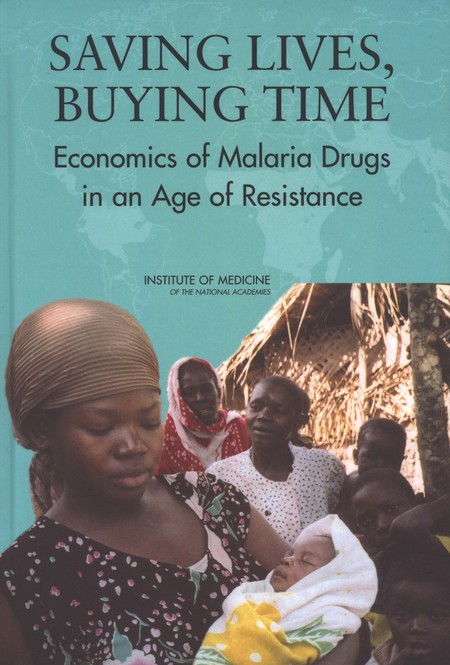
Cover of Saving Lives, Buying Time: Economics of Malaria Drugs in an Age of Resistance (2004), from the National Academies Press
Below the fold, I offer two quotes from Saving Lives, Buying Time: Economics of Malaria Drugs in an Age of Resistance (2004) Board on Global Health (BGH) (available from the National Academy of Sciences). You can see that DDT is not the golden-egg-laying goose, and that consequently Rachel Carson is not the mindless ogre she is made out to be in recent invectives.
The story is that a poor farm kid in England Scotland saves a rich kid from drowning, and the rich family offers to pay for college for the poor kid. The poor kid goes to college, and later makes a great discovery, and that discovery later saves the life of a member of the rich family, who goes on to save the world.
Churchill in Tunisia, 1943, visiting New Zealand’s 2nd Division, with Bernard Freyberg, known as Tiny
In various forms I’ve seen this story, that a member of the Churchill family, or Winston Churchill himself, was saved by a member of the Fleming family, or Sir Alexander Fleming himself (the discoverer of penicillin). Then, years later Churchill has a deadly infection, but his life is saved by Fleming’s discovery.
The story apparently originated in Worship Programs for Juniors, by Alice A. Bays and Elizabeth Jones Oakberg, published ca. 1950 by an American religious house, in a chapter entitled “The Power of Kindness.”
Or, until that account is unsuspended by the forces supporting Donald Trump: Follow @FillmoreWhite, the account of the Millard Fillmore White House Library
We've been soaking in the Bathtub for several months, long enough that some of the links we've used have gone to the Great Internet in the Sky.
If you find a dead link, please leave a comment to that post, and tell us what link has expired.
Thanks!
Retired teacher of law, economics, history, AP government, psychology and science. Former speechwriter, press guy and legislative aide in U.S. Senate. Former Department of Education. Former airline real estate, telecom towers, Big 6 (that old!) consultant. Lab and field research in air pollution control.
My blog, Millard Fillmore's Bathtub, is a continuing experiment to test how to use blogs to improve and speed up learning processes for students, perhaps by making some of the courses actually interesting. It is a blog for teachers, to see if we can use blogs. It is for people interested in social studies and social studies education, to see if we can learn to get it right. It's a blog for science fans, to promote good science and good science policy. It's a blog for people interested in good government and how to achieve it.
BS in Mass Communication, University of Utah
Graduate study in Rhetoric and Speech Communication, University of Arizona
JD from the National Law Center, George Washington University


 Posted by Ed Darrell


![EPA history caption: Rachel Carson's Silent Spring led to banning DDT and other pesticides. [EPA iimage]](https://i0.wp.com/www2.epa.gov/sites/production/files/aboutepa/history/images/form5.jpg)






 Millard Fillmore's Bathtub
