400 years of river history: NY celebrates Hudson, Champlain and Fulton in 2009

July 26, 2008

Okay, it’s the 202nd anniversary of Robert Fulton’s historic, 32-hour steamboat trip from New York City to Albany, demonstrating the viability of steamboat travel for commerce on the Hudson.  But for such a historic river, why not delay that fete for a couple of years and roll it into the 400th anniversary of Champlain’s exploration of the lake that now bears his name, and Henry Hudson’s discover of the mouth of the river to the south, the Hudson, whose mouth is home to New York City.

400 years of Hudson River history in 2009 - Hudson, Champlain, Fulton

400 years of Hudson River history in 2009 - Hudson, Champlain, Fulton

And so 2009 marks the Quadricentennial Celebration on the Hudson, honoring Hudson, Fulton and Champlain.

Alas, the committee to coordinate the celebration along the length of the river was not put in place until February, so there is a scramble.  Local celebrations will proceed, but the overall effort may fall short of the 1909 tricentennial, with replicas of Hudson’s ship, Half Moon, and Champlain’s boats, and Fulton’s steamer, and parades, and festivals, and . . .

Still, the history is notable, and the stories worth telling.

Most of my students in U.S. and world history over the past five years have been almost completely unaware of any of these stories.  One kid was familiar with the Sons of Champlin, the rock band of Bill Champlin, because his father played the old vinyl records.  Most students know nothing of the lore of Hudson, the mutiny and the old Dutch stories that have thunder caused by Hudson and his loyal crewman bowling in the clouds over the Catskills.  They don’t even know the story of Rip van Winkle, since it’s not in the Texas Essential Knowledge and Skills (TEKS) list and so gets left out of even elementary school curricula.  Is this an essential piece of culture that American children should know?  American adults won’t know it, if we don’t teach it.

Henry Hudson, from a woodcut

Henry Hudson, from a woodcut

Explorations and settlement of Quebec by Samuel de Champlain get overlooked in post-NCLB texts.  Texts tend to make mention of the French settlement of Canada, but placing these explorations in the larger frame of the drive to find a route through or around North America to get to China, or the often-bitter contests between French, English, Spanish, Dutch and other European explorers and settlers gets lost.  French-speaking Cajuns just show up in histories of Texas and the Southwest, with little acknowledgment given to the once-great French holdings in North America, nor the incredible migration of French from Acadia to Louisiana that gives the State of Louisiana such a distinctive culture today.

French explorer and settler Samuel de Champlain

French explorer and settler Samuel de Champlain

Champlain’s explorations and settlement set up the conflict between England and France that would result in the French and Indian War in the U.S., and would not play out completely until after the Louisiana Purchase and War of 1812.

Fulton’s steamboat success ushered in the age of the modern, non-sail powered navies, and also highlights the role geography plays in the development of technology. The Hudson River is ideally suited for navigation from its mouth, north to present-day Albany.  This is such a distance over essentially calm waters that sail would have been preferred, except that the winds on the Hudson were not so reliable as ocean winds.  Steam solved the problem.  Few other rivers in America would have offered such an opportunity for commercial development — so the Hudson River helped drive the age of steam.

New York City remains an economic powerhouse.  New York Harbor remains one of the most active trading areas in the world.  Robert Fulton helped propel New York ahead of Charleston, Baltimore and Boston — a role in New York history that earned him a place in for New York in the U.S. Capitol’s Statuary Hall.  The steamboat monopoly Fulton helped establish was a key player in Gibbons v. Ogden, the landmark Supreme Court case in which the Court held that Congress has the power to regulate commerce between states — an upholding of the Commerce Clause against the old structures created under colonial rule and the Articles of Confederation.

Robert Fultons statute in the U.S. Capitol - photo by Robert Lienhard

Robert Fulton's statute in the U.S. Capitol - photo by Robert Lienhard

400 years of history along the Hudson, a river of great prominence in world history.  History teachers should watch those festivities for new sources of information, new ideas for classroom exercises.

Resources:


Torturing children, the Constitution, and a teacher’s duty to protect children

June 23, 2008

This is the device Ohio teacher John Freshwater was using to shock students and brand them with crosses: A BD-10A high-frequency generator tester for leak detection, from Electro-Technic Products, Inc.:

   BD10ASV  OUTPUT: 10,000-50,000 volts at frequency of approx. 1/2 megahertz. Power 230 V, with a momentary ON/OFF switch

BD-10A high frequency generator tester leak detector, from Electro-Technic Products.  “BD10ASV OUTPUT: 10,000-50,000 volts at frequency of approx. 1/2 megahertz. Power 230 V, with a momentary ON/OFF switch”

As described at the company’s website:

  • Model BD-10A is the standard tester
  • Model BD-10AS features a momentary ON/OFF switch
  • OUTPUT: 10,000-50,000 volts at frequency of approx. 1/2 megahertz

The company also offers a line of instruments for teaching science — notably absent from that part of the catalog is this shocking device (literally).

Generally, this tester should not produce serious injury, even when misapplied. Standard middle school lab safety rules would suggest that it should never be used to “test” a human for leaks. Such voltages are designed to produce sparks. Sparks do not always behave as one expects, or hopes. High voltages may make cool looking sparks, but the effects of high voltage jolts differ from person to person. It may be harmful.

“We have instructions to warn people that it’s not a toy,” said Cuzelis, who owns Electro-Technic Products in Chicago. “If this device is directed for seconds (on the skin), that’s a clear misuse of the product.”

Cuzelis said he is not aware of anyone seriously hurt with the device and said that his company has never been sued for injuries.

What sort of lab safety rules did Freshwater have for other experiments?

If you discovered your child’s science teacher had this device, designed to produce high-voltage sparks to highlight holes in rubber and plastic liners of tanks, would you be concerned? If you know what should go on in a science class, you’d know there is probably little use for such a device in a classroom. It’s been described as a Tesla coil.

Tesla coils of extremely small voltages can be safe. They should be safe. But one occasionally finds a safety warning, such as this generalized note at Wikipedia:

Even lower power vacuum tube or solid state Tesla Coils can deliver RF currents that are capable of causing temporary internal tissue, nerve, or joint damage through Joule heating. In addition, an RF arc can carbonize flesh, causing a painful and dangerous bone-deep RF burn that may take months to heal. Because of these risks, knowledgeable experimenters avoid contact with streamers from all but the smallest systems. Professionals usually use other means of protection such as a Faraday cage or a chain mail suit to prevent dangerous currents from entering their body.

Freshwater was using a solid state Tesla coil, if I understand the news articles correctly. Knowing that these sparks can cause deep tissue and bone damage in extreme cases, I suspect that I would not allow students to experience shocks as a normal course of a science classroom, especially from an industrial device not designed with multiple safety escapes built in.

Freshwater had been zapping students for years.

Here is a classic photo of what a Tesla coil does, a much larger coil than that used by John Freshwater, and a photo not from any classroom; from Mega Volt:

Tesla coil in action, from Mike Tedesco

Tesla coil in action, from Mike Tedesco

There is nothing in the Ohio science standards to suggest regular use of a Tesla coil in contact with students performs any educational function.

I offer this background to suggest that the normal classroom procedures designed to ensure the safety of students were not well enforced in Freshwater’s classrooms, nor was there adequate attention paid to the material that should have been taught in the class.

The teacher, John Freshwater, has been dismissed by his local school board. Freshwater supporters argue that this is a case of religious discrimination, because Freshwater kept a Bible on his desk.

Among the complaints are that he burned crosses onto the arms of students with the high-voltage leak detector shown above. This gives an entirely new and ironic meaning to the phrase “cross to bear.”

Cafe Philos wrote the most succinct summary of the case I have found, “The Firing of John Freshwater.” Discussion at that site has been robust. Paul Sunstone included photos of one of the students’ arms showing injuries from the schocks. He also included links to news stories that will bring you up to date.

Amazingly, this misuse of an electrical device may not be the most controversial point. While you and I may think this physical abuse goes beyond the pale, Freshwater has defenders who claim he was just trying to instill Biblical morality in the kids, as if that would excuse any of these actions. Over at Cafe Philos, I’ve been trying to explain just why it is that Freshwater does not have a First Amendment right to teach religion in his science class. There is another commenter with the handle “Atheist” who acts for all the world like a sock puppet for anti-First Amendment forces, i.e., not exactly defending a rational atheist position.

Below the fold I reproduce one of my answers to questions Atheist posed. More resources at the end.

Read the rest of this entry »


Friends of Rachel Carson win a quiet victory

June 13, 2008

How quiet?

None of my news readers pulled it up, either last August and September, when U.S. Rep. Jason Altmire, D-Penn., got the bill through Congress and signed into law by President Bush, nor a couple of weeks ago when the action occurred.

The Post Office in Rachel Carson’s home town, Springdale, Pennsylvania, has been named in her honor. The ceremony at the Post Office was held on May 27, 2008.

Rep. Rob Bishop’s, R-Utah, incendiary and inaccurate statement on the bill was what caught my eye originally about the continuing campaign of calumny against the author and scientist.

Rep. Altmire conducted a petition campaign in Pennsylvania, and used the lever of popular, bipartisan support to pry the bill loose from U.S. Sen. Tom Coburn’s hold in the Senate. Coburn is a Republican from Oklahoma, a physician, and an ardent advocate of spraying DDT. He had placed a hold on the bill in committee, stopping all action under the Senate’s rules of profound deference to members.

The swell of popular support made clear by Altmire’s campaign appears to have persuaded Sen. Coburn to allow the bill to move. The bill passed the Senate by unanimous consent on August 3, 2007, and got President Bush’s signature on August 9. These sorts of honorary bills generally are not targeted for political points. That Coburn allowed the bill through suggests a good deal of maturation as a senator on Coburn’s part.

Below the fold, Rep. Altmire’s press releases on the bill’s passing the Senate, and on President Bush’s signing the bill.

Photo below: Rachel Carson, birding, on a ridge (in Pennsylvania); photo originally found at site of Professor Catherine Lavender, The College of Staten Island of CUNY.

Rachel Carson, birding at Hawk Mountain Sanctuary

Rachel Carson, birding at Hawk Mountain Sanctuary

Read the rest of this entry »


First Amendment: Engraved in stone

April 15, 2008

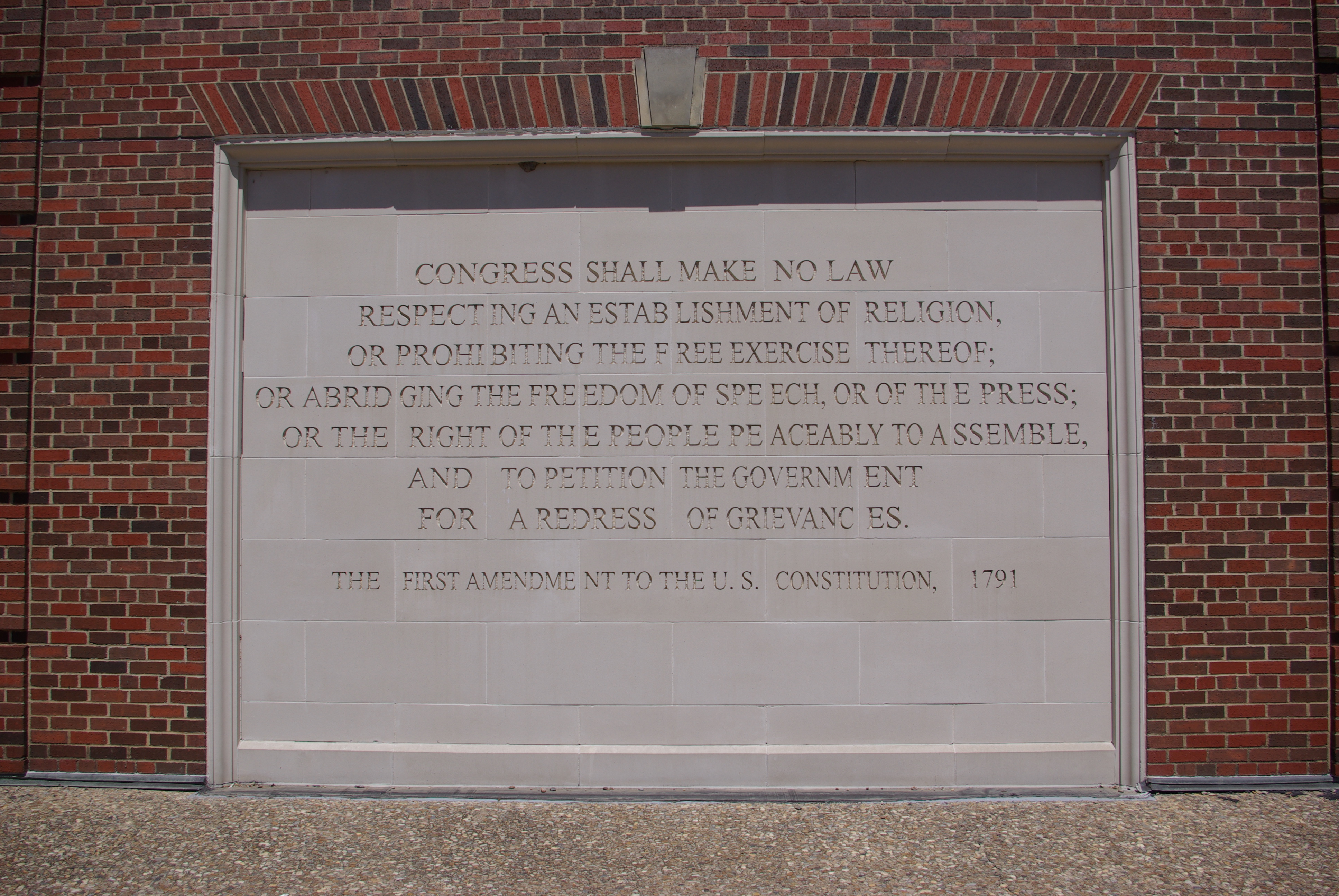
In a discussion about teaching evolution in biology classes a few years ago, I had carefully explained how and why the First Amendment does not require creationism to be taught in biology classes, and in fact is the reason that creationism isn’t taught, in the Establishment Clause. My explanation irritated the tarnation out of a creationist woman who exclaimed, “Well, it’s not like the First Amendment is engraved in stone!”

Heh. Guess what I found at Southern Methodist University Saturday. There, outside the main door of the Umphrey Lee Center, which houses the Department of Economics and the Division of Journalism of the Meadows School for the Arts:

The First Amendment, at SMU


Canute of the mountains

February 6, 2008

King Canute could not hold back the tide -- unknown artist

King Canute* couldn’t hold back the tides.

Surely the Utah legislature doesn’t think they can hold back the rumblings of the Rocky Mountains, either — but the proposed legislation raises delectable questions about the role of government in preventing disasters, especially using zoning laws as the method of prevention.

Good discussion material for government, civics, geology and “integrated physics and chemistry (IPC).”

* Canute was a Viking. Is anyone from Pleasant Grove, Utah, wondering about the symbolism here, with the high school mascot being the Viking, and the town being located at the foot of the mountains, almost astride the Wasatch Fault?
Image source. Better site: “King Canute on the Seashore.”


Choose wisdom, choose science: Sandefur savages TEA position against evolution

February 6, 2008

Must government agencies be “neutral” between science and non-science, between evolution and intelligent design?

The Texas Education Agency lost it’s long-time science curriculum expert Chris Comer last year in a sad incident in which Comer was criticized for siding with Texas education standards on evolution rather than remaining neutral between evolution and intelligent design.

Comes now Timothy Sandefur of the very conservative Pacific Legal Foundation with an article in the Chapman Law Review which argues that science is solid, a good way of determining good from bad, dross from gold. Plus, Sandefur refutes claims that evolution is religion, and so illegal in public schools. TEA’s position in the Comer affair is shown to be not defensible legally; Sandefur’s article also points out that the post-modern relativism of the TEA’s argument is damaging to the search for knowledge and freedom, too.

In short, Sandefur’s article demonstrates that the position of the Texas Education Agency is untenable in liberty and U.S. law.

Moreover, science is an essential part of the training for a free citizen because the values of scientific discourse — respect, freedom to dissent, and a demand for logical, reasoned arguments supported by evidence — create a common ground for people of diverse ethnicities and cultures. In a nation made up of people as different as we are, a commitment to tolerance and the search for empirically verifiable, logically established, objective truth suggests a path to peace and freedom. Our founding fathers understood this. Professor Sherry has said it well: “it is difficult to envision a civic republican polity — at least a polity with any diversity of viewpoints — without an emphasis on reason. . . . In a diverse society, no [definition of ‘the common good’] can develop without reasoned discourse.”

Science’s focus on empirical evidence and demonstrable theories is part of an Enlightenment legacy that made possible a peaceful and free society among diverse equals. Teaching that habit of mind is of the essence for keeping our civilization alive. To reject the existence of positive truth is to deny the possibility of common ground, to undermine the very purpose of scholarly, intellectual discourse, and to strike at the root of all that makes our values valuable and our society worthwhile. It goes Plato one better — it is the ignoble lie. At a time when Americans are threatened by an enemy that rejects science and reason, and demands respect for dog-mas entailing violence, persecution, and tyranny, nothing more deserves our attention than nourishing respect for reason.

III. CONCLUSION

The debate over evolution and creationism has raged for a long time, and will continue to do so. The science behind evolution is overwhelming and only continues to grow, but those who insist that evolution is false will continue to resist its promulgation in schools. The appeal to Postmo-dernism represents the most recent — and so far, the most desperate — attempt on the part of creationists to support their claim that the teaching of valid, empirically-tested, experimentally-confirmed science in government schools is somehow a violation of the Constitution. When shorn of its sophisticated-sounding language, however, this argument is beneath serious consideration. It essentially holds that truth is meaningless; that all ways of knowing — whether it be the scientist’s empirically tested, experimentally confirmed, well-documented theory, or the mumbo-jumbo of mystics, psychics, and shamans — are equally valid myths; and that government has no right to base its policies on solid evidence rather than supernatural conjurations. This argument has no support in epistemology, history, law, or common sense. It should simply not be heard again.

Chapman Law Review, Vol. 11, No. 1, 2008

Sandefur’s article is available online in .pdf format at the Social Science Research Network (SSRN).

Is anyone at the Texas Education Agency listening?

Tip of the old scrub brush to Ed Brayton at Dispatches from the Culture Wars.


Hittin’ the big time? Or just catching up?

January 19, 2008

Adnan Oktar’s mean-spirited campaign against knowledge, science and evolution still makes headlines — this time in the blog of Die Zeit, the most widely-read newspaper in Germany.

I’m flattered at the mention. I’d be happier if I knew Turkey’s ban on blogs had been lifted. I’d be happier if Die Zeit’s view leaned much more toward protecting freedom of the press, and much less toward general xenophobia against Moslems. Perhaps I’m reading too much into the comments.

Millard Fillmore’s Bathtub is banned in Turkey, China, and blocked in the Duncanville, Texas, school system. What does that mean?


Diagramming the Preamble

January 17, 2008

Beautiful, indeed!

I’ve often recommended students diagram the Preamble to the Constitution, to better understand the source of authority in our government (“We, the People”).

Betsy (I have no surname) sent me a link to this:

Preamble to the Constitution as your English teacher wishes you would have diagrammed it. JPEG version

Preamble to the Constitution as your English teacher wishes you would have diagrammed it.

Sentence diagram of the Preamble to the Constitution

Sentence diagram of the Preamble to the Constitution. GIF version


The work is done at a the site of Capital Community College, their “Guide to Grammar and Writing.”

Here’s the Preamble as it usually appears:

We the People of the United States, in Order to form a more perfect Union, establish Justice, insure domestic Tranquility, provide for the common defence, promote the general Welfare, and secure the Blessings of Liberty to ourselves and our Posterity, do ordain and establish this Constitution for the United States of America.

I wonder: Has anyone diagrammed the Mayflower Compact?

Tip of the old scrub brush to Betsy at The Reality Based News Feed, and to Boing Boing.


Death penalty: Cruel and unusual punishment?

December 31, 2007

A note today from the Legal Information Institute (LII) at Cornell University’s Law Library notes that a big death penalty case is set for argument on Monday, January 7.

The issue in Baze v. Rees is whether lethal injection is cruel and unusual punishment, and therefore prohibited under the 8th Amendment to the Constitution. Plaintiffs Thomas Baze and Thomas K. Bowling argue that there is an impermissible chance of pain from the execution process.

Two lower courts ruled against the plaintiffs. In a rather surprise move, the Supreme Court granted a writ of certiorari on September 25 to hear the case, which some interpret as the Court’s willingness to review the cruel and unusual argument in the light of a majority of the states now refusing to use the death penalty, while others think it means the more conservative Roberts Court is willing to quash death penalty appeals with a ruling that injection is not cruel and unusual.

This highlights the 8th Amendment. Discussion of this topic may help students cement their knowledge of the amendment and Bill of Rights. News on this case generally highlights court procedures, procedures, legal and constitutional principles that students in government classes need to understand.

News on the arguments in this case should go into teacher scrapbooks for later classroom exercises. Teachers may want to note that the decision will come down before the Court adjourns in June, but it may come down before the end of the school year. Teachers may want to have students review information about the case and make predictions, which predictions can be checked with the decision issues.

Below the fold I copy LII’s introduction to the case in their Oral Argument Previews, with the links to the full discussion, which you may use in your classes.

LII operates off of contributions. I usually give $10 or so when I think of it — these resources are provided free. You should be using at least $10 worth of stuff in your classrooms — look for the donation link, and feel free to use it in the support of excellent legal library materials provided free of cost to teachers and students.

Read the rest of this entry »


Texas Citizens for Science: Report on creationist certification

December 20, 2007

To provide a little greater access, below the fold I reproduce the complete report from the Texas Citizens for Science on the Institution for Creation Research’s bid to get approval from Texas to grant graduate degrees from the ICR’s Irving, Texas, campus.

If you are tracking this issue, you should also see these posts and sites:

The TCS report is also available at the TCS website.

Read the rest of this entry »


Texas’ face should be creationism red

December 18, 2007

P. Z. Myers at Pharyngula has a couple of posts that shed light on part of the recent creationism eruptions in Texas.

The ICR affair is quite astounding: ICR plans to grant degrees in how to violate the Constitution as an educator, and they’re asking Texas to approve it. So far, the approval is on a fast track.

What’s next? Perhaps one of the A&M campuses could start a program on marijuana farming; approval would come from the State of Texas on the basis that all the agricultural stuff is top notch — great course in fertilizing, fantastic stuff on grow lights, wonderful course on marketing agricultural products through ad hoc distribution channels, or through viral marketing.

Okay, that sounds crazy. Now tell me, what’s different about a creationism course? It only violates a different law.

This fight is just warming up. Texas Citizens for Science is in the thick of it. You should be writing to your legislators and to the Texas Higher Education Coordinating Board:

Third, we need to write to Dr. Raymund A. Paredes, the Commissioner of the THECB to express our disgust at how this process has been handled so far, and to object to granting ICR the Certification it desires. The address is:

Dr. Raymund A. Paredes, Commissioner
Texas Higher Education Coordinating Board
P.O. Box 12788
Austin, TX 78711-2788

One more chapter in the War on Science, the War on Education — one more time to stand firm for reason against stupidity.

Other resources:


Bill of Rights Day, December 15

December 14, 2007

Courtesy the Bill of Rights Institute, a few “did you knows” about the Bill of Rights:

Did You Know?

The Bill of Rights was ratified December 15, 1791.
__

Congress adopted twelve amendments, of which only ten were ratified by the states by 1791.
__

Over 200 years later, one more of the original twelve, concerning compensation for Congress was ratified on May 7, 1992, becoming the Twenty-Seventh Amendment.
__

James Madison wrote the Bill of Rights and was inspired, in part, by the Virginia Declaration of Rights, written by George Mason.
__

The Bill of Rights initially applied only to the federal government; however, the Supreme Court, through the Fourteenth Amendment, has incorporated some portions to apply to the states.
__

Only 17 amendments have been ratified since the adoption of the Bill of Rights.


Celebrate the Ides of December!*

December 10, 2007

December 15th is Bill of Rights Day, a tradition since Franklin Roosevelt first declared it in 1941.

The Bill of Rights, National Archive

It falls on Saturday this year — which means teachers can choose whether to commemorate it Friday, or next Monday, or on both days. It marks the date of the approval of the Bill of Rights, in 1790.

Texas requires social studies teachers to spend a day on the Constitution. The law isn’t well enforced, but Bill of Rights Day might be a good time to fill the legal duty in your classrooms.

The Bill of Rights Institute offers lesson plans and supporting materials (see “Instructional Materials” in the left column). Below the fold I copy a list from the Institute’s webpage on Bill of Rights Day.

More material here, and the National Archives material can be reached here.
_____________
* The ides is merely the middle of the month. Of course you thought of Shakespeare’s witch warning Julius Caesar to “beware the ides of March.” In this case, we can celebrate the ides of December — Hanukkah mostly gone, Christmas, Eid and KWANZAA on the way.
Read the rest of this entry »


Politics at the Texas Education Agency

December 9, 2007

Reaction to the political resignation/firing of the science curriculum director at the Texas Education Agency (TEA) has been almost universally negative. If there are any approving reactions, they are hidden well.

Dr. Barbara Forrest, whose speech in Austin produced the “FYI” memo Chris Comer sent to a dozen people, posted her reaction at the website of the National Center for Science Education; you can get a .pdf download from NCSE, or read the piece with a lot of reaction at Dr. P. Z. Myers’ blog, Pharyngula.

The incident now involving Ms. Comer exemplifies perfectly the reason my co-author Paul R. Gross and I felt that our book, Creationism’s Trojan Horse: The Wedge of Intelligent Design, had to be written. (http://www.creationismstrojanhorse.com) By forcing Ms. Comer to resign, the TEA seems to have confirmed our contention that the ID creationist movement — a religious movement with absolutely no standing in the scientific world — is being advanced by means of power politics.

This morning, TEA director Robert Scott’s responses to questions from the Dallas Morning News opinion editors gave the first official reaction from TEA of any substance.

I don’t think the impression was that we were taking a position in favor of evolution. We teach evolution in public schools. It’s part of our curriculum. But you can be in favor of a science without bashing people’s faith, too. I don’t know all the facts, but I think that may be the real issue here. I can’t speak to motivation but … we have standards of conduct and expect those standards of conduct to be followed.

For reading convenience, both statements are below the fold.

No, I’m not reserving judgment, but I am reserving comment for the moment. I am hopeful Scott will recognize the error and take steps to square his agency with education standards, state law, good employment practices, and reason.

Read the rest of this entry »


Crazies promise to abandon California public schools?

October 21, 2007

No, the news is not that good, really. It’s not really news, either. WorldNet Daily, an on-line publication of borderline sanity, may have left the border.

If only it were a promise, instead of a “call to abandon the schools.”

“We’re calling upon every California parent to pull their child out of California’s public school system,” Randy Thomasson, president of Campaign for Children and Families, told WND.

“The so-called ‘public schools’ are no longer a safe emotional environment for children. Under the new law, schoolchildren as young as kindergarten will be sexually indoctrinated and introduced to homosexuality, bisexuality, and transsexuality, over the protests of parents, teachers and even school districts,” he said.

The law at issue went through the California legislature as SB 777, and now bans in school texts and activities any discriminatory bias against those who have chosen alternative sexual lifestyles, Meredith Turney, legislative liaison for Capitol Resource Institute, said.

There are no similar protections for students with traditional or conservative lifestyles and beliefs, however. Offenders will face the wrath of the state Department of Education, up to and including lawsuits.

“So-called ‘public schools?'”

Below the fold, the full text of the law. You’ll note, Dear Reader, that the law includes protections for “students with traditional or conservative lifestyles and beliefs,” under the prohibition of discrimination on the bases of religion or sexual orientation, “or any other characteristic contained in the definition of hate crimes that is contained in the Penal Code.”

The new law will make it a crime to bully homosexual kids. Is that the real reason WND is worried about the bill, that it makes bullying a crime?

Why would anyone want to defend a right to bully kids? The purpose of the law is clear, from its purpose clause:

Existing law states that it is the policy of the state to afford equal rights and opportunities to all persons in the public or private elementary and secondary schools and postsecondary educational institutions of the state regardless of their sex, ethnic group identification, race, national origin, religion, or mental or physical disability and prohibits a person from being subjected to discrimination on those bases and contains various provisions to implement that policy.

Existing law prohibits a teacher from giving instruction, and a school district from sponsoring any activity, that reflects adversely upon persons because of their race, sex, color, creed, handicap, national origin, or ancestry.

This bill would revise the list of prohibited bases of discrimination and the kinds of prohibited instruction and activities and, instead, would refer to disability, gender, nationality, race or ethnicity, religion, sexual orientation, or any other characteristic contained in the definition of hate crimes that is contained in the Penal Code. The bill would define disability, gender, nationality, race or ethnicity, religion, and sexual orientation for this purpose.

Would you pull your kid out of a public school because she doesn’t have a right to bully anybody?

Critics of the bill object even to correcting English usage on forms asking information about students; forms may now ask “gender” rather than the more gauche “sex.” California’s Catholics for the Common Good found that correction a threat, somehow:

“Who knows what the consequences would be of deleting the definition of ‘sex’ of a child as a biological fact and replace it with ‘gender,’ a subjective term to be determined by the student. The legislature never investigated the cost of accommodating student preferences for lavatory and locker room facilities.” Read the rest of this entry »