Burqas forced on Texas students?

August 23, 2013

Come the CSCOPE critics from the wilds of Texas:

Of course, if you ask DanaSomething, or any other CSCOPE critic, when and where that burqa event took place, she produces no evidence.

For three weeks now I’ve made a practice of asking CSCOPE critics for evidence of the evils of Texas teachers and curriculum planners they claim occur.

Not a single example has checked out.

If you’re familiar with the “burqa” controversy in Lumberton, Texas, you know the facts don’t square with the CSCOPE critics’ shorthand version.

Monday, February 25th, 2013

Lumberton ISD Response to CSCOPE and Promotion of Islam

Recently a picture had surfaced showing five students dressed in burqas (Islamic attire) in a World Geography classroom at Lumberton High School. The lesson that was offered was not a written CSCOPE lesson; however it informed students to the customary culture of the people in the Middle East. The lesson that occurred was presented on February 1, 2013. As part of the curriculum from the World Geography TEKS (as prescribed by the state of Texas), the students are to study the culture (TEKS number 17):

“Culture. The student understands the distribution, patterns, and characteristics of different cultures.” The student is expected to:

(A)  describe and compare patterns of culture such as language, religion, land use, education, and customs that make specific regions of the world distinctive;

(B)  describe major world religions, including animism, Buddhism, Christianity, Hinduism, Islam, Judaism, and Sikhism, and their spatial distribution;

(C)  compare economic, political, or social opportunities in different cultures for women, ethnic and religious minorities, and other underrepresented populations; and

(D)  evaluate the experiences and contributions of diverse groups to multicultural societies.”

The lesson that was offered focused on exposing students to world cultures, religions, customs, and belief systems. A description on the whiteboard behind the students show the splits in religions: Islam (Sunni and Shia), Judaism (Reform, Conservatives, and Orthodox), and Christianity (Catholic, Orthodox, and Protestant). Clothing expresses the individual culture. The lesson is not teaching a specific religion, and the students volunteered to wear the clothing.

The portrait focused only on Middle Eastern attire and the students are wearing variations of this customary attire found in the Middle Eastern culture. This portrait does not reflect the entire aspect of the lesson. The lesson encompassed diversity education so students receive a firm understanding of our world and why people are motivated differently.

Lumberton ISD has purchased the CSCOPE curriculum however; the teachers are not required to teach the lessons that are provided. The school district follows the Year at a Glance, a scope and sequence of the adopted Texas Essential Knowledge and Skills, as well as the Instructional Focus Document which explains the Rationale, Common Misconceptions for students, TEKS, and the Key Academic Vocabulary that supports conceptual development. The district has great teachers and supports the teachers and their individuality in methods of instructional delivery.

Lumberton is a small  town of about 12,000 people (2010 Census) a few miles north of Beaumont.  Lumberton Independent School District (ISD) schools are “recognized” under the old, just-outdated school and district rating system Texas used, suggesting that student achievement was above average.  State test scores tend to show the same. If this is their example, we should note that in addition to characterizing the lesson wrong, getting wrong the facts of students trying on clothes of other cultures, and the fact that this exercise is not at all related to CSCOPE, the students seem to be learning well.

Kudos to Lumberton, and to CSCOPE, right? Not for the Right Wing Crazies.

Remember, when Glenn Back went on national unwatched television to complain about the “Marxist” lesson in economics, when we finally got the slide, it showed clearly that it favored free marketry.

On this burqa thing?  I’m willing to say no kid has ever been “forced” to wear a burqa for any school purpose — though some may have put on a costume for a report (is that bad?).

In short, I find the critics of CSCOPE to be at odds with the facts, making stuff up to yell about.  Almost every single one of the criticisms for how the Texas standards on Islam are taught, involves the fact that Islam is taught about at all.  CSCOPE critics claim “indoctrination” when it’s clear from lesson plans, support materials, texts, state standards, and test results, that students are simply learning about history, geography and culture.

Shame on any politician who acts on such unhinged, false rants.

There’s a “debate” between Texas State Sen. Dan Patrick, R-Bedlam, and the most sane member of the Texas State Board of Education, Thomas Ratliff, set for this Saturday, in Tyler. One wonders how absurd it can get. Will Patrick tell us which Texas school forced kids to wear burqas?  Don’t bet on it.  Will Patrick provide any other evidence of rampant socialism or Marxism in Texas schools?  No, don’t bet on that, either.

More (good and bad information here; caveat emptor:

The world is still safe for fairness.

The world is still safe for fairness.  Joseph McCarthy remains in his grave on the banks of the Fox River in Appleton, Wisconsin; Texas critics of schools and teachers should leave McCarthy’s scurrilous methods and false claims buried, too.


Favorite images for VJ Day, August 15

August 15, 2013

August 15, 1945, was VJ Day — the day that World War II ended in the Pacific Theatre. VJ is an acronym for Victory Japan. Victory in Europe, VE Day, was declared the previous April.

VJ Day is affiliated with a series of images that students of U.S. history should recognize; these images tell much of the story of the day and the events of the weeks leading up to it.

The most famous image is Alfred Eisenstadt’s photograph of an exuberant sailor kissing a swept-off-her-feet- for-the-moment nurse in Times Square, New York City. This is one of the most famous photographs from the most famous photographer from Life Magazine:

The Smack Seen 'Round the World, photo by Alfred Eisenstadt, Life Magazine, 8-15-1945

The Smack Seen ‘Round the World, photo by Alfred Eisenstadt, Life Magazine, August 15, 1945

Eisenstadt coolly titled his photo “VJ Day, Times Square.” It came to be known as The Smack Seen ‘Round the World. It was fitting that the photo would be taken by Eisenstadt, since his work came to be a symbol of Henry Luce’s Life Magazine in a pre-television era when photography magazines like Life and Look were key news organs for the nation.

In a fun and continuing mystery, several people have claimed to be the sailor, or the nurse, through the years.

Before the victory celebration, there had to be a victory. Japan asked for conditional surrender discussions, but the Allied forces insisted on unconditional surrender. Japanese military officials were rather certain that, if the Soviet Union entered the Pacific War, Allied victory would be assured. Japan hoped to either get a conditional surrender agreement, according to some sources, or inflict heavy losses on Allied forces to get better surrender conditions, but before Russia entered the war. Russia and Japan had long-standing grudges against one another dating from before their earlier war in the first decade of the 20th century.

Read the rest of this entry »


A salute to Medal of Honor winner Rodolfo Hernandez

April 1, 2011

No television cameras.  No professional photographers.  An employee of American Airlines, Andres Otero, standing by, caught the event, probably with his phone camera.

Here’s the picture, published in the obscure Queens Gazette:

Congressional Medal of Honor Winner Rodolfo Hernandez March 25, 2011.  Photo by Andres Otero, American Airlines

Congressional Medal of Honor Winner Rodolfo Hernandez received a salute from active duty military, as he boarded an American Airlines flight to Washington, D.C., for Medal of Honor Day, March 25. Photo by Andres Otero, American Airlines

[Click through to the Queens Gazette for a larger image.]

The rest of the story?

California-native Corporal Rodolfo P. Hernandez served in the U.S. Army, and saw action in the Korean conflict.  He and his unit came under attack near Wontong-ni, Korea, on May 31, 1951.  Here’s the citation, from the Congressional Medal of Honor Society:

Cpl. Hernandez, a member of Company G, distinguished himself by conspicuous gallantry and intrepidity above and beyond the call of duty in action against the enemy. His platoon, in defensive positions on Hill 420, came under ruthless attack by a numerically superior and fanatical hostile force, accompanied by heavy artillery, mortar, and machine gun fire which inflicted numerous casualties on the platoon. His comrades were forced to withdraw due to lack of ammunition but Cpl. Hernandez, although wounded in an exchange of grenades, continued to deliver deadly fire into the ranks of the onrushing assailants until a ruptured cartridge rendered his rifle inoperative. Immediately leaving his position, Cpl. Hernandez rushed the enemy armed only with rifle and bayonet. Fearlessly engaging the foe, he killed 6 of the enemy before falling unconscious from grenade, bayonet, and bullet wounds but his heroic action momentarily halted the enemy advance and enabled his unit to counterattack and retake the lost ground. The indomitable fighting spirit, outstanding courage, and tenacious devotion to duty clearly demonstrated by Cpl. Hernandez reflect the highest credit upon himself, the infantry, and the U.S. Army.

Congressional Medal of Honor awardee Cpl. Rodolfo P. Hernandez - CMOHS image

Congressional Medal of Honor awardee Cpl. Rodolfo P. Hernandez - Congressional Medal of Honor Society image

Cpl. Hernandez received the Congressional Medal of Honor on April 21, 1962.

No, I had not heard of Medal of Honor Day, either.

Here are some details from MedalofHonorNews.com, so you can get a head start on next year’s observation:

Sunday, March 13, 2011

National Medal of Honor Day: Let’s not forget our heroes on March 25th, 2011


National Medal of Honor Day is officially observed on March 25th. The Medal of Honor is the highest distinction that can be awarded by the President, in the name of the Congress, to members of the Armed Forces who have distinguished themselves conspicuously by gallantry and intrepidity at the risk of their lives above and beyond the call of duty.

“This holiday should be one of our most revered. Unfortunately all too many Americans are not even aware of its existence.” Home of Heroes

The date of March 25th was chosen because the first Medals of Honor were awarded to members of Andrew’s Raiders on March 25, 1863, for their actions during the “Great Locomotive Chase.”

Col. Robert Howard (USA Ret.) president of the Congressional Medal of Honor Society on National Medal of Honor Day states:

“Hard times ask us to put a greater good before our own interests. It is sometimes physically or emotionally painful. Yet throughout history, you will find common men and women who fought selflessly in a variety of ways for something so much larger than just their own benefit.

Today, we’re fighting terrorism and the spread of tyranny. We’re challenged by market upheaval, joblessness and perhaps hunger. But the human spirit is resilient and can withstand more than sometimes we are able to immediately comprehend.

It’s up to each of us to not lay and wait for better days, but instead look for opportunities to make the lives of those around us better. National Medal of Honor Day is not a celebration. It is a solemn time to reflect on the freedom we enjoy, its price, and how our own bravery can improve the world around us.”

Home of Heroes, a premier resource of Medal of Honor information on the internet suggests:

“National Medal of Honor day is celebrated in some communities, however for the most part the occasion comes and goes with little notice. As a patriotic American there are a few things you can do to commemorate this day:

  • Fly your flag with pride and patriotism on this day.
  • Remember our heroes. As a gesture of your appreciation, why not take just a few moments in the week prior to National Medal of Honor Day to mail a “Thank You” card to one of our living Medal of Honor recipients. You can find a list of the living as well as information on writing to them among the pages of the Home of Heroes website or contact the Congressional Medal of Honor Society who will forward the letter to the Medal of Honor Recipient.
  • Inform your local media. Most newspapers aren’t even aware that this special day exists. Why not tip your local media to the occasion. Before you do, check out the Home of Heroes database for Medal of Honor recipients from your city and state as well as any who might be buried in your city. This information can give your media a “local angle” that can increase the probability that they will consider doing a story to remind Americans of our heroes.
  • If there is a Medal of Honor recipient buried in your home town, get a school class, scout troop, or other youth organization to “adopt a grave site”.

Please visit the Home of Heroes website and the Educational Resources section of Medal of Honor News.

Also read our upcoming article: Lesson plans for History and Social Studies teachers on National Medal of Honor Day, March 25th, 2011


Texas Independence Day, March 2

March 2, 2011

Texans writing the Texas Declaration of Independence, 1836

In a meeting hall at Washington-on-the-Brazos, Texans meet to write the Texas Declaration of Independence, released March 2, 1836; image from Portal to Texas History

So, put some barbecue in the smoker, get a Shiner for you and your pet armadillo, sit back and enjoy the holiday.  If you’re near Washington-on-the-Brazos, go to the ceremony.  You’d better be sure you’ve got plenty of Blue Bell Ice Cream.

What?  You don’t get the day off?  You know, Texas schools don’t even take the day off any more.

I thought things were going to change when the Tea Party got to Austin and Washington?  What happened?


Original Manuscript, Texas Declaration of Independence - Texas State Library and Archives Commission

Original Manuscript, Texas Declaration of Independence - Texas State Library and Archives Commission

Text from the image above:

The Unanimous
Declaration of Independence
made by the
Delegates of the People of Texas
in General Convention
at the Town of Washington
on the 2nd day of March 1836

When a government has ceased
to protect the lives, liberty and property
of the people, from whom its legitimate
powers are derived, and for the advance-
ment of whose happiness it was inst-
ituted, and so far from being a guaran-
tee for the enjoyment of those inesti-
mable and inalienable rights, becomes
an instrument in the hands of evil
rulers for their oppression.

[Complete text, and images of each page, at the Texas State Library and Archives Commission site.]

Resources for Texas Independence Day

Resources at Millard Fillmore’s Bathtub


Lincoln and the Emancipation Proclamation: Free lesson plans from the Bill of Rights Institute!

February 12, 2011

A little history bauble for Abraham Lincoln’s birthday, today:

From Presidents and the Constitution, a great resource from the Bill of Rights Institute, a lesson plan on Lincoln and the Constitutional issues around the Emancipation Proclamation.  It’s very good, I think — and free (maybe only for a while?).

Presidents and the Constitution, Bill of Rights Institute

Presidents and the Constitution, Bill of Rights Institute

This Presidents and the Constitution focuses on Abraham Lincoln and the Emancipation Proclamation. Though he had always hated slavery, President Lincoln did not believe the Constitution gave him the authority to bring it to an end—until it became necessary to free the slaves in order to save the Union. With the Emancipation Proclamation, which he viewed as an essential wartime measure to cripple the Confederacy’s ability to fight, Lincoln took the first step toward abolition of slavery in the United States.

If you teach social studies, you probably know about the Bill of Rights Institute already — subscribe for lesson plans, news updates, and news about seminars.  They do good work, and the provide great resources.


Fort Worth area teachers: Amon Carter Museum workshop on art from the Gilded Age

November 29, 2010

From the Amon Carter Museum education department (in Fort Worth):

During the Gilded Age, the U.S. economy boomed, the population soared, and Americans flourished. Well, not all Americans; for some this time was not prosperous. During an educator workshop on December 9, [2010] explore both sides of this period using paintings and sculpture from the Amon Carter’s collection.  [Send a note of interest to: education@cartermuseum.org.]

Eastman Johnson, Bo-Peep (Amon Carter Museum)

Eastman Johnson (1824–1906), Bo-Peep, 1872, oil on canvas, Amon Carter Museum of American Art, Fort Worth, Texas, 1980.

Or just sign up:

Thursday, December 9, 2010 – 5:00pm – 7:00pm

The Gilded (or Not-So-Gilded) Age

Educator Workshop: $12 for museum members and $15 for nonmembers

During the Gilded Age (late 1800s to the early 1900s), the U.S. economy boomed, the population soared, and Americans prospered. Well, not all Americans; for some this time in American history was not prosperous. Explore both sides of this period using paintings and sculpture from the Amon Carter’s collection. This workshop is most appropriate for educators of all grade levels teaching English, language arts, social studies, U.S. history, and visual art, although others may benefit. Refreshments are provided from 4:30 to 5 p.m.

Download registration form


World history teachers, take quick note! Paleolithic sources

September 7, 2010

More accurately, sources on the paleolithic.

K. Kris Hirst at About.com blogs about archaeology at least weekly — I just subscribe to her stuff and get it when it comes.  So, file this under “I get e-mail.”

This week, she’s got stuff world history teachers could use on the old stone age.  See if this doesn’t pique your interest:

From K. Kris Hirst, your Guide to Archaeology

It’s the beginning of a new school year, and as every one knows, World History begins with the Paleolithic period–the Old Stone Age, the evolutionary moment from which all of our amazing human culture derives. Keep that trowel sharp!

Guide to the Stone Age
The Stone Age (known to scholars as the Paleolithic era) in human prehistory is the name given to the period between about 2.5 million and 20,000 years ago. It begins with the earliest human-like behaviors of crude stone tool manufacture, and ends with fully modern human hunting and gathering societies…. Read more

Control of Fire
The discovery of fire, or, more precisely, the controlled use of fire was, of necessity, one of the earliest of human discoveries. Fire’s purposes are multiple, some of which are to add light and heat, to cook plants and animals, to clear forests for planting, to heat-treat stone for making stone tools, to burn clay for ceramic objects…Read more

The Invention of Footwear
Believe it or not, we humans have worn shoes of one sort or another for some 40,000 years! Read more

The Ileret Footprints
Not as well known and much younger than the Laetoli footprints are the Ileret footprints, two sets of fossilized footprints of a possible Homo erectus or Homo ergaster discovered at the FwJj14E site, near the modern town of Ileret in Kenya. Read more

See what I mean? Go see what else she’s got.  Some of us are going into the third week, and are already past that lecture . . .


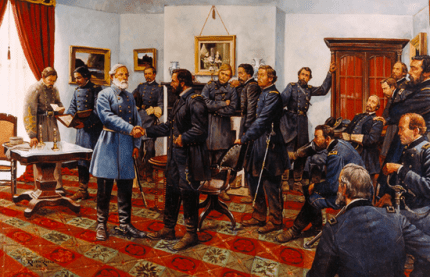
Civil War week, had I been on the ball

April 15, 2010

April would be a great month to study the Civil War, what with all the Civil War anniversaries of high import.

April 14 is the anniversary of the assassination of Abraham LincolnApril 9 is the anniversary of Lee’s Surrender at Appomattox Courthouse, and April 12 is the anniversary of the attack on Fort Sumter in Charleston Harbor.

But of course, we studied the Civil War in our U.S. history classes last fall, in the first six weeks, as a review of what the students were supposed to get in 8th grade.

In your classroom, how do you deal with anniversaries when they are out of the current course of study?  How have you seen it done well?

The Surrender, by Keith Rocco - image from National Park Service

The Surrender, by Keith Rocco – image from National Park Service, via Pillar to Post

Notes:

Help others remember history:

Add to FacebookAdd to NewsvineAdd to DiggAdd to Del.icio.usAdd to StumbleuponAdd to RedditAdd to BlinklistAdd to TwitterAdd to TechnoratiAdd to Furl

Below the fold, the identities of the soldiers in Rocco’s painting above.

Read the rest of this entry »


Remembering Christa McAuliffe: Teacher talks with North Carolina school kids, from space

April 13, 2010

Sometimes progress is so strong that we forget to note the milestones.

I’m remembering Christa McAuliffe today.

Tomorrow, April 14, Mission Specialists Dottie Metcalf-Lindenburger is scheduled to talk with students at Eastern Guilford High School in North Carolina, and all of the 71,000 students in Eastern Guilford School District.

Astronaut Dorothy Metcalf-Lindenburger, former teacher - NASA photo

Caption from NASA: STS-131 Mission Specialist Dorothy Metcalf-Lindenburger, attired in a training version of her shuttle launch and entry suit, poses for a photo prior to the start of an ingress/egress training session in the Space Vehicle Mock-up Facility at NASA's Johnson Space Center. Photo Credit: NASA

Metcalf-Lindenburger is one of three teachers selected in 2004 as astronauts.  NASA is committed to help education out.  After the Challenger disaster, and the death of “teacher in space” Christa McAuliffe, NASA finally determined to make teachers into astronauts rather than fly “civilians.”

Bittersweet, but there it is.

Press release from NASA:

Stephanie Schierholz
Headquarters, Washington
202-358-4997
stephanie.schierholz@nasa.gov

Jenna Maddix
Johnson Space Center, Houston
281-244-0185
jenna.c.maddix@nasa.gov

Haley Miller
Guilford Public Schools, Guilford, N.C.
336-370-3200
millerh3@gcsnc.com

April 12, 2010

MEDIA ADVISORY : M10-048

Orbiting Space Shuttle Astronauts — Including Former Teacher — Call North Carolina Students

WASHINGTON — Astronauts orbiting 220 miles above Earth will speak with students in Gibsonville, N.C., on Wednesday, April 14. The call with the students and space shuttle Commander Alan Poindexter and Mission Specialists Dottie Metcalf-Lindenburger, Stephanie Wilson and Clay Anderson will take place at 1:06 p.m. EDT at Eastern Guilford High School in Gibsonville.

Eastern Guilford High School is hosting students from Eastern Guilford Middle School, Gibsonville Elementary, McLeansville Elementary, Rankin Elementary and Sedalia Elementary for the downlink. The school also will broadcast the event to the entire Guilford County Schools district, which serves more than 71,000 students.

The astronauts launched Monday, April 5, aboard space shuttle Discovery from NASA’s Kennedy Space Center in Florida. During the 13-day mission to the International Space Station, the crew will deliver science experiments and supplies; take three spacewalks to switch out a gyroscope on the station’s truss, or backbone; install a spare ammonia storage tank and return a used one; and retrieve a Japanese experiment from the station’s exterior.

Metcalf-Lindenburger is one of three teachers selected to fly as shuttle mission specialists in the 2004 Educator Astronaut Class. She operates the shuttle’s robotic arm. Without robotics, major accomplishments like building the station, repairing satellites in space and exploring other worlds would not be possible.

Students have been preparing for the downlink by conducting NASA engineering design challenges and implementing agency robotics resources and activities into K-12 classrooms. A science, technology, engineering and math, or STEM, club was organized to increase participation and interest, particularly by female students.

The school’s guidance department also is collaborating with local universities to help students investigate and explore STEM opportunities beyond graduation. During follow up in-district workshops in April and May, a NASA Aerospace Education Services Program specialist will demonstrate how to access and use NASA resources in K-12 curricula.

Eastern Guilford High School employee Michael Woods, a former Aerospace Education Services Project specialist at NASA’s Goddard Space Flight Center in Greenbelt, Md., and the agency’s Langley Research Center in Hampton, Va., is leading the downlink effort. In December 2009, NASA awarded Guilford County Schools a two-year grant of nearly $1 million to help middle and high school teachers develop science lessons using the space agency’s content.

The event is part of a series with educational organizations in the U.S. and abroad to improve teaching and learning in science, technology, engineering and mathematics. The in-orbit call is part of Teaching From Space, a NASA project that uses the unique environment of human spaceflight to promote learning opportunities and build partnerships with the kindergarten through 12th grade education community.

NASA Television will air video of the astronauts during the downlink. For NASA TV downlink, schedule and streaming video information, visit:

http://www.nasa.gov/ntv

Even Bob Park will pipe down for a day for this (though he’s right, you know).


You’re not using this technology in your classroom?

April 12, 2010

Here’s another opportunity to put real, cutting edge technology in your classroom.  In fact, your kids could probably invent all sorts of new uses for it.

Have you even heard of this stuff?  Can you use it, live, with the equipment you’ve got?

Blaise Aguera y Arcas  of MicroSoft demonstrated augmented-reality maps using the power of Bing maps, Flickr, Worldwide Telescope, Video overlays and Photosynth, to an appreciative and wowed audience at TEDS:

My prediction:  One more advance in computer technology that classrooms will not see in a timely or useful manner.

But have you figured out how to use this stuff in your geography, history, economics or government classes?  Please tell us about it in comments. Give examples and links, please.


Edith Wharton on Facebook: What a horrible thought!

January 3, 2010

Nancy Sharon Colllins, reporting after her recent work at the Harry Ransom Center at the University of Texas, including reading some original letters and other writings of Edith Wharton, wonders what would be the effect on history and literary studies, had Edith Wharton used Facebook instead of keeping her journal and writing copious numbers of letters.

And that got me thinking: What if Edith Wharton had Facebooked? Had she lived in our time and communicated digitally, I wonder what her literature would be like. Looking at five days of cursive writing and personal letters made me realize that her compulsion to jot down her thoughts was no different than ours today when we tweet about what we had for lunch or share some fab link we just discovered. The difference between a letter written longhand and a Facebook post is that one takes a little bit longer (and leaves a more lasting trace), but the purpose is the same. Whether we live on a grand, Whartonian scale or a quieter, more ordinary one, we feel more significant when we share intimacies about ourselves with others.

There’s a good warm-up and/or journaling exercise in there for literature teachers.


Cool stuff: Richard Wiseman’s Top 10 Science Party Tricks for Christmas

December 9, 2009

I especially like pouring the carbon dioxide to put out the candles:

Wiseman’s blog is worth visiting from time to time — especially if you’re a teacher.


Geography Awareness Week, November 15-21

November 6, 2009

Geography Awareness week is sneaking up — November 15-21.

Got your special lesson plans ready, teachers?


Gilded Age project

October 27, 2009

I really like this project, and I wish I’d come across it about a month ago:

The Gilded Age Class Documentary Project

The Gilded Age – Class Documentary Project

Instructors:  Rachel Duffy, Marc Ducharme

May, 2005

Adapted from:  The Gilded Age WebQuest – Documenting Industrialization in America

By: Thomas Caswell and Joshua DeLorenzo

What do you think?


HippoCampus: Technology’s promise shows

May 28, 2009

Teachers, are you using HippoCampus?  (Tell us about it in comments if you are.)

Topics with lesson plans and great support material:

Algebra
Algebra (Spanish)
American Government
Biology
Calculus
Calculus (Spanish)
Environmental Science
Physics
Psychology
Religion
Statistics
USHistory

HippoCampus is a product of the Monterey Institute, a part of the University of California system.