George Washington’s influence on American geography

March 15, 2009

A quick snippet of learning from my stay at Mount Vernon:

How many places are named after Washington?  How many schools?

At the relatively new museum here I found a display that notes how Americans have honored our First President by naming things after him:

  • 26 mountains
  • 740 schools
  • 155 places (the exhibit said “155 cities and counties,” but the map also showed the State of Washington)

(All of this comes without the aid of a George Washington Legacy Project to inflate his importance and the love of Americans for his work!)

George Washington can still lay claim to his friend Richard Lee’s eulogy, as “first in the hearts of his countrymen.”

I found the display on place names on the way out of the Education Center — a place designed to help visiting teachers learn about resources available for classroom use.

Of course the group works to help teachers who can’t visit at the moment, too.  To that end they’ve published online a series of lesson plans developed by the George Washington Teachers’ Institute, a summer residency program that provides professional development.

Check out the lesson plans at http://www.mountvernon.org.  Lesson plans are here.  I particularly liked the political cartoons included in this lesson plan, all drawn by Pulitzer Prize-winning cartoonists.

Renovations and new construction at Mount Vernon during the past decade have made the place a much more valuable resource for teachers and students.

Let’s tip the entire Millard Fillmore’s Bathtub to the Bill of Rights Institute and Liberty Fund, who sponsored the program at Mount Vernon.


Bill of Rights Institute teacher training in Austin, Texas, February 6 & 7

January 27, 2009

For you Austinites, or someone close enough to make this training:

Bill of Rights Institute logo

The Bill of Rights Institute at the
Texas Law-Related Education Conference
February 6-7, 2009

Event Website

Date: February 6-7

Where:
Hilton Austin Airport 9515 Hotel Drive Austin, TX 78719

The Bill of Rights Institute is pleased and honored to be exhibiting and presenting at the 2009 Texas Law-Related Education conference on Friday and Saturday, February 6 & 7. We hope while you are attending the conference, you will stop by our booth in the exhibits area and see our wide range of materials and programs that can enrich as well as bring new excitement to your lessons. Also, on Friday at 10:00 AM, we will be presenting a session at the conference on Lincoln’s Leadership: Secession and Emancipation (with free lesson plans distributed at the end of the session!).

Have a terrific time at the conference and we hope to see you at our booth or our session!

Bill of Rights Institute
200 North Glebe RD
Suite 200
Arlington, Virginia 22203
703-894-1776


“I swear (or affirm)”: Ready for the inauguration?

January 14, 2009

Here’s a map that should be more viewed in America, but a map which has been much overlooked in the post-election euphoria, or post-election gloom.  It’s the map of electoral college results, still showing Republicans in a Soviet/Maoist red, and Democrats in blue:

Electoral College results from the 2008 presidential election - American Presidency Project

Electoral College results from the 2008 presidential election - American Presidency Project

Note especially the blue dot in Nebraska, around Omaha.  Nebraska splits its electoral college votes, giving each congressional district’s vote to the elector for the candidate who actually won in that district.  Obama won Omaha’s district; Nebraska is officially a red and blue state.  Maine also allows a split in electors, but this year did not see a split among the electorate.

America is not so red as some claim, even in the electoral college.  More states are surrounded by blue states than surrounded by red states.

Perhaps it’s time to find other ways to color these maps, so that we cannot so easily speak of a red state/blue state split that does not reflect politics, economics, or much of anything else in America.

Dallas students are out on inauguration day.  We can hope our government and history students will glue themselves to the television to watch the ceremony, but we know better than to expect it.

Will you discuss the inauguration in your classes, whatever the subject?  Here are some sources you could use:


Hudson’s Half Moon

November 25, 2008

New Yorkers, Vermonters and Candadians continue to celebrate 400 years since Hudson and Champlain, and 200 years since Robert Fulton brought steam power to the Hudson’s commercial ways.

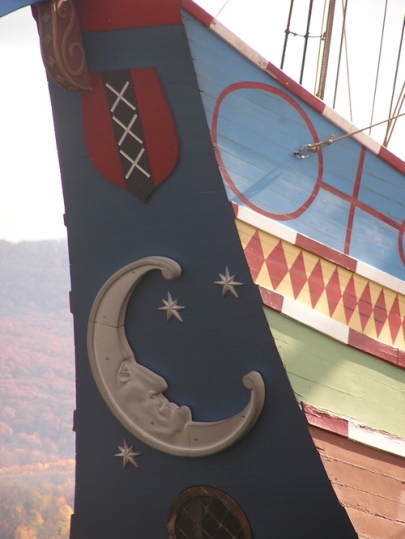
Tugster: A Waterblog features some nice shots, and a couple of stunning shots, of the reconstruction of Henry Hudson’s ship, Half Moon.  Great stuff for presentations, and he likes to share.

Tugster is an outstanding repository of images of tugboats, ships and other things related to the commerce of Greater New York Harbor, and boats on the water generally.  Tugster’s collection of images should be regular source material for teachers of history, economics, geography and government.

A Waterblog

Stern of Half Moon, Henry Hudson's ship; from Tugster: A Waterblog

Notice how the figurehead frightens even the trees to blazing red.

A Waterblog

Bowsprite of Henry Hudson's Half Moon, via Tugster: A Waterblog

Tugster tells us that Henry Hudson himself is blogging, channeling across 400 years — perhaps tired of duckpins with his crew in the Adirondacks (hello, Rip van Winkel!).  Can your students correspond with Henry Hudson?

Resources:


Dear President-elect Obama

November 24, 2008

Good execution of a lesson plan here, at one of my favorite blogs, The Living Classroom — with a lot of possibilities for follow-up.

A citizens plea to President-elect Obama

A citizen's plea to President-elect Obama

This may be the only elementary level classroom in the nation with its own lobbyist.

Never underestimate the power of students united to do good works.

In the Boy Scouts’ merit badge series on citizenship, Scouts are required to write letters to public officials.  This is a good exercise.  Not all students get the full value, but on the chance that answers actually come to the letters, this is a good classroom activity.

Hmmm.  I should use it more.


Geography lesson: New York City

November 19, 2008

Bookmark this site, geography teachers:  Farm School is going to New York City for the “American Thanksgiving” holiday.  Check out the long list of rich resources.

Any student or teacher doing a project on modern New York City should send a note of Thanksgiving to Farm School, eh?


History for fun, not profit (other than a little drink)

October 14, 2008

E Clampus Vitus has tens of thousands of members across seven Western states, though nowhere are the groups eccentric ways more alive than in California. Above, Noble Grand Humbug Scott Neilsen, left, and Steve Slonecker at Eds Restaurant in Twain Harte.

Caption from the New York Times: E Clampus Vitus has tens of thousands of members across seven Western states, though nowhere are the group's eccentric ways more alive than in California. Above, Noble Grand Humbug Scott Neilsen, left, and Steve Slonecker at Ed's Restaurant in Twain Harte. Photo fro the New York Times, by Jim Wilson.

You don’t think history can be fun? Consider the group of Californians known as Clampers, who gather to celebrate history in a place called Twain Harte (ask any California historian, or American literature mavin, how the town got its name):

“It’s a common saying that no one has been able to tell if they are historians that like to drink or drinkers who like history,” said Dr. Robert J. Chandler, a senior historian at Wells Fargo Bank and a proud member of the group’s San Francisco chapter. “And no one knows because no one has been in any condition to record the minutes.”

Whether a historical drinking society or a drinking historical society, the Clampers claim tens of thousands of members in 40 chapters across seven Western states, though nowhere are the group’s strange ways more alive than in California, where members are said to have included Ronald Reagan; John Huston, the film director; and Herb Caen, the famous San Franciscan master of the three-dot journal. Some Clamper membership claims, of course, can be suspect. It is true, however, that many noted historians have been members, as is the current director of the State Office of Historic Preservation.

I already like the bunch:  The Order of E Clampus Vitus.

Read about them in the New York Times. The Times carries a series of stories based on the WPA-produced state guide books (Works Progress Administration).  Each one of these articles would be a good topic of focus for a lesson plan.  Other articles in the series so far include:

See also the introduction to the series, and go back in time to read the .pdf of the story announcing the creation of the WPA, intended to created 3.5 million jobs in the Great Depression.


Finding our place in the world

October 2, 2008

The exhibit is gone, but the memory, and the on-line educational features still remain.

Spectacular digital map of Africa, showing current development.  Map copyright by Allan Sluis, courtesy of NAVTEQ and ESRI

Spectacular digital map of Africa, showing current development. Map copyright by Allan Sluis, courtesy of NAVTEQ and ESRI

Geography teachers should explore the on-line version of the Field Museum’s exhibit, “Maps:  Finding Our Place in the World.

This exhibit is by itself an argument for live internet links for students.  Take a few minutes to peruse some fo the interactive features, like the world map that leads to photos of the major exhibit pieces.

We need more material like this, freely available in classrooms.

Also, see especially:


Baptism by fire, and the fire this time

August 8, 2008

New teachers, teachers taking on new subjects or major curriculum redesigns, and teachers trying to keep up may find this list useful: Baptism by Fire: 100 Essential Tips and Resources for Student Teachers.

It features an extensive list of ideas, suggestions, and useful on-line resources and ideas from the blog Smart Teaching.org.

I confess, I was unaware of Smart Teaching.org until Kelly Sonora contacted me from the organization.  What do you think, Dear Reader:  Useful stuff?


Real dope on human evolution

July 24, 2008

Subtitle this one, “DBQs in prehistory, paleontology, and anthropology.”

Younger son James complained yesterday about . . . well, about stuff he wasn’t taught. His questions to me were about what was available in the history textbooks on the great advances in science in the 20th century.

Very little is available, really. What had set him off was his summer reading where he’s been introduced, for the first time, to particle physics of the past 30 years. History texts may mention Einstein’s letter to FDR which started the Manhattan project. An outstanding history and science student in a U.S. high school can pass through the experience without ever learning what Einstein’s equation, E=mc², actually means, or how it pertains to his letter to Roosevelt, or when and how Einstein came up with it, how Einstein’s papers changed physics, how Einstein’s ideas were tested, how Einstein’s pacifism and Jewish heritage drove him to the U.S., and so on. Great advances in particle physics, or even in practical applications like CAT scans and PET scans, have fallen out of the books and out of the curriculum. 21st century medicine, but 20th century science texts and 19th century history texts. It’s the David-Bartonization of American education.

The stuff wasn’t covered in his AP physics or AP chemistry classes (what’s up with that?!), nor were most of the great discoveries even mentioned in any of the AP history courses.

No wonder the head of the Texas State Board of Education knows so little about science. Cue the country/western version of the story, “Been dumb as a stump so long it looks like genius to me.”** Plus, this makes it clear why the versions of curricula the SBOE head favors must be resisted.

Texas standards and national standards in history ask that students be familiar with American inventions and innovation. In reality that translates to Eli Whitney and the cotton engine, because it’s a key factor in the rise of plantation economics in the South prior to the Civil War; maybe some mention of water-powered looms; Edison and the light bulb; Ford and the assembly line; and maybe a mention of radio or television, usually with regard to the effects on culture. I know a teacher who has a great unit for Texas history on barbed wire and the Colt .45. World history mentions James Watt and the steam engine.* The Wright brothers and the airplane get a couple of sentences. Humans going to the Moon gets a few sentences, but not as much as Sputnik, because, well because Sputnik scared the bejeebers out of some of the people who yelled loudest at Texas and Florida textbook meetings, I imagine.

I’m not going to fix all of that, not right now. It’s a subject that deserves more time in the cooker, I think.

But I’m also working on plans for this next year. Pre-history human migrations, geological development of the planet — and last night I discovered a group hitting the Bathtub for information about humans and evolution. Sheesh! Another place where the history and science texts short the glorious science, where a student is more likely to be struck by lightning waiting for the bus than to get decent coverage of human evolution in the classroom. (Hey. Do you know a teacher who covers human evolution well in any subject? Put it in comments, below — I want to congratulate her, or him. I also want to steal the lesson plans.)

Here’s a quick fix, using some seminal documents that are perfectly classroom usable: Go to the Nature magazine website, and specifically look for the section, “focus on human origins.” If your administrators aren’t fully versed on No Child Left Behind, you can claim these as “research-based” (they are purely research-based; the law asks that our pedagogical methods be research-based, though, not the content, and that’s impossible; most of what we do in the classroom is tradition-based unsupported by any significant research, and federal laws and state regulations generally require the opposite of what the research says . . . don’t get me started). But I digress.

Nature is one of the premier science journals, a peer-reviewed or juried journal that is the prime place for key research findings to be published (along with Science, the other science journal giant). Most of their material is hidden away on the internet, held in proprietary sites available to scientists whose research institutions spring for expensive subscriptions (no, these journals are generally NOT available through the databases most high schools and non-research colleges purchase). Much of the best research of the last century is unavailable to high school teachers or students. This is true of chemistry, physics, biology and geology. The textbooks tend to obfuscate and cover the stuff up — or in the case of particle physics, ignore the field.

Several years ago Nature pulled about a dozen of the seminal papers in human evolution studies out of their vaults, making them available for free. These papers include some of the real classics:

Frankly, I wouldn’t expect to see these in a real DBQ in anything except, perhaps, human geography — but I can dream, can’t I? You can certainly create outstanding DBQ exercises with exerpts from these and a few other sources. Or you can simply use these complete papers in your classes. Except for a select few debate students at the upper echelons of competitiveness, real research papers fall out of the curriculum, and it’s a shame.

There is drama in these papers. Some of them shake the Earth, but in coolly scientific words. Ironically, the papers are not written so technically that they are beyond the ken of most high school readers. These papers are real history, real science, and our students deserve to read them.

Nature deserves our thanks for making these papers available. I wish other seminal papers were available, from Nature, and from other science and history research journals. Students would benefit from reading real history about the fall of the Berlin Wall, or the development of public health to fight tuberculosis. Students could mightily use to read about physics, biology, meteorology, geology, and other sciences upon which we rely to save the human race.

_____________________

* James Rowland of Woodlands High School in the Conroe Independent School District led a group of us teachers in an exercise last week at Texas Christian University in Fort Worth, asking the question about who invented the steam engine and when. With six different AP or advanced world history texts, we came up with eight different answers, including two different years given for Watt’s work.

** Yes, from Richard Fariña’s 1966 novel, Been Down So Long It Looks Like Up to Me (finished two days before his fatal motorcycle accident), and the song (pay no attention to the Lee Hazelwood-Nancy Sinatra song, but remember the Doors’s version is probably unsuitable for classroom use).

Resources:


Even babies chunk data

July 21, 2008

How do you apply this information in your lesson plans?

Even babies chunk data for memorization. That is, even babies find it easier to remember things if the new items include chunks of already familiar information.

Not Exactly Rocket Science discusses new research that shows infants as young as 14 months use this memorization trick.

Which of these strings of letters is easier to remember: QKJITJGPI or BBCITVCNN?

Chances are, you chose the latter string, where the nine letters are the combined names of three television networks. This neatly illustrates a fundamental property of human memory – that we remember long strings of information more easily if we can break them down into bite-sized chunks. In this case, a nine-letter string can be divided into three lots of three letters. You probably use similar strategies for remembering telephone numbers, credit card details, or post codes.

Now, Lisa Feigenson and Justin Halberda from Johns Hopkins University have found that infants just 14 months old can use the same technique, delightfully known as “chunking” to increase the limited scope of their memories. Their work suggests that this technique isn’t something we learn through education or experience – it’s more likely to be a basic part of the way our minds process information.

Much more, here.


Rock and Roll Hall of Fame lesson plans

July 16, 2008

Just found this source, courtesy of Woodlands High School’s James Rowland:  Rock and Roll Hall of Fame and Museum, Summer Teacher Institute lesson plans.

Seriously.  Consider these:

  • Lesson 2: Langston Hughes and the Blues
  • Lesson 4: The Vietnam War: A Popular Music Approach
  • Lesson 9: Woody Guthrie and The Grapes of Wrath
  • Lesson 27: I Went to the Crossroads: The Faust Theme in Music, Film and Literature
  • Lesson 30: Trouble for the United States in the Middle East: The Reagan-Bush Years

Phoenix has landed

May 25, 2008

Phoenix landed on Mars today at 4:38 p.m. Pacific Time. Confirmation of the landing took 15 minutes to get to Earth, radio signals traveling at the speed of light.

We have a robot scout on Mars again!

This is another of those teachable moments, an event to note in class that your students might tell their children and grandchildren about.

Artist's drawing of Phoenix, on Mars.Touchdown occurred exactly at the time programmed and predicted. Such accuracy might be interpreted as a good sign that NASA has anticipated problems, and a successful mission of discovery is in store.

The University of Arizona leads the discovery consortium on this mission (one of my alma maters). Educational activities and plans for teachers are listed at Arizona’s Phoenix Mission website.

NASA is the world’s biggest player in astrobiology, the science of figuring out how life could have begun, and where it might be. Astrobiology is one of the topics Texas’s State Board of Education threatened to remove from biology texts in 2003. That this mission has gotten this far is a sweet little bit of beneficial revenge on the anti-scientists who tried to gut the books then. Maybe it will pose a warning to them on the next go-round.

Teachers, strike a blow for science, knowledge and leadership in knowledge gathering: Teach your kids some astrobiology.

Resources:


Olympic history FAIL!, or great PhotoShop

May 11, 2008

Ed Brayton found it.

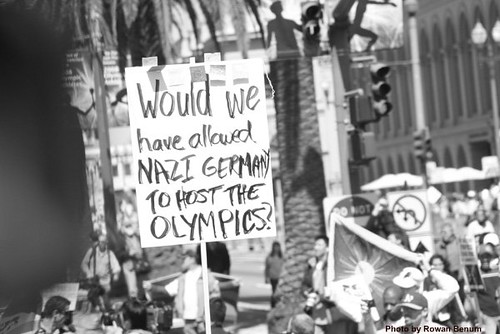
Olympic torch relay protestor with really dumb sign

Do you think the sign maker was jesting? Or do you think the sign maker genuinely didn’t know? (See: 1936 Olympics in Berlin)

While we wait to see whether someone will confess to PhotoShopping this picture, we teachers might consider using this photo as a hook for a lesson on the differences between the rising totalitarian state of Nazi Germany in 1936, and the rising, increasingly economically free state of the People’s Democratic Republic of China today.

One more lesson plan for this year — it’s reusable next fall, with the added bonus then that by then you’ll have the headlines of the actual Olympics to add to the discussion.

Update: The photo is said to have been was taken by Rowan Benum at a California site (see Mr. Benum’s comment). Since it’s all the rage on conservative sites, where the history ignorance is condemned but the conservative bloggers can’t quite bring themselves to endorse the Communist Chinese, I strongly suspect wondered about a PhotoShop origin. The torch was run through San Francisco; there are few palms in San Francisco (Californians: Can you identify the location?).

Update 5-13-2008: The photographer kindly dropped by comments to note the authenticity of the photo. I agree, the Tibetan prayer flags suggest authenticity; would a hoaxer think of such details?

Discussion questions for the classroom:

Students should look at the photo, and read coverage of the torch relay, such as CNN’s story about the San Francisco relay where Mr. Benum took the photo. Students should have access to information about the International Olympic Committee and its organization, especially the tradition of Olympic Truce. The Charter of the Olympics is probably too long for practical classroom use, but Paragraph 2 can be copied for the students, or perhaps the full page of the “Fundamental Principles of Olympism”:

“Olympism is a philosophy of life, exalting and combining in a balanced whole the qualities of body, will and mind. Blending sport with culture and education, Olympism seeks to create a way of life based on the joy found in effort, the educational value of good example and respect for universal fundamental ethical principles.”
Olympic Charter, Fundamental principles, paragraph 2

There is a wealth of information for classroom use at the website of the IOC. If you’re particularly adventurous, or deep into this topic, check out the podcasts of Olympic history from amateur historian Eli Hunt.

Students should also have some information about Tibet, and the Dalai Lama and Tibet’s government in exile, about the history of Tibet and China’s actions since World War II. Students should have some history of the 1936 Olympics, and they should be familiar with the stories of Jesse Owens’ accomplishments there and his return to a segregated U.S. You may want to provide an article about the U.S. protest of the 1980 Olympics in Moscow, and the Soviet protest of the 1984 Olympics in Los Angeles, and other Cold War moments of Olympic tension.

  1. Since the International Olympics Committee (IOC) is an avowedly non-political international agency, is it fair or rational to protest the siting of an Olympics on political grounds?
  2. What do the protesters ask the IOC to do? What do the protesters ask others to do?
  3. Under international law, what are the rights and duties of the Peoples Republic of China (PRC)?
  4. Did the IOC ask anything of the government of the Peoples Republic of China of a political nature? Would such requests be fair, or rational?
  5. Other international organizations function in other nations where governments do not have good records on human rights, such as the Red Cross/Red Crescent, Scouting, UNICEF, and others (can you add to this list?). What considerations must such organizations give to local politics where human rights are at issue?
  6. Compare and contrast the issues surrounding the Beijing Olympics with issues surrounding the Myanmar relief efforts after Cyclone Nargis (2008).
  7. Look at other protests involving the Olympics, especially in 1980 and 1984. Did those protests achieve what the protesters had hoped? Does the success or failure of past protests augur well for current protests?
  8. The creator of the protest sign in the photograph appears to have not known about the 1936 Olympics, which were hosted in Berlin, then under the control of the Nazi government of Germany. The Olympics were sited in Berlin prior to the rise of the Nazi government. Does the protester’s ignorance of history affect the message of the sign? Does it reflect well on the cause the protester advocates?
  9. What other famous or notorious examples of ignorance of history can you find?
  10. Do you ever get embarrassed for the people captured in Jay Leno’s “Jaywalking” segments?
  11. Georges Santayana (1863-1952) famously said, “Those who cannot remember the past are condemned to repeat it.” Do you find that statement to be true? Does this affect the course of history? (Students may want to explore the history of invasions of Russia by Napoleon and Hitler, or the history of invasions of Afghanistan by Britain, the Soviet Union, and the U.S.)

Carnival Catch-up: Personal Finance

April 24, 2008

Behind on our carnivaling again . . . alas, not because we’ve been soaking in the tub, either.

Texas teachers, take note of the 149th Carnival of Personal Finance hosted by The Happy Rock. If you can’t find material there to bolster your personal finance curriculum, you need a lot more coffee.  Lots of posts on saving and investing and how to make it work on limited budgets, good stuff for the classroom.  Some are rather curious though — this one, from Squawkfox, suggests women should go around virtually naked in a sense, keeping no important documents or items in their purses.  Where should a lady carry her check book, seriously?

Tip of the old scrub brush to Don’t Mess with Taxes