Yes, Virginia, Santa Claus still exists

December 25, 2008

Francis Pharcellus Church, the man who answered Virginia's simple query about Santa Claus

This is a bit of an encore post, from 2007.  Merry Christmas.

Is this the man who really saved Santa Claus?

The Newseum itself doesn’t open until opened in the autumn of 2007, but some exhibits are already up, were online earlier. Important ones.

Among other things already up is this explanation for the 1897 editorial in The New York Sun, with the famous line: “Yes, Virginia, there is a Santa Claus.” It is “history’s most reprinted editorial,” the Newseum says.

While you’re there, look at other exhibits already in place. This is a good source for kids’ reports and for teachers’ lectures.

Update: Parallel Divergence is at it again (remember the “how Hubble killed God?”) Here it is: “How Google Earth Killed Santa Claus.”

Update May 2007: Coverage of the Newseum’s pending opening.

Update December 2008More on the Sun editorial

And about angels:


“See ya Red States,” and a paean to Texas

October 16, 2008

You’ve seen it before — the letter saying toodle-oo to the red states, as the blue states muster the courage to let them go.  Somebody passed it along, I forwarded it to a few people I thought hadn’t seen it.

A discussion broke out.  Part of the discussion centered on Texas’s second secession from the U.S., and how nasty things can be in Texas (“It’s not the heat and humidity; it’s the hate and stupidity”).

A couple of exchanges in, I started to wince.  God knows Texas has its problems.  I haven’t even started in on the latest three months of lunacy at the State Board of Education where Creationist-in-Chief Don McLeroy is loosening his belt to drop his pants (figuratively, of course) and moon every kid in Texas before he eviscerates science education.

But — you know? — Texas has a couple of things going for it, reasons to smile while you’re stuck here.

Below the fold, the “So long, Red States” letter — but before that, a modest defense of Texas, as I wrote back:

I do regret that [y’all have] had such a difficult and unhappy time in Texas.  Texas is far from my ideal place, especially for the weather and lack of mountains (I appear to be losing the retirement fight – I wanted Jackson Hole, Kathryn wants Kanab.  Red rock wins with the family.)

And Yellowstone is a part of my soul, especially after we (probably illegally) scattered my brother’s ashes there in the last great family reunion before this past summer.

But, you know, Texas has some fine points that shouldn’t get overlooked. Especially, it doesn’t deserve to get every redneck.

Here are some of the great things about Texas:

It’s been a rather miserable 21 years in Texas for us, for a lot of reasons.  There are good things and good people in Texas.  It ain’t all gloomy.

Wildflowers not only do blossom where they grow:  They must blossom there.

Which reminds me, there are a dozen other wildflowers better than bluebonnets, and we haven’t even started on the magnificent grasses like big bluestem, little bluestem and side-oats grama.

(More humor below the fold.)

Read the rest of this entry »


What Lucy will see, leaving Houston . . .

June 22, 2008

What Lucy saw will see, leaving Houston . . .

[The exhibit on Lucy, our Australopithecus afarensis ancestor, has been extended at the Houston Museum of Natural Science, through September 1, 2008. Go. Go see the exhibit. Don’t put it off.]

Coming out of the display on Lucy at the Houston Museum of Natural Science, coming back down the staircase, this is the painting on the wall. In my imagination, this is what Lucy saw will see as they carried carry her, crated up, out of the building. In reality they probably took will carry her down a freight elevator.

This one’s for you, P.Z. — drop into the Houston museum next time you’re down there:

Whale and Squid mural at Houston MNH


Charles Darwin has a blog!

April 27, 2008

No kidding.  See it here.  High-end hosts, at Nature.com.

I gather they have wi-fi in the cafe at the museum from which he posts.

Charles Darwin in the cafe at the British Museum -- photo from 90% True

Charles Darwin sits congenially in the café of the British Museum.  Does he blog with wi-fi?

Huxley and Darwin in the cafe at the British Museum; temporary posts for both of them, during some renovations, it turned out -- update 2015. Photo from Airminded.

Huxley and Darwin in the cafe at the British Museum; temporary posts for both of them, during some renovations, it turned out — update 2015. Photo from Airminded

In his first post, he complains about the abuse he suffers from Ben Stein’s mockumentary.

Tip of the old scrub brush to Pharyngula.


Baltimore’s orgy of cartography and geography

March 22, 2008

The ad says “Come visit Utopia in Baltimore.” With an orgy of maps like that planned, it should be a Utopia for somebody: Geographers, cartographers, historians, and anyone interested in travel.

Baltimore’s Walters Art Museum hosts an outstanding exhibit of world-changing maps through June 8, a Festival of Maps; the entire town appears to have gone ga-ga on the idea. Baltimore will be Map Central for a few weeks, at least.

The Baltimore Sun (one of the truly great newspapers in America) described some of the cartographic gems on display:

Among the treasures is a huge and beautiful map of the fossil-embedded geological strata that underlie England and Wales. That masterpiece, published in 1815 by a pioneering geologist named William Smith, offered evidence used to support Darwin’s theory of evolution and set the stage for creation-vs.-evolution debates that still rage.

Then there’s the map researched by a doctor named John Snow in the 1850s. It allowed him to trace the source of a cholera outbreak in London to a well used by residents of a single neighborhood.

And there will be charts prepared by geographer Marie Tharp of the Mid-Oceanic Ridge, a mountainous rise in the mid-Atlantic seabed, based on data gathered by American submarines during World War II and later used to provide evidence of how the Earth’s crust has evolved through geological time.

The Smith and Snow maps anchor key events in science, the origin of paleontology and one of the greatest examples of public health sleuthing. To have both of those maps in one exhibition is a great coup for the Walters, and for Baltimore.

The exhibit also features a map of Utopia drawn by Sir Thomas Moore. Other maps were drawn by Benjamin Franklin, J. R. R. Tolkein, and Leonardo da Vinci.

Here’s a video description of one of the more remarkable pieces on view, a map of London, on a glove:

Vodpod videos no longer available. from www.baltimore.org posted with vodpod

♦ ♦ ♦ ♦ ♦ ♦ ♦ ♦ ♦

Surely there is material here for the Strange Maps blog.  Here’s a still of the glove, from the collection of The National Archives, UK:

Glove map, from London's 1851 Exposition

Below the fold, a partial list of some of the other exhibits and events planned in and around Baltimore, which will convince you, I hope, that it is indeed an orgy worth getting a ticket to see.

Baltimore remains one of my favorite towns, despite the loss of my Johnny Unitas-led Colts, despite the Orioles’ recent mediocrity; it’s a place of great history, great neighborhoods, and good food. Crabcakes from several sites, dinner at Sabatino’s, maps in the museums. Utopia indeed.

Read the rest of this entry »


State of museums

March 12, 2008

Teachers: Run out to your local Starbucks, or newsstand if you’re luckier, and get today’s New York Times. Check out the special section on museums.

Science, arts and social studies teachers especially, go look. What local museums are you overlooking? Which museums should you plan a long-distance trip to see?

Duncanville ISD teachers sometimes require “field experience” for students, including visits to local museums. I doubt we’d have gotten our kids into the African American Museum otherwise; I think too few kids bother with the Frontiers of Flight Museum (or the C. R. Smith Museum closer to DFW Airport), and I know way too few bother with the Jack Harbin Museum of Scouting, a great shining gem obscured by its working class, Scout camp location and the proximity of the National Scouting Museum in Irving, Texas.

Our family plans to visit Lucy at the Houston Museum of Natural Science this weekend. I had a great time with Abe in Springfield last month, courtesy of the Bill of Rights Institute and the Liberty Fund (and I have not written about it, bad boy that I am).

The Times’s section makes me lust for Star Trek™-style transporters that take a whole classroom of kids, cheaply, to see the real stuff.  Be sure to check out the on-line videos and slide shows, too.


Evolution on display in Austin

December 20, 2007

Header for evolution display at Texas Memorial Museum

No, unfortunately, not at either the State Board of Education/Texas Education Agency nor the Texas Higher Education Coordinating Board.

At a better place, perhaps. A permanent exhibit on evolution, “Explore Evolution, opened October 1 at the Texas Memorial Museum at the University of Texas. The exhibit, funded by a grant from the National Science Foundation, explains evolution for students. It appears essentially the same at six different museums in the Midwest:

  1. Museum of Natural History at the University of Michigan
  2. Kansas Natural History Museum and Biodiversity Research Center
  3. The Sam Noble Oklahoma Museum of Natural History
  4. Science Museum of Minnesota
  5. University of Nebraska State Museum, and
  6. Texas Memorial Museum at the University of Texas.

Explore Evolution permanent exhibit opens Sept. 10 at NU State Museum

Lincoln, Neb., Sept. 7, 2005 — Using cutting edge research, a new exhibit at the University of Nebraska State Museum gives a modern shine to Charles Darwin’s 146-year-old theory on evolution. The permanent exhibit, Explore Evolution, which opens to the public Sept. 10, was developed by a consortium of six partner museums led by the NU State Museum and prominently features the work of two UNL scientists.

The project is made possible by a $2.8 million, three-year grant from the National Science Foundation’s Informal Science Education program and consists of nearly identical permanent exhibit galleries at six partner museums in the Midwest and South — regions where evolution education is controversial. Other components of the project include a Web site, inquiry-based activities for middle-school children in the form of a book titled “Virus and the Whale, Exploring Evolution in Creatures Small and Large,” and collaborations with five statewide 4-H programs.

“Interested 4-H’ers will have the opportunity to explore exciting scientific concepts and cutting-edge research methods,” said Bradley Barker, UNL 4-H.

Priscilla Grew, director of the museum, said the exhibit is a big win for Nebraska.

“By funding the Explore Evolution project, the National Science Foundation has elevated UNL’s State Museum into a national leadership position in museum science education,” she said. “Evolution has been called the cornerstone of modern biology. The scientific understanding of evolution is fundamental to advances in modern medicine, agriculture and biotechnology. It is essential both to scientific research on the biodiversity of today’s world, and to the scientific interpretation of the fossil record through geologic time.”

The museum exhibit features seven current research projects, each presenting a major discovery about the evolution of life by a leading scientist or team of researchers. Through graphics and interactive displays, museum patrons explore evolution in organisms ranging form the smallest to the largest.

UNL’s contributions to the project are significant. While the exhibit galleries were built by the Science Museum of Minnesota, a team from UNL played major roles in the creation of the artwork and content. Judy Diamond, professor at the NU State Museum, wrote the original grant request for the project and is the team leader on the project. Research from two UNL scientists — virologist Charles Wood and geologist Sherilyn Fritz — is featured in two of the seven sections of the exhibit.

Wood’s research takes him to central Africa to study how the HIV/AIDS virus is transported from mothers to their infants. Wood’s research showcases the virus and how it evolves rapidly in newborns, with new strains being produced that are resistant to the infant’s immune system.

Fritz, working with Edward Theriot from University of Texas at Austin, used core samples from Yellowstone Lake to investigate the evolution of an organism called a diatom. Sampling tracks the diatom’s evolution from the lake’s formation 14,000 years ago and shows how diatoms — which are good barometers of climate change — developed within the first 4,000 years of the lake.

Other scientific endeavors featured in Explore Evolution include Cameron Currie’s work on farmer ants and their coevolving partners; Kenneth Kaneshiro on sexual selection among Hawaiian flies; Rosemary and Peter Grant on Galapagos finches; Svante Paabo on the genetic ties between humans and chimps; and Philip Gingerich on fossil discoveries of walking whales.

Read the rest of this entry »


The difference between science and intelligent design/creationism

December 6, 2007

Or is it just the difference between the rational English and the U.S.?

James K. Wilmot in the Louisville (Kentucky!) Courier-Journal:

Last month in England, I toured the Natural History Museum in London. (It’s free by the way.) They too [with Ken Ham’s Creation Museum] have animatronic dinosaurs. However, that’s where the similarity between this “real” museum and the AIG’s creation museum ends. The NHM of London has 55 million preserved animal specimens, nine million fossils, six million plant specimens and more than 500,000 rocks and minerals.

They have a staff of over 300 scientists working on various projects to gain a better understanding of the Earth and the creatures that inhabit (or did inhabit) our planet. Is there not something wrong when thousands of people are flocking to Northern Kentucky and paying $20 a pop to see a Flintstones-like interpretation of pre-history, and yet anyone who lives in or visits London can see one of the world’s greatest real science centers for free?

According to the Courier-Journal, “James K. Willmot is a former science teacher at St. Francis School in Goshen, Ky., and an environmental laboratory director. He is the author of many articles on science, science education and science understanding. Formerly from Louisville, he now lives in Virginia Water, England.” (Be sure to check out the comments, where advocates of the Creation Museum make the case that it is damaging to education and knowledge.)


Making history class interesting: A lesson plan

September 12, 2007

Getting kids to dive into history can be a chore — but a chore well worth the effort.

Here’s what it might look like, if the kids dive in:

ON the kind of humid summer day that sends visitors to Washington running for cool cover, not even free air-conditioning could lure more than a trickle of tourists into the art museums lining the National Mall.

But 35 miles south at the National Museum of the Marine Corps near Quantico, Va., visitors in a virtual boot camp tested their mettle against drill instructors and their marksmanship on an M-16 laser-rifle range.

Up the Potomac at Mount Vernon, crowds spilled onto a four-acre replica of George Washington’s working farm, while inside the Revolutionary War Theater the rumble of cannons and the cold prick of snow falling overhead lent verisimilitude to the re-enactment of his troops crossing the Delaware River.

And at the International Spy Museum in downtown Washington, visitors with $16 advance tickets snaked out the door as they waited their turn to practice fantasy espionage, complete with assumed identities, pen cameras, shoe phones and the kind of super-spy cars Q might have dreamed up for 007.

Admit it. Learning about history has rarely been so much fun.

You’re not close to Quantico, nor to Washington, D.C.?  How about you get your kids to invent a museum.

The New York Times collaborates with Columbia University’s Bank Street College of Education to produce lesson plans based on stories from the Times, every week day.

You may subscribe to get a lesson plan to your e-mail box every dayOr you can track them down at the Times’ website.

Below the fold, without editing, I list the lesson plan sent out September 10, as an example.  Sounds like a good day in class, to me.

Read the rest of this entry »


Slave narratives in Flash animation

August 31, 2007

Wow!

Graphic for Slave Narratives on-line exhibit

Teachers, take a look at this Flash animation about slavery, from the Museum of African Diaspora (MoAD) in San Francisco. Yes, that beautiful, distinctive narrator voice is Maya Angelou — this is a high quality, high-impact presentation.

This MoAD piece, “Slave Narratives,” gives a glimpse of the potential of on-line learning, and what can be done with computers to supercharge a subject. Here slavery is presented as not only a colonial American problem, but is instead carried on through salvery issues in the 21st century. It’s part of the MoAD “Salon,” a site that world geography, world history and U.S. history teachers need to visit right away.

Cyberspace Nova discusses the site in a quick review of recent great Flash animations:

Imagine how it looked like taking a people freedom, torturing them, killing them and moving them far far away from their home. Tears can follow very easily if you just put one picture on your mind how it looked like. Yet, Slave Narrative put thousands of pictures in front of your eyes if you listen to the stories of slaves who lived to write them and share with people that will live after them. Let’s never forget this, because it’s happening today, like some stories from Slave Narratives tell… I love that this site is done in Flash, it is so powerful, it tells a story that we cannot hear a lot… Narrative part not just only justifies use of Flash, whole interactivity makes it great. 5/5

Opening to Photographs from the African Diaspora exhibit

Also look at this photographic exhibit of from MoAD, featuring more than 2,000 photos of people of African descent and places and things important to them — again, with great flash animation.

Bookmark the home page of the museum while you’re there.


Image of the moment: San Francisco de Asis without Adams or O’Keefe

July 6, 2007

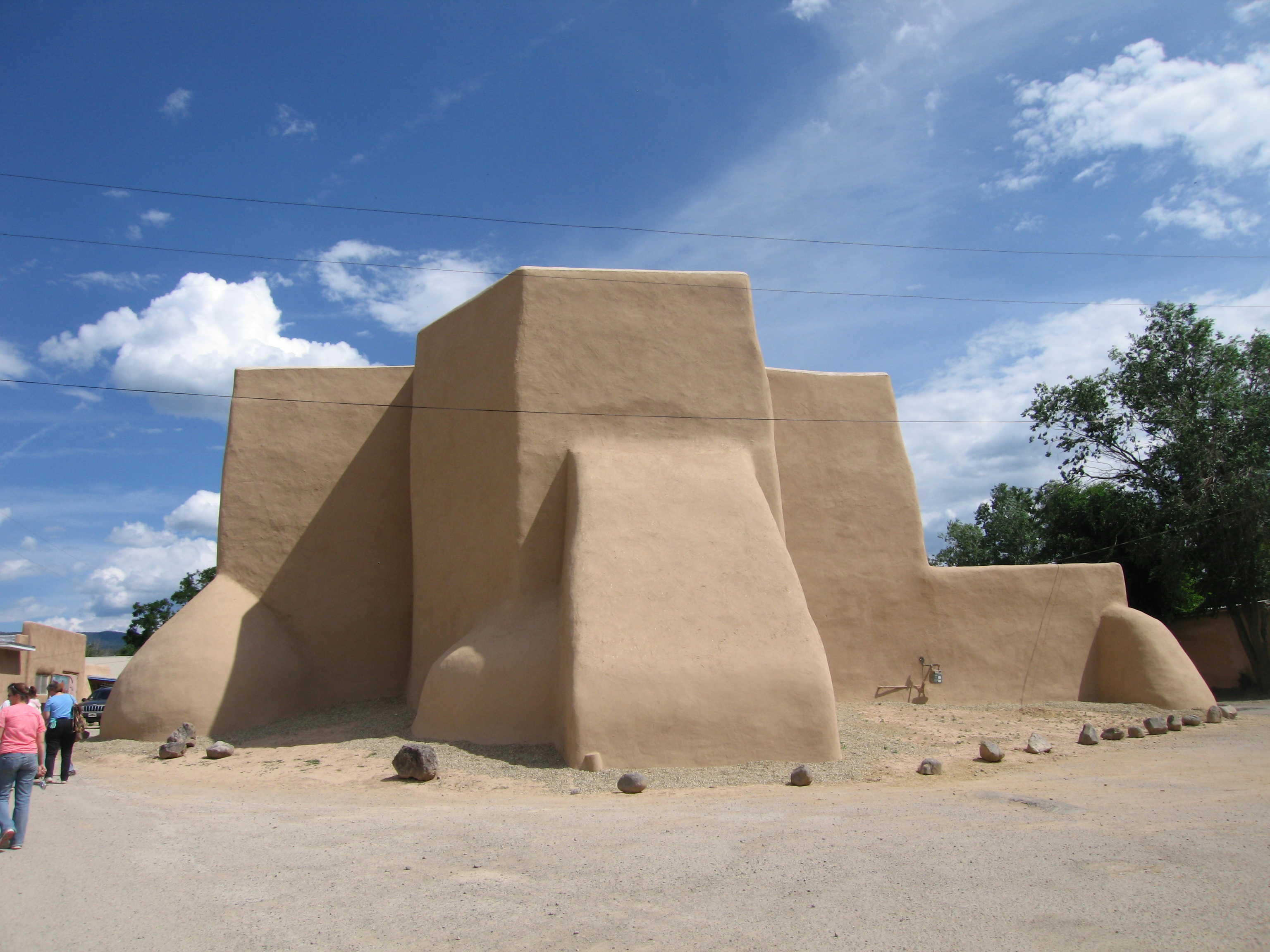
Neither Ansel Adams nor Georgia O’Keefe noted the power lines, or the gas meter.

They must be recent additions.

The essential beauty of the church remains.

1549-san-francisco-de-asis-church-in-taos-july-5-2007.jpg

The original adobe construction of the church was completed in 1772 — four years prior to the Declaration of Independence. It is built in the shape of a cross, but structural weaknesses required the addition of buttresses, shown in the photograph — also of adobe.

A bad photograph of the church is almost impossible.

The interior is cool on a hot afternoon. Adobe construction offers significant advantages, even in the 21st century. The church hosts an active congregation, without air conditioning.

Photo: Copyright 2007, Ed Darrell; you may reproduce for educational or non-profit use, so long as attribution is attached. Attribution must be attached.

Welcome, visitors!  Please leave a comment, at least tell why you visited, and where you’re from.  Thank you.