On the Tibetan Plateau, temperatures are rising and glaciers are melting faster than climate scientists would expect based on global warming alone. A recent study of ice cores from five Tibetan glaciers by NASA and Chinese scientists confirmed the likely culprit: rapid increases in black soot concentrations since the 1990s, mostly from air pollution sources over Asia, especially the Indian subcontinent. Soot-darkened snow and glaciers absorb sunlight, which hastens melting, adding to the impact of global warming.
NASA climate scientists combine satellite and ground-based observations of soot and other particles in the air with weather and air chemistry models to study how the atmosphere moves pollution from one place to another. This image is from a computer simulation of the spread of black soot (“black carbon” to climate scientists) over the Tibetan Plateau from August through November 2009. It shows black carbon aerosol optical thickness on September 26, 2009. (Aerosol optical thickness is scale that describes how much pollution was in the air based on how much of the incoming sunlight the particles absorbed.) Places where the air was thick with soot are white, while lower concentrations are transparent purple.
The highest concentrations of black soot are in the right-hand side of the image, over the densely populated coastal plain of China. But high concentrations occur over India, as well, and the black soot spreads across the southern arc of the Tibetan Plateau, which is defined by the towering peaks of the Himalaya Mountains. (Note: Topography has been exaggerated to highlight features that influence air movement). The animation shows how the black carbon pollution from India often circulates at high concentrations for several days against the base of the Himalaya, periodically “sloshing” over the rim of the mountains and spilling northward over the plateau, before being carried away over the Bay of Bengal or the Arabian Sea.
Writing about the implications of the study for the Goddard Institute for Space Studies Website, NASA climate scientist and study co-author James Hansen said, “[C]ontinued, ‘business-as-usual’ emissions of greenhouse gases and black soot will result in the loss of most Himalayan glaciers this century, with devastating effects on fresh water supplies in dry seasons. The black soot arises especially from diesel engines, coal use without effective scrubbers, and biomass burning, including cook stoves. Reduction of black soot via cleaner energies would have other benefits for human health and agricultural productivity. However, survival of the glaciers also requires halting global warming, which depends upon stabilizing and reducing greenhouse gases, especially carbon dioxide.”
References
Xu, B., Cao, J., Hansen, J., Yao, T., Joswia, D., Wang, N., Wu, G., Wang, M., Zhao, H., Yang, W., Liu, X., and He, J. (2009, December 8). Black soot and the survival of Tibetan glaciers, Proceedings of the National Academies of Sciences. Open Access article, published online before print. Accessed December 11, 2009.
NASA image by Gregory Shirah, Goddard Scientific Visualization Studio, based on model simulations from the Goddard Earth Observing System Model, Version 5 (GEOS-5). Caption by Rebecca Lindsey.
Spread the word; friends don't allow friends to repeat history.
Bob Park is probably right (he usually is). The International Space Station doesn’t have enough science value to justify the expense of it. A lot of the work we do in space exploration could better be done by robots. But you know, I grew up in that era when a manned space launch was a school-stopping experience. I was still in high school when Neil Armstrong set foot on the Moon. So I will be saddened when the shuttle launches come to an end.
Let’s hope the next chapter of space exploration will be at least as cool.
Spread the word; friends don't allow friends to repeat history.
John F. Kennedy at Rice University, Houston, Texas, Sept 12, 1962 – photo from NASA
There is no strife, no prejudice, no national conflict in outer space as yet. Its hazards are hostile to us all. Its conquest deserves the best of all mankind, and its opportunity for peaceful cooperation many never come again. But why, some say, the moon? Why choose this as our goal? And they may well ask why climb the highest mountain? Why, 35 years ago, fly the Atlantic? Why does Rice play Texas?
We choose to go to the moon. We choose to go to the moon in this decade and do the other things, not because they are easy, but because they are hard, because that goal will serve to organize and measure the best of our energies and skills, because that challenge is one that we are willing to accept, one we are unwilling to postpone, and one which we intend to win, and the others, too.
President John F. Kennedy, September 12, 1962, at Rice University, Houston, Texas
Why this speech in Houston? There’s more here than just a speech in a football stadium. Kennedy was working to save the space initiative, and to make America more secure.
In this quest, Kennedy lays out the reasons we need strong science research programs funded by our federal government, and strong science educational achievement in all of our schools.
President John F. Kennedy (1961-1963) awoke on April 12, 1961, to the news that the Soviet Union had won the race to put a man into space. Kennedy immediately met with Vice President Lyndon Johnson in the White House to discuss the embarrassment of the Soviets beating America again. “Can we put a man on the moon before them?” Kennedy asked. A few weeks later, Kennedy challenged the nation to “commit itself to achieving the goal, before this decade is out, of landing a man on the moon and returning him safely to earth.”
Kennedy challenged Congress and the imaginations of all Americans a few weeks later, when on May 25, in a special Joint Session of Congress, he proposed a Moon exploration program. In a speech outlining defense and foreign policy needs to make the U.S. secure and safe against threats from Soviet communism, or any other nation or faction, Kennedy spoke openly about the space race that had been waged since October 4, 1957, when the Soviet Union became the first nation on Earth to orbit an artificial satellite, Sputnik.
Finally, if we are to win the battle that is now going on around the world between freedom and tyranny, the dramatic achievements in space which occurred in recent weeks should have made clear to us all, as did the Sputnik in 1957, the impact of this adventure on the minds of men everywhere, who are attempting to make a determination of which road they should take. Since early in my term, our efforts in space have been under review. With the advice of the Vice President, who is Chairman of the National Space Council, we have examined where we are strong and where we are not, where we may succeed and where we may not. Now it is time to take longer strides–time for a great new American enterprise–time for this nation to take a clearly leading role in space achievement, which in many ways may hold the key to our future on earth.
I believe we possess all the resources and talents necessary. But the facts of the matter are that we have never made the national decisions or marshalled the national resources required for such leadership. We have never specified long-range goals on an urgent time schedule, or managed our resources and our time so as to insure their fulfillment.
Recognizing the head start obtained by the Soviets with their large rocket engines, which gives them many months of leadtime, and recognizing the likelihood that they will exploit this lead for some time to come in still more impressive successes, we nevertheless are required to make new efforts on our own. For while we cannot guarantee that we shall one day be first, we can guarantee that any failure to make this effort will make us last. We take an additional risk by making it in full view of the world, but as shown by the feat of astronaut Shepard, this very risk enhances our stature when we are successful. But this is not merely a race. Space is open to us now; and our eagerness to share its meaning is not governed by the efforts of others. We go into space because whatever mankind must undertake, free men must fully share.
I therefore ask the Congress, above and beyond the increases I have earlier requested for space activities, to provide the funds which are needed to meet the following national goals:
First, I believe that this nation should commit itself to achieving the goal, before this decade is out, of landing a man on the moon and returning him safely to the earth. No single space project in this period will be more impressive to mankind, or more important for the long-range exploration of space; and none will be so difficult or expensive to accomplish. We propose to accelerate the development of the appropriate lunar space craft. We propose to develop alternate liquid and solid fuel boosters, much larger than any now being developed, until certain which is superior. We propose additional funds for other engine development and for unmanned explorations–explorations which are particularly important for one purpose which this nation will never overlook: the survival of the man who first makes this daring flight. But in a very real sense, it will not be one man going to the moon–if we make this judgment affirmatively, it will be an entire nation. For all of us must work to put him there.
The race was on. The Soviet Union’s massive rocket engines gave them a decided advantage. Kennedy’s challenge captured the imagination of Americans and America. Necessary money flowed from Congress, but not in a completely free flow. Some opposed the nation’s efforts in space exploration because they thought spending on space exploration detracted from the nation’s defense efforts. Kennedy continued to stress the connection between space exploration and defense. He was backed by successes — Navy Commander Alan Shepard, Jr., had successfully launched into space and returned safely; and on February 20, 1962, pilot Marine Capt. John Glenn orbited the Earth three times, catching the U.S. up almost to where the Soviet Union was in manned space exploration.
Kennedy understood that constant attention, constant selling of the space program would be necessary. So in September 1962 he found himself in Houston, the newly-designated home of the manned space program, and he took the opportunity to cast the American goals in the space race as peaceful, good for all mankind, and definitely worth the massive costs.
Notice in how he casts putting a human on the Moon in league with other great achievements of civilization. Kennedy was truly shooting for the stars.
Notice also how he relates space exploration to practical applications then in existence, such as communication, navigation of ships at sea, and weather forecasting. This was years before geosynchronus satellites were used for everyday telephone conversations, years before quantum theory was harnessed for Global Positioning Systems (GPS) and digital personal, handheld telephones, and before the newly-invented printed circuits were miniaturized to make computer calculating a possibility in space — the Moon landing was done with slide rules and hand calculations.
Just over 14 months later Kennedy would die in Texas, in Dallas, on November 22, 1963. On July 20, 1969, Neil Armstrong and Buzz Aldrin landed the Eagle Lunar Module on the Moon, at the Sea of Tranquility. A few hours later, on July 21, they stepped out on the Moon. From Kennedy’s speech to Congress, the task had taken 8 years, one month and 26 days.
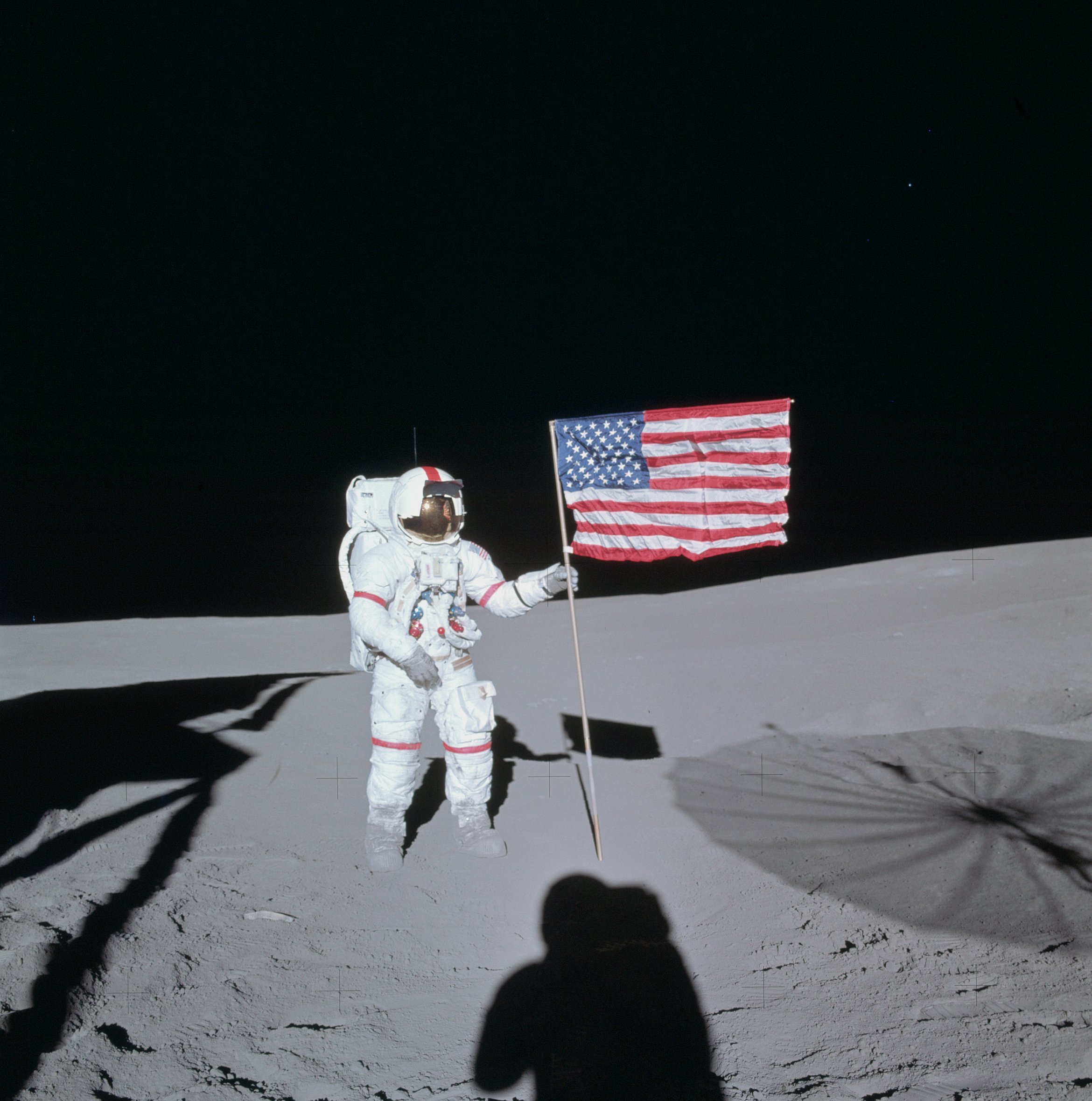
Buzz Aldrin on the Moon, with Neil Armstrong, the U.S. flag, and the Eagle Lunar Module reflected in his helmet visor, July 21, 1969 – NASA photo via Wikimedia
Please share.
Spread the word; friends don't allow friends to repeat history.
In a move that is likely to panic climate change denialists (and others who claim not to be denialists, but oppose acting because they claim to be “skeptical”), federal agencies working under the new Obama budget might actually do some of the necessary research. Bob Parks told the story in his weekly missive.
3. NASA: THINGS HAVE NOT GONE WELL IN CLIMATE OBSERVATIONS.
First there was the Bush Administration’s shameful cancellation of the Deep Space Climate Observatory (DSCOVR) launch in 2000. The only fingerprints on the cancellation belong to Dick Cheney. It would by now have settled the critical issue of the role of solar variation in global warming. Then, on Tuesday, the $278 million Orbital Carbon Observatory, designed to measure greenhouse gas emissions, crashed shortly after launch. The good news is that the Omnibus Appropriations Bill that passed on Wednesday provides $9 million for NASA to refurbish DSCOVR, which has been shut up in a Greenbelt, MD warehouse for 9 years.
Spread the word; friends don't allow friends to repeat history.
Ultraviolet image of the Andromeda Galaxy, first known to be a galaxy by Edwin Hubble on December 30, 1924 - Galaxy Evolution Explorer image courtesy NASA
Today is a good day to celebrate the universe in all it’s glory – December 30. Below, mostly an encore post.
This year for Hubble Day, Wired picked up on the story (with a gracious link to last year’s post here at the Bathtub). Wired includes several links to even more information, a good source of information.
Hubble was the guy who showed us the universe is not only bigger than we imagined, it’s probably much bigger and much more fantastic than we can imagine. Hubble is the guy who opened our imaginations to the vastness of all creation.
How does one celebrate Hubble Day? Here are some suggestions:
Easier than Christmas cards: Send a thank-you note to your junior high school science teacher, or whoever it was who inspired your interest in science. Mrs. Hedburg, Mrs. Andrews, Elizabeth K. Driggs, Herbert Gilbert, Mr. Willis, and Stephen McNeal, thank you.
Rearrange your Christmas/Hanukkah/KWANZAA lights in the shape of the Andromeda Galaxy — or in the shape of any of the great photos from the Hubble Telescope (Andromeda Galaxy pictured above; Hubble images here)
A few of the images from the Hubble Telescope
Go visit your local science museum; take your kids along – borrow somebody else’s kids if you have to (take them along, too)
Spend two hours in your local library, just looking through the books on astronomy and the universe
Anybody got a good recipe for a cocktail called “The Hubble?” “The Andromeda?” Put it in the comments, please
In 1924, he announced the discovery of a Cepheid, or variable star, in the Andromeda Nebulae. Since the work of Henrietta Leavitt had made it possible to calculate the distance to Cepheids, he calculated that this Cepheid was much further away than anyone had thought and that therefore the nebulae was not a gaseous cloud inside our galaxy, like so many nebulae, but in fact, a galaxy of stars just like the Milky Way. Only much further away. Until now, people believed that the only thing existing ouside the Milky Way were the Magellanic Clouds. The Universe was much bigger than had been previously presumed.
Later Hubble noted that the universe demonstrates a “red-shift phenomenon.” The universe is expanding. This led to the idea of an initial expansion event, and the theory eventually known as Big Bang.
Hubble’s life offered several surprises, and firsts:
Hubble was a tall, elegant, athletic, man who at age 30 had an undergraduate degree in astronomy and mathematics, a legal degree as a Rhodes scholar, followed by a PhD in astronomy. He was an attorney in Kentucky (joined its bar in 1913), and had served in WWI, rising to the rank of major. He was bored with law and decided to go back to his studies in astronomy.
In 1919 he began to work at Mt. Wilson Observatory in California, where he would work for the rest of his life. . . .
Hubble wanted to classify the galaxies according to their content, distance, shape, and brightness patterns, and in his observations he made another momentous discovery: By observing redshifts in the light wavelengths emitted by the galaxies, he saw that galaxies were moving away from each other at a rate constant to the distance between them (Hubble’s Law). The further away they were, the faster they receded. This led to the calculation of the point where the expansion began, and confirmation of the big bang theory. Hubble calculated it to be about 2 billion years ago, but more recent estimates have revised that to 20 billion years ago.
An active anti-fascist, Hubble wanted to joined the armed forces again during World War II, but was convinced he could contribute more as a scientist on the homefront. When the 200-inch telescope was completed on Mt. Palomar, Hubble was given the honor of first use. He died in 1953.
“Equipped with his five senses, man explores the universe around him and calls the adventure Science.”
(Does anyone have a suitable citation for that video? Where did it come from? Who produced it? Is there more somewhere?)
Happy Hubble Day! Look up!
Resources:
Journey to Palomar site (production currently being broadcast on PBS affiliates – wonderful story of George Ellery Hale and the origins of modern astronomy at Palomar; that’s where Hubble worked)
But, what the heck! There’s enough cool history for two celebrations every year!
Teachers might take this opportunity to stock up on photos and information for bell-ringer quizzes and other presentations on October 1, 2008, when NASA celebrates the 50th anniversary of NASA’s opening its doors, and school is actually in session.
Photos from NASA on the 47th birthday, in 2005 Image Details: First row, from left: A 1931 photo shows the original hangar at NASA’s predecessor, the National Advisory Committee for Aeronautics (NACA). The first American satellite in orbit, Explorer 1, launches in January 1958. The “Original Seven” Mercury astronauts were selected in 1959. The experimental Echo project used large metallic balloons to bounce signals from one point on Earth to another.Second row, from left: The X-15 hypersonic research aircraft flew for nearly 10 years, from June 1959 to October 1968. Apollo 11 astronauts left the first bootprints on the moon in July 1969. Jupiter’s Great Red Spot, seen from one of the twin Voyager spacecraft that launched in 1977. NASA satellites helped create the “blue marble,” a detailed image of Earth.
Third row, from left: Columbia launches on the first shuttle mission in April 1981. Image of the Eagle Nebula from the Hubble Space Telescope. The Mars rover Opportunity looks back at its tracks on the red planet. The international space station is humanity’s first permanent orbital outpost.
Fourth row, from left: The Cassini spacecraft has been sending back images of Saturn, it’s rings and moons since July 2004. Discovery returns the space shuttle fleet to flight in July 2005. NASA satellites help scientists and forecasters watch powerful hurricanes. Artist’s concept of NASA’s next spaceship, the crew exploration vehicle, docked with a lander in lunar orbit.
Photo credit: NASA
Congress created a civilian agency to honcho space exploration as part of the body of reform actions after the Soviet Union beat the U.S. with orbiting an artificial satellite, in 1957.
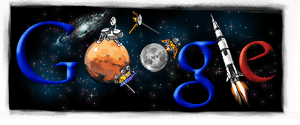
Google has another of its arty Google Logos in honor of the day:
NASA has its own logo for the 50th anniversary:
NASA’s 50th anniversary logo
Spread the word; friends don't allow friends to repeat history.
Southwest Elementary in Burley, Idaho, existed in a world far, far away from the U.S. space program. We watched rocket launches on black and white television — the orbital launches were important enough my father let me stay home from school to watch, but when he dropped me off, I was in a tiny band of students who actually made it to school. Potato farmers and the merchants who supported them thought the space program was big, big stuff.
By John Glenn’s flight, a three-orbit extravaganza on February 20, 1962, a television would appear in the main vestibule of the school, or in the auditorium, and we’d all watch. There were very few spitballs. Later that year my family moved to Pleasant Grove, Utah.
Toward the end of the Gemini series, television news networks stopped providing constant coverage. The launch, the splashdown, a space walk or other mission highlight, but the nation didn’t hold its breath so much for every minute of every mission. Barry McGuire would sing about leaving the planet for four days in space (” . . . but when you return, it’s the same old place.”), then six days, but it was just newspaper headlines.
The Apollo 1 fire grabbed the nation’s attention again.Gus Grissom, one of the three who died, was one of the original space titans; death was always a possibility, but the U.S. program had been so lucky. Apollo’s start with tragedy put it back in the headlines.
The space program and its many successes made Americans hopeful, even in that dark decade when the Vietnam War showed the bloody possibilities of the Cold War. That darkest year of 1968 — see the box below — closed nicely with Apollo 8 orbiting the Moon, and the famous Christmas Eve telecast from the three astronauts, Frank Borman, Jim Lovell, and William A. Anders. The space program kept us hopeful.
By early 1969 many of us looked forward to the flight of Apollo 11 schedule for July — the space flight that promised to put people on the Moon for the first time in history, the realization of centuries-old dreams.
But, then I got my assignment for Scouting for the summer — out of nearly 50 nights under the stars, one of the days would include the day of the space walk. Not only was it difficult to get televisions into Maple Dell Scout Camp, a good signal would be virtually impossible. I went to bed knowing the next day I’d miss the chance of a lifetime, to watch the first moon landing and walk.
Just after midnight my sister Annette woke me up. NASA had decided to do the first walk on the Moon shortly after touchdown, at an ungodly hour. I’d be unrested to check Scouts in, but I’d have seen history.
Texas Essential Knowledge and Skills (TEKS) lists 11 dates for U.S. history as the touchstones kids need to have: 1609, the founding of Jamestown; 1776, the Declaration of Independence; 1787, the Constitutional Convention; 1803, the Louisiana Purchase; 1861-1865, the American Civil War; 1877, the end of Reconstruction; 1898, the Spanish American War; 1914-1918, World War I; 1929, the Stock Market Crash and beginning of the Great Depression; 1941-1945, World War II; 1957, the launching of Sputnik by the Soviets. Most teachers add the end of the Cold War, 1981; I usually include Apollo 11 — I think that when space exploration is viewed from a century in the future, manned exploration will be counted greater milestone than orbiting a satellite; my only hesitance on making such a judgment is the utter rejection of such manned exploration after Apollo, which will be posed as a great mystery to future high school students, I think.)
* 1968, in roughly chronological order, produced a series of disasters that would depress the most hopeful of people, including: the Pueblo incident, the B-52 crash in Greenland, the Tet Offensive in Vietnam, the nerve gas leak at the Army’s facility at Dugway, Utah, that killed thousands of sheep, Lyndon Johnson’s pullout from the presidential race with gathering gloom about Vietnam, the Memphis garbage strike, the assassination of Martin Luther King, Jr., riots, the Black Panther shoot out in Oakland, the Columbia University student takeover, the French student strikes, the tornadoes in Iowa and Arkansas on May 15, the Catonsville 9 vandalism of the Selective Service office, the sinking of the submarine U.S.S. Scorpion with all hands, the shooting of Andy Warhol, the assassination of Robert F. Kennedy, the Buenos Aires soccer riot that killed 74 people, the Glenville shoot out in Cleveland, the cynicism of the Republicans and the nomination of Richard Nixon and Spiro Agnew, the Warsaw Pact invasion of Czechoslovakia crushing the “Prague Spring” democratic reforms, the Chicago Democratic Convention and the police riot, the brutal election campaign, the Tlatololco massacre of students in Mexico City, Black Power demonstrations by winning U.S. athletes at the Mexico City Olympics, coup d’etat in Panama. Whew!
Spread the word; friends don't allow friends to repeat history.
In a classroom discussion of “how do we know what we know” about history, another student brought up the allegations that the National Aeronautics and Space Administration (NASA) faked the manned Moon landings. That makes about a dozen times this year a kid has mentioned this claim (who thinks to start counting these things?). The kid was pretty unshakable in his convictions — after all, he said, how can a flag wave in a vacuum?
I usually mention a couple of things that the fake claimers leave out — that dozens, if not hundreds, of amateur astronomers tracked the astronauts on their way to the Moon, that many people intercepted the radio transmissions from the Moon, that one mission retrieved debris from an earlier unmanned landing, etc. Younger students who lack experience in serious critical thinking have difficulty with these concepts. They also lack the historic background — the last manned Moon landing occurred when their parents were kids, perhaps. They didn’t grow up with NASA launches on television, and the whole world holding its breath to see what wonders would be found in space.
From the very first moment to the very last, the program is loaded with bad thinking, ridiculous suppositions and utterly wrong science. I was able to get a copy of the show in advance, and although I was expecting it to be bad, I was still surprised and how awful it was. I took four pages of notes. I won’t subject you to all of that here; it would take hours to write. I’ll only go over some of the major points of the show, and explain briefly why they are wrong.
Also, consider these chunks of evidence, which Phil does not mention so far as I know:
First, the first Moon landing left a mirror on the surface, off of which Earth-bound astronomers may bounce laser transmissions in order to measure exactly the distance from the Earth to the Moon. Read the rest of this entry »
Spread the word; friends don't allow friends to repeat history.
Or, until that account is unsuspended by the forces supporting Donald Trump: Follow @FillmoreWhite, the account of the Millard Fillmore White House Library
We've been soaking in the Bathtub for several months, long enough that some of the links we've used have gone to the Great Internet in the Sky.
If you find a dead link, please leave a comment to that post, and tell us what link has expired.
Thanks!
Retired teacher of law, economics, history, AP government, psychology and science. Former speechwriter, press guy and legislative aide in U.S. Senate. Former Department of Education. Former airline real estate, telecom towers, Big 6 (that old!) consultant. Lab and field research in air pollution control.
My blog, Millard Fillmore's Bathtub, is a continuing experiment to test how to use blogs to improve and speed up learning processes for students, perhaps by making some of the courses actually interesting. It is a blog for teachers, to see if we can use blogs. It is for people interested in social studies and social studies education, to see if we can learn to get it right. It's a blog for science fans, to promote good science and good science policy. It's a blog for people interested in good government and how to achieve it.
BS in Mass Communication, University of Utah
Graduate study in Rhetoric and Speech Communication, University of Arizona
JD from the National Law Center, George Washington University


 Recommend this image


 Posted by Ed Darrell








 Millard Fillmore's Bathtub
