Terri Potts Smith showed up bright and early for work — was it in the spring? — and we talked in our first floor Dirksen Senate Office Building office about the grind we faced ahead with the hearing schedule for the Senate Labor Committee and subcommittees. Suddenly she was transfixed by something out the window.
Having just recently learned that terrorists favored that particular corner for planting bombs under cars, I started a bit. Terri explained, astonished, that a red bird flew into the tree out the window.
It was a cardinal (Cardinalis cardinalis), a common bird, but not one common to Utah, where both of us had grown up.
I think of that often these days, and am still constantly startled, to see green birds flit across the streets of Duncanville, Texas.
Monk parakeets. Myiopsitta monachus. Also known as the Quaker parrot.
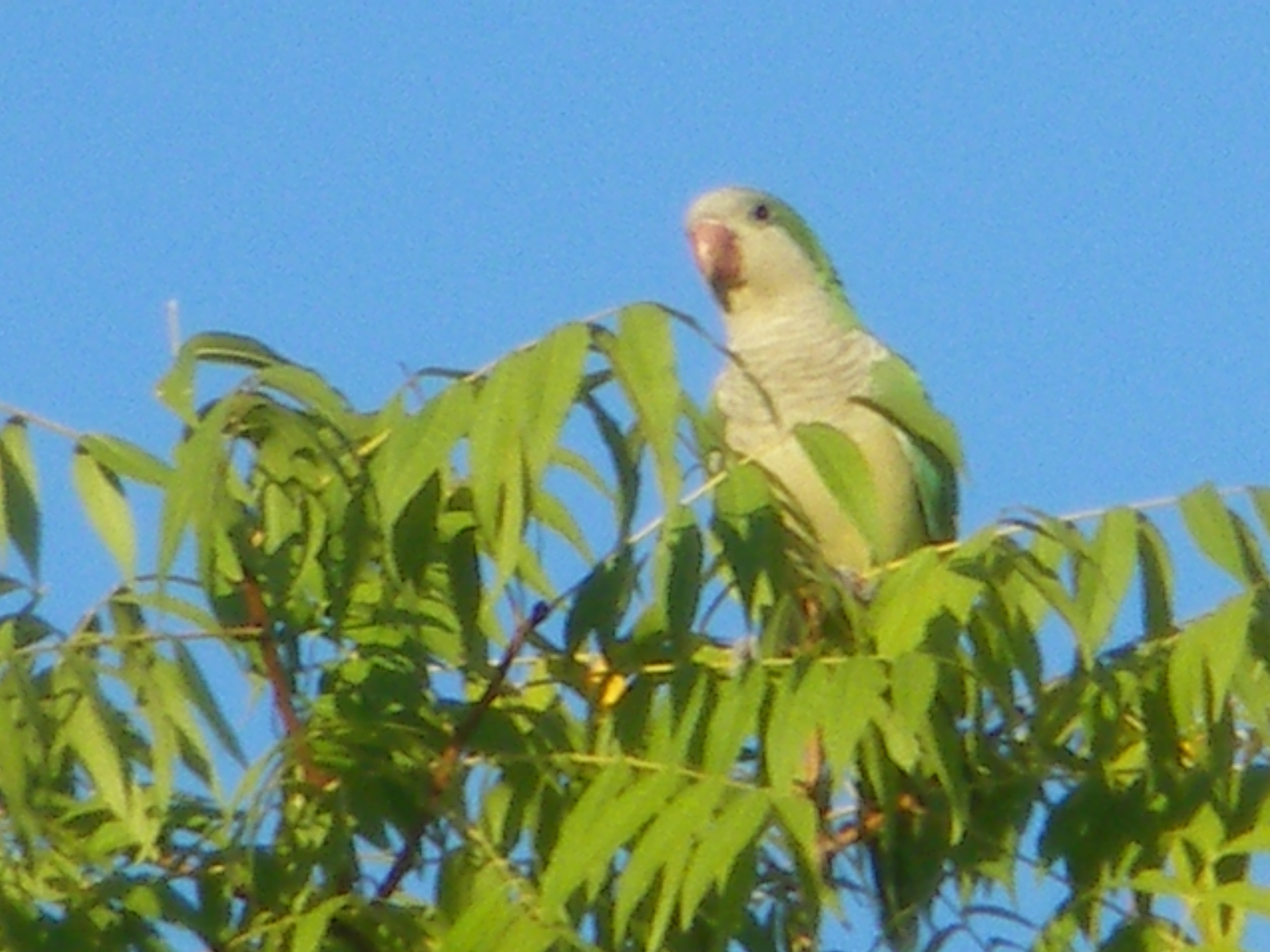
Monk parakeets profiled in the Chinese pistache, Duncanville, Texas, August 10, 2010 - photo by Ed Darrell; more than a dozen birds are hidden deeper in the tree.
Monk parakeets are invasive in Texas — it is thought the wild flocks developed from a few dozen escapees in the past three decades. They favor nesting on tall electrical poles — the stadium lights of the high school and college football stadia host a lot, as do electrical transmission lines. At Verizon Wireless we had at least one occasion when one of our cell tower climbers was attacked by one of the birds, apparently a mother just after the chicks had hatched. Cell towers provide excellent habitat for the birds.
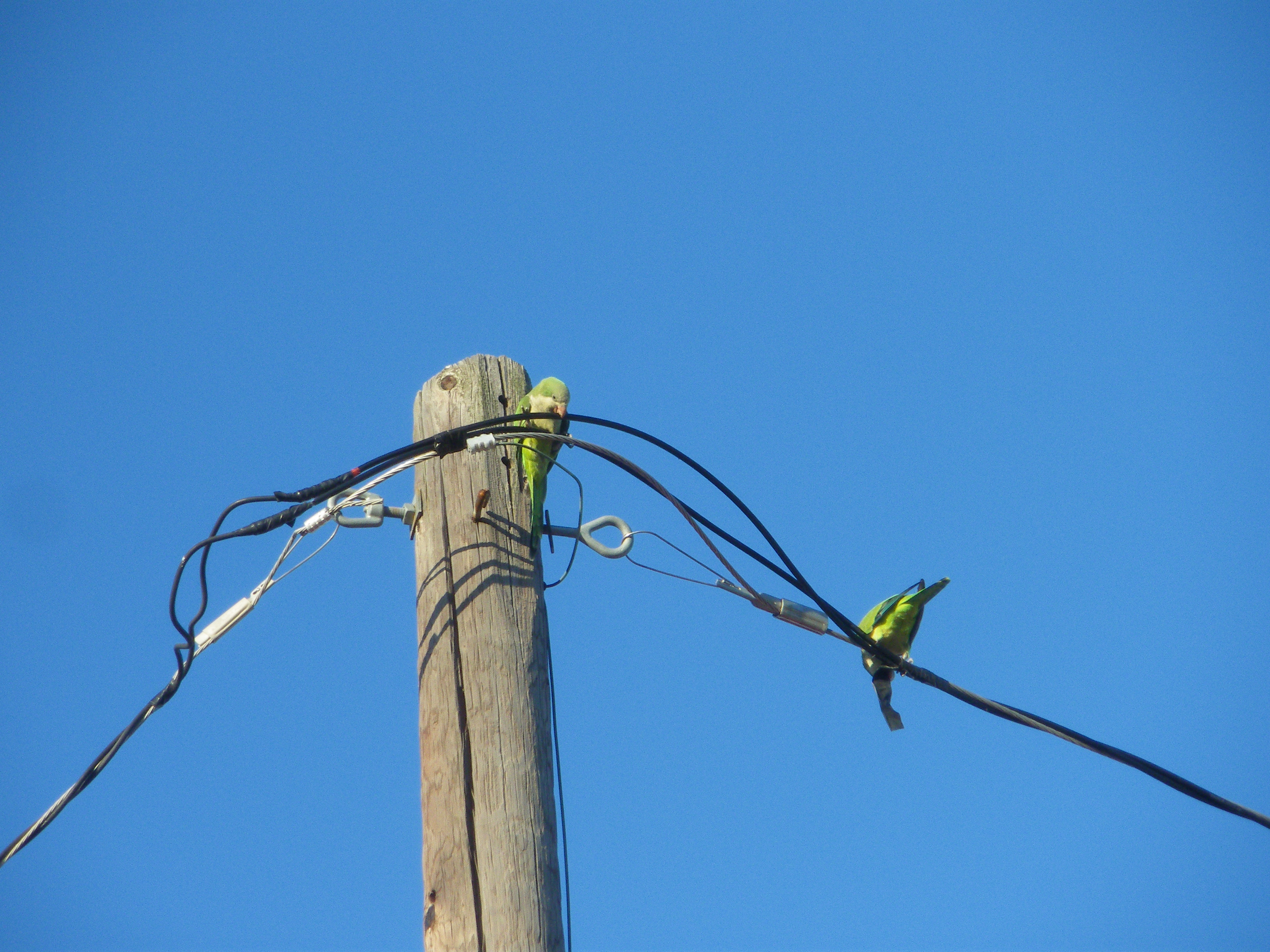
At the best sitings I’ve had, previously I lacked a camera. Today I happened to have the small Pentax Optio V20. 20 to 30 of the birds roosted along an electrical wire. They were happy to see me until I pulled out the camera. (Pure conjecture: They’re smart. They’ve seen people with cameras before — and frequently, shortly after that some crew appears with a cherry-picker to destroy their nests. Camera-shyness is a survival function for the birds.)
All I observed was social activity and some preening, except for the one bird flitting around with a stick in its bill.
And the two who were trying to pull tape off of electrical transmission wires.
Monk parakeets working to get a charge out of life, picking at insulation on an electrical wire.
Troublemakers.
Truth be told, I’ll take the monk parakeets in greater profusion, if we can reduce the populations of starlings, grackles and cowbirds.
Is there any evidence of the parakeets preying on songbirds?
Monk parakeet in the Chinese pistache tree. All photos by Ed Darrell, use with attribution encouraged.
[Update: Oops. Looked like a locust tree on a quick look. A longer look, I wasn’t so sure. Kathryn confirmed that it’s really a Chinese pistache, Pistacia chinensis.]
Spread the word; friends don't allow friends to repeat history.
Cicada killer wasps appeared as early as July 7, in our yard. This year we had a cold winter, with snows that appear to have stymied even the nasty, invasive Argentine fire ant. But June was dry and hot. July came with rains, and cicada killers don’t like wet soil to dig in.
For that matter, we don’t have many cicadas, either.
Plus, we had to tear down a planter box attached to the dining room window, since it hid termites too well. No doubt that planter had young from the cicada killers in it.
It became really apparent during the rains last week.
Snails crawl up the walls and plants around our patio, and appear to wait to die there. We’ve moved them back down to the soil, and they climb up again.
Kathryn remarked at the army of snails on the garage wall, beneath a bird feeder . . . that was the clue.
I don’t think ours do that eye-stalk thing. Worse for the parasites, most of the birds ignore the snails.
MacDowell’s book kept me out of church for at least a decade.
In the later pages he talks about how many copies of the Bible there are, and he says that’s an indication of how accurate it is, and that it’s the truth. That’s like saying any document I create becomes more truthful the higher the number of Xerox copies I make.
I figured that was one of the stupidest claims ever made. Maybe it was the crowd I was in with, but the more devout Christians (except for the Mormons, but that’s a different tale) swooned over the claim. I thought that any belief system that was so devoid of logic, and which required adherents to abandon all reason, was foolish.
About five years ago I picked it up again when one of our youth ministers asked me about it, and I skimmed through it again looking for any cogent, careful and compelling argument. Of course, this was long after law school and due diligence work in the law . . . I thought it more foolish than I had found it years before.
I summed it up this way for the youth minister: If there were evidence, we wouldn’t need faith. We call it a faith proudly, and we discuss the mysteries. It’s a tragedy that MacDowell has been divorced from that sweet part of Christian discovery and leap of faith. Were there evidence enough for a verdict, we’d not need faith, and it would be impossible to be anything other than an agnostic who has found the evidence.
Your mileage may differ, but if so, you need a tune-up.
Ed Darrell
Dallas
Spread the word; friends don't allow friends to repeat history.
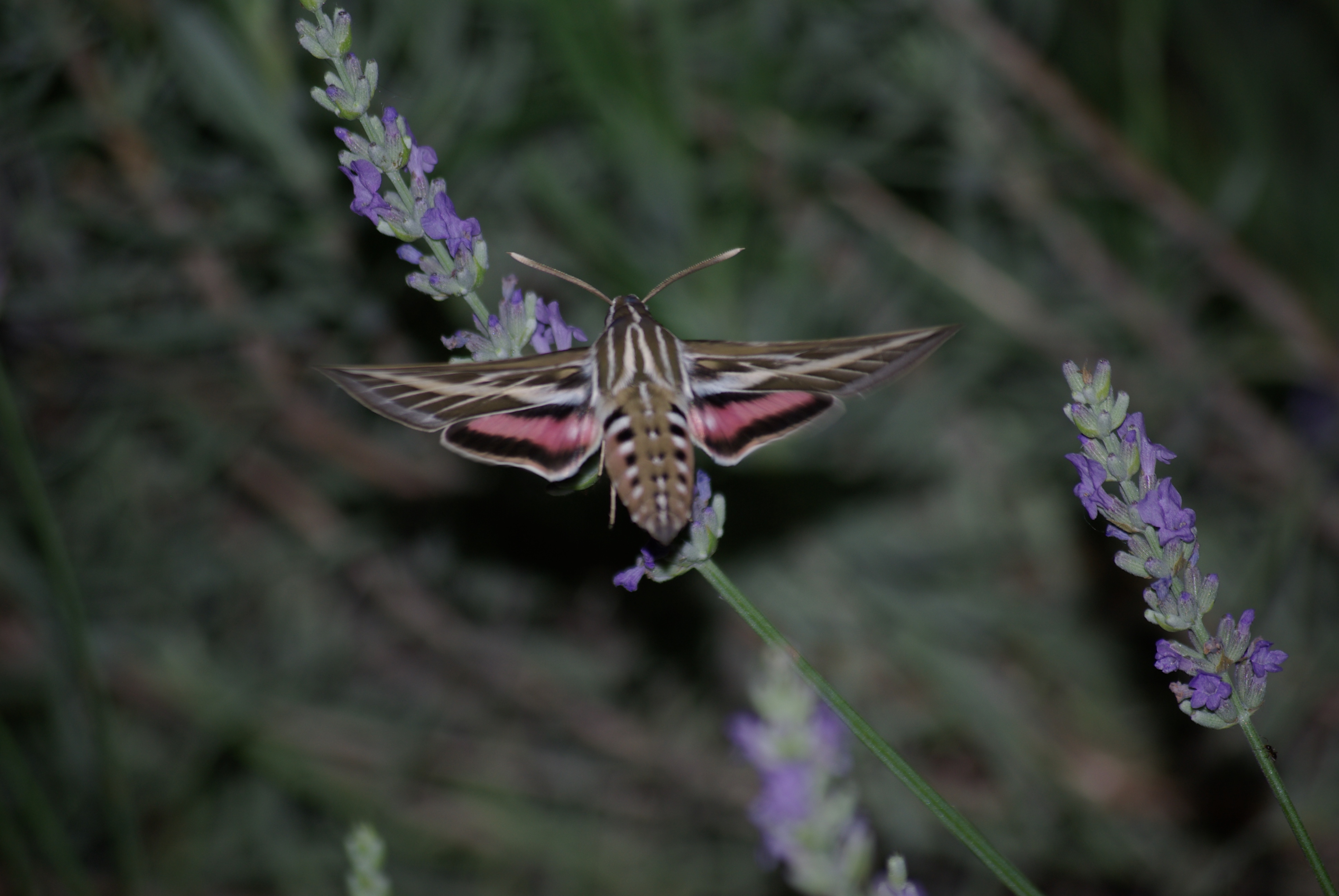
Hummingbird moth (Hyla lineata?) breakfasts at the lavender in the front yard - photo by Ed Darrell
Kathryn planted lavendar on the front walk. It crowds the walk, so you have to brush by it coming in or going out of the house, and sometimes you get a great whiff of lavender.
On the way back from getting the newspaper this morning I was greeted by this hummingbird moth sipping its breakfast from the lavender blossoms. It was too dark for natural lighting. The flash froze the wings, and exposed colors that you can’t see as the little creature hovers.
Friday Fox will not be a regular feature — but, Wow! isn’t that a great photo?
Unless you’re the mouse.
Ron Charest photo of a red fox in the Bombay Hook National Wildlife Refuge (Delaware) - Defenders of Wildlife
Defenders of Wildlife called for entries for the 2010 wildlife and wilderness photography contest. They got more than 10,000 entries, and they’ve got the top 10. They want you to vote for the best one. The photo above is just one of the spectacular nominees.
I predict one of the photos featuring animals will win, but the wild lands photos are great, too.
You may vote for three. Voting ends Sunday, April 4, 2010.
Clearly the writer can’t didn’t read a map, or figure distances, and knows nothing knew little about the migratory habits of mosquitoes. Stopping the spraying of DDT in Arkansas didn’t stop the use or manufacture of DDT in Africa nor Asia, anywhere. Nor did mosquitoes not killed in America fly to Africa to infect kids. Someone who has decided to rail against wise science probably isn’t interested much in the facts, though.
DDT has never been banned in Africa, nor Asia. Today, China and India together manufacture thousands of tons of DDT for use around the world.
Odd — in the nations where DDT was banned (for use on agriculture, never to fight malaria), malaria is eradicated or all but eradicated. In those nations where DDT is still legal, still manufactured, and still used in great quantities, malaria runs rampant.
Perhaps a lack of DDT doesn’t have anything to do with the spread of malaria.
There are very few, if any, serious malaria fighters asking for DDT. Improved medical care is the basis for beating malaria in humans. Malaria is a parasite that must live for part of its life cycle in mosquitoes, and for part of its life cycle in humans. If your goal is to wipe out malaria, you could do it more effectively by wiping out the humans that harbor the parasite. That would be stupid and cruel, and very expensive.
Fortunately, DDT is not a powerful acute poison to use against the mammals where malaria breeds. Perhaps unfortunately, it’s no panacea against malaria, either.
Why did African malaria fighters stop using DDT in the middle 1960s? Mosquitoes had become resistant and immune to DDT.
Ronald Reagan once said for every serious problem there is a solution that is simple, easy, and wrong. DDT is that simple, easy and wrong solution for malaria.
Why is this man so bigoted Let’s hope it’s ignorance of the issue and not bigotry against brown beings that he thinks leads anyone to think the brown pelican should have been sacrificed, and that he thinks brown Africans are too stupid to figure out how to fight malaria with DDT, if DDT would in fact save them? [See Mr. Leap’s comment below. Not stupid at all, he just didn’t have the facts. Great to find someone willing to admit error. Clearly, I was wrong assuming he knew better — see edits throughout the post. It’s actually pleasant to discover one was wrong in a case like this.]
Rachel Carson was right: We should have restricted the use of DDT to save wild populations of animals, and to have preserved its efficacy for fighting malaria in carefully planned and delivered programs to fight malaria and other insect-borne diseases around the world. Carson proposed we use integrated pest management (IPM) to fight disease, and this is the program and process Africans and Asians have turned to over the past decade as other slap-dash methods of fighting disease faltered.
In diverting attention from improving medical care to fight malaria, to a hopeless campaign to reintroduce DDT where it would not work the miracle claimed, edwinleap.com favors too many people favor malaria over the kids in reality. Odd position for a health professional to take, and we can be relatively certain that he’s responding to political hackery, and not basing his views on any sound science or history.
The brown pelicans‘ migration from the Endangered Species List pays high tribute to Rachel Carson’s views on saving life in the wild, and verification once again that she was right. Perhaps its time more people paid attention to her accurate and effective ideas about how to fight human disease, without trying to poison all of Africa.
Spread the word; friends don't allow friends to repeat history.
This photo caught me a bit off guard, bringing back wonderful memories.
Bill and Christian explore outdoors, photographed by Gina – Gina, age 36, Bill, age 64, Christian, age 1 – 3rd place photo, 2009 Rachel Carson Sense of Wonder art contest – EPA
Gina, the photographer, described the photo:
My father has been a good role model to me as I grew up with plenty of time outdoors. The red plaid shirt became a sort of symbol, and it was an honor to get a matching shirt myself when I was in college. Now, at just one year old, my son is continuing the tradition of wearing the red and black shirt outdoors. It was fun to photograph the two together in our rural wooded backyard, and helped illustrate that my father can continue to pass along his sense of wonder and love of the outdoors to my son, his first grandchild.
My father, Paul Darrell, wore an old jacket for my entire life — a once-fuzzy buffalo plaid red-and-black woolen jacket. No one in the family can remember a time he didn’t have it. The jacket was probably at least 30 years old when I was born. He wore it when it was bitter cold — one story was that when it was well below zero one wintry morning in Burley, Idaho, it was the only coat he wore to walk to his furniture and appliance store to make sure the pipes hadn’t frozen, a walk of about a mile each way. It was too cold to start the car.
After he moved to Utah it was his usual gardening and yard-work coat on cold mornings. I know he took it on a few campouts with my Scout troop, and I’ll wager it went along on camping trips with my older brothers and sister 20 years before that. I remember my father sitting warm in that jacket on cold mornings around the campfire.
We had a peach tree in the back yard in Pleasant Grove, Utah. Frosts would come on those mountain slopes when the peaches were just ripened. I have memories of my father picking peaches in the jacket. He’d slice the peaches for our breakfast. No peach has ever been sweeter or more flavorful (but I keep searching). I remember my father in his buffalo plaid jacket, his arms full of ripe, cold peaches, coming through the kitchen door, and the smile on his face.
The red buffalo plaid coat was so much a symbol of my father that, at his death in 1988, it was one of those objects we nearly fought over. My niece Tamara ended up with it.
I have one, now. It’s a good L. L. Bean version, with the wool much thicker than my father’s well-worn version. After 20 years it still looks new, compared to his. I suspect it always will. It could never be warmer than his.
Special tip of the old scrub brush to Dr. Pamela Bumsted.
Spread the word; friends don't allow friends to repeat history.
Well I remember summer camp as a Boy Scout, annually at Maple Dell, a few miles up Payson Canyon, Utah. Troop 17 camped the week of July 4th, by tradition. Most other troops avoided that week so families could get together on the holiday — there would be half the usual number of Scouts, and we had a lot more opportunities to hit the rifle range, archery range, rowboats and canoes. Over four years, we noticed that the annual cicada invasion would usually start near the end of that week, as the Utah heat started its march toward August records. It was a good week to camp, to avoid the heat and the astounding noise of those insects.
As an Explorer, and junior camp staff member later, I spent entire summers at Maple Dell. We’d start in early June, when the Payson River still ran icy from the snow runoff, and when our sleeping bags would be coated with frost in the morning. Cicadas in July said it was warming. Cicadas in August screamed it was hot — sometimes near 100° F, a dramatic shift from the frost just eight weeks earlier.
In Maryland, one year we lived through the confluence of the 13-year and 17-year locusts, which are related to cicadas. (Bug Girl? You out there? Help me out on these details.) The adults would literally coat trees. They’d mate and die, and fall to the street, where cars would smush them — driving was more treacherous than driving on ice. What few predators there were — and the predators seemed awfully few in relation to the billion locusts per acre — would eat their fill, and then ignore the rest of the mob. The locusts came earlier than the cicadas, as I recall — but still later in the summer.
A post I wrote two years ago has been getting a lot of hits. In late July 2007 I wrote of the return of the cicada hawks, here in Dallas. Each summer since, about the time the cicada hawks return, people start cruising the web to find out how to get rid of them, mostly (don’t, they’re practically harmless). As I watched the traffic counts, I noticed that I had posted it on July 20 back in 2007. I wrote that the wasps had been around for about ten days, then. Last year I posted a welcome to the wasps on July 8.
Cicada killer wasps on Boisenberry Lane, Dallas, 2008 - copyright Ed Darrell
I saw my first cicada-killer wasp in 2009 about June 10. We didn’t have cicadas, then, that I could find. The cicadas started buzzing on June 21, the first day of summer. Our backyard is quite busy with cicada hawks right now, tracking down the cicadas and digging the holes in which to store the cicada zombies.
I hate to crash the denialists’ parties, but it sure seems to me that this cicada season thing is moving up. The tilt of the Earth is still 23°. The amount of daylight is the same. What factors other than climate warming would cause these insects to come earlier each year? What’s your experience?
No real Texan would ever entertain the slightest doubt about the accuracy of evolution theory, once that Texan understood how evolution helps fight the imported Argentine fire ant, Solenopsis invicta. And, who could invent flies that turn the tiny ants into zombies as their larva eat the brains of the ants?
Evolution theory suggests that predators, or at least a parasite, exists for almost every species on Earth. Fire ants, though seemingly invincible (hence the species name, invicta), also have predators and parasites. Control of the ants may be a function of finding the right natural enemy of the ant.
Caption from TAES: As the egg of a new type of phorid fly develops inside the heads of red imported fire ants, it takes over the control of the host, said Dr. Scott Ludwig, Texas AgriLife Extension Service integrated pest management specialist. Ludwig released fire ants infested with the parasite at the Texas AgriLife Research and Extension Center at Overton on April 29. (Texas AgriLife Extension photo by Robert Burns)
It sounds like something out of science fiction: zombie fire ants. But it’s all too real.
Fire ants wander aimlessly away from the mound.
Eventually their heads fall off, and they die.
The strange part is that researchers at the University of Texas at Austin and Texas A&M’s AgriLife Extension Service say making “zombies” out of fire ants is a good thing.
“It’s a tool — they’re not going to completely wipe out the fire ant, but it’s a way to control their population,” said Scott Ludwig, an integrated pest management specialist with the AgriLife Extension Service in Overton, in East Texas.
The tool is the tiny phorid fly, native to a region of South America where the fire ants in Texas originated. Researchers have learned that there are as many as 23 phorid species along with pathogens that attack fire ants to keep their population and movements under control.
[This is an Encore Post, from August 2007 — just as it appeared then. See especially the links on textbook selection processes, and “cargo cult” science, at the bottom.]
NOVA had a couple of good programs on Richard Feynman that I wish I had — it had never occurred to me to look at YouTube to see what people might have uploaded.
By then, of course, Feynman was one of my heroes. His stories are useful in dozens of situations — his story of joining the samba bands in Rio testify to the joy of living, and the need for doing new things. Brazil was also the place he confronted the dangers of rote learning, when students could work equations perfectly for examples in the book — which they had memorized — but they couldn’t understand real world applications, such as describing how the sunlight coming off the ocean at Ipanema was so beautiful.
Feynman wrote about creationism, and about the dangers of voodoo science, in his now-famous essay on “Cargo cult science” — it’s so famous one has difficulty tracking down the facts to confirm the story.
Feynman’s stories of his wife, and her illness, and his love for her, were also great inspirations. Romance always gets me.
I failed to track him closely enough. During the run of the President’s Commission on Americans Outdoors, we had the misfortune of having scheduled a hearing in Orlando on January 30 (or maybe 29), 1986. We had hoped that the coincidental launch of the Space Shuttle Challenger on January 28 might boost our press response. Of course, the Challenger exploded. Our hearing went on as planned (we had a tough schedule to meet). The disaster affected our staff a lot, those who were in Florida, and the rest of us in Washington where many of us had been on the phone to Florida when the disaster occurred.
Feynman’s appointment to the commission studying the disaster was a brilliant move, I thought. Our schedule, unfortunately, kept me tied up on almost every day the Challenger commission met. So I never did walk the three blocks down the street to meet Feynman, thinking there would be other opportunities. He was already fatally ill. He died on February 15, 1988. I missed a chance of a lifetime.
We still have Feynman’s writings. We read the book aloud to our kids when they were younger. James, our youngest and a senior this year, read Surely You’re Joking again this summer, sort of a warmup to AP physics and his search for a college. [2009 Update: James is studying physics in the wilds of Wisconsin, finals week at Lawrence University next week — study hard, and good luck, James!]
BBC made portions of The Pleasure of Finding Things Out available for free online. These interviews include a short video of his explaining how a scientist can perceive the beauty of a flower at many different levels, beyond the artist’s view — a testament to science as a way of knowing AND appreciating life.
Or, until that account is unsuspended by the forces supporting Donald Trump: Follow @FillmoreWhite, the account of the Millard Fillmore White House Library
We've been soaking in the Bathtub for several months, long enough that some of the links we've used have gone to the Great Internet in the Sky.
If you find a dead link, please leave a comment to that post, and tell us what link has expired.
Thanks!
Retired teacher of law, economics, history, AP government, psychology and science. Former speechwriter, press guy and legislative aide in U.S. Senate. Former Department of Education. Former airline real estate, telecom towers, Big 6 (that old!) consultant. Lab and field research in air pollution control.
My blog, Millard Fillmore's Bathtub, is a continuing experiment to test how to use blogs to improve and speed up learning processes for students, perhaps by making some of the courses actually interesting. It is a blog for teachers, to see if we can use blogs. It is for people interested in social studies and social studies education, to see if we can learn to get it right. It's a blog for science fans, to promote good science and good science policy. It's a blog for people interested in good government and how to achieve it.
BS in Mass Communication, University of Utah
Graduate study in Rhetoric and Speech Communication, University of Arizona
JD from the National Law Center, George Washington University


 Posted by Ed Darrell








 Millard Fillmore's Bathtub