Flag Day poster from 1917

June 14, 2012

140th US Flag Day poster. 1777-1917. The birthday of the stars and stripes, June 14th, 1917. 'Tis the Star Spangled Banner, oh, long may it wave, o'er the land of the free and the home of the brave!" Library of Congress description: "Poster showing a man raising the American flag, with a minuteman cheering and an eagle flying above." - Wikipedia

140th US Flag Day poster. 1777-1917. The birthday of the stars and stripes, June 14th, 1917. ‘Tis the Star Spangled Banner, oh, long may it wave, o’er the land of the free and the home of the brave!” Library of Congress description: “Poster showing a man raising the American flag, with a Minuteman cheering and an eagle flying above.” – Wikipedia

Details about the poster, from the Library of Congress:


1777-1917: The 140th flag day. The birthday of the stars and stripes, June 14th, 1917. The text continues: ‘Tis the Star Spangled Banner, oh, long may it wave, o’er the land of the free and the home of the brave! President Woodrow Wilson remarked, “this flag, which we honor and under which we serve, is the emblem of our unity, our power, our thought and purpose as a nation. Though silent, it speaks to us of the past, of the men and women who went before us, and of the records they wrote upon it.”

MEDIUM: 1 print (poster) : lithograph, color ; 101 x 65 cm.

CREATED/PUBLISHED: 1917.

NOTES: Forms part of: Willard and Dorothy Straight Collection.

Who was the artist?  Who ordered the printing, and for what specific purpose?  Anyone know?

The Library of Congress sells copies of this poster.


A good reason to send a letter on Flag Day

June 14, 2012

Forever Justice, Equality, Freedom, Liberty stamps - photo by Mary Almanza

A trip to the Post Office turned into a patriotic exercise — photo by Mary Almanza.


U.S. government propaganda circa 1943: “Don’t be a sucker”

January 22, 2012

"Mike is learning his lesson." Still shot from the 1947 U.S. government film, "Don't Be a Sucker," intended to encourage Americans to be inclusive to avoid the divisions and disaster that afflicted Nazi Germany. Vox.com image

“Mike is learning his lesson.” Still shot from the 1947 U.S. government film, “Don’t Be a Sucker,” intended to encourage Americans to be inclusive to avoid the divisions and disaster that afflicted Nazi Germany. Vox.com image

If only the Republican Party still subscribed to these all-American, egalitarian values  . . .  A few sources say the film was intended to be an anti-racism film after the desegregation of the U.S. armed forces by President Harry Truman, and was not intended for general public viewing.  (Is it fair to say this is secret stuff?)  The Internet Movie DataBase (IMDB) said the film was made in 1943, and reissued by the Defense Department later; good movies stay fresh:

Financed and produced by the United States War Department, and shot at the Warners [Bros.] studio, although it was distributed through all of the major studios’ film exchanges and also by National Screen Services free to the theatre exhibitors: A young, healthy American Free Mason is taken in by the message of a soap-box orator who asserts that all good jobs in the United States are being taken by the so-called minorities, domestic and foreign. He falls into a conversation with a refugee professor who tells him of the pattern of events that brought Hitler to power in Germany and how Germany’s anti-democratic groups split the country into helpless minorities, each hating the other. The professor concludes by pointing out that America is composed of many minorities, but all are united as Americans. (Reissued in 1946 following the end of World War II.) (Written by Les Adams)

From the Department of Defense in 1943 and 1946, “Don’t Be a Sucker,” about 18 minutes:

More, resources: 


Fly your flag today, in honor of the Rev. Dr. Martin Luther King, Jr.

January 16, 2012

You already have it up and waving, right?  Did I really need to remind you?

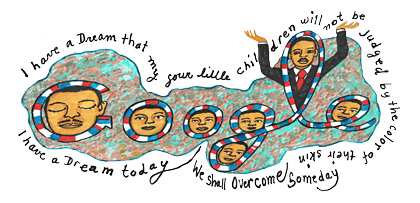
Google logo for Martin Luther King, Jr., Day 2012

Google logo for Martin Luther King, Jr., Day 2012 - click for more information

Fly your flag today, in honor of our nation, and in honor of our nation’s honoring the memory and legacy of the Rev. Dr. Martin Luther King, Jr.

U.S. law encourages Americans to fly the U.S. flag on holidays and a few other occasions. Congress set aside the third Monday in January as a holiday to commemorate the life of the Rev. Dr. Martin Luther King, Jr.

To honor Dr. King, for several years civil rights leaders and others have urged us to find some way to serve our communities on this day — Americans have done it long enough to make it a tradition. Here’s the official find-a-way-to-serve page from the the federal government; look out your window, go spend a few minutes at your city hall, post office, or at the biggest church in town, or walk into any middle school in America, and opportunities to serve will caress you at every turn.

More, much more:

King, by photographer Ben Fernandez's "Countdown to Eternity"

King, by photographer Ben Fernandez's portfolio of photos from one year in the life of Dr. King, "Countdown to Eternity"

MLK logo from Google mlk2010

Google's logo for Martin Luther King, Jr. Day, 2010 - click for more information


Pete Seeger: STILL standing taller than his critics

September 6, 2011

(This is almost completely an encore post — one that should get more circulation.  From four years ago, in 2007.  I have not updated years or ages — sharpen your math skills, and do it as you go.)

Some people can’t let go of the past, and like the greedy chimpanzee who grasps the rice in the jar, and then is trapped when he cannot pull out his fist nor will he give up his prize to save his freedom, they trap themselves out of a good life.

  • Cover to Pete Seeger album

    Cover of 1996 album of songs, "Pete." Seeger, born May 3, 1919, is 88 years old now.

Like this fellow, whose father’s dislike of an old political position of Pete Seeger kept them both from a good concert. He appears to agree with his father, though, thinking that somehow Seeger is responsible for the evils of Stalinism, and complaining that Seeger was tardy in making note of the fact that Stalin was evil. And Instapundit’s Glenn Reynolds agrees, profanely, and inaccurately, as I’ll explain below the fold. But heed this warning: I’m explaining at length.

Get a life, people! Pete Seeger did.

Read the rest of this entry »


That flag you flew yesterday — want to burn it today?

July 5, 2011

Some of the more astute students in our high school classes ask questions about everything.  For example, they ask:  “What does the Pledge of Allegiance mean, when it says, ‘ . . . and to the Republic for which it stands?'”

Is the Pledge all that important?  Is the flag all that important?

Maybe.  How would you answer that question, really?

Penn and Teller offer a demonstration:

What do you think?  Did they burn a flag?  Should that sort of performance be legal?

What if Penn and Teller burned a flag in the White House?

An exercise in ambiguity:  A fictional drama about a sleight of hand, illusionary performance.  (Best line:  The answer to the question, “Did you go to law school?”  For the record, yes, I did go to law school.  I’m an amateur clown.)

Did you fly your  flag yesterday?


July 4, 2011 – Fly your flag today

July 3, 2011

Fourth of July: NPR has already read the Declaration of Independence, PBS broadcast the Capitol Fourth concert  last night (maybe a rebroadcast is available — check your local listings), your town has a parade somewhere this weekend, and fireworks are everywhere.

Remember to put your flag up today.

Astronaut Eugene Cernan and the U.S. Flag -- Apollo 17 on the Moon (NASA photo)

Last flag on the Moon: Astronaut Eugene Cernan and the U.S. Flag -- Apollo 17 on the Moon (NASA photo)

Also:

Lunar Reconnaissance Orbiter photo of Apollo 17 landing site

Lunar Reconnaissance Orbiter photo of Apollo 17 landing site

This is mostly an encore post, but I so love that photo of the flag with the Earth in the distance.

Happy birthday, Kathryn!


Fly your flag today: Armed Forces Day 2011, May 21

May 21, 2011

Armed Forces Day honors those Americans who are, today, protecting our freedom, under arms, in the U.S. military services.

Veterans Day honors those who protected us in the past.  Memorial Day honors those who died in our nation’s service, and those veterans who have passed on.  Armed Forces Day honors and celebrates living Americans, to whom we owe immediate thanks.

Fly your flag today in their honor.  Today is Armed Forces Day 2011.

The slogan on this year’s poster:  Our Troops, and Those Supporting Them Back Home, Are United in Strength.

Poster for Armed Forces Day 2011, May 21

2011 Armed Forces Day poster

Previously, in Millard Fillmore’s Bathtub:


Republicans and fixing the economy

March 20, 2011

Apparently they think that “fix the economy” means something more akin to “fix your dog” than increase jobs.

If you’re unemployed, or facing layoff, you will be happy to know how the Republicans have your back.  Or, happy to know they’re doing something behind your back.  Or they’re trying to put you flat on your back.  Or something.


Veterans Day 2010 — why not volunteer to help veterans other days, too?

November 7, 2010

Video from the Veterans Administration:

More:


O, say! Does that woman’s lamp still burn beside the golden door?

September 12, 2010

Liberty stands gazing out at about 265 feet* above the water of New York Harbor, a fixture there since construction in the 1880s.

The Statue of Liberty Enlightening the World was a gift of friendship from the people of France to the people of the United States and is a universal symbol of freedom and democracy. The Statue of Liberty was dedicated on October 28, 1886, designated as a National Monument in 1924 and restored for her centennial on July 4, 1986.

The Statue of Liberty has been a fixture in the U.S. and American psyche, too.  Excuse me, or join me, in wondering whether we have not lost something of our former dedication to the Statue of Liberty, and the reasons France and Americans joined to build it.

Poem-a-Day sent Emma Lazarus’s “The New Colossus” out this morning (Poem-a-Day is a wonderful service of the American Academy of Poets — you may subscribe and I recommend it).  There it was, waiting for me in e-mail.   My students generally have not heard nor read the poem, I discover year after year —  some sort of Texas-wide failure in enculturation prompted by too-specific requirements of federal law and state law, combining to make a slatwork of culture taught in our classrooms with too many cracks into which culture actually falls, out of sight, out of mind; out of memory.  I fear it may be a nationwide failure as well.

Have you read the poem lately?  It once encouraged American school children to send pennies to build a home for the statue.  Today it wouldn’t get a majority of U.S. Congressmen to sign on to consponsor a reading of it.  Glenn Beck would contest its history, Rush Limbaugh would discount the politics of the “giveaways” in the poem, John Boehner would scoriate the victims in the poem for having missed his meeting of lobbyists (‘they just missed the right boat’), and Sarah Palin would complain about “an air-bridge to nowhere,” or complain that masses who huddle are probably up to no good (they might touch, you know).

Have you read it lately?

The New Colossus

by Emma Lazarus

Liberty Enlightening the World; French: La Liberté éclairant le monde - Wikimedia Commons image

Liberty Enlightening the World; French: La Liberté éclairant le monde - Wikimedia Commons image

Not like the brazen giant of Greek fame,
With conquering limbs astride from land to land;
Here at our sea-washed, sunset gates shall stand
A mighty woman with a torch, whose flame
Is the imprisoned lightning, and her name
Mother of Exiles. From her beacon-hand
Glows world-wide welcome; her mild eyes command
The air-bridged harbor that twin cities frame.
“Keep, ancient lands, your storied pomp!” cries she
With silent lips. “Give me your tired, your poor,
Your huddled masses yearning to breathe free,
The wretched refuse of your teeming shore.
Send these, the homeless, tempest-tost to me,
I lift my lamp beside the golden door!”

AAP makes poems available for iPhones, too, and you can see how it appears, phrase by phrase.  “The New Colossus” takes on more of its power and majesty delivered that way.

Is the Academy of American Poets playing politics here?  It’s September 12.  Yesterday many Americans took part in ceremonies and service projects in remembrance of the victims of the attack on the U.S. on September 11, 2001.  In much of the rest of America, there is an active movement to nail shut the “golden door,” to turn out a sign that would say “No tired, no poor nor huddled masses yearning to breathe free; especially no wretched refuse, no homeless, and let the tempest-tost stay in Guatemala and Pakistan.”

Would Americans bother to contribute to build a Statue of Liberty today?  Or would they protest against it?

Does that lamp still shine beside the golden door?

Stereoscopic image of the arm and torch of Liberty, at the 1876 Centennial Exposition in Philadelphia

Stereoscopic image of the arm and torch of Liberty, at the 1876 Centennial Exposition in Philadelphia; Robert N. Dennis Collection, New York Public Library. The arm was displayed to encourage contributions to the fund to build a pedestal for the statue, from private donations.

_____________

*  I’m calculating Liberty’s gaze at about 40 feet below the tip of the torch, which is just over 305 feet above the base of the statue on the ground.  The base is probably 20 feet higher than the water, but this isn’t exact science we’re talking about here.


A song for our times: Arlo and Pete sing Woody

July 20, 2010

In the late 1960s and the 1970s, conservatives made big displays of singing this song.  The Mormon Tabernacle Choir recorded one very popular version of it; it showed up often.  In those occasional complaints about the difficulty of singing “The Star-Spangled Banner,” this song’s suitability for national anthem status was always raised.

Today?  I haven’t heard it at a Republican gathering in long, long time.  I’m not saying that it’s completely disappeared from the conservative song book — among other things, I don’t attend Republican conventions as often as I once did, but I don’t think I’d hear it if I did.  I am saying that people finally started listening to the song, and it’s been largely dropped from conservative sing alongs for political reasons.

And that tells us a lot.

It would be good to hear this song a lot more; it would be good if more people sang it.

Arlo Guthrie and Pete Seeger leading the congregation in singing Woody Guthrie’s “The Land Is Your Land,” from a 1993 concert at Wolf Trap Farm Park in Virginia (one of my favorite venues for any music):

(Arlo’s got a new release this year, featuring this tune.)

More:


July 4, 2010 – Fly your flag today

July 4, 2010

Fourth of July:  NPR has already read the Declaration of Independence, PBS has the Capitol Fourth concert this evening (8:00 p.m. Eastern — check your local listings), your town has a parade somewhere this weekend, and fireworks are everywhere.

Remember to put your flag up today.

Astronaut Eugene Cernan and the U.S. Flag -- Apollo 17 on the Moon (NASA photo)

Last flag on the Moon: Astronaut Eugene Cernan and the U.S. Flag -- Apollo 17 on the Moon (NASA photo)

Also:

Lunar Reconnaissance Orbiter photo of Apollo 17 landing site

Lunar Reconnaissance Orbiter photo of Apollo 17 landing site


Patriotic shame of Corpus Christi, Texas

July 2, 2010

Flag in Corpus Christi, Texas, at corner of Staples and Craig - photo by Ed Darrell - IMGP4383

This flag needs to be retired. Will some patriot step up to the job?

Leaving Corpus Christi can be a trial.  It’s at least a 15 mile drive from the American Banking Center to Interstate 37, if you go by the Starbucks on Staples to get coffee for the drive back to Dallas.  (It’s a 100-yard drive otherwise.)

Tourist that I am I drove Staples all the way back, to see the nitty-gritty of the town.

Must it be this gritty?

The flag above, if it can still be considered a flag, struggles to honor our nation at the corner of Staples and Craig Streets.  Clearly this is not a flag that is retired at sundown, as the U.S. flag code urges.  It looks as though it has been flying there for at least a year.  Perhaps it has flown since September 11, 2001.  Perhaps it has flown since the War of 1812.

When a flag becomes tattered, it should be mended, appropriate for a symbol of our nation.  When it can no longer be repaired, it should be retired, according to the Congressional Research Service Report for Congress — The United States Flag:  Federal Law Related to Display and Associated Questions (pages 11 and 12):

Destruction of Worn Flags

The Flag Code states:

The flag, when it is in such condition that it is no longer a fitting emblem for display, should be destroyed in a dignified way, preferably by burning.*  The act is silent on procedures for burning a flag. It would seem that any procedure which is in good taste and shows no disrespect to the flag would be appropriate. The Flag Protection Act of 1989,38 struck down albeit on grounds unrelated to this specific point,39 prohibited inter alia “knowingly” burning of a flag of the United States, but excepted from prohibition “any conduct consisting of disposal of a flag when it has become worn or soiled.”

4 U.S.C. § 8(k).

Do we have any readers in Corpus Christi?  Could you drop by the shop where this flag is flown sometime through the week, and ask them to retire the flag, as an act of honor for our nation?

Thank you.


Something to think about as you get your flag ready to fly for July 4

July 2, 2010

This is mostly an encore post, from last year.

July 4th is the 234th anniversary of the announcement of the Declaration of Independence.  I hope you’re thinking about how you’ll fly the flag this weekend in honor of the Declaration of Independence.

The resolution proposed by Richard Henry Lee calling for independence of the 13 colonies passed the Continental Congress on July 2, 1776.  The Declaration would be Thomas Jefferson’s crowning achievement, outshining even his presidency and the Louisiana Purchase.   John Adams wrote to his wife, Abigail, that July 2 would forever be marked by patriotic displays.

But the Declaration itself, which gave teeth to the resolution, was adopted two days later on July 4 — and that has come to be the day we celebrate.

Detail, John Trumbull's Signing of the Declaration of Independence - Theodor Horydczak photo, Library of Congress

Detail, John Trumbull's Signing of the Declaration of Independence - The committee of five presents the Declaration of Independence to John Hancock, the President of the Second Continental Congress; from left, the committee is John Adams, Robert Livingston, Roger Sherman, Thomas Jefferson, and Ben Franklin. Theodor Horydczak photo, Library of Congress

Adams didn’t miss a beat.  Who quibbles about a couple of days when the celebrating is so good?

Adams and Jefferson were two of the five-member committee the Congress had tasked to write a declaration.  Adams and Ben Franklin quickly determined to leave it up to Jefferson, who had a grand flair with words, and who had just written a couple of stirring documents for Virginia.  Roger Sherman and Robert Livingston, the other two members, went along.  And so it was that the Declaration of  Independence is almost completely the work of Thomas Jefferson.

Adams and Jefferson became friends only later, when they both served the nation at war as ambassadors to France, and then for Adams, to England.  A widower, Jefferson was taken in by Abigail Adams who worried about him.  After the war, Jefferson was in England when Adams was to meet King George III in a grand ceremony in which the king would accept the credentials of all the ambassadors of foreign nations to England.  As the king strode down the line, each ambassador or delegation would bow, the king would acknowledge them, the papers would be passed, and the king would move on.  Adams and Jefferson bowed.  King George moved on, ignoring them completely.

In such a case of such a snub, the snubbed foreigners usually made a quick exit.  Adams and Jefferson did not.  They stood at attention as if the king had treated them like all the rest, reversing the snub.  From the beginning, Americans and the United States pushed for more practical, reasonable, and compassionate government and relations.

Back in America in peacetime, and both members of the administration of George Washington, Adams and Jefferson fell out.  Secretary of State Jefferson favored a more limited federal government; Vice President Adams favored a more powerful one.  By the end of Washington’s second term, party politics had been well developed.  Adams defeated Jefferson in the election of 1796.  As was the law then, Jefferson was vice president as the runner-up vote getter in the electoral college; but Adams kept Jefferson out of all government affairs.  Perhaps because he didn’t have Jefferson to help, Adams’s presidency did not go well.  In the rematch election in 1800, one of  the bitterest fights ever, Jefferson’s party defeated Adams.  The gleeful Democratic-Republican electors all voted one ballot for Jefferson, the presidential candidate, and one ballot for Aaron Burr, the party’s vice presidential candidate.

Alas, that produced a tie vote in the electoral college.  Adams’s party, the Federalists, still held the House of Representatives before the new Congress came in.  A tie vote goes to the House for decision.  They could not bring themselves to vote for Jefferson, and the deadlock continued for 37 ballots.  Finally Jefferson’s former friend but now arch enemy Alexander Hamilton intervened, explaining that Burr was clearly the greater scoundrel, and the House elected Jefferson.  Adams slunk out of town, avoiding the inauguration.

It wasn’t until after 1809 when Benjamin Rush hoodwinked Jefferson into writing to Adams, and Adams to Jefferson, that the two became friendly again.  For the next 17 years Jefferson and Adams carried on perhaps the greatest series of correspondence in history between two great minds.  Letters went out almost daily, from Monticello, Virginia,  to Braintree, Massachusetts, and from Braintree to Monticello.  They discussed the weather, their families, old times, farming — but especially the republic they had been most instrumental in creating, and how it might be preserved, and prosper.  Eventually the letters became harder to read, both because their eyesight was failing, and because their penmanship deteriorated, too.

The ideas, however, flowed like a great river of freedom.

Letter from Thomas Jefferson to John Adams, August 15th, 1820 - Library of Congress image

Letter from Thomas Jefferson to John Adams, August 15th, 1820. From The Thomas Jefferson Papers at the Library of Congress, Thomas Jefferson Papers Series 1. General Correspondence. 1651-1827. Library of Congress image

Both men took ill early in 1826.  This was a landmark year, 50 years since the Declaration of Independence.  In Massachusetts, a grand display of fireworks was to cap off a day of feasting and celebration.  Adams hoped he might attend.  In Virginia, a week before, it became clear Jefferson was too ill to venture even as close as Charlottesville for the celebration.  Jefferson slept through most of July 3, but awoke about 9:00 p.m., and asked, “This is the fourth?”  It was not.  These are the last significant, recorded words of Jefferson.  He awoke at about 4:00 a.m. on the Fourth of July, 1826, but could not make a rally.  He died at 12:50 in the afternoon.

Adams, too, was too ill to attend the celebrations.  In the late afternoon or early evening of the Fourth, he awoke, and heard the celebration in the town.  Almost as if he had worked just to live to see that particular day, he checked the date.  Realizing he was near the end, happy that he’d seen 50 years after the Declaration, and unaware of the events earlier that day in Virginia, Adams said, “Thomas Jefferson still survives.”  Adams, too, died on July 4, 1826.

Fly your flag July 4th. Remember John Adams and Thomas Jefferson.  Remember their great work in creating the nation that protects our freedoms today.  Remember their great friendship.  Write a letter to a good friend you’ve not written to lately.

It is Independence Day this Sunday.  Their spirit survives in us, as we celebrate, and if we remember why we celebrate.