January 13, 2011

Sitting Bear, Chief of the Arikaras, wearing a medal commemorating Millard Fillmore - Photo by Edward S. Curtis, Library of Congress image
In the 19th century, the U.S. Mint struck medals with the likeness of the sitting president, for use as gifts to foreign dignitaries. Often these medals would be given to Native Americans as tokens of friendship between the government and the tribe, or as a ceremonial gift on the striking of a treaty.
Description from the Library of Congress:
Photograph shows Sitting Bear, an Arikara chief, in full regalia, with a medallion around his neck. The medallion appears to bear the image of Millard Fillmore and the words: … President of the United States, 1851(?).
Famous photographer of American Indians Edward S. Curtis took this photo. The photo was copyrighted on November 19, 1908.
- Reproduction Number: LC-USZ62-136605 (b&w film copy neg.)
- Rights Advisory: No known restrictions on publication.
- Call Number: LOT 12321-D [item] [P&P]
- Other Number: H118592
- Repository: Library of Congress Prints and Photographs Division Washington, D.C. 20540 USA
- Notes:
- H118592 U.S. Copyright Office.
- Title from item.
- Curtis no. 2894-08.
- Forms part of: Edward S. Curtis Collection (Library of Congress).
- Published in: The North American Indian / Edward S. Curtis. [Seattle, Wash.] : Edward S. Curtis, 1907-30, Suppl. v. 5, pl. 166.
Is the medal the 1851 Indian Peace Medal, perhaps?
Without medals, any plan of operations among the Indians, be it what it may, is essentially enfeebled. This comes of the high value which the Indians set upon these tokens of Friendship. They are, besides this indication of the Government Friendship, badges of power to them, and trophies of renown. They will not consent to part from this ancient right, as they esteem it; and according to the value they set upon medals is the importance to the Government in having them to bestow.
Thomas L. McKenney, head of the Indian Office, to the secretary of the War Department, 1829
And, by the way — isn’t that a grand photo of Sitting Bear? Even knowing that Curtis might, on occasion, take some liberties in clothing Indians he photographed, it’s a great photo in a great setting of a great man.
Spread the word; friends don't allow friends to repeat history.
 1 Comment |
  DBQ sources, Historic documents, History, History and art, History images, Native Americans, photography, Primary Source Documents | Tagged: 1908, DBQ, Edward S. Curtis, History, Indians, Millard Fillmore, Native Americans, Original Source Documents, photography, Primary Source Documents, Sitting Bear |
  Permalink
 Posted by Ed Darrell
January 2, 2011
If you’re a few dozen miles from the Earth, for example:

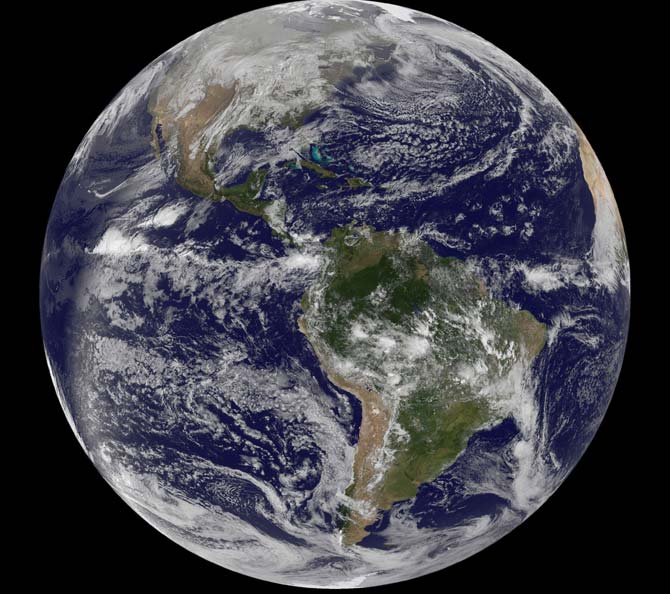
From NASA: The GOES-13 satellite captured a "full-disk image" of North and South America in an image created December 30 at 1445 UTC (9:45 a.m. EST), as the world awaits the new year. Credit: NOAA/NASA GOES Project; click on picture for larger view
Press information from NASA:
As the World Turns to 2011 GOES Satellites Watch its Approach and Look Back at 2010
The GOES series of satellites keep an eye on the weather happening over the continental U.S. and eastern Pacific and Atlantic Oceans and had a busy time with wild weather in 2010. Today, GOES-13 captured one of the last images of North and South America in 2010 as the world continues to turn toward 2011.
The Geostationary Operational Environmental Satellite called GOES-13 satellite captured a “full-disk image” of North and South America in an image created December 30 at 1445 UTC (9:45 a.m. EST) as the world awaits the new year. The stunning image shows cloud cover associated low pressure areas over the upper Midwestern U.S. and Colorado’s Rocky Mountains.
NASA’s GOES Project, located at NASA’s Goddard Space Flight Center in Greenbelt, Md., procures and manages the development and launch of the GOES series of satellites for NOAA on a cost-reimbursable basis. NASA’s GOES Project also creates some of the GOES satellite images and GOES satellite imagery animations. NOAA manages the operational environmental satellite program and establishes requirements, provides all funding and distributes environmental satellite data for the United States.
NASA’s GOES Project was very busy this year. GOES-13 monitors the eastern continental U.S., Atlantic Ocean, Gulf of Mexico and Caribbean, while GOES-11 monitors weather conditions over the western U.S. and the Eastern Pacific Ocean.
In 2010, GOES satellites were busy providing images and animations of weather systems from nor’easters to tropical cyclones that caused blizzards, flooding and wind damage.
Most recently, the GOES project used satellite data to create an impressive animation of the great Christmas weekend blizzard that pummeled the northeastern U.S. Prior to that, GOES imagery showed travel conditions for the holiday weekend when that low was over the Colorado Rockies.
On Dec. 19, the GOES-11 satellite captured an image of the famous “Pineapple Express.” Occasionally in the winter, a large jet stream forms across the mid-Pacific, carrying a continuous flow of moisture from the vicinity of Hawaii to California, bringing heavy rain and snow to the Sierra-Nevada for several days.
On Dec. 8 GOES-13 satellite imagery revealed a snow-covered, winter-like upper Midwest, several weeks before astronomical winter. On Nov. 24, GOES satellites helped Thanksgiving travelers figure out where delays may be happening.
During the summer, on July 25, GOES-13 imagery tracked one of the most destructive storms in years to strike Washington, D.C. and the surrounding area. Strong winds downed trees and power lines, leaving hundreds of thousands of residents without power, stopping elevators, and darkening malls and movie theaters. Falling trees killed at least two people. The NASA GOES Project created a satellite animation of the storm as moved through the region.
GOES-13 was busy in the Atlantic during the 2010 hurricane season. The Atlantic season started on June 1 and ended on November 30. The Atlantic season tied for third with two other years (1995 and 1887) as having the largest number of named storms at 19, and tied with two other seasons (1969 and 1887) for the second largest number of hurricanes, with 12. GOES-13 covered all of those tropical cyclones. GOES-11 didn’t see the action in the Eastern Pacific tropics that GOES-13 did, however. Because of a La Niña event, the 2010 Pacific hurricane season (which began May 15 and ended Nov. 30) was the least active season in terms of the number of named storms and hurricanes on record. All tropical cyclones can be seen at NASA’s Hurricane page archives for 2010 at: http://www.nasa.gov/mission_pages/hurricanes/archives/index.html.
On April 14, months before hurricane season started, GOES-13 became the official GOES-EAST satellite. GOES-13 was moved from on-orbit storage and into active duty. It is perched 22,300 miles above the equator to spot potentially life-threatening weather, including tropical storm activity in the Atlantic Ocean and Gulf of Mexico..
Before GOES-13 moved into the position previously occupied by GOES-12, GOES-12 captured a parade of three large storms the flooded the upper Midwest and Northeast in the second half of March. In the first half of March, GOES-12 covered storms as they dumped heavy rainfall in the Northeastern U.S.
On March 12, GOES-12 captured a very rare event in the tropics: the second–ever known tropical cyclone called Tropical Storm 90Q formed in the South Atlantic Ocean off the coast of Argentina.
During the first two weeks of February 2010, the GOES-12 weather satellite also observed a record-setting series of “Nor’easter” snow storms which blanketed the mid-Atlantic coast in two blizzards.
Whatever and wherever the weather in 2011, the GOES series of satellites will always go.
Related Links:
› GOES-POES web site
› NOAA web site
Rob Gutro
NASA’s Goddard Space Flight Center, Greenbelt, Md.
Spread the word; friends don't allow friends to repeat history.
2 Comments | Geography - Physical, NASA, photography, Science, Space exploration | Tagged: Earth, geography, GOES, NASA, photography, Science, Space exploration | Permalink
Posted by Ed Darrell
December 28, 2010

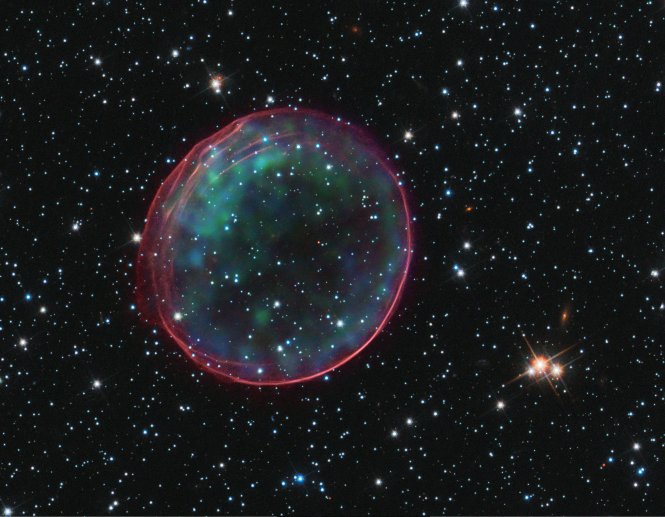
Supernova SNR 0509-67.5, image a composite of Hubble Space Telescope and CHANDRA X-ray Observatory images - image from NASA (click on image for larger view)
Press release from NASA:
This colorful creation was made by combining data from two of NASA’s Great Observatories. Optical data of SNR 0509-67.5 and its accompanying star field, taken with the Hubble Space Telescope, are composited with X-ray energies from the Chandra X-ray Observatory. The result shows soft green and blue hues of heated material from the X-ray data surrounded by the glowing pink optical shell which shows the ambient gas being shocked by the expanding blast wave from the supernova. Ripples in the shell’s appearance coincide with brighter areas of the X-ray data.
The Type 1a supernova that resulted in the creation of SNR 0509-67.5 occurred nearly 400 years ago for Earth viewers. The supernova remnant, and its progenitor star reside in the Large Magellanic Cloud (LMC), a small galaxy about 160,000 light-years from Earth. The bubble-shaped shroud of gas is 23 light-years across and is expanding at more than 11 million miles per hour (5,000 kilometers per second).
Data from Hubble’s Advanced Camera for Surveys, taken in 2006 with a filter that isolates light from glowing hydrogen were combined with visible-light images of the surrounding star field that were imaged with Hubble’s Wide Field Camera 3 in 2010. These data were then merged with X-ray data from the Chandra X-ray Observatory taken with the Advanced CCD Imaging Spectrometer (ACIS) in 2000 and 2007.
Credits: X-ray: NASA/CXC/SAO/J.Hughes et al, Optical: NASA/ESA/Hubble Heritage Team (STScI/AURA)
Spread the word; friends don't allow friends to repeat history.
Leave a Comment » | Astronomy, photography, Science, Space exploration | Tagged: Astronomy, CHANDRA X-ray Observatory, Cool Stuff, Hubble Space Telescope, NASA, photography, Science, Supernova | Permalink
Posted by Ed Darrell
December 21, 2010
Joni Mitchell warned us: Clouds get in the way:

A clouded view for openers
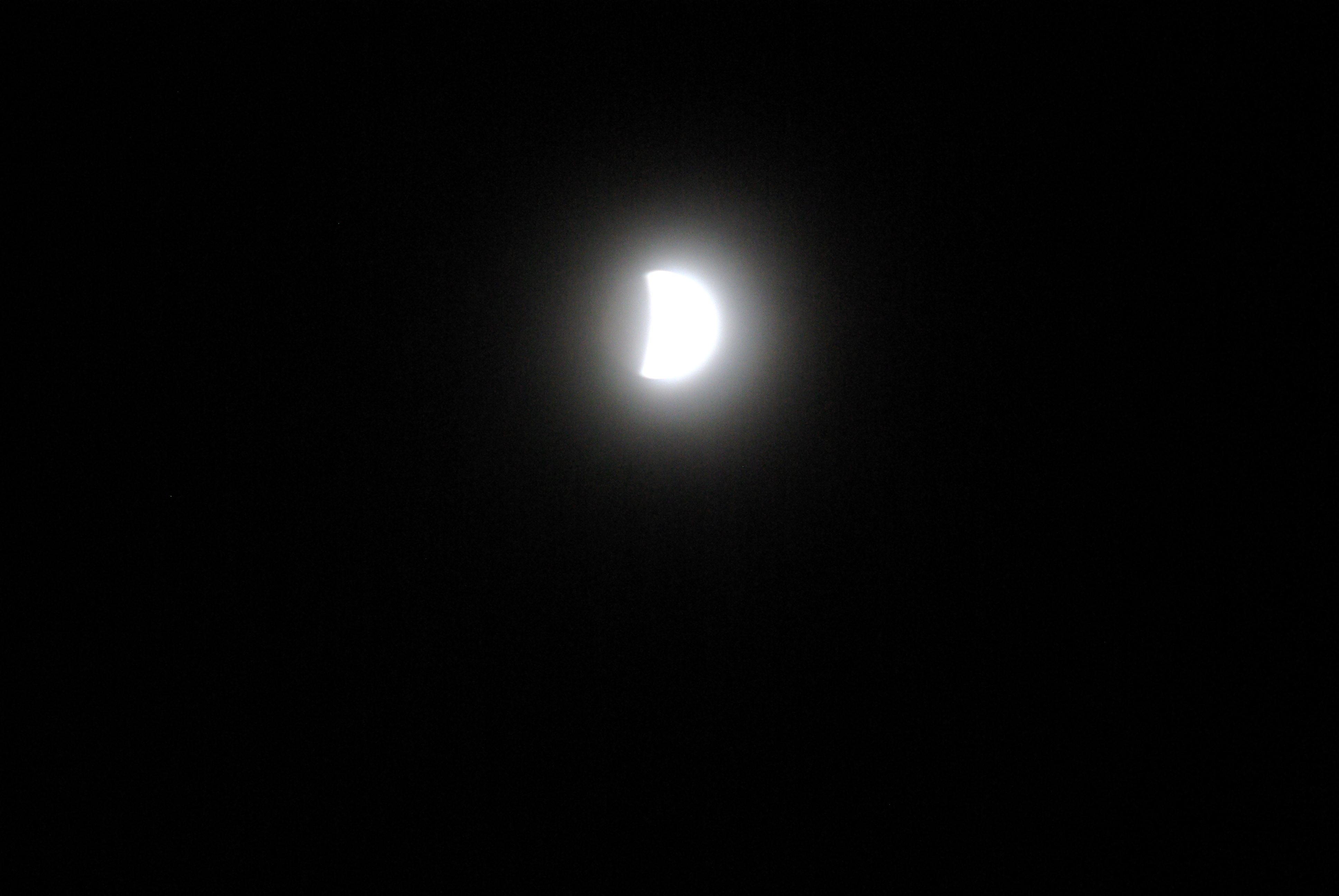
A long eclipse — more than an hour of almost-total coverage of the Moon’s disk. Clouds came and went, with a few good viewing times. With the naked eye, the view was spectacular. Through the 200 mm Pentax zoom, not quite as spectacular, even with the tripod mount. Photographing eclipses takes some skill that I don’t yet possess.
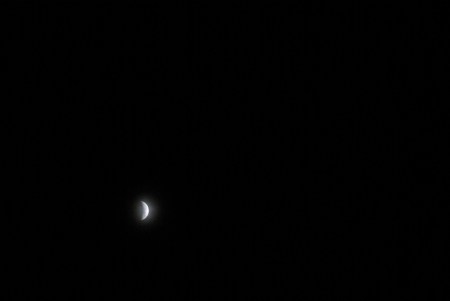
Clouds took a break
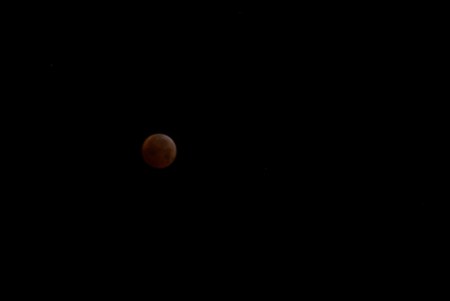
Eclipse totality

Eclipse nearing its end
Near the end of totality, where the shadow slips away from the full Moon, a bright white light provides a dazzlying view that confounds the light meters.

Celestial orange, tinged in silver

Step back, see a few of the starts, even from inside Dallas city limits

To every Earth shadow, there's a silver lining to confuse the built-in light meter
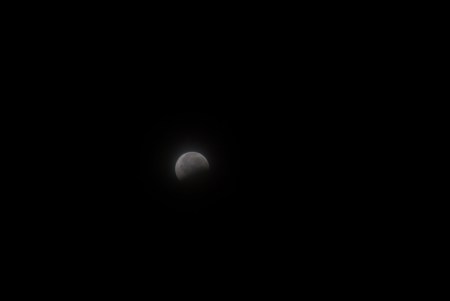
Blood-tinge gone, Earth's shadow retreats (all photos by Ed Darrell)

Eclipse nearly over, clouds again fog the view
Longer lens, better tripod next time. (Heh. We should live so long.)
Spread the word; friends don't allow friends to repeat history.
3 Comments | Astronomy, Geography - Physical, Moon, photography, Science | Tagged: Astronomy, geography, Lunar Eclipse 12-21-2010, Moon, photography, Science | Permalink
Posted by Ed Darrell
December 5, 2010

What event critical to western history and the development of the democratic republic in the U.S. happened here in 1215?
A teacher might use some of these photos explaining the steps to the Constitution, in English law and the heritage of U.S. laws. Other than the Magna Carta, all the events of Runnymede get overlooked in American studies of history. Antony McCallum, working under the name Wyrdlight, took these stunning shots of this historic meadow. (He photographs stuff for studies of history, it appears.)
Maybe it’s a geography story.

View of Runnymede Meadow from Engham Village -- Wyrdlight photo through Wikimedia
Several monuments to different events of the past millennium populate the site. The American Bar Association dedicated a memorial to the Magna Carta there — a small thing open to the air, but with a beautiful ceiling that is probably worth the trip to see it once you get to England.
Wikipedia explains briefly, with a note that the ABA plans to meet there again in 2015, the 800th anniversary of the Great Charter:
Magna Carta Memorial


The Magna Carta Memorial & view towards the ‘medes’

Engraved stone recalling the 1985 ABA visit
Situated in a grassed enclosure on the lower slopes of Cooper’s Hill, this memorial is of a domed classical style, containing a pillar of English granite on which is inscribed “To commemorate Magna Carta, symbol of Freedom Under Law”. The memorial was created by the American Bar Association to a design by Sir Edward Maufe R.A., and was unveiled on 18 July 1957 at a ceremony attended by American and English lawyers.[5]
Since 1957 representatives of the ABA have visited and rededicated the Memorial renewing pledges to the Great Charter. In 1971 and 1985 commemorative stones were placed on the Memorial plinth. In July 2000 the ABA came:
to celebrate Magna Carta, foundation of the rule of law for ages past and for the new millennium.
In 2007 on its 50th anniversary the ABA again visited Runnymede and during the convention installed as President Charles Rhyne who devised Law Day which seeks in the USA an annual reaffirmation of faith in the forces of law for peace.
The ABA will be meeting at Runnymede in 2015 on the 800th anniversary of the sealing of the original charter.
The Magna Carta Memorial is administered by the Magna Carta Trust, which is chaired by the Master of the Rolls.[10]
In 2008, flood lights were installed to light the memorial at night, but due to vandalism they now lie smashed.
I’ll wager the lights get fixed before 2015.

Detail of ceiling of the Magna Carta Memorial detailing play of light, and star pattern, Runnymede - Wikimedia image
More, resources:
Spread the word; friends don't allow friends to repeat history.
8 Comments | 1215, Civil Rights, Democracy, Geography - Physical, Geography - Political, Heritage of Law, History, History of Law, Human Rights, photography, Travel, U.S. Constitution, World history | Tagged: 1215, Civil Rights, Democracy, geography, Heritage of Law, History, Human Rights, Law, Magna Carta, photography, Runnymede, Travel, U.S. Constitution | Permalink
Posted by Ed Darrell
November 25, 2010
Adam Goodheart’s online essay on the beginning of Abraham Lincoln’s beard makes worthy reading.

Very first photo of president-elect Abraham Lincoln with a beard, November 25, 1860. Lincoln was photographed in Chicago by Samuel G. Alschuler. Library of Congress photo, via New York Times
Goodheart points to the first photo of Lincoln’s beard, made November 25, 1860, exactly 150 years ago, today.
Spread the word; friends don't allow friends to repeat history.
1 Comment | 1861-1865, A Good Story, Abraham Lincoln, Civil War, History, History images, photography | Tagged: 1861-1865, Abraham Lincoln, Adam Goodheart, Civil War, History, History images, Lincoln's Beard, photography | Permalink
Posted by Ed Darrell
November 20, 2010
What I really like about this story is that the guy did it for his grandmother, to pull her out of a funk.
From My Modern Met:

Sacha Goldberger's loving portrait of his grandmother, who happens to be a superhero.
A few years ago, French photographer Sacha Goldberger found his 91-year-old Hungarian grandmother Frederika feeling lonely and depressed. To cheer her up, he suggested that they shoot a series of outrageous photographs in unusual costumes, poses, and locations. Grandma reluctantly agreed, but once they got rolling, she couldn’t stop smiling.
Frederika was born in Budapest 20 years before World War II. During the war, at the peril of her own life, she courageously saved the lives of ten people. When asked how, Goldberger told us “she hid the Jewish people she knew, moving them around to different places everyday.” As a survivor of Nazism and Communism, she then immigrated away from Hungary to France, forced by the Communist regime to leave her homeland illegally or face death.
Aside from great strength, Frederika has an incredible sense of humor, one that defies time and misfortune. She is funny and cynical, always mocking the people that she loves.
With the unexpected success of this series, titled “Mamika,” Goldberger created a MySpace page for his grandmother. She now has over 2,200 friends and receives messages like: “You’re the grandmother that I have dreamed of, would you adopt me?” and ” You made my day, I hope to be like you at your age.”
Initially, she did not understand why all these people wrote to congratulate her. Then, little by little, she realized that her story conveyed a message of hope and joy. In all those pictures, she posed with the utmost enthusiasm. Now, after the set, Goldberger shares that his grandmother has never shown even a hint of depression. Perhaps it’s because her story serves some sort of purpose. That through the warm words of newfound friends, she’s reminded of just how lucky she is to be alive.
Several great photos here, at My Modern Met.
Who wouldn’t admire a guy who makes a superhero out of his grandmother?

Going to the wall for your grandmother -- Sacha Goldberger photo.
More, and resources:
Tip of the old scrub brush to Jean Detjen.
Spread the word; friends don't allow friends to repeat history.
Leave a Comment » | Family, History, Humor, Life, photography | Tagged: Family, Humor, Life, photography | Permalink
Posted by Ed Darrell
October 24, 2010
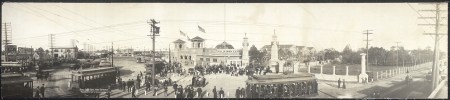
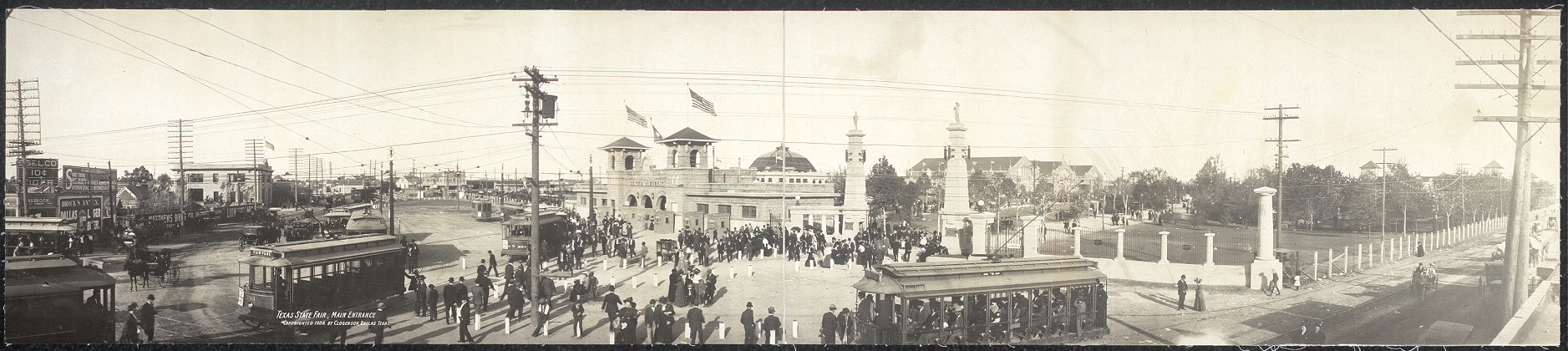
Texas State Fair, 1908 - Library of Congress panoramic photo
Click on the photo to see a much larger version.
From the astonishingly vast vaults of the Library of Congress, a panoramic photograph of the main entrance of the Texas State Fair, in 1908. This is almost certainly Dallas, and this is probably the same entrance where today the short-rail mass transit trains pass by — a century later, and Dallas has once again got mass transit.
This photo contrasts starkly with Fair Park in Dallas today, a week after the closing of the 2010 Texas State Fair.
Details from the Library of Congress:
Item Title
Texas State Fair, Main Entrance.
Created/Published c1908.
Copyright deposit; H. Clogenson; December 8, 1908; DLC/PP-1908:43634.
Copyright claimant’s address: Dallas, Texas
Medium: 1 photographic print : gelatin silver ; 9.5 x 43 in.
Call Number: PAN SUBJECT – Events no. 31
REPRODUCTION NUMBER: LC-USZ62-125457 DLC (b&w film copy neg.)
Who was H. Clogenson? What other treasures did he leave around?
Spread the word; friends don't allow friends to repeat history.
Leave a Comment » | photography, Texas, Texas history | Tagged: 1908, Dallas, History, Panoramic Photo, photography, Texas, Texas State Fair | Permalink
Posted by Ed Darrell
October 24, 2010
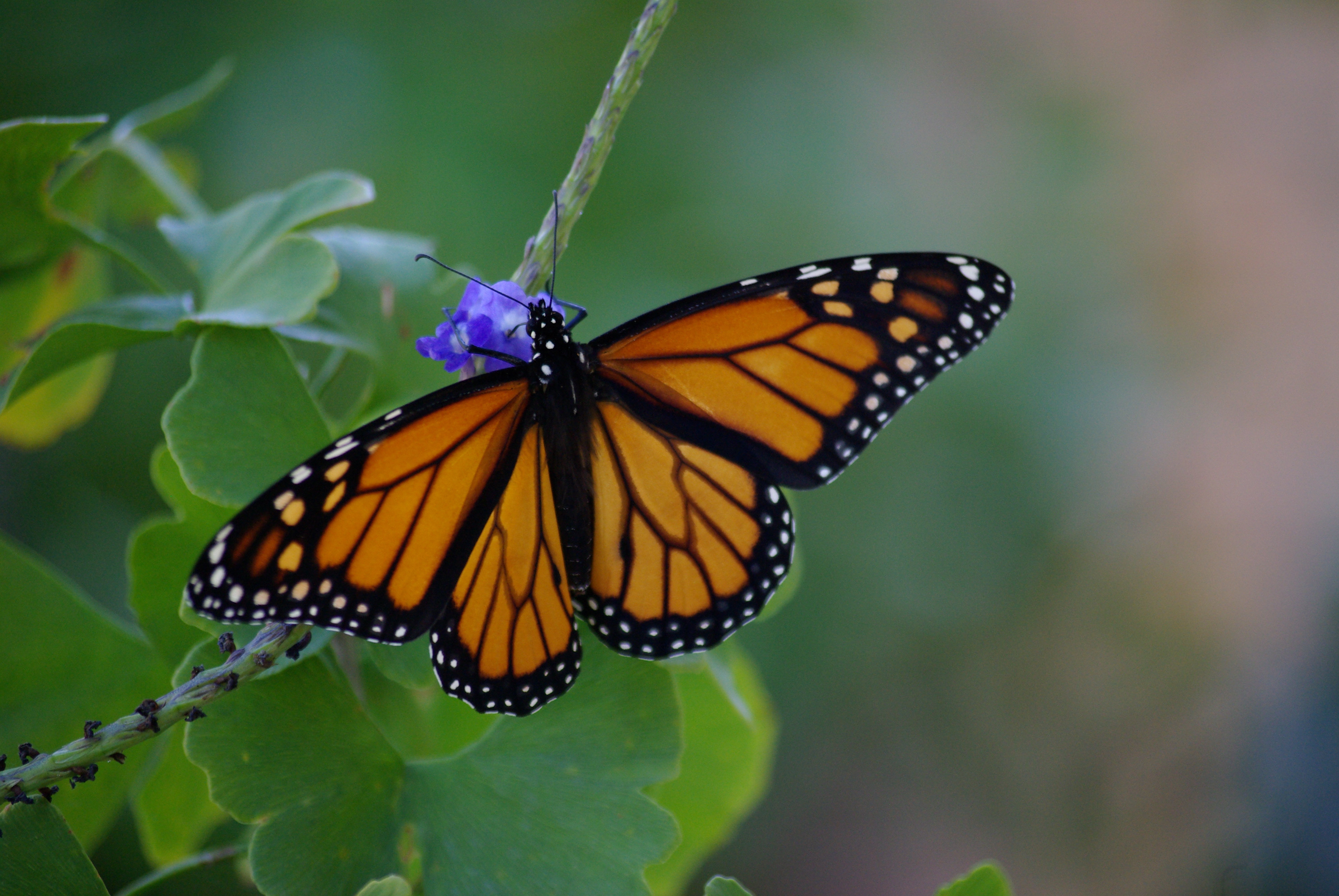
Great mysteries of science, history and spirit call to us: How do the monarch butterflies do it?
Monarch butterflies (Danaus plexippus) fly north from their enclave in Mexico every spring, stopping to lay eggs on milkweed plants. After a migration of several hundred miles, that first group that left Mexico dies off. Their offspring hatch in a few days, devour the milkweed, make a chrysalis, metamorphose into butterflies, then fly farther north, where they repeat their parents’ behavior: Lay some eggs, and die. Within three generations, they’ve spread north into Canada.

Inviting the monarchs in: You can see how Kathryn worked to attract butterflies. In this photo, you can see the butterfly weed (a milkweed), red Turk's cap, and blue ageratum especially for the monarchs.
Then the fourth generation does something so strange and wonderful people can’t stop talking about it: They fly back to Mexico, to the same trees their great-great-great grandparents left. There they sip some nectar, get some water, and spend a lot of time hanging in great globs, huddling over the winter, to start life for generations of monarch butterflies the next spring.
Sometimes in Texas in October, we can see clouds of monarch butterflies winging south. If we’re lucky, they stop to visit our backyards and gardens, and we might provide some water and nectar to urge them homeward. Kathryn, of course, plants the stuff the monarchs like, to help them, and to give us a chance to see them.
Monarch habitat in Mexico is under severe stress and threat. Late storms and early freezes decimated monarch populations over the last decade [yes, that’s the proper use of “decimated;” look it up]. Human plantings are more critical to the monarch butterflies than ever before.
Two years ago Kathryn and I spent a September morning outside the library at Lawrence University, in Appleton, Wisconsin, watching monarchs sip nectar from local flowers for their journey. Those same butterflies — we hope — passed through Texas a couple of weeks later.
Two weeks ago . . . well, see for yourself:
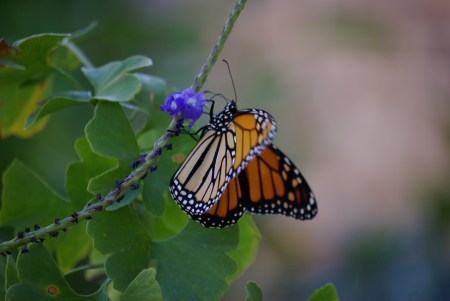
A monarch butterfly feeds on blue porterweed in Kathryn's garden, October 2010 - photo by Ed Darrell

. . . we're here with the camera, little guy, just open up those wings, please . . .
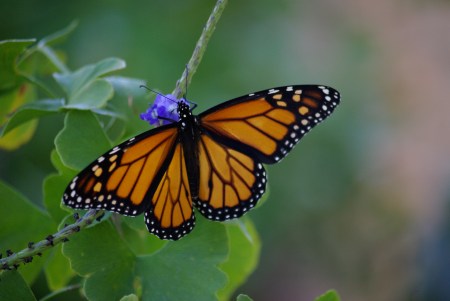
That's it! Beautiful! Have a safe trip, and come back next spring, will you?
Resources, more:
- Blue ageratum is also known as blue mistflower, Conoclinium coelestinum
- Turk’s Cap passes under a lot of aliases: Drummond Wax-mallow, Texas Mallow, Mexican Apple, Red Mallow, May Apple, Wild Turk’s Cap, Bleeding Heart;
Malvaviscus drummondii (M. arboreus var. drummondii)
- Butterfly weed — there are several plants that take this name in various parts of the country, this one is Asclepias tuberosa, but Kathryn’s bloom redder and more intense yellow than any of the photos I’ve seen on line.
- Blue porterweed is another important butterfly plant, Stachytarpheta jamaicensis; it also goes under many names: Blue Snakeweed, Jamaica vervain, Brazilian Tea, Devil’s Coachwhip. Ours is in a container on the patio (not in the garden path picture).
- Yeah, the headline is a real groaner — an old movie title coupled with Southwest Airline’s slogan. You’re free to suggest a better headline, anytime.
- You can help track the migrations of the monarch butterflies — go to MonarchWatch.org for instructions and details.
- Here’s another migration tracking program, at Learner.org (an Annenberg Foundation project)
- MonarchButterflyUSA.com
- Enchanted Learning’s monarch page
- I think the monarch in my photos is a male, at least, that’s what it looks like from the photos at Great Plains Nature Center in Wichita, Kansas — can anyone tell for sure? How?
- Mexico’s tourism office advertising agency appears unable to tell the difference between a monarch and a viceroy — can you tell?
Conoclinium coelestinum
Spread the word; friends don't allow friends to repeat history.
12 Comments | Biology, Botany, Entomology, Gardening, Geography - Physical, Natural history, Science, Travel, Wildflowers, Wildlife | Tagged: Biology, Botany, Butterfly Gardens, Entomology, Gardening, geography, Monarch Butterflies, Natural history, Nature, photography, Science, Travel, Wildlife | Permalink
Posted by Ed Darrell
October 23, 2010
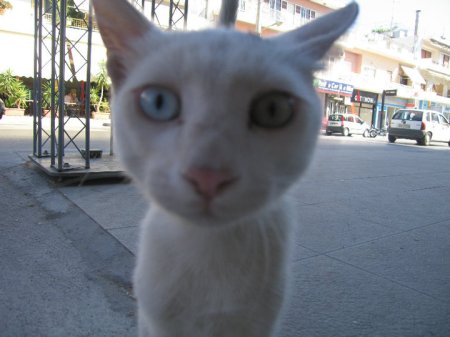
A cat Kenny Darrell photographed in Crete -- notice each eye is a different color.
Darwin wondered about the genetic reasons behind white cats being blind deaf (though, of course, he didn’t call it “genetics” then). Evolution in action: White cats today usually can see hear.
Kenny found this cat in Crete, and got a good shot of its eyes, each of a different color — though of course, as soon as the focus was set, the cat leaned forward for a pet.
Kenny’s in China right now. I wonder if China has cats and dogs on the streets like Crete?
Below the fold: Darwin on white cats.
Read the rest of this entry »
Spread the word; friends don't allow friends to repeat history.
4 Comments | China, Evolution, Family, Greece, Personal, photography, Travel | Tagged: China, Crete, Evolution, Family, Greece, Personal, photography, Travel | Permalink
Posted by Ed Darrell
October 18, 2010
You can learn a lot just by observing.
Sam O’Hare’s observations, captured with his Nikon D-300, can teach you a lot.
Or, you can sit back an enjoy the images. Spectacular stuff.
A day in the life of New York City, in miniature.
Winner: Prix Ars Electronica Award of Distinction 2010
Original Music: composed by Human (humanworldwide.com), co-written by Rosi Golan and Alex Wong.
Geography bell ringer?
Tip of the old scrub brush to Kenny in Beijing.
Spread the word; friends don't allow friends to repeat history.
2 Comments | Geography - Economic, Geography - Physical, Music, photography, Urbanization, Video and film | Tagged: Cool Stuff, geography, Music, New York, photography, Sam O'Hare, Urbanization, video | Permalink
Posted by Ed Darrell
September 20, 2010
Did I mention that San Francisco is one of my favorite cities in the world?
A lot of reasons. My father had businesses there (1930s?). My parents wooed in and around there. Our Favorite Aunt Linda did well in the area (Marin County, but that just adds to the beauty).
I was accepted at Hastings College of Law. We figured we had enough saved that we could either pay tuition at Hastings, and live on what Kathryn could earn, if she could get a job; or we could buy a house in the D.C. area, keep our jobs on Senate staff, and pay tuition.
We had a wonderful week in San Francisco getting no job interviews. On our last night we found a Tower Record Store and stocked up (back in the days of vinyl) for the next four years at George Washington, and sadly left the city. In a fit of irony, Tower Records opened a store across the street from GW’s law school two years later.
Earlier, after the 1976 elections, I hid out at Aunt Linda’s joint, Red Robin Catering, tending bar, washing dishes, washing a lot of lettuce, and generally trying to make a car payment and enjoy San Francisco. She catered the opening of the Marin/San Francisco ferry, which meant more than a dozen trips overall, as I recall, serving champagne mostly. Now I look back on how unfair it was that my youth did not include electronic cameras.
Early mornings — and there were more than a few — the city is just unsurpassed in beauty. Cousin Steve pushed me out of bed to go see the Muir Woods at near dawn (I confess I did not go often enough). Some nights I’d just cruise across the Golden Gate Bridge for the views.
Like this one, a composition from several shots from the same place, woven together with the wonders of electronic camera software:

Golden Gate Bridge and San Francisco, and fog, from Marin County - Wikimedia image, panorama photo stitching by Mila Zinkova
It’s shot from Marin County, west of the Golden Gate Bridge, I think — that’s the North Tower of the bridge, with the Bay Bridge and the city of San Francisco in the background.
Discussion at Wikimedia: Those are crepuscular rays coming through the trees. There’s an SAT vocabulary word for you: Crepuscular.

More crepuscular rays from Marin County, Wikimedia photo by Mila Zinkova
More:
- More great shots of San Francisco at Heida Biddle’s Tales of 7, here, and especially here
Spread the word; friends don't allow friends to repeat history.
2 Comments | Geography - Physical, Geography - Political, photography, Travel | Tagged: Fog, geography, Golden Gate Bridge, History, photography, San Francisco, Travel | Permalink
Posted by Ed Darrell
September 10, 2010

Sleeping Dog at the Palace at Knossos, Crete (Greece) - photo copyright 2010 Kenny Darrell (free use with attribution)
You recognize the three maidens, of course, the Ladies in Blue fresco. Dogs wander all over Crete, Kenny discovered. Strays? Neighborhood dogs just not bound by a fence?
Maybe this mutt is just a lover of history, or archaeology. Dreaming of the Knossos that was? Who will tell the dog the fresco is a reproduction? Do they duplicate the dog at the display in the Heraklion Museum?
Kenny got inspiration from roaming the ruins of the palace. Some of his colleagues, he reported, were less interested, because they were ruins. They had hoped for more of a palace to tour. Walking through a cradle of civilization, but craving the comforts of guides and air conditioning . . .
From Kenny’s stay in Crete early in the summer.
See also:
Spread the word; friends don't allow friends to repeat history.
2 Comments | Archaeology, Greece, History, photography, Travel | Tagged: Archaeology, Crete, Greece, History, Palace at Knossos, photography, Travel | Permalink
Posted by Ed Darrell
August 13, 2010
Go see the photos. Seriously. “The Capital was his classroom”, by David Dunlap.
Doubtless, there are other accomplished photojournalists in Washington who have won an Eagle Scout medal with bronze palm. Luke Sharrett of The Times may be the only one who earned his just six years ago.
And he is almost certainly the only photographer who’ll be leaving the D.C. press corps on Friday to start his junior year in college.
“Why are you doing that?” President Obama asked him as Air Force One was taking off the other day.
Dunlap does not say whether Sharrett earned the Photography Merit Badge. Anyone know?
Spread the word; friends don't allow friends to repeat history.
Leave a Comment » | Boy Scouts of America, Eagle Scout, Education, Higher education, News, Newspapers, photography | Tagged: Back-to-school, Boy Scouts of America, Eagle Scout, Education, History, History images, Journalism, Luke Sharrett, Newspapers, photography | Permalink
Posted by Ed Darrell
August 12, 2010
Earlier I found an idea I’ve not been able to incorporate into my classes, but which I still like: Take historic photos of your town, go to the same place today and see what it looks like.
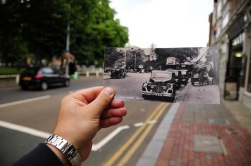
Students could do this: Comparing historic images with places today
A Russian photographer takes the exercise further, and creates sometimes-stunning art.
Sergey Larenkov has photos from Europe in World War II. He blends parts of those images with photos of the same places today, in cities across Europe. He has images from Berlin, Leningrad, and other cities (crawl over his LiveJournal site — there’s good stuff).

Sergey Larenkov, World War II historic photo overlay on modern shot - is this Leningrad? Whose soldiers, what year?

Sergey Larenkov work, the Siege of Leningrad, and Leningrad today (reverting to the name St. Petersburg)
Ghostly, no?
The photos show the destruction of war, and how far Europe has come since then. It’s an astounding view of history. If a picture is worth a thousand words, these photo mashups are worth ten thousand words or more.
Tip of the old scrub brush to Alices’ blog at My Modern Met.


Spread the word; friends don't allow friends to repeat history.
6 Comments | Education, Famous Battles, History, History images, photography, War, World War II | Tagged: Education, Famous Battles, History, photography, Siege of Leningrad, Student projects, World War II | Permalink
Posted by Ed Darrell









 Millard Fillmore's Bathtub