August 9, 2010

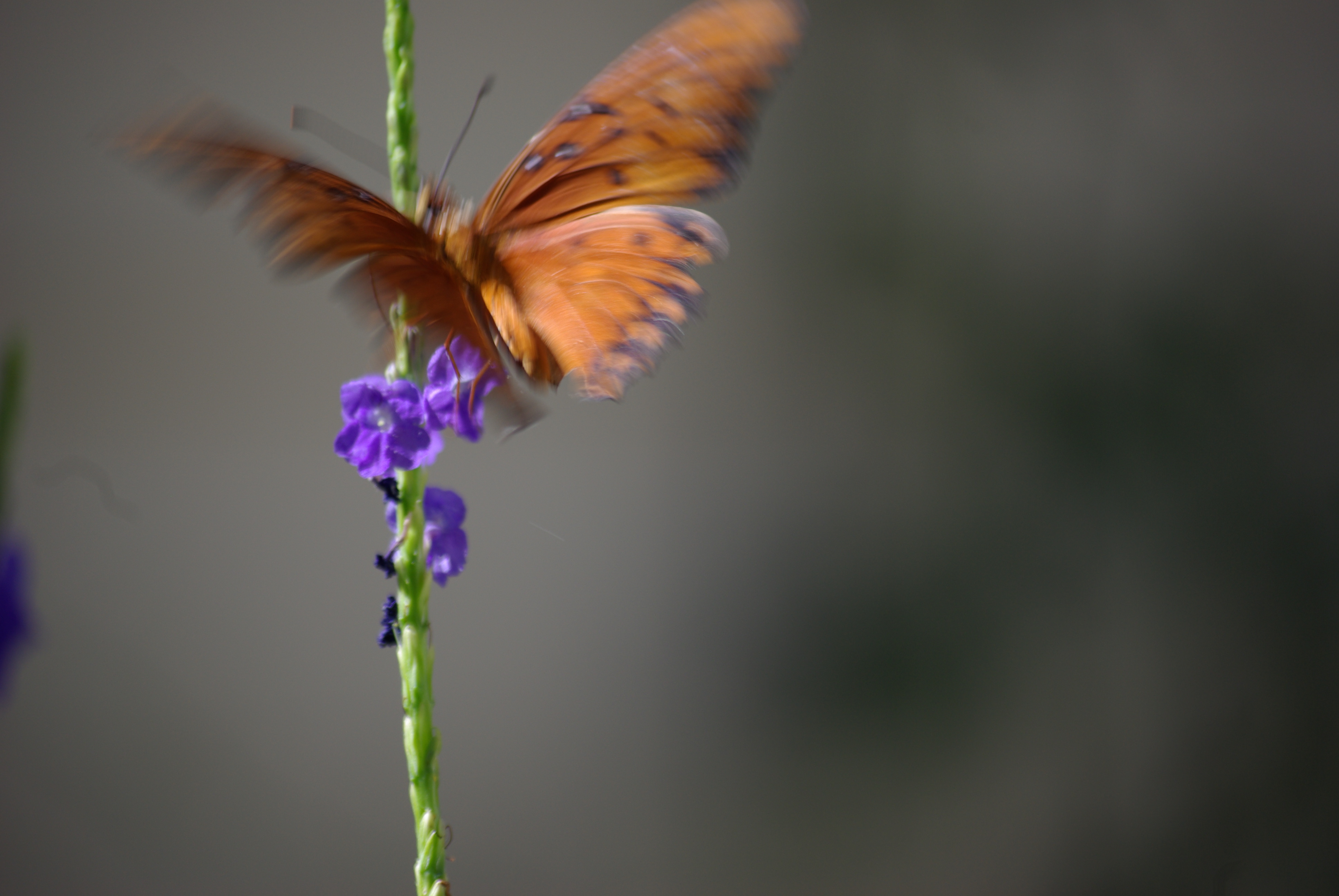
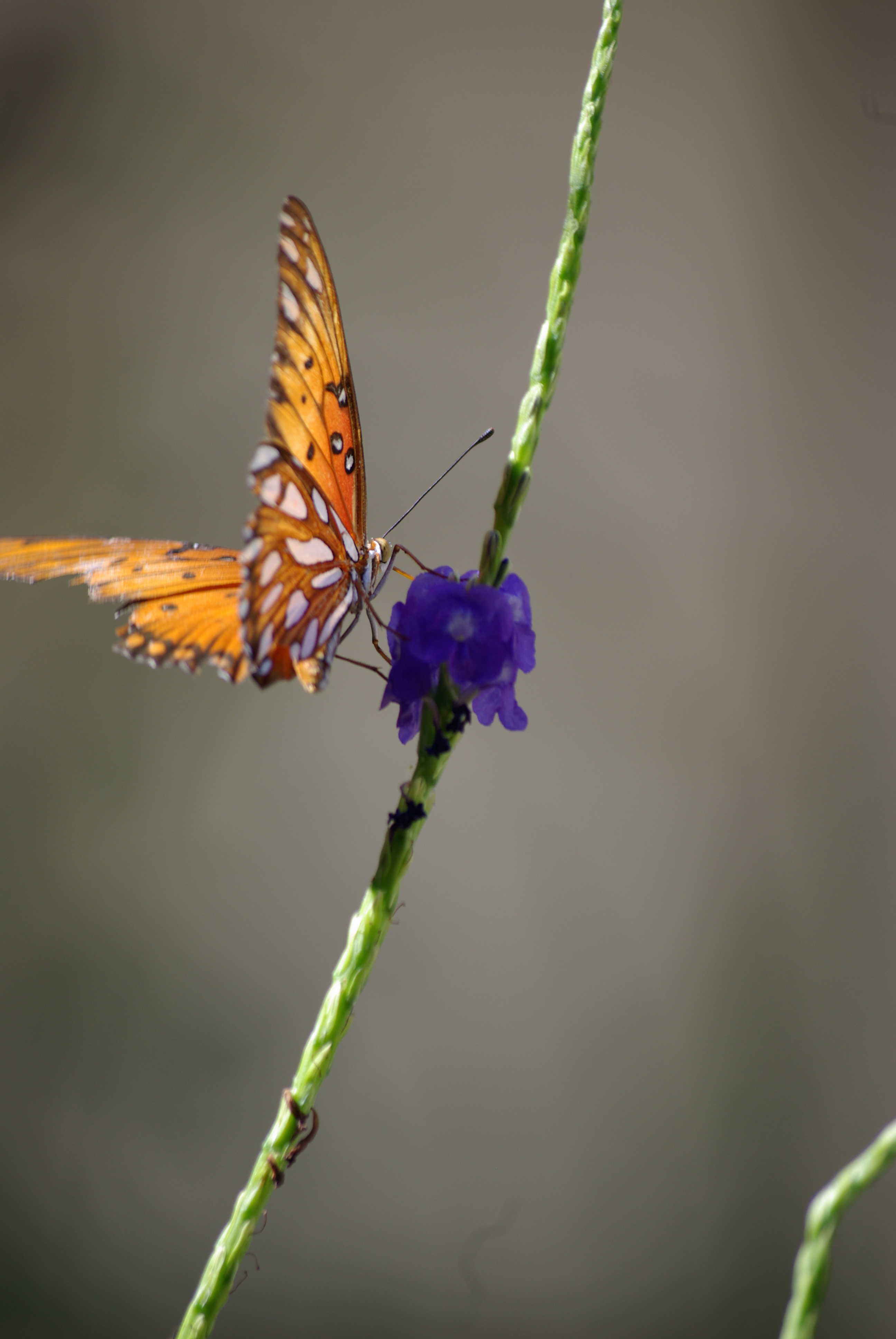
Gulf fritillary butterfly on blue porterweed, Dallas, Texas — photo by Ed Darrell — use free with attribution
A gulf fritillary (Agraulis vanillae (Linnaeus, 1758)) on blue porterweed, Stachytarpheta urticifolia, also known as blue rats tail, or nettleleaf velvetberry. Dallas, Texas, August 9, 2010.

This fritillary hung around for a few minutes.
Kathryn plants butterfly-attracting plants — a concept that was new to me when she introduced it at our home in Cheverly, Maryland, with several plants that acted like butterfly magnets, to my astonished delight. We first ran into the brilliant orange gulf fritillaries in 1988 or 1989 here in Dallas. For the past few summers, fritillaries have not been frequent visitors in our yard.
Kathryn stepped up the butterfly plantings this spring, including passion vine (Passiflora incarnata). The passion vine twines toward one of the bird feeders, but in the past week or so has been losing leaves — to caterpillars of the gulf fritillary, it turns out. Blue porterweed attracts all sorts of butterflies, but the fritillaries have been rather common, no doubt hoping to give their progeny a little boost with the passion vine, their favored food.
Butterfly afficianadoes in Dallas are urged to plant milkweed and butterfly bush to help the monarchs, whose populations are stressed by the recent cold winter, dramatic reductions in habitat, and destruction of their sanctuary trees in Mexico where they migrate each winter. But all butterflies could use some habitat help, I think. The rewards are great.
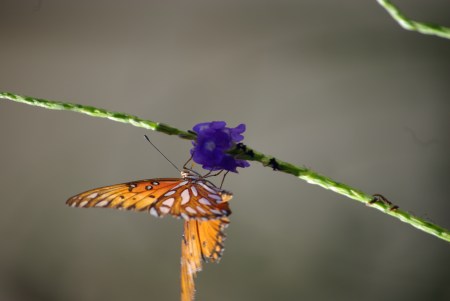
Gulf fritillary on blue porterweed, catching the morning sun

Butterfly plantings will attract butterflies, guaranteed. Gulf fritillary enjoys some blue porterweed nectar.
Spread the word; friends don't allow friends to repeat history.
 4 Comments |
  Entomology, Gardening, Natural history, Science | Tagged: Blue Porterweed, Botany, Butterflies, Entomology, Gardening, Gulf Fritillary, Life, Natural history, photography, Science |
  Permalink
 Posted by Ed Darrell
August 9, 2010
Quick quiz: Can you identify this Midwest American city?

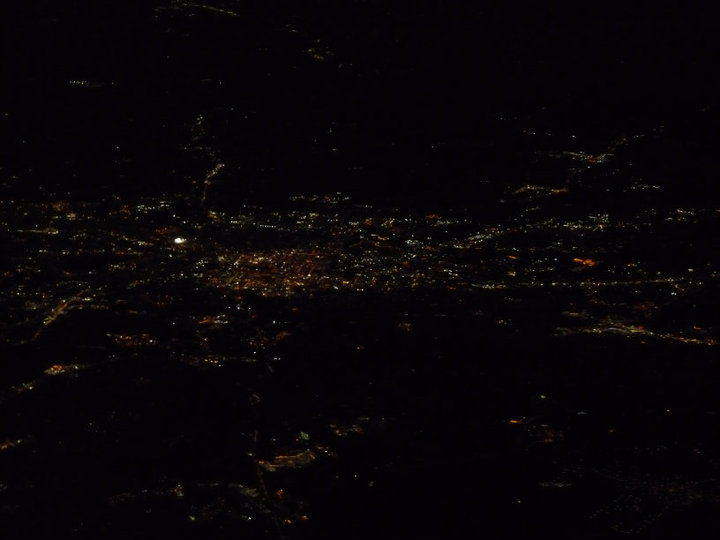
Can you identify the city shown in this photo? Photo by James Darrell, flying to DFW from ATL. (Click for larger view)
Can you identify this Midwest city? The photo was taken about an hour outside of DFW International, flying in from Atlanta Hartsfield. North in on the right side of the photo. My quick guess was Oklahoma City, but that was when I thought the departure city was Milwaukee (it could still be OKC).
Can you shed some light, and tell why you think it’s that city?
Night flying is cool. While I enjoy flying any time, I really enjoy the views from an airplane at night.
Somewhere in the trunk of film-that-may-one-day-be-digitized, I have several photos of smaller cities along the Wasatch Front in Utah, taken during campaigns and business trips in the 1970s and 1980s. At one time I had a list of the cities in the shots, but that list is long gone. I wonder whether I could identify those cities today?
Historically, it would be interesting, since most of those small towns now are sizable suburb cities.
Chicago lays out in an orange grid of glowing citrine gemstones at night. New York City dazzles from 2,000 feet, looking better than any movie you’ve ever seen, and glowing. Dallas presents a colored outline against the black sky when you come in for a landing (or Fort Worth, with more white lights, if you’re on the west side of the aircraft coming in). Salt Lake City sparkles and spreads up the mountains and canyons. St. Louis is neat rows of lighted pathways broken by the snaking Mississippi and Missouri Rivers. Washington, D.C. is a Shining City on a Hill spectacular when the weather is clear, coming down the Potomac River to National (now Reagan).
Which city is this one, above?


Spread the word; friends don't allow friends to repeat history.
4 Comments | Airplanes, Geography - Physical, Geography - Political, photography, Transportation, Travel | Tagged: Airplanes, Aviation, Flying, geography, Night Photography, photography, Travel | Permalink
Posted by Ed Darrell
July 6, 2010

Sculptor and conceptual artist Marcel Duchamp playing chess. Unknown photographer, via Concepts into Virtualities
Marcel Duchamp, according to Andrew Stafford:
Marcel Duchamp (1887-1968), the painter and mixed media artist, was associated with Cubism, Dadaism and Surrealism, though he avoided any alliances. Duchamp’s work is characterized by its humor, the variety and unconventionality of its media, and its incessant probing of the boundaries of art. His legacy includes the insight that art can be about ideas instead of worldly things, a revolutionary notion that would resonate with later generations of artists.
Also, he liked to play chess.

Marcel Duchamp with chess set designed by his friend, Max Ernst
The photograph at left comes from ChessMate.com:
. . . Marcel Duchamp, enjoying a chess set designed and presented to him by fellow artist, Max Ernst.
To say that Duchamp was an avid chess player would be an understatement. He played at approximately expert to master strength, and it is well known that he had — during the later part of his formidable career as a visual artist — given up the pursuit of art in favor of chess.
Here is an interesting quote about art and chess that is attributed to Marcel Duchamp:
“I am still a victim of chess. It has all the beauty of art — and much more. It cannot be commercialized. Chess is much purer than art in its social position.”
You will also want to see:
- “Half-naked Thursday: Eve Babitz with Marcel Duchamp,” at You Can Hire An Artist. Is it safe for work or school? The photo shows Duchamp in a gallery filled with his works at in 1963, playing chess with Eve Babitz, who is nude. (The museum is identified as the “Pasadena Art Museum,” which would be the Pasadena Museum of Art of California See the explanation from Kathleen Benton in comments; I think it more likely that the museum is the Norton Simon Museum, also in Pasadena, but showing much more modern art and European art. (The Pasadena Art Museum is wonderful, by the way — an outstanding place to spend an afternoon; the Norton Simon is one you must see in your lifetime.)
- “Not Wanting to Say Anything About Marcel,” by John Cage, at the Norton Simon Museum in Pasadena.
Spread the word; friends don't allow friends to repeat history.
5 Comments | Art, Chess, Museums, photography, Travel | Tagged: Art, Chess, Marcel Duchamp, Museums, Pasadena, photography, Surrealism, Travel | Permalink
Posted by Ed Darrell
July 6, 2010
No, literally. Well, okay, 36,000 people isn’t a tiny hamlet. Still, Duncanville, Texas, is a small town in many ways.
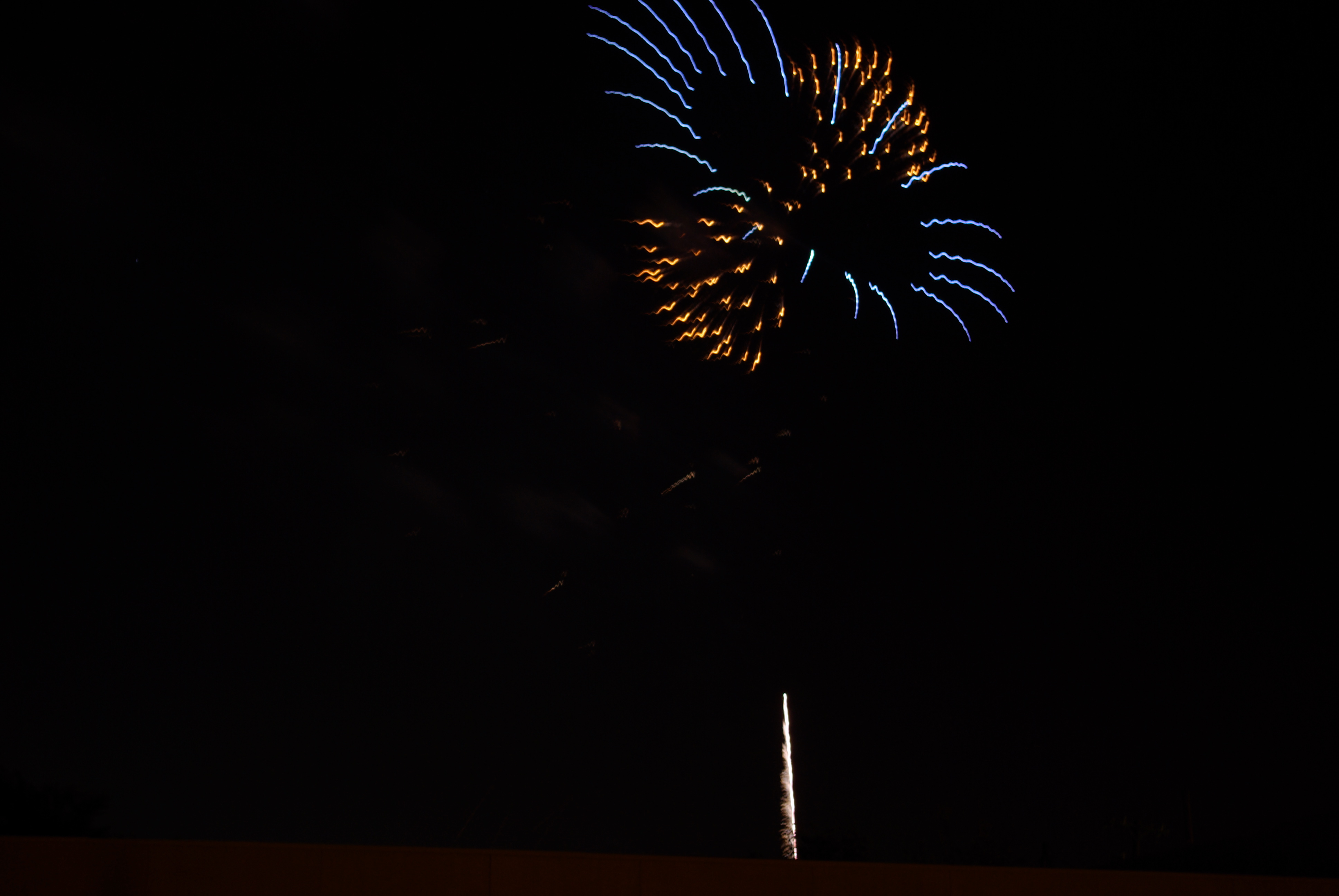
Nice fireworks show, nothing super spectacular. But enough for me to experiment with the digital SLR on capturing images. Lessons learned: Yes, the tripod is a must; a “cable release” is essential, too; to get good color, smaller aperture settings work best; exposures over a second work best.

Duncanville, Texas, Fireworks, July 4, 2010 - Big blue blossom
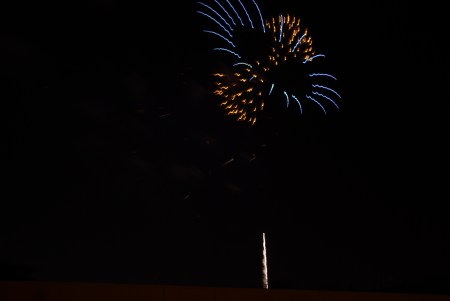
Duncanville fireworks - black hole at the center of a galaxy

Duncanville fireworks - a colored crown

Duncanville fireworks - a blue aster

Duncanville fireworks - four blossoms

Duncanville fireworks - were they trying to portray Cthulu?

Duncanville fireworks - multicolor burst
These are a few of the many shots I took — more successful than in past years (why didn’t I think of the tripod before?). Generally these are the most successful fireworks shots I’ve taken since that old Kodak Hawkeye FlashFun — was it that long ago? — at the Idaho Centennial.
I wonder where those pictures are now?
The idea is to get this down to where I can set up the camera and take shots while smiling at Kathryn, whose birthday is July 4, and who thinks fireworks are for watching, forget about the hassle of photography. She’s probably right.
Spread the word; friends don't allow friends to repeat history.
Leave a Comment » | 4th of July, photography | Tagged: 4th of July, Fireworks, Independence Day, photography | Permalink
Posted by Ed Darrell
July 3, 2010

Bob Dylan at the chessboard, Woodstock, New York, 1964 – low resolution version of the original photo, copyright by Daniel Kramer – Barbara Archer Galleries
A good decade before I got to Woodstock.
Daniel Kramer began photographing Bob Dylan early in Dylan’s career, making many of the best shots available.
This 1964 photo of Dylan playing chess in Woodstock, New York, featured in an exhibition of Kramer’s photographs put on by Barbara Archer Galleries in 2005.
From the exhibit’s biography of Kramer:
Daniel Kramer is a New York-based photographer and film director who is long recognized for his portraits and picture stories in national and international magazines and books. Shortly after opening his first studio in New York City, Daniel Kramer saw Bob Dylan perform The Lonesome Death of Hattie Carroll on television in 1964. Even after the show ended, Kramer couldn’t shake the image of Dylan from his mind. “I was completely taken by what this man had done and how he had done it. His performance was perfect. With simple, basic tools – his voice, a guitar, and a harmonica, he drove his message deep into my mind. I was aware that I was seeing a very important talent.”
In August 1964, after months of phone calls and letters to Dylan’s manager, Albert Grossman, Kramer was given the opportunity to arrange a portrait sitting in Woodstock, New York with the twenty-three-year old performer who was by then in the process of becoming an international star. The two men quickly developed a warm and trusting professional relationship that allowed for many extraordinary photographic sessions. “Photography has brought me into contact with many notable people, including Presidents of the United States, and I have happily had the opportunity to meet and talk with prominent people in all walks of life,” comments Kramer. “Although many of these encounters were memorable, my association with Dylan has a special meaning.”
Many of these photographs were first published in Kramer’s 1967 book bob dylan, the first major work about the performer-songwriter (reprinted as Bob Dylan: A Portrait of the Artist’s Early Years, 2001). They were also used on the album covers for Highway 61 Revisited (1965), Biograph (1985) and Bringing It All Back Home (1965), which was nominated for a Grammy and selected by Rolling Stone as one of the “100 Greatest Album Covers of All Time.” A number of rare and previously unpublished pictures by Kramer also appear in the 52-page booklet and packaging that accompanies Bob Dylan’s two-CD set, Live 1964: Concert at Philharmonic Hall – The Bootleg Series, Volume 6 (2004) and on the cover of a three-CD boxed set BOB DYLAN the collection (2004).
Daniel Kramer’s photographs have also been exhibited or collected by such museums as the Whitney Museum of American Art, The International Center of Photography in New York, The Smithsonian’s National Portrait Gallery in Washington, D.C., The Experience Music Project in Seattle, The Rock and Roll Hall of Fame and Museum in Cleveland, and in numerous national and international galleries.
An interesting three-way marriage of the young Bob Dylan, a great photographer in Daniel Kramer, and one of the world’s oldest and most respected games of skill, chess. Go see all the photos.
More:
Spread the word; friends don't allow friends to repeat history.
6 Comments | Art, Chess, History, History images, Music, photography | Tagged: Art, Barbara Archer Galleries, Bob Dylan, Chess, Daniel Kramer, History, Music, photography | Permalink
Posted by Ed Darrell
June 29, 2010

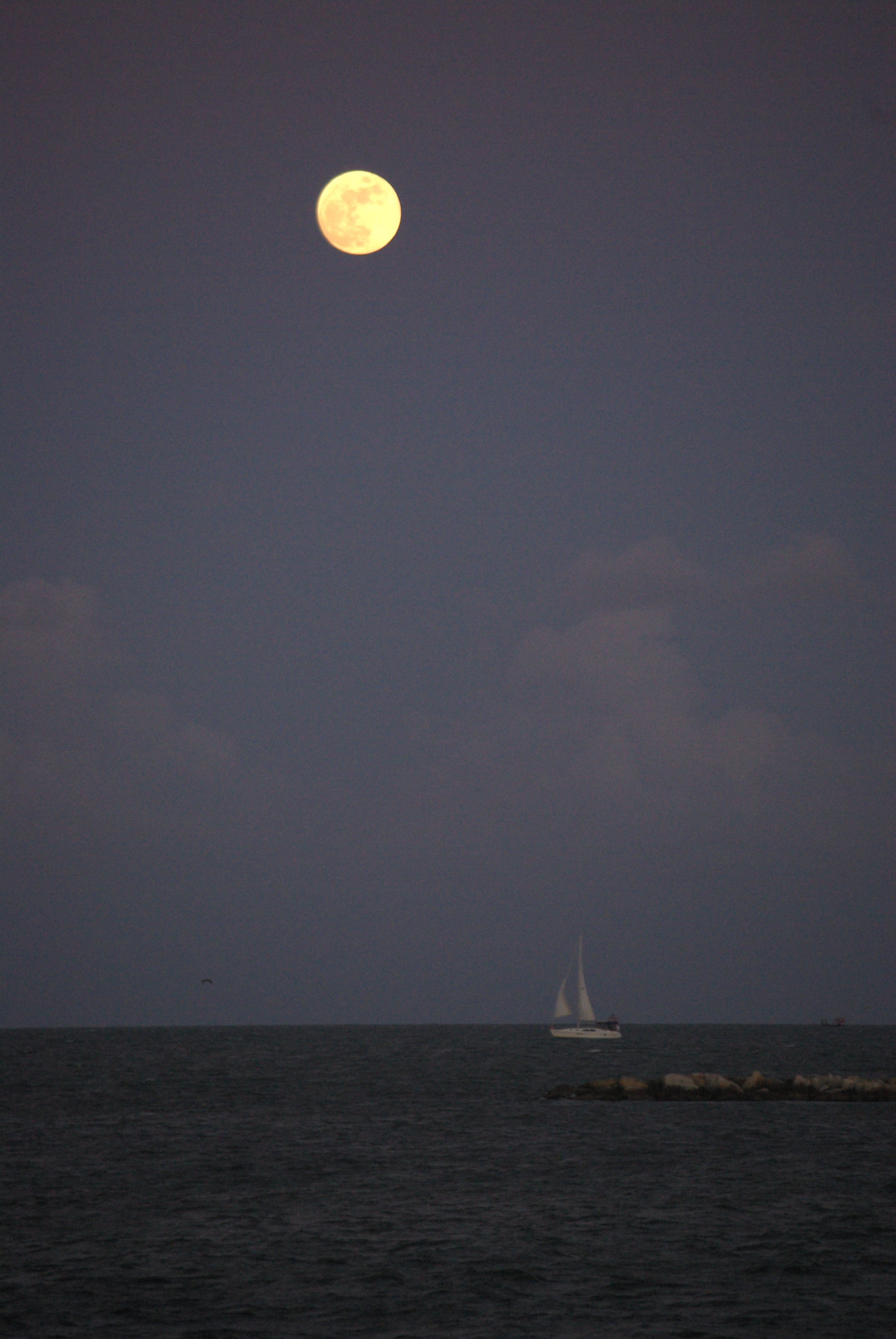
Moon over Corpus Christi Bay, June 25, 2010 - photo by Ed Darrell; use permitted with attribution
This is the scene that greeted delegates to the Texas Democratic Convention as they left the American Bank Center in Corpus Christi, Texas, at about 8:00 p.m. last Friday, June 25. (Natural light photo, handheld, 1/60th exposure at ISO 400)
The Moon was near full, and the tide was good for sailing.
Delegates had just heard Bill White accept the party’s nomination for governor.
In my brief period as a Sea Scout, I most enjoyed evening and night sailing. Water is astoundingly quiet at dusk and later, when sailing. In Corpus Christi I got a half-dozen shots and lamented I didn’t have a tripod, to get a better shot of the Moon.
Actually, the tide was on the way out at 8:00 p.m. — it had peaked about about 1:10. But it was still good for sailing.
I thought of Shakespeare:
There is a tide in the affairs of men
Which, taken at the flood, leads on to fortune;
Omitted, all the voyage of their life
Is bound in shallows and in miseries.
On such a full sea are we now afloat,
And we must take the current when it serves,
Or lose our ventures.
(Julius Caesar, Act IV.ii.269–276)
Spread the word; friends don't allow friends to repeat history.
2 Comments | Democratic Party, Elections, photography, Political conventions, Politics, Texas, Travel | Tagged: Corpus Christi, Corpus Christi Bay, Democratic Convention, Elections, Moon, photography, Political conventions, Politics, Sail Boat, Shakespeare, Texas, Tide in the affairs of men, Travel | Permalink
Posted by Ed Darrell
June 27, 2010
Amazing photo of two Chicago buildings struck by lightning simultaneously, by Chicago Tribune photog Chris Sweda:

Dual lightning strike in Chicago, June 2010 - photo by Chris Sweda, Chicago Tribune
Among other things, the photo isn’t perfect enough to suggest post-shutter-snap manipulation — you can see from other photos that the rain drops on the window disappear with a focus farther away.
Blair Kamin writing at Cityscapes discussed skepticism from readers of the Chicago Tribune about whether the strikes were really simultaneous, or instead the result of a very long exposure.
Exactly the sort of skepticism anti-warmists should have exhibited when confronted with the story of a fourth-grade student in Beeville, Texas, disproving global warming, or the story of a Spanish solar energy company sending a bomb by courier to an anti-warmist, and then bragging about it.
Kamin offers a couple of paths by which a reasonable person can determine it was a chance photo, the photographer pushing the shutter release coincidentally with a double lightning strike (see the “postscripts” section of Kamin’s post).
Were they true to their warming science, in the anti-warmist world two camps would be forming. One camp would argue the photograph was manipulated, a clever collage of two different photos, or maybe a clever use of miniatures; the other camp would argue that lightning doesn’t strike man-made objects.
Spread the word; friends don't allow friends to repeat history.
1 Comment | Climate change, climate_change, denialism, Global warming, History, How do we know what we know, photography, Science | Tagged: Chicago, Climate change, denialism, Global warming, Lightning, photography, Science, Skepticism | Permalink
Posted by Ed Darrell
June 24, 2010

Rachmaninoff Crater on Mercury, NASA photo

Click on the thumbnail image for a much larger version of the photo
News from NASA about a cool picture and feature on Mercury:
The International Astronomical Union (IAU) recently approved the name Rachmaninoff for an intriguing double-ring basin on Mercury. This basin, first imaged in its entirety during MESSENGER’s third Mercury flyby, was quickly identified as a feature of high scientific interest, because of its fresh appearance, its distinctively colored interior plains, and the extensional troughs on its floor. The basin’s name honors the Russian composer, pianist and conductor, Sergei Rachmaninoff (1873-1943).
IAU names craters on Mercury after “deceased artists, musicians, painters and authors who have made outstanding or fundamental contributions to their field and have been recognized as art historically significant figures for more than 50 years.” The process of proposing a new crater name includes gathering fundamental information about the crater, such as the crater’s central latitude, central longitude, and diameter. Justification is provided as to why the crater is of sufficient scientific importance to be named, and details are provided about the name choice, including sources that support the worthy contributions made by that individual. Ten newly named craters join 42 others named since MESSENGER’s first Mercury flybyin January 2008.
Image Credit: NASA/Johns Hopkins University Applied Physics Laboratory/Carnegie Institution of Washington
Tip of the old scrub brush to Eric Koenig.
Spread the word; friends don't allow friends to repeat history.
1 Comment | Astronomy, Music, photography, Science, Space exploration | Tagged: Art, Astronomy, Cool Stuff, Mercury, Music, photography, Rachmaninoff, Science, Space exploration | Permalink
Posted by Ed Darrell
June 16, 2010

Troop 1, Brownsville, Texas, May 20, 1916 - photo by Robert Runyon (The Center for American History and General Libraries, University of Texas at Austin; via American Memory, Library of Congress)
On June 15, 1916, President Woodrow Wilson signed the law granting a national charter to the Boy Scouts of America, which had been incorporated six years earlier. The charter is now encoded at 36 USC 309.
The purposes of the corporation are to promote, through organization, and cooperation with other agencies, the ability of boys to do things for themselves and others, to train them in scoutcraft, and to teach them patriotism, courage, self-reliance, and kindred virtues, using the methods that were in common use by boy scouts on June 15, 1916.
Good goals then, good goals now — maybe more important now.
Have you volunteered to be a leader?
Resources (and councils where I’ve Scouted and volunteered):
- National Council, Boy Scouts of America (BSA)
- Circle 10 Council, BSA (Dallas area)
- Wisdom Trail District (part of Circle 10, for Southwest Dallas County)
- Utah National Parks Council, BSA (Utah, south of Salt Lake County) (where I did most of my Scouting)
- National Capital Area Council, BSA (Washington, D.C. area) (where I was a Cubmaster)
- Great Salt Lake Council, BSA
- Snake River Council, BSA (serving the Magic Valley of Idaho, including Burley)
- BeAScout.org (help in finding a unit to join — but with a few glitches right now!)
- Troop 355, Duncanville, Texas (First Christian Church, Disciples of Christ, of Duncanville)
Tip of the old scrub brush to the Bill of Rights Institute on Facebook.

Click here for a larger view of the Troop 1 of Brownsville, Texas, in 1916
Click here for a larger view of a second photo of Troop 1 of Brownsville, Texas, in 1916
Spread the word; friends don't allow friends to repeat history.
1 Comment | Boy Scouts of America, History, History images, photography | Tagged: Boy Scouts of America, Circle 10 Council, History, History images, photography, Scouting's National Charter, Wisdom Trail District, Woodrow Wilson | Permalink
Posted by Ed Darrell
June 14, 2010
From the digital collections at the Library of Congress:

Boy Scout wreath, 1924 - Library of Congress Digital Collection, National Photo Company Collection (Call Number: LC-F8- 28581 (P&P))
Three Boy Scouts and a wreath with the BSA’s fleur de lis, in 1924. Who are the Scouts? What was the occasion? Questions we have in the centennial year of Boy Scouting.
This photo is in the middle of a collection of photos taken at the funeral of President Woodrow Wilson, which was on February 6, 1924. Was this the Boy Scouts’ tribute to Wilson? By the way, Wilson is the only president interred in the District of Columbia (Arlington National Cemetery is across the Potomac River, in Virginia). Wilson’s sarcophagus in in the main chapel of the National Cathedral.

Woodrow Wilson's tomb in the National Cathedral, Washington, D.C. - Wikimedia image
Spread the word; friends don't allow friends to repeat history.
Leave a Comment » | Boy Scouts of America, History, History images, Libraries, photography | Tagged: 1924, Boy Scouts, History, History images, Library of Congress, photography, Scouting Centennial | Permalink
Posted by Ed Darrell
June 9, 2010

"Hmmm. Sitting here, we might be able to catch a . . . FOUL BALL!" Click thumbnail for larger view
Kathryn scored some great seats, with great parking pass. Rangers ran away with the game, eventually, beat the Mariners 7-1.
Just after I took this panoramic shot, I thought I should put the camera away in case a foul ball should come our way.
And then it did. Fast!
I got a bruise on my left thigh where the little spinning devil first hit, but it spun away and bounced about three rows in back of us. On the way it took out the nachos of the guy next to us. Whoever got the ball probably got a cheesy surprise.
I have the bruise, but lost the ball.
Another surprise: The brätwursts down on the lower level of the Ballpark at Arlington are pretty good — not so good as the bräts at Miller Stadium in Milwaukee last June, but very good.
Spread the word; friends don't allow friends to repeat history.
Leave a Comment » | Baseball, Life, Personal, photography, Texas | Tagged: Baseball, Life, photography, Texas, Texas Rangers | Permalink
Posted by Ed Darrell
June 8, 2010

Moon over Hopper Ranch, by Amanda Holland
Kathryn’s cousin Amanda Holland writes from her great adventure helping to rescue the California Condor, with this photo of the Moon, behind clouds and haze, over the mountains, from Hopper Ranch.
Here’s where I feel the pangs of leaving biology behind for rhetoric, then politics and law. Probably the best part of research in biology was the places one had to go. The best adventures involve getting to and back from the places researchers must go to get data or samples.
And now, with electronic cameras and cards that will easily accommodate 1,000 photos, images are easy to capture.
Some of the images I wish I could get back: Moonrise over Shiprock*; the rattlesnake who liked to hide in the equipment box at the New Mexico Agriculture Experiment Station; the field of asparagus at the Experiment Station, poking up through the desert for the first time (I wonder if they decided to grow asparagus); thunderstorms at Shiprock and over Kimberly, New Mexico; sunrise in Huntington Canyon, Utah; looking nearly into Nevada through crystal air after a summer thunderstorm near Seeley Mountain. There are a lot more, really.
Adventures past: We remember them warmly. Getting out in the wild, doing the hard, grunt work necessary to learn about endangered species, or save them, or just improve conservation practices, is close to godliness, and among the greatest pleasures life can offer.
More:
- See this photo of Shiprock and Moon, probably by a photography named William Stone; this photo of Shiprock and storm, by Radeka, is good, too; at one time my job was to drive from Farmington, New Mexico, past the Shiprock everyday, to get air pollution samples. The Shiprock rivals Mt. Timpanogos in my personal pantheon of great mountains I grew up with.
Spread the word; friends don't allow friends to repeat history.
Leave a Comment » | endangered species, History, Natural history, photography, Science, Wildlife | Tagged: California, Condor Recovery, endangered species, Natural history, photography, Science | Permalink
Posted by Ed Darrell
April 2, 2010
Friday Fox will not be a regular feature — but, Wow! isn’t that a great photo?
Unless you’re the mouse.

Ron Charest photo of a red fox in the Bombay Hook National Wildlife Refuge (Delaware) - Defenders of Wildlife
Defenders of Wildlife called for entries for the 2010 wildlife and wilderness photography contest. They got more than 10,000 entries, and they’ve got the top 10. They want you to vote for the best one. The photo above is just one of the spectacular nominees.
I predict one of the photos featuring animals will win, but the wild lands photos are great, too.
You may vote for three. Voting ends Sunday, April 4, 2010.
Go see. Go vote
Spread the word; friends don't allow friends to repeat history.
1 Comment | Art, Environmental protection, National Wildlife Refuge, Natural history, Natural resources, photography, Wildlife, Zoology | Tagged: Art, Bombay Hook NWR, Defenders of Wildlife, Delaware, Environmental protection, Natural history, Nature, Photo Contest, photography, Red Fox, Ron Charest, Wildlife, Zoology | Permalink
Posted by Ed Darrell
February 28, 2010
 Really?
Really sad thing: This photo’s comic explanation is deeper and more accurate than the average creationist or other denizen of the Discovery Institute.
Tip of the old scrub brush to 9Gag.com.
Spread the word; friends don't allow friends to repeat history.
2 Comments | Evolution, Genetics, Humor, photography | Tagged: 9gag.com, Evolution, Genetics, Humor, photography | Permalink
Posted by Ed Darrell
January 30, 2010
Look at this stuff, at Pillar Post. Could your students do something like this for your town?

image by Bu Yourself, at Pillar Post
Students would have to find the old photos at the library, or at your local historical association or museum. Most of your students already have the electronic photo equipment though . . .
Just an idea.
Resources, and more:
Spread the word; friends don't allow friends to repeat history.
1 Comment | Education, History, History and art, History images, photography, Student projects | Tagged: Education, History, History images, photography, Student projects | Permalink
Posted by Ed Darrell










 Millard Fillmore's Bathtub
