Again: Why do we worry about global warming? It ain’t the climate, it’s the people

July 15, 2013

This is almost entirely an encore post, repeated for the benefit of the millions who missed it the first time who make fools of themselves when they argue we don’t need to save trees.  It’s not about trees.

Kids hiking in a forest. These are the humans environmentalists worry about, these four, and a few billion like them.  Photo from American Forests.

Kids hiking in a forest. These are the humans environmentalists worry about, these four, and a few billion like them. Photo from American Forests.

Alun Salt gave great advice about not bothering to engage idiots, pigs, denialists or trolls (here, among other places).  He said I should avoid lengthy answers to blogs that have little audience.

This is probably one of those occasions.

But in a running attempt to stimulate serious thought at a denialist blog, I got a question that has been rather common, and a question which indicates the deep serious misunderstanding denialists and even some well-meaning, overly-skeptical sensible people have:

Why worry about  climate change, since the climate is changing all the time?  Especially, why are people like Al Gore urging that we stop climate change, when CO2 has no great direct effect on human health?  Shouldn’t environmentalists be cheering climate change on, since it’s a “natural process?”

The answer is lost on the other blog, as Mr. Salt predicted it would be.  But since I’ve gotten some version of the question repeatedly in the last month, I may as well repeat the answer here, for the record.

The short answer to why we worry about climate change is that, as with almost all environmental protection, we are worried first about the quality of life of humans, and ultimately about the ability of human life to survive at all.

Here’s the question put to me there:

Ed I’m a little confused. I thought we were talking about the effect of co2 on the climate not the effect of co2 on human health. Co2 is not a toxic gas and would have no effect on human health. The fact that humans weren’t around when co2 was 10-20 times higher has absolutely nothing to do with its effect on climate.
Ed there was no runaway greenhouse effect [link added here] or climate catastrophe. The planet was fine during the phanerazoic. There is actually a lack of co2 in the atmopshere comapred to that time.

Here’s my answer, with a few more links than their format would allow:

No, you’re not a little confused.  You’re a lot confused, greatly misinformed, and not thinking hard.

We worry about CO2’s effects on climate only because we worry about the future of humanity.  Many of us who have children and wish them the same blessings of having children and grandchildren, have thought through the truth of the matter that we don’t possess and rule the Earth for ourselves, but instead act only as stewards for future generations.

No Earth, no humans; but at the same time, no habitable Earth, no humans.  In the long run, Earth doesn’t care.  It’ll do fine — without humans.

We can’t damage the planet.  We can only damage its habitability for humans.

I don’t know what sort of dystopian Randian future you and other Do Nothings hope for, but it’s a future contrary to human life, American values, and all known religions.

We’re talking about the future of humans.  I tell “skeptics,” “If you don’t care, butt out.  You’ll be dead in the short run anyway, but that’s no reason to stand in the way of action not to ensure a livable planet for our grandchildren.”

You also fail to understand chemistry, pollution, and how the world works.  CO2 is indeed a toxic gas.  For about a century now we’ve had indoor air standards that require air circulation to keep CO2 down below concentrations of about 500 5000 ppm [see comments], because at that level it starts to have dramatic effects on humans working.  It clouds their thinking and causes drowsiness.  CO2 is a conundrum, in that it is also necessary to trigger mammalian breathing.  If CO2 drops too low, we don’t take in enough oxygen and may pass out.  Too much oxygen in place of CO2 is a problem in that regard.  A substance can be both essential and a  pollutant, at the same time. (This has vexed food safety experts for years, especially after the 1958 Delaney Clause; substances we know to be essential nutrients can be carcinogenic, in the same concentrations, or in the same concentrations with a slight twist in chemical formula — how do we regulate that stuff?)

English: Main symptoms of carbon dioxide toxic...

Main symptoms of carbon dioxide toxicity (See Wikipedia:Carbon_dioxide#Toxicity). References: Toxicity of Carbon Dioxide Gas Exposure, CO2 Poisoning Symptoms, Carbon Dioxide Exposure Limits, and Links to Toxic Gas Testing Procedures By Daniel Friedman – InspectAPedia Davidson, Clive. 7 February 2003. “Marine Notice: Carbon Dioxide: Health Hazard”. Australian Maritime Safety Authority. Model: Mikael Häggström. To discuss image, please see Template talk:Häggström diagrams (Photo credit: Wikipedia)

CO2 is toxic in much greater proportions — it was a CO2 cloud that killed thousands in Cameroon 30 years ago or so, if you know history.

Clearly you did not know that we’ve regulated indoor CO2 for decades.  Clearly you haven’t looked at the medical journals‘ discussion on CO2 — and I’ll wager you’d forgotten the Cameroon incident, if you ever knew about it.

CO2 is a toxic gas (the dose is the poison); CO2 has dramatic effects on human health — too little and we die, too much and we die.

The fact that humans were not around when CO2 was much higher is exactly the point.  That was presented here, as it is in most venues, as support for a claim that we don’t need to worry about CO2 pollution.  Well, that’s right — if we don’t care about a habitable Earth.  But when CO2 was higher, life for humans was impossible.

I think it’s reckless to run an experiment on what would happen with higher CO2 levels, using the entire planet as a testing place, and testing the hypotheses on just how much CO2 will kill us all off, and how.

How about a control group, at least?

In the past, massive CO2 created massive greenhouse effects that would devastate us today — not as a toxic gas, but as a result of the warming that greenhouse gases do.

Let us understand the physical conundrum of CO2 here:  Without the greenhouse effect from the human-historic levels of CO2, this would be an ice planet.  Our lives today depend on the greenhouse effects of CO2.

Consequently, anyone who claims there is no greenhouse effect fails to understand physics, chemistry, biology and history.  (Heck, throw in geology, too.)  Life would be impossible but for the greenhouse effect.  Life is impossible without water, too, but you can’t live totally surrounded by water.

Can it be true that there can never be too much of a good effect, with regard to greenhouse gases?  Ancient Greek ideas of “all things in moderation” applies here.  We need a Goldilocks amount of CO2 in our atmosphere — not to much, not too little; not too hot, not too cold.

To the extent that higher CO2 levels didn’t produce a total runaway greenhouse effect, as some hypothesize exists on Venus, we know that was due to other feedbacks.  Early on, for example, CO2 began to be reduced by photosynthesizing life.  Animal life today would be impossible but for that occurrence.  Few if any modern chordates could breathe the very-low oxygen atmosphere of the early Earth, and live.  Those feedbacks and limiting situations do not exist today.

Greenhouse Effect

Greenhouse Effect. Wikipedia image

So now we face a double or triple whammy.  The reduction in CO2 in the air was accomplished through a couple billion years of carbon sequestration through plants.  In fact, a lot of carbon was sequestered in carbon-rich fossils, stuff we now call coal and oil.  Oxygen replenishment was accomplished with massive forests, and healthy oceans, with a great deal of photosynthesis.  This created a rough CO2 equilibrium (with fluctuations, sure) that existed we know for at least the last 50,000 years, we’re pretty sure for the last 100,000 years (we know that from carbon-dating calibration exercises).

Today we have removed fully 30% of the forests that used to replenish oxygen and lock up a lot of CO2 (some estimates say 50% of the forests are gone); modern plant communities cannot pluck CO2 out fast enough.  Plus, we’re releasing a lot of that old, sequestered carbon in coal and oil — at rates unprecedented in human history.

Will more CO2 warm the planet?  We know from the fact that the planet is warm enough for life, that more CO2 will warm the planet more.  Anyone who says differently does not know physics and chemistry, nor history.

Is there anything that can stop that effect?  Sure — healthy, massive forests, and healthy oceans.  Reducing carbon emissions could help a lot, too.  But we’re committed for about a century.  CO2 in the atmosphere doesn’t fall to the ground like particulate pollution.  it drifts until it is incorporated into something else, either through photosynthesis or other chemical reactions.  It takes a mole of CO2 a couple of centuries to come out of the air.  We’re stuck with elevated and elevating CO2 regardless our actions, for a century or two, even if we are wildly successful in reining in emissions and creating sequestration paths.

What happens when CO2 levels get higher than 350 ppm?  History, physics and chemistry tells us glaciers will melt, rainfall patterns will alter dramatically, sea levels will rise, carbon will be absorbed by the seas in increasing amounts (causing acidification — simple chemistry).  [See the counter in the right column of this blog; by July 2013, CO2 temporarily climbed above 400 ppm in a spike, and rested dangerously close to 400 ppm constantly.]

It’s a very exciting experiment.  The entire human race is at stake. How much CO2 will it take to produce the effects that kill us all?  It’s likely that changing rainfall patterns and rising sea levels will produce wars over resources, long before CO2 itself starts being physically toxic.  That’s what the Pentagon’s big thinkers say.  That’s what the Chinese big thinkers say, which is why they are working to reduce emissions even without an enforceable treaty.

As experiments go, I think it’s immoral to use humans in experimentation without getting their consent, and without passing the entire experiment through the Institutional Review Board to make sure the experiment is useful, necessary, and done ethically.

Do you have those consent statements?  All seven billion of them?  Have you got approval from the research overseers of the institution?

If you don’t have permission to proceed with this progeny-killing experiment, why do you propose to proceed?  Many people believe that, if the courts on Earth don’t get us, a higher court will.

How will you plead wherever the call to justice is delivered?

More:


Epic political cartoons: Steve Benson on GOP and women’s rights

July 14, 2013

Hard to believe this cartoon was published back in May.

Steve Benson cartoon for the Arizona Republic, May 10, 2013:

Steve Benson cartoon for the Arizona Republic, May 10, 2013: “Speaking of holding women in captivity . . .”


Apparently the Texas Lege thought it was a model for action, and not a ridiculing of their ideas.

More:


About Florida

July 14, 2013

I don’t know.  It seems a little extreme.

But I don’t see anybody trying to stop Bugs.  Bugs Bunny, Florida, Zimmerman Trial, Stand Your Ground

Bugs Bunny deals with Florida

Undoubtedly copyrighted by Warner Bros. This is fair use. Thanks to Coyote Crossing.

Tip of the old scrub brush to Chris Clarke at Coyote Creek.

More:

A depiction of Bugs Bunny's evolution through ...

A depiction of Bugs Bunny’s evolution through the years. Regardless how Bugs looks, he usually reflects some of the more popular views of the day. Wikipedia image


Doubt climate change? Here, have a cigarette . . .

July 9, 2013

Colorado River runs dry, Peter McBried, Smithsonian

From Smithsonian Magazine: The Colorado River Runs Dry A boat casts a forlorn shadow in a dry river channel 25 miles from the river’s historical end at the Gulf of California. Photo by Peter McBride (Go see the entire slide show; spectacular and troubling images)

As John Mashey has been quietly but consistently warning us for some time . . .

From ClimateRealityProject.org:

Join us and stand up for reality. http://climaterealityproject.org – This film exposes the parallels between Big Tobacco‘s denial of smoking’s cancer-causing effects and the campaign against the science of climate change — showing that not only are the same strategies of denial at work, but often even the same strategists.

If you watched that all the way through, odds are high you’re not a denier.  If you can’t watch it, you really should think about it, hard.

More, and useful resources:


Annals of global warming: Arizona wildfires 2013 and “the new normal”

July 6, 2013

A burned home is seen in an unidentified neighborhood west of Highway 89 in Yarnell, Arizona July 3, 2013. Reuters

A burned home is seen in an unidentified neighborhood west of Highway 89 in Yarnell, Arizona July 3, 2013. Reuters, via International Business Times

From a much longer story you should read by Felicity Barringer and Kenneth Chang  in The New York Times, Tuesday, July 2, 2013, page A13 of the National Edition:

Since 1970, Arizona has warmed at a rate 0.72 degrees per decade, the fastest among the 50 states, based on an analysis of temperature data by Climate Central, an independent organization that researches and reports on climate. Even as the temperatures have leveled off in many places around the world in the past decade, the Southwest has continued to get hotter.

“The decade of 2001 to 2010 in Arizona was the hottest in both spring and the summer,” said Gregg Garfin, a professor of climate, natural resources and policy at the University of Arizona and the executive editor of a study examining the impact of climate change on the Southwest.

Warmer winters mean less snowfall. More of the winter precipitation falls as rain, which quickly flows away in streams instead of seeping deep underground.

The soils then dry out earlier and more quickly in May and June. “It’s the most arid time of year,” Dr. Garfin said. “It’s windy as well.”

The growing season also starts earlier, so there is more to burn.

“The fire season has lengthened substantially, by two months, over the last 30 years,” said Craig D. Allen, a research ecologist at the United States Geological Survey station at Bandelier National Monument in New Mexico.

The fire potential is exacerbated by the past policy, beginning around 1900, of putting out all fires. Fires are a natural way of clearing out the underbrush. With that natural rhythm disrupted, the flammable material piled up, so when it did catch fire, it ignited a giant fire that burned hotter and wider.

This total-suppression policy began to ease as early as the 1950s, when scientists began to see fire’s role in ecosystems. It was completely abandoned nearly two decades ago.

But in the 1970s, the Southwest entered a wet period, part of a climate cycle that repeats every 20 to 30 years. “That wet period helped keep a lid on fires,” Dr. Allen said. “And it also allowed the forests to fluff up.”

Since 1996, the climate pattern, known as the Pacific decadal oscillation, has swung to the dry end of the spectrum, and the region is caught in a long-term drought.

Stephen J. Pyne, one of the nation’s leading fire historians and a professor at Arizona State University, said, “How we live on the land, what we decide we put on public and private lands, how we do things and don’t do things on the land, changes its combustibility.”

In many landscapes, he added, “you’ve enhanced the natural combustibility” by building hundreds of thousands of homes in fire-prone areas, and for years suppressing natural fires, allowing a buildup of combustible materials like the “slash” debris left behind by logging.

The article explains how this is the dry phase of the Pacific Decadal Oscillation; so we can hope the wet phase will be wet enough to suppress fires.  However, the simple fact of additional effects brought on by PDO does not mean warming goes away when the PDO switches phases.  Note especially the lengthening fire season over three decades; incrementally, warming is making these well-known cycles, warmer, and too often, destructive or more destructive.

More: 

Sign welcoming visitors to Yarnell, Arizona:

Sign welcoming visitors to Yarnell, Arizona, with wildfire in the background: “Elevation 4,850 ft., ‘Where the desert breeze meets the mountain air.'” Sedonaeye.com image


English: Monthly values for the Pacific decada...

Monthly values for the Pacific decadal oscillation index, 1900 – 2010 Black line:121-month smooth Data source: http://jisao.washington.edu/pdo/PDO.latest (Photo credit: Wikipedia)


One more time: Basic climate science with Bill Nye

July 4, 2013

What year is this? 2013?

Shouldn’t the Sputnik Revolution in science education have obviated the need for this video, like 30 years ago?

One more time, the basics of climate change/global warming, with Bill Nye the Science Guy explaining; from the ClimateRealityProject.org:

http://vimeo.com/climatereality/climate101

climate change, CO2, global warming, science, Bill Nye, environmental protection, Clean Air, Air Pollution

More:

Newsweek, March 4, 1957,

Cover of Newsweek Magazine, from March 4, 1957; notice this concern about U.S. science competency came seven months before Sputnik was launched by the Soviet Union. Science deniers then delayed action until after the Soviets demonstrated clearly that the U.S. was behind. (Image from Computer History.org)


Amazon haiku to Sen. Wendy Davis’s pink Mizuno shoes

June 27, 2013

(Yes, you’re right — the shoes are red, not pink.)

Texas State Sen. Wendy Davis‘s filibuster so insinuated itself into our culture already that it is now a part of shoe reviews at Amazon.com:

Mizuno running shoes for sale at Amazon.com -- the same shoes Sen. Wendy Davis wore during her filibuster on June 25, 2012.

Mizuno running shoes for sale at Amazon.com — the same shoes Sen. Wendy Davis wore during her filibuster on June 25, 2012.

Customer Review


147 of 150 people found the following review helpful

5.0 out of 5 stars SHOES HAIKUS, June 27, 2013

By

mistersnoid “mistersnoid”

This review is from: Mizuno Women’s Wave Rider 16 Running Shoe (Apparel)

Wendy wore these, and
she wasn’t even running.
Here’s hopes she soon will!

Standing and talking,
one needs a lot of support.
You have all of ours.

More:

Mizuno's red running shoes, worn by Texas Sen. Wendy Davis.  Image from Outside the Beltway

Mizuno’s red running shoes, worn by Texas Sen. Wendy Davis. Image from Outside the Beltway


Got questions about ObamaCare? Check out this site

June 24, 2013

I get e-mail; this one may prove useful to more than a few people, especially anyone who owns a small business and has questions about how ObamaCare — the Affordable Care Act — will affect your taxes, your hiring, your expenses, etc.:

The White House, Washington

Hi, all —

In fewer than 100 days, the new health care reform law takes an important step forward. On October 1, 2013, Health Insurance Marketplaces will open in every state, and millions of Americans will be eligible to apply for coverage. Between now and then, we’re sure that lots of people will be looking for information about the upcoming changes.

That’s why we revamped HealthCare.gov.

On the updated site, you’ll be able to get a personalized list of coverage options, tailored to your situation, and a checklist to help prepare for October 1. You’ll find a rich set of answers to frequently asked questions, powerful search features to help you find the specific information you need, and two great ways to talk to customer service representatives, 24/7: a new 1-800 number (1-800-318-2596) and online chat.

When open enrollment starts on October 1, 2013, you’ll be able to use the site to compare various health care plans side by side to find a plan that fits your life and your budget. You’ll even be able to use HealthCare.gov to apply for coverage or be directed to your own state’s application portal.

We hope you’ll use the site to get answers to your questions about the health care law — and forward this email to your friends so they can do the same.

Thanks!

Tara

Tara McGuinness
Senior Communications Advisor
The White House

P.S. — Have questions about what else you can expect from health care reform? Click here for a timeline of the key features of the Affordable Care Act.

Visit WhiteHouse.gov

[My e-mail address cut out ]

The White House • 1600 Pennsylvania Ave NW • Washington, DC 20500 • 202-456-1111

Several people I’ve run into have questions about the program — some of the questions are serious, and difficult for me to answer, and some are silly (“Why do I have to give up my insurance now?” Answer:  You don’t.)  There’s a great need for answers.  Distortions of the plan from the nasty political fights involved, have taken hold in the mind of many as representations of what the plan weill do.

Go try the site.  Does it answer your questions?  What questions do you have that are not answered by this site?

More:

Screenshot of HealthCare.gov. Click to visit the site.

Screenshot of HealthCare.gov. Click to visit the site.


Time to raise the minimum wage

June 21, 2013

Illustration for Bloomberg News by Rand Renfrow: $15 Minimum Wage

Illustration for Bloomberg News by Rand Renfrow: $15 Minimum Wage

Robert Reich put it succinctly at his Facebook site [links added here]:

Nick Hanauer, one of the nation’s most successful businessmen, proposed yesterday that the minimum wage be raised to $15 an hour. But wouldn’t that cause employers not to hire workers who were “worth” less, and thereby lead to higher unemployment? No, says Hanauer. By putting more money into the hands of more people, it would stimulate more buying — which would generate more jobs than any jobs that might be lost. Hanauer understands that the basic reason the economy is still limping along is workers are consumers, and workers continue to get shafted, which means consumers lack the purchasing power to get the economy off the ground. A minimum wage of $15 an hour, combined with basic worker standards such as paid sick leave and a minimum of 3 weeks paid vacation per year, should all be in a national campaign for better jobs and a better economy in the 2014 election.

That’s the case, in brief.

Last March Reich said raising the minimum wage to $9/hour was a “no brainer.”

Alas, he didn’t account enough for the anti-brain lobby.

What do you think?

More:

Also good, an update:


How about another cup of coffee? (Global Warming Conspiracy and Starbucks Cup #289)

June 19, 2013

Encore post from September 17, 2007, and August 2009 — maybe more appropriate today than ever before.

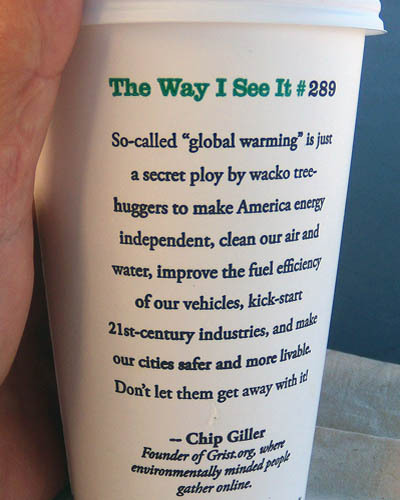
Found this on my coffee cup today (links added here):

The Way I See It #289

So-called “global warming” is just

a secret ploy by wacko tree-

huggers to make America energy

independent, clean our air and

water, improve the fuel efficiency

of our vehicles, kick-start

21st-century industries, and make

our cities safer and more livable.

Don’t let them get away with it!

Chip Giller
Founder of Grist.org, where
environmentally-minded people
gather online.

Starbucks Coffee Cup, The Way I See It #289 (global warming)

Look! Someone found the same cup I found!

I miss those old Starbucks cups — but then, they killed the Starbucks in our town.  I don’t buy the 100 cups of Starbucks coffee I used to get in a year.

More:

Save


ObamaCare in 90 seconds – from nurses, so you know it’s right

June 18, 2013

Nurses attend signing ceremony

Nurses attended the  signing ceremony for the Affordable Care Act. Photo: flickr.nurse;

Tired of the distortions of ObamaCare all over Facebook, blogs, and Twitter?

Need a quick summary to give your obnoxious brother-in-law something to think about, without seeming rude?

Here, in 90 seconds, a bunch of nurses go over the basics:

Who did this video?

Wondering what the Affordable Care Act can do for you and your family? Check out what nurses have to say about the benefits of the healthcare law and then share this video with friends, family and co-workers!

* HealthLawBenefits.org is a joint campaign of SEIU, the Nurse Alliance of SEIU and 1199SEIU.

Tip of the old scrub brush to the BlueStreet Journal.

More:


Do Nothing GOP Congress

June 13, 2013

Poorly-attended hearing of Congressional Joint Economic Committee hearing on jobs, 2013

“Do Nothing Congress?” How about “Missing in Inaction Congress?” Photo and caption from National Journal: When the Joint Economic Committee’s hearing on fixing the nation’s long-term unemployment problem kicked off on April 24, only one lawmaker was in attendance: Sen. Amy Klobuchar, the committee’s vice chair who was holding the hearing. (Niraj Chokshi)

National Journal’s article fairly damns Congress and especially the House for doing very little this year about jobs.

Probably more damning is this little fact:  In a period of time that historically might see 50 or 100 laws passed, Congress has passed into law only 13 measures.  The “Do Nothing” 80th Congress Truman campaigned against passed nearly 900 laws.  The current Congress is on track to pass 52.  Most important, probably, are the authorization and appropriations bills for the different departments of the federal government, much more important than the non-binding budget resolutions conservatives whine about.  Republicans have successfully blocked almost all authorization and appropriations action.  Appropriations bills, of course, must originate in the GOP-shackled House of Representatives.

In the six months and four days since the 113th Congress began, it has passed 13 laws. And, despite lawmakers constantly beating the drum on boosting jobs, none of the new measures have been focused on employment. Here’s a list of what the 113th Congress has passed in its first six months:

  1. H.R.41: To temporarily increase the borrowing authority of the Federal Emergency Management Agency for carrying out the National Flood Insurance Program.
    Sponsor: Rep Garrett, Scott [NJ-5] (introduced 1/3/2013) Cosponsors (44)
  2. H.R.152: Disaster Relief Appropriations Act, 2013
    Sponsor: Rep Rogers, Harold [KY-5] (introduced 1/4/2013) Cosponsors (None)
  3. H.R.325: No Budget, No Pay Act of 2013
    Sponsor: Rep Camp, Dave [MI-4] (introduced 1/21/2013) Cosponsors (1)
  4. S.47: Violence Against Women Reauthorization Act of 2013
    Sponsor: Sen Leahy, Patrick J. [VT] (introduced 1/22/2013) Cosponsors (61)
  5. H.R.307: Pandemic and All-Hazards Preparedness Reauthorization Act of 2013
    Sponsor: Rep Rogers, Mike J. [MI-8] (introduced 1/18/2013) Cosponsors (5)
  6. H.R.933: Consolidated and Further Continuing Appropriations Act, 2013
    Sponsor: Rep Rogers, Harold [KY-5] (introduced 3/4/2013) Cosponsors (None)
  7. S.716: A bill to modify the requirements under the STOCK Act regarding online access to certain financial disclosure statements and related forms.
    Sponsor: Sen Reid, Harry [NV] (introduced 4/11/2013) Cosponsors (None)
  8. H.R.1246: District of Columbia Chief Financial Officer Vacancy Act
    Sponsor: Rep Norton, Eleanor Holmes [DC] (introduced 3/19/2013) Cosponsors (None)
  9. H.R.1765: Reducing Flight Delays Act of 2013
    Sponsor: Rep Latham, Tom [IA-3] (introduced 4/26/2013) Cosponsors (None)
  10. H.R.1071: To specify the size of the precious-metal blanks that will be used in the production of the National Baseball Hall of Fame commemorative coins.
    Sponsor: Rep Hanna, Richard L. [NY-22] (introduced 3/12/2013) Cosponsors (2)
  11. H.R.360: To award posthumously a Congressional Gold Medal to Addie Mae Collins, Denise McNair, Carole Robertson, and Cynthia Wesley to commemorate the lives they lost 50 years ago in the bombing of the Sixteenth Street Baptist Church, where these 4 little Black girls’ ultimate sacrifice served as a catalyst for the Civil Rights Movement.
    Sponsor: Rep Sewell, Terri A. [AL-7] (introduced 1/23/2013) Cosponsors (301)
  12. H.R.258: Stolen Valor Act of 2013
    Sponsor: Rep Heck, Joseph J. [NV-3] (introduced 1/15/2013) Cosponsors (127)
  13. S.982: Freedom to Fish Act
    Sponsor: Sen Alexander, Lamar [TN] (introduced 5/16/2013) Cosponsors (3)

Freedom to Fish Act?  No doubt it is important to someone.  But even that someone, or those somebodies, would benefit from a jobs bill, more than from the Freedom to Fish Act.

When I worked for Lamar Alexander, I found him to be among the more fair and forward thinking of elected politicians.  It’s good to see he can still move a bill.

It’s tragic he’s been unable to push the GOP to move on more important matters.

The “Do-Nothing Congress” Harry Truman successfully indicted in 1948 looks like Wilma Rudolph streaking over the finish line in the 1960 Rome Olympics, by comparison.

I recall sitting up to get the news out to Utah, and anyone else interested in the nation, when Congress would pass 13 laws in a night.  At no point did it occur to me to think “these are the good old days of America,” then.

More:

taken by yours truly during 2007 hof induction...

Baseball Hall of Fame on Induction Weekend, 2007, crowded with people who now need jobs.  Congress passed a bill dealing with the Baseball Hall of Fame.  Ironic, no? All inductees in Cooperstown got there by doing something, doing it with hustle, and doing a lot, a sharp contrast to the 2013-2014 U.S. Congress.  Wikipedia image


Seen on the street: Where do gays come from?

June 11, 2013

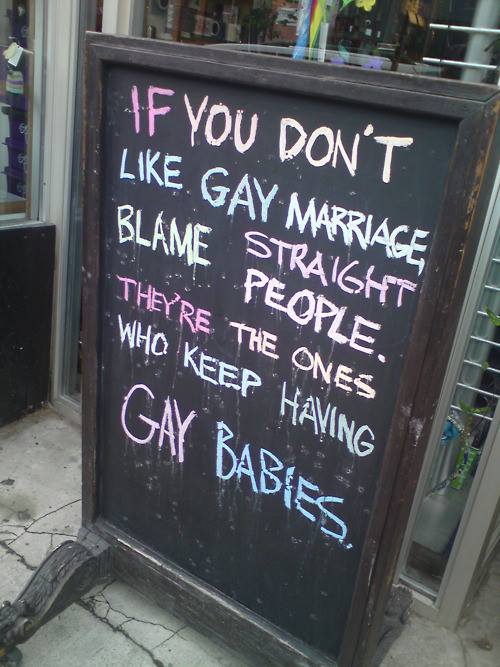
Gay babies from straight couples street sign

Photo from George Takei’s Facebook page; can anyone tell us who took the photo?

From George Takei’s Facebook page.

Sign on the street said, “If you don’t like gay marriage, blame straight people.  They’re the ones who keep having gay babies.”


Moral Monday in Raleigh, North Carolina

June 11, 2013

Unidentified pProtester Thierry Wernaers in Raleigh, North Carolina,  in photo by an unnamed photographer:

Protester in Raleigh, North Carolina, on Moral Monday, June 11, 2013

Protester Thierry Warnaers in Raleigh, North Carolina, on Moral Monday, June 11, 2013; photographer unidentified

Love that sign:  OMG/GOP/WTF?

Tip of the old scrub brush to Devona Wyant. Thanks to Thierry Warnaers for writing in to identify himself (see comments).

More, but not all:


Words most abused by the right

June 5, 2013

Morgan Freeberg had a great idea, but mislabled it.  I’ve started a corrected list here, below.  More corrections will need to be made, and a few additions will be in order.  I already added a tiny handful.  To start out all the links go to Morgan’s site, so I can’t vouch for any of his definitions.  Feel free to suggest explanatory links for any work or phrase, in comments.

First draft,”Words Most Abused by the Right”:

  1. Tolerance

    Tolerance t-shirt design from Northern Sun

    Tolerance t-shirt design from Northern Sun; t-shirt will certainly tick off members of the Right Wing.

  2. Fairness
  3. Equality
  4. Vote
  5. Democracy
  6. Capitalism
  7. Free market
  8. Economics
  9. Jobs
  10. Family
  11. Marriage
  12. Contraception, and Family Planning
  13. Inclusion
  14. Science
  15. Open-minded
  16. Egalitarian
  17. Stereotype
  18. Oppressive
  19. Non-threatening
  20. Diversity
  21. Everyone
  22. Skeptic
  23. Nuance
  24. Progressive
  25. Constitution
  26. History
  27. Science
  28. Religion
  29. Environment
  30. News
  31. Journalism
  32. Hate speech
  33. Tea Party
  34. Abuse
  35. Torture
  36. Greed
  37. Assault (weapon/rifle/gun)
  38. Wealthy
  39. Any tangible noun that ends with “ist,” or intangible noun that ends with “ism.”
  40. Undocumented
  41. Working (family)
  42. Worker
  43. Labor
  44. Right(s)
  45. Ethical
  46. Transparent(cy)
  47. Landmark
  48. Theocracy
  49. Common sense
  50. Safety
  51. Fascist/ism
  52. Communist/ism
  53. Socialist/ism
  54. Mainstream
  55. Forward

Morgan also “cross-posted” his list at House of Eratosthenes and Right Wing News.  Hilarity ensues, I’m sure.