Issues you haven’t heard discussed in the campaign, 3: Clinton on national service

November 5, 2016

Part 3 of a series, listing policy issues we’ve heard too little about during this presidential campaign.

This is borrowed wholesale from the campaign website for Hillary Clinton (unless otherwise noted), just to try to get a little discussion going on the real issues of the campaign.

Millard Fillmore’s Bathtub is working on a series of issues not yet discussed, less than a week before the vote. Consider it public service, in the spirit of Fillmore, who remained ever conversant in public affairs and anxious to take a role to push for policies to improve America, as he saw it — and who, supported by his wives, founded the White House Library, the Buffalo and Erie County Historical Society, and the University of Buffalo (now SUNY-Buffalo) to further knowledge.

Beyond a military draft, which few people want in an era of a very successful all-volunteer military, should we ask more of our young people, ask them to serve the nation? How would such a scheme work?

Clinton’s policy paper introduction on national service:

There aren’t many places where people of all ages, all races, all backgrounds, all beliefs come together in common cause. But service is one of them, and that’s one of the reasons I think it’s so valuable, because in addition to the good work it does, it helps us reconnect with each other to feel more a part of our shared American life. I believe that one of the jobs of president is to encourage more service … .

Hillary, September 30, 2016

The generation of Americans coming of age today has changed our politics and our country. From racial justice and marriage equality to economic opportunity and climate change, they have put key issues at the top of the national agenda. Hillary Clinton believes we must do more to support activism and create pathways for Americans to serve and to lead.

As president, Hillary will:

  • Expand national service. Hillary will create more opportunities for Americans to participate in national service, creating economic and educational opportunities while improving communities. She will significantly expand AmeriCorps to allow hundreds of thousands of more Americans to serve their communities through organizations such as City Year, YouthBuild, American Red Cross, Habitat for Humanity, and other community organizations. To achieve this, Hillary will grow AmeriCorps to 250,000 members annually, fulfilling the goals of the Edward M. Kennedy Serve America Act. And she will create a National Service Reserve to enable millions of Americans across the country to engage in part-time volunteer service to their communities, taking on the most pressing challenges identified by state and local leaders and earning recognition for their contributions. Read more here.
  • Increase access to higher education. Hillary believes that if you serve your country through national and community service, you should be able to earn meaningful educational benefits. Her New College Compact will build on the current AmeriCorps Segal Education Award, on top of her plans to make debt-free college available to all by doubling the Segal Award and making it tax-free so that AmeriCorps members can earn more than $10,000 for college for every year of full-time service.
  • Strengthen international service. As secretary of state, Hillary saw firsthand the impact that Peace Corps Volunteers have around the world. That’s why, as president, she will continue to be a strong advocate for the Peace Corps. She will strengthen the program to provide more opportunities to send Americans abroad to work side by side with local leaders and address our most pressing global challenges.
  • Bring Americans together. Hillary strongly believes in the power of service to break down barriers by bringing together Americans from all backgrounds and uniting them in common purpose. She will ensure that national service remains at the top of her agenda as a broad-based solution to expand opportunity for people across America and strengthen our communities and our country.

Hillary has a strong record of supporting national service:

  • As first lady, Hillary advocated for Congress to reauthorize AmeriCorps so that tens of thousands more Americans would have opportunities to learn “how much more we get when we give.”
  • As senator, Hillary fought to protect AmeriCorps from budget cuts, and in 2003 stood alongside 150 mayors and governors in requesting funding to secure and grow the program. She also co-sponsored a bill to base AmeriCorps Education Award on the average public college tuition as a way to reduce student debt and allow more Americans to attend college in a time of rising costs.
  • As secretary of state, Hillary re-established the Peace Corps’s relationship with Indonesia after a 45-year hiatus. The first program in 2010 sent 19 volunteers, and now that number has grown to more than 100. Also under her leadership, the State Department provided $1 million to the Peace Corps to advance renewable energy efforts.

Read the fact sheet

Related:

I must confess a bias. In my time in Washington I met many former Peace Corps volunteers, and others who volunteered for VISTA and other programs. I found them without exception to be great leaders of people, and committed workers (in and out of government) who put service to the nation before their own welfare, often — and almost always to the great benefit of American people.

I liked them. Service to America had made them better people, and easier to befriend and respect.

Programs that train such leaders are priceless, in my estimation.

More:

Save

Save

Save

Save


Global Warming is on the ballot; Bill Nye urges voting wisely

November 2, 2016

Bill Nye told Business Insider voters in 2016 can make a huge change, just voting for a president who will work on climate change.

Bill Nye told Business Insider voters in 2016 can make a huge change, just voting for a president who will work on climate change.

No secret that Bill Nye wants governments to act to slow and stop global warming.

Nothing if not hopeful, Nye explained to Mother Jones earlier that electing a president dedicated to making change could push Congress off the dime:

Electing a climate-friendly president is key, Nye says, because it could inject new life into Congress’ long-stagnant climate debate. “There are…many very reasonable people in Congress who are playing the hand they are dealt with these gerrymandered congressional districts,” he adds. “They have to please an extraordinary minority.” With the right leadership and timing, he says, the politicians just might take action.

A candidate rational about science and climate change is likely to be rational on other issues, too.

More:

Save

Save


George H. W. Bush’s letter to Bill Clinton reminds us what we have lost

October 28, 2016

Do they make Republicans so patriotic and thoughtful any more?

1992’s election was unnecessarily nasty, I thought. Incumbent George H. W. Bush had fallen from record approval ratings after Gulf War I, due to economic problems. GOP campaigning targeted Bill Clinton’s failings in personal life, and imaginary policies — much of what were real issues were ignored, I thought.

Transition was relatively smooth. GOP continued the tactic’s they’d adopted in 1977 against Jimmy Carter, constant harping on small issues, some refusal to cooperate.

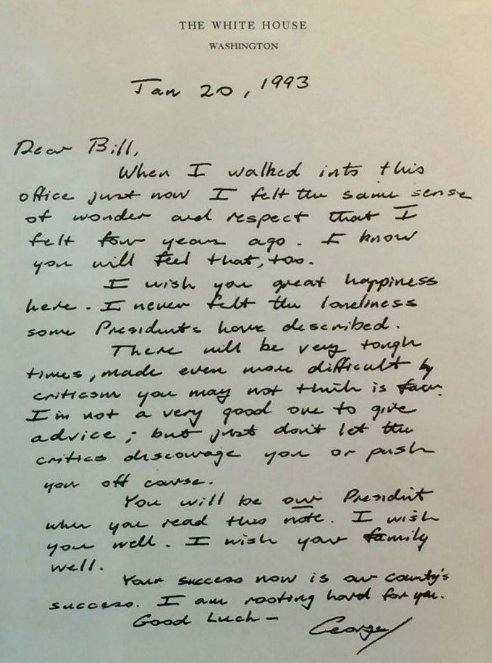
George H. W. Bush is always gracious. In his last hours in office, he penned a personal letter to the man who had defeated him, Bill Clinton. He left the letter on the President’s Desk in the Oval Office, one of the first things Clinton would see after the ceremonies, and as the weight of his new job began dragging him into reality.

Bush’s grace, then, shines now as an example of a lost time, when despite deep divisions, Washington politicians understood the nation needed to run, and were willing to compromise to make the laws and appointments necessary to help America.

Bush wrote:

Letter from President George H. W. Bush to President Bill Clinton, January 20, 1993. Image via NBC News.

Letter from President George H. W. Bush to President Bill Clinton, January 20, 1993. Image via NBC News.

Bush wrote to Clinton:

You will be our president when you read this note. I wish you well. I wish your family well.

Your success is now our country’s success. I am rooting for you. Good Luck.

Are there any such Republicans left in the party? Does anyone make Republicans like that now?

We need that grace, and resolve to make America a better and happier place, back again. Send a thank-you letter to someone you know today.

More:

Save

Save


Michelle Obama lays it on the line in New Hampshire – listen

October 13, 2016

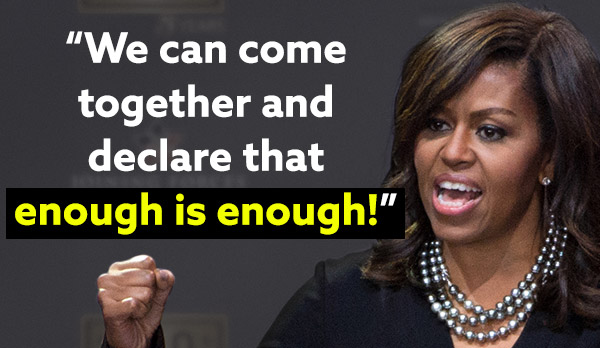
First Lady Michelle Obama. DCCC image

First Lady Michelle Obama. DCCC image

President Barack Obama maybe told us. We need to listen to first Lady Michelle Obama.

Some wag said back at the convention, think about it this way: How would you like to be Barack Obama, and realize you’re not even the best orator in your own home?

Listen to what Michelle Obama said about the election, today, October 13, in Manchester, New Hampshire. Here I start just over five minutes in, at the serious stuff that goes for about 9:30 minutes:

Mrs. Obama had some good things to say about the future for girls, and women, in the first five minutes, too, you may want to see. Full 24-minute speech here:

More:


Save

Save


History in cartoons: Joseph Keppler on the need for the 17th Amendment

September 26, 2016

From the Historian of the U.S. Senate, a Joseph Keppler cartoon from Puck Magazine,

From the Historian of the U.S. Senate, a Joseph Keppler cartoon from Puck Magazine, “The Making of a Senator.” Print by J. Ottmann Lith. Co. after Joseph Keppler, Jr., Puck. Lithograph, colored, 1905-11-15. Image with text measurement Height: 18.50 inches (46.99 cm) Width: 11.50 inches (29.21 cm) Cat. no. 38.00624.001

This is a lithograph after a cartoon by Joseph Keppler in Puck Magazine, November 15, 1905. Keppler’s cartoons kept on the heat for some legislative solution to continuing corruption in state legislatures and the U.S. Senate, driven by the ability of large corporations and trusts to essentially purchase entire states’ legislatures, and tell legislators who to pick for the U.S. Senate.

Described by the Historian of the U.S. Senate:

The “people” were at the bottom of the pile when it came to electing U.S. senators, when Joseph Keppler, Jr.’s cartoon, “The Making of a Senator, ” appeared in Puck on November 15, 1905. Voters elected the state legislatures, which in turn elected senators. Keppler depicted two more tiers between state legislatures and senators: political bosses and corporate interests. Most notably, he drew John D. Rockefeller, Sr., head of the Standard Oil Corporation, perched on moneybags, on the left side of the “big interests. ”

This cartoon appeared while muckraking magazine writers such as Ida Tarbell and David Graham Phillips were accusing business of having corrupted American politics. The muckrakers charged senators with being financially beholden to the special interests. Reformers wanted the people to throw off the tiers between them and directly elect their senators–which was finally achieved with ratification of the 17th Amendment in 1913.

Recent scuttlebutt about repealing the 17th Amendment seems to me wholly unconnected from the history. The 17th Amendment targeted corruption in the Senate and states. It largely worked, breaking the course of money falling from rich people and large corporations into the hands of everyone but the people, and breaking the practice of corporate minions getting Senate seats, to do the bidding of corporations and trusts.

Anti-corruption work was part of the larger Progressive Agenda, which included making laws that benefited people, such as clean milk and food, pure drugs, and banking and railroad regulation so small farmers and businessmen could make a good living. Probably the single best symbol of the Progressive movement was “Fighting Bob” LaFollette, Congressman, Governor and U.S. Senator from Wisconsin. LaFollette was a great supporter of the 17th Amendment

Again from the Senate Historian:

Nicknamed “Fighting Bob,” La Follette continued to champion Progressive causes during a Senate career extending from 1906 until his death in 1925. He strongly supported the 17th Amendment, which provided for the direct election of senators, as well as domestic measures advocated by President Woodrow Wilson’s administration, including federal railroad regulation and laws protecting workers rights. La Follette worked to generate wider public accountability for the Senate. He advocated more frequent and better publicized roll call votes and the publication of information about campaign expenditures.

Criticism of the 17th Amendment runs aground when it analyzes the amendment by itself, without reference to the democracy- and transparency-increasing components from the rest of the Progressive movements’ legislative actions from 1890 to 1930.

No one favors corruption and damaging secrecy in politics. By pulling the 17th out of context, critics hope to persuade Americans to turn back the clock to more corrupt times.

More:

Save

Save

Save

Save

Save

Save

Save


Chess games of the rich and famous: Gary Johnson

September 17, 2016

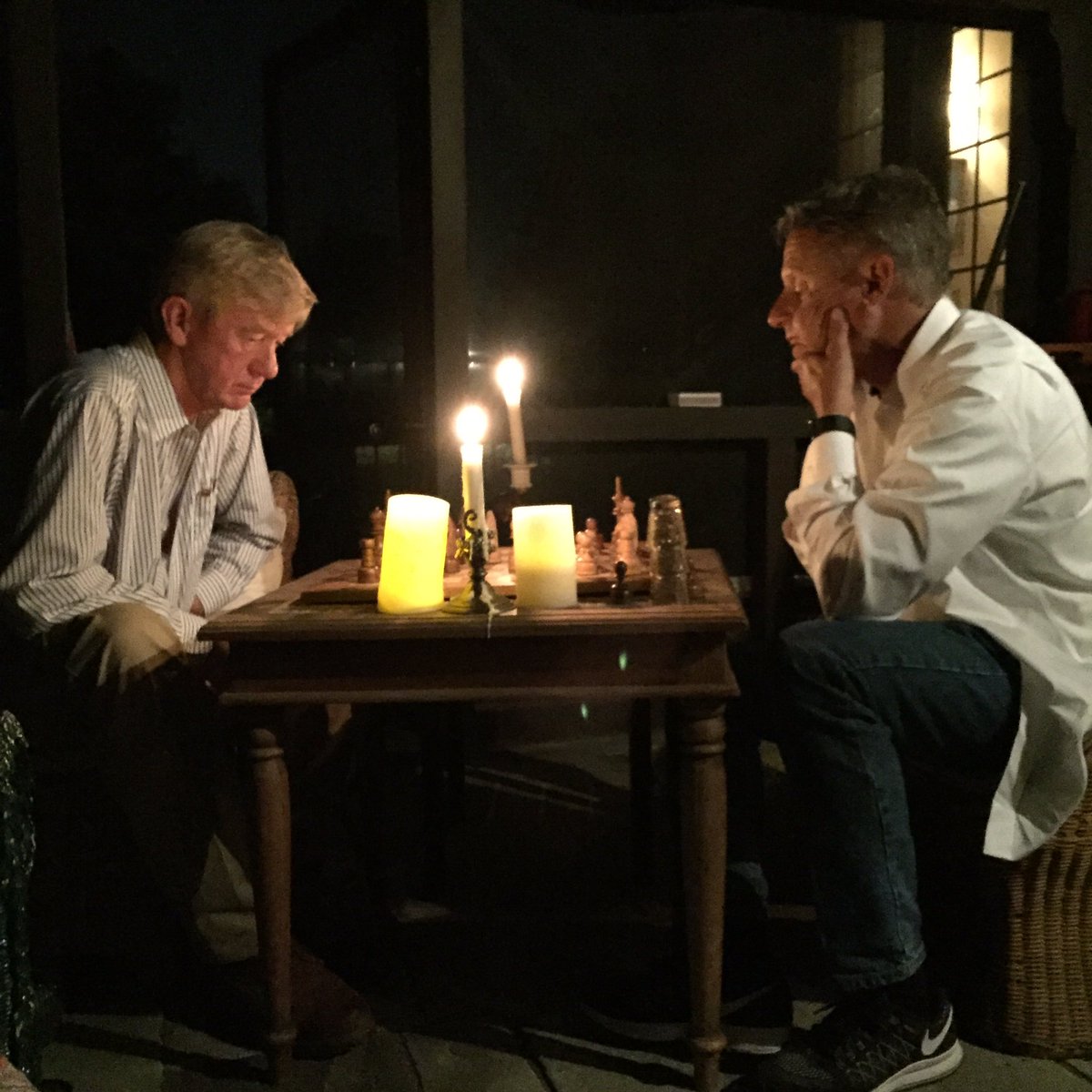
Libertarian candidate for President, Gary Johnson, relaxes with chess.

Twitter caption:

Twitter caption: “What does #TeamGov do after two rallies, a couple dozen interviews, and 4 or 5 hours on the road? #Chess.” Johnson in sneakers on the right. Who’s he playing against?

Nice qualifier for a presidential candidate. It is reputed that some of our better presidents were players of chess, but it’s difficult to find photographic evidence of it, or sketch or drawing evidence for those before 1840.

Save


July 15, 1848, economist Vilfredo Pareto born

July 15, 2016

Happy 80/20 Day!

Italian economist, engineer and political activist Vilfredo Pareto was born on July 15, 1848, in Paris, where his father had fled due to political difficulties.

Pareto should be more famous, for his explanation of the 80/20 rule, and for his contribution to making better things, the Pareto chart.  Many economic texts ignore his work almost completely.  Quality management texts ignore his life, too — generally mentioning the principles they borrow, but offering no explanation.

Vilifred Pareto, Wikipedia image

Vilfredo Pareto, Wikipedia image; why are there so few photographs of the man, who died in 1923?

His contributions, as accounted at Wikipedia:

A few economic rules are based on his work:

And now you, dear reader, having just skimmed the surface of the pool of information on Vilfredo Pareto, know more about the man than 99.99% of the rest of the people on the planet.  Welcome to the tip-top 0.01%.

A mystery I attribute to low readership: I’ve posted much of this information before. In several years, not once has anyone criticized these posts as supporting fascism, the most common mis-directed criticism of Pareto.

Resources:

Portrait drawing of Vilfredo Pareto, from one of the few photographs of the man available. Image at Alchetron. Artist?

Portrait drawing of Vilfredo Pareto, from one of the few photographs of the man available. Image at Alchetron, by Artigas at Deviant Art.


You’ll be shocked to learn what Hillary Clinton REALLY told Goldman Sachs leaders

May 4, 2016

Hillary Clinton secretly filmed at a Goldman Sachs event, speaking to Goldman Sachs executives.   Okay, not secretly filmed. But you didn't see this on the news, did you.

Hillary Clinton secretly filmed at a Goldman Sachs event, speaking to Goldman Sachs executives. Okay, not secretly filmed. But you didn’t see this on the news, did you.

You want a transcript?

We can do better than that: How about a secret video of Hillary Clinton talking to the executives at Goldman Sachs, one of the world’s leading investment firms?

After all the hoo-haw, you’ll be shocked at the content.

Here’s how Goldman Sachs described it:

Published on Oct 22, 2014

Learn more: http://www.goldmansachs.com/citizensh…

On September 23, 2014, Goldman Sachs 10,000 Women hosted its annual dinner at the Clinton Global Initiative.

The event featured a keynote address from former Secretary of State Hillary Clinton on the business case for empowering women to ensure future economic growth.

Here’s the video:

True to Clinton’s history, she tells people with power and money they have to do a much better job of empowering and hiring from groups known to lack power and money, for the sake of capitalism, for the sake of our nation, for the sake of the world.

Okay, so it’s not secret. People who complain about these speeches pretend she said something different, and they certainly don’t want you to know what Clinton actually said. Clinton’s opponents hope this video remains close to secret.

Shocking that these speeches continue as an issue.  Maybe they should be campaign ads, for Clinton.

More:

Tip of the old scrub brush to Leslie Salzillo and DailyKos.


March 4, 1801: Thomas Jefferson’s inauguration as 3rd president

March 4, 2016

Words to be sung at a service honoring the inauguration of Thomas Jefferson as President. Image from the Treasures of the Library of Congress.

Words to be sung at a service honoring the inauguration of Thomas Jefferson as President. Image from the Treasures of the Library of Congress. (If we only knew the music . . .)

Thomas Jefferson ascended the the presidency to save the American Revolution, and to celebrate American arts and sciences, his friends and supporters said. The lyrics to be sung at the service at the German Reformed Church reflect those views.

What joyful prospects rise before!
Peace, Arts, and Science hale our shore
      And thro’ the country spread.
Long may these blessings be preserv’d,
And by a virtuous land deserv’d
      With JEFFERSON our head.

1800’s election campaign was a bitter one. Because balloting was not for president and vice president, but instead with the second-leading vote-getter taking the vice presidency, the Electoral College deadlocked on Jefferson and his vice president running mate, Aaron Burr. The election then went to the House of Representatives — the holdover House, dominated by Federalists who supported the vanquished John Adams. The House had great difficulty choosing between Jefferson and Burr, but at length picked Jefferson when Alexander Hamilton pushed his influence, favoring his once-friend Jefferson, and snubbing his enemy and eventual killer, Burr.

The Library of Congress briefly described Jefferson’s inauguration:

Thomas Jefferson, the third president of the United States, was the first to be inaugurated in the capital city of Washington, D.C. The ceremonies took place on March 4, 1801, in the Senate wing of the not yet finished Capitol building. Chief Justice John Marshall administered the oath of office to Jefferson, the first of five presidents-elect he would induct. In his speech Jefferson attempted to assuage the bitter rivalry between the Federalist and Republicans that had culminated in a deadlock election broken by Congress’s election of Jefferson on the 36th ballot. Jefferson remarked: “but every difference of opinion is not a difference of principle. We have called by different names brethren of the same principles. We are all Republicans. We are all Federalists.” Jefferson’s sentiments notwithstanding, his predecessor, former president John Adams, did not attend the ceremony — the first president to do so.

Mathematicians and scientists celebrate the election of Jefferson as a triumph for reason and science in politics. Jefferson was an accomplished and proud American naturalist, and often turned to scientists for advice on issues. Ironically perhaps, he never did reconcile his belief that rocks could not “fall from the sky,” doubting the provenance of meteoroids; skeptic to the end.

Tip of the old scrub brush to Pat’s Blog.


Darwin and Lincoln and February 12: Cool coincidence or divine intervention?

February 12, 2016

Is it an unprecedented coincidence?  207 years ago today, just minutes (probably hours) apart according to unconfirmed accounts, Abraham Lincoln was born in a rude log cabin on Nolin Creek, in Kentucky, and Charles Darwin was born into a wealthy family at his family’s home  in Shrewsbury, England.

Gutzon Borglums 1908 bust of Abraham Lincoln in the Crypt of the U.S. Capitol - AOC photo

Gutzon Borglum’s 1908 bust of Abraham Lincoln in the Crypt of the U.S. Capitol – Architect of the Capitol photo

Lincoln would become one of our most endeared presidents, though endearment would come after his assassination.  Lincoln’s bust rides the crest of Mt. Rushmore (next to two slaveholders), with George Washington, the Father of His Country, Thomas Jefferson, the author of the Declaration of Independence, and Theodore Roosevelt, the man who made the modern presidency, and the only man ever to have won both a Congressional Medal of Honor and a Nobel Prize, the only president to have won the Medal of Honor. 

In his effort to keep the Union together, Lincoln freed the slaves of the states in rebellion during the civil war, becoming an icon to freedom and human rights for all history.  Upon his death the entire nation mourned; his funeral procession from Washington, D.C., to his tomb in Springfield, Illinois, stopped twelve times along the way for full funeral services.  Lying in state in the Illinois House of Representatives, beneath a two-times lifesize portrait of George Washington, a banner proclaimed, “Washington the Father, Lincoln the Savior.”

Charles Darwin statue, Natural History Museum, London - NHM photo

Charles Darwin statue, Natural History Museum, London – NHM photo

Darwin would become one of the greatest scientists of all time.  He would be credited with discovering the theory of evolution by natural and sexual selection.  His meticulous footnoting and careful observations formed the data for ground-breaking papers in geology (the creation of coral atolls), zoology (barnacles, and the expression of emotions in animals and man), botany (climbing vines and insectivorous plants), ecology (worms and leaf mould), and travel (the voyage of H.M.S. Beagle).  At his death he was honored with a state funeral, attended by the great scientists and statesmen of London in his day.  Hymns were specially written for the occasion.  Darwin is interred in Westminster Abbey near Sir Isaac Newton, England’s other great scientist, who knocked God out of the heavens.

Lincoln would be known as the man who saved the Union of the United States and set the standard for civil and human rights, vindicating the religious beliefs of many and challenging the beliefs of many more.  Darwin’s theory would become one of the greatest ideas of western civilization, changing forever all the sciences, and especially agriculture, animal husbandry, and the rest of biology, while also provoking crises in religious sects.

Lincoln, the politician known for freeing the slaves, also was the first U.S. president to formally consult with scientists, calling on the National Science Foundation (whose creation he oversaw) to advise his administration.  Darwin, the scientist, advocated that his family put the weight of its fortune behind the effort to abolish slavery in the British Empire.  Each held an interest in the other’s disciplines.

Both men were catapulted to fame in 1858. Lincoln’s notoriety came from a series of debates on the nation’s dealing with slavery, in his losing campaign against Stephen A. Douglas to represent Illinois in the U.S. Senate.  On the fame of that campaign, he won the nomination to the presidency of the fledgling Republican Party in 1860.  Darwin was spurred to publicly reveal his ideas about the power of natural and sexual selection as the force behind evolution, in a paper co-authored by Alfred Russel Wallace, presented to the Linnean Society in London on July 1, 1858.   On the strength of that paper, barely noticed at the time, Darwin published his most famous work, On the Origin of Species, in November 1859.

Darwin and Lincoln might have got along well, but they never met.

What unusual coincidences.

Go celebrate human rights, good science, and the stories about these men.

A school kid could do much worse than to study the history of these two great men.  We study them far too little, it seems to me.

Resources:

Charles Darwin:

Abraham Lincoln:

More:

Anybody know what hour of the day either of these men was born?

Yes, you may fly your flag today for Lincoln’s birthday, according to the Flag Code; the official holiday, Washington’s Birthday, is next Monday, February 15th — and yes, it’s usually called “Presidents Day” by merchants and calendar makers. You want to fly your flag for Charles Darwin? Darwin never set foot in North America, remained a loyal subject of Her Majesty, Queen Victoria, to the end of his days. But go ahead. Who would know?

Yes, this is mostly an encore post. Fighting ignorance requires patience.

Yes, this is mostly an encore post. Fighting ignorance requires patience.


Texans! Last day to register to vote in March primary elections, February 1

February 1, 2016

Texas Democrats send me e-mail, trying to make democracy in America stronger, and work better, especially in Texas:

Ed,

Today is the absolute LAST DAY to register to vote for the March 1 Presidential Primary.

If you or someone you know wants to vote for Bernie Sanders, Hillary Clinton, or Martin O’Malley in the Democratic Primary but they aren’t registered to vote yet, today is the last day to get registered.

Fill out your voter registration application online — then print it, sign it, and make sure to get it in the mail before the post office closes.

http://act.txdemocrats.org/RegisterToVote

If you are already registered to vote, forward this email to any friends and family members that you think haven’t registered to vote. 

Let’s do this,

Crystal Perkins
Executive Director, Texas Democratic Party

Paid for by the Texas Democratic Party (www.txdemocrats.org)
and not authorized by any candidate or candidate’s committee.

I do not know why Texas Republicans did not send me a similar e-mail. I’m on their lists, too.

Excluding run-off elections where no candidate received 50%+1 in the primary, here is Texas’s election calendar for 2016, from the Texas Secretary of State:

Last Day to Register to Vote Monday, February 1, 2016
First Day of Early Voting Tuesday, February 16, 2016*
*First business day after Presidents’ Day
Last Day to Apply for Ballot by Mail
(Received, not Postmarked)
Friday, February 19, 2016
(NEW LAW: 11th day before election day; Application for Ballot By Mail (ABBM) and Federal Postcard Application (FPCA))
Last Day of Early Voting Friday, February 26, 2016
Last day to Receive Ballot by Mail Tuesday, March 1, 2016 (election day) at 7:00 p.m. (unless overseas deadline applies)

Democratic socialism’s darkest secret: More democracy than socialism

January 26, 2016

Fans of irony will find interesting this depiction of the of the greatest achievements in history of democratic socialism: The U.S. National Defense Highway System, better known as the Interstate Highway System.  Irony is that it is a key driver of the U.S. economy and has made possible great economic expansion that enriches capitalists greatly.

Fans of irony will find interesting this depiction of one of the greatest achievements in history of democratic socialism: The U.S. National Defense Highway System, better known as the Interstate Highway System. Irony is that it is a key driver of the U.S. economy and has made possible great economic expansion that enriches capitalists greatly. From the Online Atlas.

Stunning how some people will say Bernie Sanders makes sense in one breath, then when hearing he calls himself a socialist, claim Bernie is nuts and a threat to America.

Sanders’s supporters fight back, some. The phenomenon I describe is strongest among self-proclaimed extreme conservatives, and so is not such a huge issue in the primaries as it would be in the general election, if it is an issue at all.  A wise political strategist would not wait to confront the issue. It’s not an argument that can be answered with a bumper sticker.

Right wing publications take great pains to link any use of the word “socialism” with the now-repulsive violence of the Bolshevik Revolution and the autocratic nightmares of bureaucracy under the old Soviet-style government system, that even the Soviets abandoned. Right wingers don’t even pause to avoid saying socialism cares for people over corporations, in their blind striking out to smear anyone brave enough to take on the name.

We shouldn’t be surprised if Democrats generally defend the philosophy of democratic socialism from such demonizing.

This Tweet from one of Bernie’s guys offers to define democratic socialism rather as mother’s milk, apple pie and saluting the flag.

Is it correct? Does it persuade you?

http://twitter.com/IanMolony/status/690076734859919360

The poster says*:

Democratic Socialism

Of the People, By the People, For the People

A political ideology which balances a democratic political system alongside a socialist economic system, involving a combination of political democracy with social ownership fo the means of production, free-market capitalism in the form of business receiving reasonable profits for goods and services while at the same time providing fair compensation to labor with a shared responsibility for civil societal needs such, but not limited to, emergency services, military, publicly-owned utilities and services, and infrastructure in the form of maintenance and management of public roadways, providing water and waste-water treatment, public parks and recreation, resource management and wildlife conservation, public ports, airports, rail lines and interstates, and in providing programs within a publicly elected representatives state and federal government.

Were I advising the Sanders campaign, I’d advise that the language in that statement be made much more reader friendly, and formatted to aid reading. But in the main, it doesn’t differ much from the Wikipedia definition.  See if you can find any critical differences:

Democratic socialism is a political ideology advocating a democratic political system alongside a socialist economic system, involving a combination of political democracy with social ownership of the means of production. Although sometimes used synonymously with “socialism”, the adjective “democratic” is often added to distinguish itself from Leninist and Stalinist brand of socialism, which is widely viewed as being non-democratic. In all, democratic socialists don’t support single-party system and centralism.[1]

Democratic socialism is usually distinguished from both the Soviet model of centralized socialism and social democracy, where “social democracy” refers to support for political democracy, regulation of the capitalist economy, and a welfare state.[2] The distinction with the former is made on the basis of the authoritarian form of government and centralized economic system that emerged in the Soviet Union during the 20th century,[3] while the distinction with the latter is made in that democratic socialism is committed to systemic transformation of the economy while social democracy is not.[4] That is, whereas social democrats seek only to “humanize” capitalism through state intervention, democratic socialists see capitalism as being inherently incompatible with the democratic values of freedom, equality, and solidarity; and believe that the issues inherent to capitalism can only be solved by superseding private ownership with some form of social ownership. Ultimately democratic socialists believe that reforms aimed at addressing the economic contradictions of capitalism will only cause more problems to emerge elsewhere in the economy, so that capitalism can never be sufficiently “humanized” and must ultimately be replaced by socialism.[5][6]

Democratic socialism is not specifically revolutionary or reformist, as many types of democratic socialism can fall into either category, with some forms overlapping with social democracy.[7] Some forms of democratic socialism accept social democratic reformism to gradually convert the capitalist economy to a socialist one using the pre-existing political democracy, while other forms are revolutionary in their political orientation and advocate for the overthrow of the bourgeoisie and the capitalist economy.[8]

Few people want to debate what “democratic socialism” really means, chiefly because socialism is such a loaded word and concept. There are two camps, one which wants people to rationally look at cooperative activities of the world’s great democratic republics and smile at their virtues, and continue them, the Bernie Sanders camp. The other camp holds strictly to the philosophy expressed in Friedrich von Hayek’s cartoon of socialism in The Road To Serfdom**, which indicts authoritarianism, and makes an unevidenced claim that any move towards socialism inherently leads to dictatorship.

We should give Sanders and his supporters credit for trying to open discussion. But we should be ready with first aid kits when they discover it’s not an open door to discussion with conservatives, but a tempered glass window posing as a door — and administer to their contusions as they smash into it.

If you find a tempered discussion of modern democratic socialism anywhere, will you let us know?

In comments, let us know what you think even if you don’t find the perfect, tempered discussion.

Matt Wuerker's classic cartoon from the 2008 campaign, when Barack Obama was accused of socialism for proposing to increase health care coverage. Perhaps ironically, Obama's plan ended up with powerful capitalist institutions entrenched in it. Critics of socialism sill haven't noticed.

Matt Wuerker’s classic cartoon from the 2009 campaign for the Affordable Care Act, when Barack Obama was accused of socialism for proposing to increase health care coverage. Perhaps ironically, Obama’s plan ended up with powerful capitalist institutions entrenched in it. Critics of socialism sill haven’t noticed.

More:

_____________

* I list the text here to aid in indexing for search sites.

** Link is to the version at the Mises Institute, which is generally a biased source; in this case, their biases help to make sure the cartoon version presented is faithful to Hayek’s original; otherwise, discussion there on “democratic socialism” is probably fruitless.


Quote of the Moment – Pete Seeger: Not singing is a big mistake

January 18, 2016

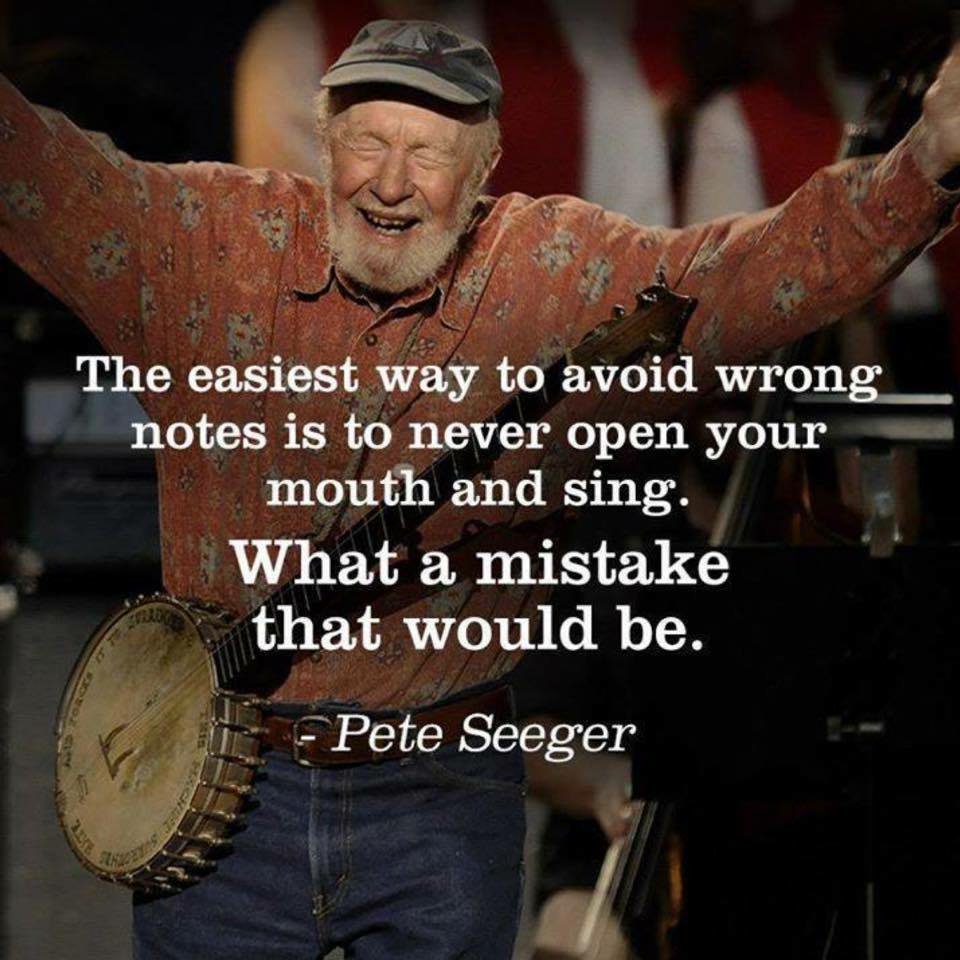
I don’t have a citation for where Pete Seeger said this, but it’s wholly within his character and mission. Anyone got a cite?

@Area9Handbells said:  Pete Seeger got it right with the exception of one word –

A Tweet from @Area9Handbells: Pete Seeger got it right with the exception of one word – “sing.” We think he meant “ring.”

“The easiest way to avoid wrong notes is to never open your mouth and sing. What a mistake that would be.”

∇ Pete Seeger

I’ve asked for a citation, for accuracy and to keep the anti-plagiarism and accuracy mavens happy, but don’t have one yet. Nor do I know to whom goes credit for the poster and photo. Can you help?


January 5, 1949: Truman launches the “Fair Deal”

January 5, 2016

Front page of the New York Times on January 6, 1949, with news of President Truman's State of the Union message. Oddly, via Conservapedia

Front page of the New York Times on January 6, 1949, with news of President Truman’s State of the Union message. Oddly, via Conservapedia

President Harry Truman delivered his State of the Union address to Congress on January 5, 1949, the first after he’d won election to the presidency in his own right (he succeeded to the presidency on the death of Franklin Roosevelt on April 12, 1945, remember).

Campaign button from the 1948 presidential campaign; on January 5, 1949, Truman presented a more detailed program backing the slogan, in his State of the Union Address

Campaign button from the 1948 presidential campaign; on January 5, 1949, Truman presented a more detailed program backing the slogan, in his State of the Union Address

Not a barn-burner of a speech, but an important one.  He appealed to history and the Square Deal of Teddy Roosevelt and the New Deal of Franklin Roosevelt; he appealed to Americans’ innate patriotism, and he appealed to a nation grateful to the soldiers who had defended freedom and democracy in World War II.  Truman called for a Fair Deal for all Americans, because they’d earned it, and it was the American thing to do.

This was barely eight weeks since Truman pulled out a stunning re-election win against the “do-nothing Congress.”  In many, many ways, the problems of 1949 look stunningly familiar to us today.  He spoke of the successes of the country in World War II, and the successes in business and finance since the war.  Truman said:

Reinforced by these policies, our private enterprise system has reached new heights of production. Since the boom year of 1929, while our population has increased by only 20 percent, our agricultural production has increased by 45 percent, and our industrial production has increased by 75 percent. We are turning out far more goods and more wealth per worker than we have ever done before.

This progress has confounded the gloomy prophets–at home and abroad who predicted the downfall of American capitalism. The people of the United States, going their own way, confident in their own powers, have achieved the greatest prosperity the world has even seen.

But, great as our progress has been, we still have a long way to go.

As we look around the country, many of our shortcomings stand out in bold relief.

We are suffering from excessively high prices.

Our production is still not large enough to satisfy our demands.

Our minimum wages are far too low.

Small business is losing ground to growing monopoly.

Our farmers still face an uncertain future. And too many of them lack the benefits of our modern civilization.

Some of our natural resources are still being wasted.

We are acutely short of electric power, although the means for developing such power are abundant.

Five million families are still living in slums and firetraps. Three million families share their homes with others.

Our health is far behind the progress of medical science. Proper medical care is so expensive that it is out of the reach of the great majority of our citizens.

Our schools, in many localities, are utterly inadequate.

Our democratic ideals are often thwarted by prejudice and intolerance.

Each of these shortcomings is also an opportunity-an opportunity for the Congress and the President to work for the good of the people.

Hello, boy howdy!  Prices aren’t so stifling as they were considered to be, then, and inflation is far from the plate of problems we face.

But the rest?

Perhaps we should look back to see what Congress, and the nation, did in 1949, as instructive to us in 2014.  Did Americans get a Fair Deal then?  Do they deserve one now?

From “Today in History” at American Memory, the Library of Congress:

On January 5, 1949, President Harry Truman used his State of the Union address to recommend measures including national health insurance, raising the minimum wage, strengthening the position of organized labor, and guaranteeing the civil rights of all Americans. Referencing the popular “New Deal” programs of his predecessor, Franklin Delano Roosevelt, Truman styled his reform package the “Fair Deal.”

A few months earlier the president’s career seemed over.  Political pundits of the time agreed that Truman needed a miracle to win his 1948 bid for reelection against the popular Republican governor from New York, Thomas E. Dewey. Adding to the incumbent’s troubles, a revived Progressive Party attempted to attract left-leaning Democrats, while segregationist “Dixiecrats” broke with the Democrats to run South Carolina Governor Strom Thurmond for president. Responding to the competition, Truman embarked on a campaign tour by train, delivering “whistle-stop” speeches to thousands of voters in small communities throughout the United States. This tactic proved effective, and President Truman was reelected by a slim margin. Still, the Chicago Daily Tribune was so confident of the president’s defeat it went to press with the November 3, 1948 headline “DEWEY DEFEATS TRUMAN.”

Truman had begun to push for Fair Deal-type legislation following the end of World War II in 1945. However, Congress resisted his plans for the extension of federal social and economic programs. Concerned about the transition from a wartime to a peacetime economy, lawmakers ultimately accepted the role of government in maintaining full employment and stabilizing the economy, but rejected Truman’s proposals for national health insurance, educational aid, and federally-supported housing programs. Even after Truman’s successful 1948 campaign, the mandate for expanded social programs remained weak. The minimum wage rose and social security coverage broadened, but few Fair Deal programs were enacted.

On July 26, 1948, President Harry Truman issued two executive orders. One instituted fair employment practices in the civilian agencies of the federal government; the other provided for “equality of treatment and opportunity in the armed services without regard to race, color, religion, or national origin.”

Gib Crockett cartoon on Truman's Fair Deal, 1949. May still be under copyright

Gib Crockett cartoon on Truman’s Fair Deal, 1949. May still be under copyright

We could use a Fair Deal for America today, in 2016. GOP wouldn’t stand for it, though.

More:

Yes, this is mostly an encore post. Fighting ignorance requires patience.

Yes, this is mostly an encore post. Fighting ignorance requires patience. Heaven knows this nation needs good news of great turnarounds in history.


Banksy’s modern Nativity, revisited in 2015: Trump’s wall, and Jesus

December 25, 2015

Those who cannot remember the past are condemned to repeat it.
==> Georges Santayana,
The Life of Reason, vol. 1: Reason in Common Sense)

Those who don’t pay attention to history are condemned to repeat it? Then, gods forbid we should have leaders among the condemned, and heaven keep us from joining their folly.

Has there ever been a good wall that actually worked to keep trouble away? Do we need to rebuild the Berlin Wall in the Americas?

Thomas Nast helped bring down the crooks at Tammany Hall with cartoons. Boss Tweed, the chief antagonist of Nast, crook and leader of the Tammany Gang, understood that Nast’s drawings could do him in better than just hard hitting reporting — the pictures were clear to people who couldn’t read.

But a cartoon has to get to an audience to have an effect.

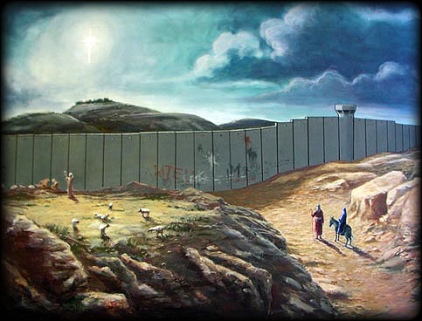
Here’s a cartoon below, a comment on the security wall being built in Israel, that got very little circulation in the west at Christmas time. Can you imagine the impact had this drawing run in newspapers in Europe, the U.S., and Canada?

It’s a mashup of a famous oil painting* related to the Christian Nativity, from a London-based artist who goes by the name Banksy. (Warning: Banksy pulls no punches; views shown are quite strong, often very funny, always provocative, generally safe for work unless you work for an authoritarian like Dick Cheney who wants no counter opinions.)

banksy-israels-wall-77721975_fda236f91a.jpg

Banksy’s modern nativity — does he ever bother to copyright his stuff, or would he rather you broadcast it?

*  At least I thought so in 2008.  I can’t find the painting now.  Anybody recognize a work underneath Banksy’s re-imagining?  Let us know in comments, eh?  Perhaps this one, by David Roberts?  Perhaps this engraving after Joseph M. W. TurnerTurner’s original? Plus, in 2008, most people said “Banksy who?”

Tip of the old scrub brush to Peoples Geography.

More, in 2011: 

More in 2012:

Yes, this is mostly an encore post. Fighting ignorance requires patience.

Yes, this is mostly an encore post. Fighting ignorance requires patience.