Thomas Nast in 1864: “The Union Christmas Dinner” pushed reconciliation in time of war

December 23, 2015

Thomas Nast may have done as much as Abraham Lincoln to invent the Republican Party.

Nast’s illustration for Harper’s Weekly for the issue of December 31, 1864, expressed his great desire for an end to the Civil War, and offered a vision of what could happen when arms were put down.

Image by Thomas Nast, in Harper's Weekly.  White House History @WhiteHouseHstry Tweeted: “The Union Christmas Dinner,” an illustration which symbolically depicts the reconciliation of the war-torn nation.

Image by Thomas Nast, in Harper’s Weekly. White House History @WhiteHouseHstry Tweeted: “The Union Christmas Dinner,” an illustration which symbolically depicts the reconciliation of the war-torn nation.

We were alerted to the image by a Tweet from White House History; the image above comes via SonoftheSouth.net.

An explanation of the illustration comes from The New York Times Learning page (for teachers — you’re invited):

As the Union military advanced across the South in December 1864, making Confederate defeat seem to be only a matter of time, artist Thomas Nast drew a holiday illustration betokening mercy for the vanquished and sectional reconciliation for the nation. Under the Christmas proclamation of “Peace on Earth and Good Will Toward Men,” President Abraham Lincoln is the gracious host who generously welcomes the Confederates—President Jefferson Davis, General Robert E. Lee, and state governors—in from the cold, and gestures for them to return to their rightful seats at the sumptuous feast of the states. Seated at the table are the governors of the Union states, and on the wall behind them appear portraits of leading Union generals.

Framing the main banquet scene are four circular insets that convey the message that if the Confederacy will lay down its arms, surrender unconditionally, and be contrite, then the Union will be merciful and joyously welcome them back into the fold. Viewing them clockwise from the upper-left, the symbolic figure of Victory, backed by the American Eagle, offers the olive branch of peace to a submissive Confederate soldier; the forgiving father from the biblical parable embraces his wayward son, whose sorrow for his past rebellion prompts the father to honor his son with a celebratory dinner; under the tattered American flag, the ordinary soldiers of the Union and Confederacy reunite happily as friends and brothers after the Confederate arms and battle standards have been laid on the ground; and, General Robert E. Lee, the Confederate commander, bows respectfully and offers his sword in unconditional surrender to General Ulysses S. Grant, the commander of the Union troops. In the lower-center is a scene from a holiday table at which a Northern family drinks a toast to the Union servicemen.

While Nast could be partisan, as in his portrayal of Democrats as mules kicking down a barn, or Republicans as noble elephants, and Nast could be subject to bigotry, as in his frequent jabs at Catholics and his portrayal of Irish immigrants as near-gorillas, much of his work in illustration for Harper’s and other publications offered a vision of a much better America which welcomed everyone — as his later portrayal of “Uncle Sam’s Thanksgiving” in 1869 demonstrated.

We could use more Republicans, and newspapermen, like the hopeful Nast, today (leave the bigotry behind).


25 most-viewed presidents’ documents at the American Presidency Project

December 4, 2015

Every U.S. history teacher is familiar with a great on-line resource assembled by John Woolley and Gerhard Peters at the University of California – Santa Barbara, The American Presidency Project.  Or, if by some oversight any teacher is not familiar with it, someone should do them a favor and let them know.

It’s an ambitious project of cataloging and making available in one place all the official papers of the presidents of the United States, speeches, press conferences, executive orders, and miscellaneous material including election speeches. The project started in 1999, and as of today contains more than 111,000 documents.

Masthead photo collage from the American Presidency Project at the University of California - Santa Barbara

Masthead photo collage from the American Presidency Project at the University of California – Santa Barbara

In 2008, the project started counting access to the documents, and can now give us seven years of data as to which documents of presidents, from George Washington to Barack Obama, are the most popularly accessed.

Before you read further, ponder this question: Which presidential speeches, documents and miscellanea do you think should be in the top 25 documents people look in a decade? Surely students and scholars, and policy wonks, would be interested in Lincoln’s inspiring words at Gettysburg, perhaps his two inaugural addresses, or the Emancipation Proclamation. FDR’s first inaugural address, “nothing to fear but fear itself,” ought to be among the top. Wilson’s 14 Points, perhaps? Washington’s Farewell? John Kennedy’s inaugural? Lyndon Johnson’s Great Society speech? Eisenhower’s farewell, warning of the “military-industrial complex?”

Now look at the list. What does it tell us that these are the top 25 sought-after documents from the American Presidency Project? What does it tell us that what we might expect to be in the top 25, are not? Tell us in comments what you think.

Here’s the top 25 Most Viewed Documents since 2008 at the American History Project; hotlinks go to the document at AHP:

The 25 Most Viewed Documents Since 2008
#1 John F. Kennedy
Inaugural Address
#2 Republican Party Platforms
Republican Party Platform of 1956
#3 Democratic Party Platforms
2008 Democratic Party Platform
#4 Republican Party Platforms
2008 Republican Party Platform
#5 John F. Kennedy
Executive Order 10990 – Reestablishing the Federal Safety Council
#6 Democratic Party Platforms
2012 Democratic Party Platform
#7 Republican Party Platforms
2012 Republican Party Platform
#8 George W. Bush
Address to the Nation on the Terrorist Attacks
#9 Ronald Reagan
Inaugural Address
#10 John F. Kennedy
Executive Order 11110 – Amendment of Executive Order No. 10289 as Amended, Relating to the Performance of Certain Functions Affecting the Department of the Treasury
#11 Franklin D. Roosevelt
Fireside Chat on Banking
#12 Barack Obama
Inaugural Address
#13 Franklin D. Roosevelt
Letter on the Resolution of Federation of Federal Employees Against Strikes in Federal Service
#14 John F. Kennedy
Remarks at a Dinner Honoring Nobel Prize Winners of the Western Hemisphere
#15 Franklin D. Roosevelt
1944 State of the Union Message to Congress
#16 Franklin D. Roosevelt
Inaugural Address
#17 Barack Obama
Executive Order 13603 – National Defense Resources Preparedness
#18 Franklin D. Roosevelt
Executive Order 6102 – Requiring Gold Coin, Gold Bullion and Gold Certificates to Be Delivered to the Government
#19 Republican Party Platforms
Republican Party Platform of 1860
#20 George Bush
Executive Order 12803 – Infrastructure Privatization
#21 Abraham Lincoln
Inaugural Address
#22 George Washington
First Annual Message to Congress on the State of the Union
#23 William J. Clinton
Inaugural Address
#24 Democratic Party Platforms
Democratic Party Platform of 1960
#25 John F. Kennedy
Address of Senator John F. Kennedy Accepting the Democratic Party Nomination for the Presidency of the United States – Memorial Coliseum, Los Angeles

Why not a price on carbon, a tax with cap-and-trade capabilities?

October 29, 2015

Tax on air pollutants with a cap-and-trade process worked wonders cleaning up acid rain in the U.S.  Is there any rational reason to oppose such a plan, in the U.S. or anywhere else, to help clean up carbon air pollution to slow or stop global warming?

Germany’s Chancellor Angela Merkel issued a call for a carbon pricing system. Who will listen?

It’s a feature story from World Bank, who seems to have figured out that global warming poses great threats to commerce and growing the world’s economies.

Heads of State, City, Regional and Business Leaders Unite to Call for Price on Carbon

October 19, 2015

For the first time Heads of State, city and provincial leaders have come together with the support of leading companies to urge countries and companies around the world to put a price on carbon pollution.

For the first time Heads of State, city and provincial leaders have come together with the support of leading companies to urge countries and companies around the world to put a price on carbon pollution.


STORY HIGHLIGHTS
  • Carbon pricing is a key building block to tackle climate change and drive investment in a low carbon future.
  • Launched today, the Carbon Pricing Panel is an unprecedented alliance of Global Leaders united to put a price on carbon pollution.
  • The number of implemented or scheduled carbon pricing instruments has nearly doubled since 2012, reaching an aggregate market value of about $50 billion.

What can be done to reduce greenhouse gas emissions, protect our environment, and help support people most vulnerable to climate change?

The answer is simple: A key element for any strategy to tackle climate change must be to put a price on carbon pollution. The transition to a cleaner future requires government action and the right incentives. Carbon pricing is a key building block to help cut pollution and drive investment in a low carbon future.

It’s a point recognized by leaders from Europe, across to Africa and Asia, who have today – for the first time – come together with the support of leading private companies to urge countries and businesses around the world to put a price on carbon.

Convened by World Bank Group President Jim Yong Kim and the International Monetary Fund’s Managing Director Christine Lagarde, the high-level Carbon Pricing Panel is calling on their peers to follow their lead and put a price on carbon. They are joined in this effort by OECD Secretary General Angel Gurria.

The call by the leaders comes on the first day of the last round of negotiations ahead of the Paris climate talks in December. The leaders aim to seize the momentum generated by the Paris talks to spur further, faster action towards carbon pricing, as a necessary path to a low carbon, productive, competitive economy of the future.

Members of the Carbon Pricing Panel include German Chancellor Angela Merkel, Chilean President Michelle Bachelet, French President François Hollande, Ethiopian Prime Minister Hailemariam Desalegn, Philippines President Benigno Aquino III, Mexican President Enrique Peña Nieto, Governor Jerry Brown of California, and Mayor Eduardo Paes of Rio de Janeiro.

Private sector support is spearheaded by Anne Stausboll, CEO of US Institutional Investor CalPERS, Gérard Mestrallet, CEO of ENGIE of France, Anand Mahindra, Chairman and Managing Director of Mahindra Group of India, and Feike Sijbesma, Chairman and CEO of Netherlands-based Royal DSM.


” There has never been a global movement to put a price on carbon at this level and with this degree of unison. It marks a turning point from the debate on the economic systems needed for low carbon growth to the implementation of policies and pricing mechanisms to deliver jobs, clean growth and prosperity. The science is clear, the economics compelling and we now see political leadership emerging to take green investment to scale at a speed commensurate with the climate challenge. “

ImageJim Yong Kim
World Bank Group President

Summary map of existing, emerging and potential regional, national and sub-national carbon pricing instruments (ETS and tax)

Summary map of existing, emerging and potential regional, national and sub-national carbon pricing instruments (ETS and tax)


Around the world, about 40 nations and 23 cities, states and regions have implemented or are putting a price on carbon with programs and mechanisms covering about 12 percent of global greenhouse gas emissions.

The number of implemented or scheduled carbon pricing instruments has nearly doubled since 2012, reaching an aggregate market value of about $50 billion.

And already more than 400 businesses around the world are using a voluntary, internal price on carbon as part of their investment strategies, with prices ranging from US$4 to over US$100 per ton of CO2. This is a tripling in the number of companies compared with last year reporting that they price their emissions.

Carbon pricing delivers a triple dividend.

Firstly, it is good for the environment and it reduces emissions – lowering social costs of health impacts on people, as well as tackling the global warming.  A price on carbon can help alleviate health and environmental problems like premature deaths from exposure to outdoor air pollution. According to the World health Organization, an estimated 3.7 million people die prematurely from outdoor air pollution.

Secondly, carbon pricing is an essential part of getting prices right for the move to a low carbon more resilient growth. It raises revenue efficiently, making it possible to reduce more distortionary taxes, and it allows for targeted support for clean energy solutions rather than harmful subsidies that do little for poor people or the environment.

And thirdly, it drives innovation and critically needed investments in low-carbon solutions, boosting private sector investment in clean tech research and development, and offering the prospect of job creation in the sectors of the future.

Why is is it important to act now on carbon pricing? Because strong public policy gives the private sector the certainty and predictability to make the necessary long-term investments in climate-smart development and prevent catastrophic impacts from climate change. Carbon pricing is the cornerstone of a package of policy measures designed to achieve emission reductions at lowest cost.

Today, countries and regions are learning from one another and creating a set of successful approaches to pricing carbon. Some early lessons are described in the World Bank Group publication The FASTER Principles for Successful Carbon Pricing – which lays out principles for effective, efficient and fair pricing of carbon.

Some examples include:

  • The Canadian province of British Columbia was an early mover on carbon pricing, with the creation of a carbon tax in 2008, with the tax used to cut income taxes and fund tax credits. Also, British Columbia is home to a growing clean technology sector, with more than 150 firms in 2013, accounting for 22% of Canada’s clean tech presence in a province with only 12% of Canada’s GDP. Several experts attribute this growth to the carbon tax.
  • California, Quebec and the European Union allocate a portion of their emissions trading scheme (ETS) auction revenues to designated green technology funds and innovation, to support sectors affected directly or indirectly by higher carbon costs.
  • In Chile, the government has passed legislation on a carbon tax – effective as of 2017 – as part of a much larger tax reform package with the explicit aim of providing additional resources for education and other social protection programs.
  • In Northeastern United States, the Regional Greenhouse Gas Initiative is expected to save people money on energy bills. The RGGI states have invested over $1 billion from ETS proceeds in energy-efficiency program, which are expected to return more than $2.3 billion in lifetime energy bills savings to 1.2 million participating households. Also, from 2008-2012, RGGI invested more than $130 million to help energy and electricity customers in need.

The high level panel provides political momentum to complement the voices of government and industry leaders in the Carbon Pricing Leadership Coalition (CPLC), a working coalition that is being formed on the back of support for carbon pricing from 74 countries and 1,000 companies, at the 20014 UN summit on climate change.

Putting a price on carbon can be done in many ways: using an emissions trading system (ETS), like the one in Europe, or introducing carbon taxes and fees, like in Sweden and Norway. Most importantly, the “polluter pays” principle applies – those who are responsible for the pollution face the cost of it.


Quote of the moment encore: Hillary Clinton, on being a Cubs fan

October 26, 2015

Today is the birthday of Hillary Rodham Clinton, born October 26, 1948.

Secretary of State Hillary Rodham Clinton

Secretary of State Hillary Rodham Clinton – Topnews image

Happy birthday, Hillary!

Without citation, Robert A. Nowlan’s Born This Day lists this as something Clinton said:

Being a Cubs fan prepares you for life — and Washington.

Still true, in 2015.

Didn’t the Cubbies have a great year, though?

Yes, this is mostly an encore post. Fighting ignorance requires patience.

Yes, this is mostly an encore post. Fighting ignorance requires patience.


Texas Gov. Abbott sides with cancer, brags about it

October 23, 2015

I get e-mail from Texas Gov. Greg Abbott, and all too often it leaves me shaking my head in disgust.

This one came today. I suppose one needs to understand that the e-mail is intended to mislead the recipients about what Gov. Abbott is doing.

In the War on Cancer, Abbott has sided with cancer. As Attorney General in the later stages of the wilting administration of the beleaguered Rick Perry, Abbott refused to investigate a Texas Constitutionally-established, billion-dollar fund to support cancer research whose administration then-Gov. Perry had turned over to old political friends.

Tens of millions of dollars of taxpayer money went into black holes of bank accounts of Perry’s political supporters.

Abbott should have recused himself from any investigation by his office, because under the laws setting up the research fund, he was on the board.  Any investigation would need to answer the question about what Abbott had done to be sure the funds were spent as the law intended.

Conflicts of interest don’t bother Greg Abbott, though, so long as the conflicts work in favor of his friends, and political donors.

Fortunately for Texas, there is another, separate office to investigate public wrongdoing in state agencies, the Public Integrity Unit of the Travis County District Attorney’s office. That office indicted one of the cancer agency’s officials (he was convicted of misappropriating $11 million in public funds), and promised to indict more.

This so angered Perry he stepped all over the Texas Constitution to bring down the Travis County DA — and that earned Perry his own indictment after an investigation by a GOP-led task force.  Oh, yeah, there were other shenanigans by Perry that he might have wanted to cover up; but the cancer research abuse already sent one Perry buddy to jail.

You get the idea. Cancer research is political in Texas, and probably not all that serious a concern to GOP elected officials. Cancer is something poor people get. Republicans have health insurance.

For years, Planned Parenthood clinics in Texas and the rest of the nation offered free cancer screenings and checkups to women who otherwise could not get them for lack of money. These services have nothing to do with abortion, but a lot to do with obstetrical and gynecological care poor women cannot get otherwise.

Well, now Greg Abbott has ordered funding for those health care services to stop.

Read Abbott’s fund-raising letter — yes, he wants me (and you) to donate to his unholy campaign against women’s health care — and pay particular attention to how he avoids any mention of what kinds of services this funding cut-off will kill. He wants you to think he’s fighting abortion.

Which might be oddly and rarely true, if his denial of cancer screenings enables cancer to kill a woman who might have later gotten an abortion, or destroy her ability to conceive at all.

See the letter, sent with the subject, “Another win against Planned Parenthood”:

___________________________________

Friend,

Abbott cuts funding for cancer fightAbbott cuts funding for cancer fight disclaimer_______________________________________

So there you have it. Greg Abbott wants you to send him money, because he’s stopped poor women in Texas from getting cancer screenings.

Because, abortion, liberty, guns, and probably, illegal immigrants.

And, because he can get away with it.

How stupid must a Texas politician be to think promoting cancer will help any of those problems? How conniving must one be to try to hoodwink Texans into sending him money, neglecting to mention it’s money to support cutting medical care to women who need it?

How stupid must Texas voters be, if they don’t see through this corrupt ruse?

More:


October 9, 2015 – St. Denis’s Day, patron saint for those who have lost their head

October 8, 2015

Dear Reader: My apologies. As Cecil might say, we’ve been fighting ignorance since 1973, and it’s taking longer than we thought.  My hopes to retire this post have not been realized.  Heck, it doesn’t even need much editing from past years. Saints save us, please!

We might pause to reflect, too:  Recent years have seen the media rise of actual beheadings.  This practice, which now strikes many of us as barbaric, occurs in reality as well as memory and literature; unlike St. Denis, those beheaded do not usually carry on to do anything at all; like St. Denis, they are martyred. Vote well in your local elections, and national elections.  Your vote should be directed at preventing anyone’s losing their head, even just figuratively.

October 9 is the Feast Day of St. Denis.

Who?  He’s the patron saint of Paris (and France, by some accounts), and possessed people.   Take a look at this statue, from the “left door” of the Cathedral of Notre Dame  in Paris (Cathédrale Notre-Dame de Paris: portail de gauche).  He was martyred by beheading, in about 250 C.E.

English: Cathédrale Notre-Dame de Paris: porta...

St. Denis greets vistors to the Cathedral of Notre Dame, Paris (Cathédrale Notre-Dame de Paris: portail de gauche)

Our trusty friend Wikipedia explains:

According to the Golden Legend, after his head was chopped off, Denis picked it up and walked two miles, preaching a sermon the entire way.[6] The site where he stopped preaching and actually died was made into a small shrine that developed into the Saint Denis Basilica, which became the burial place for the kings of France. Another account has his corpse being thrown in the Seine, but recovered and buried later that night by his converts.[2]

Clearly, he is the guy to pray to about Donald Trump, Ben Carson, Rush Limbaugh, Todd Akin, Paul Ryan, intelligent design, and the Texas State Board of Education, no?  In 2013, we added Ted Cruz, Mike Lee, Louis Gohmert, the entire Tea Party, and the entire GOP crew of the House of Representatives.  You catch my drift.

Perhaps you can use this factoid to some advantage, enlightenment, and perhaps humor.  In Catholic lore, St. Denis is one of the “14 Holy Helpers,” and his aid is sought to help people with headaches, or who have been possessed.

Crazy GOP members who I suspect of having been possessed give me and America a headache.  St. Denis seems to be our man. Or saint.

Who else do you know of in this modern, vexatious time, who keeps talking after losing his/her head?

As Rod Stewart sang, just “let your imagination run wild.”  Maybe St. Denis is listening.

More:

Statue to St. Denis, in Cluny

Another portrayal, in sculpture, of St. Denis. Notice how this one’s face doesn’t really look like the one above? Ouvre du Musée de Cluny, Wikipedia photo by Guillaume Blanchard (Aoineko), June 2001, FinePix 1400Z.

Yes, this is mostly an encore post. I had hoped to have to retire this post someday.  I still hope.  Perhaps this will be the last year we’ll have so many wackaloons running loose. Pray to St. Denis.


September 29, 1936: FDR warned Republicans would try to take away Social Security

September 29, 2015

How can this still be true, 79 years later to the day?

FDR warned us in 1936, that Republicans would try to gut federal programs that help people and make America great. It’s as if we have a haunting by Santayana‘s Ghost, on Social Security, unemployment insurance, job training, job creation and budget deficits:

Update: Shorter excerpt of speech, leaving out the parts I really wanted; the video originally featured is not available. Rats.

Our friend SBH pointed us to the text of the speech.  FDR addressed the New York State Democratic Convention, in Syracuse, on September 29, 1936  (Can you imagine — does any state have such thing still —  state party conventions so late in the year, today?).  He found it at UC-Santa Barbara‘s American Presidency Project website.  Here’s the text of the excerpt above, plus a little:

In New York and in Washington, Government which has rendered more than lip service to our Constitutional Democracy has done a work for the protection and preservation of our institutions that could not have been accomplished by repression and force.

Let me warn you and let me warn the Nation against the smooth evasion which says, “Of course we believe all these things; we believe in social security; we believe in work for the unemployed; we believe in saving homes. Cross our hearts and hope to die, we believe in all these things; but we do not like the way the present Administration is doing them. Just turn them over to us. We will do all of them — we will do more of them, we will do them better; and, most important of all, the doing of them will not cost anybody anything.”

But, my friends, these evaders are banking too heavily on the shortness of our memories. No one will forget that they had their golden opportunity—twelve long years of it.

Remember, too, that the first essential of doing a job well is to want to see the job done. Make no mistake about this: the Republican leadership today is not against the way we have done the job. The Republican leadership is against the job’s being done.

Read more at the American Presidency Project: Franklin D. Roosevelt: Address at the Democratic State Convention, Syracuse, N.Y. http://www.presidency.ucsb.edu/ws/index.php?pid=15142&st=Roosevelt&st1#ixzz1T2VHx1tx

More:

Social Security Poster: old man

Social Security Poster: old man (Photo from the Social Security Board, via Wikipedia)

Yes, this is mostly an encore post. Fighting ignorance requires patience.

Yes, this is mostly an encore post. Fighting ignorance requires patience.


Key part of Burwell decision: “Congress passed the Affordable Care Act to improve health insurance markets”

June 25, 2015

U.S. Supreme Court hearing oral arguments in King v. Burwell.  The decision issued on June 25, 2015. Image from Newsworks (who is the artist?)

U.S. Supreme Court hearing oral arguments in King v. Burwell. The decision issued on June 25, 2015. Image from Newsworks. [Continued search for credit information on this image turned up this caption; artist is Dana Verkouteren of Associated Press] “This courtroom artist rendering shows Michael Carvin, lead attorney for the petitioners, right, speaking before the Supreme Court in March. King v. Burwell, a major test of the Affordable Care Act, could halt health care premium subsidies in all the states where the federal government runs the insurance marketplaces. (AP Photo/Dana Verkouteren)

In all the rending of garments and gnashing of teeth about the Supreme Court’s decision in the Burwell case today, you’d be lucky to learn what the Court actually said.

Here are the key paragraphs of the majority’s decision (links added here), as written by Chief Justice John Roberts:

Reliance on context and structure in statutory interpretation is a “subtle business, calling for great wariness lest what professes to be mere rendering becomes creation and attempted interpretation of legislation becomes legislation itself.” Palmer v. Massachusetts, 308 U. S. 79, 83 (1939). For the reasons we have given, however, such reliance is appropriate in this case, and leads us to conclude that Section 36B allows tax credits for insurance purchased on any Exchange created under the Act. Those credits are necessary for the Federal Exchanges to function like their State Exchange counterparts, and to avoid the type of calamitous result that Congress plainly meant to avoid.

*    *    *

In a democracy, the power to make the law rests with those chosen by the people. Our role is more confined—“to say what the law is.” Marbury v. Madison, 1 Cranch 137, 177 (1803). That is easier in some cases than in others. But in every case we must respect the role of the Legislature, and take care not to undo what it has done. A fair reading of legislation demands a fair understanding of the legislative plan.

Congress passed the Affordable Care Act to improve health insurance markets, not to destroy them. If at all possible, we must interpret the Act in a way that is consistent with the former, and avoids the latter. Section 36B can fairly be read consistent with what we see as Congress’s plan, and that is the reading we adopt.

The judgment of the United States Court of Appeals for the Fourth Circuit is

Affirmed.

Go read the rest of the 47 pages (in the .pdf from the Supreme Court), if you wish to be well-informed.  The case probably isn’t at all what’s being reported in most venues.


How do Texas’s voter ID laws hurt Texas voters? This film shows how

April 30, 2015

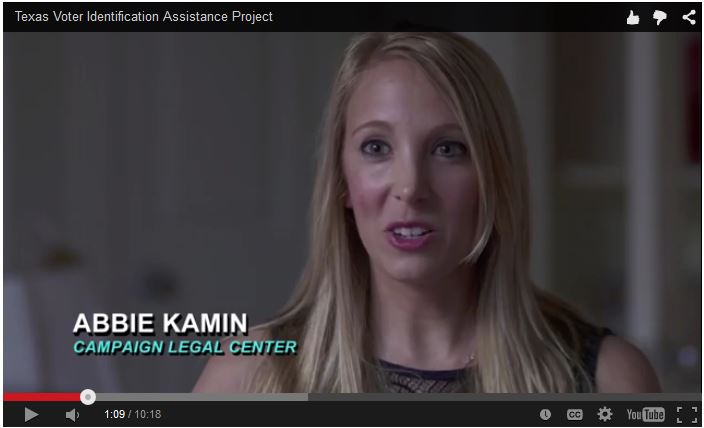
Abbie Kamin, a Houston lawyer assisting Texas voters keep their right to vote, explains how Texas's voter ID laws hurt Texans, and damage democracy in the U.S.

Abbie Kamin, a Houston lawyer assisting Texas voters keep their right to vote, explains how Texas’s voter ID laws hurt Texans, and damage democracy in the U.S.

Video you won’t see at 11.

From the Texas Voter Identification Assistance Project, at the Campaign Legal Center.

Description:
Published on Apr 24, 2015

Under Texas’ new restrictive photo/voter ID law, more than 600,000 Texans now lack sufficient identification to vote in elections, with little to no help from the State of Texas to resolve the problems. The Texas Voter Identification Assistance Project, coordinated by the Campaign Legal Center, a nonpartisan nonprofit, provided assistance to Texas voters who wished to vote but lacked the newly required identification, and thus were disenfranchised.

At the Campaign Legal Center’s site, there’s a press release on the video, released to correspond with arguments on voter identification issues at the Fifth Circuit Court of Appeals.

CLC FILM RELEASE: On Day of Fifth Circuit Oral Argument, Meet Victims of Texas Voter Photo ID Law

CLC Staff

Apr 28, 2015

Today, the Campaign Legal Center released a short film focusing on three lifelong voters disenfranchised by Texas’ voter photo ID law (SB 14), the most restrictive and burdensome voter ID law in the nation.  The ten-minute film produced by Firelight Media traces the efforts of the Campaign Legal Center’s Voter ID Project to assist registered voters to overcome the many hurdles erected by the new law in order to obtain the photo IDs required by SB 14.

Today in Veasey v. Abbott, oral arguments will be heard in a challenge to that law, in the U.S. Court of Appeals for the Fifth Circuit in New Orleans.  Attorneys at the Campaign Legal Center serve as co-counsel for plaintiffs Congressman Marc Veasey, LULAC, and a group of Texas voters.

Following a two-week trial last fall, U.S. District Court Judge Nelva Gonzales Ramos enjoined SB 14, finding that it was as an unconstitutional burden on the right to vote as well as an unconstitutional poll tax, had “an impermissible discriminatory effect against Hispanics and African-Americans, and was imposed with an unconstitutional discriminatory purpose.”  The state defendants immediately appealed Judge Ramos’ decision. In mid-October, the Fifth Circuit Court of Appeals stayed that decision solely to avoid confusion in the November 2014 elections, and the U.S. Supreme Court subsequently refused to vacate the Fifth Circuit’s stay.

The film released today traces the plight of three Texans who were victims of the Texas voter photo ID law and the massive effort required of many voters to exercise their right to vote under the new law.

“These longtime voters were had their voting rights violated because of SB 14 which the District Court found to be unconstitutional and in violation of the Voting Rights Act,” said J. Gerald Hebert, Executive Director of The Campaign Legal Center.  “The plight of these victims, who suffered a violation of their voting rights through no fault of their own, mirrors the evidence that prompted Judge Ramos to strike down Texas’ intentionally discriminatory, modern-day poll tax.”

The first challenge (Veasey v. Perry) to the Texas photo ID law was filed by the Campaign Legal Center and others in the summer of 2013 claiming that SB 14 violates the 1st, 14th, 15th and 24th Amendments to the Constitution, as well as Section 2 of the Voting Rights Act.  Several additional challenges were then brought against the Texas law (including one by the United States).  All of the cases were consolidated in the Southern District of Texas in Corpus Christi.

In addition to overseeing the Voter ID Project, the Campaign Legal Center is part of the legal team representing the Veasey-LULAC plaintiffs that includes Chad Dunn and K. Scott Brazil (Brazil & Dunn), Neil G. Baron, David Richards (Richards, Rodriguez & Skeith), Armand Derfner (Derfner & Altman), and Luis Roberto Vera, Jr. (LULAC).

To read the Legal Center’s Fifth Circuit brief, click here.

To read the District Court decision striking down the Voter ID law, click here.

Tip of Millard’s old scrub brush to Michael Li.


Close one: Turns out Obama’s not the antichrist

February 16, 2015

In case you were worried:

http://twitter.com/TheFix/status/567111784184938496

That appeared in the Lexington Dispatch, in Lexington, North Carolina.  Wish they had that paper at my newsstand.

Read the rest of this entry »


God blessed February 12, 1809, with Darwin and Lincoln

February 12, 2015

Is it an unprecedented coincidence?  206 years ago today, just minutes (probably hours) apart according to unconfirmed accounts, Abraham Lincoln was born in a rude log cabin on Nolin Creek, in Kentucky, and Charles Darwin was born into a wealthy family at the family home  in Shrewsbury, England.

Gutzon Borglums 1908 bust of Abraham Lincoln in the Crypt of the U.S. Capitol - AOC photo

Gutzon Borglum’s 1908 bust of Abraham Lincoln in the Crypt of the U.S. Capitol – Architect of the Capitol photo

Lincoln would become one of our most endeared presidents, though endearment would come after his assassination.  Lincoln’s bust rides the crest of Mt. Rushmore (next to two slaveholders), with George Washington, the Father of His Country, Thomas Jefferson, the author of the Declaration of Independence, and Theodore Roosevelt, the man who made the modern presidency, and the only man ever to have won both a Congressional Medal of Honor and a Nobel Prize, the only president to have won the Medal of Honor.  In his effort to keep the Union together, Lincoln freed the slaves of the states in rebellion during the civil war, becoming an icon to freedom and human rights for all history.  Upon his death the entire nation mourned; his funeral procession from Washington, D.C., to his tomb in Springfield, Illinois, stopped twelve times along the way for full funeral services.  Lying in state in the Illinois House of Representatives, beneath a two-times lifesize portrait of George Washington, a banner proclaimed, “Washington the Father, Lincoln the Savior.”

Charles Darwin statue, Natural History Museum, London - NHM photo

Charles Darwin statue, Natural History Museum, London – NHM photo

Darwin would become one of the greatest scientists of all time.  He would be credited with discovering the theory of evolution by natural and sexual selection.  His meticulous footnoting and careful observations formed the data for ground-breaking papers in geology (the creation of coral atolls), zoology (barnacles, and the expression of emotions in animals and man), botany (climbing vines and insectivorous plants), ecology (worms and leaf mould), and travel (the voyage of H.M.S. Beagle).  At his death he was honored with a state funeral, attended by the great scientists and statesmen of London in his day.  Hymns were specially written for the occasion.  Darwin is interred in Westminster Abbey near Sir Isaac Newton, England’s other great scientist, who knocked God out of the heavens.

Lincoln would be known as the man who saved the Union of the United States and set the standard for civil and human rights, vindicating the religious beliefs of many and challenging the beliefs of many more.  Darwin’s theory would become one of the greatest ideas of western civilization, changing forever all the sciences, and especially agriculture, animal husbandry, and the rest of biology, while also provoking crises in religious sects.

Lincoln, the politician known for freeing the slaves, also was the first U.S. president to formally consult with scientists, calling on the National Science Foundation (whose creation he oversaw) to advise his administration.  Darwin, the scientist, advocated that his family put the weight of its fortune behind the effort to abolish slavery in the British Empire.  Each held an interest in the other’s disciplines.

Both men were catapulted to fame in 1858. Lincoln’s notoriety came from a series of debates on the nation’s dealing with slavery, in his losing campaign against Stephen A. Douglas to represent Illinois in the U.S. Senate.  On the fame of that campaign, he won the nomination to the presidency of the fledgling Republican Party in 1860.  Darwin was spurred to publicly reveal his ideas about the power of natural and sexual selection as the force behind evolution, in a paper co-authored by Alfred Russel Wallace, presented to the Linnean Society in London on July 1, 1858.   On the strength of that paper, barely noticed at the time, Darwin published his most famous work, On the Origin of Species, in November 1859.

The two men might have got along well, but they never met.

What unusual coincidences.

Go celebrate human rights, good science, and the stories about these men.

A school kid could do much worse than to study the history of these two great men.  We study them far too little, it seems to me.

Resources:

Charles Darwin:

Abraham Lincoln:

More:

Anybody know what hour of the day either of these men was born?

Yes, you may fly your flag today for Lincoln’s birthday, according to the Flag Code; the official holiday, Washington’s Birthday, is next Monday, February 16th — and yes, it’s usually called “President’s Day” by merchants and calendar makers. You want to fly your flag for Charles Darwin? Darwin never set foot in North America, remained a loyal subject of Her Majesty, Queen Victoria, to the end of his days. But go ahead. Who would know?

Yes, this is mostly an encore post.  Fighting ignorance requires patience.

Yes, this is mostly an encore post. Fighting ignorance requires patience.


Who wrote “A Day in the Life of Joe Republican?”

January 30, 2015

As it came to me. Similar to a module we used to use in Orrin Hatch speeches back in the Pleistocene (probably would have gotten him voted out if he used the old module now, let alone this one).

Why do these essays usually come with no author, or “author unknown?”  I’ve tracked it down to Crooks and Liars and a recitation by Thom Hartmann, who attributes it to a guy named John Gray in Cincinnati, in 2004. Is that right?

A Day In the Life of Joe Republican

Joe gets up at 6 a.m. and fills his coffeepot with water to prepare his morning coffee. The water is clean and good because some tree-hugging liberal fought for minimum water-quality standards. With his first swallow of water, he takes his daily medication. His medications are safe to take because some stupid commie liberal fought to ensure their safety and that they work as advertised.

All but $10 of his medications are paid for by his employer’s medical plan because some liberal union workers fought their employers for paid medical insurance – now Joe gets it too.

He prepares his morning breakfast, bacon and eggs. Joe’s bacon is safe to eat because some girly-man liberal fought for laws to regulate the meat packing industry.

In the morning shower, Joe reaches for his shampoo. His bottle is properly labeled with each ingredient and its amount in the total contents because some crybaby liberal fought for his right to know what he was putting on his body and how much it contained.Joe dresses, walks outside and takes a deep breath. The air he breathes is clean because some environmentalist wacko liberal fought for the laws to stop industries from polluting our air.

He walks on the government-provided sidewalk to subway station for his government-subsidized ride to work. It saves him considerable money in parking and transportation fees because some fancy-pants liberal fought for affordable public transportation, which gives everyone the opportunity to be a contributor.

Joe begins his work day. He has a good job with excellent pay, medical benefits, retirement, paid holidays and vacation because some lazy liberal union members fought and died for these working standards. Joe’s employer pays these standards because Joe’s employer doesn’t want his employees to call the union.

Hal Coffman in the New York American, 1912. Via Superitch

Hal Coffman in the New York American, 1912. Via Superitch

If Joe is hurt on the job or becomes unemployed, he’ll get a worker compensation or unemployment check because some stupid liberal didn’t think he should lose his home because of his temporary misfortune.

It is noontime and Joe needs to make a bank deposit so he can pay some bills. Joe’s deposit is federally insured by the FDIC [FSLIC] because some godless liberal wanted to protect Joe’s money from unscrupulous bankers who ruined the banking system before the Great Depression.

Joe has to pay his Fannie Mae-underwritten mortgage and his below-market federal student loan because some elitist liberal decided that Joe and the government would be better off if he was educated and earned more money over his lifetime. Joe also forgets that in addition to his federally subsidized student loans, he attended a state funded university.

Joe is home from work. He plans to visit his father this evening at his farm home in the country. He gets in his car for the drive. His car is among the safest in the world because some America-hating liberal fought for car safety standards to go along with the tax-payer funded roads.

He arrives at his boyhood home. His was the third generation to live in the house financed by Farmers Home Administration because bankers didn’t want to make rural loans.

The house didn’t have electricity until some big-government liberal stuck his nose where it didn’t belong and demanded rural electrification.

He is happy to see his father, who is now retired. His father lives on Social Security and a union pension because some wine-drinking, cheese-eating liberal made sure he could take care of himself so Joe wouldn’t have to.

Joe gets back in his car for the ride home, and turns on a radio talk show. The radio host keeps saying that liberals are bad and conservatives are good. He doesn’t mention that the beloved Republicans have fought against every protection and benefit Joe enjoys throughout his day. Joe agrees: “We don’t need those big-government liberals ruining our lives! After all, I’m a self-made man who believes everyone should take care of themselves, just like I have.”

Thom Hartmann recites:


Je suis Charlie!

January 8, 2015

If you follow my Tweets, or if you watch what I post on Facebook, you may have noticed I frequently credit editorial cartoonists with telling the truth.  Cartoonists fill a critical need.  I admire their work.

That’s not strong enough.  I find that political cartoons offer truths, in quickly grokable form, that would remain hidden in news and commentary otherwise.

Perhaps more importantly, cartoons lampoon those who desperately, bitterly need lampooning.

Why is that important?  Lampooning exposes crazy behaviors in our leaders, behaviors that if unchecked might lead a group to disaster.  Or a community.  Or a nation.  Or a planet.

Ancient sayings, properly and improperly attributed to various sources, over a period of 500 to 1,000 years point to the importance of lampooning in correcting actions of leaders and governments.  This version comes from a Sophocles play, Antigone (620-3):

For cunningly of old
was the celebrated saying revealed:
evil sometimes seems good
to a man whose mind
a god leads to destruction.

Lampooning helps, illustrating perhaps with laughter where the problem lies, though it also suggests that the chief perpetrators and promulgators of the craziness may be immune from such insights, whether through laughter or any other method.

If those lampooned genuinely cannot see the humor, a greater problem is exposed.  That’s the point. Expose the madness, lay it bare for all to see.  Sane people will work to help the insane, and avoid leading others into that madness.  Lampooning provides us a great tool to avoid disasters, if we would only look. Laughter is optional, if the message gets through.

Even insane leaders and groups understand this at some level. Mark Twain (Samuel Clemens) wrote about the value of ridicule of majestic error in his Notebook:

No god and no religion can survive ridicule. No church, no nobility, no royalty or other fraud, can face ridicule in a fair field and live.*

We got a sharp and painful reminder of these facts yesterday, when a group of gunmen, stung by ridicule from a French satire magazine, stormed that magazine’s offices and brutally gunned down a score of people, a dozen of whom died.  Their form of religious struggle appears insane to sane people, and when that is pointed out to them, they behave with more intense insanity.

To these gunman, whose existence alone is a blasphemous assault on the idea of peaceful religion, ridicule in publication was too much to take.  Rather than answer with other cartoons or parody, or serious thought in print, they attempted to change the playing field’s fairness.

In doing they exposed their critics as accurate and true. Those already crazed by the gods probably have no sense of irony left, either.

This morning comes the word that Charlie Hebdo will publish next week as scheduled.  Instead of the usual run of 113,000 copies, the first run will be more than a million, to meet greater demand. Stricken down by gunmen, Charlie Hebdo rises phoenix-like, with strength multiplied by more than ten.

We mourn the cartoonists and editors lost.  They are martyrs in the cause of freedom and peace, and especially in the “jihad” they engage in for freedom of expression, something that we know now is not a uniquely American virtue or necessity.

Throughout history memorable phrases heralded periods of great change, when people took a stand against tyranny and violence, and stood for freedom and peace.

I am Spartacus.

Here I stand.  I can do no other.”

“Union!”

“. . . the only thing we have to fear is fear itself.”

” . . . Freedom of speech and expression . . . Freedom of every person to worship God in his own way . . . Freedom from Want . . . Freedom from Fear. . .”

Ich bin ein Berliner.

We Shall Overcome

I Am A Man.”

And now, “Je suis Charlie!”

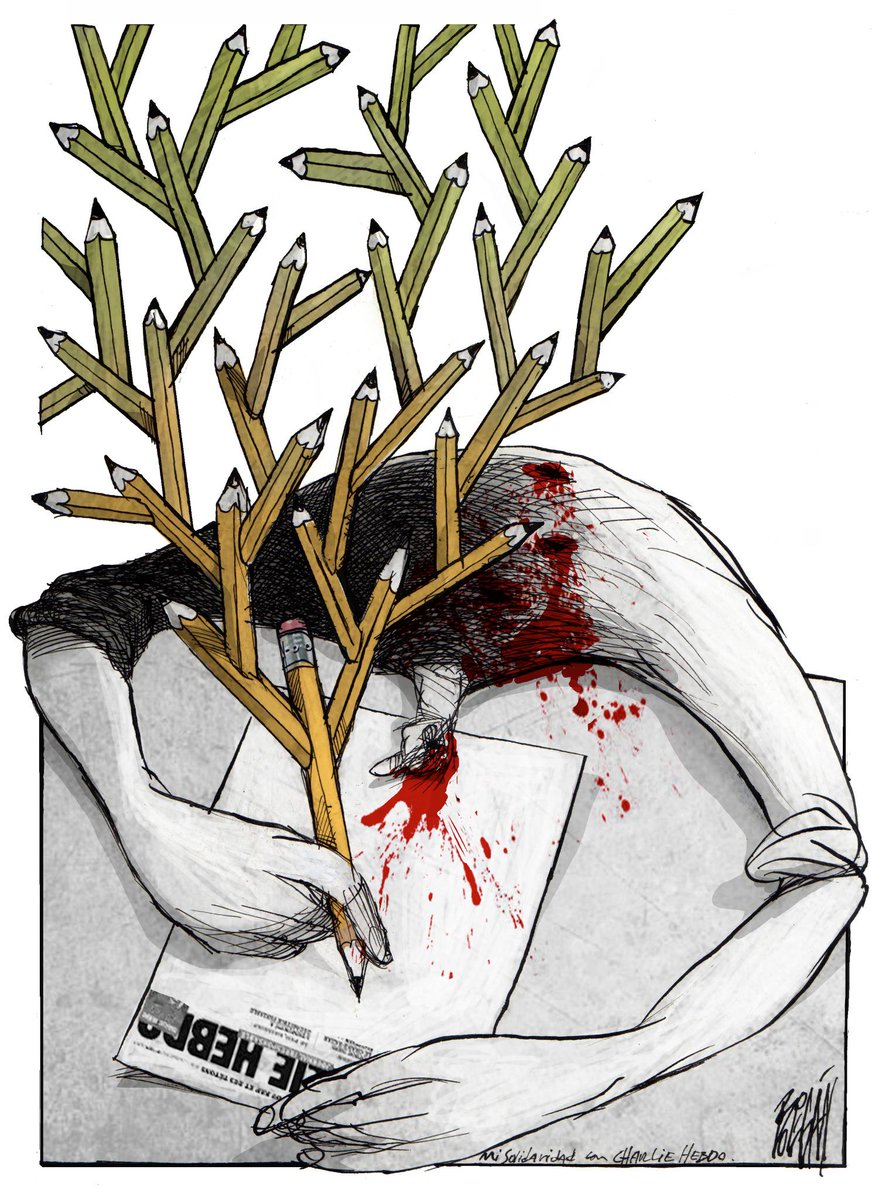
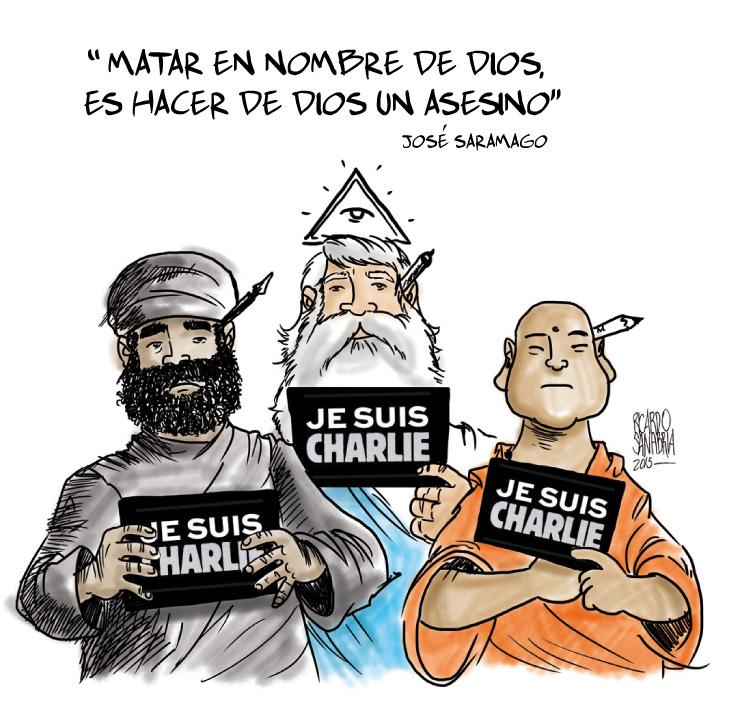
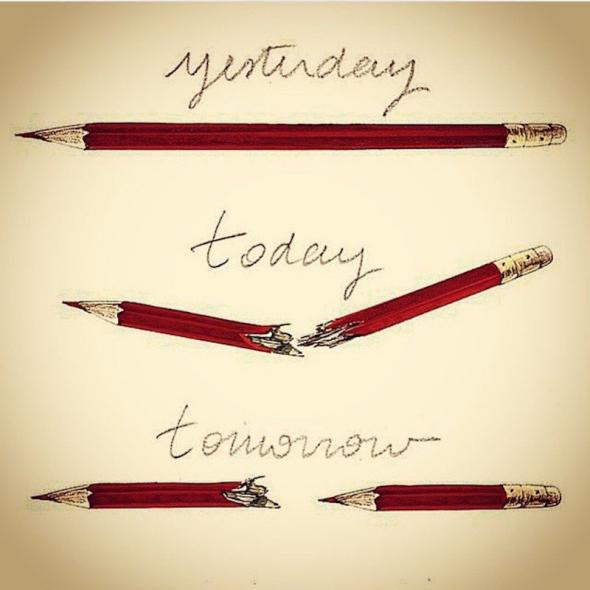
Beyond Charlie Hebdo, the world’s cartoonists and editorialists storm traditional and electronic media with support for the cartoonists.  Here below are some examples, in no particular order.  What other cartoons or commentary have you seen that we all should see?

Andy Marlette, cartoonist for the Pensacola News-Journal borrowed the saying from the sticker that Woody Guthrie used on his guitar, “This Machine Kills Fascists”:

Andy Marlette of the Pensacola News-Journal, borrowing from Woody Guthrie's guitar

Andy Marlette of the Pensacola News-Journal, borrowing from Woody Guthrie’s guitar

Pete Seeger borrowed Woody’s line, and painted on the drum head of his banjo, “This Machine Surrounds Hate and Forces It to Surrender.” Marlette also penned a piece for USA Today.

Cuban Angel Boligan (@AngelBoligan):

Cuban-born cartoonist Angel Boligan, on Charlie Hebdo

Cuban-born cartoonist Angel Boligan, on Charlie Hebdo

Nate Beeler in the Columbus Dispatch:

Nate Beeler's cartoon on Charlie Hebdo, for the Columbus Dispatch

Nate Beeler’s cartoon on Charlie Hebdo, for the Columbus Dispatch

Pat Bagley in the Salt Lake Tribune:

Pat Bagley, Salt Lake Tribune

Pat Bagley, Salt Lake Tribune

Ricardo Sanabria in Venezuela:

Ricardo Sanabria, Venezuela

Ricardo Sanabria, Venezuela

Manjool, an Indian cartoonist:

“Last message from #CharlieHebdo cartoonists to their killers. My #cartoon “

Clay Bennett at the Chattanooga, Tennessee newspapers:

Clay Bennett's cartoon on the tragedy at Charlie Hebdo

Clay Bennett’s cartoon on the tragedy at Charlie Hebdo

NOT by Banksy, but by Lucille Clerc:

Cartoon by Lucille Clerc

Cartoon circulated as by Banksy, but really by graphic designer Lucille Clerc

John Cole, Scranton Times-Tribune:

@AnnePhutto said:  Je suis Charlie...my 12 year old daughter's favorite cartoon in response to the tragedy.  Cartoon by John Cole, Scranton News-Tribune

@AnnePhutto said: Je suis Charlie…my 12 year old daughter’s favorite cartoon in response to the tragedy. Cartoon by John Cole, Scranton Times-Tribune

Charlie Hebdo dead?  I don’t think so.

______________

*  Twain also warned against taking ridicule too far, and spoke on the difficulty of knowing, if you’re the butt of the ridicule:

  • Sense of ridicule is bitterer than death & more feared. — men commit suicide daily to escape it.
    Mark Twain’s Notebooks and Journals, Vol. 3, p. 346.
  • There is no character, howsoever good and fine, but it can be destroyed by ridicule, howsoever poor and witless. Observe the ass, for instance: his character is about perfect, he is the choicest spirit among all the humbler animals, yet see what ridicule has brought him to. Instead of feeling complimented when we are called an ass, we are left in doubt.
    Pudd’nhead Wilson

More:


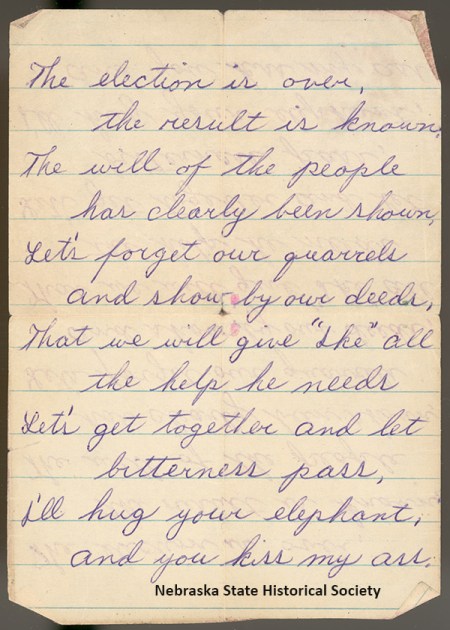
Post-election kissing and making up

December 21, 2014

Someone, now I forget who, sent me this little ditty in the wake of Barack Obama’s election victory in 2012.

The election is over,
The talking is done.

From CarStickers.com

From CarStickers.com

Your party lost.
My party won.

So let us be friends,
Let arguments pass.
I’ll hug your elephant,
If you kiss my ass.

I wondered who wrote it.  My handwritten note says whoever sent it to me said they got it off the internet.

Who needs plagiarism with the WorldWide Web? The usual tendencies to attribute witty or snarky sayings to famous people, and to strip actual authorship, get huge boosts from the internet. Mark Twain said a good lie could get around the Earth seven times before truth gets its boots on — with the internet, the lies, falsehoods and lack-of-appropriate attribution pieces fly at the speed of electronic interchange, near the speed of light but for the copper in the wires.

Here, a couple of years later, it could come into use again. Have I learned any more about who wrote it? Not really.  I looked, and didn’t find an authoritative version with an author’s name attached, which looks to be final.

From Etsy and ThinkOutLoudApparel.

From Etsy and ThinkOutLoudApparel.

This version claims to come from 1972, and the re-election of Richard Nixon:

The election is over, the results are now known,
The will of the people has clearly been shown.

Let’s all get together and show by our deeds,
That we will give Dick all the help that he needs.

Let bygones by bygones and all bitterness pass,
I’ll hug your elephant if you kiss my ass.

Still no author; from 2004:

The election is over, the results are now known.
The will of the people has clearly been shown.
We should show by our thoughts and our words and our deeds
That unity is just what our country now needs.
Let’s all get together. Let bitterness pass.
I’ll hug your elephant.
You kiss my ass.

We might assume it’s been around at least since Nixon’s second election then. I’ll wager it goes back farther into the recesses of history.

But does anyone know for sure? It’s been around long enough to have made the leap to bumperstickers, and other political paraphernalia.

Help us out in comments, if you have information.
[Update December 2020]

Handwritten note suggesting the poem comes no later than 1956; sadly, note comes from the wallet of a murder victim. History Nebraska blog

Handwritten note suggesting the poem comes no later than 1956; sadly, note comes from the wallet of a murder victim. History Nebraska blog

From Kaboodle.com

From Kaboodle.com

[Editor’s note: What was the image from Kaboodle.com, that is now no longer available there? December 2020]


December 1, 1955: “Why do you push us around?” Rosa Parks asked the cop. (Anyone know the answer?)

December 1, 2014

Mrs. Rosa Parks asked a question of the policeman who arrested her for refusing to move to the back of the bus. In 2014, it’s a chilling question, to which we have no good answer.

Rosa Parks being fingerprinted, Library of Congress

Mrs. Parks being fingerprinted in Montgomery, Alabama; photo from New York World-Telegram & Sun Collection, Library of Congress

Rosa Parks: “Why do you push us around?”

Officer: “I don’t know but the law is the law and you’re under arrest.”

From Rosa Parks with Gregory J. Reed, Quiet Strength
(Grand Rapids, MI: Zondervan Pub. House, 1994), page 23.

Photo: Mrs. Parks being fingerprinted in Montgomery, Alabama; photo from New York World-Telegram & Sun Collection, Library of Congress

Today in History at the Library of Congress provides the simple facts:

On the evening of December 1, 1955, Rosa Parks, an African American, was arrested for disobeying an Alabama law requiring black passengers to relinquish seats to white passengers when the bus was full. Blacks were also required to sit at the back of the bus. Her arrest sparked a 381-day boycott of the Montgomery bus system and led to a 1956 Supreme Court decision banning segregation on public transportation.

Rosa Parks made a nearly perfect subject for a protest on racism. College-educated, trained in peaceful protest at the famous Highlander Folk School, Parks was known as a peaceful and respected person. The sight of such a proper woman being arrested and jailed would provide a schocking image to most Americans. Americans jolted awake.

Often lost in the retelling of the story are the threads that tie together the events of the civil rights movement through the 1940s, 1950s and 1960s. As noted, Parks was a trained civil rights activist. Such training in peaceful and nonviolent protest provided a moral power to the movement probably unattainable any other way. Parks’ arrest was not planned, however. Parks wrote that as she sat on the bus, she was thinking of the tragedy of Emmet Till, the young African American man from Chicago, brutally murdered in Mississippi early in 1955. She was thinking that someone had to take a stand for civil rights, at about the time the bus driver told her to move to allow a white man to take her seat. To take a stand, she kept her seat.

African Americans in Montgomery organized a boycott of the Montgomery bus system. This was also not unique, but earlier bus boycotts are unremembered. A bus boycott in Baton Rouge, Louisiana, earlier in 1955 did not produce nearly the same results.

The boycott organizers needed a place to meet, a large hall. The biggest building in town with such a room was the Dexter Street Baptist Church. At the first meeting on December 5, it made sense to make the pastor of that church the focal point of the boycott organizing, and so the fresh, young pastor, Rev. Dr. Martin Luther King, Jr., was thrust into civil rights organizing as president, with Ralph Abernathy as program director. They called their group the Montgomery Improvement Association (MIA). When their organizing stretched beyond the city limits of Montgomery, the group became the Southern Christian Leadership Conference.

Litigation on the boycott went all the way to the Supreme Court (Browder v. Gale). The boycotters won. The 381-day boycott was ended on December 21, 1956, with the desegregation of the Montgomery bus system.

Sources for lesson plans and projects:

Yes, this is mostly an encore post.  Fighting ignorance requires patience.

Yes, this is mostly an encore post. Fighting ignorance requires patience.


Tip of the old scrub brush to Slacktivist, who gave this post a nice plug.