May 6, 2008
One of the affairs Ben Stein’s mockumentary covers is the Sternberg affair, in which a creationist bent the rules of the biology society whose journal he was editing to sneak into publication an article purporting to promote intelligent design. Stein claims the guy suffered persecution, though under cross examination in the Dover trial, no ID advocate could remember just what that persecution might be (creationists go quiet under oath . . . hmmm).
The mackarel by moonlight in that story (both shining and stinking at the same time) was a letter from the Office of Special Counsel which, while claiming to have found unspecified evidence of wrongdoing, said that OSC was the wrong agency to prosecute wrong-doers (OSC had an obligation to turn over any evidence of wrongdoing to the right agency, but Stein doesn’t mention that; there never was any evidence turned over to anyone).
Um, don’t look now, but the FBI raided the office of the OSC today, looking for evidence of wrongdoing. FBI and inspector general investigators appear to be looking into charges that the head of the office, Scott Bloch, retaliated against certain employees who, he suspected, had leaked information about political moves he had made in the legally non-political agency.

- Jim Mitchell, communications director for the Office of the Special Counsel, in Washington on Tuesday. (New York Times caption). AP Photo by J. Scott Applewhite
Will Ben Stein do an update?
Resources:
Spread the word; friends don't allow friends to repeat history.
 1 Comment |
  Charles Darwin, Creationism, Darwin, Evolution, Intelligent Design, Jurisprudence, Justice, Law, Research, Voodoo science, War on Science | Tagged: Ben Stein, Corruption, Creationism, Politics, Science, Sternberg, War on Science |
  Permalink
 Posted by Ed Darrell
May 6, 2008
Living through the Watergate scandals and the Constitutional crises they produced — and spending part of that time in Washington, D.C., working for the Senate — I got a wonderful view of how constitutional government works, why it is important that good people step up to make it work, and a glimpse of what happens when good people lay back and let the hooligans run amock.
Over the last three months it occurs to me that we may be living in a similar time, when great but latent threats to our Constitution and the rule of law may be halted or rolled back by one John Dean-like character who will stand up before a group of elected officials, swear to tell the truth, and then, in fact, tell the whole truth.
Teachers, are you taking advantages of these lessons in civics that come into our newspapers every day?
We live in interesting times, exciting times — we live in educational times.
You should be clipping news stories on these events, and you should be using them in your classrooms today, and saving them for the fall elections, for the January inauguration, for the new Congress . . . and for your future classes.
What other opportunities for great civics lessons come to our doorsteps every day?
Spread the word; friends don't allow friends to repeat history.
Leave a Comment » | Accuracy, Checks and Balances, Government, Heroes, Journalism, Justice, Law, Leadership, Lessons of history, Scandals, U.S. Constitution, U.S. House of Representatives, Watergate scandal | Tagged: Checks and Balances, civics, Constitution, Current Events, Government, Newspapers, Politics, Teaching, U.S. Congress | Permalink
Posted by Ed Darrell
May 3, 2008
Utah rejected education vouchers last November, so the release from the Census bureau at the first of April probably got overlooked as not exactly important — I saw no major story on it in any medium.
 Maybe it was the April 1 release date.
Whatever the reason for the lack of recognition, the figures are out from the Census Bureau, and Utah’s at the bottom end of spending per student lists, in the U.S. I wrote earlier that Utah gets a whale of a bargain, since teachers work miracles with the money they have. But miracles can only go so far. Utah’s educational performance has been sliding for 20 years. Investment will be required to stop the slide.
Utah’s per pupil spending is closer to a third that of New York’s.
Of course, spending levels do not guarantee results. New York and New Jersey lead the pack, but the District of Columbia comes in third place. Very few people I know would swap an education in Idaho, Utah or Arizona, the bottom three in per pupil spending, for an education in D.C.
Public Schools Spent $9,138 Per Student in 2006
School districts in the United States spent an average of $9,138 per student in fiscal year 2006, an increase of $437 from 2005, according to a U.S. Census Bureau report released today.
Public Education Finances: 2006 offers a comprehensive look at the revenues and expenditures of public school districts at the national and state levels. The report includes detailed tables that allow for the calculation of per pupil expenditures. Highlights from these tables include spending on instruction, support services, construction, salaries and benefits of the more than 15,000 school districts. Public school districts include elementary and secondary school systems.
All the census statistics are on-line, for free. Policy makers can mine these data for insights — will they? You may download the data in spreadsheet or comma-delimited data form.
The rest of the press release is pure policy talking points:
Spread the word; friends don't allow friends to repeat history.
21 Comments | Classroom size, Economics, Education, Education reform, Education spending, Education success, Government, Politics, Public education, Teacher Pay, Teaching, War on Education | Tagged: Education, Education spending, Government, Politics, School Finance | Permalink
Posted by Ed Darrell
May 1, 2008
Our usual free press in history discourse suggests that the press, especially the newspapers, were more partisan in the early days of our republic than they are now. American Aurora tells the story of newspaper editors being thrown in jail during the administration of John Adams, for example, for their excesses (which may merit being known as “rabid” excesses).
Regnery Publishing is today at least as inaccurate, if not as completely vitriolic, as any of the nasty newspapers published in the John Adams administration. Regnery is the publisher of Jonathan Wells’ mostly fictional, all incorrect account of biology, Icons of Evolution, for example.
Regnery once again pushes the bounds of propriety with a new book by Iain Murray with a title that tells all the author thinks he knows: The Really Inconvenient Truths: Seven Environmental Catastrophes Liberals Don’t Want You to Know About–Because They Helped Cause Them.
You can bet the conservative and anti-science, and anti-environmental protection blogs will light up with this book.
I see from the index on Amazon that I get a mention. I hope Murray claims I caused one of those disasters. You can bet that if he says it, the opposite is true.
In the past couple of months I have had a couple of opportunities to spend some time in libraries and with databases. Checking out the citations from Steven Milloy’s “100 things” about DDT list, I discovered not a single citation relating to DDT’s effects on birds was correct; those articles that did exist concluded opposite what Milloy claims. Some of the articles simply didn’t exist. Bet Murray doesn’t question a single claim from Milloy.
And, did you know that DDT problems were common items for newspapers through the 1950s? You won’t learn that from Murray’s book.
Update, May 2: I have a copy of the book (Regnery did not provide it); it’s worse than I had imagined. Examples: The quote from this blog is criticized as being inaccurate; the quote describes Bush administration policies in 2004 and corporate actions in Uganda to discourage DDT spraying which continue. Murray’s rebuttal discusses Bush administration actions taken two years later, but fails to note that they have not yet worked.
Worse example: Murray has an entire chapter accusing “environmentalists” of being asleep at the switch for damages to fish and other wildlife due to birth control pill residues in the water; he fails to mention that DDT causes exactly the same problems. He fails to note that DDT and especially DDE are endocrine disruptors usually cited as culprits in these cases. He fails to note that the issues are at the top of the list of environmental organizations involved in fish, river conservation, and pesticide safety issues. Regnery’s name is rapidly becoming synonymous with”wildly inaccurate and politically skewed.”
Alas, that’s what I got from a skim of the book before this evening’s meetings.
Spread the word; friends don't allow friends to repeat history.
3 Comments | Accuracy, Business Ethics, DDT, Debunking, Ethics, Journalism, Junk science, Rachel Carson, Science, Voodoo history, Voodoo science | Tagged: DDT, denialism, Environmental protection, Junk science, Politics, Science, Voodoo science | Permalink
Posted by Ed Darrell
April 29, 2008
From a paid advertisement in The Daily Oklahoman:


Full text below the fold, should you find it difficult to read this ad on your browser.
Other resources:
Read the rest of this entry »
Spread the word; friends don't allow friends to repeat history.
4 Comments | Boy Scouts of America, Civil Rights, Eagle Scout, Ethics, History, Human Rights, Parents, Patriotism, Politics, Rampant stupidity | Tagged: Civil Rights, Gay Rights, Hate Agenda, Hate Speech, Oklahoma, Politics, Sally Kern | Permalink
Posted by Ed Darrell
April 27, 2008
Who is this guy?

Are you sure it’s not the same as this guy, below?

Is it possible that England, who thinks it is being led by a fellow named Gordon Brown, of Tony Blair’s Labour Party, is instead being led by Terry Jones, of Monty Python fame?


Are they not the same man? Are you sure?
Have you ever seen director Terry Jones and Prime Minister Gordon Brown photographed together?
Joanne Jacobs was so close to the truth! But she missed it.
It would be so unfair. Britain gets a Python. We get . . . something else.
Update, June 16, 2008: Even better comparison of photos here. I’m having difficulty reading the caption — monitor resolution problems? Can you read the post and translate it here?


Spread the word; friends don't allow friends to repeat history.
5 Comments | History, Humor, Images, Politics | Tagged: Entertainment, Gordon Brown, Humor, Media, Monty Python, Politics, Terry Jones | Permalink
Posted by Ed Darrell
April 25, 2008
April 25, 2008, is World Malaria Day. I’ve purchased some bednets thorugh Nothing But Nets to help fight malaria. Educating others about the disease is one of the chief goals, too.
Will you help, please?
See the statement from the World Malaria Day community below; pass it along to someone else.
April 25th is World Malaria Day and also Malaria Awareness Day in the United States. In observance of this day and in recognition of the tremendous opportunities to reduce the burden that malaria imposes on the health of people worldwide, we, the Malaria Community, stand in support of the following statement.
We Have Made Progress
Dynamic new public and private partnerships and renewed commitments to strengthen
longstanding efforts to combat malaria are showing positive results. Global partners include
bilateral, multilateral and U.N. programs, faith-based groups, business coalitions and private
foundations. The single largest U.S.-funded malaria program, the President’s Malaria Initiative
(PMI), has accomplished the following:
- Indoor residual spraying benefiting more than 17 million people;
- Procurement and distribution of 5 million insecticide-treated mosquito nets;
- Procurement of 12.6 million artemisinin-based combination therapy (ACT) treatments and training of more than 28,000 health workers in use of ACTs; and
- Procurement of malaria treatment for more than 4 million pregnant women.
Expanding Access to Current Interventions
It is imperative that stakeholders in the fight against malaria maximize global access to existing proven interventions including insecticide-treated nets, indoor residual spraying with insecticides, and effective medications. Through generous donor contributions, access to essential interventions is improving—yielding dramatic successes in places like Ethiopia and Rwanda where malaria infections and deaths have decreased by more than 50 percent. But the availability of interventions is only half the battle. We must find means to expand delivery of proven interventions, strengthen the capacity of partner countries to administer basic interventions at the community level, share best practices across countries, and motivate individuals to protect themselves and their families.
Investing in New Tools
Simultaneously, we must increase investment in developing new, improved technologies for controlling malaria, including effective drugs, insecticides, and vaccines. Resistance to the most commonly prescribed drugs in most countries has been rapidly increasing. Artemisinin-based combination therapies (ACTs) must be readily available and affordable, and new therapies must be developed to prevent resistance to ACTs and eventually replace them. The U.S. government’s commitment to expedite the development of highly effective malaria vaccines is needed now, understanding that the process will take significant time and investment. The potential of developing a vaccine of even limited efficacy could have a significant impact on deaths and illness, especially among infants and young children.
Global Problem, Local Solutions
Achieving results will also depend on the effective engagement of national, regional and local governments in the effective deployment of malaria control tools. To guarantee the best use of resources, steps must be taken to ensure that anti-malaria tools, research and investment reach the communities that need them the most, while ensuring that no community is left unsupported. Community-based efforts to deliver malaria prevention and treatment programs must inform the development of the comprehensive global strategy needed so that efforts can be sustained over time. All stakeholders need to be engaged in thoughtful, coordinated planning that brings to bear the best evidence from all levels of efforts to control or eliminate malaria while addressing changes in the epidemiology of the disease.
Note carefully and well that the major organizations fighting malaria neither slam Rachel Carson, whose methods they use to fight malaria today, nor call for a return to wholesale poisoning of Africa and Asia with DDT, but instead urge wise use of resources including an expansion of health care to aid the human victims of malaria. Malaria is the problem, not science.
World Malaria Day is a logical extension of Earth Day; the two are not in opposition.
More Resources:
Spread the word; friends don't allow friends to repeat history.
Leave a Comment » | Africa, DDT, Health care, Malaria, Politics, Rachel Carson, Science, Travel, War on Science | Tagged: Africa, DDT, health, Politics, Science, World Malaria Day | Permalink
Posted by Ed Darrell
April 22, 2008
There’s a guy who doesn’t like my comments on his blog, so he’s banned me. Every once in a while I find a headline or link to something, and it takes me over there — and I remember why he doesn’t like my comments.
Rationality and accuracy are barriers to be overcome for some bloggers, and this guy often falls into that category. Today he’s bummed that gay students and their friends and relatives protest bullying of gays with a Day of Silence. Neil Simpson wrote:
The Day of Silence (where schools encourage kids to be completely silent for a day to protest alleged discrimination against gays) is back, and students’ rights are being violated left and right. It is bad enough that they disrupt the learning process for a whole day, but now some schools aren’t permitting students to miss school that day or instituting other requirements.
Okay, that’s enough. I gotta stop the quoting and make corrections. “Where schools encourage kids to be completely silent for a day?” There is no such place. This is a fabrication of someone. Who?
The link in the quoted paragraph goes to Kevin Bussey’s blog; from there we get a link to a story in WorldNet Daily, perhaps the single greatest source of information pollution on the internet.
But read the story — even WND doesn’t claim that schools are supporting the event. WND only decries the fact that schools won’t bully kids into not supporting the anti-bullying campaign (irony drips from every serif of this story . . .).
Gay clubs and the “Day of Silence” have no purpose in schools. The GLBTX propoganda machine just uses the Trojan Horse of being anti-bullying to get them in. It is all part of the drive not just for tolerance, not just for affirmation, but to silence all critics.
But why have sex clubs and school-sponsored protest days just for that? All you need is a simple and thoroughly enforced anti-bullying policy:
If you physically or verbally harass other students on or off school grounds you will have swift and serious consequences. It doesn’t matter if you are bullying because they are gay / straight / fat / thin / smart / dumb / pretty / ugly / etc., or if it is just because you are a mean jerk. Zero tolerance. Training over. Now go to class and learn something.
Bullying is wrong. I would always protect gays if they were being bullied, but that isn’t what this issue is really about. If it was, then the kids who are picked on for all those other reasons should get a special day as well, and schools wouldn’t persecute students who wanted to opt out of this special day.
Just a stand against bullying? Maybe Simpson will take a stand against bullying, you think? Maybe Simpson would urge his friends at the Texas State Board of Education to rejoin the National Association of State Boards of Education (NASBE). Texas pulled out a few months back, protesting the anti-bullying curriculum NASB had put together. The Texas officials — speaking for themselves, not necessarily the people of Texas, let me assure you — said they didn’t like the part that said “don’t bully gays.”
When stuff like that happens, people will on occasion use their First Amendment right to petition and right to assemble and freedom of speech to protest the stupidity. In the immediate case, the protest takes the form of remaining silent.
When gays and the friends of gays don’t speak, it makes the hardcore fundies crazy. The voices in their heads seem so much louder.
Nuts.
Spread the word; friends don't allow friends to repeat history.
8 Comments | Citizenship, Civil Rights, Education, First Amendment, Freedom of the Press, Politics, Public education, Rampant stupidity, Religion, Religious Freedom, Texas | Tagged: bullying, Christian hypocrisy, Day of Silence, Education, Freedom of Speech, Politics, Religion | Permalink
Posted by Ed Darrell
April 18, 2008
I found such a fantastically wonderful parody of the way denialists think science works . . .
If it’s not parody, the author should stay alert for men in white with nets.
Maybe the author should just stay alert; who can tell parody these days? This thing is so good that I’ll bet it suckers in dozens of denialists.
It’s what you’d expect, after all. Lightning will strike the same lunacy twice, or three times.
Spread the word; friends don't allow friends to repeat history.
5 Comments | Global warming, Hoaxes, Politics, Science, War on Science | Tagged: Al Gore, Climate change, Hoaxes, Humor, Politics, Science | Permalink
Posted by Ed Darrell
April 17, 2008
The kid in Kearny, New Jersey, who caught his U.S. history teacher peddling religion instead, is at it again.
This time he’s targeting a textbook on government — and it happens to be one written by the most right wing of the semi-mainstream government text writers.
Education Gadfly has the story here, with the Official Fordham Foundation cynicism at anyone who professes to be the the left of Ayn Rand (it’s an endearing cynicism, really — it makes the stuff much more readable, and it indicates that there is gray matter in action behind the comments). CNBC has the Associated Press story here.
Matthew LaClair complains about the book’s slant on climate change and church-state relations — two hot-button issues, to be sure. One wonders why a government text has any view on climate change, and one wonders how anyone could get the church-state thing wrong without criminal intent — but go see for yourself. LaClair, you recall, recorded his U.S. history teacher going on about the glories of Christianity, and blew the whistle. For that Matthew got slapped around unjustly in the local media. He was correct, before, about church state relations, so we might cut him some slack on this complaint.
Read it all; and remember to trust your textbooks no farther than you can throw them. The Bathtub tends to agree with the Gadfly that texts should be accurate, and that the selection processes for texts is out of hand (as defined by Diane Ravitch). But on the other hand, it appears to me that James Q. Wilson and John Dilulio, the authors of the text in question, got some things wrong. They can fix it, and do so with a smile.
Will they?
See also the other bias on the issue, from the Center for Inquiry — with a detailed critique.
http://www.centerforinquiry.net/
Spread the word; friends don't allow friends to repeat history.
1 Comment | Academic freedom, Accuracy, Climate change, Government, History, Textbook Selection, Textbooks | Tagged: Accuracy, Climate change, Education, Politics, Religious Freedom, Textbooks | Permalink
Posted by Ed Darrell
April 15, 2008
In a discussion about teaching evolution in biology classes a few years ago, I had carefully explained how and why the First Amendment does not require creationism to be taught in biology classes, and in fact is the reason that creationism isn’t taught, in the Establishment Clause. My explanation irritated the tarnation out of a creationist woman who exclaimed, “Well, it’s not like the First Amendment is engraved in stone!”
Heh. Guess what I found at Southern Methodist University Saturday. There, outside the main door of the Umphrey Lee Center, which houses the Department of Economics and the Division of Journalism of the Meadows School for the Arts:
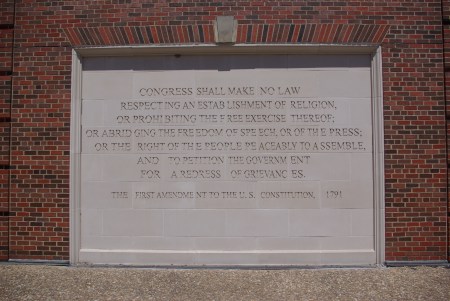
Spread the word; friends don't allow friends to repeat history.
2 Comments | Creationism, History, Politics | Tagged: Constitution, First Amendment, Humor, Law, Politics, Southern Methodist University | Permalink
Posted by Ed Darrell
April 14, 2008
We haven’t persuaded the candidates to discuss science policy, though it directly affects health care policy, the war in Iraq, climate change, and housing. That scrappy little newspaper in York, Pennsylvania got Barack Obama to go on the record against teaching intelligent design, though.
Obama gave about five minutes to a reporter from the York Daily Record, the paper that led the nation in reporting on the Kitzmiller case. They scooped again:
Q: York County was recently in the news for a lawsuit involving the teaching of intelligent design. What’s your attitude regarding the teaching of evolution in public schools?
A: “I’m a Christian, and I believe in parents being able to provide children with religious instruction without interference from the state.
But I also believe our schools are there to teach worldly knowledge and science. I believe in evolution, and I believe there’s a difference between science and faith. That doesn’t make faith any less important than science.
It just means they’re two different things. And I think it’s a mistake to try to cloud the teaching of science with theories that frankly don’t hold up to scientific inquiry.”
Has either Clinton or McCain gone on the record on the issue yet?
Tip of the old scrub brush to the blogs of the Dallas Morning News.
Spread the word; friends don't allow friends to repeat history.
7 Comments | Creationism, Education, Politics, Public education, Science, Teaching | Tagged: 2008 Presidential Race, Creationism, Education, Intelligent Design, Politics, Science | Permalink
Posted by Ed Darrell
April 14, 2008
A dozen scholars from a half dozen universities presented papers at SMU Saturday, at a symposium titled “Indians and Energy: Exploitation and Opportunity in the American Southwest.” Papers detailed the history, economics, cultural and social effects of the development of energy resources on Indian lands, concentrating on development of the massive Navajo Reservation that straddles four western states.
The seminar was cosponsored by the William P. Clements Center for Southwest Studies at SMU, and the distinguished School for Advanced Research of the Human Experience, at Santa Fe.
Energy development does not paint a pretty picture. Since 1800, development of Indian resources generally means value is extracted from Indian lands, but the Indians themselves make no profit, and often bear the burdens of development, especially in health damage, pollution, and hammering of social structures.
One presenter, Colleen O’Neill of Utah State, had a photograph that hit me hard. It showed two Navajos aboard an ore car from a uranium mine on the Reservation, in 1952. Neither man had any breathing protection of any kind. I worked for a decade to get compensation for victims of atomic fallout and mine radiation, on the U.S. Senate staff. And I know that the death rate from lung cancer for the uranium miners was nearly 95% when I worked the issue, 30 years ago. Those smiling men had been given a death sentence, and no one told them.
Especially after the final presentation, specifically aimed at a new proposal for another massive coal-fired electrical generating plant in an area that hosts two already, concern about the effects of energy development was clear from the symposium participants and audience.
Stakes got a lot higher Sunday morning. The Arizona Republic published a story on Desert Rock about as glowing as the proponents could hope for, pitting high unemployment rates and a lack of electricity on the Navajo Reservation against environmentalists who oppose the plant.
This post is a marker. I hope I’ll get time to write more about the seminar and the extensive findings (the School for Advanced Research will publish the papers, but that will be several months in the future). But until then, let me urge you to read the newspaper’s story, “For Navajos, Coal means survival.”
When you read the story, remember this: The employment numbers cited in the story are considerably more optimistic than any touted before; past construction on the Reservation has been difficult for Navajos to break into the work force, and imported workers generally do much of the work; it’s taken more than 50 years for Navajos to get the number of jobs they now hold at the Four Corners Plant, a fight that continues; and the sad story of the woman who died during a cold snap will tug at your heart and conscience, but you need to remember that there is no way her cold hogan will get electricity from Desert Rock; her children will still be cold if the plant is built.
More, later, I hope.
Sherry Smith and Brian Frehner did a whale of a job organizing the thing, by the way. You shoulda been there.
Resources:
Spread the word; friends don't allow friends to repeat history.
3 Comments | History, Politics | Tagged: Energy, Environmental protection, Navajos, Politics, Poverty, Science | Permalink
Posted by Ed Darrell
April 14, 2008
Natural resources people — foresters, river masters, biologists, botanists, agronomists, farmers, rock climbers and miners — understand almost instinctively that wise management of natural resources takes a blend of wisdom in commercial sectors and by government. Still, every once in a while some newly-minted Ph.D. in economics, or some economist who recently learned that governments own 86% of the land in Nevada, put forth a “bold proposal” to let the markets resolve environmental issues. Let pricing do it, they say.
Jeffrey Sachs, director of the Earth Institute at Columbia University, gives a short interview to the Wall Street Journal’s economics bloggers, in which he details why pricing cannot do the entire job, with examples:
Sachs: Pricing plays a role. Certainly with carbon emissions we need a price. But it’s almost never enough when we’re talking about really big technological changes. When you think of the computer industry and its roots in defense, when you think of the Internet with its root in defense and the National Science Foundation, when you think about drug development and the crucial role of the National Institutes of Health – one major industry after another has always relied, and needed to rely, on a mix of public and private actions.
When we’re talking about something as basic as a sustainable technology this is going to be inevitable. Think about how we’re going to climb out of the mess on nuclear power for example. We need a nuclear power industry in this country but it’s tied up in knots. Pricing by itself isn’t going to do it. There has to be public acceptability, there has to be sense of security that a regulatory framework, safe storage and nonproliferation protection is in place. These are just too complicated to be solved by a price.
For many other things, such as watershed management, there isn’t even a price that turns them into a market. The issues of watershed management involve different rights of upstream and downstream users, and different types of users. [like agriculture, households and industry.] The right price is going to be different. Pricing plays a role, but so does basic science, eminent domain, right of passage and liability.
Sachs is widely experienced in international economics, and in alternative economics. As an advocate of free markets generally, he’s pretty deep into development ideas. You won’t always agree with his opinions, but you’d do well to pay attention to what he says and the data upon which he bases his opinions.
Teachers, this is a short answer that covers a wealth of issues in your economics courses.
Spread the word; friends don't allow friends to repeat history.
7 Comments | Politics, Science | Tagged: Climate change, Economics, Environmental protection, Free Markets, Politics, pollution, Science | Permalink
Posted by Ed Darrell
April 4, 2008
William Henry Harrison died on April 4, 1841, 31 days after his inauguration as president of the United States.
Perhaps during the cold and rainy inauguration, perhaps from a well-wisher, Harrison caught a cold. The cold developed into pneumonia. The pneumonia killed him.
 Harrison, a Whig, was the first president to die in office. His vice president, John Tyler, was a converted Democrat who abandoned the Whig platform as president.
Harrison won fame pushing Indians off of lands coveted by white settlers in the Northwest Territories. Harrison defeated Tecumseh’s Shawnee tribe without Tecumseh at the Battle of Tippecanoe, then beat Tecumseh in a battle with the English in which Tecumseh died in the War of 1812.
Schoolchildren of my era learned Harrison’s election slogan: “Tippecanoe, and Tyler, too!”
Congress voted Harrison’s widow a payment of $25,000 since he had died nearly penniless. This may be the first example of a president or his survivors getting a payment from the government after leaving office.
In the annals of brief presidencies, there is likely to be none shorter than Harrison’s for a long time. As you toast him today, you can honestly say he did not overstay his White House tenure. Others could have learned from his example.
Spread the word; friends don't allow friends to repeat history.
4 Comments | History, Presidents, War of 1812 | Tagged: Battle of Tippecanoe, History, Politics, Presidents, War of 1812, William Henry Harrison | Permalink
Posted by Ed Darrell





 Millard Fillmore's Bathtub