December 20, 2007
Did you know infamous historian with a view to the left, Howard Zinn, has a blog?

And you didn’t tell me?
Actually, it’s more of a website. Many teachers use some of Zinn’s writings, and your library really should include a copy of Zinn’s A People’s History of the United States. Note the on-line collection of essays from The Progressive and ZNet. Links go to audio and video of Zinn lectures and debates, and this series of dramatic readings from A People’s History featuring James Earl Jones, Alfre Woodard, Marisa Tomei and other stars. Students will find his site entertaining.
And notice, revealed in the note about a movie coming from the book, there is a connection between Zinn and Matt Damon. Any mnemonic device will do in a rising tide . . .
Spread the word; friends don't allow friends to repeat history.
 4 Comments |
  Books, Education, History, History audio sources, History video sources, Human Rights, Politics | Tagged: Education, History, Human Rights, Media, Politics |
  Permalink
 Posted by Ed Darrell
December 20, 2007
Mike Thomas at Rhetoric & Rhythm wonders if the deck was stacked against science: The review team sent to evaluate the science education offerings at the Institute for Creation Research does not look like a fair cross-section of educators, had no science representation, and had an odd surplus of creationism connections, he learned from reading the San Antonio Express-News:
What happened is that a delegation of so-called experts made a formal site visit to the ICS in Dallas and gave them a glowing report which led to a unanimous vote of affermation from the accreditation committee. Now the issue will go to the full committee in January.
But who were these “experts” that evaluated the ICS? The E-N reports thusly:
The trio consisted of two scholars at Texas A&M University-Commerce, reference librarian David Rankin and educational leadership professor Lee “Rusty” Waller, and Gloria White, managing director of the Dana Research Center for Mathematics and Science Education at the University of Texas at Austin.
A reference librarian and an education leadership professor? Where are the scientists?? Oh, and here is the kicker. The educational leadership prof is also a Baptist minister.
And the third person, Gloria White, is a graduate of Abilene Christian University, a private religious school in West Texas.
It certainly sounds like the deck was stacked in favor of the fundamentalist crowd.
I’m still wondering why the legal evaluation does not include a question about whether it would be legal to do what ICR trains people to do. Public schools hiring people with graduate degrees in creationism should probably ask for indemnity from ICR against the inevitable lawsuit that comes when they teach what ICR trains them to teach.
The audacity of this plan takes one’s breath away, doesn’t it?
Spread the word; friends don't allow friends to repeat history.
Leave a Comment » | Creationism, Government, Higher education, Religion, Science, Texas | Tagged: creationism controversy, Politics, Religion, Science | Permalink
Posted by Ed Darrell
December 19, 2007
Texas’s creationism controversy continues, today with new articles in The San Antonio Express and The New York Times.
Melissa Ludwig’s article in the San Antonio paper gets right to the problem, that the Institute for Creation Research proposes to train educators to do what the law says they cannot do:
Science teachers are not allowed to teach creationism alongside evolution in Texas public schools, the courts have ruled. But that’s exactly what the Dallas-based Institute for Creation Research wants them to do. The institute is seeking state approval to grant online master’s degrees in science education to prepare teachers to “understand the universe within the integrating framework of Biblical creationism,” according to the school’s mission statement.
Last week, an advisory council made up of university educators voted to recommend the program for approval by the Texas Higher Education Coordinating Board in January, sparking an outcry among science advocates who have fended off repeated attempts by religious groups to insert creationism into Texas science classrooms.
“It’s just the latest trick,” said James Bower, a neurobiologist at the University of Texas at San Antonio who has publicly debated creationists. “They have no interest in teaching science. They are hostile to science and fundamentally have a religious objective.”
The 43-page site visit report by the Texas Higher Education Coordinating Board (THECB) is available for download in .pdf form at the San Antonio Express site (and thanks to the Express for making this available!). This report provides details that regulators should check carefully, such as the library for ICR is in California and unavailable to students. Up-to-date science articles are unavailable to these graduate students, it appears from the report. In science, journal articles provide the most recent research, and often the most interesting work. Graduate students would be expected to rely heavily on such sources for much of their work.
In the Times, the focus is on just getting the facts out. Perhaps understandably, some officials did not want to talk to the Times:
The state’s commissioner of higher education, Raymund A. Paredes, said late Monday that he was aware of the institute’s opposition to evolution but was withholding judgment until the Texas Higher Education Coordinating Board meets Jan. 24 to rule on the recommendation, made last Friday, by the board’s certification advisory council.
Henry Morris III, the chief executive of the Institute for Creation Research, said Tuesday that the proposed curriculum, taught in California, used faculty and textbooks “from all the top schools” along with, he said, the “value added” of challenges to standard teachings of evolution.
“Where the difference is, we provide both sides of the story,” Mr. Morris said. On its Web site, the institute declares, “All things in the universe were created and made by God in the six literal days of the creation week” and says it “equips believers with evidences of the Bible’s accuracy and authority through scientific research, educational programs, and media presentations, all conducted within a thoroughly biblical framework.”
Notable is the absence of consultation with the science community in Texas. Texas officials avoid meeting with scientists, as if they know what the scientists will tell them about programs to offer creationism.
The report to the THECB includes a section on legal compliance. ICR has required building occupancy permits and no obvious OSHA citations, the report says.
The legality of teaching creationism gets no mention. It’s not legal, of course. Generally, a program to train people must not train them to violate a state’s laws, or federal laws. If no one asks that question, the answer that it’s not legal won’t get made.
Spread the word; friends don't allow friends to repeat history.
2 Comments | Creationism, Education, First Amendment, Government, Politics, Religion | Tagged: Creationism, Education, Government, Politics, Religion | Permalink
Posted by Ed Darrell
December 19, 2007
Working to be a better reminder: The 150th Carnival of Education comes to you from the Education Wonks, the organizers of the entire enterprise. 150 editions? We can call it an internet institution now, can’t we?
Self interest forces me to be more timely with this notice — a post from this blog is featured, a post on the astounding proposal to award degrees in creationism to educators in Texas.
But that’s one of the lesser reasons you should check it out. Education bloggers give insights on how to improve your classroom that you cannot get anywhere else in such timely fashion, nor so ready to cut and paste into your lesson plans.
Why read it?
That’s a small sampling. The Education Carnival is, week in and week out, one of the more valuable digests of blogs on the web. Teachers — and students and parents — are lucky to have it.
(By the way, is the Carnival of Education blocked from your school’s access? What’s up with that?)

Students in Samangan School, Afghanistan, June 8, 2007; USAID photo.
Spread the word; friends don't allow friends to repeat history.
1 Comment | Creationism, Education, Education blogs, Education quality, No Child Left Behind Act, Testing | Tagged: Education, No Child Left Behind, Politics | Permalink
Posted by Ed Darrell
December 17, 2007
Texas A&M University will be home to an institute to train students for careers in nuclear power. This is a logical and welcome extension for one of Texas’s, and one of the nation’s premiere engineering schools. Nuclear power offers opportunities for the nation made more urgent by continuing, inherent problems with carbon-based fossil fuels.

Texas is the nation’s second largest state. The institute will provide another source for Texas kids to get career training.
The Nuclear Power Institute will help train staff needed to operate new reactors and generating plants. It will also revamp curriculum for junior high, high school and college students who are interested in pursuing careers in the field, according to officials with Texas A&M Engineering.
The institute was established in a joint effort by the Dwight Look College of Engineering and the Texas Engineering Experiment Station (TEES). The Look College is one of the largest engineering colleges in the nation, with nearly 9,000 students and 12 departments.
“The Texas A&M University System is uniquely configured with the ideal combination of education, research and service agencies and universities to lead this effort,” Vice Chancellor and Dean of Engineering Kem Bennett said in a statement released last week. “The institute will make a significant impact upon the work force and economy of the state and nation.”
The Texas A&M University System Board of Regents signed off on the formal creation of the Nuclear Power Institute earlier this month.
There is a high degree of irony in this announcement at this time. While Texas A&M looks to the future with nuclear power, the state weighs whether to allow a Dallas religious school to train teachers that management of nuclear power is based on flawed theory. A&M will train people to manage nuclear power; the Institute for Creation Research (ICR) wants to train high school teachers to teach Texas’s high school kids that nuclear power is mysterious and cannot work.
Does Texas contradict itself? Walt Whitman might have asked. Texas is large. It contains multitudes.
But should it contain a school that teaches much of basic science is just wrong?
It might be nice if a higher percentage of the multitudes had the reasoning power to see what’s wrong with this picture, and why the question is important.
This may be too subtle for people unfamiliar with atomic theory to realize the full impact. Zeno at Halfway There explains the wacky part of ICR’s misunderstanding, or wishful thinking about atomic theory. Simply put, ICR claims to have discovered that God interferes with nuclear reactions, making it difficult to predict that a nuclear reactor won’t suddenly increase its output by ten times, cooking the nuclear power plant and a couple of nearby towns in the doing.
Texas A&M is working to prepare people to live in the late 21st and 22nd centuries. ICR is fighting to take us back to the 16th or 17th century.
If ICR is successful, from what pool will A&M draw its candidates for nuclear engineering and nuclear power management? Against its will, Texas A&M could become one of the largest graduate institutions for all of India and China.
Please see the update, December 18, here: Texas’s face should be creationism red.
Spread the word; friends don't allow friends to repeat history.
8 Comments | Creationism, Physics, Politics, Rampant stupidity, Science | Tagged: Nuclear power, Politics, Religion, Science | Permalink
Posted by Ed Darrell
December 14, 2007
Courtesy the Bill of Rights Institute, a few “did you knows” about the Bill of Rights:
The Bill of Rights was ratified December 15, 1791.
__
Congress adopted twelve amendments, of which only ten were ratified by the states by 1791.
__
Over 200 years later, one more of the original twelve, concerning compensation for Congress was ratified on May 7, 1992, becoming the Twenty-Seventh Amendment.
__
James Madison wrote the Bill of Rights and was inspired, in part, by the Virginia Declaration of Rights, written by George Mason.
__
The Bill of Rights initially applied only to the federal government; however, the Supreme Court, through the Fourteenth Amendment, has incorporated some portions to apply to the states.
__
Only 17 amendments have been ratified since the adoption of the Bill of Rights.
Spread the word; friends don't allow friends to repeat history.
Leave a Comment » | Bill of Rights, Civil Rights, Historic documents, History, U.S. Constitution | Tagged: Bill of Rights, History, Law, Politics | Permalink
Posted by Ed Darrell
December 13, 2007
[Time passes and internet links die, expire, or otherwise fall into the black hole of irrelevancy. Alas. Rachel Carson is still right.]
Sometimes, when people make gross errors, they get caught. They apologize, or they mumble, and they move on.
A few times, when people make gross errors, they revel in it. Rather than admit the error, they make it again. They say it wasn’t an error. They repeat it, time and again, as if two wrongs make a right, or as if 126 wrongs make a right.
We caught Caosblog repeating some bad stuff about Rachel Carson, and false, good stuff about DDT, and false claims that eagles were not endangered by DDT. We called ’em on it. [But the blogger appears to have deleted the response. It was that good.]
Whoooee! This is the result. Note the list of unquestioning links to other stuff on the web. (Yeah. “Milton Fillmore.” Probably not reading comprehension error so much as rant-blindness.)
If there is anything crazy and mean about Rachel Carson, it’s probably in that list. If there is any wild and insane claim about the safety of DDT, it’s in that list. If there were any accurate information, it would be a miracle. (Well, actually there’s some good information in the National Geographic story about malaria, but I doubt the blog writer bothered to read it.) The blog links to all the Lyndon Larouche crazies, all the tobacco lobbyist crazies, and acts as if such manure is golden.
Very little of it is accurate. Most of the material so far out to lunch, it’s not even wrong. The person who runs the blog sent me an e-mail saying my comments are no longer welcome there, because of the tone of my remarks. Too many links to too much refutation of blog’s points, I gather — too much real information!
DDT poisoning clearly is damaging, with effects far beyond anything Rachel Carson ever predicted.
This is the venal, vicious spirit that Sen. Tom Coburn defends with his hold in the U.S. Senate on honors for Mrs. Carson. This is the spirit with which the anti-Rachel Carson movement rails at environmentalists about malaria in Africa, while holding back funding for anti-malaria projects in Africa.
Woody Allen had a line in Annie Hall that may be appropriate: “There’s nothing wrong with you that couldn’t be cured with Prozac and a polo mallet.”
Reason and evidence won’t do it now. When someone starts out arguing that eagles were not threatened with extinction by the poison that a thousand studies verified was doing them in, you can’t reason them back to reality.
Below the fold: At the second outlet of that blog, conversation carried for a while, though not necessarily so for enlightenment. In 2015, I thought it a good idea to capture some of that.
Read the rest of this entry »
Spread the word; friends don't allow friends to repeat history.
28 Comments | DDT, Malaria, Rachel Carson, Rampant stupidity, Voodoo history, Voodoo science | Tagged: DDT, Health care, Malaria, Politics, Rachel Carson, Rampant stupidity, Voodoo science | Permalink
Posted by Ed Darrell
December 13, 2007
I love Thomas Nast cartoons, partly for their dated look. They look like they are 100 years old from the style of the art.
For much the same reason, I love Herblock cartoons. They look like the middle of the 20th century. And Pat Oliphant cartoons look like post-Kennedy modern ideas.

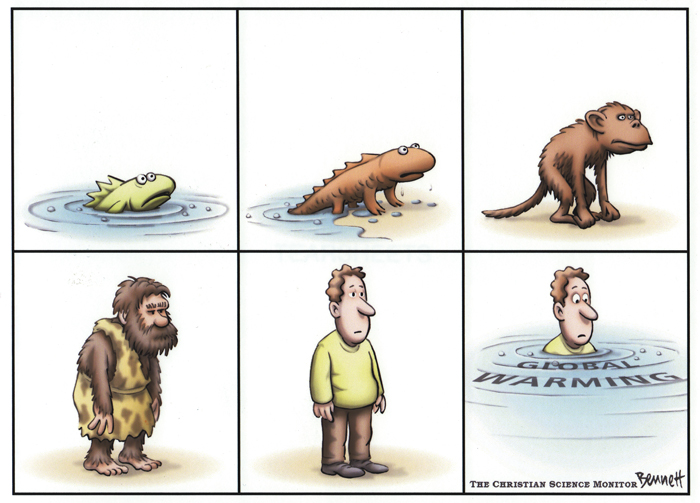
Clay Bennett, winner of the 2007 Curie UN Cartoon Award
Clay Bennett cartoons look like 21st century clean to me. There’s a smoothness, a silkiness of color that lends an immediacy to them. They really look good, and they look like they’d project well in a classroom (though I’ve not tried any of Bennett’s, actually).
All four of these cartoonists had or has something to say, too. I’ve enjoyed Bennett’s work in the Christian Science Monitor for some time. His work is clean, but it has a cutting edge that can’t be missed.
So, I was happy to see that he had won a commendation from the Ranan Lurie Cartoon Competition at the UN Correspondents’ Association dinner. Other people see good stuff in his drawings — I’m not alone.
Here’s his UN Lurie award-winning cartoon:
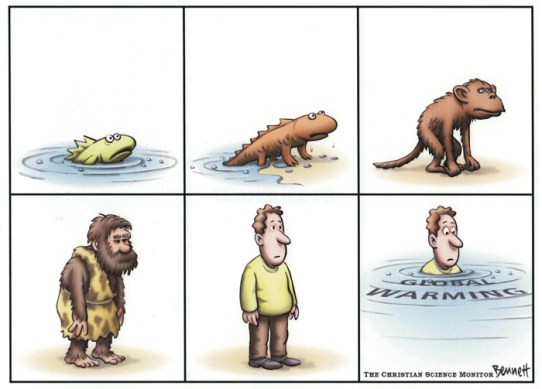
Cartoon winner of the 2007 Curie UN Cartoon Award
More of Bennett’s cartoons can be seen here, at the Clay Bennett Archives.
Bennett’s last cartoon in the Monitor was November 17. The good news: He’s moving to the Chattanooga Times-Free Press. We can hope that means one more opening is available for a cartoonist.
One more, below the fold. Read the rest of this entry »
Spread the word; friends don't allow friends to repeat history.
2 Comments | Cartoons, Climate change, climate_change, Global warming, Political cartoons, Politics | Tagged: Cartoons, Clay Bennett, Climate change, Evolution, Global warming, Intelligent Design, Political cartoons, Politics | Permalink
Posted by Ed Darrell
December 13, 2007
Paul Driessen wrote a book, Eco-Imperialism, that in essence blames environmentalists for every case of malaria in Africa since 1962. It is possible, that overreaction to environmental concerns by African governments and by Africans in the path of malaria parasites has indeed caused some delay in decreasing malaria infections. I have not seen any convincing evidence to make that case.
But it is untrue that environmentalists advocate policies intended to hurt Africans. It is untrue that DDT is a silver bullet that meanie environmentalists refuse to let African governments use — environmentalists do not have the power to tell African governments what the governments can or cannot do. Plus, it’s unfair to the point of gross distortion to blame environmentalists for the many problems which still exist that prevented the eradication of malaria 40 years ago and continue to frustrate efforts to reduce the frequency and mortality of the disease.
I assume Driessen is well-intentioned, though I have no first hand information about his motivations.
With that assumption, let me ascribe to simple error the many problems of his recent column for an on-line magazine perhaps aptly named spiked.
Driessen calls for an “all-out war on malaria.” That would be good.
But then he accuses environmentalists of standing in the way of such a war.
False blame calling cures not a single case of malaria, nor kills a single malaria-carrying mosquito. If Driessen wishes to fight malaria, there are a lot of people who would like to help. We can start to fight malaria, any time. [More after the fold.]
Read the rest of this entry »
Spread the word; friends don't allow friends to repeat history.
Leave a Comment » | DDT, History, Malaria, Public health, Voodoo history, Voodoo science | Tagged: Africa, DDT, environment, Health care, Malaria, Politics, Rachel Carson, Science | Permalink
Posted by Ed Darrell
December 12, 2007
Here is one surefire way to tell someone is bluffing, and perhaps doing a bit of planned prevarication, about Rachel Carson and the safety of DDT: Look for a footnote like this:
31 Sweeney EM. EPA Hearing Examiner’s recommendations and findings concerning DDT hearings. 25 April 1972 (40 CFR 164.32).
Why is that a sign of a bluff?
The volume and paging, “40 CFR 164.32,” is a reference to the Code of Federal Regulations. One knows that codes do not contain hearing records, and sure enough, this one does not. 40 CFR covers the rules of administrative hearings in federal agencies, but there is nothing whatsoever in that entire chapter about DDT, or birds, or chemical safety.

40 CFR is the chapter of the Code of Federal Regulations that pertains to the rules, regulations and procedures of the Environmental Protection Agency (EPA); it does not contain transcripts of regulatory hearings. Anyone who cites a hearing to this publication is giving you a bogus citation, probably to promote bogust history and bogus science.
If that citation shows up in a screed against environmentalists, or against Rachel Carson, or urging that we spray poison till the cows come home to die, you can be pretty sure that the person offering it has copied it wholesale from Steven Milloy’s junk science purveyor shop, and that the person has not read it at all. If the person has a law degree, or was ever a librarian or active in interscholastic debate, you can be pretty sure the person knows the citation is wrong, and is insulting you by listing it, knowing it’s unlikely you’ll ever find it in your local library.
(What is the accurate citation for the hearings? I’m not sure; but 40 CFR is not it. See the current section of CFR below the fold — it’s one page, not more than 100 pages.)
I have posted about this before. The hearings Judge Sweeney presided over were conducted early in the existence of the EPA. They were conducted under court orders requiring EPA to act. The transcripts are not in usual legal opinion publications, so far as I have been able to find. Many claims have been made about the hearings, most of the claims are false. Jim Easter at Some Are Boojums did the legwork and extracted a copy of the actual decision out of EPA’s library. He’s posted it at his blog, so you can see. Check the pages — “40 CFR” is a bogus citation, designed to keep you from learning the truth.
So the footnote is intended to make the gullible or innocent think there is a reference, where there is no reference.
But read the analysis of the hearings at Some Are Boojums. It is more than just the citation is wrong. Contrary to Internet Legend claims, Sweeney did not determine that DDT was harmless. Sweeney determined that DDT usage provided some benefits that outweighed the harms, considering the dramatically reduced use of DDT then allowed. DDT use had been severely restricted prior to the Sweeney hearings; Sweeney was not looking at all uses, nor even at historic uses. Sweeney was looking at dramatically reduced DDT use under the registrations then allowed. His conclusions of “no harm” where he actually concluded that, were based on greatly reduced use of DDT. This finding cannot be used today to urge an expansion of use — or should not be so used, by honest people.
Not to mention that at Caosblog, footnotes are not even listed in the text. The listing of the footnotes is a gratuitous error, there is no footnote 31 in the text.
Read the rest of this entry »
Spread the word; friends don't allow friends to repeat history.
1 Comment | Bogus history, History, Politics, Rachel Carson, Science, Voodoo science, War on Science | Tagged: Bogus history, bogus science, DDT, Politics, Science, Voodoo science | Permalink
Posted by Ed Darrell
December 12, 2007
Our friends and benefactors at the Bill of Rights Institute put up a great branch of their site, Founders Online. A grant from the Shelby Cullom Davis Foundation made the project possible.

Check it out:
John Adams | Samuel Adams | Alexander Hamilton | Patrick Henry
Thomas Jefferson | James Madison | GeorgeMason | Gouverneur Morris
James Otis | Thomas Paine | George Washington | John Witherspoon
This page should be a first stop for your students doing biographies on any of these people, and it should be a test review feature for your classes that they can do on the internet at home, or in class if you’re lucky enough to have access in your classroom.
Good on-line sources are still too rare. This is stuff you can trust to be accurate and appropriate for your students. Send a note of thanks to the Bill of Rights Institute, and send your students to the site.
Just in time for Bill of Rights Day, December 15 . . .
Spread the word; friends don't allow friends to repeat history.
Leave a Comment » | 1787, 1789, Accuracy, Ben Franklin, Civil Rights, Classroom technology, Declaration of Independence, Education, Famous quotes, Freedom - Economic, Freedom - Political, George Washington, Heroes, Historic documents, History, James Madison, John Adams, On-line education, On-line learning, Student projects, Technology in the classroom, Thomas Jefferson, U.S. Constitution | Tagged: Bill of Rights, Constitution, Education, founders, History, Lesson plans, Politics | Permalink
Posted by Ed Darrell
December 12, 2007
Oh, yeah, good debates are hard to come by.
Still, wouldn’t you like to see the final presidential candidates debate science issues seriously?

Lawrence Krauss got through the muddle at the generally science-averse Wall Street Journal to make the case.
The day before the most recent Democratic presidential debate, the media reported a new study demonstrating that U.S. middle-school students, even in poorly performing states, do better on math and science tests than many of their peers in Europe. The bad news is that students in Asian countries, who are likely to be our chief economic competitors in the 21st century, significantly outperform all U.S. students, even those in the highest-achieving states.
While these figures were not raised in recent Democratic or Republican debates, they reflect a major challenge for the next president: the need to guide both the public and Congress to address the problems that have produced this “science gap,” as well as the serious consequences that may result from it.
♦ ♦ ♦ ♦ ♦
Almost all of the major challenges we will face as a nation in this new century, from the environment, national security and economic competitiveness to energy strategies, have a scientific or technological basis. Can a president who is not comfortable thinking about science hope to lead instead of follow? Earlier Republican debates underscored this problem. In May, when candidates were asked if they believed in the theory of evolution, three candidates said no. In the next debate Mike Huckabee explained that he was running for president of the U.S., not writing the curriculum for an eighth-grade science book, and therefore the issue was unimportant.
Apparently many Americans agreed with him, according to polls taken shortly after the debate. But lack of interest in the scientific literacy of our next president does not mean that the issue is irrelevant. Popular ambivalence may rather reflect the fact that most Americans are scientifically illiterate. A 2006 National Science Foundation survey found that 25% of Americans did not know the earth goes around the sun.
Our president will thus have to act in part as an “educator in chief” as well as commander in chief. Someone who is not scientifically literate will find it difficult to fill this role.
Chris Mooney makes the case in Seed Magazine.
Science is too important, too big a player in too many issues, to not have a major focus of its own in the final debates. Failing to have such a discussion is tantamount to failing to ask whether the candidates are capitalist or communist in economic policy (as if such a question could be unanswered by a wealth of other campaign material).
Science Debate 2008 argues for a science debate, lists supporters of the idea (it’s an impressive list, really), and offers advice on how you can help the campaign for science discussion at the presidential level. You can track the issue at the Intersection, or at Bora’s place, A Blog Around the Clock.
If nothing else, a science debate might make it clear to the candidates that we need to revive the Office of Technology Assessment, in addition to making the candidates aware that the president needs to have a strong, independent science advisor to whom the president actually pays attention.
Science literacy is to important to leave it up to chance, or partisans alone — in the case of our kids in school, and in the case of the person we elect president.
Spread the word; friends don't allow friends to repeat history.
3 Comments | Education, Elections, Politics, Presidents, Science | Tagged: Education, Elections, Politics, president, Science | Permalink
Posted by Ed Darrell
December 11, 2007
Leading biologists at several of Texas’s leading universities sent a letter to the Texas State Board of Education trying to scold the agency back onto the path of good science, in the wake of the firing scandal at the agency late last month. Laura Heinauer wrote in Homeroom, an education blog of the Austin American-Statesman:
More than 100 biology faculty from universities across Texas signed a letter sent Monday to Education Commissioner Robert Scott saying Texas Education Agency employees should not have to remain neutral on evolution.The letter is in response to the departure of former science curriculum director Chris Comer, who says she was forced to resign days after forwarding an e-mail her superiors said made the agency appear biased against the idea that life is a result of intelligent design.“I’m an evolutionary biologist, and I and many others simply feel that good evolution education is key to understanding biology as a whole,” said University of Texas professor Daniel Bolnick, who has been collecting signatures since last week.
More biologists from more Texas universities would have signed, probably, with more time allowed to gather signatures. Word I have is that the author and organizers wanted to get the letter delivered quickly.The letter was forceful, and stern in emphasizing the strength of scientific support for evolution theory, a rebuke to Commissioner Robert Scott’s political assistant, Lizzette Gonzales Reynolds:
It is inappropriate to expect the TEA’s director of science curriculum to “remain neutral” on this subject, any more than astronomy teachers should “remain neutral” about whether the Earth goes around the sun. In the world of science, evolution is equally well-supported and accepted as heliocentrism. Far from remaining neutral, it is the clear duty of the science staff at TEA and all other Texas educators to speak out unequivocally: evolution is a central pillar in any modern science education, while “intelligent design” is a religious idea that deserves no place in the science classroom at all.
A massive body of scientific evidence supports evolution. All working scientists agree that publication in top peer-reviewed journals is the scoreboard of modern science. A quick database search of scientific publications since 1975 shows 29,639 peer-reviewed scientific papers on evolution in twelve leading journals alone2. To put this in perspective, if you read 5 papers a day, every day, it would take you 16 years to read this body of original research. These tens of thousands of research papers on evolution provide overwhelming support for the common ancestry of living organisms and for the mechanisms of evolution including natural selection. In contrast, a search of the same database for “Intelligent Design” finds a mere 24 articles, every one of which is critical of intelligent design3. Given that evolution currently has a score of 29,639– while “intelligent design” has a score of exactly zero– it is absurd to expect the TEA’s director of science curriculum to “remain neutral” on this subject. In recognition of the overwhelming scientific support for evolution, evolution is taught without qualification– and intelligent design is omitted– at every secular and most sectarian universities in this country, including Baylor (Baptist), Notre Dame (Catholic), Texas Christian (Disciples of Christ) and Brigham Young (Mormon).
This last sentence is weaker than it needs to be. Evolution is taught at every major sectarian university in the U.S., including Southern Methodist University, Vanderbilt, Wake Forest, all the Jesuit colleges and all other Catholic institutions, in addition to those named. It is only the rare, odd Bible college that may not teach evolution. Jerry Falwell’s Liberty University, which does not emphasize science, and the strictly fundamentalist, 19th century Bob Jones University are the only two I have been able to confirm who do not teach evolution in biology courses.
Be sure to check out the footnotes in the letter, too.
There is no serious college textbook available which uses a non-evolution model to explain biology.In 2003, when the Discovery Institute presented a letter to the Texas SBOE urging skepticism of evolution theory, and then misrepresented the letter as support for intelligent design, more than 100 professors at the University of Texas at Austin and more than 100 professors at Rice University wrote to support evolution. Texas’s four Nobel winners in Medicine or Physiology also called on TEA and the SBOE to emphasize evolution in textbooks. Physics Nobelist Steven Weinberg personally appeared at the citizen hearings on textbooks to stress the point.Texas’s top science scholars and researchers have been clear, consistently over the past decade.
It takes a particular form of political chutzpah and political hubris to ignore this unity of opinion among Texas’s leading researchers and teachers of biology. But Gov. Rick Perry’s recent appointment of arch-creationist Donald McLeroy to chair the SBOE, and the firing of science curriculum expert Chris Comer over her FYI e-mail alerting people to a speech by science philosopher Prof. Barbara Forrest, seem to have made most scientists nervous that the Texas SBOE is gearing up to get stupid again.
No comments from any State Board member, nor from the commissioner yet.
The story has been playing on Texas radio stations most of the day. It was picked up by major Texas newspapers, generally from the Associated Press wire:
- News story from the Austin American-Statesman
- Houston Chronicle
- KGBT Channel 4 News, Rio Grande Valley
- News blog of the Chronicle of Higher Education
- Waco Tribune (American-Statesman story, plus links to archives)
- Fort Worth Star-Telegram
- El Paso Times
- Dallas Morning News
- KRIS TV, Channel 6, Corpus Christi
- KLTV, Channel 7, Tyler/Longview/Jacksonville
- KTEN, Ardmore, Oklahoma
- KSWO, Lawton, Oklahoma/Wichita Falls, Texas
- KVIA, Channel 7, El Paso
- Wichita Falls Times-Record
See also:
One commenter at the American-Statesman site was happy to hear the news. “Big Fat Phil” wrote, “Hello, sanity. I missed you.”
The full text of the letter, and the full list of signers, is below the fold.
Read the rest of this entry »
Spread the word; friends don't allow friends to repeat history.
4 Comments | Biology, Creationism, Education quality, Evolution, Politics, Science, State school boards, Texas, Textbook Selection, Textbooks | Tagged: Education, Evolution, Intelligent Design, Politics, Religion, Science, Texas | Permalink
Posted by Ed Darrell
December 10, 2007
December 15th is Bill of Rights Day, a tradition since Franklin Roosevelt first declared it in 1941.

It falls on Saturday this year — which means teachers can choose whether to commemorate it Friday, or next Monday, or on both days. It marks the date of the approval of the Bill of Rights, in 1790.
Texas requires social studies teachers to spend a day on the Constitution. The law isn’t well enforced, but Bill of Rights Day might be a good time to fill the legal duty in your classrooms.
The Bill of Rights Institute offers lesson plans and supporting materials (see “Instructional Materials” in the left column). Below the fold I copy a list from the Institute’s webpage on Bill of Rights Day.
More material here, and the National Archives material can be reached here.
_____________
* The ides is merely the middle of the month. Of course you thought of Shakespeare’s witch warning Julius Caesar to “beware the ides of March.” In this case, we can celebrate the ides of December — Hanukkah mostly gone, Christmas, Eid and KWANZAA on the way.
Read the rest of this entry »
Spread the word; friends don't allow friends to repeat history.
3 Comments | Bill of Rights, Civil Rights, Historic documents, Human Rights, Lesson plans, U.S. Constitution | Tagged: Bill of Rights, Civil Rights, History, Law, Politics | Permalink
Posted by Ed Darrell
December 9, 2007
Reaction to the political resignation/firing of the science curriculum director at the Texas Education Agency (TEA) has been almost universally negative. If there are any approving reactions, they are hidden well.
Dr. Barbara Forrest, whose speech in Austin produced the “FYI” memo Chris Comer sent to a dozen people, posted her reaction at the website of the National Center for Science Education; you can get a .pdf download from NCSE, or read the piece with a lot of reaction at Dr. P. Z. Myers’ blog, Pharyngula.
The incident now involving Ms. Comer exemplifies perfectly the reason my co-author Paul R. Gross and I felt that our book, Creationism’s Trojan Horse: The Wedge of Intelligent Design, had to be written. (http://www.creationismstrojanhorse.com) By forcing Ms. Comer to resign, the TEA seems to have confirmed our contention that the ID creationist movement — a religious movement with absolutely no standing in the scientific world — is being advanced by means of power politics.
This morning, TEA director Robert Scott’s responses to questions from the Dallas Morning News opinion editors gave the first official reaction from TEA of any substance.
I don’t think the impression was that we were taking a position in favor of evolution. We teach evolution in public schools. It’s part of our curriculum. But you can be in favor of a science without bashing people’s faith, too. I don’t know all the facts, but I think that may be the real issue here. I can’t speak to motivation but … we have standards of conduct and expect those standards of conduct to be followed.
For reading convenience, both statements are below the fold.
No, I’m not reserving judgment, but I am reserving comment for the moment. I am hopeful Scott will recognize the error and take steps to square his agency with education standards, state law, good employment practices, and reason.
Read the rest of this entry »
Spread the word; friends don't allow friends to repeat history.
1 Comment | Creationism, History, Intelligent Design, Law, Politics, State school boards, Voodoo science | Tagged: Education, Evolution, Intelligent Design, Law, Politics | Permalink
Posted by Ed Darrell





 Millard Fillmore's Bathtub