Hillary Clinton’s birthday quote of the moment: Learning from the Chicago Cubs

October 25, 2017

Today is the birthday of Hillary Rodham Clinton, born October 26, 1948.

Former Secretary of State Hillary Rodham Clinton

Secretary of State Hillary Rodham Clinton

Happy birthday, Hillary!

Without citation, Robert A. Nowlan’s Born This Day lists this as something Clinton said:

Being a Cubs fan prepares you for life — and Washington.

When she wrote or spoke that about a decade ago, she knew it was wise, but not how apt, for 2017.

Since she spoke it, the Chicago Cubs won the 2016 World Series.

Hope is alive.

Yes, this is mostly an encore post. Fighting ignorance requires patience.

Yes, this is mostly an encore post. Fighting ignorance requires patience.


Carl Sagan’s “foreboding” of a dumb America; too late to stop it?

August 9, 2017

NASA photo of Dr. Carl Sagan with a model of the Mars Viking Lander, in Death Valley, California. Or was it taken on Mars? How could we tell, if we lacked sharpened and practiced critical thinking practices?

NASA photo of Dr. Carl Sagan with a model of the Mars Viking Lander, in Death Valley, California. Or was it taken on Mars? How could we tell, if we lacked sharpened and practiced critical thinking practices?

Are we already too late?

In The Demon-Haunted World in 1995, astronomer and thinker Carl Sagan worried about the directions America was heading, intellectually, and what it could mean for the future. He wrote:

Science is more than a body of knowledge; it is a way of thinking. I have a foreboding of an America in my children’s or grandchildren’s time—when the United States is a service and information economy; when nearly all the key manufacturing industries have slipped away to other countries; when awesome technological powers are in the hands of a very few, and no one representing the public interest can even grasp the issues; when the people have lost the ability to set their own agendas or knowledgeably question those in authority; when, clutching our crystals and nervously consulting our horoscopes, our critical faculties in decline, unable to distinguish between what feels good and what’s true, we slide, almost without noticing, back into superstition and darkness. The dumbing down of America is most evident in the slow decay of substantive content in the enormously influential media, the 30-second sound bites (now down to 10 seconds or less), lowest common denominator programming, credulous presentations on pseudoscience and superstition, but especially a kind of celebration of ignorance.

Sagan had hope. His book’s full title is The Demon-Haunted World: Science as a candle in the dark.

Should we hold that hope today? Elections in 2016 demonstrated that false news does sway the electorate, superstition can overcome knowledge. Worse, too many Americans cannot tell the difference. In a time when millions of Americans profess to work to find “the way,” we confront those same people wandering aimlessly through American culture, apparently with little clue as to how far off the path of reality they are, or any real understanding of what “the way” would even look like. Their compasses operate on faith, not magnetism; their compass needles point whichever way they want them to point, with no fixed power to guide them.

Sagan didn’t write that long ago. A child born in 1995 just voted in her first national election — we hope. Perhaps she didn’t bother to register, and did not vote. What causes our national lack of motivation to even vote, to push our government in the directions we think it should go?

How do we remove the barriers to that motivation? is a more important question.

Was Sagan right? Are we doomed?

We have cause to worry, I think.

  • 58% of Americans eligible to vote, voted in 2016. While that’s near a recent high-water mark, it’s a paltry percentage compared to other democracies in the world. Apathy was highest in key states Donald Trump carried; Hillary Clinton won the popular vote, but trailed President Barack Obama’s 2012 totals by 2 million votes, in those key states. 2016’s election was decided by people who did not vote.
  • While tensions run high in the Korean Peninsula, only about 36% of Americans can find Korea on a map. Most of those who can find Korea favor diplomacy to resolve tensions, not war. Who was the wag who said God gives us wars so Americans learn geography? (It was Rose-Belford’s Canadian Monthly in 1879, rephrased and repeated dozens of times by others.)
  • Flat Earthers? Oy.
  • Anti-vaccine movement. Chem-trails fearfuls. Climate change dissenters. Creationists. Moon-landing deniers. Racists. So-called non-racists who oppose immigration completely. Republican senators who imagined a tax cut for the wealthy would help working and poor Americans have better health. DDT advocates. “Libertarians” and so-called conservatives who fear “socialism” of the economics of John Maynard Keynes, one of the foremost capitalism defenders in economics.
  • Cuts to education. As a barometer, consider Texas, where 25 years ago the state provided 67% of funding for public schools. After decades of cuts, the state provides only 38% of public school funding in the 2017-2019 budget. Lt. Gov. Dan Patrick touts the total as an increase.
  • Cuts to science. Trump administration proposals slash all science research dramatically, as if we already have cures for cancer and the common cold, and Alzheimer’s disease.

To be sure, we can find pockets of hope. Girl Scouts demonstrate great success with new programs to attract girls to careers in science, with special camps for Science Technology Engineering and Mathematics (STEM). Boy Scouts have their own initiative. But the Texas legislature cut back on math, science and geography requirements for graduation. For every hopeful sign, there’s another sinister sign.

How can we tell civilization, and humanity, gain ground?


Pollsters for the New York Times asked 1,746 Americans to locate North Korea on a map. 36% could do it; many of the guesses are troubling, if not downright shocking. In the map above, from the New York Times, correct answers are marked in red, incorrect in blue.

Pollsters for the New York Times asked 1,746 Americans to locate North Korea on a map. 36% could do it; many of the guesses are troubling, if not downright shocking. In the map above, from the New York Times, correct answers are marked in red, incorrect in blue.

“Science as a candle in the dark” is a good image.

How can we provide light in the darkness, if we don’t have a candle, and we can’t find matches?

More:

The Tweet that piqued my interest tonight:
https://twitter.com/KStreetHipster/status/894574338409672708


Save

Save

Save

Save

Save


M.A.S.H. quote of the moment: War is worse than hell

May 22, 2017

"Why do you say that, Hawkeye?" Screen capture from video snippet of M.A.S.H.

“How do you figure that, Hawkeye?” Father Mulcahy, screen capture from video snippet of M.A.S.H.

Our correspondents Jameses, Stanley and Kessler, alerted me months ago to this exchange in the old television show, “M.A.S.H.” In a discussion of the First Battle of Bull Run, we discussed war as hell.

War is worse than hell, they said. Still true.

They pointed to a scene from “M.A.S.H.”

Dialogue borrowed from IMDB:

Hawkeye: War isn’t Hell. War is war, and Hell is Hell. And of the two, war is a lot worse.

Father Mulcahy: How do you figure that, Hawkeye?

Hawkeye: Easy, Father. Tell me, who goes to Hell?

Father Mulcahy: Sinners, I believe.

Hawkeye: Exactly. There are no innocent bystanders in Hell. War is chock full of them — little kids, cripples, old ladies. In fact, except for some of the brass, almost everybody involved is an innocent bystander.

Deep thinking, maybe wisdom, from a mobile operating room filtered through sit-com writers.

M.A.S.H., copyright 20th Century Fox

More:

Save

Save

Save


February 15 is Shoulders of Giants Day

February 15, 2017

February 15th is Shoulders of Giants Day (unless you’re still on the Julian calendar).

Or should be. 

Famous quotations often get cited to the wrong famous person. ‘Somebody said something about standing on the shoulders of giants — who was it? Edison? Lincoln? Einstein? Jefferson?’  It may be possible someday to use Google or a similar service to track down the misquotes.

The inspiration, perhaps

Robert Burton, author of "Anatomy of Melancholy"

Robert Burton, melancholy scholar at Oxford

A dwarf standing on the shoulders of a giant may see farther than a giant himself.

Robert Burton (February 8, 1577-January 25, 1640), vicar of Oxford University, who wrote The Anatomy of Melancholy to ward off his own depressions

The famous quote

Sir Isaac Newton, by Sir Godfrey Keller, 1689

Sir Isaac Newton, by Sir Godfrey Keller, 1689

If I have seen further (than you and Descartes) it is by standing on the shoulders of Giants.

Sir Isaac Newton, letter to Robert Hooke, February 5, 1675, Julian/February 15, 1676, Gregorian

Newton consciously paid tribute to others who had plowed his science fields before, even if he came up with different crops, er, answers. All science is based on something that comes before it, and in the modern world science advances, oddly, by trying to disprove what scientists thought happened before.

But the sentiment applies equally well in business, in politics, in raising children. We are products of what we learn, and what we learn is a result of culture, which is a result of history. We all stand on the shoulders of those who came before us.

It’s our job to try to see farther, and not just look down, at how far up we are.

Someone will ask (since we so often discuss it), ‘can we fly our flags today?’

Of course you may fly your U.S. flag today. It’s not a day designated by law, but you may fly it in honor of Sir Isaac Newton’s letter if you wish. The U.S. flag code suggests times Americans may fly their flags, but does not require it, nor does law forbid flying the flag for other occasions, or just for every day.

Maybe better, climb to the top of the flag pole. What can you see, aided by a giant’s height?

Other references:

Inscription on the edge of Britain's 2-pound coin; in this photo, four coins are used, to show the entire inscription. Flickriver image

Inscription on the edge of Britain’s 2-pound coin; in this photo, four coins are used, to show the entire inscription. Flickriver image, 1875Brian

Yes, this is mostly an encore post. Fighting ignorance requires patience.

Yes, this is mostly an encore post. Fighting ignorance requires patience. But, nanos gigantum humeris insidentes.


Save

Save

Save

Save

Save


Quote of the moment: Ali, ‘said I was the greatest even before I was’

February 3, 2017

Muhammad Ali, mural on business building on west Commerce Street, Dallas, Texas. Photo, Creative Commons copyright by Ed Darrell.

Muhammad Ali, mural on business building on west Commerce Street, Dallas, Texas. Photo, Creative Commons copyright by Ed Darrell.

It’s a tribute to self-confidence, a motivational-poster caption with a hundred different photos just featuring Muhammad Ali.

On the mural, Ali is quoted, I said I was even before I knew I was.” Here’s the more commonly-accepted version:

“I am the greatest. I said that even before I knew I was. I figured that if I said it enough, I would convince the world that I really was the greatest.”

Can you guess? It’s difficult to pin down a solid attribution for the quote. I have little doubt he said it — but can someone say where?

Save


Quote of the moment: Ann Richards, open doors of government, let people in

February 1, 2017

Texas Gov. Ann Richards in the Governor's Office, with the motorcycle she got on her birthday. Texas State Library image.

Texas Gov. Ann Richards in the Governor’s Office, with the motorcycle she got on her birthday. Texas State Library image.

Sarah Weddington wrote:

Ann now rests at the Texas State Cemetery in Austin. Her grave marker reads, “Today we have a vision of a Texas where opportunity knows no race, no gender, no color—a glimpse of what can happen in government if we simply open the doors and let the people in.”

Weddington wrote a remembrance to Richards in The Texas Observer, October 12, 2012. This quote comes from Richards’s speech at her inauguration as Texas Governor, January 15, 1991.

Richards served Texas as governor, 1991 to 1995.

Let the sunshine in, then!

Texas Gov. Ann Richards's grave marker in the Texas State Cemetery, Austin, Texas, reverse. Quote comes from her 1991 inaugural address. Image from Findagrave.com

Texas Gov. Ann Richards’s grave marker in the Texas State Cemetery, Austin, Texas, reverse. Quote comes from her 1991 inaugural address. Image from Findagrave.com

More:

Save


Quote of the Trump administration? “What’s the Constitution between friends?”

January 8, 2017

Timothy J. Campbell, Congressman from New York; photo from Mathew Brady negative circa 1870; Library of Congress, Prints and Photographs Division, http://www.loc.gov/pictures/item/2005691716/

Timothy J. Campbell, Congressman from New York; photo from Mathew Brady negative circa 1870; Library of Congress, Prints and Photographs Division, http://www.loc.gov/pictures/item/2005691716/

What’s the Constitution between friends?

–Timothy J. Campbell (1840-1904), Attributed, circa 1885

A little more below the fold? Certainly. Read the rest of this entry »


Scrooge’s 2016 Christmas gift to Donald Trump: His platform reduced to three words

December 30, 2016

Oh, why bother with this BEFORE Christmas? It’s more salient now, looking at the new year, and wondering what is the fate of man and men, in the new year.

Roberto Innocenti, Scrooge on a dark staircase

Ebenezer Scrooge, up a dark staircase; “Darkness was cheap, and Scrooge liked it.” Illustration by Roberto Innocenti, via Pinterest.

It’s a Quote of the Moment (an encore post for the season, with a bit of context thrown in later), Trump’s platform, and life, edited down to just three words, in green:

Darkness is cheap,
and Scrooge liked it.

– Charles Dickens, A Christmas Carol, Stave 1

Isn’t that the entire GOP platform in three words? “Darkness is cheap.”

I think of that line of Dickens’s often when  I read of the celebrations of calumny that pass as discourse in Republican politics these days. Although, with the 2008 renewing of Limbaugh’s contract, it may no longer be true that his particular brand of darkness is cheap. With the advent of Donald Trump’s insult politics, offending America’s allies and all American ethnic groups possible, with un-ironic calls to drop nuclear weapons, GOP politics is even darker than ever.

Cheap or not, darkness remains dark.

John Leach, Scrooge meets Ignorance and Want

Scrooge meets Ignorance and Want, the products of his stinginess (drawing by John Leech, 1809-1870)


Here is the sentence Dickens put before the quote, to add a little context; Scrooge was climbing a very large, very dark staircase.

Half-a-dozen gas-lamps out of the street wouldn’t have lighted the entry too well, so you may suppose that it was pretty dark with Scrooge’s dip.

Up Scrooge went, not caring a button for that. Darkness is cheap, and Scrooge liked it.

Speaking of darkness, a longer excerpt from a bit later in Dickens’s story, when the Ghost of Christmas Present ushers Scrooge to glimpse what is in the present, but what will be the future if Scrooge does not repent:

‘Forgive me if I am not justified in what I ask,’ said Scrooge, looking intently at the Spirit’s robe, ‘but I see something strange, and not belonging to yourself, protruding from your skirts. Is it a foot or a claw?’

‘It might be a claw, for the flesh there is upon it,’ was the Spirit’s sorrowful reply. ‘Look here.’

From the foldings of its robe, it brought two children; wretched, abject, frightful, hideous, miserable. They knelt down at its feet, and clung upon the outside of its garment.

‘Oh, Man! look here. Look, look, down here!’ exclaimed the Ghost.

They were a boy and girl. Yellow, meagre, ragged, scowling, wolfish; but prostrate, too, in their humility. Where graceful youth should have filled their features out, and touched them with its freshest tints, a stale and shrivelled hand, like that of age, had pinched, and twisted them, and pulled them into shreds. Where angels might have sat enthroned, devils lurked, and glared out menacing. No change, no degradation, no perversion of humanity, in any grade, through all the mysteries of wonderful creation, has monsters half so horrible and dread.

Scrooge started back, appalled. Having them shown to him in this way, he tried to say they were fine children, but the words choked themselves, rather than be parties to a lie of such enormous magnitude.

‘Spirit! are they yours?’ Scrooge could say no more.

‘They are Man’s,’ said the Spirit, looking down upon them. ‘And they cling to me, appealing from their fathers. This boy is Ignorance. This girl is Want. Beware them both, and all of their degree, but most of all beware this boy, for on his brow I see that written which is Doom, unless the writing be erased. Deny it!’ cried the Spirit, stretching out its hand towards the city. ‘Slander those who tell it ye! Admit it for your factious purposes, and make it worse. And bide the end!’

‘Have they no refuge or resource?’ cried Scrooge.

‘Are there no prisons?’ said the Spirit, turning on him for the last time with his own words. ‘Are there no workhouses?’ The bell struck twelve.

Scrooge looked about him for the Ghost, and saw it not. As the last stroke ceased to vibrate, he remembered the prediction of old Jacob Marley, and lifting up his eyes, beheld a solemn Phantom, draped and hooded, coming, like a mist along the ground, towards him.

A Christmas Carol, Stave 3

Think of 2014, 2015, and 2016, children abused in Central America and in the Middle East, fleeing as best they can, only to die, off the shores of Greece, on the southern deserts of the U.S., or be cast into incarceration after having achieved a nation whose very name promised them refuge, the United States. “Two children; wretched, abject, frightful, hideous, miserable,” Dickens described. Whose children? “Man’s.” Yours, and mine.

Christmas is a festival to celebrate light, what many Christians call “the light of the world?” If so, let us work to stamp out the darkness which the unrepentant Scrooge so dearly loved.

Darkness may be cheap, but it is not good.  Light a candle, and run into the darkness, spreading light. We need more light.

Hope you had a merry Christmas in 2016. Let us remember, as Tom and the late Ray Magliozzi always reminded us, the cheapskate pays more in the end, and usually along the way. Is Darkness cheap? Let us then eschew it as too costly for a moral nation, too costly for a moral people.

Is Donald Trump as smart as Ebenezer Scrooge? Is his heart as good as Scrooge’s heart?

More:

Yes, this is mostly an encore post. Fighting ignorance requires patience.

Yes, this is mostly an encore post. Fighting ignorance requires patience.

Save


Quote of the moment, December 6, 1852: Millard Fillmore explains his legacy; history ignores it

December 6, 2016

For an accidental president, a man who no one expected to take the office; for a guy whose term was marked by his party’s rejection of his policies so much that they did not even entertain the idea he might be the nominee in the next election; for the last Whig president, an obvious dinosaur of a dying political view; for a guy so obscure that a hoax more than a half-century later remains his greatest acknowledged point of reference, Millard Fillmore left the U.S. in good shape.

Should that be his real legacy?

On the anniversary of his final State of the Union message, let us ponder what Millard Fillmore bragged about.

Millard Fillmore for President, campaign poster from 1856 (American Party)

Campaign poster for Millard Fillmore, running for president in 1856 on the American Party ticket. He carried Maryland, which is probably ironic, considering Maryland’s Catholic roots, and the American Party’s anti-Catholic views, views probably not entirely shared by Fillmore; the American Party is more often known as the “Know-Nothings.”  Image from the Library of Congress American Memory files.

These are the last two paragraphs of his final State of the Union message, delivered on paper on December 6, 1852 Perhaps establishing a tradition, he made the message a listing of current zeitgeist, starting out mourning the recent passing of Daniel Webster, and the abatement of epidemics of mosquito-borne plagues in several cities.  He recited activities of the government, including the abolishing of corporal punishment in the Navy and improvements in the Naval Academy; he mentioned U.S. exploration around the world, in the Pacific, in the Amazon River, in Africa, and especially his project to send a fleet to Japan to open trade there.  He noted great opportunities for trade, domestically across an expanded, Atlantic-to-Pacific United States, and in foreign markets reachable through both oceans.

The last two paragraphs would be considered greatly exaggerated had any president in the 20th century delivered them; but from Millard Fillmore, they were not.  He gave credit for these achievements to others, not himself.

In closing this my last annual communication, permit me, fellow-citizens, to congratulate you on the prosperous condition of our beloved country. Abroad its relations with all foreign powers are friendly, its rights are respected, and its high place in the family of nations cheerfully recognized. At home we enjoy an amount of happiness, public and private, which has probably never fallen to the lot of any other people. Besides affording to our own citizens a degree of prosperity of which on so large a scale I know of no other instance, our country is annually affording a refuge and a home to multitudes, altogether without example, from the Old World.

We owe these blessings, under Heaven, to the happy Constitution and Government which were bequeathed to us by our fathers, and which it is our sacred duty to transmit in all their integrity to our children. We must all consider it a great distinction and privilege to have been chosen by the people to bear a part in the administration of such a Government. Called by an unexpected dispensation to its highest trust at a season of embarrassment and alarm, I entered upon its arduous duties with extreme diffidence. I claim only to have discharged them to the best of an humble ability, with a single eye to the public good, and it is with devout gratitude in retiring from office that I leave the country in a state of peace and prosperity.

What president would not have been happy to have been able to claim as much?  Historians often offer back-handed criticism to Fillmore for the Compromise of 1850; in retrospect it did not prevent the Civil War.  In the circumstances of 1850, in the circumstances of Fillmore’s presidential career, should we expect more?  Compared to Buchanan’s presidency and the events accelerating toward war, did Fillmore do so badly?

Compare with modern analogs: Donald Trump appears to be working exactly contrary to those things Fillmore said were beneficial to the U.S., then: Friendly relations with foreign powers, the U.S. recognized as a refuge for persecuted people, and domestic prosperity. Any president since Franklin Roosevelt would have loved to have left such a legacy.

Have we underestimated Millard Fillmore?  Discuss.

More:

Yes, this is mostly an encore post. Fighting ignorance requires patience.

Yes, this is mostly an encore post. Fighting ignorance requires patience.

Save

Save


December 2: Happy Guano Day! (Thank you, Millard Fillmore)

December 2, 2016

Why December 2?

(You couldn’t make this stuff up if you were Monty Python.)

English: Millard Fillmore White House portrait

Millard Fillmore’s White House portrait, via Wikipedia

President Millard Fillmore, in the State of the Union Address, December 2, 1850

Peruvian guano has become so desirable an article to the agricultural interest of the United States that it is the duty of the Government to employ all the means properly in its power for the purpose of causing that article to be imported into the country at a reasonable price. Nothing will be omitted on my part toward accomplishing this desirable end. I am persuaded that in removing any restraints on this traffic the Peruvian Government will promote its own best interests, while it will afford a proof of a friendly disposition toward this country, which will be duly appreciated.

Did any other U.S. President spend so much time thinking about guano?  Did any president ever mention it in a State of the Union Address?  The curious case of Millard Fillmore, Seer, just grows.

Guano, or bird poop (and its relative, bat poop), contains phosphorus, which is an essential element for life.  Consequently, it turns out to be a key ingredient in effective agricultural fertilizers.  In international competition for supremacy in farming and farm exports, guano became a key resource to fight over, in the 19th century.

It’s almost safe to say the fights were economic; but guano did play a key role in wars in South America (see Andrew Leonard’s article, noted below).

Fillmore figured out that the substance had great importance, coupled that with the rather esoteric knowledge that sea birds tended to deposit guano in great abundance on certain islands, often unoccupied, and ordered the U.S. Navy to claim islands found to contain guano deposits that were not claimed by other nations.

By the American Civil War, the importance of phosphorus to the production of gun powder became an issue for the armies of the North and South.  Millard Fillmore had set the stage for the North to win an important advantage in gun powder production, just one of many that led to the defeat of the South.

It’s one more thing we should thank Millard Fillmore for doing. Our study of history should inform us that it is, indeed, important for politicians to understand the importance of guano.

Fillmore knew his guano.

Take a moment on December 2 to toast Millard Fillmore’s prescience, on Guano Day!

More:  

Yes, this is mostly an encore post. Fighting ignorance requires patience.

Yes, this is mostly an encore post. Fighting ignorance requires patience.

Save

Save


Rosa Parks Sit Down to Stand Up for Freedom Day, December 1: “Why do you push us around?” Rosa Parks asked the cop. (Anyone know the answer?)

December 1, 2016

Mrs. Rosa Parks asked a question of the policeman who arrested her for refusing to move to the back of the bus on December 1, 1955. In 2016, it is again, and still, a chilling question, to which we have no good answer.

Rosa Parks being fingerprinted, Library of Congress

Mrs. Parks being fingerprinted in Montgomery, Alabama; photo from New York World-Telegram & Sun Collection, Library of Congress

Rosa Parks: “Why do you push us around?”

Officer: “I don’t know but the law is the law and you’re under arrest.”

From Rosa Parks with Gregory J. Reed, Quiet Strength
(Grand Rapids, MI: Zondervan Pub. House, 1994), page 23.

Photo: Mrs. Parks being fingerprinted in Montgomery, Alabama; photo from New York World-Telegram & Sun Collection, Library of Congress

Today in History at the Library of Congress provides the simple facts:

On the evening of December 1, 1955, Rosa Parks, an African American, was arrested for disobeying an Alabama law requiring black passengers to relinquish seats to white passengers when the bus was full. Blacks were also required to sit at the back of the bus. Her arrest sparked a 381-day boycott of the Montgomery bus system and led to a 1956 Supreme Court decision banning segregation on public transportation.

Rosa Parks made a nearly perfect subject for a protest on racism. College-educated, trained in peaceful protest at the famous Highlander Folk School, Parks was known as a peaceful and respected person. The sight of such a proper woman being arrested and jailed would provide a schocking image to most Americans. Americans jolted awake.

Often lost in the retelling of the story are the threads that tie together the events of the civil rights movement through the 1940s, 1950s and 1960s. As noted, Parks was a trained civil rights activist. Such training in peaceful and nonviolent protest provided a moral power to the movement probably unattainable any other way. Parks’ arrest was not planned, however. Parks wrote that as she sat on the bus, she was thinking of the tragedy of Emmet Till, the young African American man from Chicago, brutally murdered in Mississippi early in 1955. She was thinking that someone had to take a stand for civil rights, at about the time the bus driver told her to move to allow a white man to take her seat. To take a stand, she kept her seat.

African Americans in Montgomery organized a boycott of the Montgomery bus system. This was also not unique, but earlier bus boycotts are unremembered. A bus boycott in Baton Rouge, Louisiana, earlier in 1955 did not produce nearly the same results.

The boycott organizers needed a place to meet, a large hall. The biggest building in town with such a room was the Dexter Street Baptist Church. At the first meeting on December 5, it made sense to make the pastor of that church the focal point of the boycott organizing, and so the fresh, young pastor, Rev. Dr. Martin Luther King, Jr., was thrust into civil rights organizing as president, with Ralph Abernathy as program director. They called their group the Montgomery Improvement Association (MIA). When their organizing stretched beyond the city limits of Montgomery, the group became the Southern Christian Leadership Conference.

Litigation on the boycott went all the way to the Supreme Court (Browder v. Gale). The boycotters won. The 381-day boycott was ended on December 21, 1956, with the desegregation of the Montgomery bus system.

Sources for lesson plans and projects:

Yes, this is mostly an encore post. Fighting ignorance requires patience.

Yes, this is mostly an encore post. Fighting ignorance requires patience.

Tip of the old scrub brush to Slacktivist, who gave this post a nice plug.

Save

Save


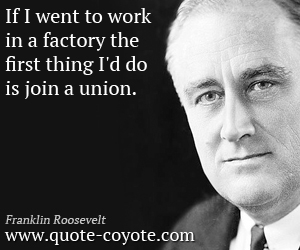
August 16 quote of the moment: FDR, ‘I’d join a union’

August 16, 2016

One wag, who didn’t want to discuss things after all, referred me to President Franklin Roosevelt’s message to the National Federal of Federal Employees (NFFE), of August 16, 1937 (from the American Presidency Project at the University of California – Santa Barbara (UCSB)).  The wag asked me to confess that FDR was anti-union, and that Wisconsin Gov. Scott “Ahab” Walker had acted in Roosevelt’s path in Walker’s assaults on the unions of policemen, firefighters and teachers in Wisconsin.

I demurred, and pointed out instead that Walker went after the unions despite their having NOT struck, that Walker refused to bargain in good faith, or bargain at all.  I pointed out that Walker had failed in his duty, in the view of FDR.

President Franklin Delano Roosevelt

President Franklin Delano Roosevelt, in 1936 (Checking to see whether, when and where FDR said that; Robert Reich says he did.)

It’s a good way to send wags packing on Twitter, I’ve learned.  They don’t like to read or think, and they certainly don’t want anyone pointing out that they may have misinterpreted something. Anything.

NFFE had invited Roosevelt to speak at their Twentieth Jubilee Convention; Roosevelt sent a letter declining the invitation. In declining, Roosevelt noted he opposed strikes by government employees.  No doubt there is more history there that deserves our attention.  We can get to it later.

Here’s the meat of FDR’s letter:

Particularly, I want to emphasize my conviction that militant tactics have no place in the functions of any organization of Government employees. Upon employees in the Federal service rests the obligation to serve the whole people, whose interests and welfare require orderliness and continuity in the conduct of Government activities. This obligation is paramount. Since their own services have to do with the functioning of the Government, a strike of public employees manifests nothing less than an intent on their part to prevent or obstruct the operations of Government until their demands are satisfied. Such action, looking toward the paralysis of Government by those who have sworn to support it, is unthinkable and intolerable. It is, therefore, with a feeling of gratification that I have noted in the constitution of the National Federation of Federal Employees the provision that “under no circumstances shall this Federation engage in or support strikes against the United States Government.”

What do you think Roosevelt would have made of the current and last “do nothing” GOP blocs in Congress?  (Or should we say “blocks?”)

Doesn’t this describe Republicans in Congress today?

” . . . intent on their part to prevent or obstruct the operations of government until their demands are satisfied. Such action, looking toward the paralysis of Government by those who have sworn to support it, is unthinkable and intolerable.”

Is it too much to ask Republicans in Congress to be at least as loyal to the U.S. as the unionized government employees who pledged not to shut down the government?

FDR was pro-union, for very good reasons. Patriots should be, too.

More:

Yes, this is mostly an encore post. Fighting ignorance requires patience.

Yes, this is mostly an encore post. Fighting ignorance requires patience.


John Adams was SO wrong about the Fourth of July?

June 30, 2016

John Adams, by By John Trumbull, 1793. National Portrait Gallery, Smithsonian Institution

“The Second Day of July 1776 will be the most memorable Epocha, in the History of America. . . . It ought to be solemnized with Pomp and Parade, with Shews, Games, Sports, Guns, Bells, Bonfires, and Illuminations from one End of this Continent to the other from this Time forward forever more.”
John Adams to Abigail Adams, July 3, 1776

Surely John Adams knew that July 4 would be Independence Day, didn’t he?

In writing to his wife Abigail on July 3, John Adams committed one of those grand errors even he would laugh at afterward. We’ll forgive him when the fireworks start firing.

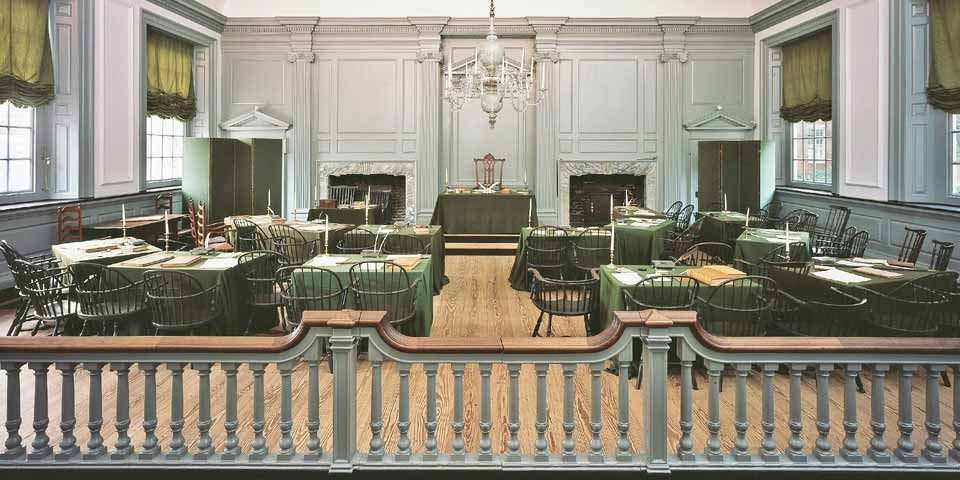
1776 filled the calendar with dates deserving of remembrance and even celebration. John Adams, delegate from Massachusetts to the Second Continental Congress, wrote home to his wife Abigail that future generations would celebrate July 2, the date the Congress voted to approve Richard Henry Lee’s resolution declaring independence from Britain for 13 of the British colonies in America.

Continental congress DSC_0607
Scene of the crime — Independence Hall in Philadelphia, where the Second Continental congress approved the resolution to declare the colonies independent from Britain – (Photo credit: National Park Service)

Two days later, that same Congress approved the wording of the document Thomas Jefferson had drafted to announce Lee’s resolution to the world.

Today, we celebrate the date of the document Jefferson wrote, and Richard Henry Lee is often a reduced to a footnote, if not erased from history altogether.

Who can predict the future?

(You know, of course, that Adams and Jefferson both died 50 years to the day after the Declaration of Independence, on July 4, 1826. In the 50 intervening years, Adams and Jefferson were comrades in arms and diplomacy in Europe, officers of the new government in America, opposing candidates for the presidency, President and Vice President, ex-President and President, bitter enemies, then long-distance friends writing almost daily about how to make a great new nation. Read David McCullough‘s version of the story, if you can find it.)

(Yes, this is mostly an encore post.)

More, and Related articles:

The Lee Resolution.
The Lee Resolution, passed by the Second Continental Congress on July 2, 1776 – Wikipedia image (Wait a minute: Are those numbers added correctly? What are they?)
Yes, this is mostly an encore post. Fighting ignorance requires patience.

Quote of the moment: DDT ban justified, Judge Malcolm R. Wilkey

June 20, 2016

Environmental Protection Agency (EPA) Administrator William Ruckelshaus’s 1971 rule banning DDT use on U.S. crops, while allowing U.S. production of DDT to continue for export and for fighting diseases carried by insects, threaded a coveted needle. It was challenged in court by environmental protection groups who argued the rule should have been tougher and more restrictive, and by chemical companies, who argued the science basis for the law was inadequate.

Though we couldn’t tell from current news barkers’ claims that DDT should be freed to fight Zika, the courts ruled that there was ample science justifying Ruckelshaus’s ruling. These are the important words in that court decision. In other words, claims that the DDT ban was political or biased, are false.

IV. CONCLUSION

On review of the decision and Order of the EPA Administrator, we find it to be supported by substantial evidence based on the record as a whole. Furthermore, we find that EPA has provided the functional equivalent of a formal NEPA report. Therefore, the two challenges raised concerning the Administrator’s decision to cancel DDT registrations are rejected and the Administrator’s action is affirmed.

Judge Malcolm R. Wilkey, U.S. Court of Appeals for the District of Columbia Circuit, in Environmental Defense Fund v. EPA, 489 F.2d 1247 (1973)


Quote of the Moment – Pete Seeger: Not singing is a big mistake

January 18, 2016

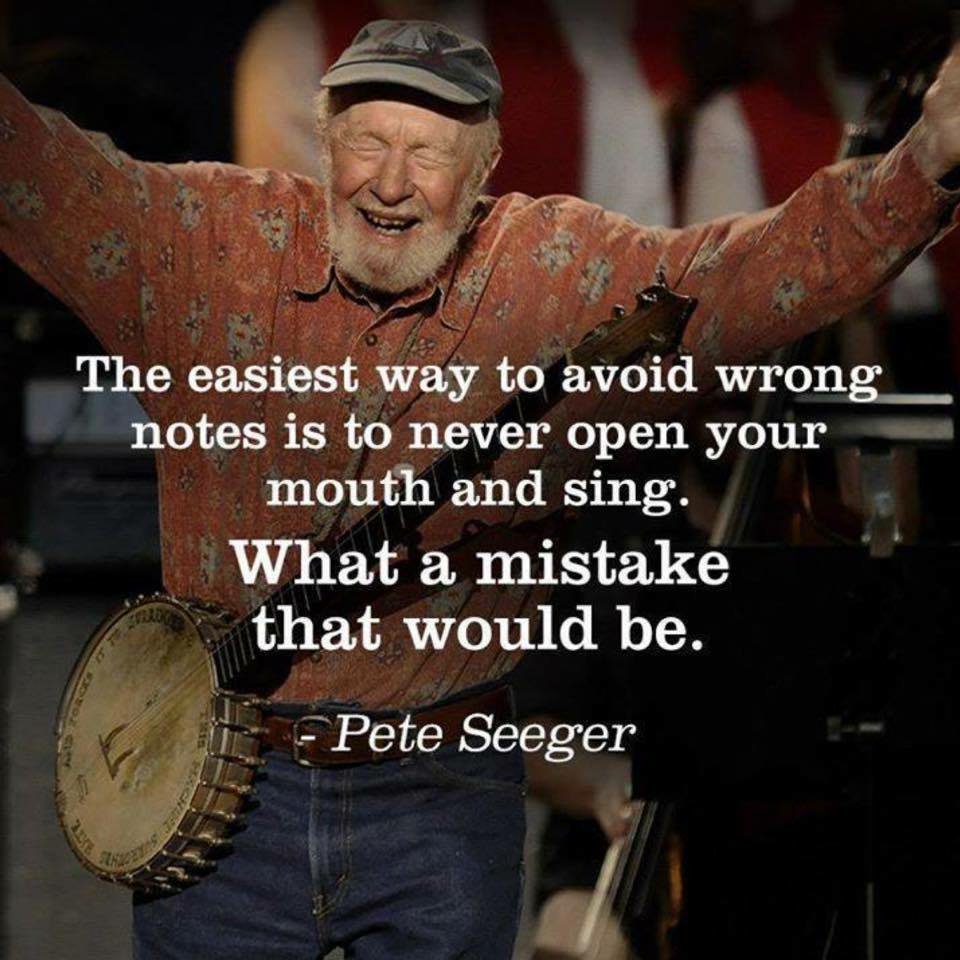
I don’t have a citation for where Pete Seeger said this, but it’s wholly within his character and mission. Anyone got a cite?

@Area9Handbells said:  Pete Seeger got it right with the exception of one word –

A Tweet from @Area9Handbells: Pete Seeger got it right with the exception of one word – “sing.” We think he meant “ring.”

“The easiest way to avoid wrong notes is to never open your mouth and sing. What a mistake that would be.”

∇ Pete Seeger

I’ve asked for a citation, for accuracy and to keep the anti-plagiarism and accuracy mavens happy, but don’t have one yet. Nor do I know to whom goes credit for the poster and photo. Can you help?