Carl Sagan Day, November 9, 2012

November 9, 2012

Electioneering cut into my planning — didn’t get anything done for Carl Sagan Day, today, November 9.  Here’s the post from last year, with a few links to sources including new sources at the bottom.  “Our species needs, and deserves, a citizenry with minds wide awake and a basic understanding of how the world works,” Sagan said.  Boy, howdy, now more than ever.

Have a happy Carl Sagan Day!

_________________________________________________________________________

Press release from the Center for Inquiry:

Carl Sagan Day: November 9 — Celebrate with us!
Event Ideas & Sagan Day Commemorative Posters

Carl Sagan Day Poster 2011Carl Sagan was a Professor of Astronomy and Space Science and Director of the Laboratory for Planetary Studies at Cornell University, but most of us know him as a Pulitzer Prize winning author and the creator of COSMOS. That Emmy and Peabody award-winning PBS television series transformed educational television and continues to affect the hearts and minds of over a billion people in over sixty countries.

No other scientist has been able to reach and engage so many nonscientists in such a meaningful way, and that is why we honor Dr. Sagan, remember his work, and revel in the cosmos he helped us understand.

Two years ago, CFI–Fort Lauderdale and other groups hostd the first Carl Sagan Day event in Florida.  It was a fantastic success and now individuals and groups around the world are planning their own tributes with science fairs, planetarium shows, teacher workshops, star parties, COSMOS marathons, and more—all to say “Thanks!” to Sagan and to bring his gifts to another generation of “starstuff.”

How can you celebrate Carl Sagan Day?

Whether you’re an independent skeptics group, an astronomy club, a science department, a researcher, a teacher, a student, or just a really big Sagan fan, there are plenty of ways to celebrate Sagan Day:

  • Host a COSMOS marathon—all 13 episodes are available for free at hulu.com.
  • Check out Sagan’s many books at your local library or bookstore using the thorough listings from WorldCat.org.
  • Enjoy the special collection of articles by or about Sagan, previously published in Skeptical Inquirer magazine.
  • Listen to Sagan’s last public address for the Committee for Skeptical Inquiry (formerly CSICOP) as replayed on CFI’s podcast, Point of Inquiry: “Wonder and Skepticism.”
  • Listen to Ann Druyan, writer, producer, and widow of Sagan, discuss life with Carl, his outlook on life, and his famous Gifford Lectures, “The Varieties of Scientific Experience,” also on Point of Inquiry.
  • Host your own apple pie baking contest (from scratch, of course).
  • Dress like Carl for a day!
  • Refresh your skeptic skills with a review of Sagan’s Baloney Detection Kit.
  • Invite your friends over and try to convince them you have a dragon in your garage.
  • Take in a star show at your local planetarium.
  • At the very least, seek out a dark sky, look UP, and reconnect with the grandeur of the cosmos.

Let us know how you’re planning to commemorate Carl Sagan Day 2011 and we’ll add your event to our Carl Sagan Day Event Calendar to help spread the word.  Please email your event information to grassroots@centerforinquiry.net.

Great collection of posters, featuring Sagan, the Very Large Array, and quotes from the good doctor, here.

November 9 is the anniversary of Sagan’s birth, of course.

More, for 2012:


Too late to save the planet?

November 6, 2012

Denialists scoff that 2º Celsius could cause disaster, say wait to see.  But is it too late already?

It’s a link to an article in the business section of The Guardian (links added here):

The report concludes that “governments and businesses can no longer assume that a two-degree warming world is the default scenario”, and urges greater planning to cope with the disruptive effects that more unpredictable and extreme weather will have on supply chains, long-term assets, and infrastructure, particularly in coastal or low-lying regions.

Meanwhile, businesses in carbon-intensive sectors must also anticipate “invasive regulation” and the possibility of stranded assets, said Jonathan Grant, director of sustainability and climate change at PwC.

“Resilience will become a watchword in the boardroom – to policy responses as well as to the climate,” he said. “More radical and disruptive policy reactions in the medium term could lead to high-carbon assets being stranded.

“The new reality is a much more challenging future in terms of planning, financing and predictability,” Grant added. “The challenge now is to implement gigatonne-scale reductions across the economy, in power generation, energy-efficiency, transport and industry, as well as REDD+ in forested nations.”

More:

CO2 emissions, by continent - Visual-ly

CO2 emissions, by continent – Visual-ly; click image for a larger version.


Steve Schafersman, Texas State Board of Education District 15

November 6, 2012

District 15 for the Texas State Board of Education covers 77 counties in Texas’s northern Panhandle.  It’s oil (Midland), cotton, Texas prairie and small towns, and lots of schools, and some surprisingly good colleges and universities.

Texas State Board of Education District 15, TFN image

Texas State Board of Education District 15, TFN image – “District Overview
District 15 is huge, covering all of northwestern Texas. It is also arguably the most Republican SBOE district, giving more than 74 percent of the vote to Sen. John McCain in the 2008 presidential election and more than 70 percent to Gov. Rick Perry in the 2010 gubernatorial race.”

It’s a district where science plays a big role, and should play a bigger one.  The 15th includes those lands in Texas where the Dust Bowl got started, where unwise plowing based on inaccurate readings of climate contributed to one of the greatest man-made natural resources disasters in all of history.  It’s the home of Texas Tech University, where members of the chemistry faculty created a wine industry based on the chemistry of grape selection and fermentation, and where geologists learn how to find oil.

This area leads Texas in wind power generation, a considerable factor in the state that leads the nation in wind power generation.

In short, science, engineering and other technical disciplines keep this area economically alive, and vital at times.

Of the two candidates, Democrat Steve Schafersman is a scientist, and a long-time, staunch defender of science education (what we now cutely call “STEM” subjects:  Science, Technology, Engineering and Math).  If the race were decided by a test in STEM subjects, Schafersman would be the winner.  Schafersman lives in Midland.

The GOP candidate in the race is religiously anti-science, Marty Rowley of Amarillo.  As a good-ol’-boy, former pastor, he’s got a lot of support from the usual suspects.  Rowley’s views on science, technology, engineering and mathematics run contrary to the business and farming interests of his entire district.  Do his supporters look to the future?

Do you vote in Midland, Lubbock, Amarillo, Dalhart, Abilene, San Angelo, Dallam County, Tom Greene County, Cooke County or Montague County?  You need to vote for Steve Shafersman.  Do your children a favor, do your schools a favor, and do your region of Texas a favor, and vote for the guy who works to make education good.

Shafersman is the better-qualified candidate, and probably among the top two or three people with experience making the SBOE work well, in the nation.  He deserves the seat, and Texas needs him.

More:

Steve Schafersman campaign flier:

Shafersman for Texas State Board of Education District 15

Schafersman for Texas State Board of Education District 15 – click image for larger version


Ouch! Warming denialists’ claims blown away by Sandy

October 30, 2012

Over at Rabbett Run:

tonylearns said…
Could someone go over to Goddard’s blog for me ( I have been banned three times most recently for having the gall to suggest he was wrong in ridiculing the possibility of a new record minimum SIE this year. ) and ask for his apology to Hansen for ridiculing the possibility of the West Side Highway being underwater. I just saw a video showing the West Side Highway underwater.
29/10/12 7:46 PM

No! Someone whose comments don’t show up at Steve Goddard’s blog? Must be some massive disruption in the force of the Tubes of the Interweb thingy.

What is this guy Tony on about?

At Steve Goddard’s blog — this is the same guy who said the western drought was over because Lake Powell rose a few feet, though the drought raged on everywhere else — Goddard and his flying and limping monkeys have been poking fun at something James Hansen is alleged to have said:

According to NASA’s top scientist, Manhattan has been underwater for the past four years, and is experiencing a horrific drought.

While doing research 12 or 13 years ago, I met Jim Hansen, the scientist who in 1988 predicted the greenhouse effect before Congress. I went over to the window with him and looked out on Broadway in New York City and said, “If what you’re saying about the greenhouse effect is true, is anything going to look different down there in 20 years?” He looked for a while and was quiet and didn’t say anything for a couple seconds. Then he said, “Well, there will be more traffic.” I, of course, didn’t think he heard the question right. Then he explained, “The West Side Highway [which runs along the Hudson River] will be under water. And there will be tape across the windows across the street because of high winds. And the same birds won’t be there. The trees in the median strip will change.” Then he said, “There will be more police cars.” Why? “Well, you know what happens to crime when the heat goes up.”

And so far, over the last 10 years, we’ve had 10 of the hottest years on record. [Quoting an article at Salon]

The West Side Highway under water?  Ha.

Goddard’s blog has used Hansen’s quote as a regular punchline, not noticing that Hansen said “in 20 to 30 years,” and assuming he was just awfully, comically wrong.  30 years from 1988 will be 2018.  This year is 2012, six years to go.  Goddard tried to ridicule Hansen a few times over the past couple of years, for example:

  1. Here on October 4, 2010;
  2. Here on October 10, 2010;
  3. Here on November 13, 2010;
  4. Here on December 19, 2010 (with a photo of Al Gore, Barack Obama and an unidentified guy, maybe Goddard himself?);
  5. Here on January 15, 2011;
  6. Again on March 14, 2011;
  7. A special St. Patrick’s Day posting, March 17, 2011;
  8. Here on April 9, 2011;
  9. Here on May 22, 2011;
  10. Here on May 30, 2011; and obviously running out of comedy material, Goddard went for two in one day,
  11. Here on May 30, 2011, and by this time it’s such a regular meme attempting to mock James Hansen with same old material, Goddard doesn’t refer to the actual quote from Hansen;
  12. Here on June 15, 2011;
  13. Here on July 20, 2011;
  14. Here on July 21, 2011;
  15. Here on August 25, 2011;
  16. Here on May 7, 2012;
  17. Here on May 8, 2012;
  18. Here on May 23, 2012;
  19. June 25, 2012;
  20. August 9, 2012;
  21. August 23, 2012;
  22. August 31, 2012;
  23. September 28, 2012.

AP may complain about this use, but this is an academic, learning exercise:

Photo showing West Side Highway underwater from Hurricane Sandy

Caption from Yahoo! News: This photo provided by Dylan Patrick shows flooding along the Westside Highway near the USS Intrepid as Sandy moves through the area Monday, Oct. 29, 2012 in New York. Much of New York was plunged into darkness Monday by a superstorm that overflowed the city’s historic waterfront, flooded the financial district and subway tunnels and cut power to nearly a million people. (AP Photo/Dylan Patrick) MANDATORY CREDIT: DYLAN PATRICK

Dylan Patrick got the photographic evidence that shows, once again, warming denialists really are a classless, fact-lacking bunch.  CNN has photos from Dylanphoto1 (the same guy, almost certainly), in a slide show, noting, “Most of the Westside Highway south of 49th street is flooded all the way down, and in front of the USS Intrepid.”  Across from Pier 88 and the USS Intrepid, the street is indeed underwater.

So we learn that, as a comedian, Steve Goddard has an extremely limited range and depends on a sympathetic room to get laughs; and as a climate scientist, he is even more limited, and wrong, with 6 years to go in the 20 to 30 year range James Hansen offered.  And we learn once again, sadly, that James Hansen was right back in 1988 when he hit the claxons to warn us of global warming.

23 times Goddard repeated the charge?  Do you get the idea that “climate skeptics” ran out of material years ago, and have been dancing a cover-up for a very, very long time?  Hurricane Sandy blew and floated his claim away.

More:

Even more, a bit later:


Creationism vs. Christianity (a reprise)

October 30, 2012

This is an encore post, a repeat post from about four years ago, back in 2008.  For some reason the post got a couple hundred hits one day this past week, probably from a reference at another blog that I could not track.  I reread it — still true, still good stuff.  In this campaign year of 2012, I am dismayed at how anti-science and the denial of reality haunts election discussions, especially on-line, but also in the newspapers and magazines, on television and radio, in diners and drugstore fountains, in churches and PTA meetings.  Denial of reality may or may not be a genuine ailment to humans.  When it becomes a core belief of a significant number of people, denial can cripple our nation, our states, cities and towns. We need to ask deep questions.  We need to have real answers, not fantasies nor dangerous delusions.

PhotonQ-Charles Darwin 's Office

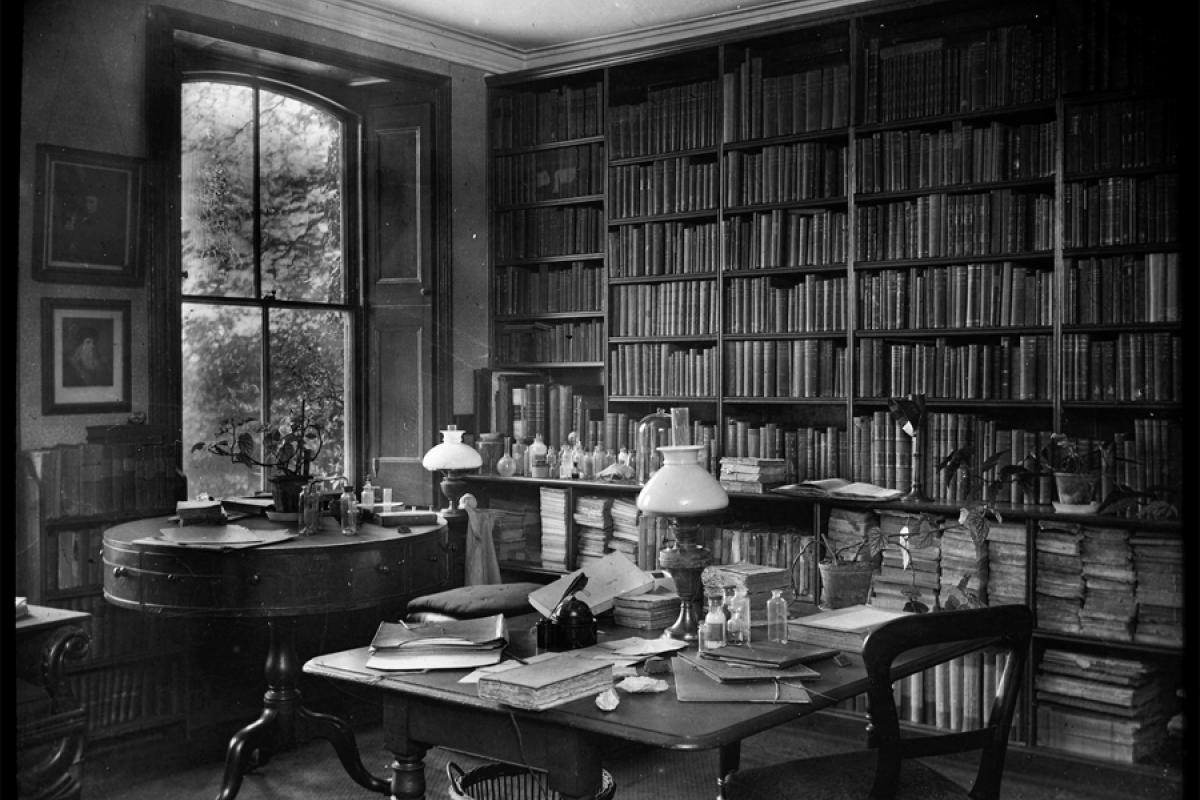
Charles Darwin’s study, where he conducted experiments and made many of the observations he wrote about. Photo: National Endowment for the Humanities

Denying reality plagues us as an actual political response to several problems.  Denialists wander so far down paths of disreality, they argue that we should ignore serious problems, and that the problems will then go away.

Should we teach the science of evolution to our children, or should we pretend fairy tales will substitute?  This has deep meaning to those who understand that Charles Darwin’s greatest contribution to science probably was his strict methodology, which required observation of things in nature before writing about them as if authoritative. 

Early in his life Darwin recognized that the natural world he saw, in Brazil, in the Galapagos Islands, in Australia and Tasmania, in South Africa, bore little resemblance to the world portrayed as authoritative by the great William Paley in his Natural Theology.  Throughout his science career Darwin observed real things in real time.  For his monograph on coral atolls, Darwin extensively observed the volcanic island phenomena throughout the South Pacific.  To write about barnacles, Darwin raised them in tanks in his study.  Looking at the mystery of exactly how the ivy twines, Darwin put a plant before him, and watched it, unraveling the secrets of how tendrils “knew” what to latch onto for support of the vine.  To write about leaf moulds, Darwin observed worms at work, in his lab and in his gardens.  To show the variation existing in what we now call the genome of a species, Darwin made extensive interviews and correspondence with animal husbanders of pigs, sheep and cattle, and he raised pigeons for generations himself, demonstrating how variations can be expressed that drive populations of one species to split into two through natural, everyday processes familiar to anyone who observed nature, and accessible by anyone who made methodical notes.

This familiarity with reality made Darwin a great scientist.  The methodology proved extendable into other areas when he carefully observed the mediums to whom his brother had cast great credence.  Charles revealed to Erasmus that spirit knocking on the tables at the séances did not occur so long as they held the hands of the mediums, who were then unable to feign the knocking. 

Ultimately it provided some despair to Darwin, too:  In the face of criticism from William Thompson, Lord Kelvin, that the Earth was not old enough to allow for evolution as Darwin suggested it must have occurred, Darwin had no answer.  Lord Kelvin calculated the ages of the Earth and Sun to be no more than 200 million years.  This was shown by the present temperatures and color of the Earth and the Sun, and calculated by Lord Kelvin from how long it would take the Earth, known to be composed of much iron and nickel, to cool from white hot to current temperatures.  Lord Kelvin ventured deep into coal mines to measure the temperatures of the Earth deep underground, to confirm his calculations.  At his death, though he defended his own observations of fossils and breeding of live animals, Darwin had no response for those arguments.  Darwin thought there must be other forces at play.  Only some years later did Ernest Rutherford find the secret of the Earth’s heat:  Radioactive decay in the mantle and core of the planet keeps it warm.  Measures of heat loss for such a large body had not accounted for continuous heating from within.  A short while later astronomers and physicists discovered problems with Lord Kelvin’s calculations of the age of the Sun:  The Sun is not composed of iron, cooling from white hot temperatures, but instead is hydrogen, fusing into helium, and making its own heat.

Darwin’s calculations of the age of the Earth were more accurate than Lord Kelvin’s, based on Darwin’s crude calculations of how long it might take animals and plants to have evolved from much more primitive forms.  History demonstrated by easily observable things provided greater accuracy than history devised without benefit of grounding in reality.

In what other realms might grounding in reality produce answers different from what some expect, even producing better questions that many ask?  Should we consider the migratory pattern changes of birds, fish and mammals, as indicators of a warming climate, over rebuttals provided by untested claims that measuring stations might not be placed correctly?  Can we actually “cool” atoms with lasers, and use individual atoms to store information, no matter how counterintuitive that might sound?  Can it be true that teaching people about contraception, and about sex, actually prompts teenagers (and others) to reduce sexual activity and look for love, rather than just sex?  Does extending medical coverage to an entire population actually decrease total health care costs as observed in all other nations where that solution has been tried, or will it increase costs because the only way to reduce medical costs is to ration it, either with a bureaucracy, or by cutting off access by backdoor, death panel means testing (no money, no health care)?  Is there any place Arthur Laffer‘s “curve” of increasing tax revenues by cutting tax rates, actually does not work — or any place it actually works?  Has any society in history ever gotten rich by showering riches on the rich, and ignoring the poor, the merchants, and the working class?

In short, how does reality we know, inform us about reality yet to be?  Which is the more potent predictor, observed reality, or hoped-for results to the contrary?

Our future hangs on how we answer the question, probably more than what the answer actually is.

I believe Christians, the largest faith group in the U.S., have a duty to stand for reality, and truth discovered by observation.  That was the issue in 2008, too.

Here is my post of four years ago.  I noticed a few of the links no longer work; I’ll replace them with working links as I can.  If you find a bad link, please note it in comments; and if you have a better link, note that, too.

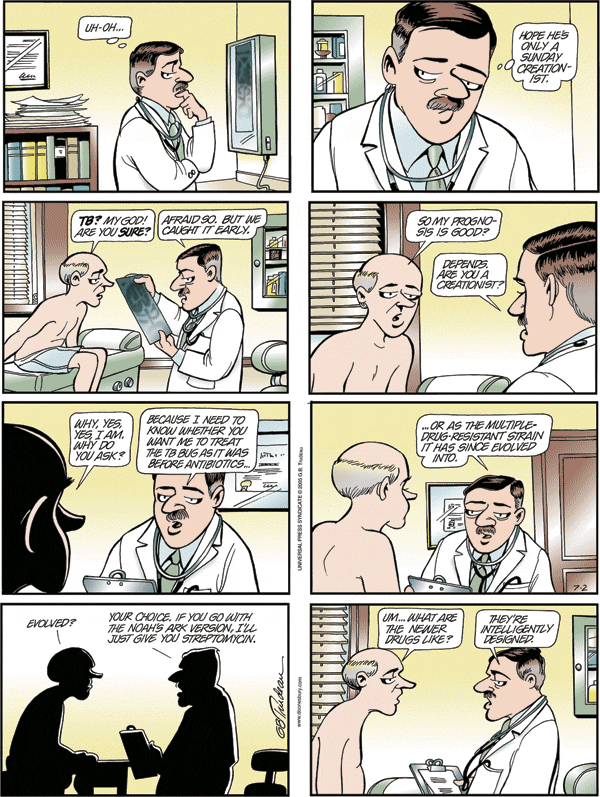
Several weeks ago [in 2008] I responded to a lengthy thread at Unreasonable FaithThe original post was Garry Trudeau’s “Doonesbury” cartoon of the guy in a doctor’s office, just diagnosed with an infection.  The physician asks the guy if he’s a creationist, explaining that if he is, the doc will treat him with old antibiotics in honor of his belief that evolution of bacteria doesn’t occur.

Charles Darwin's Study, Down House. Photo by and copyright held by Bob Radlinski. Radlinski's description: Darwin regularly spent about 5 hours a day here for 40 years and kept a chamber pot behind the partition so that he wouldn't have to trek to the toilet. But he still had time for an active family life with his wife Emma and their 10 children. The low stool with casters was used to spin himself from one desk where he dissected in front of the window to another where he took notes or wrote up labels—the stool the children were allowed to use for their games, punting themselves around the living room with long poles. The sitting room at the back of the house has large windows that go to the floor so that on nice days, the children (and dogs) could roam back and forth from house to garden at will.

Charles Darwin’s Study, Down House, where Darwin wrote all of his publications after his marriage. Photo by and copyright held by Bob Radlinski. Radlinski’s description: Darwin regularly spent about 5 hours a day here for 40 years and kept a chamber pot behind the partition so that he wouldn’t have to trek to the toilet. But he still had time for an active family life with his wife Emma and their 10 children. The low stool with casters was used to spin himself from one desk where he dissected in front of the window to another where he took notes or wrote up labels—the stool the children were allowed to use for their games, punting themselves around the living room with long poles. The sitting room at the back of the house has large windows that go to the floor so that on nice days, the children (and dogs) could roam back and forth from house to garden at will.

Point being, of course, that evolution occurs in the real world.  Creationists rarely exhibit the faith of their claims when their life, or just nagging pain, is on the line.  They’ll choose the evolution-based medical treatment almost every time.  There are no creationists in the cancer or infectious disease wards.

At one point I responded to a comment loaded with typical creationist error.  It was a long post.  It covered some ground that I’ve not written about on this blog.  And partly because it took some time to assemble, I’m reposting my comments here.  Of course, without the Trudeau cartoon, it won’t get nearly the comments here.

I’ll add links here when I get a chance, which I lacked the time to do earlier.  See my post, below the fold.

Read the rest of this entry »


What does Superstorm Sandy tell us about how to vote? Is disaster aid “immoral?”

October 29, 2012

Is it immoral for the federal government to coordinate disaster responses, and to provide aid for disasters, especially during and after superstorms like Sandy?

SUOMI view of Hurricane Sandy, early October 29, 2012 - NASA image

Caption from NASA: This night-view image of Hurricane Sandy was acquired by the Visible Infrared Imaging Radiometer Suite (VIIRS) on the Suomi NPP satellite around 2:42 a.m. Eastern Daylight Time (06:42 Universal Time) on October 28, 2012. In this case, the cloud tops were lit by the nearly full Moon (full occurs on October 29). Some city lights in Florida and Georgia are also visible amid the clouds.
CREDIT: NASA/Suomi NPP – VIIRS/Michael Carlowicz

I was troubled when GOP Louisiana Gov. Bobby Jindal called for cuts to disaster forecasting and especially our volcano monitoring systems, in 2009. I’ve been troubled by slams at NASA and NOAA with calls to cut budgets for orbiting satellites used to forecast storms and floods and other disasters, from the GOP.

And, with Sandy bearing down on the U.S. Northeast, Middle Atlantic and New England states (where older son Kenny lives in building that is, we hope, about 20 feet above sea level), I’ve been troubled by memories of calls for cuts to FEMA in the Republican presidential primaries.

Correspondent James Kessler tracked down a transcript from a campaign event in June, a presidential candidate cavalcade broadcast by CNN, with John King as moderator/anchor.  Look at this exchange:

KING: What else, Governor Romney? You’ve been a chief executive of a state. I was just in Joplin, Missouri. I’ve been in Mississippi and Louisiana and Tennessee and other communities dealing with whether it’s the tornadoes, the flooding, and worse. FEMA is about to run out of money, and there are some people who say do it on a case-by-case basis and some people who say, you know, maybe we’re learning a lesson here that the states should take on more of this role. How do you deal with something like that?

ROMNEY: Absolutely. Every time you have an occasion to take something from the federal government and send it back to the states, that’s the right direction. And if you can go even further and send it back to the private sector, that’s even better.

Instead of thinking in the federal budget, what we should cut — we should ask ourselves the opposite question. What should we keep? We should take all of what we’re doing at the federal level and say, what are the things we’re doing that we don’t have to do? And those things we’ve got to stop doing, because we’re borrowing $1.6 trillion more this year than we’re taking in. We cannot…

KING: Including disaster relief, though?

ROMNEY: We cannot — we cannot afford to do those things without jeopardizing the future for our kids. It is simply immoral, in my view, for us to continue to rack up larger and larger debts and pass them on to our kids, knowing full well that we’ll all be dead and gone before it’s paid off. It makes no sense at all.

Can you imagine how different the world would be today had Americans shared that view in 1936, or 1940, or 1942?  Immoral to do what is necessary to preserve the future, because we have to borrow to do some of it?

Has Romney changed his position in the last 24 hours?  I predict he will change it very soon, if he hasn’t already flip-flopped on it.  Of course, he may double down on crazy, and stand pat.   What do you think a rational patriot would do in this case?  [At about 1:00 p.m. Central Time, I heard an NPR radio news report — Romney urges private contributions to the Red Cross.  Meanwhile, President Obama has been working all morning to make sure the disaster response from the federal government is coordinated with affected states.] [Ha! But within hours, Romney has taken the almost-opposite position again.  World land speed record for flips on an issue?]

I erred, perhaps.  I had thought Mitt Romney the most capable and sober of the GOP candidates for president, and I urged by GOP friends to support Romney if they had no chance of completely recovering their senses by November.  Now I realize that, on the GOP side, “most capable” should be “most nearly capable,” and still means “incapable.”  And “sober” means nothing at all.  Perhaps worse, he’s still the best of the GOP lot this year.  Even worse, he has a chance to win.

Can we blame Romney?  Yes, we can blame people who reject science and don’t think of consequences past election day.  Yesterday Greg Laden offered a long post on what we should have learned from the “Storm of 1938” and the remnants of Hurricane Irene that slammed the Northeast in 2011, “What you need to know about Frankenstorm Hurricane Sandy”:

Here’s the thing. Imagine that a storm like Sandy came along in either of two years; 70 years ago or 35 years ago. Sandy is much larger and contains much more energy than the ’38 storm, or for that matter, of any known storm of the North Atlantic (we’ll get to that below). If Sandy hit the region in the 1930s, it would have been without warning, and it would have been prior to the reconstruction of seawalls and the development of flood mitigation measures inland that have happened in recent decades. Sandy, in ’38, would kill tens of thousands and destroy thousands of structures. That would be an average Sandy, a Sandy not being as bad as the most dire predictions we are considering today as the storm begins to take a grip on the eastern seaboard.

A Sandy of 35 years ago would have been predicted. The ability to see hurricanes coming was in place, but not as well developed as it is today. We would have seen Sandy coming, but her massiveness and extent, and her exact trajectory, would probably have been unknown. But at least there would be warning. Many of the seawalls and flood mitigation systems would have been in place, but the overbuilding on barrier islands and other vulnerable coastal regions would have been at or near a peak. With evacuations, Sandy would not kill 10s of thousands… probably only hundreds. But the number of buildings destroyed would be unthinkable. Most of those buildings are now gone or shored up. A Sandy in 1975 would have left some very interesting coastal archaeology for me to have observed during my trips to the shore in the 1980s. Very interesting indeed.

Mr. Laden always offers a good view of science, and his history is good here, too.

We can learn from the past.  FEMA is charged with learning from past disasters.  It’s a function of federal government we would be foolish to forego.  “Austere” shouldn’t mean “stupid.”

What do you think?  Is it immoral for the federal government to provide disaster assistance?

More:


U.S. actions to support Agenda 21: Soil conservation, farm and rural development; no population control, no black helicopters

October 24, 2012

Not sure what Agenda 21 is?  It’s the larger program of the United Nations to pick up where the U.S. Soil Conservation Service left off (SCS is now the U.S. Natural Resources Conservation Service, NRCS).  Erosion control.  Don’t deplete the soils.  Keep water sources clean and flowing.  Use wise plowing practices to prevent another Dust Bowl.  Get Girl Scouts and Boy Scouts and Future Farmers of America and 4-H Clubs to build check dams and plant beneficial trees.

See a quick explanation of Agenda 21 here (courtesy of Grist, here).

Keenan Wynn and a Coke machine, Dr. Strangelove (publicity still?)

Keenan Wynn as Col. Bat Guano, pauses before shooting open a Coke machine to get change to place a call to the President of the United States to save the world, in Stanley Kubrick’s “Dr. Strangelove, Or How I Learned to Stop Worrying and Love the Bomb,” (publicity still?).  Agenda 21 is not like “Dr. Strangelove,” except perhaps in the minds of those poisoned by dramatic over-consumption of Coca-Cola or Monster Cola.

You can’t find that stuff easily on Google, nor Bing, usually.  Instead you’ll find people worrying about black helicopters, the massive, unseen and never-detected UN Army poised to take over U.S. golf courses, and unhinged rants about forced population control, rants worthy of Col. Bat Guano but lacking Kubrick’s and Southern’s and George’s wit or Keenan Wynn‘s sharp delivery.  (Yes, if you hear someone complaining about Agenda 21, you may and perhaps should say, “That’s Bat Guano!”)

Agenda 21 is the umbrella agency under which nations who are members of the UN undertake studies of Earth’s resources, human effects upon those resources, and which makes recommendations about how to save our planet’s resources from depletion.  KyotoRio CopenhagenIPCC.

Agenda 21 is about as milk toast a policy initiative as it is possible to get.  Why all the angst among so-called neo-conservatives and so-called libertarians?  Beats me.  I can only imagine that they have never read any of the documents, know nothing of the issues discussed, and have slept through much of the past 50 years on farm and food production issues.

Should we fear, as Paul Sadler‘s GOP opponent for the Texas U.S. Senate seat does, that Agenda 21 will require Texas to turn over all its golf courses to the UN?  No, we should instead pay attention to what the government has actually done in support of Agenda 21 initiatives — all of which are voluntary under the Agenda 21 program and the UN Charter.  Also, perhaps, we should make sure to vote against anyone who tries to instill fear by misstating what Agenda 21 is, or does, or “requires” (Yeah, you, Ted Cruz — what sort of crazy are you on? and this is why we’re voting for Paul Sadler instead; we need rational people who love Texas more than crazies who speak smack about golf courses and people who golf).

Here’s the White House list of activities to support Agenda 21 in the last four years; can you find the black helicopters and UN takeover of U.S. territory?  No, neither can anyone else:

Policy Initiatives

President Obama’s administration understands that a strong American economy is contingent upon a strong rural economy. Since the creation of the White House Rural Council, the President has made historic investments in rural America designed to drive job growth.  The actions will help ensure the development of a rural economy built to last.  These actions include:

Doubling Small Business Administration (SBA) Investment Funds for Rural Small Businesses
Announced August 2011

The Administration established a rural “carve-out” in the Small Business Investment Company (SBIC) Impact Investment Program that will invest in distressed areas and emerging sectors such as clean energy.  SBA will provide up to a 2:1 match to private capital raised by the fund.  SBA and the U.S. Department of Agriculture (USDA) are committed to partnering to drive $350 million of investment capital through the fund and existing SBICs into rural small businesses over five years, doubling the current rate of investment.

Providing Job Search Information through USDA Field Offices
Announced August 2011

The USDA and Department of Labor (DOL) partnered to offer job training information and better utilize the rural footprint of the USDA field offices across the country to provide them with greater access to job search resources by reducing the driving times and distances for rural customers seeking program information.

Expansion of the National Health Service Corps to Critical Access Hospitals
Announced August 2011

The Department of Health and Human Services (HHS) expanded eligibility for the National Health Service Corps loan repayment program so that Critical Access Hospitals, those with 25 beds or fewer, can recruit new physicians, using student loan repayment incentives.  This program will help hospitals across the country recruit needed staff.  Once a hospital has qualified as a service site, it can then apply for student loan repayment on behalf of its primary care physicians, nurse practitioners, and physician assistants.

Expanding Health Information Technology in Rural Communities
Announced August 2011

USDA and HHS signed an agreement to improve access to capital for rural hospitals and other providers seeking to implement health information technology and expand the health IT workforce in rural communities.

Commercial Aviation Biofuels Partnership
Announced August 2011

The Navy, the Department of Energy, and USDA have joined forces to spur the creation of an advanced biofuels industry that will support commercial aviation, with a pledge of $510 million, over three years, under the Defense Production Act of 1950.

Promoting a Bioeconomy through BioPreferred
Announced February 2012

To support the Administration’s “Blueprint for a Bioeconomy,” the President is utilizing the purchasing power of the Federal government by directing Federal agencies to take additional steps to significantly increase the purchase of biobased products over the next two years, which will create thousands of new rural jobs and drive innovation where biobased products are grown and manufactured. Utilizing the existing BioPreferred program, the Federal government will use its procurement power to increase the purchasing and use of biobased products, promoting rural economic development, creating new jobs, and providing new markets for farm commodities. Biobased products include items like paints, soaps and detergents and are developed from farm grown plants, rather than chemicals or petroleum bases. The biobased products sector marries the two most important economic engines for rural America: agriculture and manufacturing.

Rural Jobs Accelerator
Announced February 2012

The “Rural Jobs Accelerator” will link Federal programs to facilitate job creation and economic development in rural communities by utilizing regional development strategies. The “Rural Jobs Accelerator” will allow multiple agencies to coordinate technical assistance and grant/loan programs so that a consortium of public and private rural entities can have a single access point within the Federal government, allowing for improved access, streamlining of programs, and better leveraging of resources.  USDA and EDA will leverage approximately $14 million in funding, with technical support from Delta Regional Authority, Appalachian Regional Commission, Department of Housing and Urban Development, and the Department of Education.

Development of Rural Health IT Workforce
Announced February 2012

HHS and the DOL signed a memorandum of understanding to link community colleges and technical colleges that support rural communities with available materials and resources to support the training of HIT professionals.  Rural health care providers face challenges in harnessing the benefits of health information technology (HIT) due to limited capital and a workforce that is not trained to work within the expanding field of HIT. Due to lower financial operating margins and limited capital, funds for hiring new staff or training existing staff in HIT implementation and maintenance are often simply not available to rural health care providers.  The Bureau of Labor Statistics estimates that the needed HIT workforce will increase by 20 percent by the year 2016.  A significant part of that growth will come in rural areas, which are served by approximately 2,000 rural hospitals, 3,700 Rural Health Clinics as well as the more than 3,000 Community and Migrant Health Centers that are either located in or serve rural communities.

Timber and National Forest Restoration
Announced  February 2012

USDA’s Forest Service, in conjunction with the White House Rural Council, released a strategy to increase the scale of restoration treatments like forest thinning, reforestation, and other activities to restore and sustain the health of our forests.  In addition to environmental benefits, these activities create jobs in the forest industry which has been hurt significantly by the economic downturn.  The strategy relies on (1) using collaborative approaches to broaden public support for forest restoration; (2) expanding restoration tools like the Collaborative Forest Landscape Restoration Program and stewardship contracting; (3) better targeting budget resources; and (4) streamlining forest planning and analysis without sacrificing quality.

Mortgage Refinancing
Announced February 2012

The Administration announced an initiative to assist rural homeowners refinance their mortgages at lower interest rates through USDA’s Rural Development agency. By reallocating existing funding, at no additional cost to taxpayers, USDA will have almost doubled the amount of funds available to homeowners seeking to lower their mortgage payments or avoid foreclosure.  Under the new allocation, the amount of the $24 billion program dedicated to refinancing will increase from $520 million to $1.1 billion, allowing USDA to meet the growing demand for refinance transactions.

Task Force on Tourism and Competitiveness
Announced January 2012

On January 19, the President signed an Executive Order creating a Task Force charged with developing a National Travel and Tourism Strategy with recommendations for new policies and initiatives to promote domestic and international travel opportunities throughout the United States. The strategy will include recommendations to promote visits to the United States public lands, waters, shores, monuments, and other iconic American destinations, thereby expanding job creation in the United States, as well as tourism opportunities in rural communities. The Task Force is co-chaired by Secretary Salazar and Secretary Bryson, with participation from USDA, other agencies and WH offices.

Advancing Water Quality Conservation across the U.S.
Announced May 2012

The United States Department of Agriculture (USDA) announced the launch of a new National Water Quality Initiative committed to improving one to seven impaired watersheds in every U.S. state and territory. The Initiative is part of the Obama Administration’s White House Rural Council which is working in partnership with farmers, ranchers and forest owners to improve conservation of working lands in rural America. The 157 selected watersheds were identified with assistance from state agencies, key partners, and USDA’s Natural Resources Conservation Service (NRCS) State Technical Committees. NRCS will make available at least $33 million in financial assistance to farmers, ranchers and forest landowners this year to implement conservation practices to help provide cleaner water for their neighbors and communities.

Small Business Administration Investing in Rural Small Businesses
Announced June 2012

The Administration extended more than $400 million in FY 2011 of investments in rural America through the Small Business Investment Company (SBIC) Impact Investment Program, at no cost to taxpayers. Nearly $2 billion in additional funding will be invested by the end of fiscal year 2016. These investments will continue to help finance, grow, expand, and modernize rural small business operations around the country.

MOU to Improve Support in the Colonias
Announced June 2012

The U.S. Department of Agriculture-Rural Development (USDA-RD), Housing and Urban Development, and Department of Treasury’s Community Development Financial Institutions Fund (CDFI) partnered to create the Border Community Capital Initiative. This collaboration is designed to expand access to capital in the U.S/Mexico border region which includes some of the poorest communities in the country. The Memorandum of Understanding (MOU) will provide up to $200,000 to nonprofit and/or tribal financial institutions that serve colonias. This funding will go to increase access to basic necessities such as safe drinking water, adequate sewage systems, and safe, sanitary housing.

U.S Department of Education Investing in Rural Schools
Announced June 2012

Through the national broadband plan, the Obama Administration will leverage the power of technology to overcome distance and increase collaboration to accelerate student achievement in rural schools. The White House Rural Council partnered with the U.S Department of Education to deliver a new online community of practice groups for rural schools. This online tool will create virtual communities of practice for educators to connect to resources, tools, colleagues, experts, and learned activities both within and beyond schools. The Administration is using technology to break down geographic barriers and address rural isolation in education.

Accelerating Broadband Infrastructure Deployment
Announced June 2012

On June 14, 2012 President Obama signed an Executive Order to make broadband construction along Federal roadways and properties up to 90 percent cheaper and more efficient. U.S agencies that manage Federal properties and roads will partner to offer carriers a single approach to leasing Federal assets for broadband deployment. Providing a uniform approach for broadband carriers to build networks will speed the delivery of connectivity to communities, business, and schools in rural America. In order to further expand the nations broadband service, more than 25 cities and 60 national research universities are partnering to form “US Ignite.” US Ignite will create a new wave of services that will extend programmable broadband networks to 100 times the speed of today’s internet. This partnership will improve services to Americans and drive job creation, promote innovation, and create new markets for American business.

Supporting Appalachian Communities
Announced June 2012

Facilitated through the White House Rural Council, the Appalachian Regional Commission (ARC) developed a Livable Communities Initiative. This initiative is a partnership between ARC, the U.S Environmental Protection Agency (EPA), and the U.S Department of Agriculture Rural Development (USDA RD). The initiative provides technical assistance to small rural towns to help them develop and implement strategies for making the communities more livable and competitive. The partnership will focus on expanding transportation choices, supporting thriving and distinctive rural communities by investing in rural town centers, and extending affordable housing opportunities.

There is nothing seriously objectionable in that list of activities.  If you’re an astute, patriotic American, you’ll recognize a lot of actions that strengthen our nation.  Maybe opposition to Agenda 21 is a virus spread by an insect vector — there is no rational explanation for it, certainly.

More:

Highlights from the video, as listed at the White House blog:

Drought Relief: President Obama also toured McIntosh Family Farms in Missouri Valley, Iowa to see drought damage first-hand and offer relief to those being effected. The President announced that the Department of Agriculture will begin to buy up to $170 million worth of pork, chicken, lamb, and catfish. And the President is directing the Department of Defense — which purchased more than 150,000 million pounds of beef and pork in the last year alone — to encourage its vendors to accelerate meat purchases for the military and freeze it for future use.

“Understand this won’t solve the problem. We can’t make it rain,” the President said. “But this will help families like the McIntoshes in states across the country, including here in Iowa. And we’re going to keep doing what we can to help because that’s what we do. We are Americans. We take care of each other.”

To learn more, the Department of Agriculture is collecting resources for farmers, ranchers, and small businesses wrestling with this crisis at USDA.gov/drought. More information still is available at WhiteHouse.gov/drought.

Banner Year for the U.S. Wind Industry: Also this week, the Energy Department and Lawrence Berkeley National Laboratory released a new report highlighting strong growth in America’s wind energy market in 2011 and underscoring the importance of continued policy support and clean energy tax credits to ensure that the U.S. remains a leading producer and manufacturer in this booming global industry.As President Obama has made clear, we need an all-of-the-above approach to American energy and the U.S. wind industry is a critical part of this strategy. In fact, wind energy contributed 32 percent of all new U.S. electric capacity additions last year, representing $14 billion in new investment.

Wall of Shame on Agenda 21; sites that promote the crazies:


Gradient Sun, NASA video for classroom use

October 21, 2012

Real science often is more fantastic that the stuff people make up. Haldane was right.

Still shot from NASA solar gradient video

Not the Sun you’re used to seeing.

In a century our studies of the Sun progressed from the deep calculations based on erroneous assumptions of what our star is make of  (Lord Kelvin‘s calculations on how long the iron in the Sun would take to cool to its present color), to today’s solar studies, in which nearly every moment of the Sun’s life is recorded through a half dozen different sensors, by satellites and telescopes and whatever other means we have to capture data from the Sun’s burning.

It’s hard science — but it borders on art, too, doesn’t it?  Watch this:

Gradient Sun [HD Video], originally uploaded by NASA Goddard Photo and Video.

What’s going on here?

Via Flickr:

Watching a particularly beautiful movie of the sun helps show how the lines between science and art can sometimes blur. But there is more to the connection between the two disciplines: science and art techniques are often quite similar, indeed one may inform the other or be improved based on lessons from the other arena. One such case is a technique known as a “gradient filter” – recognizable to many people as an option available on a photo-editing program. Gradients are, in fact, a mathematical description that highlights the places of greatest physical change in space. A gradient filter, in turn, enhances places of contrast, making them all the more obviously different, a useful tool when adjusting photos. Scientists, too, use gradient filters to enhance contrast, using them to accentuate fine structures that might otherwise be lost in the background noise. On the sun, for example, scientists wish to study a phenomenon known as coronal loops, which are giant arcs of solar material constrained to travel along that particular path by the magnetic fields in the sun’s atmosphere. Observations of the loops, which can be more or less tangled and complex during different phases of the sun’s 11-year activity cycle, can help researchers understand what’s happening with the sun’s complex magnetic fields, fields that can also power great eruptions on the sun such as solar flares or coronal mass ejections.

The images here show an unfiltered image from the sun next to one that has been processed using a gradient filter. Note how the coronal loops are sharp and defined, making them all the more easy to study. On the other hand, gradients also make great art. Watch the movie to see how the sharp loops on the sun next to the more fuzzy areas in the lower solar atmosphere provide a dazzling show.

NASA/Goddard Space Flight Center

NASA/Goddard Space Flight Center

To download this video go to: svs.gsfc.nasa.gov/goto?11112

NASA image use policy.

NASA Goddard Space Flight Center enables NASA’s mission through four scientific endeavors: Earth Science, Heliophysics, Solar System Exploration, and Astrophysics. Goddard plays a leading role in NASA’s accomplishments by contributing compelling scientific knowledge to advance the Agency’s mission.

Follow us on Twitter

Like us on Facebook

Find us on Instagram

Teachers ought to figure out how to use this in classrooms — and I don’t mean astronomy, physics and chemistry only.  Can you find a use for this film in geography?  History? English and literature?

Sometime shortly after World War II scientists captured film of a mass coronal ejection from the Sun.  You probably can imagine the film I’m remembering.  That snippet found its way into films students saw in science, geography, chemistry, biology (“this is our Sun, from which all living things get energy, through photosynthesis”), and probably a half dozen other subjects.  It was spectacular, and it was just about all that was available for classroom use, then.  Students now probably have never seen it.  Worse, my experience is that students in high school generally have very little familiarity with the science projects carried out by agencies like NASA and the National Science Foundation, and they know very little about the Sun, or the Moon and other planets.

Teachers, the state isn’t going to help you put this into your classrooms.  Can you figure out some way to get it in?

More:


Endangered western forests: The Yellowstone

October 10, 2012

Additional CO2 and warmer weather will help plants, the climate change denialists say.  That’s not what we see, however.  Turns out CO2 helps weeds, and warmer weather helps destructive species, more than it helps the stuff we need and want in the wild.

For example, the white-bark pine, Pinus albicaulis:


161

From American Forests:

With increasingly warm winters at high elevations in the West, a predator that has stalked forests for decades has gained the upper hand. It is mountain pine blister rust, an invasive fungus. Combined with mountain pine beetles, which kill hundreds of thousands of trees per year in the Greater Yellowstone Area (GYA), the environmental health of the Rocky Mountains and neighboring regions is in danger. To make matters worse, the species most susceptible to these two threats, the whitebark pine, is also the most vital to ecosystem stability, essential to the survival of more than 190 plant and animal species in Yellowstone alone.

First debuted at SXSW Eco, this video tells the story of our endangered western forests and how American Forests and the Greater Yellowstone Coordinating Committee are working toward their restoration and protection for future generations.

Learn more: http://www.americanforests.org/what-we-do/endangered-western-forests/

More:

Whitebark Pine

Whitebark Pine (Photo credit: Wikipedia)

Whitebark Pine. Français : Tige et cônes de Pi...

Whitebark Pine, cones and needle cluster (Photo credit: Wikipedia)

Whitebark Pine Français : Un cône de Pin à éco...

Whitebark pine’s distinctive, almost-black cone. (Photo: Wikipedia)


Draconid meteor shower — a great show in 2012?

October 8, 2012

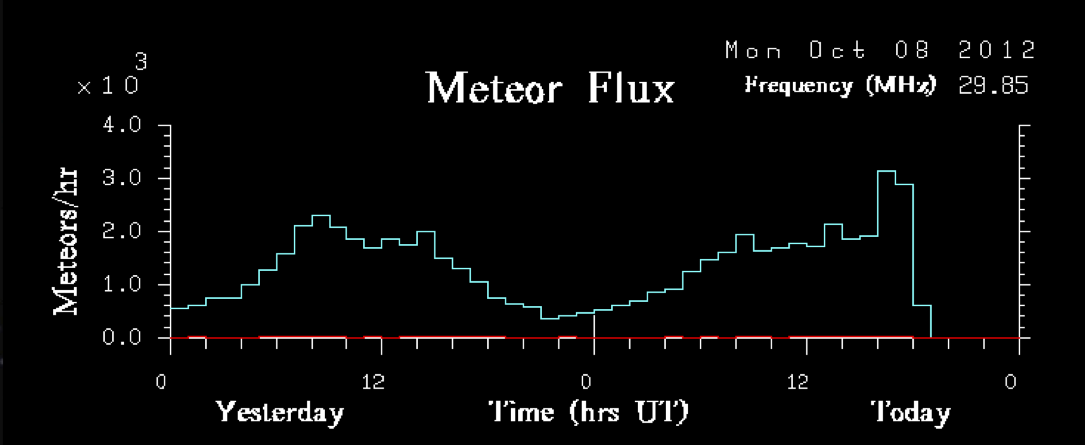
Space Weather says radar suggests a big show, already begun, with 1,000 meteoroids an hour:

DRACONID METEOR OUTBURST UNDERWAY: The CMOR radar in Canada is picking up a major outburst of Draconid meteors commencing at 16 UT on Oct. 8th. “Radar rates are at 1000 meteors per hour,” reports Bill Cooke of NASA’s Meteoroid Environment Office. “This is greater than last year’s outburst, and 5x the 2005 level.” Cooke encourages northern sky watchers, especially in Europe where night is falling, to be alert for Draconid activity. Because radars are sensitive to very small meteoroids, there is no guarantee that this radar outburst will translate into meteors visible to the human eye. On the other hand, a brilliant display could be in progress. The only way to know is to go outside and look. [CMOR radar data] [sky map] [Submit: reports or photos]
Listen: Tune into Space Weather Radio to hear live Draconid radar echoes.

Can you see these rocks as they burn up?  Or are they too small to make a visible “splash,” even though registering on radar?

Heck, some reports say it’s even more active than that; Sky and Telescope reports up to 2,200 meteoroids per hour.

How to tell?  Go outside and look up!

Draconids are most active in the early evening (other showers tend to be active after midnight).  Look toward the head of Draco the Dragon.  EarthSky.org offers a skymap to help out:

Draconid meteor shower, October 8, 2012 - map from EarthSky.org

Draconid meteor shower, October 8, 2012 – map from EarthSky.org

More:


Doubt, about the science of tobacco consumption, DDT, and global warming

October 6, 2012

From The Climate Reality Project.

(Yes, there is a bias.  Several biases exist there simultaneously, actually, so we should say there are biases.  The most important for you to know about are the biases for good science and accuracy, especially historical accuracy.)

More:

Graffiti: BIAS

Graffiti: BIAS (Photo credit: Franco Folini, via Flickr) (Creative Commons)


MacArthur grants announced; 23 lucky people to follow, or not

October 2, 2012

I got the press release three minutes early, actually — not that I could have gotten anything published in that time.  At the promised time, in other words.

MacArthur grant announcement time!  It’s one of those things I take some delight in, to see who are the unsung (usually) from whom much will be expected.  With 23 grantees this year, it’s about as much fun as the Rhodes Scholar announcements.  Rhodes Scholars at least know they are in contention, having had to apply and go through rigorous interviews.  MacArthur fellows don’t know they’ve been nominated.

So, of course, the stories about the grantees often start with the surprise announcement.  The Foundation’s press release starts there, too.  I wonder how many news stories will replicate the press release in that?

23 MacArthur Fellows Announced
One call out of the blue – $500,000 – No strings attached

The MacArthur Foundation today named 23 new MacArthur Fellows for 2012. Working across a broad spectrum of endeavors, the Fellows include a pediatric neurosurgeon, a marine ecologist, a journalist, a photographer, an optical physicist and astronomer, a stringed-instrument bow maker, a geochemist, a fiction writer, and an arts entrepreneur. All were selected for their creativity, originality, and potential to make important contributions in the future.

The recipients learned, through a phone call out of the blue from the Foundation, that they will each receive $500,000 in no-strings-attached support over the next five years. MacArthur Fellowships come without stipulations or reporting requirements and offer Fellows unprecedented freedom and opportunity to reflect, create, and explore. The unusual level of independence afforded to Fellows underscores the spirit of freedom intrinsic to creative endeavors. The work of MacArthur Fellows knows neither boundaries nor the constraints of age, place, and endeavor.

“These extraordinary individuals demonstrate the power of creativity,” said MacArthur President Robert Gallucci. “The MacArthur Fellowship is not only a recognition of their impressive past accomplishments but also, more importantly, an investment in their potential for the future. We believe in their creative instincts and hope the freedom the Fellowship provides will enable them to pursue unfettered their insights and ideas for the benefit of the world.”

Meet the 2012 MacArthur Fellows ››

An eclectic group.  Already Larry Ferlazzo posted that one of the awardees is the young economist who bashes teachers, Raj Chetty — there is no requirement that awardees be universally loved, but someone who courts controversy rarely makes the list.  (An exception might be Eugenie Scott , the genius behind the National Center for Science Education, whose winning a MacArthur grant forever tainted such awards to creationists, to the delight of fans of science.)

Go noodle around at the MacArthur Foundation site — each awardee has a bio, a couple of very nice photos, and a video on their work.  Good stuff.

Here they are, in alphabetical order, straight from the MacArthur Foundation.  Hot links go to more information at the Foundation’s site.

Meet the 2012 MacArthur Fellows

Profile portrait of Natalia Almada

Natalia Almada

Altamura Films

Mexico City, Mexico

Age: 37

Documentary Filmmaker capturing complex and nuanced views of Mexican history, politics, and culture in insightful and poetic works that affirm the potency of documentary film as both an art form and a tool for social change.

More 

Profile portrait of Uta Barth

Uta Barth

Los Angeles, CA

Age: 54

Conceptual Photographer exploring the nature of vision and the difference between how we see reality and how a camera records it in evocative, abstract compositions that focus attention on the act of looking and the process of perception.

More 

Profile portrait of Claire Chase

Claire Chase

International Contemporary Ensemble

Brooklyn, NY

Age: 34

Arts Entrepreneur forging a new model for the commissioning, recording, and live performance of classical music and opening new avenues of artistic expression for the twenty-first-century musician.

More 

Profile portrait of Raj Chetty

Raj Chetty

Harvard University

Cambridge, MA

Age: 33

Public Economist elucidating key policy issues of our time in theoretical and empirical studies that refine our understanding of the impact of public finance on economic activity.

More 

Profile portrait of Maria Chudnovsky

Maria Chudnovsky

Columbia University

New York, NY

Age: 35

Mathematician investigating the fundamental principles of graph theory and laying the conceptual foundations for deepening connections between graph theory and other major branches of mathematics, such as linear programming and geometry.

More 

Profile portrait of Eric Coleman

Eric Coleman

University of Colorado School of Medicine

Denver, CO

Age: 47

Geriatrician addressing system-wide deficiencies in patient transitions from hospitals to homes and other sites of care and improving the health outcomes of millions of older adults suffering from chronic illness.

More 

Profile portrait of Junot Díaz

Junot Díaz

Massachusetts Institute of Technology

Cambridge, MA

Age: 43

Fiction Writer using raw, vernacular dialogue and spare, unsentimental prose to draw readers into the various and distinct worlds that immigrants must straddle.

More 

Profile portrait of David Finkel

David Finkel

Washington Post

Washington, DC

Age: 56

Journalist pushing beyond the constraints and conventions of traditional news writing to craft sustained narratives that heighten the reality of military service and sacrifice in the public consciousness.

More 

Profile portrait of Olivier Guyon

Olivier Guyon

University of Arizona

Tucson, AZ

Age: 36

Optical Physicist and Astronomer designing telescopes and other astronomical instrumentation that play a critical role in the search for Earth-like planets outside our solar system.

More 

Profile portrait of Elissa Hallem

Elissa Hallem

University of California, Los Angeles

Los Angeles, CA

Age: 34

Neurobiologist exploring the physiology and behavioral consequences of odor detection and chemoreception in invertebrates and identifying interventions that may eventually reduce the scourge of parasitic infections in humans.

More 

Profile portrait of An-My Lê

An-My Lê

Bard College

Annandale-on-Hudson, NY

Age: 52

Photographer approaching the subjects of war and landscape from new perspectives to create images that blur the boundaries between fact and fiction and are rich with layers of meaning.

More 

Profile portrait of Sarkis Mazmanian

Sarkis Mazmanian

California Institute of Technology

Pasadena, CA

Age: 39

Medical Microbiologist illuminating the complex interplay between microbes and the host immune system and the role certain bacteria may play in the development, or mitigation, of a broad range of human diseases.

More 

Profile portrait of Dinaw Mengestu

Dinaw Mengestu

Washington, DC

Age: 34

Writere nriching understanding of the little-explored world of the African diaspora in America in tales distilled from the experience of immigrants whose memories are seared by escape from violence in their homelands.

More 

Profile portrait of Maurice Lim Miller

Maurice Lim Miller

Family Independence Initiative

Oakland, CA

Age: 66

Social Services Innovator designing programs of mutual support and self-sufficiency that break the cycle of economic dependency for low-income families and build more resilient communities from the ground up.

More 

Profile portrait of Dylan C. Penningroth

Dylan C. Penningroth

Northwestern University

Evanston, IL

Age: 41

Historianunearthing evidence from widely scattered archives to shed light on shifting concepts of property ownership and kinship among African American slaves and their descendents following emancipation.

More 
Profile portrait of Terry Plank

Terry Plank

Columbia University

New York, NY

Age: 48

Geochemistprobing the usually invisible but remarkably powerful thermal and chemical forces deep below the Earth’s crust that drive the motion of tectonic plate collisions.

More 

Profile portrait of Laura Poitras

Laura Poitras

Praxis Films

New York, NY

Age: 48

Documentary Filmmaker revealing the consequences of military conflict abroad in illuminating documentaries that portray the lives and intimate experiences of families and communities largely inaccessible to the American media.

More 

Profile portrait of Nancy Rabalais

Nancy Rabalais

Louisiana Universities Marine Consortium

Chauvin, LA

Age: 62

Marine Ecologist documenting the environmental and economic consequences of hypoxic zones in the Gulf of Mexico and informing strategies for restoring the degraded waters of the Gulf and the Mississippi River basin.

More 

Profile portrait of Benoît Rolland

Benoît Rolland

Benoît Rolland Studio

Boston, MA

Age: 58

Stringed-Instrument Bow Maker experimenting with new designs and materials to create violin, viola, and cello bows that rival the quality of prized nineteenth-century bows and meet the artistic demands of today’s musicians.

More 

Profile portrait of Daniel Spielman

Daniel Spielman

Yale University

New Haven, CT

Age: 42

Computer Scientist connecting theoretical and applied computing to resolve issues in code optimization theory with implications for how we measure, predict, and regulate our environment and behavior.

More 

Profile portrait of Melody Swartz

Melody Swartz

École Polytechnique Fédérale de Lausanne

Lausanne, Switzerland

Age: 43

Bioengineer enhancing understanding of the dynamic processes of tissue vascularization and immune responses to tumor invasion using a large toolbox of concepts and methods from biophysics, cell culture, molecular genetics, engineering, and immunology.

More 

Profile portrait of Chris Thile

Chris Thile

New York, NY

Age: 31

Mandolinist and Composer creating a new musical aesthetic and a distinctly American canon for the mandolin through a lyrical fusion of traditional bluegrass orchestrations with a range of styles and genres.

More 

Profile portrait of Benjamin Warf

Benjamin Warf

Children’s Hospital Boston

Boston, MA

Age: 54

Pediatric Neurosurgeon revolutionizing treatment of hydrocephalus and other intra-cranial diseases in very young children and advancing standards of and access to health care in both the developed and poorest regions of the world.

More 

More:


Annals of global warming: Insurance companies note increasing costs of floods, due to climate change

October 1, 2012

Note today in Al Gore’s Journal:

Flooding Costs October 1, 2012 : 10:32 AM

Time cover from April 28, 2008 - how to win war on global warming

Time Magazine cover for April 28, 2008 – How to Win the War On Global Warming

A new report from Swiss Re finds that the financial impact of flooding has doubled in the past decade – climate is a major driver:

“Flood losses are increasing at an alarming rate while the insurability of floods provides unique challenges for the industry, according Swiss Re’s latest report, “Flood – an underestimated risk: Inspect, inform, insure”.” …

“No other natural catastrophe impacts as many people as flooding with an estimated 500 million people affected every year. Insured flood losses are also increasing significantly; 1970’s annual claims were between USD 1–2 billion, whereas insured flood losses amounted to USD 15 billion in 2011. Recent flood events in Thailand, Australia and the Philippines have shown that floods are now rivalling earthquakes and hurricanes in terms of economic losses.” …

“Population growth, demographic change, a higher concentration of assets in exposed areas, greater vulnerability of insured objects and climate change are all contributing to the increasing costs of flood damage. The rising costs of floods are creating challenges for the insurance industry and the economic viability of flood insurance is currently an issue under scrutiny.”

More:


Bathtub instant profundity, 1

September 26, 2012

Clearing out a backlog.

  1. Turns out that tax cuts don’t spur jobs development.  An economist at Berkeley finds that any job stimulus from tax cuts comes from tax cuts to the middle class and poor — in other words, the people who instantly stimulate demand by spending on needed goods and services.
  2. On-line version of the Library of Congress’s exhibit, “88 Books that Shaped America.”  In case you can’t make it to D.C. soon.
  3. Kennedy’s speech at Rice University, “We Choose to Go to the Moon,” was on September 12, 1962.  That was also the ninth anniversary of his marriage to Jacqueline Bouvier.  She let him go out of town to talk rockets?
  4. Thomas B. Edsall makes the case that Paul Ryan’s budget, or any version of it (like the Romney plan), would be an economic disaster for the nation, in at article titled “The Ryan Sinkhole.” Why don’t the Republicans ever listen to economists?
  5. Those “work requirements” that Ryan insists Obama has illegally stripped from law, to the great detriment of the work ethic in the U.S.?  Not only did Mitt Romney ask for them, when he was governor of Massachusetts, but earlier this year Ryan voted “yes” on a House bill to do exactly what Obama is trying to do.  Can’t Ryan keep his own stories straight?
  6. Graphic shows that summers in the U.S. are getting warmer.  More evidence for warming denialists to deny!
  7. More GOP election fraud, this time in California.
  8. It is said God looks out for drunks and babies; can we make a case that our government works better with more drunks in elective office?  David Frum discusses. (I actually have some thoughts and experience in this area . . . when to find time to discuss?)  There’s a video there, but not in a format I can embed here easily — go see.
  9. Jim Hightower tells a scary story of a coup d’etat within the borders of the United States, in Michigan.  Imaginary?  This is a guy who doesn’t see UFOs, who isn’t afraid of black helicopters . . .
  10. New studies on colony collapse disorder affecting especially commercial beehives suggests insecticides, and substances related to insecticides, may be hammering our bees; worse, EPA has known about it, but kept quiet.  Reported readably in New Yorker, 50 years after that magazine serialized a book named Silent Spring.  Rachel Carson’s Ghost joins Santayana’s Ghost pacing America, nervously, as if to awaken us all . . .

More:


Laissez Faire Today, lazy and unfair as yesterday on issues of DDT

September 25, 2012

In June [2012] I drew encouragement that Henry I. Miller, the musty old anti-science physician at the Hoover Institution, had not renewed his annual plea to bring back DDT.  Miller is just one of the most predictable trolls of science and history; most years he waits until there are a number of West Nile virus victims, and then he claims we could have prevented it had we just jailed Rachel Carson and poisoned the hell out of America, Africa, Asia and the Moon with DDT.  For years I’ve reminded him in various fora that DDT is particularly inappropriate for West Nile . . .

Rachel Carson Homestead Springdale, PA

Rachel Carson Homestead Springdale, Pennsylvania (Photo credit: Wikipedia)

Since June, Miller popped up and popped off in Forbes, but using the event of the 50th anniversary of Rachel Carson’s brilliant book Silent Spring.  Brilliance and science and history aside, Miller still believes that protecting wildlife and humans from DDT’s manifold harms is a threat to free enterprise — how can anyone be expected to make a profit if they can’t poison their customers?

Miller is not the only throwback to the time before the Age of Reason, though.  It’s time to put the rebuttals on the record, again.

Comes this morning Jeffrey Tucker of Laissez Faire Today, complaining that the resurgence of bedbugs in America is an assault on democracy, apple pie, free enterprise, and Rachel Carson should be exhumed and tortured for her personal banning of DDT worldwide.  You can read his screed.  He’s full of unrighteous and unholy indignation at imagined faults of Carson and imagined benignity of pesticides.

I responded (links added here):

I’m shocked by your mischaracterizations of Rachel Carson, her great book Silent Spring (which it appears to me you didn’t read and don’t know at all), and pesticide regulation. Consequently, you err in history and science, and conclusion. Let me detail the hub of your errors.

You wrote:

Carson decried the idea that man should rule nature. “Only within the moment of time represented by the present century has one species — man — acquired significant power to alter the nature of the world.” This anthropocentrism she decried.

Carson was concerned that we were changing things that would have greater effects later, and that those effects would hurt humans. Her concern was entirely anthropocentric: What makes life worth living? Should we use chemicals that kill our children, cripple us, and create havoc in the things we enjoy in the outdoors, especially if we don’t know the ultimate effects?

Exactly contrary to your claim, her book was directed at the quality and quantity of human lives. She wanted long, good lives, for more people. How could you miss that, if you read any of her writings?

She suggested that killing a bedbug is no different from killing your neighbor: “Until we have the courage to recognize cruelty for what it is — whether its victim is human or animal — we cannot expect things to be much better in this world… We cannot have peace among men whose hearts delight in killing any living creature.”

Carson never wrote that there should be difficulty in killing bedbugs. The passage you quote, but conspiratorially do not cite, comes not from Silent Spring, but from a commentary on a compilation of hunting stories.* She’s referring to killing for the sake of killing, in that passage. I think it’s rather dishonest to claim she equates fighting biting bedbugs with killing animals unsportingly. I worry that you find it necessary to so grossly and dishonestly overstate your case. Is your case so weak?

In fact, she spoke of animals in patently untrue ways: “These creatures are innocent of any harm to man. Indeed, by their very existence they and their fellows make his life more pleasant.”

She did not write that about bedbugs. That’s a false claim.**

I guess she never heard of the Black Death.

I guess you never heard of accuracy. On page 266 of Silent Spring Carson directly addressed plague in a list of insect- and arthropod-borne diseases; Carson wrote:

“The list of diseases and their insect carriers, or vectors, includes typhus and body lice, plague and rat fleas, African sleeping sickness and tsetse flies, various fevers and ticks, and innumerable others.

“These are important problems and must be met. No responsible person contends that insect-borne disease should be ignored. The question that has now urgently presented itself is whether it is either wise or responsible to attack the problem by methods that are making it worse.” (Silent Spring, page 266)

Carson describes abuse of pesticides — such as DDT on bedbugs — that actually makes the insects stronger and tougher to get rid of. That appears to be your stand, now, to do whatever Carson said not to do, in order to poke a thumb in her eye, even if it means making bedbugs worse.

[Tucker continued:] In short, she [Rachel Carson] seemed to suggest that bedbugs — among all the millions of other killer insects in the world — enjoy some kind of right to life. It was a theory that could be embraced only in a world without malaria and bedbugs. But embraced it was.

That’s total fiction. What you write is completely divorced from fact.

By 1972, DDT was banned. And not only DDT. The whole enterprise of coming up with better and better ways to further human life and protect its flourishing was hobbled.

By 1960, DDT had ceased to work against bedbugs — this was one of the things that worried Carson*** and would worry any responsible person [see Bug Girl’s blog]. In her book, Carson warned that indiscriminate use and abuse of DDT would render it useless to fight disease and other insects and pests. By 1965, super mosquito-fighter Fred Soper and the World Health Organization had to stop their campaign to eradicate malaria when they discovered that abuse of DDT in agriculture and other uses had bred malaria-carrying mosquitoes in central and Subsaharan Africa that were resistant and immune to DDT. Keep in mind that the U.S. ban on DDT applied only in the U.S., and only one other nation in the world had a similar ban. DDT has never been banned in Africa, nor Asia.

Carson sounded the warning in 1962. By 1972, when the U.S. banned use of DDT on agricultural crops (and only on crops), it was too late to preserve DDT as a key tool to wipe out malaria.

Was the pesticide industry “hobbled?” Not at all. EPA’s order on DDT explicitly left manufacturing in the U.S. available for export — keeping profits with the pesticide companies, and multiplying the stocks of DDT available to fight disease anywhere in the world that anyone wanted to use it.

The fact is that DDT was a fortunate find, a bit of a miracle substance, and we overused it, thereby cutting short by decades its career as a human life-saver. That was exactly what Carson feared, that human lives would be lost and made miserable, unnecessarily and prematurely, by unthinking use of chemical substances. Pesticide manufacturers have been unable to come up with a second DDT, but not because regulation prevents it. Carson understood that.

There is no shortage of science-ignorant, and science-abusive websites that claim Rachel Carson erred. But 50 years out, the judgment of the President’s Science Advisory Council on her book remains valid: It’s accurate, and correct, and we need to pay attention to what she wrote. Not a jot nor tittle of what Carson wrote in 1962 has proven to be in error. Quite the contrary, as Discover Magazine noted in 2007, thousands of peer-reviewed studies reinforce the science she cited then.

Malaria deaths today are at the lowest level in human history, largely without DDT, and much due to malaria fighters having adopted the methods of fighting the disease that Carson advocated in 1962. Unfortunately, those methods were not adopted for nearly 40 years. Still, the reductions in malaria are remarkable. At peak DDT use in 1959 and 1960, a half-billion people in the world got malaria every year, one-sixth of the world’s people. 4 million died from the disease. In 2009, about 250 million people got malaria — a reduction of 50% in infections — and fewer than 800,000 people died — a dramatic reduction of more than 75% in death toll. This is all the more remarkable when we realize that world population more than doubled in the interim, and at least a billion more people now live in malaria-endemic areas. Much or most of that progress has been without DDT, of necessity — every mosquito on Earth today now carries the alleles of resistance and immunity to DDT.

You impugn a great scientist and wonderful writer on false grounds, and to damaging effect. I hope you’re not so careless in other research.

Rachel Carson was right. The re-emergence of bedbugs, 50 years after she wrote, is not due to anything Carson said, but is instead due to people who petulantly refused to listen to her careful and hard citations to science, and exhortations to stick to what we know to be true to protect human health and the quality of life.

_____________

* Rachel Carson: Legacy and Challenge, by Lisa H. Sideris, Kathleen Dean Moore, citing another of Carson’s writings, a critique of a collection of Aldo Leopold’s essays on hunting, Round River.

**  Here is the full quote, from pages 99-100 of Silent Spring, highlights added here:

Incidents like the eastern Illinois spraying raise a question that is not only scientific but moral. The question is whether any civilization can wage relentless war on life without destroying itself, and without losing the right to be called civilized. These insecticides are not selective poisons; they do not single out the one species of which we desire to be rid. Each of them is used for the simple reason that it is a deadly poison. It therefore poisons all life with which it comes in contact: the cat beloved of some family, the farmer’s cattle, the rabbit in the field, and the horned lark out of the sky. These creatures are innocent of any harm to man. Indeed, by their very existence they and their fellows make his life more pleasant. Yet he rewards them with a death that is not only sudden but horrible. Scientific observers at Sheldon described the symptoms of a meadowlark found near death: ‘Although it lacked muscular coordination and could not fly or stand, it continued to beat its wings and clutch with its toes while lying on its side. Its beak was held open and breathing was labored.’ Even more pitiful was the mute testimony of the dead ground squirrels, which ‘exhibited a characteristic attitude in death. The back was bowed, and the forelegs with the toes of the feet tightly clenched were drawn close to the thorax…The head and neck were outstretched and the mouth often contained dirt, suggesting that the dying animal had been biting at the ground.’

***  See page 273 of Silent Spring.

More: