But I can’t resist putting the video here, because I know a few old-timers would be confused by the link, and some people will think they don’t have the time to make two clicks instead of one.
So, here, in its Seussian glory and demand for Flash Animation, is TeacherSabrina’s story of D.C.’s late Queen of the Schools, Michelle Rhee, and her desire to get D.C.’s kids to score well on an increasing battery of tests [Got a good joke about assault and battery we can insert here?]: “Rhee the Reformer: A Cautionary Tale.”
Teaching is a lonely profession, oddly enough. All too often teachers get stuck on an island away from other adults, away from socializing with colleagues even just a few feet away in the next room. Different from most other professions, teachers in most schools are required to function without basic support for much of what they do, or with minimal support.
Consequently, teachers organizing to support teachers is difficult and too rare.
Unions become vital organizations to fight against unhealthy social isolation, to fight for teachers, to fight for education.
On March 22 union teachers in New York will wear red as an expression of solidarity with and support for teachers under attack in Wisconsin, Tennessee, Texas, Ohio, Indiana, and dozens of other places that we don’t know much about because, after all, brutal legislative attacks on teachers and teaching are so commonplace these days — “dog bites man” stories.
I was asked to join a group of bloggers who will blog on the importance of teaching, the importance of education, and why we support teacher unions on March 22.
If you teach and blog, will you join us? If you had a teacher who made a difference in your life, and blog, will you join us?
As we all know, teachers and our unions, along with those of other public sector employees, face unprecedented attacks in the national media and from local and state governments. It is easy for politicians and the media to demonize the “unions” and their public faces; it is far more difficult to demonize the millions of excellent teachers who are proud union members. Those of us who are excellent teachers and who stand in solidarity with our unions are probably no stranger to the question “Well, why are you involved with the union if you’re a good teacher?” It’s time for us to stand up and answer that question loudly and clearly.
On Tuesday, March 22, teachers in NYC will wear red in solidarity with our brothers and sisters who are under attack in Wisconsin, Ohio, Indiana, Tennessee and elsewhere. We also stand with teachers in places like Idaho, California, and Texas who are facing massive layoffs. We would like to take this stand on the web as well. We encourage you to publish a piece on March 22 entitled “Why Teachers Like Me Support Unions.” In this piece, please explain your own reasons for being a proud union member and/or supporter. Including personal stories can make this a very powerful piece. It would be great to also explain how being a union member supports and enables you to be the kind of teacher that you are. We want these posts to focus not only on our rights, but also on what it takes to be a great teacher for students, and how unions support that.
After you have published your post, please share it through the form that will go live on March 22 at http://www.edusolidarity.us. Posts should also be shared on Twitter using the tag #edusolidarity.
Eric Brehm teaches in Wisconsin. Now you know the answers to any questions about bias you may have.
It’s been more than three weeks, and Mr. Brehm has gotten no answer from Wisconsin Gov. Scott Walker. It’s not exactly like Walker is a student who hasn’t done his homework, but it’s close enough.
On Saturday, February 19, 2011, I sent the following letter to Wisconsin Governor Scott Walker. It has since been reposted and blogged a number of times, for which I am grateful. However, this blog would not be complete unless I included a copy of it here. And so, here is where it all began:
To the Duly-Elected Governor of Wisconsin, Scott Walker (and anyone else who gives a hoot):
It has only been a week, and I grow weary of the political struggle that your Budget Repair Bill has caused. I am tired of watching the news, though I have seen many of the faces of those I hold dear as they march on the Capitol. I am tired of defending myself to those who disagree with me, and even a bit tired of fist-bumping those who do. I am tired of having to choose a side in this issue, when both sides make a certain degree of sense. And so I offer you this desultory (aimless or rambling) philippic (angry long-winded speech), because at the end of the day I find that though this issue has been talked to death, there is more that could be said. And so, without further ado, here are my points and/or questions, in no particular order.
1. You can have my money, but. . .. Ask any number of my students, who have heard me publicly proclaim that a proper solution to this fiscal crisis is to raise taxes. I will pay them. I have the great good fortune to live in a nation where opportunity is nearly limitless, and I am willing to pay for the honor of calling myself an American. Incidentally, Warren Buffett, the second richest man in the nation (and a Democrat) agrees with me. Your proposed Budget Repair Bill will cost me just under $3000 per year at my current salary, with the stated goal of saving $30 million this year on the state budget. I say, take it. You can have it. It will hurt me financially, but if it will balance the budget of the state that has been my home since birth, take it with my blessing. But if I may, before you do, I have some questions.
According to the 2009 estimate for the U.S. Census, 5,654,774 people live in the state of Wisconsin. Of those, 23.2% are under the age of 18, and presumably are not subject to much in the way of income tax. That still leaves about 4,342,867 taxpayers in the state of Wisconsin. If you wished to trim $30 million off of the budget, that works out to about $6.91 per Wisconsin taxpayer. So I must ask: Is it fair that you ask $3000 of me, but you fail to ask $6.91 of everyone? I know that times are tough, but would it not be more equitable to ask that each taxpayer in the state contribute an extra 13 cents a week?
Would you please, kindly, explain exactly how collective bargaining is a fiscal issue? I fancy myself to be a fairly intelligent person. I have heard it reported in the news that unless the collective bargaining portion of this bill is passed, severe amounts of layoffs will occur in the state. I have heard that figure given as 6,000 jobs. But then again, you’ve reportedly said it was 10,000 jobs. But then again, it’s been reported to be as high as 12,000 jobs. Regardless of the figure, one thing that hasn’t been explained to my satisfaction is exactly how or why allowing a union to bargain collectively will cost so much money or so many jobs. Am I missing something? Isn’t collective bargaining essentially sitting in a room and discussing something, collectively? Is there now a price tag on conversation? How much does the average conversation cost? I feel your office has been eager to provide doomsday scenarios regarding lost jobs, but less than willing to provide actual insight as to why that is the case. I would welcome an explanation.
Why does your concern over collective bargaining, pensions, and healthcare costs only extend to certain unions, but not all? Why do snow plow drivers and child care providers and teachers and prison guards find themselves in “bad” unions, but firefighters and state police and local police find themselves in unions that do not need to be effected by your bill? The left wing news organizations, of course, state that this is because these are unions that supported your election bid, while you seek to punish those unions that did not; I would welcome your response to such a charge. You have stated that the state and local police are too vital to the state to be affected. Can I ask how child care, or prison guards, or nurses or teachers are not vital? Again, I would welcome a response.
Though you are a state employee, I have seen no provision in your bill to cut your own pension or healthcare costs. The governor’s salary in Wisconsin was about $137,000 per year, last I checked. By contrast, I make about $38,000 per year. Somewhere in that extra $99,000 that you make, are you sure you couldn’t find some money to fund the state recovery which you seem to hold so dear? As you have been duly elected by the voters of Wisconsin, you will receive that salary as a pension for the rest of your life. I don’t mean to cut too deeply into your lifestyle, but are you sure you couldn’t live off $128,000 per year so that you could have the same 7% salary reduction you are asking certain other public employees to take?
2. Regarding teachers being overpaid and underworked. I don’t really have many questions in this regard, but I do have a couple of statements. If you haven’t already figured it out, I am a teacher, so you may examine my statement for bias as you see fit. I admit I find it somewhat suspect that teachers are mentioned so prominently in your rhetoric; those protesting at the Capitol are indeed teachers. But they are also students, and nurses, and prison guards, and plumbers, and firefighters, and a variety of other professions. If you could go back to “public sector employees,” I would appreciate it. But as far as being overpaid and underworked . . . I grant you, I have a week’s vacation around Christmas. I have a week off for Spring Break. I have about 10 weeks off for summer. With sick days and personal days and national holidays and the like, I work about 8.5 months out of every year. So perhaps I am underworked. But before you take that as a given, a couple of points in my own defense.
The average full-time worker puts in 40 hours per week, 50 weeks per year, with two weeks’ vacation time. That makes for a grand total of 2000 hours per year. Part of the teachers’ arguments regarding their time is that no one sees how many hours they work at home to grade papers, or create lesson plans, or things of that nature. I am in a rare state, in that I am not one of those teachers. I work an hour from where I live, and I like to keep my work at work. I, therefore, do not bring work home with me, but rather stay at school, or come in early, so that I can grade papers or create lesson plans while at school. So I am more prepared than most to explain the hours it takes to do my job. I also supervise an extra-curricular activity (as many teachers do), in that I serve as the Drama Coach for my school. The school year, so far, has lasted for 24 weeks. I have, in that time, averaged 78 hours per week either going to school, being at school, or coming home from school. If you remove my commute, of course, I still average 68 hours per week, thus far. That means I have put in 1,632 hours of work time this year, which works out to over 80% of what your average full time worker does in a calendar year. If you include my commute, I’m over 90%. If ikeep going at my current pace, I will work 2,720 hours this school year (or 3,120 hours if you include my commute). That means I work 136% to 156% as much as your average hourly worker.
As to underpaid — I’m not sure I am underpaid in general, though I do believe I am underpaid in terms of the educational level expected to do my job. I have two Bachelor’s Degrees, and will be beginning work toward my Master’s this summer. By comparison, sir, you never completed college, and yet, as previously stated, you outearn me by almost $100,000 per year. Perhaps that is an argument that I made the wrong career choice. But it is perhaps an argument that we need to discuss whether you and others like you are overpaid, and not whether teachers are.
3. Regarding the notion that teachers that are protesting, or legislators currently in Illinois, are hurting the state. Very briefly, if I may:
Teachers have been accused of shirking their duties by protesting for what they believe to be their rights instead of being in school. The argument has been, of course, that no lessons have been taught when classes aren’t in session. I must submit that lessons in protest, in exercise of the First Amendment right to peaceable assembly, in getting involved as a citizen in political affairs, have been taught these past few days. The fact that they haven’t been taught in the classroom is irrelevant. Ultimately a very strong duty of the school system is to help students become citizens — I think that has clearly happened this week.
As to the legislators, it seems to me as though they feel their constituents deserve to have a length of time to examine the proposed bill on its merits, not vote it straight up or down three days after it was presented. As the current budget does not expire until June, this seems to me like the only response left them in light of your decision to fast-track the bill without discussion. Give them another option, and perhaps they will come back. I can’t say that I agree with their decision, but I can say that I understand it.
4. Regarding the notion that protestors at the Capitol are rabble-rousers and/or thugs. Such name-calling on the part of conservatives in the state and the conservative media could be severely curtailed if you would speak out against it. True, most of the people protesting, if not all, are liberals. Historically, liberals have always tended to think that they have far more support than they actually do. They also (in my opinion) have a tendency to get extremely organized about three months too late, if at all. So you can fault them for their decision-making, but I would ask you to speak out against the notion of thuggery. Again, very briefly:
So far, 12 arrests have been made. Estimates say there were about 25,000 people at the Capitol today, and about 20,000 yesterday. Let’s be conservative (mathematically) and say that 40,000 people protested over two days. That would mean that officers arrested .0003% of all protestors. By almost any definition, that is an extremely peaceful demonstration, and of course you are aware that the U.S. Constitution guarantees the right of peaceable assembly for a redress of grievances. So in the main, these people have done nothing wrong.
5. If I may provide you with a sense of history. You work in the largest and most magnificiently appointed state capitol in the nation, built by Bob LaFollette (a Republican). You work in the same building where Phil LaFollette (a Republican) helped guide Wisconsin out of the Great Depression. You work in the same building where Gaylord Nelson (a Democrat) was the first in the nation to offer rights to unions of state employees, rights that you now seek to overturn. And you work in the same building where Tommy Thompson (a Republican) provided more state funding to education than any other governor before or since. Are your current actions truly how you would choose to be remembered?
6. Finally, Governor, a note of thanks. Whatever the outcome of the next several days, you deserve a certain degree of credit. As an educator, I understand how difficult it can be to get young people interested in politics. You have managed to do this in the space of one week. A number of Wisconsin’s youth support you. A number of them do not. But whatever else can be said of you, you have them paying attention, and thinking about voting, and walking around the Capitol, and turning out to be involved. You have taught your own lessons this week, Governor, and that has its own value.
Thank you for your time,
Eric Brehm
XXX North XXXXXX Street
Endeavor, WI 53930
While I recognize that the governor has many issues on his plate, I should note that I am still waiting for a response.
Be sure to see the story in the New York Times today. Obama administration “Race to the Top” money went to states who proposed to replace principals in failing schools. A problem in the strategy threatens the program: Not enough qualified people exist to replace all the “bad” ones.
Wrong-headed education “reformers” keep talking about “firing the bad ones,” teachers, administrators, or janitors. Without significantly raising the pay for teachers, without greatly increasing the number of teachers and administrators in the pipeline from teaching colleges or any other source, reformers can’t attract anyone better qualified than the people they wish to replace.
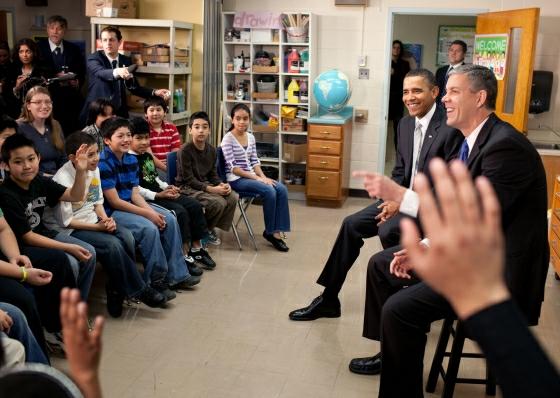
President Barack Obama and Education Secretary Arne Duncan took questions from a 6th grade class at Graham Road Elementary School in Falls Church, Virginia, January 18, 2010 – photo credit unknown
Maybe, just maybe, it’s time these reformers took a step back and did some study, perhaps from the quality gurus, Deming and Juran and Crosby, or from the heights of championship performance, in basketball, football, soccer, sailing (try the America Cup), horse racing or politics: No one can use firing as a chief tool to turn an organization around, nor to lead any organization to a championship. Threatening people’s jobs does not motivate them, nor make the jobs attractive to others.
How can we tell the fire-the-teachers-and-principals group is on the wrong track? See the article:
“To think that the same leader with a bit more money is going to accomplish tremendous change is misguided,” said Tim Cawley, a managing director at the Academy for Urban School Leadership, a nonprofit group that began leading turnaround efforts in Chicago when Mr. Duncan was the superintendent there.
“This idea of a light-touch turnaround is going to sully the whole effort,” Mr. Cawley added.
Tell that to Steve Jobs, who turned Apple around. Tell it to Jack Welch, the tough-guy boss from GE (who had his own peccadilloes about firing, but who emphasized hiring and pay, at least, as the way to create a succession plan for the vacancies). Tell it to any CEO who turned around his organization without falling on his own sword.
Any competent quality consultant would have foreseen this problem: Nobody wants to train for a job with little future, less money to do the job right, little authority to get the job done, and the sole promise that the exit door is always open.
Secretary of Education Arne Duncan should know better, intuitively. He used to play basketball, professionally. Surely he knows something about team building and team turnarounds. What caused his astounding, expensive amnesia?
Part of the issue identified in the article is training:
Because leading schools out of chronic failure is harder than managing a successful school — often requiring more creative problem-solving abilities and stronger leadership, among other skills — the supply of principals capable of doing the work is tiny.
Most of the nation’s 1,200 schools, colleges and departments of education do offer school leadership training. “But only a tiny percentage really prepare leaders for school turnaround,” said Arthur Levine, a former president of Teachers College who wrote a 2005 study of principal training.
That only contributes to the larger problem, that people in the positions are, often, the best ones for the job already; firing them damages turnaround efforts.
In Chicago, federal money is financing an overhaul of Phillips Academy High School. Mr. Cawley’s nonprofit trained Phillips’s new principal, Terrance Little, by having him work alongside mentor principals experienced at school makeovers.
“If we’re talking about turning around 700 schools, I don’t think you can find 700 principals who are capable of taking on the challenge of this work,” Mr. Little said. “If you could, why would we have this many failing schools?”
Education’s problems are many. Few of the problems are the result of the person at the chalkboard in the classroom. Firing teachers won’t help. W. Edwards Deming claimed that 85% of the problems that plague front-line employees, like teachers, are management-caused. Firing their bosses won’t solve those problems, either, but will just push the problems around. (What? “Deck chairs?” “Titanic?” What are you talking about?)
Did you hear? Texas plans to cut state funding to all education by at least 25% for next year, due to Gov. Rick Perry’s $25 billion deficit, which he worked so hard to conceal during last year’s election campaign.
Our nation is at risk. The educational foundations of our society are presently being eroded by a rising tide of mediocrity. If an unfriendly foreign power had attempted to impose on America the mediocre educational performance that exists today, we might well have viewed it as an act of war. We have, in effect, been committing an act of unthinking, unilateral educational disarmament. History is not kind to idlers.
When do we get political leaders who will swim against that tide instead of trying to surf it?
From the Amon Carter Museum education department (in Fort Worth):
During the Gilded Age, the U.S. economy boomed, the population soared, and Americans flourished. Well, not all Americans; for some this time was not prosperous. During an educator workshop on December 9, [2010] explore both sides of this period using paintings and sculpture from the Amon Carter’s collection. [Send a note of interest to: education@cartermuseum.org.]
Eastman Johnson (1824–1906), Bo-Peep, 1872, oil on canvas, Amon Carter Museum of American Art, Fort Worth, Texas, 1980.
Or just sign up:
Thursday, December 9, 2010 – 5:00pm – 7:00pm
The Gilded (or Not-So-Gilded) Age
Educator Workshop: $12 for museum members and $15 for nonmembers
During the Gilded Age (late 1800s to the early 1900s), the U.S. economy boomed, the population soared, and Americans prospered. Well, not all Americans; for some this time in American history was not prosperous. Explore both sides of this period using paintings and sculpture from the Amon Carter’s collection. This workshop is most appropriate for educators of all grade levels teaching English, language arts, social studies, U.S. history, and visual art, although others may benefit. Refreshments are provided from 4:30 to 5 p.m.
They claim to be constitutionalists, and they claim to want to uphold the U.S. Constitution. But here’s an excerpt from Federalist #30, in which Alexander Hamilton explains why it is necessary for a federal government to tax, and sometimes to tax heavily.
Alexander Hamilton: "Money is, with propriety, considered as the vital principle of the body politic; as that which sustains its life and motion, and enables it to perform its most essential functions."
This is the U.S. Constitution and the “Founding Fathers” the Tea Partiers hope you will never see, and this is the Constitution and Founders they work hard to hide (some highlights added):
IT HAS been already observed that the federal government ought to possess the power of providing for the support of the national forces; in which proposition was intended to be included the expense of raising troops, of building and equipping fleets, and all other expenses in any wise connected with military arrangements and operations. But these are not the only objects to which the jurisdiction of the Union, in respect to revenue, must necessarily be empowered to extend. It must embrace a provision for the support of the national civil list; for the payment of the national debts contracted, or that may be contracted; and, in general, for all those matters which will call for disbursements out of the national treasury. The conclusion is, that there must be interwoven, in the frame of the government, a general power of taxation, in one shape or another.
Money is, with propriety, considered as the vital principle of the body politic; as that which sustains its life and motion, and enables it to perform its most essential functions. A complete power, therefore, to procure a regular and adequate supply of it, as far as the resources of the community will permit, may be regarded as an indispensable ingredient in every constitution. From a deficiency in this particular, one of two evils must ensue; either the people must be subjected to continual plunder, as a substitute for a more eligible mode of supplying the public wants, or the government must sink into a fatal atrophy, and, in a short course of time, perish.
In the Ottoman or Turkish empire, the sovereign, though in other respects absolute master of the lives and fortunes of his subjects, has no right to impose a new tax. The consequence is that he permits the bashaws or governors of provinces to pillage the people without mercy; and, in turn, squeezes out of them the sums of which he stands in need, to satisfy his own exigencies and those of the state. In America, from a like cause, the government of the Union has gradually dwindled into a state of decay, approaching nearly to annihilation. Who can doubt, that the happiness of the people in both countries would be promoted by competent authorities in the proper hands, to provide the revenues which the necessities of the public might require?
The present Confederation, feeble as it is intended to repose in the United States, an unlimited power of providing for the pecuniary wants of the Union. But proceeding upon an erroneous principle, it has been done in such a manner as entirely to have frustrated the intention. Congress, by the articles which compose that compact (as has already been stated), are authorized to ascertain and call for any sums of money necessary, in their judgment, to the service of the United States; and their requisitions, if conformable to the rule of apportionment, are in every constitutional sense obligatory upon the States. These have no right to question the propriety of the demand; no discretion beyond that of devising the ways and means of furnishing the sums demanded. But though this be strictly and truly the case; though the assumption of such a right would be an infringement of the articles of Union; though it may seldom or never have been avowedly claimed, yet in practice it has been constantly exercised, and would continue to be so, as long as the revenues of the Confederacy should remain dependent on the intermediate agency of its members. What the consequences of this system have been, is within the knowledge of every man the least conversant in our public affairs, and has been amply unfolded in different parts of these inquiries. It is this which has chiefly contributed to reduce us to a situation, which affords ample cause both of mortification to ourselves, and of triumph to our enemies.
What remedy can there be for this situation, but in a change of the system which has produced it in a change of the fallacious and delusive system of quotas and requisitions? What substitute can there be imagined for this ignis fatuus in finance, but that of permitting the national government to raise its own revenues by the ordinary methods of taxation authorized in every well-ordered constitution of civil government? Ingenious men may declaim with plausibility on any subject; but no human ingenuity can point out any other expedient to rescue us from the inconveniences and embarrassments naturally resulting from defective supplies of the public treasury.
Cup o’ Joel got there earlier (worth a read): “And get this: Hamilton was arguing that the power to tax was a central reason — maybe the central reason — the Constitution needed to be passed. And not just any power to tax: Unlimited power to tax.”
IT HAS been already observed that the federal government ought to possess the power of providing for the support of the national forces; in which proposition was intended to be included the expense of raising troops, of building and equipping fleets, and all other expenses in any wise connected with military arrangements and operations. But these are not the only objects to which the jurisdiction of the Union, in respect to revenue, must necessarily be empowered to extend. It must embrace a provision for the support of the national civil list; for the payment of the national debts contracted, or that may be contracted; and, in general, for all those matters which will call for disbursements out of the national treasury. The conclusion is, that there must be interwoven, in the frame of the government, a general power of taxation, in one shape or another.Money is, with propriety, considered as the vital principle of the body politic; as that which sustains its life and motion, and enables it to perform its most essential functions. A complete power, therefore, to procure a regular and adequate supply of it, as far as the resources of the community will permit, may be regarded as an indispensable ingredient in every constitution. From a deficiency in this particular, one of two evils must ensue; either the people must be subjected to continual plunder, as a substitute for a more eligible mode of supplying the public wants, or the government must sink into a fatal atrophy, and, in a short course of time, perish.
In the Ottoman or Turkish empire, the sovereign, though in other respects absolute master of the lives and fortunes of his subjects, has no right to impose a new tax. The consequence is that he permits the bashaws or governors of provinces to pillage the people without mercy; and, in turn, squeezes out of them the sums of which he stands in need, to satisfy his own exigencies and those of the state. In America, from a like cause, the government of the Union has gradually dwindled into a state of decay, approaching nearly to annihilation. Who can doubt, that the happiness of the people in both countries would be promoted by competent authorities in the proper hands, to provide the revenues which the necessities of the public might require?
The present Confederation, feeble as it is intended to repose in the United States, an unlimited power of providing for the pecuniary wants of the Union. But proceeding upon an erroneous principle, it has been done in such a manner as entirely to have frustrated the intention. Congress, by the articles which compose that compact (as has already been stated), are authorized to ascertain and call for any sums of money necessary, in their judgment, to the service of the United States; and their requisitions, if conformable to the rule of apportionment, are in every constitutional sense obligatory upon the States. These have no right to question the propriety of the demand; no discretion beyond that of devising the ways and means of furnishing the sums demanded. But though this be strictly and truly the case; though the assumption of such a right would be an infringement of the articles of Union; though it may seldom or never have been avowedly claimed, yet in practice it has been constantly exercised, and would continue to be so, as long as the revenues of the Confederacy should remain dependent on the intermediate agency of its members. What the consequences of this system have been, is within the knowledge of every man the least conversant in our public affairs, and has been amply unfolded in different parts of these inquiries. It is this which has chiefly contributed to reduce us to a situation, which affords ample cause both of mortification to ourselves, and of triumph to our enemies.
What remedy can there be for this situation, but in a change of the system which has produced it in a change of the fallacious and delusive system of quotas and requisitions? What substitute can there be imagined for this ignis fatuus in finance, but that of permitting the national government to raise its own revenues by the ordinary methods of taxation authorized in every well-ordered constitution of civil government? Ingenious men may declaim with plausibility on any subject; but no human ingenuity can point out any other expedient to rescue us from the inconveniences and embarrassments naturally resulting from defective supplies of the public treasury.
Spread the word; friends don't allow friends to repeat history.
Spent half a day with H. W. Brands, professor of history at the University of Texas, and author of at least one of my favorite history books, The First American (and several others).
Brands banned the use of computers for notetaking in his classrooms this fall. It’s not the notes he objects to, of course, but the students’ side-activities of checking e-mail, eBay, and ESPN, rather than paying attention to the lecture, and other activities in lieu of taking notes.
Nominally our discussion centered on the decade of 1890 to 1900, the Reckless Decade, as Brands’ book on the era titles it. Brands took a larger, circular route to the topic, today. These discussions come under the aegis of the Dallas Independent School District’s Teaching American History Grant, and the Gilder-Lehrman Institute chipped in today, too. We are a polyglot group of teachers of American history, and a few other related social studies subjects, in Dallas high schools.
I asked about technology beyond lecture, or “direct instruction” as the curriculum and teacher berating rubrics so dryly and inaccurately phrase it. Brands focused on the effects of connected students in the lecture, a problem which we officially should not have in Dallas schools. We discovered he’s using Blackboard (probably the electronic classroom standard for UT-Austin). I’ve used Blackboard in college instruction, and a somewhat less luxurious version in high schools. Blackboard works better than others I’ve tried.
Over several hours Brands said he teaches best when he performs well as a story teller — when the students put down their note-taking pencils and listen. Two observations: It helps to be a good story teller, and, second, that requires that one know a story to tell.
Our grant could give us better stories to tell. Most educational enterprises produce great benefits as by-products of the original learning goal. Our teacher studies of history are no different.
Spread the word; friends don't allow friends to repeat history.
From the Department of Education where my group was in charge of dragging the rest of the research branch into the computer age — putting computers on desks of contract managers for the first time, in most cases — I moved to American Airlines. Though American boasted the best computer reservations system in the world, at headquarters my cubicle came with no computer, not even a typewriter.
I requested a typewriter to draft documents. “That’s what we have secretaries for,” I was told. “You draft longhand, let the secretaries turn them into print.”
That quickly changed, thank the business gods, but I feel like I’ve been thrust back to 1987 in many ways since my laptop crashed last week.
The good people at Fry’s noted the fan wasn’t working, but feared it might be damage beyond that. I’m informed now that it’s been sent to its birthplace with HP/Compaq in California for a more serious assessment and, I hope, quick repair. Alas, when we bought the extended warranty (the first time such a purchase seems to have not been a really stupid idea) we did not purchase the “automatic loaner” rider.
Oh, I’ve got the data backed up. What I don’t have is an easy access to one computer I can use regularly or transport with me to get that information into the formats I need. Lesson plans, presentations, worksheets and tests are essentially on hold.
A somewhat better prepared group of juniors this year. They have heard of Columbus. They know basic map stuff, like in which direction we say the sun rises. Prehistory remains mysterious to them, human migrations prior to 1750 are fuzzy to them, and the Age of Exploration seems to be complete news. All that stuff I put together last year in case this happened? It’s on the backup drive, the drive that I don’t have enough USB ports to tap into while doing much of anything else.
My classroom for a good book! Of course, I’d have to reinvent the book check out process, and find some way to transport a half-ton of books from the book room to the classroom, and check them out.
We had a meeting Friday on what we’re doing to differentiate classroom lessons for differently-abled learners. Unable to get lessons to any learners, I found it a waste of time at the moment. How much other work teachers do is frustrated by the assumptions that all systems are go for teachers, when few systems are.
Teaching in America is, too often, a constant reinvention of the wheel.
The laptop I’m typing this on is 9 years old, old enough that it can connect to the home WiFi only with an expensive modem. That takes up the one USB port. I think I donated the last wired mouse I had, and the touchpad on the computer is failing (which is a big reason I bought the now-ailing computer back in 2009). The battery has been failing for a long time, but that model is no longer manufactured. Used batteries are tough to find on eBay, even.
I can write it out longhand, and fax it to a secretarial service who will convert it to electronic files for me.
How is your 1987 going?
Spread the word; friends don't allow friends to repeat history.
It ain’t easy being a teacher. Newsweek puts you on the cover, saying you need to be fired. Texas Gov. Rick Perry says you don’t need job security, as if getting additional money for teacher salaries would make teachers secure in places like Dallas, where mid-year RIFs are a too-recent, bitter memory. Heck, just looking at the curriculum in Texas can depress a teacher. Parents think you don’t call them enough, or too much — but never the Goldilocks optimum. Students? Even the best student is surly in the last period of the first day back at school.
Taylor Mali knows all about that. He taught for several years — but he struck out as a professional slam poet. His work there remains among the best tributes to teaching of the past 50 years, at least. You probably heard this poem, or somebody sent it to you in an e-mail (especially if you’re a teacher) — but attributed to “Anonymous.”
Well, here is Anonymous, the Unknown Teacher — whose name is Taylor Mali. Watch for him and his work.
Teachers ARE superheroes, a lot of them. More than in other professions, certainly.
Which reminds me of this video. Teachers, you need to watch this sometime here in the first month of school. What do you say when someone rudely asks, “What do you make?” Wholly apart from the Ann Landers-style answer, “Whatever would possess anyone to ask such a personal question?” there is an answer to give, as explained by slam poet Taylor Mali; surely you’ve seen this before, but watch it again — to remember what teachers should be doing, as well as how to talk about it. See below.
[Update August 2010: Hmmmmm. Well, that video is out of commission at the moment — Mali and copyright?
Here’s a shorter version of the tape not available above:
It remains the single best piece about teaching and why teachers do it when they don’t get paid the big bucks, when administrators make it so hard, and when society at large wants to fire them all — they do it for the kids. What do they make?]
You can support Mr. Mali and his campaign for good teachers in another way, too. Make sure that whenever you talk about this poem of his, you credit it to him. I think we as teachers owe that to artists, and other teachers, as part of our continuing struggles against plagiarism.
But we also owe it to ourselves to get credit to Mr. Mali. Odds are he has some other good things to say. When you properly attribute his work, you increase the chances that someone else will find the rest of his work. You increase the chances that some superintendent will hire Mr. Mali to speak to the teachers in his district. You increase the chances that someone will understand that Mr. Mali is a real human being who loves teaching — he is, in short, one of those superheroes we call “teachers,” even without a cape.
Uncaped crusaders need compliments, too.
Spread the word; friends don't allow friends to repeat history.
An encore post from two years ago. 50,000 educators from Dallas ISD gathered at the American Airlines Center, and then-5th grader Dalton Sherman gave the performance of his young life.
That was 2008. Later that school year a $64 million shortfall showed up in the Dallas ISD budget, and many of those teachers were laid off mid-year. In 2010, Dallas ISD provided a short video of encouragement from Superintendent Michael Hinojosa, rather than a mass gathering and pep rally.
This year’s inspiration for Dallas teachers comes from Dalton Sherman, a fifth grader at Charles Rice Learning Center. Here’s a YouTube video of the presentation about 20,000 of us watched last Wednesday, a small point that redeemed the annual “convocation” exercise, for 2008:
Sherman’s presentation rescued what had been shaping up as another day of rah-rah imprecations to teachers who badly wanted, and in my case needed, to be spending time putting classrooms together.
(By the way, at the start of his presentation, you can see several people leap to their feet in the first row — Mom, Dad, and older brother. Nice built-in cheering section.)
Staff at DISD headquarters put the speech together for Dalton to memorize, and he worked over the summer to get it down. This background is wonderfully encouraging.
First, it makes a statement that DISD officials learn from mistakes. Last year the keynote was given by a speaker out of central casting’s “classic motivational speaker” reserves. As one teacher described it to me before the fete last Wednesday, “It was a real beating.”
Second, DISD’s planning ahead to pull this off suggests someone is looking a little bit down the road. This was a four or five month exercise for a less-than-10 minute presentation. It’s nice to know someone’s looking ahead at all.
Third, the cynical teachers gave Dalton Sherman a warm standing ovation. That it was delivered by a 10-year-old kids from DISD made a strong symbol. But the content was what hooked the teachers. Superintendent Michael Hinojosa provided a death-by-PowerPoint presentation leading up to the speech, one that was probably not designed solely as contrasting lead in. In other words, Dalton Sherman’s speech demonstrated as nothing else the district has done lately that someone downtown understands that the teachers count, the foot soldiers in our war on ignorance and jihad for progress.
The kids came back Monday, bless ’em. School’s in session, to anyone paying attention.
Full text of Dalton Sherman’s speech to Dallas Independent School District teachers, August 20, 2008:
I believe in me. Do you believe in me?
Do you believe I can stand up here, fearless, and talk to all 20,000 of you?
Hey, Charles Rice Learning Center – do you believe in me?
That’s right – they do.
Because here’s the deal: I can do anything, be anything, create anything, dream anything, become anything – because you believe in me. And it rubs off on me.
Let me ask you a question, Dallas ISD.
Do you believe in my classmates?
Do you believe that every single one of us can graduate ready for college or the workplace?
You better. Because next week, we’re all showing up in your schools – all 157,000 of us – and what we need from you is to believe that we can reach our highest potential.
No matter where we come from, whether it’s sunny South Dallas, whether its Pleasant Grove, whether its Oak Cliff or North Dallas or West Dallas or wherever, you better not give up on us. No, you better not.
Because, as you know, in some cases, you’re all we’ve got. You’re the ones who feed us, who wipe our tears, who hold our hands or hug us when we need it. You’re the ones who love us when sometimes it feels like no else does – and when we need it the most.
Don’t give up on my classmates.
Do you believe in your colleagues?
I hope so. They came to your school because they wanted to make a difference, too. Believe in them, trust them and lean on them when times get tough – and we all know, we kids can sometimes make it tough.
Am I right?
Can I get an Amen?
So, whether you’re a counselor or a librarian, a teacher assistant or work in the front office, whether you serve up meals in the cafeteria or keep the halls clean, or whether you’re a teacher or a principal, we need you!
Please, believe in your colleagues, and they’ll believe in you.
Do you believe in yourself? Do you believe that what you’re doing is shaping not just my generation, but that of my children – and my children’s children?
There’s probably easier ways to make a living, but I want to tell you, on behalf of all of the students in Dallas, we need you. We need you now more than ever.
Believe in yourself.
Finally, do you believe that every child in Dallas needs to be ready for college or the workplace? Do you believe that Dallas students can achieve?
We need you, ladies and gentlemen. We need you to know that what you are doing is the most important job in the city today. We need you to believe in us, in your colleagues, in yourselves and in our goals.
If you don’t believe – well, I’m not going there.
I want to thank you for what you do – for me and for so many others.
Do you believe in me? Because I believe in me. And you helped me get to where I am today.
Thank you.
Spread the word; friends don't allow friends to repeat history.
Two days before school starts, with the computers in the classroom not yet up and running well, with a lot of material yet to create, with poor printer connections in the best of times, there appears to be a power supply issue. Sudden loss of data. Inability to back up. Days for a solution.
Expletive deleted.
You know, when I was in solo practice I had a much smaller burden to bear on office automation. I was responsible for all of it, but I didn’t have Wizards of Smart from downtown creating programs and processes incompatible with computer use. The comic strip, “Dilbert,” discusses the Department of Automation and Information Prevention.
I got that. With troubles on my own computer.
Another expletive deleted.
Maybe I can get Jonathan Kozol to do a chapter in a new book, a follow-up to Rudolph Flesch’s work: Why Johnny Can’t Teach.
Feel free to discuss on any thread.
Spread the word; friends don't allow friends to repeat history.
NASA announced a series of awards totaling $7.7 million to 17 agencies who will work to improve education on climate change. One of NASA’s goals and duties is to educate about NASA research.
These grants have been in the mill for a while, and should be welcomed by the winners of the awards. Wait for people convinced climate change isn’t happening or shouldn’t be prevented, to howl up a storm.
WASHINGTON — NASA has awarded $7.7 million in cooperative agreements to 17 organizations across the United States to enhance learning through the use of NASA’s Earth science resources. The selected organizations include colleges and universities, nonprofit groups, and a community college. The winning proposals in the Global Climate Change Education Awards illustrated innovative approaches to using NASA content in elementary, secondary and undergraduate teaching, and lifelong learning. The proposals emphasized engaging students in NASA Earth observation data and Earth system models, and providing climate-related research experiences for teachers and undergraduate students. Each cooperative agreement is expected to leverage NASA’s unique contributions in climate and Earth system science. The grants support NASA’s goal of engaging students in the critical disciplines of science, technology, engineering and mathematics, and inspiring the next generation of researchers and explorers. The 17 proposals will fund organizations in Washington, D.C., and 13 states: California, Colorado, Florida, Idaho, Massachusetts, Minnesota, Nebraska, New Hampshire, New York, North Carolina, Ohio, Oregon and Pennsylvania. Winning proposals were selected through a merit-based, peer-reviewed competition. The performance period is up to three years and awards range in value from $300,000 to $700,000. For a list of selected organizations and projects descriptions, click on “Selected Proposals” and look for “Global Climate Change Education” at: http://nspires.nasaprs.com For information about NASA’s education programs, visit: http://www.nasa.gov/education
Or, until that account is unsuspended by the forces supporting Donald Trump: Follow @FillmoreWhite, the account of the Millard Fillmore White House Library
We've been soaking in the Bathtub for several months, long enough that some of the links we've used have gone to the Great Internet in the Sky.
If you find a dead link, please leave a comment to that post, and tell us what link has expired.
Thanks!
Retired teacher of law, economics, history, AP government, psychology and science. Former speechwriter, press guy and legislative aide in U.S. Senate. Former Department of Education. Former airline real estate, telecom towers, Big 6 (that old!) consultant. Lab and field research in air pollution control.
My blog, Millard Fillmore's Bathtub, is a continuing experiment to test how to use blogs to improve and speed up learning processes for students, perhaps by making some of the courses actually interesting. It is a blog for teachers, to see if we can use blogs. It is for people interested in social studies and social studies education, to see if we can learn to get it right. It's a blog for science fans, to promote good science and good science policy. It's a blog for people interested in good government and how to achieve it.
BS in Mass Communication, University of Utah
Graduate study in Rhetoric and Speech Communication, University of Arizona
JD from the National Law Center, George Washington University


 Posted by Ed Darrell





 Millard Fillmore's Bathtub