Typewriter of the moment: An old one, manual or electric (yours?)

October 25, 2012

Typewriter

A manual, Royal typewriter (Photo by mikeymckay)

It’s enough to make an old typewriter guy drive to Arizona, for more than the air (with a stop in Albuquerque at the Owl Cafe for an Owl burger, of course).

Polymath reporter Bill Geist from CBS News reported this piece for Sunday Morning, in February, featuring Mesa Typewriter Exchange in Arizona, and more:

Where is that movie on typewriters“The Typewriter in the 21st Century.”  Geist was poaching on their material a bit, wasn’t he?

Bring on the movie!

More:


Typewriter of the moment: e. e. cummings

October 25, 2012

Typewriter of the poet and author e. e. cummings:

Typewriter of e. e. cummings at NYPL, photo by Chris Wolack, WildmooBooks

Typewriter of e. e. cummings, displayed at the New York Public Library, 2012. Photo by Chris Wolack, WildmooBooks

Through March of 2012, 250 objects from the collections of the New York Public Library were displayed to celebrate the 100th anniversary of the opening of the library’s Stephen A. Schwarzman Building.  A few of the objects exhibited were typewriters, including this one.

Did you notice?  The keyboard shows only capital letters!  Did that anger cummings, or make him crazy?  Not that we can see.

More: 

Self-Portrait, Oil Painting. Cummings in the 1950s. Courtesy of Nancy T. Andrews, via Modern American Poetry


Tip of the old scrub brush to Chris Wolack at WildmooBooks.


What do your clothes see in the washing machine?

September 15, 2012

Do you ever wonder what  your clothes would see, if they could see, from inside the washing machine?

Dario Viola provides a brief answer, courtesy his waterproof GoPro camera, on Vimeo:


Encore typewriter of the moment: Mencken and the 1948 conventions

September 4, 2012


Mencken at 1948 Democratic Convention

Mencken at 1948 Democratic Convention

Photo from the collection of the School of Journalism and Mass Communication, at the Park Library, University of North Carolina.

H. L. Mencken at one of the 1948 political conventions (Thomas Dewey was the Republican nominee, Harry S. Truman was the Democratic nominee). Obviously the photo is a copy from the National Press Club Library. The Park Library site describes the photo and Mencken:

H. L. Mencken (1880-1956) was a familiar figure at many national political conventions. This photo, taken at the one in 1948, was his last political convention. He is well known for his attacks on American taste and culture, or the lack of same. His magnum opus, The American Language: An Inquiry into the Development of English in the United States, was first published in 1919 and remains a classic. From 1906 to 1941, he worked chiefly as a reporter, editor, and columnist for the Baltimore Sun. (Photo courtesy of the Baltimore Sun Library.)

Assuming Mencken covered both conventions, this photo was taken at the Democratic convention in Philadelphia in mid-July, 1948. We know it was taken in Philadelphia since both parties held their conventions there that year, the Republicans from June 21 to June 26, and the Democrats from July 12 to July 14.

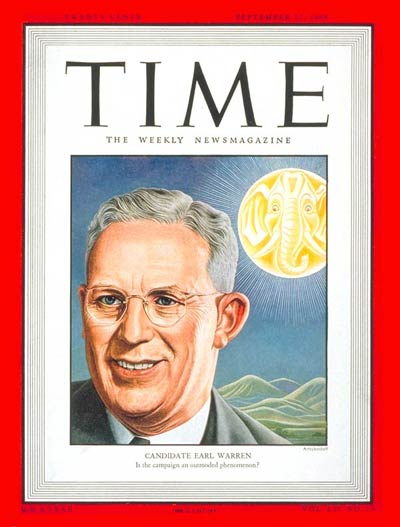
Republicans nominated New York Gov. Thomas J. Dewey and California Gov. Earl Warren for president and vice president.

After a contentious convention that saw Minneapolis Mayor Hubert H. Humphrey propose a civil rights plank that got South Carolina Gov. Strom Thurmond to walk out of the convention and found his own States’ Rights (Dixiecrat) Party (with himself as the nominee for president), and former Vice President Henry Wallace walk out because the party platform was too conservative (Wallace ran on the Socialist Progressive Party ticket), Democrats nominated President Harry S Truman and Kentucky Sen. Alben W. Barkley for president and vice president. Truman narrowly defeated Georgia Sen. Richard B. Russell for the nomination. Had Thurmond not walked out, Truman may well have lost the nomination of his own party.

And the rest of the story?

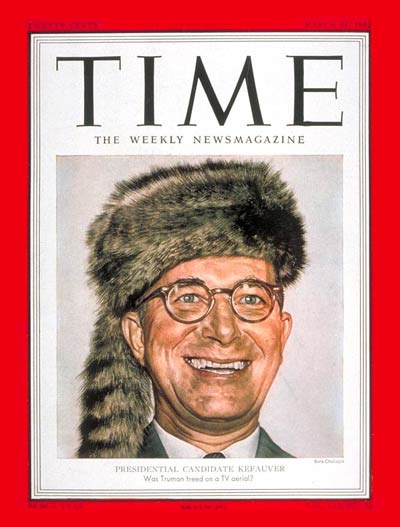
Sen. Estes Kefauver, cover of Time Magazine, 1952

Sen. Estes Kefauver

  • Truman had a contentious second term, and was defeated in the New Hampshire primary in 1952 by Sen. Estes Kefauver; Truman ended his campaign for a second full term shortly after.
  • Earl Warren was appointed Chief Justice of the Supreme Court by Truman’s successor, President Dwight D. Eisenhower, in late 1953. Warren is remembered for engineering the 9-0 decision in Brown vs. Topeka Board of Educationwhich ruled “separate but equal” school systems to violate the Constitution’s equal protection clause, and for his chairing the commission that investigated the assassination of President John F. Kennedy.  
  • Hubert Humphrey moved on to the U.S. Senate, served as Vice President to Lyndon Johnson, and won the Democratic nomination for president in another contentious convention in 1968 in Chicago. Humphrey lost the election to Richard Nixon, and returned to the U.S. Senate two years later.

    California Gov. Earl Warren, cover of Life Magazine, May 10, 1948; copyright Time-Life.

  • Strom Thurmond won election to the U.S. Senate in 1954, switching parties to Republican in 1964, and serving until his death in 2003.
  • Russell, who had served as Georgia’s senator since 1933, continued to serve to his death on January 21, 1971; he was a key member of the Warren Commission that investigated the assassination of President John F. Kennedy. The Russell Senate Office Building is named in his honor, the oldest of the three Senate office buildings.
  • Barkley was the oldest vice president ever inaugurated, aged 71. He remarried in his first year as vice president (his first wife died in 1947). Barkley’s nephew suggested that he should be called “the veep” because “Mr. Vice President” was too long. The title was seized up on by headline writers. Considered too old to run for the presidency in 1952, Barkley won a U.S. Senate seat from Kentucky in the 1954 elections, serving from 1955 to his death in 1956. Barkley Dam on the Cumberland River is named in his honor, as is the lake behind it, Lake Barkley.
  • Henry Wallace finished a distant fourth in the 1948 election, behind Dewey and Thurmond. His political career was essentially over due to his inability or unwillingness to disavow communist support. He achieved success as a chicken breeder. In a daramatic turnabout, he wrote a book, Where I Was Wrong, disavowing communism and critical of Joseph Stalin, and endorsed Republican candidates in 1956 and 1960. He died of Amyotrophic Lateral Sclerosis (ALS, or Lou Gehrig’s Disease) in 1965.
  • Dewey returned to his law practice. In 1952, Dewey helped engineer the nomination of Eisenhower over his old political nemesis Sen. Robert Taft of Ohio, pushed Richard Nixon as the Vice Presidential nominee, and in 1956 first convinced Ike to run again, and then to keep Nixon on the ticket. Dewey politely refused offers of offices, including refusing a nomination to the U.S. Supreme Court, sticking to his law practice which made him very wealthy. He died suddenly of a heart attack in 1971, at age 68.
  • Mencken suffered a stroke later in 1948 that left him unable to speak, or read, or write for a time. He spent much of the rest of his life working to organize his papers, and died in 1956. His epitaph, on his tombstone and on a plaque in the lobby of the Baltimore Sun, reads: “If, after I depart this vale, you ever remember me and have thought to please my ghost, forgive some sinner, and wink your eye at some homely girl.”

This is an encore post.  Some new links have been added — though, as you can see, I don’t yet have a better photo of Mencken at the conventions.  More news sources, below.

More, Other Sources:


Typewriter of the moment: LBJ’s teleprompter typewriter

August 6, 2012

LBJ Library photo by Mike Geissinger

July 27, 1967, in preparations for President Lyndon B. Johnson’s televised address to the Nation concerning civil unrest in American cities, an unidentified White House Staff member types President Johnson’s address for a teleprompter – LBJ Library photo by Mike Geissinger, public domain (Other sizes of photo available at LBJ Library site)

The first personal computers were more than a decade away.  Today’s teleprompters — a computer screen mounted to reflect into a glass in front of a television camera lens — had not been conceived.  Teleprompters were cathode-ray tube televisions attached to a massive television camera with a clunky device.  The image would be reversed to reflect correctly.  Into that television would be a closed-circuit feed of a scrolling piece of paper on which was typed, in very large letters, the script the speaker was to read.  In this case, of course, the speaker was the President of the United States, Lyndon B. Johnson.

In 1967, a special typewriter was required to type out the oversized-font, easy-to-read script on a roll of paper with sprocket holes along the side to enable an automated scrolling.

Just looking at the equipment for the technology of the time is an education.

Schematic of teleprompter system, from Wikimedia Commons

Schematic of teleprompter system:
1. Video camera
2. Shroud
3. Video monitor
4. One-way mirror
5. Image from subject
6. Image from video monitor

Teleprompters allow someone reading a script to look directly into the television camera lens, giving an impression to a viewer that the person is speaking directly to them, instead of glancing down at a script and back at a camera.  Research showed viewers tend to grow disinterested in people looking down at a script, and would more likely be engaged by someone appearing to look at them.

Teleprompters existed in the 1950s, but many local television stations did not use them until into the 1960s — news broadcasts of the time often featured the anchors reading from written scripts on a desk in front of the broadcaster.  A few intrepid news anchors, throwbacks to a more theatrically-inclined era, would memorize an entire script every night.

The schematic is based on modern, smaller television cameras and modern, thin devices to project the word images.  Older versions were larger — sometimes much larger.

Ed Mason as a studio technician, adjusting the teleprompter before a local broadcast - WCIA TV (Illinois) circa 1957

Ed Mason as a studio technician, adjusting the teleprompter before a local broadcast, WCIA television, Channel 3 in Champaign, Illinois; photos from site of DougQuick.com, an on-line tour of history of broadcasting

One popular version put a simple paper scroller mounted above the lens of the very large, studio television cameras — a broadcaster’s eyes could focus an inch above the lens, and viewers couldn’t tell he or she was not looking directly into the lens.

Modern teleprompter mounted on television camera, circa 2005 - Wikipedia image

Modern teleprompter mounted on television camera, circa 2005; text is projected from a thin screen on the top of the camera lens – Wikipedia image

Teleprompters emerged as a symbolic political whipping device in the early 21st century. Partisans wishing to impugn the intelligence of a politician complain that he or she cannot speak extemporaneously, without a script. Oddly, the charge was rarely leveled at President Ronald Reagan, famous for his use of scripts in almost every situation. Reagan’s White House pushed modernizing of the technical devices employed at the White House, including the latest in teleprompter devices.

The most frequently-seen politician-used teleprompters today are simple stands, “conference” teleprompters, designed as much to allow a speaker to use teleprompters with a live audience as to facilitate television use.  The devices are simple stands with a highly-reflective, clear plastic or glass on the top, and computer screen on the floor shining up.

A modern,

A modern, “conference” teleprompter of the style usually seen at public appearances by politicians.

Modern teleprompters cost a fraction of earlier versions.  Everybody uses them now — I’ve even heard of first-time candidates who did not have to go to teleprompter school.

Here I am, reading from a teleprompter at the George H. W. Bush Library and Museum in College Station, Texas, in 2011:
Ed Darrell tries out the Presidential podium and teleprompter

Here I am trying out the teleprompter and podium at the George H. W. Bush Library and Museum, College Station, Texas, in 2011.

And more people using teleprompters, with years in captions, so far as I can get them.

Teleprompter script used by President Kennedy; JFK Library collection, image by thewastesmile

Teleprompter script used by President John F. Kennedy, from Kennedy Library collection; image by a private party.

President Reagan using a teleprompter, in speech from the Oval Office - undated

President Reagan often used teleprompters — in a computerized form by then.

Teleprompter in use:  LBJ addresses the nation prior to signing the Civil Rights Act of 1964, on July 2, 1964 - LBJ Library and Museum photo

Teleprompter in use:  In the White House East Room, President Lyndon B. Johnson used a teleprompter to address the nation in a live television broadcast, just before he signed the 1964 Civil Rights Act. People watching include Attorney General Robert Kennedy, Senator Hubert Humphrey, First Lady “Lady Bird” Johnson, Rev. Martin Luther King, Jr., F.B.I. Director J. Edgar Hoover, Speaker of the House John McCormack. Television cameras are broadcasting the ceremony.

A more modern use:

Judy Licht using a teleprompter in a broadcast from Italy.

Broadcaster Judy Licht using a teleprompter in broadcast or taping from Piazza Duomo, Milan, Italy, in September 2007.


Notebook – an animation look at reality in a digital age

August 4, 2012

I’m up for a brilliant little idea not carried on too long.

Stumbled into this film from four years ago.  The producer/director/creator explains it:

Noteboek (English title: Notebook) consists of 4 short experimental films where I try to confuse the reality.
In these films, illusions and expectations are challenged.

Noteboek is a short film and part of my graduation project.

[Music: The White Stripes-Seven Nation Army.]

And where is Evelien Lohbeck today?

If you want to see more work please visit:
evelienlohbeck.com

The guy’s woman’s got a wicked sense of the surreal, and a good sense of humor.

Tip of the old scrub brush to Le Web  . . . et le reste.

More:


Typewriter anniversary: July 23, 1829, William Austin Burt’s “typographer”

July 23, 2012

An encore post, history we need to remember.

National Typewriter Day, July 23?  Type a letter to your mom, to celebrate.

William Austin Burt received a patent on a typographer on July 23, 1829 — signed personally by President Andrew Jackson.

First patent issued for a typewriter, July 23, 1829, to William Austin Burt -- signed by Andrew Jackson

Image of the first patent issued for a typewriter, July 23, 1829, to William Austin Burt, a Michigan surveyor and inventor. It was signed personally by President Andrew Jackson.

The typographer is considered the forerunner to the typewriter.

Burt’s chief reputation came from his work as a surveyor in Michigan. He discovered the massive iron ore deposits for which Michigan became famous, the iron that fueled much of American industrialization in the 19th and 20th centuries. He discovered one of the world’s largest deposits of copper, the Calumet and Hecla Mine. He invented the solar compass, to survey areas where iron deposits made magnetic compasses inaccurate.

English: Typographer patent 1829 by William Au...


Patent drawing of W. A. Burt’s typographer, the first patented typewriter – Wikimedia image

Some of Burt’s biographies do not mention his invention of the typewriter.

Burt was born in an era of great technological development and invention. People in all walks of life invented devices to aid their work, or just for the joy of invention. Even future president Abraham Lincoln invented a device to float cargo boats in shallow water, hoping to increase river commerce to his home county, Sangamon County, Illinois.

William Austin Burt

William Austin Burt (Photo: Wikipedia)

Burt invented devices to aid his work in surveying, a very important service industry in frontier America. Because surveyors often worked on the frontier, they were famous for discovering natural resources in the course of their work. So it was that Burt, working in the Upper Peninsula of Michigan, found his magnetic compasses spinning wildly. Suspecting a natural phenomenon, Burt ordered his crew to look for ferrous rocks, and they quickly determined they were in an area rife with iron deposits.

It was to further surverying in such areas that Burt invented the solar compass.

Even uninteresting frontiersmen could lead lives that fascinate us today. Was it Burt’s inventiveness that led him to such a life as a surveyor, or was it his work that pushed him to invent?

First typewritten letter, 1829 - Wikimedia Image

First letter ever written on a typewriter, in 1829 — to Martin Van Buren, then Vice President of the U.S., and future president. Notice the letter was written nearly two months prior to the patent being issued on the device upon which it was written. Wikimedia image


You make farming fun

July 7, 2012

ThePetersonFarmBros have a YouTube hit here, “I’m Farming and I Grow It”:

  1. This is a great form of reality.  How many other professions will jump into this game?
  2. Teachers, here are those big farm machines shown doing what they do — technology applied, for history?  If  you teach in an urban or suburban school, as I do, many of your students have never seen these machines in action. Many have never seen these machines, period.
  3. English and social studies teachers, use this as a warmup to an exercise for students to storyboard something, a short story, a chapter of history — somebody will have a student who can do a video with equal quality in music and video; no, it won’t meet the requirements for National History Day entries, but it’s a great start.
  4. Will this video entice any other kids to go into farming?  How could someone do a study of that?
  5. No, seriously:  This is great reality television.  I can imagine a summer series with a half dozen of these videos per hour, running four or five weeks.  Construction workers, cops, firefighters, teachers, nurses, physicians, auto mechanics, radio tower climbers, cargo airplane pilots, ferry boat captains, truck drivers . . . almost any occupation could fit, yes?

Here’s the YouTube site — lyrics are available there, and more information.

A parody music video promoting agriculture! If you like it, feel free to share it with your friends! No copyright infringement of original song intended.
Become a fan of our new facebook page: http://www.facebook.com/PetersonFarmBros
Follow Greg Peterson on Twitter @gregpeterson33
Greg Peterson Music Fan Page: http://www.facebook.com/gregpetersonmusic

More:  


Quick! Vote for Bill Adkins! Get a new printer for his classroom

May 16, 2012

We have a great art department at Molina High SchoolBill Adkins, and his colleagues, pull great work out of kids who too often are not expected to produce good art.

Adkins is in contest to get a fancy printer, based on votes from the internet.  Will you do Mr. Adkins, and especially his students, a great favor and go cast a vote for him right now?  Voting ends today, and he’s in the running but not in first.

Details:

I want to thank Mr. Rhee and Mr. Jones for their efforts encouraging their students to vote for my project.  I also thank the rest of you who have voted to help me win a new printer for the art department.  It’s still a very close race, I’m currently in 3rd place and voting ends tomorrow.  If you haven’t voted yet, I hope you will.  Your students are allowed to vote too.  Just go the this link:  http://www.weareteachers.com/teaching-ideas/grant/teaching-idea?app=24725&grantId=98 and click on vote for me.

Someday schools will provide equipment like this without contests on the internet — but not yet.   A vote for Adkins is a vote for educational excellence.

Thanks!

From an earlier post:


Typewriter of the moment: Tom Hanks’s 1969 Royal Apollo 10 Electric

March 3, 2012

Some indications on Twitter that actor Tom Hanks may be turning into a collector of these historic items:

Typewriter - Tom Hanks Royal Apollo 10 1969 - Photo by Tom Hanks at WhoSay

Tom Hanks found a vintage 1969 typewriter (circa Apollo 13 mission), a Royal Apollo 10, and Tweeted this picture - Photo by Tom Hanks at WhoSay

In his Tweet, captured at WhoSay, Hanks wrote:

Typewriter of the day. Royal ‘Apollo 10’ model from 1969. Electric that got us to the moon! It’s noisy but types fine. Hanx

Do you think there’s a movie about typewriters coming?

Confess, Dear Reader — are you taken in by the magic, charm and dinging carriage-return bell of these old typewriters?  Do you remember the machine you used to use?  Do you still use a typewriter?  Minds soaking in the Bathtub want to know.

Grateful tip of the old scrub brush to Judy Crook @Jude2004.


Automaton from “Hugo,” alive and well and living in Philadelphia

February 20, 2012

You saw and loved Scorsese’s “Hugo.”  You rushed home and Googled “Georges Melies,” and you rediscovered a thrilling character from history You wondered:  Surely the automaton was wholly fictional, right?  No one could really make something like that!

Oh, but they did.  The Franklin Institute in Philadelphia has one restoredCBS Sunday Morning reported it:

(And then CBS disabled embedding — you’ll have to go watch at YouTube.  Sorry.)

Here, watch this longer piece demonstrating the device:

Steampunkers everywhere are suddenly filled with hope.

But, should we be surprised that mere mechanical devices can do such seemingly wonderous stuff?  Remember the “bird pistols” that were auctioned a few months ago?  And what about all those mechanized clocks in towns and cities across Europe? See the clock tower in Poznan, Poland, for example:

At Mid day everyday, 2 mechanical goats bang their heads together and a guy plays a trumpet.

Amazing stuff was possible, without electronics.  2D animation on film is fantastic.  3d animation of a real object?  It appears just short of miraculous, and then only because we know something about how it was done.  Arthur C. Clarke’s famous Third Law screams to be noted here:  “Any sufficiently advanced technology is indistinguishable from magic.”  But of course, no one is making such automata today.  Maybe they are miracles, no?  Bugs Bunny sang, “Carrots are sublime/You get a dozen for dime/It’s magic!”

Magic of and on film, one of the great themes of the movie “Hugo.”

Updated:  More sources (courtesy of Zemanta): 


Time lapse flight, San Francisco to Paris

January 23, 2012

I continue to like time-lapse photo compilations, and I continue to wonder about how to use them to expand geography teaching.  It’s a great circle route, over the Arctic nearing the North Pole.  This movie comes from Nate Bolt, who posts his work at Beepshow.

Obviously I’m not the only one who likes it — between the YouTube and Vimeo sites, the movie has more than 4 million viewers.

Bolt explained at YouTube:

More of these time lapses at http://beepshow.com

I shot a photo roughly every two miles between take-off in San Francisco and landing in Paris CDG to make this airplane time lapse. For some reason the Vimeo version of this is more linked to: http://vimeo.com/21822029

Shot with a 5d2, a time-lapse controller, and a 16mm – 35mm, mixed with some iPhone shots. The flight path from SF to Paris goes well over greenland and the arctic circle, where you can see “northern” lights from all sides of the plane, which explains why I could shoot them facing South.

Big thanks to the folks at http://uxlondon.com for inviting me to europe to speak – if it wasn’t for them I wouldn’t have made the trip. The music is a modified template of “Gain” used with permission from DETUNE ltd. denkitribe http://soundcloud.com/denkitribe/gain – I created this arrangement on the Korg iMS20 iPad App, and it’s my first custom score. Edits and pans in After Effects CS5 and iMovie.

The photos during take-off and landing are all computer models and totally rendered because I would never use an electronic device during times when the FAA prohibits them. I did get lucky and have a whole row to myself to setup the tripod and gear.

Thanks to my neighbors for not minding an SLR click every 2 to 30 seconds for 11 hours, and thanks to the whole Air France flight crew for being insanely friendly and allowing me to shoot. Thanks to @ztaylor for showing me the Korg iMS20 iPad App. Thanks to @jayzombie and the #nerdbird on the way to SXSW this year for helping me come up with the idea. Thanks to @somnabulent for the idea of live scoring. Thanks to you for actually reading this far. You are a champion.

Tip of the old scrub brush to Boys’ Life Heads Up blog.


Boys’ Life on YouTube, February issue preview

January 21, 2012

Every time I pick up an issue of Boys’ Life I think how much better students could perform if they just looked that this magazine once a month; you don’t have to be a Scout to subscribe, but why not live the adventures, too?

Will 30-second montages sell more magazines?  What more could/should Boys’ Life do on the web?

Here’s an example of the sorts of skills I wish my students had, again from the Boys’ Life YouTube offerings.  In “Cache Me If You Can,” these are young Scouts, I’m guessing ages 11 to about 13 from a Troop 6 somewhere in Colorado, out navigating a path through the woods using GPS and hand-held ham radios.  I fear most of my 16-18-year-old students would be challenged to do the stuff these younger kids are doing, if they could do it at all.

Of course, while those skills would make them better students more able to understand and use maps and charts, very little of those skills are listed in the Texas Essential Knowledge and Skills.  I’m given neither time nor resources to teach them.

More, resources: 

  • A feature at the Boys’ Life site I really like is the “Wayback Machine,” which allows viewing of many issues of the magazine dating back to 1911 — actualy from March 1911 through December 2009.  Alas, the features uses Google Books, so viewing at the site is about all you can do — no copying of the great covers by Boy Scouts of America art director Norman Rockwell, no copying of articles with teachable skills for use as illustrations in lessons.   This would be a good research site for high school history projects — Scouts in time of war, Scouting and education, map use, youth in exploration, etc.

(Missing) Typewriter of the moment: Albert Einstein

December 30, 2011

Einstein at his desk, Princeton, New Jersey, circa 1955

Einstein at his desk, Princeton, New Jersey, circa 1955

He wrote papers, and letters, long-hand.  Sometimes they would be typed up by an assistant, perhaps Helen Dukas.

The desk of Albert Einstein features a refreshing, bracing lack of technology.  No typewriter.  No telephone.  No radio.  No Dictaphone.  No intercom.  Pencils.  Is there even a ballpoint pen?  A chalkboard in back of the desk provided a large sketch pad for new ideas, and new trials of ideas, from the man who gave us nuclear power, gravity as a deformation of space, the speed of light as a firm constant in the universe, and relativity.

Somewhere there may be a typewriter Einstein actually used once or twice.  I’d like to know about it.

More: 

Ralph Morse photo of Einstein's office the day he died, April 18, 1955 -- originally for Life Magazine, not published

Ralph Morse photo of Einstein’s office the day he died, April 18, 1955 — originally for Life Magazine, not published; via AllPosters.  Note the antiquated telephone away from the desk, near the wall; Einstein’s pipe and a tobacco tin appear the closest things to technology on the desk; is that a bottle of ink for a fountain pen next to the tobacco tin?


Annals of Global Warming: Planetary energy budget, for beginners, and climate engineering — from GAO

December 28, 2011

From the General Accountability Office, an arm of Congress, a report to the House Committee on Science, Space and Technology.

Aug 25, 2011
01:16

Global Average Energy Budget of the Earth’s Atmosphere

In eight steps, this animation depicts the path of sunlight that enters the planet’s atmosphere, illustrating how that radiation is reflected, absorbed, and emitted as heat energy.

In less than 90 seconds, an animated, graphic description of how and why global warming occurs.  You didn’t get it in 90 seconds?  Watch it again.  This video was made to accompany a GAO report on climate engineering. (Emphasis added, in red.)

Climate Engineering: Technical Status, Future Directions, and Potential Responses

GAO-11-71, Aug 25, 2011

[135-page report, in .pdf, here]

Summary:  Reports of rising global temperatures have raised questions about responses to climate change, including efforts to (1) reduce carbon dioxide (CO2) emissions, (2) adapt to climate change, and (3) design and develop climate engineering technologies for deliberate, large-scale intervention in Earth’s climate. Reporting earlier that the nation lacks a coordinated climate-change strategy that includes climate engineering, GAO now assesses climate engineering technologies, focusing on their technical status, future directions for research on them, and potential responses. To perform this technology assessment, GAO reviewed the peer-reviewed scientific literature and government reports, consulted experts with a wide variety of backgrounds and viewpoints, and surveyed 1,006 adults across the United States. Experts convened with the assistance of the National Academy of Sciences advised GAO, and several reviewed a draft of this report. GAO incorporated their technical and other comments in the final report as appropriate.

Climate engineering technologies do not now offer a viable response to global climate change. Experts advocating research to develop and evaluate the technologies believe that research on these technologies is urgently needed or would provide an insurance policy against worst case climate scenarios–but caution that the misuse of research could bring new risks. Government reports and the literature suggest that research progress will require not only technology studies but also efforts to improve climate models and data. The technologies being proposed have been categorized as carbon dioxide removal (CDR) and solar radiation management (SRM). CDR would reduce the atmospheric concentration of CO2, allowing more heat to escape and thus cooling the Earth. For example, proposed CDR technologies include enhancing the uptake of CO2 in oceans and forests and capturing CO2 from air chemically for storage underground. SRM technologies would place reflective material in space or in Earth’s atmosphere to scatter or reflect sunlight (for example, by injecting sulfate aerosols into the stratosphere to scatter incoming solar radiation or brightening clouds) or would increase the planet’s reflectivity (for example, by painting roofs and pavements in light colors). GAO found these technologies currently immature, many with potentially negative consequences. Some studies say, for example, that stratospheric aerosols might greatly reduce summer precipitation in places such as India and northern China. Many experts advocated research because of its potential benefits but also recognized its risks. For example, a country might unilaterally deploy a technology with a transboundary effect. Research advocates emphasized the need for risk management, envisioning a federal research effort that would (1) focus internationally on transparency and cooperation, given transboundary effects; (2) enable the public and national leaders to consider issues before they become crises; and (3) anticipate opportunities and risks. A small number of those we consulted opposed research; they anticipated major technology risks or limited future climate change. Based on GAO’s survey, a majority of U.S. adults are not familiar with climate engineering. When given information on the technologies, they tend to be open to research but concerned about safety.

Transcript of the video, describing each slide, below the fold.

Read the rest of this entry »