Co-evolving technologies: Telephones, film

May 31, 2011

Blasts from the past.

First, an AT&T advertisement — shown in theatres — in silent film.  the short introduced dial phones to part of central California in early 1927.  Historical footnote:  Some theatres had played short-subject sound films, but the famous full-length first “talkie,” “The Jazz Singer” with superstar Al Jolson in the lead role, didn’t get into production until after this phone exchange went to dials (the dial service cutover was set for May 28; Jolson didn’t sign a contract to do the film until July, and the film’s rushed premiere was October 6).

This short reflects movie conventions of the silent era.

A short time later, we get a sound version of the film instructing in the use of a dial telephone.

In 1962 AT&T promoted Touch-Tone dialing at the Seattle World’s Fair (the Fair was in 1962; the YouTube video says 1963); this is a clip from a longer film, in color; where the film was intended to be exhibited I do not know:

The longer film was a 14-minute production from AT&T, “Century 21 Calling . . .”  The longer film used the backdrop of the World’s Fair, including the monorail, to demonstrate new technologies in the pipeline, like call forwarding — technologies that were really about 20 years in the future for most people.  If you’ve got the time and want to immerse yourself in the past, here’s the whole film at CrunchGear.

We should search for earlier films on telephones.  Telephones were toys of the rich in the late 19th century.  Edison’s workable movie system started cranking out movies in 1892.  It is conceivable that there is another, earlier film on how to use a hand-crank telephone, prior to 1927.

But here we see three classic, period pieces, from 1927, from about 1930, and from 1962.  Each film ostensibly shows an advance in the user interface for the telephone, but each film also demonstrates the technology of films available at the time.  There’s a heck of an essay with a grand moral in there, somewhere.

Note on filibustering new technologies:  Virginia’s U.S. Sen. Carter Glass worked to get dial telephones banned and removed from the Senate wing of the Capitol with a resolution in 1930.  Here’s the account from the Senate Historical Office:

June 25, 1930
Senate Considers Banning Dial Phones

Senator Carter Glass of Virginia
Carter Glass (D-VA)

In the spring of 1930, the Senate considered the following resolution:

Whereas dial telephones are more difficult to operate than are manual telephones; and Whereas Senators are required, since the installation of dial phones in the Capitol, to perform the duties of telephone operators in order to enjoy the benefits of telephone service; and Whereas dial telephones have failed to expedite telephone service; Therefore be it resolved that the Sergeant at Arms of the Senate is authorized and directed to order the Chesapeake and Potomac Telephone Co. to replace with manual phones within 30 days after the adoption of this resolution, all dial telephones in the Senate wing of the United States Capitol and in the Senate office building.

Sponsored by Virginia’s Carter Glass, the resolution passed without objection when first considered on May 22, 1930. Arizona’s Henry Ashurst praised its sponsor for his restrained language. The Congressional Record would not be mailable, he said, “if it contained in print what Senators think of the dial telephone system.” When Washington Senator Clarence Dill asked why the resolution did not also ban the dial system from the District of Columbia, Glass said he hoped the phone company would take the hint.

One day before the scheduled removal of all dial phones, Maryland Senator Millard Tydings offered a resolution to give senators a choice. It appeared that some of the younger senators actually preferred the dial phones. This angered the anti-dial senators, who immediately blocked the measure’s consideration.

Finally, technology offered a solution. Although the telephone company had pressed for the installation of an all-dial system, it acknowledged that it could provide the Senate with phones that worked both ways. But Senator Dill was not ready to give up. In his experience, the dial phone “could not be more awkward than it is. One has to use both hands to dial; he must be in a position where there is good light, day or night, in order to see the number; and if he happens to turn the dial not quite far enough, then he gets a wrong connection.”

Senator Glass, the original sponsor, had the last word before the Senate agreed to the compromise plan. “Mr. President, so long as I am not pestered with the dial and may have the manual telephone, while those who want to be pestered with [the dial] may have it, all right.”

A very big tip of the old scrub brush to Mary Almanza, who piqued my interest with her post of the “how to dial” video on Facebook.


Common Core of Errors and Nostalgia: Where is the future of education?

May 18, 2011

How do you plan for the future?

Oh, yeah, I know the old story about the ants and the grasshopper.  But it’s really a story about traditional agriculture and the need to look no more than a year ahead, as usually told.  In the classic Aesop version, the moral is about the need to prepare for “days of necessity.”    The story doesn’t say anything about how the ants planned for the advent of DDT, Dieldren or Heptachlor, nor for an invasion of immigrants from Argentina, nor for the paving of the forested field they lived in.

And that’s probably the point.  How do we plan for what we don’t know will happen, for what we cannot even imagine will happen?

In retrospect, much “planning” looks silly.  Bob Townsend, the former head of Avis and American Express, wrote a book years ago that I wish more educators would read today, Up the Organization.  In one of its brief chapters he talks about having been appointed poobah (vice president? managing director?) of “future planning” at one of those corporations, and how proud he was to have the title.  A few days after he got the job his bubble was burst in a most unusual way.  He got home for dinner, and his wife asked him, “What did you plan today?”

(I don’t do the story justice.  Go get a copy and read the story.)

Nancy Flanagan at Teacher in a Strange Land demonstrates the folly that Townsend’s wife brought to light, the folly in thinking we’ve got a good grip on what the future holds, and especially on what skills and education and training will be required to get there:  “Common Core Standards:  A though experiment.”

Soon after the report of the President’s Commission on Excellence in Education came out, and for some years after, there was much worry about just what was the “common core” of knowledge that a modern kid would need, both to be a successful student and prepare for a life of beneficial work, family raising, voting and tax paying.  Tradition and federal law had kept (and still keep) the federal government from writing a national curriculum, leaving that task to the states and local school boards — the 50 states, plus the District of Columbia, plus territories of the Virgin Islands, Guam and Puerto Rico, and the more than 15,000 local school boards.  There is no national curriculum in the U.S., nor is there agreement from state to state or district to district on just what should be taught.  State standards exist, but they were supposed to be the floor above which students could soar, instead of what they have become, the too-low target at which students really aim in their drive to be good bubble-guessers.

Flanagan has a sharp and entertaining fantasy about what would have happened, if:

So now the Common Core Everything movement is worried about whether schools’ technological capacity is up to the task of constant, computer-driven assessment–and Bill Gates and Pearson are developing the aligned on-line curriculum that you always knew was just around the corner. Soon–all the pieces will be in place, and we’ll be on our way to that One Unified System that we’ve been pursuing for decades. At last. Too bad it’s taken so long…

Just imagine what could be in place if Ronald Reagan had leveraged the political will engendered by the “Nation at Risk” report to get Congress to agree to a set of common standards and tests.

Is it a glorious future?  Well, consider the standards for students to learn about business and communications:

The business career rooms are outfitted with zippy Selectric typewriters and dictation machines–Williams sees girls transcribing the tapes. He is especially pleased with the broadcast studio, where students can read the morning announcements over the public address system, meeting the standard for broadcast media. A group of students is taking French IV via distance learning there, watching a TV lecture, then mailing off their homework and quizzes. Elmwood could only afford one language lab, so Mr. Williams has phased out Latin and Spanish, deciding to offer only French in a four-year block. Rationale: the French Club can travel to France–but his rural students were not likely to meet Spanish-speaking people in the future!

Flanagan’s view is entertaining, and enlightening, even in that short glimpse.  Go read the rest of her fantasy.  If you agree — and you will find it hard not to — can you think of ways to prevent the obvious problems?  Can you think of how we could have dealt with those problems, in 1983 and 1989?  Are we avoiding those problems with our curriculum standards today?

Did any state plan to educate kids on the ethics of real estate deals, so they’d be ready to avoid the real estate bubble, or its bursting?  It’s still true that we are “ready to fight the last war.”

I responded:

Generally I argue, against those who claim any beneficial change in schools is “socialism” and should be fought, that we compete against nations who do better than we do, at least as measured by the international comparison tests — and every nation ranked above the U.S. has a national curriculum. So, I argue, there doesn’t appear to be harm in a national curriculum, per se.

But as you demonstrate, there could indeed be harm in a national curriculum set in stone that is wrong — or even the wrong curriculum set in Jello.

When I did quality work and consulting with big corporations, way back in 19XX, I often used the story about the difference between Nissan and GM on robotics. Nissan was seen as the wave of the future with fancy auto plants with lots of big robots doing high quality work in assembling autos. GM, on the other had, was struggling. GM sank $5 billion or so into a robotized plant in Hamtramck, Michigan — and had to close it down. Couldn’t make it work.

What was the difference?

Nissan used to make fenders by having metalworkers pound them out by hand. Nissan took a few of those workmen, and asked them to search for machines that would make their work easier. Those guys found some stamp presses, got expert on them, and Nissan was off to the races on automation. At each step, the people who actually did the work were brought in to make the next improvements. I saw one interview of a guy running several massive robots, and the interviewer asked what sort of education he’d gotten to get to that point. He said he’d started out pounding fenders with a hammer and anvil, years earlier.

GM saw those robots in that plant, and bought a whole plantful of them. When the robots were installed in Michigan, they began the search for people to run the machines, unfortunately having to let go a lot of the people who ran the old stamping machines, because they lacked the “necessary background.”

What is the equivalent front line worker in education today? What is the “necessary background?” Impose that on your story, you could get some good results.

By the way, I was handicapped greatly by my high school education. We didn’t have enough advanced math students to get a calculus class going. So I couldn’t get calculus. But, the district said, they had purchased a brand new machine to get going in “computer math.” It was a card compiler. Students could learn to punch IBM computer cards, and that would give them a leg up in the computer world . . .

35 years later, my kids needed help with their calculus homework. They took some of my old debate cards, on old [computer] punch cards, to school for show and tell. Antiques. ( I didn’t have any programs to send — I couldn’t fit the computer math into the schedule opposite “student council;” my counselor advised me to drop out of student council for computer math, a decision I probably would have regretted in my years in Washington.)

I spoke with one of my high school English teachers last year — she’s the doyen of the computer lab today, an after-retirement job.  Turns out the computer lab really needed someone who could teach kids to write, someone who knows grammar and a bit about reading and judging sources for research papers.

What did you “plan” today?


Typewriter of the moment: Godrej & Boyce, the last manual ever made

April 30, 2011

Can this be correct?

The Daily Mail in London reports that the last manufacturer of manual typewriters in the world, Godrej & Boyce of India, is shutting down production.

Is this the last manual typewriter ever to be made?

Godrej and Boyce, Prima, the last manual typewriter manufactured in the world

The Prima, from Godrej & Boyce; in India, the last company making manual typewriters is closing down

According to the Daily Mail:

It’s an invention that revolutionised the way we work, becoming an essential piece of office equipment for the best part of a century.

But after years of sterling service, that bane for secretaries has reached the end of the line.

Godrej and Boyce – the last company left in the world that was still manufacturing typewriters – has shut down its production plant in Mumbai, India with just a few hundred machines left in stock.

Although typewriters became obsolete years ago in the west, they were still common in India  – until recently.  Demand for the machines has sunk in the last ten years as consumers switch to computers.

The company’s general manager, Milind Dukle, told India’s Business Standard newspaper: ‘We are not getting many orders now.

‘From the early 2000s onwards, computers started dominating. All the manufacturers of office typewriters stopped production, except us.

‘Till 2009, we used to produce 10,000 to 12,000 machines a year. But this might be the last chance for typewriter lovers. Now, our primary market is among the defence agencies, courts and government offices.’

The company is now down to its last  200 machines – the majority of which are Arabic language models.

The firm began production in the 1950s – when Prime Minister Jawaharlal Nehru described the typewriter as a symbol of India’s emerging independence and industrialisation. It was still selling 50,000 models annually in the early 1990s, but last year it sold less than 800 machines.

The first commercial typewriter was produced in the U.S. in 1867 and by the turn of the century had developed into the  standardised format – including a qwerty’ keyboard – that we know today.

Say it ain’t so, Mr. Christopher Latham Sholes!

Godrej & Boyce manufactures several different technology products in its conglomerate of factories — but the typewriter is already gone from their website’s listing of company products.

Electric typewriters will continue to roll off of foreign assembly lines, for companies like Swintec and Brother.

More, resources, etc.: 


George Jetson come true? Maverick Flying Car at Oshkosh

April 14, 2011

Next time somebody asks ‘where’s my flying car?” you can show them this.

Steve Saint of I-TEC drove his road-legal flying car from Florida to Oshkosh this summer. Since then the FAA has also issued the Maverick a S-LSA aircraft airworthiness certificate. I-TEC hopes to be in production by EAA Oshkosh 2011.

[Because it comes with built-in autoplay from the Experimental Aircraft Association, it’s below the fold.]

Read the rest of this entry »


The 12 States of America from The Atlantic: Income inequality marks majority of America

March 10, 2011

Graphics story in The Atlantic this month — “The 12 States of America.”

Looking at my print copy I was struck that most of the “states” listed — really communities of people — have lost economic ground in the past decade.  Average per capita incomes dropped for most groups.

Since 1980, income inequality has fractured the nation. Click each icon to see each of the dozen states, which counties belong to them and how median income has changed over the last 30 years.

The old income inequality monster rearing its ugly, ugly head again.  America is losing ground.  No wonder the Republicans are discouraged — but why don’t they understand that its their policies that create the trouble?

This is a good version, but you’d do well to go check out a larger version at The Atlantic site, and read the short article by Dante Chinni and James Gimpel.

Vodpod videos no longer available.

The 12 States of America – The Atlantic, posted with vodpod

Click on any descriptor, and it will show which counties in America match that description.

Hmmm. In the headline, should that be “scars” instead of “marks?”


Typewriter of the moment: Helen Keller (again)

February 21, 2011

Helen Keller at her typewriter, 1946 - Perkins School for the Blind

Helen Keller at her typewriter, circa 1946 – Perkins School for the Blind

Helen Keller at her typewriter, circa 1946

Helen Keller at her typewriter, circa 1946. Perkins School for the Blind caption: In 1902, Helen Keller became the first person who was deafblind to write a book. Her autobiography, The Story of My Life, was the first of 14 books she wrote in her lifetime.

Earlier at Millard Fillmore’s Bathtub:  “Typewriter of the Moment:  Helen Keller”


The Egyptian Revolution will be Tweeted as well

February 12, 2011

Not only broadcast, but Tweeted, too.  From Dave Does The Blog:

RT @mhegi: Uninstalling dictator COMPLETE – installing now: egypt 2.0: █░░░░░░░░░░░░░░░░░░ #egypt #jan25 #tahrir#

Hey, I’m not that tech savvy — I had to think about that for a minute myself.  Quick:  Can you define “hashtag” to your grandmother?

Shouldn’t it be more like “Egypt 10.0?”

Update:  The actual Tweet:


Typewriter of the moment: Daniel Patrick Moynihan’s policy machine and crystal ball

January 15, 2011

Daniel Patrick Moynihan at his typewriter - photo from the American Academy of Political and Social Science

Daniel Patrick Moynihan at his typewriter – photo from the American Academy of Political and Social Science

This photo adorns the page announcing and asking for nominations to the annual Daniel Patrick Moynihan Prize, at the site of the American Academy of Political and Social Sciences.

Moynihan was the always-opinionated, rarely un-informed social scientist who caused a firestorm of criticism to rain down on Richard Nixon when Moynihan, working for Nixon, suggested that civil rights might benefit from a period of  “benign neglect” by the President.  Later he caused another firestorm, and along period of reflection, when he worried in a paper about the potential bad effects of social welfare programs that would ease suffering, but fail to achieve all of their loftier goals — the workers compensation program that could not restore a worker to full service, the program to provide food and shelter to the children of out-of-work parents if the parents could not find new jobs, etc.  He worried about the ‘culture of poverty.’

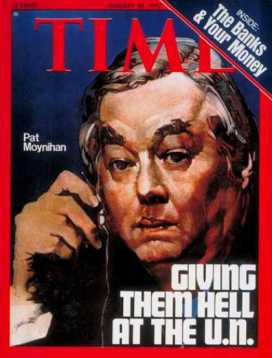
He raised hell as the U.S. Ambassador to the United Nations.

Time Magazine cover of UN Ambassador Daniel Patrick Moynihan

Time Magazine cover of UN Ambassador Daniel Patrick Moynihan

I knew him as the U.S. Senator from the State of New York, where he would shock his staff by showing up early on a Saturday morning to knock out a few letters to the editor, and op-ed pieces on his typewriter, without the bother of an in-session Senate to slow him down.  Later I worked for Checker Finn, who had worked with Moynihan when Moynihan was U.S. Ambassador to India.  Finn adopted many of his scholarly habits from Moynihan.  While working for Finn, nearly 25 years ago at the Department of Education, I got a taste of the world to come when Finn aggressively adopted e-mail messaging for himself and anyone of any executive influence under him, at the old Office of Educational Research and Improvement (OERI).  Aggressive adoption of new technologies can greatly improve organizations and organizational effectiveness.

Almost always with a bow tie.  Usually heavily editing his speeches, or writing his own op-ed pieces while other officials paid ghosts to do it for them.  Thinking thoughts Republicans would come to love, while a Democrat, but years before Republicans would come to love them.  Thinking thoughts Democrats would learn to love, but much later.

Few topics evaded his attention and careful thought.  He talked at length with David Gergen about the problem of Wikileaks, a dozen years before Wikileaks came to public attention (and years before Wikileaks even existed.)  He wrote books about international affairs, and education at home.  He pushed environmental laws to be better. Moynihan worried about the health of American families while James Dobson was still learning what a microphone and a family were.  In 1970, Moynihan warned the U.S. president that global warming is a problem.

Moynihan often appeared as the man who went everywhere, and did everything — after leaving Tulsa.  Moynihan studied everywhere.  He worked under New York Gov. Averell Harriman, and Presidents Kennedy, Johnson, Nixon and Ford, before serving a quarter century in the U.S. Senate (Is there some magic in that seat?  His predecessor was James Buckley; his successor was Hilary Rodham Clinton).   Here’s his brief Congressional biography:

MOYNIHAN, Daniel Patrick, a Senator from New York; born in Tulsa, Tulsa County, Okla., March 16, 1927; attended the public and parochial schools of New York City; attended City College of New York 1943; graduated, Tufts University, Medford, Mass., 1948; received graduate and law degrees from the Fletcher School of Law and Diplomacy 1949, 1961, 1968; studied as a Fulbright fellow, London School of Economics and Political Science 1950-1951; served in the United States Navy 1944-1947; Navy reserve 1947-1966; assistant and secretary to New York Governor W. Averell Harriman 1955-1958; member, New York State Tenure Commission 1959-1960; director, Syracuse University’s New York State Government Research Project 1959-1961; director, Joint Center for Urban Studies, Massachusetts Institute of Technology and Harvard University 1966-1969; author; held cabinet or sub-cabinet positions under Presidents John Kennedy, Lyndon Johnson, Richard Nixon, and Gerald Ford 1961-1976; Ambassador to India 1973-1975; United States Permanent Representative to the United Nations 1975-1976; elected as a Democrat to the United States Senate in 1976; reelected in 1982, 1988, and 1994 and served from January 3, 1977, to January 3, 2001; was not a candidate for reelection in 2000; chairman, Committee on the Environment and Public Works (One Hundred Second and One Hundred Third Congresses); Committee on Finance (One Hundred Third Congress); awarded the Presidential Medal of Freedom on August 9, 2000; professor at Syracuse University’s Maxwell School 2001; senior scholar, Woodrow Wilson International Center for Scholars 2001-2003; died of complications from a ruptured appendix on March 26, 2003; interment at Arlington National Cemetery.

Moynihan was a man ahead of his time.

In this photo, he’s making use of the technology of his time:  A typewriter (I think it’s an old Royal).  How much different would the world be had there been personal computers, and the internet, for Moynihan to toy with?

Moynihan was a writer, and the typewriter the chief tool of his trade.  How important was writing?  He gets his own page at Amazon.com.   Hendrik Hertzberg, in The New Yorker, last year:

Nevertheless, Pat Moynihan was, first, last, and always, a writer. “When I was five years old, I asked my mother, what does Dad do?” his daughter, Maura, recalls in a charming afterword to a splendid new book. “She replied, he’s a writer. And he was: he wrote every day—even at Christmas—articles, books, speeches, and, in great abundance, letters.” You might say he wrote his way to power. Without the writing, no foot-in-the-door job in John F. Kennedy’s Labor Department (and no influence once he was there), no high domestic-policy post in Richard Nixon’s White House, no ambassadorships to India and the United Nations, no twenty-four years in the Senate—and no Moynihan Station.

More, Resources:

Daniel Patrick Moynihan and typewriter, Harvard University

Daniel Patrick Moynihan and typewriter (Smith-Corona, I think) in his office at Harvard University – 1971. George Tames/The New York Times.


Typewriter of the moment: Sigurd Olson, a typewriter in the wilderness

January 11, 2011


Chuck Wick with Sigurd Olson's typewriter, in Olson's Ely, Minnesota, Home.  MPR photo
Chuck Wick knew Sigurd Olson and now owns Olson’s Ely home and writing shack. Olson’s old Royal typewriter, his pipes, photos, duck decoys and rock collection are still in the shack, where they were left after Olson died more than 20 years ago. (MPR Photo/Bob Kelleher)

Sigurd Olson, in his spare time, ghosted part of the National Wilderness Act, always fighting to preserve and protect his love, the Boundary Waters Canoe Area — on this typewriter.

It’s just a small shack, really an old garage — a drab olive green with a pair of windows on each side, tucked under a few shade trees in the corner of the yard.

When you enter, you hear the spring of a weathered, wooden screen door, and the slap when it closes behind.

Inside, it’s mustiness and old pine. The faded Royal typewriter still waits on a broad oak desk. Olson’s pipes are in the shallow bowl to the right.

Sigurd Olson at Quetico

Sigurd Olson at Quetico

From this typewriter, and this shack, Sigurd Olson captured in words the spirit of wilderness. Olson’s poetic writing has been compared to Henry David Thoreau’s, or John Muir’s. Chuck Wick owns the shack now.

“There’s all kinds of stuff here,” Wick says, fumbling a metal axe head pulled from a wooden drawer. “This piece here — this is an interesting one here. This is a trader’s axe that’s back from the voyageurs era.”

As he worked in his shack, Olson worried that 20th century America was fast gobbling up the nation’s last wild places.

Read the story at Minnesota Public Radio.

Read Olson’s book, The Singing Wilderness, or visit the website for the documentary on Olson with the same title, by Peter Olsen.

Resources:

It is wonderful to have national parks and forests to go to, but they are not enough. It is not enough to make a trip once a year or to see these places occasionally over a long week end. We need to have places close at hand, breathing spaces in cities and towns, little plots of ground where things have not changed; green belts, oases among the piles of steel and stone.

Sigurd Olson, “Our Need of Breathing Space,” at a Resources for the Future, Inc., forum, Washington, D.C., early 1958.


December 31: Bright Idea Day, anniversary of Edison’s light bulb

December 31, 2010

100,000 people gather in Times Square, New York City, tonight, and millions more around the world, in festivities for the new year made possible by the work of Thomas Alva Edison.

Here it is, the invention that stole sleep from our grasp, made clubbing possible, and launched 50,000 cartoons about ideas:

The light bulb Thomas Edison demonstrated on December 31, 1879, at Menlo Park, New Jersey - Wikimedia image

The light bulb Thomas Edison demonstrated on December 31, 1879, at Menlo Park, New Jersey - Wikimedia image (GFDL)

The light bulb. It’s an incandescent bulb.

It wasn’t the first bulb. Edison a few months earlier devised a bulb that worked with a platinum filament. Platinum was too expensive for mass production, though — and Edison wanted mass production. So, with the cadre of great assistants at his Menlo Park laboratories, he struggled to find a good, inexpensive filament that would provide adequate life for the bulb. By late December 1879 they had settled on carbon filament.

Edison invited investors and the public to see the bulb demonstrated, on December 31, 1879.

Thomas Edison in 1878, the year before he demonstrated a workable electric light bulb.  Library of Congress image

Thomas Edison in 1878, the year before he demonstrated a workable electric light bulb. CREDIT: Thomas Edison, head-and-shoulders portrait, facing left, 1880. Prints and Photographs Division, Library of Congress. Reproduction number LC-USZ62-98067

Edison’s successful bulb indicated changes in science, technology, invention, intellectual property and finance well beyond its use of electricity. For example:

  • Edison’s Menlo Park, New Jersey, offices and laboratory were financed with earlier successful inventions. It was a hive of inventive activity aimed to make practical inventions from advances in science. Edison was all about selling inventions and rights to manufacture devices. He always had an eye on the profit potential. His improvements on the telegraph would found his laboratory he thought, and he expected to sell the device to Western Union for $5,000 to $7,000. Instead of offering it to them at a price, however, he asked Western Union to bid on it. They bid $10,000, which Edison gratefully accepted, along with the lesson that he might do better letting the marketplace establish the price for his inventions. Other inventive labs followed Edison’s example, such as the famous Bell Labs, but few equalled his success, or had as much fun doing it.  (Economics teachers:  Need an example of the marketplace in action?)
  • While Edison had some financial weight to invest in the quest for a workable electric light, he also got financial support, $30,000 worth, from some of the finance giants of the day, including J. P. Morgan and the Vanderbilts who established the Edison Light Company.
  • Edison didn’t invent the light bulb — but his improvements on it made it commercial. “In addressing the question ‘Who invented the incandescent lamp?’ historians Robert Friedel and Paul Israel list 22 inventors of incandescent lamps prior to Joseph Wilson Swan and Thomas Edison. They conclude that Edison’s version was able to outstrip the others because of a combination of three factors: an effective incandescent material, a higher vacuum than others were able to achieve (by use of the Sprengel pump) and a high resistance lamp that made power distribution from a centralized source economically viable.”
  • Edison’s financial and business leadership acumen is partly attested to by the continuance of his organizations, today — General Electric, one of the world’s most successful companies over the past 40 years, traces its origins to Edison.

Look around yourself this evening, and you can find a score of ways that Edison’s invention and its descendants affect your life. One of the more musing effects is in cartooning, however. Today a glowing lightbulb is universally accepted as a nonverbal symbol for ideas and inventions. (See Mark Parisi’s series of lightbulb cartoons, “Off the Mark.”)

Even with modern, electricity-saving bulbs, the cartoon shorthand hangs on, as in this Mitra Farmand cartoon.

Fusilli has an idea, Mitra Farmand, Fuffernutter

Brilliant cartoon from Mitra Farmand, Fuffernutter

Or see this wonderful animation, a video advertisement for United Airlines, by Joanna Quinn for Fallon — almost every frame has the symbolic lightbulb in it.

Other resources:

Patent drawing for Thomas Edison's successful electric lamp.  Library of Congress

Thomas Edison's electric lamp patent drawing and claim for the incandescent light bulb CREDIT: “New Jersey--The Wizard of Electricity--Thomas A. Edison's System of Electric Illumination,” 1880. Prints and Photographs Division, Library of Congress. Reproduction Number LC-USZ62-97960.

Yeah, this is mostly an encore post.


Antique, if not ancient, technology

December 28, 2010

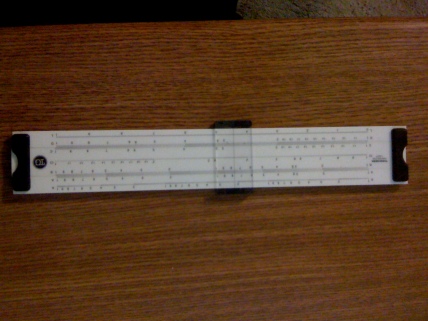
Slide rule, gifted to Art Hunt in December 2010 by his children - photo by Art Hunt

You could slide through the physics final with this device, at one time.

This is the device used to put humans on the Moon.

Have you ever used one?

It’s a slide ruleNice story about Art Hunt’s kids listening to tales from the olden days, and bringing back a little piece of the olden days for him.  He now claims to be ready for a power outage at his lab.

How does anyone understand a logarithmic scale anymore without a slide rule?  Does anyone make good slide rules anymore?


The view from the seat of the pilot of the Enola Gay / Smithsonian National Air and Space Museum

December 19, 2010

Old friend and thorn in the side Gil Brassard in Baton Rouge alerted us to this wonderful marriage of modern technology and history from David Palermo Photography — an interactive, panoramic view of the cockpit of the Enola Gay, the B-29 from which the first atomic bomb used in war was dropped.

How can you use this in class, teachers?  Got a lesson plan that puts a student in the seat of the pilot?

Vodpod videos no longer available.

Enola Gay / Smithsonian National Air and Space …, posted with vodpod

For technical reasons beyond my ken, one may not make this a full screen image. No problem. Go to David Palermo’s site, and see this as big as your computer monitor. I recommend viewing it there — it’s better, really.

Palermo has a portfolio of cockpits he’s shot at the Smithsonian, including the French Concorde, Gemini VII, a Bell Huey helicopter, Mercury Friendship VII, and a Lockheed Martin X-35 — with spherical panoramas available of those and more (look for the link that says “HD360°” and look at the drop-down menu).  He sells massive prints of the cockpits — something special for aviation and space buffs.


Typewriter of the moment: William Saroyan

December 19, 2010

William Saroyan's typewriter, photo from the Bancroft Library, University of Caliornia - Berkeley

William Saroyan's typewriter, displayed at the Saroyan Museum at his home in San Francisco - photo from the Bancroft Library, University of California; Berkeley

William Saroyan’s niece, Jacqueline Kazarian, recently gifted the Bancroft Library with a significant part of the archives of Saroyan’s work.  The press release on the gift included a photo of Saroyan’s Fox typewriter, which is displayed at the Saroyan museum in San Francisco.

Saroyan came from an Armenian American family, born in Fresno, California in 1908.  His writings illuminated the experience of Californians and Armenian Americans, especially during the Great Depression.

In many ways Saroyan’s work symbolizes the uniqueness of the Armenian community in America, especially California.  [You still out there, Ben Davidian?]   Wikipedia strikes the right tone:

Saroyan’s stories celebrated optimism in the midst of the trials and tribulations of the Depression. Several of Saroyan’s works were drawn from his own experiences, although his approach to autobiographical fact contained a fair bit of poetic license.

His advice to a young writer was: “Try to learn to breathe deeply; really to taste food when you eat, and when you sleep really to sleep. Try as much as possible to be wholly alive with all your might, and when you laugh, laugh like hell.” Saroyan endeavored to create a prose style full of zest for life and seemingly impressionistic, that came to be called “Saroyanesque”.

The complete May 19, 2010,  press release from the University of California is below.

a sketch "from a Turkish admirer," a photo of the author in his youth, and a framed sketch of Saroyan

The Bancroft Library's new archival material on William Saroyan includes (left to right) a sketch "from a Turkish admirer," a photo of the author in his youth, and a framed drawing of Saroyan with a passage of his writing on Armenia. (Images courtesy of the Bancroft Library)

The Bancroft Library accepts gift of William Saroyan archives

By Kathleen Maclay, Media Relations | 19 May 2010

William Saroyan

William Saroyan (Photo courtesy of The Bancroft Library)

BERKELEY — The Bancroft Library at the University of California, Berkeley, has received a spectacular gift of hundreds of books, drawings, correspondence and other personal communications to and from one of America’s best-known writers, the Armenian-American author and playwright William Saroyan.

The rich collection includes approximately 48 cartons with 1,200 books and other archival materials assembled by his niece, Jacqueline Kazarian, of San Francisco, who also is the founder of the William Saroyan Literary Foundation International. A celebration of the gift is set for noon on Friday (May 21) at The Faculty Club on campus.

“UC Berkeley is such an incredible place of learning and growing and intellectual exploration,” said Kazarian, who earned degrees in communication and decorative arts at UC Berkeley in the early 1950s. “I know that my uncle wanted his library, manuscripts and galleys to go to Berkeley. Students will be inspired by the collection.”

Apart from this gift, The Bancroft Library already retains significant holdings of Saroyan’s work that it collected over the course of his life and career, and it continues to add to that collection. Most of the latest materials come from Saroyan’s home on San Francisco’s 15th Avenue that is now a Saroyan museum directed by Kazarian. Those materials were supplemented by Kazarian’s extensive personal collection, as well as by items of Saroyan’s that she acquired through a prominent Boston archivist and via a Saroyan friend.

“Jacqueline Kazarian’s new gift is the largest and most substantial augmentation to the Saroyan collections at Bancroft that we have ever received,” said Peter Hanff, Bancroft’s deputy director.

The author’s classic manual typewriter, as displayed at his San Francisco home

The author’s classic Fox manual typewriter, as displayed at his San Francisco home. (Photo courtesy of The Bancroft Library)

Saroyan, born in Fresno, Calif., in 1908, drew extensively on his Armenian-American heritage and childhood experiences for his books, plays and short stories. Much of his writing was considered impressionistic and reflected a hearty optimism often hard to find during the gritty Great Depression. He died in 1981 at the age of 72, with his niece at his side.When Story magazine editors Martha Foley and Whit Burnett printed Saroyan’s “The Daring Young Man on the Flying Trapeze” in 1934, it was an immediate success, triggering Saroyan’s fame and standing as one of his many literary achievements.

“Uncle Bill’s writing revolutionized the short story,” said Kazarian, adding that she has always found his work “almost spiritual and fable-like.”

His five-act play, “The Time of Your Life,” is the only American play to have won both the New York Drama Critics’ Circle Award and the Pulitzer Prize. Saroyan’s work as a screenwriter with Hollywood director Louis B. Mayer on the film “The Human Comedy” won an Academy Award in 1943, and Saroyan later wrote a widely acclaimed book with the same title.

Kazarian’s gift to The Bancroft Library includes multiple first editions of Saroyan’s works, such as “The Daring Young Man on the Flying Trapeze,” “My Name is Aram” (1940), “The Human Comedy” and “Obituaries” (1979), and many materials personally inscribed by the writer. Also among the new items according to Steven Black, the head of acquisitions for Bancroft, are letters, telegrams and notes written by Saroyan to relatives and others close to him, mostly during the 1930s and 1940s.

antiquarian book dealer Peter Howard of Berkeley, shown here poring through Saroyan materials

Antiquarian book dealer Peter Howard of Berkeley, poring through Saroyan materials. (Photo courtesy of The Bancroft Library)

“He personalized a lot of what passed through his hands,” Black said, noting that much of the material features marginalia reflecting Saroyan’s thoughts and interests.

There also is a copy of Henry Miller’s “Aller Retour New York,” an 80-page journal about a 1935 visit by Miller to New York City and his journey aboard a Dutch ship back to Europe. It is inscribed by Miller to Saroyan.

And a Saroyan scrapbook in the collection contains press announcements about the Pulitzer Prize for his book, “The Time of Your Life.” He scoffed at the award, contending that the arts should not be judged by commerce.

The new Bancroft collection also contains a pre-publication proof of “Burnt Norton,” the first poem of T.S. Eliot’s “Four Quartets,” which Black said the publisher may have given to Saroyan “when he crossed the pond” on a trip from his temporary home in France to England.

There also is a wide range of magazines, including issues of Horizon and the Partisan Review, a leading publication of the Anglo-American intelligentsia during the 1930s and ’40s, Black said.

The first major deposit at The Bancroft Library of Saroyan’s papers was recorded in October 1980, and the library agreed to organize the collection and give Saroyan a general description and an index. After Saroyan died in 1981, the Saroyan Foundation paid the library to continue assembling the papers for official archives, which the foundation ultimately decided to place at Stanford University. That happened in 1996.

William Saroyan's niece, Jacqueline Kazarian, surveys materials at his San Francisco home

William Saroyan's niece, Jacqueline Kazarian, surveys materials in his home. (Photo courtesy of The Bancroft Library)

Kazarian’s donation is in honor of Berkeley antiquarian book dealer Peter Howard, who has provided appraisal assistance to Bancroft on Saroyan materials and other collections for decades. While director of The Bancroft Library, the late James D. Hart also developed strong professional and personal ties to Saroyan over the years, according to Kazarian and Black.

“Now, the Saroyan family materials come to a place that Saroyan himself would have been happy to see accepting them,” Black said, noting that Bancroft is proud to have so much of Saroyan’s “intellectual remains” to be able to share with the public.

Scheduled to speak about the acquisition at Friday’s event are Jacqueline Kazarian; David Calonne, vice president of education for the Saroyan Literary Foundation International and a Saroyan scholar; San Francisco novelist Herbert Gold; theater director Val Hendrickson reading Saroyan’s short story, “Common Prayer,” and the credo to “The Time of Your Life”; and Charles Faulhaber, director of The Bancroft Library.

UC Berkeley already is home to an Armenian Studies Program, which is focused on contemporary Armenian history, politics, language and culture. And Bancroft, a rich, special collections library containing historical and literary documents and other materials relating to California, the West, Mexico and Latin America, is known for its strong collections on California writers, including Jack London, Robinson Jeffers, Bret Harte, Frank Norris and others.

More information about The Bancroft Library is online. Bancroft is celebrating its 150th anniversary this year.

More:

William Saroyan commemorative stamps from the U.S., and U.S.S.R.

On commemorative stamps issued in both the U.S. and the U.S.S.R., Saroyan wears the Armenian-style moustache he wore through most of his later life. For a stamp to honor a man in both the U.S. and the Soviet Union was extremely rare -- maybe unique.


Typewriter of the moment: Harlan Ellison and his Olympia SG3

December 12, 2010

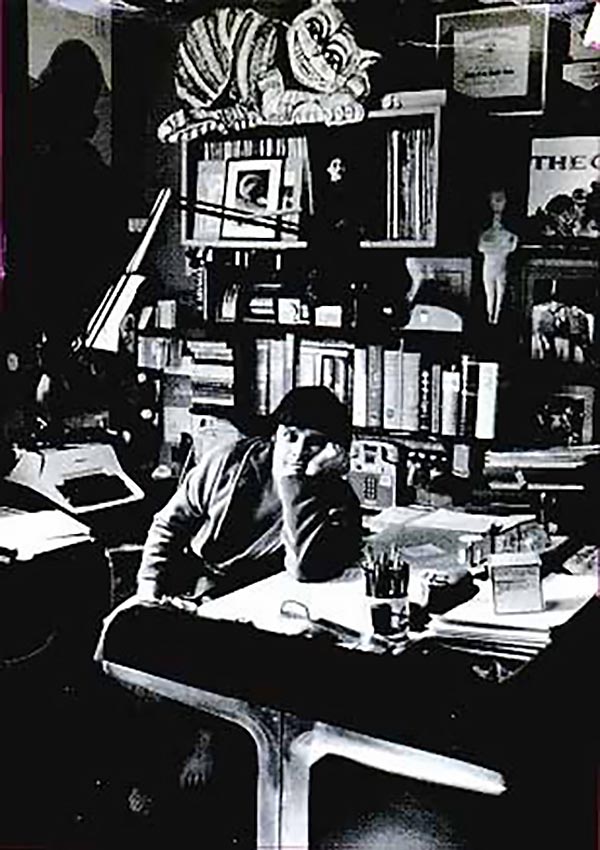
Harlan Ellison, his Olympia SG3, and other stuff - photo credit to MAX KATZ and KAREN FRIEDRICH
Harlan Ellison and his typewriter.  According to Richard Polt, the machine pictured is probably the Olympia SG3. Photo credit to Max Katz and Karen Friedrich.

Writers and their tools, in their workspaces.  We could probably date this photo by the stuff in Ellison’s office — the Cheshire Cat cutout?  Wasn’t that from an Edward Gorey-illustrated version of the Alice in Wonderland story?  What year was that?  The telephone on the wall, the desk scissors design . . . none of those fall into any expertise I have.  Someone else will have to date it.  My TinEye search didn’t shed any useful light.

I found the photo at Richard Polt’s fun site at Xavier University, The Classic Typewriter Page.  Polt is clearly working toward a MacArthur Foundation genius grant with this material.  Well, he would be, were I a judge.  (Who should get credit for the photo?  I don’t know — can you help identify who gets credit? See comment from Mr. Ellison:  ” . . .  image was captured for my 1974 STORY collection, APPROACHING OBLIVION, by MAX KATZ and KAREN FRIEDRICH.”  Credit for the photo gleefully acknowledged here.)

Oh, by the way, stay tuned:  Ellison is trying to sell his first typewriter.  That is a topic worthy of its own post.

Tip of the old scrub brush to the unfortunately moribund The Wit of the Staircase.


Norton Security: Customer service fail

November 29, 2010

For the past two weeks I’ve been trying to get approval for a license I already paid for to work on my laptop.  Probably a dozen times I’ve gotten a message that I’ve been “updated,” or “approved,” or somesuch, but each morning when I boot up I get the nastygram from Norton that my “trial” security period is ended — or now, that I’m wholly unprotected.

Never mind that this is the 6th license I’ve bought from Norton in two years for two different computers.

Skroom.  Norton security is worthless if it doesn’t work after you’ve paid them several times.  Off to shop for something else.

And, just try to contact them.  E-mails go unanswered for weeks.  Phone calls are disconnected after 15 minutes of waiting, in the middle of some explanation for why you should be happy to be waiting.

Once upon a time I found Norton to be responsive and very useful.  Now Norton is merely the subject of great frustration.

Rats.