Color movie film of one of the flag raisings surfaced.
So little of the news coverage of World War II is in color, it’s almost shocking to see this and realize it’s not a later re-enactment.
twitter.com/wwiipix/status/1364181702629818372
Color movie film of one of the flag raisings surfaced.
So little of the news coverage of World War II is in color, it’s almost shocking to see this and realize it’s not a later re-enactment.
twitter.com/wwiipix/status/1364181702629818372
 Leave a Comment » |
  Flag etiquette, History, U.S. Flag, World War II | Tagged: Fly your flag, History, Iwo Jima, U.S. Flag, World War II |
  Permalink
 Posted by Ed Darrell
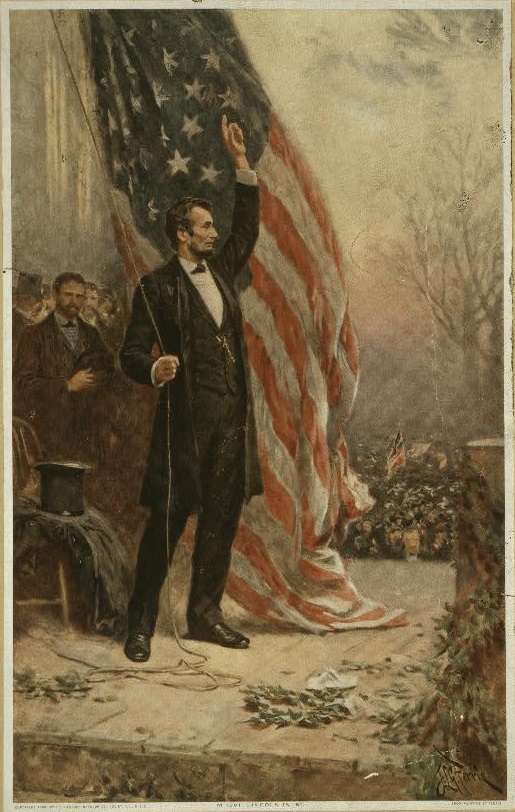
Lincoln at Independence Hall, February 22, 1861, raising a flag in honor of George Washington’s birthday; Library of Congress image via Lincoln’s Cottage
You want to mark your calendar so you remember to put your U.S. flag up on those dates designated by law and tradition, right?
Is the flag flying a bit more easily and briskly, with the new administration in Washington?
Which dates in February? A few are already gone (cue Eagles?)
You may fly your flag on state holidays, too — which of those dates do we see in February? Is there a good list? (I don’t have one.)
Though we don’t mark it usually, February 14 is the anniversary of the first recognition of the Stars and Stripes by a foreign government, in 1778. The French fleet recognized the ensign carried by Capt. John Paul Jones, at Quiberon Bay.
February 23 is the anniversary of the raising of the U.S. flag on Iwo Jima, in 1945 — 76 years ago. We should probably watch for proclamations to fly the flag on that date, an anniversary made more important simply because so few survivors of from among the veterans of that war and that fight can be expected to live to see the 80th anniversary. Regardless any official, formal proclamation to fly the flag for the Iwo Jima events, you may always fly your flag.
Please visit earlier posts at Millard Fillmore’s Bathtub, on the death of Joe Rosenthal, the photographer who took the widely-released iconic photo; on the death of Charles Lindberg, pictured in the first flag-raising on Mt. Suribachi; on the death of Raymond Jacobs, the last-surviving veteran from the flag raisings; and on my visit to the Sunset Parade at the Iwo Jima-themed U.S. Marine Memorial overlooking Washington, D.C.
Happy flag-flying!
More:

Yes, some of this is an encore post. Defeating ignorance takes patience and perseverance.
Leave a Comment » | Abraham Lincoln, Flag etiquette, Fly your flag today, George Washington, History, U.S. Flag | Tagged: Abraham Lincoln, Flag etiquette, Fly your flag today, George Washington, History, U.S. Flag, U.S. Flag Code | Permalink
Posted by Ed Darrell
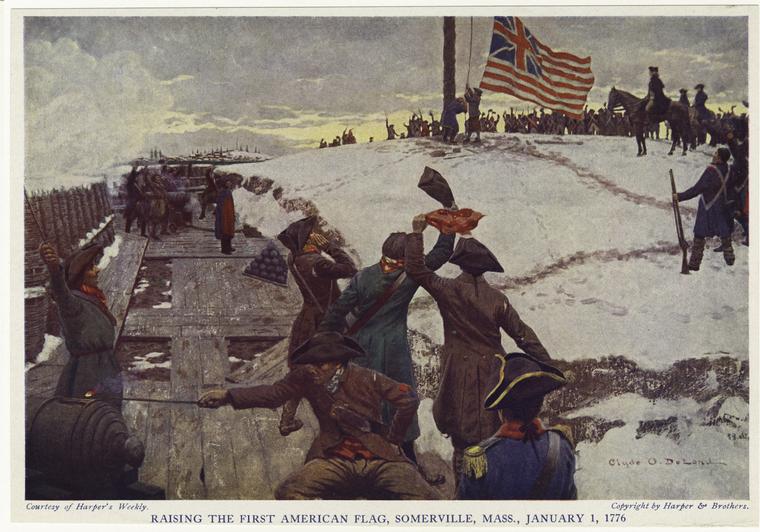
“Raising the first American flag, Somerville, Mass., January 1, 1776.” Harper’s Weekly painting by Clyde Osmer DeLand, 1897. From the digital collections of the New York Public Library; yes, MFB has used this painting before. I like it.
One problem with January’s flag flying dates is that if I snooze a little, you miss a lot. There are four flag-flying dates in the first five days of January: New Year’s Day and statehood days for Georgia, Alaska and Utah. You, Dear Reader, are alert and didn’t let any of those dates pass unmarked if you’re in those states, right?
There are six more dates to go in January 2021, including New Mexico’s statehood today. We’re not halfway done, yet.
In January 2020, the U.S. Flag Code urges citizens to fly flags on these dates, listed chronologically:
You may fly your flag any other day you wish, too; flags should not be flown after sundown unless they are specially lighted, or at one of the few places designated by Congress or Presidential Proclamation for 24-hour flag flying. According to Wikipedia’s listing, those sites include:

Flag House in 1936, where Mary Pickersgill sewed the garrison-sized, 15-star flag that flew over Fort McHenry at the Battle of Baltimore in 1814; one of the sites where the U.S. flag may be flown 24 hours. The house is at 844 East Pratt & Albemarle Streets (Baltimore, Independent City, Maryland). Cropped image courtesy of the federal HABS—Historic American Buildings Survey of Maryland.
Save

Leave a Comment » | Flag etiquette, Fly your flag today, History, Patriotism, U.S. Flag | Tagged: Flag etiquette, Fly your flag, History, Patriotism, U.S. Flag | Permalink
Posted by Ed Darrell
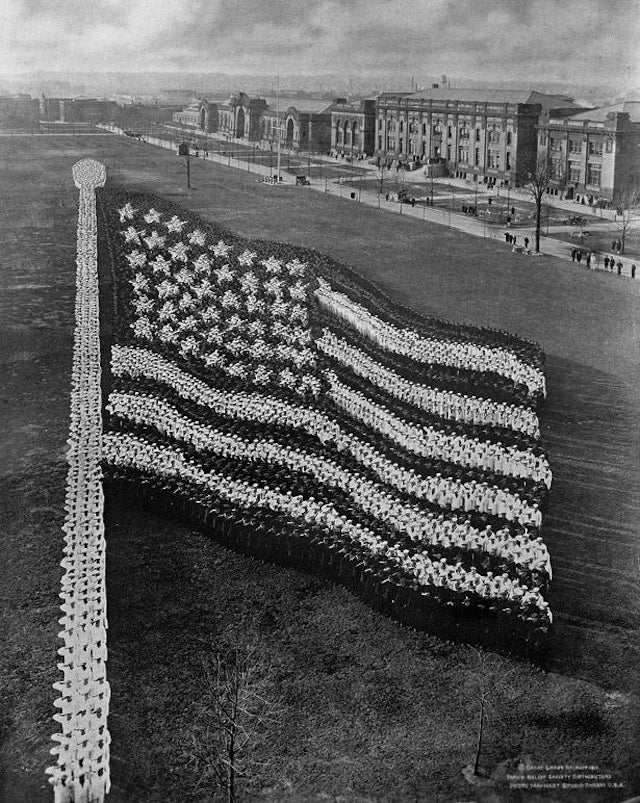
A “living flag” composed of 10,000 sailors, or “Blue Jackets at Salute,” by the Mayhart Studios, December 1917; image probably at the Great Lakes training facility of the Navy. Gawker media image
November offers several flag flying days, especially in years when there is an election.
But December may be the month with the most flag-flying dates, when we include statehood days.
December 7 is Pearl Harbor Remembrance Day. It’s not in the Flag Code, but public law (P.L. 103-308) urges that the president should issue a proclamation asking Americans to fly flags.
December 25 is Christmas Day, a federal holiday, and one of the score of dates designated in the Flag Code. If you watch your neighborhood closely, you’ll note even some of the most ardent flag wavers miss posting the colors on this day, as they do on Thanksgiving and New Years and Easter.
Other dates?
Nine states attained statehood in December, so people in those states should fly their flags (and you may join them). Included in this group is Delaware, traditionally the “First State,” called that because it was the first former England colony to ratify the U.S. Constitution:
December 15 is Bill of Rights Day, marking the day in 1791 when the Bill of Rights was declared ratified; but though this event generally gets a presidential proclamation, there is no law or executive action that requires flags to fly on that date, for that occasion. I predict there will be no proclamation from the White House in 2020.
Eleven flag-flying dates in December. Does any other month have as many flag flying opportunities?
Have I missed any December flag-flying dates? 11 events on 10 days (Delaware’s statehood falls on the anniversary of the Pearl Harbor attack).
Here’s a list of the 10 days to fly the flag in December 2020, under national law, in chronological order:
Fly your flag with respect, for the flag, for the republic it represents, and for all those who sacrificed that it may wave on your residence.

Appropriate to a snowy December. “The Barn on Grayson-New Hope Road. This barn with its old truck and ever-present American flag, is often the subject of photographs and paintings by the locals.” Photo and copyright by Melinda Anderson
6 Comments | Flag etiquette, Fly your flag today, History, Patriotism, U.S. Flag | Tagged: Flag Code, Flag etiquette, Fly your flag today, History, Patriotism, U.S. Flag | Permalink
Posted by Ed Darrell

The Major, a very large U.S. flag made in honor of Maj. Brent R. Taylor, Mayor of North Ogden, Utah, killed in action in Afghanistan in 2018. The flag flew at the mouth of Coldwater Canyon. The flag is a quarter-acre in size, more than 100 feet on the longest side. North Ogden plans an annual celebration of the U.S. flag in early November. Photo by Ben Dorger, for the Ogden Standard-Examiner newspaper.
2020 is not exactly flying by — but November 3 will probably change our perception of how fast time moves, and how the year moves at all.
Do we even fly our flags during a pandemic? Sure we do.
Eight events spread over seven different days come with urgings to fly the U.S. flag in November: Six states celebrate statehood, Veterans Day falls as always on November 11, and Thanksgiving Day on November 26.
Did I say eight? Elections are dates to fly the flag. 2020 is a presidential election year — in Texas, May and other election dates for counties, cities and school boards were moved to November. (Some thought a pandemic would surely be over by November. Who knew?)
You may fly your flag at home on election day, too. (Yes, flags should be flown at all early polling places, on days of early voting, too — do you know of poll where that did not occur? Tell us in comments.)
Two states, North Dakota and South Dakota, celebrate their statehood on the same date. Washington’s statehood day falls on Veterans Day, November 11 — so there are only seven days covering nine events.
In calendar order for 2019, these are the seven days:
Most Americans will concern themselves only with Veterans Day and Thanksgiving Day. Is flying the U.S. flag for statehood day a dying tradition?
More:

Polling station in South Carolina. SCETV image.
Yes, this is an encore post. Fighting ignorance takes longer than we hoped.
1 Comment | 2020 Campaign, 2020 Elections, Campaigns, Elections, Flag etiquette, Fly your flag today, History, Statehood, U.S. Flag | Tagged: Elections 2018, Flag etiquette, Fly your flag today, History, U.S. Flag | Permalink
Posted by Ed Darrell
“Raising the first American flag, Somerville, Mass., January 1, 1776.” Harper’s Weekly painting by Clyde Osmer DeLand, 1897. From the digital collections of the New York Public Library
January is loaded with flag flying dates, when we add in statehood days, dates those states are invited to fly their U.S. flags.
In January 2020, the U.S. Flag Code urges citizens to fly flags on these dates, listed chronologically:
You may fly your flag any other day you wish, too; flags should not be flown after sundown unless they are specially lighted, or at one of the few places designated by Congress or Presidential Proclamation for 24-hour flag flying. According to Wikipedia’s listing, those sites include:
Flag House in 1936, where Mary Pickersgill sewed the garrison-sized, 15-star flag that flew over Fort McHenry at the Battle of Baltimore in 1814; one of the sites where the U.S. flag may be flown 24 hours. The house is at 844 East Pratt & Albemarle Streets (Baltimore, Independent City, Maryland). Cropped image courtesy of the federal HABS—Historic American Buildings Survey of Maryland.
Save
Leave a Comment » | Flag etiquette, Fly your flag today, History, Patriotism, U.S. Flag | Tagged: Flag etiquette, Fly your flag, History, Patriotism, U.S. Flag | Permalink
Posted by Ed Darrell
A “living flag” composed of 10,000 sailors, or “Blue Jackets at Salute,” by the Mayhart Studios, December 1917; image probably at the Great Lakes training facility of the Navy. Gawker media image
November offers several flag flying days, especially in years when there is an election.
But December may be the month with the most flag-flying dates, when we include statehood days.
December 7 is Pearl Harbor Remembrance Day. It’s not in the Flag Code, but public law (P.L. 103-308) urges that the president should issue a proclamation asking Americans to fly flags.
December 25 is Christmas Day, a federal holiday, and one of the score of dates designated in the Flag Code. If you watch your neighborhood closely, you’ll note even some of the most ardent flag wavers miss posting the colors on this day, as they do on Thanksgiving and New Years.
Other dates?
Nine states attained statehood in December, so people in those states should fly their flags (and you may join them). Included in this group is Delaware, traditionally the “First State,” as it was the first colony to ratify the U.S. Constitution:
December 15 is Bill of Rights Day, marking the day in 1791 when the Bill of Rights was declared ratified; but though this event generally gets a presidential proclamation, there is no law or executive action that requires flags to fly on that date, for that occasion.
Eleven flag-flying dates in December. Does any other month have as many flag flying opportunities?
Have I missed any December flag-flying dates? 11 events on 10 days (Delaware’s statehood falls on the anniversary of the Pearl Harbor attack).
Here’s a list of the days to fly the flag, under national law, in chronological order:
Fly your flag with respect to the flag, for the republic it represents, and for all those who sacrificed that it may wave on your residence.
Appropriate to a snowy December. “The Barn on Grayson-New Hope Road. This barn with its old truck and ever-present American flag, is often the subject of photographs and paintings by the locals.” Photo and copyright by Melinda Anderson
1 Comment | Flag etiquette, Fly your flag today, History, Patriotism, U.S. Flag | Tagged: Flag Code, Flag etiquette, Fly your flag today, History, Patriotism, U.S. Flag | Permalink
Posted by Ed Darrell
The Major, a very large U.S. flag made in honor of Maj. Brent R. Taylor, Mayor of North Ogden, Utah, killed in action in Afghanistan in 2018. The flag flew at the mouth of Coldwater Canyon. The flag is a quarter-acre in size, more than 100 feet on the longest side. North Ogden plans an annual celebration of the U.S. flag in early November. Photo by Ben Dorger, for the Ogden Standard-Examiner newspaper.
Running late. November flies by!
Eight events spread over seven different days come with urgings to fly the U.S. flag in November: Six states celebrate statehood, Veterans Day falls as always on November 11, and Thanksgiving Day on November 28.
Did I say eight? Elections are dates to fly the flag, and several states have “off-year” elections. You may fly your flag at home on election day, too. (Yes, flags should be flown at all early polling places, on days of early voting, too — do you know of poll where that did not occur? Tell us in comments.)
Two states, North Dakota and South Dakota, celebrate their statehood on the same date. Washington’s statehood day falls on Veterans Day, November 11 — so there are only seven days covering nine events.
In calendar order for 2019, these are the seven days:
Most Americans will concern themselves only with Veterans Day and Thanksgiving Day. Is flying the U.S. flag for statehood day a dying tradition?
More:
Polling station in South Carolina. SCETV image.
Yes, this is an encore post. Fighting ignorance takes longer than we hoped.
1 Comment | History | Tagged: Elections 2018, Flag etiquette, Fly your flag today, History, U.S. Flag | Permalink
Posted by Ed Darrell

Schooner on Chesapeake Bay flies the 15-stripe/15-star flag that flew over Fort McHenry. Image from the Maryland Secretary of State’s Office
It’s cruel to people who want to fly U.S. flags often, but only on designated flag-flying dates. (April is also National Poetry Month, so it’s a good time to look up poetry references we should have committed to heart).
For 2019, these are the three dates for flying the U.S. flag; Easter is a national date, the other two are dates suggested for residents of the states involved.
One date, nationally, to fly the flag. That beats March, which has none (in a year with Easter in April and not March). But March has five statehood days, to April’s two.
Take heart! You may fly your U.S. flag any day you choose, or everyday as many people do in Texas (though, too many do not retire their flags every evening . . .).
Three dates to fly Old Glory in April, by the Flag Code and other laws on memorials and commemorations.

April usually sees the opening of Major League Baseball’s season — some teams jumped into March in 2018. In this photo, U.S. Navy sailors assigned to the USS Bonhomme Richard practice for the San Diego Padres’ opening day flag ceremony in San Diego on April 5, 2011. The ship sent nearly 300 volunteers to unfurl an 800-pound U.S. flag that covered the entire field. The Bonhomme Richard was in dry-dock for maintenance and upgrades. Defense Department photo via Wikimedia.
More:
Yes, this is an encore post. Defeating ignorance takes patience and perseverance.
2 Comments | Flag etiquette, Fly your flag today, History, U.S. Flag | Tagged: April, Fly your flag today, History, U.S. Flag | Permalink
Posted by Ed Darrell

U.S. flag on Mt. Suribachi, Iwo Jima Island – At sea with USS Kitty Hawk (CV-63) Jan. 16, 2003 — F-14 Tomcats assigned to the Black Knights of Fighter Squadron One Five Four (VF-154) fly by Mt. Suribachi on Iwo Jima Island. VF-154 is part of Carrier Air Wing Five (CVW-5) embarked aboard Kitty Hawk, conducting Carrier Readiness Certifications. Kitty Hawk is the Navy’s only permanently forward-deployed aircraft carrier and operates out of Yokosuka, Japan. Photo by U.S. Navy, Lt. j.g. Greg Kausner
You want to mark your calendar so you remember to put your U.S. flag up on those dates designated by law and tradition, right?
Which dates in February? Here at the Bathtub, we’re running behind on the news — we’ve missed marking Massachusetts statehood.
You may fly your flag on state holidays, too — which of those dates do we see in February? Is there a good list?
Though we don’t mark it usually, February 14 is the anniversary of the first recognition of the Stars and Stripes by a foreign government, in 1778. The French fleet recognized the ensign carried by Capt. John Paul Jones, at Quiberon Bay — painting of the event is at the top of this post.
February 23 is the anniversary of the raising of the U.S. flag on Iwo Jima, in 1945 — 74 years ago. We should probably watch for proclamations to fly the flag on that date, an anniversary made more important simply because so few survivors from among the veterans of that war and that fight can be expected to live to see the 80th anniversary. Regardless any official, formal proclamation to fly the flag for the Iwo Jima events, you may always fly your flag.
Please visit earlier posts at Millard Fillmore’s Bathtub, on the death of Joe Rosenthal, the photographer who took the widely-released iconic photo; on the death of Charles Lindberg, pictured in the first flag-raising on Mt. Suribachi; on the death of Raymond Jacobs, the last-surviving veteran from the flag raisings; and on my visit to the Sunset Parade at the Iwo Jima-themed U.S. Marine Memorial overlooking Washington, D.C.
A Youtube poster edited a part of the Army’s documentary, “To the Shores of Iwo Jima,” showing the flag raising on film, and added in some other images for a less-than-three-minute look. (Alas, that edited version is gone — here’s the full 20-minute movie; propaganda at its best, for noble purposes.)
Wave your flag!
More:

Caption from the U.S. Navy, via Wikipedia: Photo #: 80-G-K-21225 (color) “First Recognition of the American Flag by a Foreign Government,” 14 February 1778. Painting in oils by Edward Moran, 1898. It depicts the Continental Navy Ship Ranger, commanded by Captain John Paul Jones, receiving the salute of the French fleet at Quiberon Bay, France, 14 February 1778. Earlier in the month, after receipt of news of the victory at Saratoga, France recognized the independence of the American colonies and signed a treaty of alliance with them. The original painting is in the U.S. Naval Academy Museum, Annapolis, Maryland. Official U.S. Navy Photograph, now in the collections of the National Archives. [A larger version is available for download at Wikipedia.]
Yes, this is an encore post. Defeating ignorance takes patience and perseverance.
2 Comments | Flag etiquette, Fly your flag today, History, U.S. Flag | Tagged: Fly your flag today, History, U.S. Flag | Permalink
Posted by Ed Darrell

U.S. flag flies at the U.S. Capitol in a snow storm. Photo by Victoria Pickering, Creative Commons license, from Flickr. (This photo was actually taken in March.)
November offers several flag flying days, especially in years when there is an election.
But December may be the month with the most flag-flying dates, when we include statehood days.
December 7 is Pearl Harbor Remembrance Day. It’s not in the Flag Code, but public law (P.L. 103-308) urges that the president should issue a proclamation asking Americans to fly flags.
December 25 is Christmas Day, a federal holiday, and one of the score of dates designated in the Flag Code. If you watch your neighborhood closely, you’ll note even some of the most ardent flag wavers miss posting the colors on this day, as they do on Thanksgiving and New Years.
Other dates?
Nine states attained statehood in December, so people in those states should fly their flags (and you may join them). Included in this group is Delaware, traditionally the “First State,” as it was the first colony to ratify the U.S. Constitution:
December 15 is Bill of Rights Day, marking the day in 1791 when the Bill of Rights was declared ratified; but though this event generally gets a presidential proclamation, there is no law or executive action that requires flags to fly on that date, for that occasion.
Eleven flag-flying dates in December. Does any other month have as many flag flying opportunities?
Have I missed any December flag-flying dates? 11 events on 10 days (Delaware’s statehood falls on the anniversary of the Pearl Harbor attack).
At least one site lists Pan American Aviation Day, December 17, as a date to fly the flag. It’s the anniversary of the Wright Brothers’ first flight at Kittyhawk, North Carolina, and it’s a date U.S. law says should be commemorated — but flag flying is not one of the listed ways. Unless a president calls for flag flying, it’s not an official date. (Always, you can fly the flag any day, or every day.)
Here’s a list of the December days to fly the flag, under national law, in chronological order:
Fly your flag with respect to the flag, for the republic it represents, and for all those who sacrificed that it may wave on your residence.
And if you travel for the holidays? You’re away from home?
Astronauts Eugene Cernan and Harrison Schmitt took a flag with them when they visited the Moon in December 1972. Maybe you could carry a small travel flag, too.

NASA caption: Apollo 17 commander Eugene A. Cernan is holding the lower corner of the American flag during the mission’s first EVA, December 12, 1972. Photograph by Harrison J. “Jack” Schmitt. Image Credit: NASA
Yes, this is an encore post. Defeating ignorance takes patience and perseverance.
1 Comment | Flag etiquette, Fly your flag today, History, U.S. Flag | Tagged: Days to Fly the Flag, Flag etiquette, Flag-flying dates, History, U.S. Flag | Permalink
Posted by Ed Darrell

A U.S. flag flies at a polling place in Glasgow, Kentucky, in 2016. Photo by Kevin Willis, WKU Public Radio.
Nine events spread over seven different days come with urgings to fly the U.S. flag in November: Six states celebrate statehood, Veterans Day falls as always on November 11, and Thanksgiving Day on November 22.
Did I say eight? 2018 is an election year for Congress; we fly flags at polling places on election day, so that makes nine events. You may fly your flag at home on election day, too. (Yes, flags should be flown at all early polling places, on days of early voting, too — do you know of poll where that did not occur? Tell us in comments.)
Two states, North Dakota and South Dakota, celebrate their statehood on the same date. Washington’s statehood day falls on Veterans Day, November 11 — so there are only seven days covering nine events.
In calendar order for 2018, these are the seven days:
Most Americans will concern themselves only with Veterans Day and Thanksgiving Day. Is flying the U.S. flag for statehood day a dying tradition?
More:
Polling station in South Carolina. SCETV image.
Yes, this is an encore post. Fighting ignorance takes longer than we hoped.
3 Comments | 2018 Elections, Elections, Flag etiquette, Fly your flag today, History, U.S. Flag | Tagged: Elections 2018, Flag etiquette, Fly your flag today, History, U.S. Flag | Permalink
Posted by Ed Darrell
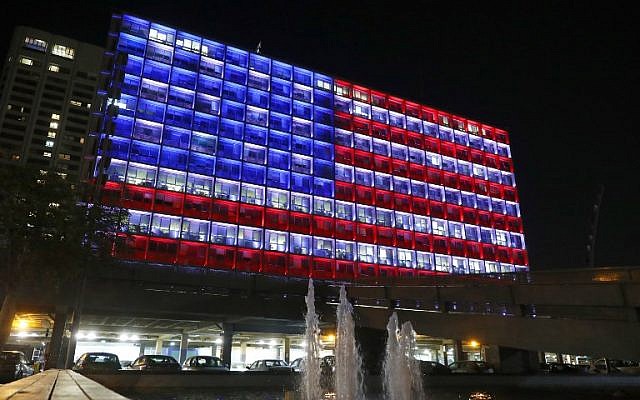
Solidarity with the United States: “Tel Aviv city hall, lit up in the colors of the American flag to honor the victims of the mass shooting in Las Vegas, on October 2, 2017. (AFP Photo/Jack Guez)” – From the Times of Israel
October is not a big month for dates to fly the U.S. flag. Only one state joined the union in October, and only two other dates received Congress’s designation for flag-flying.
Here are October’s three flag-flying days, in chronological order:
(Yes, I’m getting to this late this year; it’s an election year, you know.)
Federal law also designates October 9 as Leif Erickson Day, a concession to Scandanavian-descended Americans who argue Erickson beat Columbus to the Americas by a few hundred years. Congress’s recognition does not include an urging to fly the flag, though the President may issue such a proclamation.
October 6 is German-American Day, whose history I do not know.
October 27 is also the birth date of Theodore Roosevelt (1858), the Secretary of the Navy who led the dramatic updating of the fleet that preceded the U.S. push to become a major international power. Navy Day was set on October 27 partly to honor Teddy’s work, and Teddy himself — the “birth” date of the U.S. Navy is considered to be October 7. Here’s a brief history of TR before his presidency, at the Miller Center, written by Sidney Milkis.
Fans of Roosevelt may get an little extra kick flying the flag on his birthday.
Other notable stuff:
More:
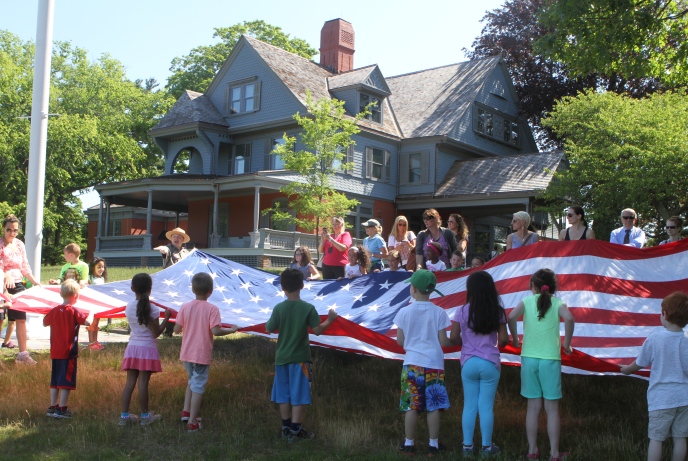
Fourth grade students practice U.S. flag etiquette with the help of National Park Service Rangers at Sagamore Hill National Historic Site in New York. Sagamore Hill, at Oyster Bay, was the home of Theodore Roosevelt and his family. National Park Service Photo
Yes, this is an encore post. Defeating ignorance takes patience and perseverance.
1 Comment | Columbus, Flag etiquette, History, U.S. Flag | Tagged: Columbus Day, Flag etiquette, History, Leif Erickson Day, Navy Day, Nevada Statehood Day, October, U.S. Flag | Permalink
Posted by Ed Darrell

Caption from Foreign Policy Magazine: ARLINGTON, VA – SEPTEMBER 11: In this U.S. Navy handout, sunrise at the Pentagon prior to a ceremony to commemorate the 2016 anniversary of the Sept. 11, 2001 terror attacks. The American flag is draped over the site of impact at the Pentagon. Photo by Damon J. Moritz
September features few dates to fly the U.S. flag in an average year. Labor Day is the only national holiday. Only California joined the union in a past September, so that’s the only statehood date. Gold Star Mothers Day had fallen out of regular honors, until our two wars in Iraq and Afghanistan.
School reform efforts after 2000 turned to adding patriotism to the curriculum. Most states now require something be said about the Constitution in social studies classes, and that has increased focus on Constitution Day on September 17. On September 17, 1787, the convention in Philadelphia signed and formally transmitted the proposed Constitution to the 2nd Continental Congress, with a plan that each state would call a convention of citizens to ratify the document; when citizens of at least 9 states ratified, the document entered into force.
Attacks on the U.S. on September 11, 2001, led to a new day honoring patriots, on that day of the month every year.
The dates are few, but the sobriety and somberness are great.
Here are the dates to fly the U.S. flag in September 2018. In order:
More:

The largest free-flying American flag in the world flew over the George Washington Bridge Monday, Sept. 2, 2013, in Fort Lee, New Jersey, for Labor Day. The Port Authority of New York and New Jersey said the flag flew on Labor Day under the upper arch of the bridge’s New Jersey tower, to honor working men and women across the country. The flag is 90 feet long by 60 feet wide, with stripes measuring about five feet wide and stars about four feet in diameter. (AP Photo/Mel Evans) (via Mowry Journal)
2 Comments | Flag etiquette, Fly your flag today, History, U.S. Flag | Tagged: Flag etiquette, Flag Fly Dates, History, September, U.S. Flag | Permalink
Posted by Ed Darrell
Of course you know to fly your flag on June 14 for Flag Day — but did you know that the week containing Flag Day is Flag Week, and we are encouraged to fly the flag every day?

Clifford Berryman’s 1901 Flag Day cartoon, found at the National Archives: “In this June 14, 1904, cartoon, Uncle Sam gives a lesson to schoolchildren on the meaning of Flag Day. Holding the American flag in one hand, Uncle Sam explains that the flag has great importance, unlike the Vice Presidency, which he ridicules in a kindly manner. (National Archives Identifier 6010464)”
Our National Archives has a blogged history of Flag Day pointing out it was a teacher who started Flag Day celebrations.
On June 14, 1885, Bernard J. Cigrand placed a 10-inch, 38-star flag in a bottle on his desk at the Stony Hill School in Ozaukee County, Wisconsin. The 19-year-old teacher then asked his students to write essays on the flag and its significance to them. This small observance marked the beginning of a long and devoted campaign by Cigrand to bring about national recognition for Flag Day.
And so we do, today, still.
Yes, this is an encore post. Defeating ignorance takes patience and perseverance.
1 Comment | Flag etiquette, Fly your flag today, History, U.S. Flag, Uncle Sam | Tagged: Cartoons, Clifford Berryman, Flag Day, Fly your flag today, U.S. Flag | Permalink
Posted by Ed Darrell


Ed Darrell on Texas's Colorado River


Come on in, the water's fine. Come often: Cleanliness is next to godliness.


 Millard Fillmore's Bathtub
