Roosevelt look-alike Pietro Casini, an Italian merchant. Casini stands outside his Magazzino Roosevelt shop in Florence, Italy, holding a U.S. flag and a photo of Roosevelt. Oct. 26, 1915. George Grantham Bain Collection, Library of Congress Prints and Photographs Division. via Pinterest
October is not a big month for dates to fly the U.S. flag. Only one state joined the union in October, and only two other dates have merited Congress’s designation for flag-flying.
Here are October’s three flag-flying days, in chronological order:
Columbus Day, October 12 — tradition puts Columbus Day on October 12, but in law it is designated as the second Monday in October (to make a three-day weekend for workers who get a holiday); in 2016, October 10 is the second Monday of the month.
Nevada Statehood Day, October 31; Nevada joined the union during the Civil War, in 1864, the 36th state.
Federal law also designates October 9 as Leif Erickson Day, a concession to Scandanavian-descended Americans who argue Erickson beat Columbus to the Americas by a few hundred years. Congress’s recognition does not include an urging to fly the flag, though the President may issue such a proclamation.
National 9-11 Flag patched up with pieces from many flags, including the flag from Ft. McHenry; displayed at the National 9-11 Memorial Museum in New York City. Photo by Ed Darrel, use with attribution encouraged.
Five days designated by law to fly the U.S. flag in September — only one statehood day, though, for California. In chronological order:
Labor Day, the first Monday in September — September 5, in 2016 (yep; passed)
California Statehood, September 9 (1850, the 31st state)
Patriot Day, September 11
Constitution Day and Citizenship Day, September 17; September 17-23 is also designated Constitution Week, though flag flying is not mentioned as a recommended activity (you may feel free to fly your flag anyway)
Gold Star Mothers Day, last Sunday in September — September 25 in 2016
Gold Star Mothers Day will probably get extra attention in this election year.
This occurred during a Revolutionary War skirmish at Cooch’s Bridge, Delaware. Gen. William Maxwell, commanding a Patriot force of infantry and cavalry, ordered the new flag raised in a clash with an advance guard of British and Hessian troops.
The rebels were defeated and forced to retreat to the encampment housing Gen. George Washington’s main force near Brandywine Creek in Pennsylvania.
Three months beforehand, on June 14, the Continental Congress resolved that “the flag of the United States be 13 alternate stripes red and white” and that “the Union be 13 stars, white in a blue field, representing a new constellation.”
The new national flag, which quickly became known as the “Stars and Stripes,” was based on the “Grand Union” flag – a banner carried by the Continental Army in 1776 that consisted of 13 red and white stripes.
Ten dates to fly the U.S. flag in September; eleven if you’re in California.
September features several other commemorations that usually involve no flag flying (these are declarations for 2015):
Presidential Proclamation — Honoring the Victims of the Attack in Dallas, Texas
BY THE PRESIDENT OF THE UNITED STATES OF AMERICA
A PROCLAMATION
As a mark of respect for the victims of the attack on police officers perpetrated on Thursday, July 7, 2016, in Dallas, Texas, by the authority vested in me as President of the United States by the Constitution and the laws of the United States of America, I hereby order that the flag of the United States shall be flown at half-staff at the White House and upon all public buildings and grounds, at all military posts and naval stations, and on all naval vessels of the Federal Government in the District of Columbia and throughout the United States and its Territories and possessions until sunset, July 12, 2016. I also direct that the flag shall be flown at half-staff for the same length of time at all United States embassies, legations, consular offices, and other facilities abroad, including all military facilities and naval vessels and stations.
IN WITNESS WHEREOF, I have hereunto set my hand this eighth day of July, in the year of our Lord two thousand sixteen, and of the Independence of the United States of America the two hundred and forty-first.
Caption from the U.S. Navy, via Wikipedia: Photo #: 80-G-K-21225 (color) “First Recognition of the American Flag by a Foreign Government,” 14 February 1778. Painting in oils by Edward Moran, 1898. It depicts the Continental Navy Ship Ranger, commanded by Captain John Paul Jones, receiving the salute of the French fleet at Quiberon Bay, France, 14 February 1778. Earlier in the month, after receipt of news of the victory at Saratoga, France recognized the independence of the American colonies and signed a treaty of alliance with them. The original painting is in the U.S. Naval Academy Museum, Annapolis, Maryland. Official U.S. Navy Photograph, now in the collections of the National Archives. [A larger version is available for download at Wikipedia.]
You want to mark your calendar so you remember to put your U.S. flag up on those dates designated by law and tradition, right?
Massachusetts statehood, February 6 (6th state, 1788)
Lincoln’s birthday, February 12 (yes, it’s still designated in law as a date to fly the flag)
Oregon statehood, February 14 (33rd state, 1859)
Arizona statehood, February 14 (48th state, 1913)
Washington’s birthday, now designated President’s Day, the third Monday in February, February 16 in 2015
You may fly your flag on state holidays, too — which of those dates do we see in February? Is there a good list?
Though we don’t mark it usually, February 14 is the anniversary of the first recognition of the Stars and Stripes by a foreign government, in 1778. The French fleet recognized the ensign carried by Capt. John Paul Jones, at Quiberon Bay — painting of the event is at the top of this post.
February 23 is the anniversary of the raising of the U.S. flag on Iwo Jima, in 1945 — 71 years ago. We should probably watch for proclamations to fly the flag on that date, an anniversary made more important simply because so few survivors of from among the veterans of that war and that fight can be expected to live to see the 80th anniversary. Regardless any official, formal proclamation to fly the flag for the Iwo Jima events, you may always fly your flag.
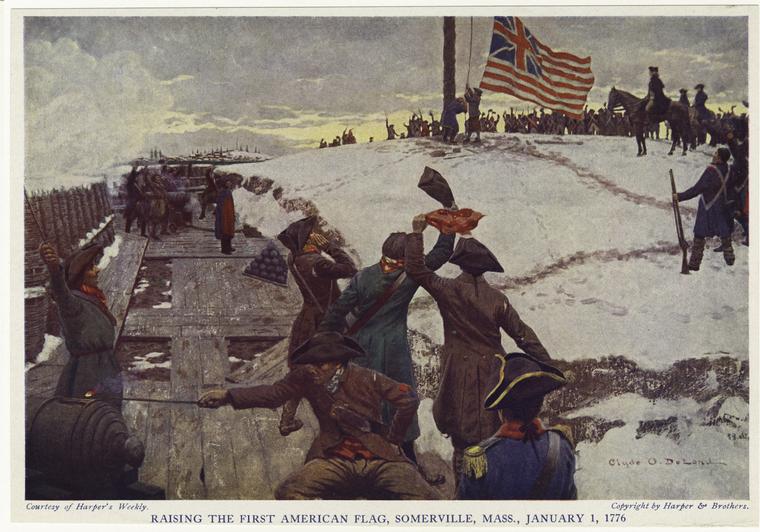
“Raising the first American flag, Somerville, Mass., January 1, 1776.” Harper’s Weekly painting by Clyde Osmer DeLand, 1897. From the digital collections of the New York Public Library
January is loaded with flag flying dates, when we add in statehood days, dates those states are invited to fly their U.S. flags.
In January 2016, the U.S. Flag Code urges citizens to fly flags on these dates, listed chronologically:
New Year’s Day, January 1, a federal holiday
January 2, Georgia Statehood Day
January 3, Alaska Statehood Day
January 4, Utah Statehood Day
January 6, New Mexico Statehood Day
January 9, Connecticut Statehood Day
Martin Luther King’s Birthday, a federal holiday on the third Monday of January; that date is January 18, in 2016; King’s actual birthday is January 15, and you may fly your flag then, too
Inauguration Day, January 20, the year after election years (next one in 2017)
January 26, Michigan Statehood Day
January 29, Kansas Statehood Day
You may fly your flag any other day you wish, too; flags should not be flown after sundown unless they are specially lighted, or at one of the few places designated by Congress or Presidential Proclamation for 24-hour flag flying. According to Wikipedia’s listing, those sites include:
Fort McHenry, Baltimore, Maryland (Presidential Proclamation No. 2795, July 2, 1948).
Flag House Square, Albemarle and Pratt Streets, Baltimore, Maryland (Public Law 83-319, approved March 26, 1954).
Lexington Battle Green, Lexington, Massachusetts (Public Law 89-335, approved November 8, 1965).
White House, Washington, D.C. (Presidential Proclamation No. 4000, September 4, 1970).
Washington Monument, Washington, D.C. (Presidential Proclamation No. 4064, July 6, 1971, effective July 4, 1971).
Any port of entry to the United States which is continuously open (Presidential Proclamation No. 413 1, May 5, 1972).
Grounds of the National Memorial Arch in Valley Forge State Park, Valley Forge, Pennsylvania (Public Law 94-53, approved July 4, 1975).
Flag House in 1936, where Mary Pickersgill sewed the garrison-sized, 15-star flag that flew over Fort McHenry at the Battle of Baltimore in 1814; one of the sites where the U.S. flag may be flown 24 hours. The house is at 844 East Pratt & Albemarle Streets (Baltimore, Independent City, Maryland). Cropped image courtesy of the federal HABS—Historic American Buildings Survey of Maryland.
Spread the word; friends don't allow friends to repeat history.
Mural of Alexander Henson planting the American flag at North Pole, by Austin Mecklem, at the Recorder of Deeds building, built in 1943. 515 D St., NW, Washington, D.C. Library of Congress image. Santa Claus may have been out of town when Henson was there.
November offers several flag flying days, especially in years when there is an election.
But December may be the month with the most flag-flying dates, when we include statehood days.
December 25 is Christmas Day, a federal holiday, and one of the score of dates designated in the Flag Code. If you watch your neighborhood closely, you’ll note even some of the most ardent flag wavers miss posting the colors on this day, as they do on Thanksgiving and New Years.
Other dates?
Nine states attained statehood in December, so people in those states should fly their flags (and you may join them). Included in this group is Delaware, traditionally the “First State,” as it was the first colony to ratify the U.S. Constitution:
Illinois, December 3 (1818, 21st state)
Delaware, December 7 (1787, 1st state)
Mississippi, December 10 (1817, 20th state)
Indiana, December 11 (1816, 19th state)
Pennsylvania, December 12 (1787, 2nd state)
Alabama, December 14 (1819, 22nd state)
New Jersey, December 18 (1787, 3rd state)
Iowa, December 28 (1846, 29th state)
Texas, December 29 (1845, 28th state)
December 15 is Bill of Rights Day, marking the day in 1791 when the Bill of Rights was declared ratified; but though this event generally gets a presidential proclamation, there is no law or executive action that requires flags to fly on that date, for that occasion.
Eleven flag-flying dates in December. Does any other month have as many flag flying opportunities?
Have I missed any December flag-flying dates? 11 events on 10 days (Delaware’s statehood falls on the anniversary of the Pearl Harbor attack).
Here’s a list of the days to fly the flag, under national law, in chronological order:
Delaware, December 7 (1787, 1st state) (shared with Pearl Harbor Remembrance Day)
Mississippi, December 10 (1817, 20th state)
Indiana, December 11 (1816, 19th state)
Pennsylvania, December 12 (1787, 2nd state)
Alabama, December 14 (1819, 22nd state)
New Jersey, December 18 (1787, 3rd state)
Christmas Day, December 25
Iowa, December 28 (1846, 29th state)
Texas, December 29 (1845, 28th state)
Fly your flag with respect to the flag, for the republic it represents, and for all those who sacrificed that it may wave on your residence.
Appropriate to a snowy December. “The Barn on Grayson-New Hope Road. This barn with its old truck and ever-present American flag, is often the subject of photographs and paintings by the locals.” Photo and copyright by Melinda Anderson
Spread the word; friends don't allow friends to repeat history.
The U.S. flag is popular the world over, especially when the president visits a foreign nation, as President Barack Obama visited Burma (Myanmar) in November 2012. Voice of America caption from November 16, 2012: “A shopkeeper waves an American flag at a roadside shop in Rangoon, Burma. U.S. President Barack Obama will visit Burma on Monday, becoming the first U.S. president to visit the country. (AP)”
Eight events spread over six different days come with urgings to fly the U.S. flag in November: Six states celebrate statehood, Veterans Day falls as always on November 11, and Thanksgiving Day on November 26.
Two states, North Dakota and South Dakota, celebrate their statehood on the same date. Washington’s statehood day falls on Veterans Day, November 11 — so there are only six days covering eight events.
In calendar order for 2015, these are the seven days:
North Dakota statehood day, November 2 (1889, 39th or 40th state)
South Dakota statehood day, November 2 (1889, 39th or 40th state) (shared with North Dakota)
Montana statehood day, November 8 (1889, 41st state)
Veterans Day, November 11
Washington statehood day, November 11 (1889, 42nd state) (shared with Veterans Day)
Oklahoma statehood day, November 16 (1907, 46th state)
North Carolina statehood day, November 21 (1789, 12th state)
Thanksgiving Day, fourth Thursday in November (November 26 in 2015)
Most Americans will concern themselves only with Veterans Day and Thanksgiving Day. Is flying the U.S. flag for statehood day a dying tradition?
Knights of Columbus of New Haven, Connecticut, present the U.S. flag at the start of New Haven’s Columbus Day Parade, 2006. 28 flags demonstrated the history of the U.S. flag. KofC photo
October is not a big month for dates to fly the U.S. flag. Only one state joined the union in October, and only two other dates have merited Congress’s designation for flag-flying.
Here are October’s three flag-flying days, in chronological order:
Columbus Day, October 12 — tradition puts Columbus Day on October 12, but in law it is designated as the second Monday in October (to make a three-day weekend for workers who get a holiday); in 2015, October 12 is the second Monday of the month.
Nevada Statehood Day, October 31; Nevada joined the union during the Civil War, in 1864, the 36th state.
Federal law also designates October 9 as Leif Erickson Day, a concession to Scandanavian-descended Americans who argue Erickson beat Columbus to the Americas by a few hundred years. Congress’s recognition does not include an urging to fly the flag, though the President may issue such a proclamation.
Business Insider photo of a giant flag suspended at the George Washington Bridge between New York City and New Jersey, on September 2, 2013, to celebrate Labor Day; Collins Flags said: “This flag isn’t just any flag, it is the largest free-flying American flag in the entire world. It measures a total of 90 feet (27 meters) long and 60 feet (18 meters) wide. In order to preserve the quality of the flag, the Port Authority took the flag down Monday evening after letting it fly all day.”
Five days designated by law to fly the U.S. flag in September — only one statehood day, though, for California. In chronological order:
Labor Day, the first Monday in September — September 8, in 2015
California Statehood, September 9 (1850, the 31st state)
Patriot Day, September 11
Constitution Day and Citizenship Day, September 17; September 17-23 is also designated Constitution Week, though flag flying is not mentioned as a recommended activity (you may feel free to fly your flag anyway)
Gold Star Mothers Day, last Sunday in September — September 27 in 2015
This occurred during a Revolutionary War skirmish at Cooch’s Bridge, Delaware. Gen. William Maxwell, commanding a Patriot force of infantry and cavalry, ordered the new flag raised in a clash with an advance guard of British and Hessian troops.
The rebels were defeated and forced to retreat to the encampment housing Gen. George Washington’s main force near Brandywine Creek in Pennsylvania.
Three months beforehand, on June 14, the Continental Congress resolved that “the flag of the United States be 13 alternate stripes red and white” and that “the Union be 13 stars, white in a blue field, representing a new constellation.”
The new national flag, which quickly became known as the “Stars and Stripes,” was based on the “Grand Union” flag – a banner carried by the Continental Army in 1776 that consisted of 13 red and white stripes.
September features several other commemorations that usually involve no flag flying:
Of course you know to fly your flag on June 14 for Flag Day — but did you know that the week containing Flag Day is Flag Week, and we are encouraged to fly the flag every day?
Clifford Berryman’s 1901 Flag Day cartoon, found at the National Archives: “In this June 14, 1904, cartoon, Uncle Sam gives a lesson to schoolchildren on the meaning of Flag Day. Holding the American flag in one hand, Uncle Sam explains that the flag has great importance, unlike the Vice Presidency, which he ridicules in a kindly manner. (National Archives Identifier 6010464)”
On June 14, 1885, Bernard J. Cigrand placed a 10-inch, 38-star flag in a bottle on his desk at the Stony Hill School in Ozaukee County, Wisconsin. The 19-year-old teacher then asked his students to write essays on the flag and its significance to them. This small observance marked the beginning of a long and devoted campaign by Cigrand to bring about national recognition for Flag Day.
And so we do, today, still.
Spread the word; friends don't allow friends to repeat history.
February 23, 1945. It’s a date that will live in famous heroics, war brutality, photography, and bronze.
On the morning of February 23, U.S. troops raised the U.S. flag on a hill known as Mt. Suribachi, on the island of Iwo Jima — a visual signal to U.S. troops that the high ground had been taken, and the battle turned for the U.S.
First flag-raising on Mt. Suribachi, Iwo Jima, on February 23, 1945. Photograph for Leatherneck Magazine by Sgt. Lou Lowery.
Later in the day, an officer ordered a larger flag to be posted, to be more visible. AP photographer Joe Rosenthal caught that raising on film.
Is this the most iconic photo ever? Wikimedia caption: Raising the Flag on Iwo Jima, Joe Rosenthal’s historic photo depicts five United States Marines and one sailor raising an American flag over Mount Suribachi during the Battle of Iwo Jima. The image above is an Associated Press photograph that won the Pulitzer Prize for Photography. It was taken by Joe Rosenthal on February 23, 1945.
February 23 does not appear in the list of dates by law recommended for Americans to fly the U.S. flag. You may want to fly yours today, anyway.
Mt. Suribachi’s prominence is clear in this photo of the island of Iwo To, as it is known in Japan. Suribachi is a 546-foot (166 m) dormant volcanic cone, on the southern tip of the island. Wikipedia image
Spread the word; friends don't allow friends to repeat history.
Caption from the U.S. Navy, via Wikipedia: Photo #: 80-G-K-21225 (color) “First Recognition of the American Flag by a Foreign Government”, 14 February 1778 Painting in oils by Edward Moran, 1898. It depicts the Continental Navy Ship Ranger, commanded by Captain John Paul Jones, receiving the salute of the French fleet at Quiberon Bay, France, 14 February 1778. Earlier in the month, after receipt of news of the victory at Saratoga, France recognized the independence of the American colonies and signed a treaty of alliance with them. The original painting is in the U.S. Naval Academy Museum, Annapolis, Maryland. Official U.S. Navy Photograph, now in the collections of the National Archives. [A larger version is available for download at Wikipedia.]
You want to mark your calendar so you remember to put your U.S. flag up on those dates designated by law and tradition, right?
Massachusetts statehood, February 6 (6th state, 1788)
Lincoln’s birthday, February 12 (yes, it’s still designated in law as a date to fly the flag)
Oregon statehood, February 14 (33rd state, 1859)
Arizona statehood, February 14 (48th state, 1913)
Washington’s birthday, now designated President’s Day, the third Monday in February, February 16 in 2015
You may fly your flag on state holidays, too — which of those dates do we see in February? Is there a good list?
Though we don’t mark it usually, February 14 is the anniversary of the first recognition of the Stars and Stripes by a foreign government, in 1778. The French fleet recognized the ensign carried by Capt. John Paul Jones, at Quiberon Bay — painting of the event is at the top of this post.
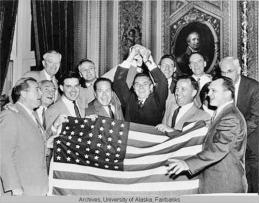
On Jan. 3, 1959, President Dwight Eisenhower signed a proclamation admitting Alaska to the Union as the 49th state. The New York Times noted that the signing included the unveiling of the new 49-star American flag.
The land that became Alaska came into U.S. possession in 1867, when William Seward, secretary of state under President Andrew Johnson, negotiated a deal to buy the 586,000-square-mile area from Russia for $7.2 million, less than 2 cents per acre. Seward’s decision was ridiculed in the American press, who saw no potential in the vast, inhospitable and sparsely populated area.
For decades after its purchase, Alaska was derided as “Seward’s folly” or “Seward’s icebox.” This opinion changed in 1896 with the discovery of gold in the neighboring Yukon Territory, which spurred tens of thousands of people to head to Alaska in search of gold. The gold rush also brought about a boom in mining, fishing and trapping.
Though the first statehood bill had been presented to Congress in 1916, there was little desire in either Alaska or Washington for Alaskan statehood until after World War II. During the war, the U.S. established multiple military bases to resist Japan’s attacks on Alaska’s Aleutian Islands and prevent a potential invasion of the mainland. The military activity, along with the completion of a major highway from Montana, led to a large population growth.
In 1946, Alaskans voted in favor of statehood in a referendum and Alaskan delegates began to lobby Congress for statehood. After years of debate, Congress voted in June 1958 to admit Alaska.
Eight months after Alaska’s admission, on Aug. 21, 1957 [should be 1959, no?], Hawaii became the 50th state. The 49-star remained in place until the following July 4, when it was replaced by the now-familiar 50-star flag.
49-star flags were produced only until August 1959, so there are few of them around. I love this photo of the unveiling of the flag with President Eisenhower:
“Quartermaster General MG Andrew T. McNamara and President Eisenhower examine new 49 star flag” – image and caption from the Quartermaster Foundation. (Who are the other two people? The guy on the right looks to me a bit like is Pennsylvania’s Sen. Hugh Scott.)
How did the nation survive for 170 years without firm, decisive and conclusive orders on what the flag should look like? Isn’t it a great story that we went so long without law setting the requirements?
Alaska’s state flag design came from 13-year old Benny Benson. Benny Benson holding the Alaska flag at the Jesse Lee Home, Seward, Alaska. ASL-P01-1921, Alaska State Library-Historical Collections.
Flag House in 1936, where Mary Pickersgill sewed the garrison-sized, 15-star flag that flew over Fort McHenry at the Battle of Baltimore in 1814; one of the sites where the U.S. flag may be flown 24 hours. The house is at 844 East Pratt & Albemarle Streets (Baltimore, Independent City, Maryland). Cropped image courtesy of the federal HABS—Historic American Buildings Survey of Maryland.
January is loaded with flag flying dates, when we add in statehood days, dates those states are invited to fly their U.S. flags.
In January, the U.S. Flag Code urges citizens to fly flags on these dates:
New Year’s Day, January 1, a federal holiday
Martin Luther King’s Birthday, a federal holiday on the third Monday of January; that date is January 18, in 2014; King’s actual birthday is January 19, and you may fly your flag then, too
Inauguration Day, January 20, the year after election years (next one in 2017)
January 2, Georgia Statehood Day
January 3, Alaska Statehood Day
January 4, Utah Statehood Day
January 6, New Mexico Statehood Day
January 9, Connecticut Statehood Day
January 26, Michigan Statehood Day
January 29, Kansas Statehood Day
You may fly your flag any other day you wish, too; flags should not be flown after sundown unless they are specially lighted, or at one of the few places designated by Congress or Presidential Proclamation for 24-hour flag flying. According to Wikipedia’s listing, those sites include:
Fort McHenry, Baltimore, Maryland (Presidential Proclamation No. 2795, July 2, 1948).
Flag House Square, Albemarle and Pratt Streets, Baltimore, Maryland (Public Law 83-319, approved March 26, 1954).
Or, until that account is unsuspended by the forces supporting Donald Trump: Follow @FillmoreWhite, the account of the Millard Fillmore White House Library
We've been soaking in the Bathtub for several months, long enough that some of the links we've used have gone to the Great Internet in the Sky.
If you find a dead link, please leave a comment to that post, and tell us what link has expired.
Thanks!
Retired teacher of law, economics, history, AP government, psychology and science. Former speechwriter, press guy and legislative aide in U.S. Senate. Former Department of Education. Former airline real estate, telecom towers, Big 6 (that old!) consultant. Lab and field research in air pollution control.
My blog, Millard Fillmore's Bathtub, is a continuing experiment to test how to use blogs to improve and speed up learning processes for students, perhaps by making some of the courses actually interesting. It is a blog for teachers, to see if we can use blogs. It is for people interested in social studies and social studies education, to see if we can learn to get it right. It's a blog for science fans, to promote good science and good science policy. It's a blog for people interested in good government and how to achieve it.
BS in Mass Communication, University of Utah
Graduate study in Rhetoric and Speech Communication, University of Arizona
JD from the National Law Center, George Washington University


 Posted by Ed Darrell









 Millard Fillmore's Bathtub