Excellence in the Classroom report gets cool reception from teachers

March 7, 2007

A business group advising Texas Gov. Rick Perry released their report, Excellence in the Classroom, earlier this month, in time to affect legislation in the hopper in Austin at the Texas Lege. The report gets attention simply because Sandy Kress is a part of the reporting team — Kress is a former chair of the Dallas Independent School District Board, and was advisor to President George W. Bush during the push for the No Child Left Behind Act.

On one hand, the report advocates modest spending boosts for “good” teachers. On the other hand, it’s ambiguous in its call for tougher classroom standards, and most of the recommendations that have any teeth will bite teachers in the classroom.

Teacher groups coolly greeted the report, according to the Fort Worth Star-Telegram:

The ideas in “Excellence in the Classroom” generally got a thumbs-down from area educators.

“The problem is, business councils expect kids to be just like parts,” said Larry Shaw, executive director of the United Educators Association of Texas. “If I’m a farmer and I get a crop I don’t like, I reject it. Nobody lets us reject the kids that we get. We take them where they are, and we do the best that we can with them.”

Karen Moxley is a teacher at Cross Timbers Middle School in Grapevine and president of the local chapter of the Texas State Teachers Association. She is critical of the report.

“Children and lives aren’t products. They’re really lovely, wonderful, messy things that have their peaks and valleys,” Moxley said. “We can’t control that. It’s grossly unfair to say that teachers are the only solution.”

A key quote from the report, used by Kress in his press advance, cites Erik Hanushek’s claim that students lagging behind can catch up with just five years with an effective teacher. The problem is, of course, that effective teachers tend to quit after five years, because the rest of the system is so fouled up.

More later.

Tip of the old scrub brush to TexasEd, “Do As I Say – It’s Not About the Money.”


Millard Fillmore’s gravesite

March 7, 2007

Millard Fillmore died on March 8, 1874, 133 years ago tomorrow.

Of course, he is interred in Buffalo, New York, his base of political power and home where he practiced those civic virtues that got him elected Vice President and nominated President. There are people who visit presidential gravesites, and here is an account of one fellow who is working to visit as many as he can. Notice the snow. It is Buffalo, after all.

Fillmore’s dying words were reputed to have been something about the ‘sustenance’ being ‘palatable.’ I suspect that, as with so much else about Fillmore, the attributed quote is not accurate. I find the word “palatable” in a subhead of one of the death notices in a newspaper, but no reporter was present. Heck, I’m beginning to wonder about Fillmore’s State of the Union speeches.

What were Fillmore’s dying words, really?

Also:

Millard Fillmore's grave in Forest Lawn Cemetery in Buffalo, New York.  Photo by Keven Petersen, via FindaGrave.com

Millard Fillmore’s grave in Forest Lawn Cemetery in Buffalo, New York. Photo by Keven Petersen, via FindaGrave.com


Limericks and Liberals, a happy combination

March 6, 2007

Haiku, nothing! Limericks are everywhere!

Blue Gal has the 33rd Carnival of the Liberals. It’s a huge disappointment for those radical right wingers who hope that such a compilation will be bereft of care and thought, and substance. Go see.


Kid blogs for human rights, asks that kids be let out of U.S. jails

March 5, 2007

Really.

I can’t gloss this at all, and so far it checks out as presented. Political Teen Tidbits is a blog run by a bright young Texan with a conscience. She’s trying to draw attention to the bizarre cases that keep coming out of Texas’ immigration detention practices.

Political Teen Tidbits thinks we should let the 9-year-old Canadian kid out of jail. Go read the details — what do you think?


Good! Bad History Carnival is back

March 5, 2007

April may be the cruelest month overall, but March has been deadly on some of my favorite weblog carnivals.

Fortunately, the Bad History Carnival is back, over at Old is the New Way.


Treating kid’s brains as finely toned muscle

March 3, 2007

How many of us have worked with former athletic coaches who just don’t quite master the need for practice of academic topics, time to master academic skills, the need for constant rehearsal of the skills, and good care and feeding of the brain, the same way they understand the care and feeding of kinesthetic skills?

Chris Wondra.com posted a 7-point summary of Eric Jensen’s plan for keeping kids’ brains in top learning order. It’s worth a look. Treat it like a checklist: How many of these get done in your classroom? How much of this brain conditioning do you have control over?

Now, remember that part of the No Child Left Behind Act that says what we do should be backed by research?


Plagiarism would have been the more noble course

March 3, 2007

Coulter chose the ignoble coarse. (No, that’s not misspelled.)


Best Sushi in the Rocky Mountains

March 2, 2007

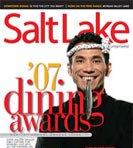
takashis-magazine-cover-cropped.jpg

Caption: Sushi Master Takashi Gibo catches top honors — dig into all the winners on page 84.

See that guy on the magazine cover above? He’s my nephew-in-law. (The one showing his teeth, that is — though, to the consternation of Seattle’s own Animal House, the Discovery Institute, I confess being related very distantly to the finny one, too.)

Takashi’s restaurant — cleverly named “Takashi” — won Best Restaurant honors in Salt Lake City last month. For that, he gets this cover on Salt Lake magazine, and a warm description inside.

Alas, the magazine keeps its best stuff in the print edition. You’ll have to get your copy on the newsstand — and if you’re in Dallas, or Morris, Minnesota, or Kennesaw, Georgia, or even Atlanta, that might be a real trick.

But not to worry: Just grab the next flight to Salt Lake City. Takashi is downtown, on Market Street. Tell Takashi or Tamara that Uncle Ed sent you. The sushi will delight you, I promise. Here’s an earlier review.

Can’t wait? Here’s a little recipe you can try at home, that Takashi passed on from an earlier place: Ankimo with Ponzu.

[I had hoped to do a much larger picture, but that little thumbnail is the best the magazine had at its site. Will they send a better one, in the hope that maybe two or three Utahns will read this blog and rush out to buy a copy?]


Have a good Texas Independence Day

March 2, 2007

Independence from what? “Do you mean the Alamo stuff?”

March 2 formerly was celebrated widely in Texas. Today, not so much.

Marshall Doke, Dallas attorney and chairman of the Texas Historical Foundation lectures Texas educators and parents today, on what should be done, in an opposite-editorial page piece in the Dallas Morning News.

Our Texas story helps us learn from the great men and women of the past that the one element essential for success (and possibly survival) is character. In the words of John Quincy Adams in the movie Amistad, “Who we are is who we were.”

Pray Texans never forget.

What does Texas Independence Day commemorate, again?

Update: Looking for more material, teachers? Go here, to Grits for Breakfast. You’ll find a list of other blogs that discussed the event today, and over the past couple of years. Interesting views.


Arthur Schlesinger

March 1, 2007

History is a bit more poorly told, the world is a bit less knowledgeable today. Arthur M. Schlesinger, Jr., died last night. He was 89.

Details at the New York Times.

Schlesinger was a model historian in some ways. He wrote well, earning two Pulitzer Prizes. He picked important, salient subjects — The Imperial Presidency, for example, came in the Nixon years, in time to analyze Nixon’s own actions and help make the case for his impeachment.

Also important, Schlesinger was no library recluse. He spent time as an advisor to President Kennedy in the best tradition of a practical, professional historian — trying to help Kennedy avoid the mistakes of the past.

A man who wrote history worth the reading, AND who made history worth the writing. Perhaps no one else other than Winston Churchill and Theodore Roosevelt could be described so, in the 20th century.

I hope you teachers will mention Schlesinger’s passing to your classes, and offer him as an example of the effect a student of history might have.

Arthur M. Schlesinger in 2004, WNYC photo

Arthur M. Schlesinger in 1994; photo courtesy of WNYC FM. 


Ninth Festival of the Trees

March 1, 2007

You are a social scientist?  You do not pay adequate attention to trees, in my view (with a few exceptions).  History is not only made with treaties signed under great trees, but history is made when forests move (ask Macbeth), or when orchards and forests are planted.  Economics would be nowhere without a building to do the economics in, and that building most likely owes much of its structure to trees — as does our entire economy (checked lumber prices lately?).  Don’t get me started on agriculture.

And then there are those trees that inspire (Isaac Newton, Joyce Kilmer), and those that simply give us beauty.

You have many good reasons to check out this compilation of posts, a web carnival, all about trees:  Festival of the Trees #9.  If you check carefully, you’ll even find some history involving Thomas Jefferson there.


Teaching critical thinking, “further reading”

March 1, 2007

Once upon a time I was a graduate student in a rhetoric program. At the same time I was the graduate assistant for the intercollegiate debate program at the University of Arizona, which at the time had an outstanding, nationally-competitive team and a lot of up-and-comers on the squad. From there I moved almost immediately to a political campaign, a sure-loser that we won, and from there to Congressional staffing, writing speeches, editorials, press releases and a few legislative dabbles. Then law school, etc., etc.

Some of the fights I’ve been involved in include air pollution and the laws controlling it, land use in statewide plans, tobacco health warnings, compensation for victims of fallout from atomic bomb tests, food safety, food recall standards, education testing standards, measurement of management effectiveness, noise control around airports, social studies textbooks and biology textbooks, and a few others. Most political issues are marked by people who really don’t understand the information available to them, and many issues are pushed by people who have no ability or desire to understand the issues in any depth.

And so, having survived a few rounds in the crucibles of serious debate with real stakes, I am often amused and frustrated by state education standards that demand teachers teach “critical thinking,” often as not grounded in something that looks like hooey to me.

In one of my internet rambles I came across a site with modest ambitions of continuing discussion of critical thinking. Rationale Thoughts comes out of Australia. The view is a little different, but not too much so (hey, it’s in English, which is a bonus for me).

If you’re looking for sources to seriously understand what critical thinking is, this is one place you would be well-advised to check. You might find especially useful this list for “further reading” in the topic.