Maps of lost worlds: Caddoland

June 29, 2007

Caddoland collage, UT-Austin, Texas Beyond History (Click on thumbnail for a larger view of this Caddoland Collage)

Caddos, Anadarkoes, Tawaconies, Southern Delawares — so many Native American tribes disappear from U.S. history books, and from U.S. history. These histories should be better preserved and better taught.

Texas history texts mention the Caddo Tribe, but largely ignore what must have been a significant cultural empire, if not an empire that left large stone monuments. Teaching this material in Texas history classes frustrates me, and probably others. Student projects on the Caddos are frequently limited in what they cover, generally come up with the same three or four factoids and illustrations.

The Caddo Tribe lived in an area spanning five modern states, Louisiana, Texas, Arkansas, Oklahoma, and eventually Missouri. Here is an interactive map that offers more information and useful photos of Caddoland than I have found in any other source: The Caddo Map Tool.

Basic map of Caddoland

This is just an image of the tool — click on the image above and it will link to the actual site. One of the things that excites me about this map is its interactive features, especially the map that carries links to photos that show just what the local environment looks like.

Read the rest of this entry »


Cold, Clear and Deadly

June 28, 2007

Title of a book that documents and discusses the omnipresence of DDT and related pesticides in waters all over the world, even in places far from any known application, such as the Arctic and Antarctic.

Author Melvin J. Visser wrote a tribute to Rachel Carson at his blog, also called Cold, Clear and Deadly.

Cover of Cold, Clear and Deadly, by Melvin J. Visser.  Michigan State University Press

Cover of Cold, Clear and Deadly, by Melvin J. Visser. Michigan State University Press; at Thrift Books

More:


Hey, Britain! Duck! It’s another armada!

June 28, 2007

Gordon Brown may face a situation Tony Blair didn’t imagine: An invasion of ducks.

Plastic cuck similar to floating armada members - Times of London photo

Plastic ducks. An armada of ducks.

Quack! Quack!

Or, maybe more appropriately, “Rubber Ducky, you’re the one!”

Geography fans everywhere are salivating. History fans already recognize the ducks bear no resemblance to the Spanish Armada, but may be interested anyway.

Plastic duck toys, survivors from an original lot of about 30,000 knocked off a container ship in the north Pacific in 1992, could be drifting onto the shores of the British Isles this summer. A reward is offered for the first one found and reported to a scientist who has tracked the ducks from their accident, through currents in four of the world’s five oceans, to landfalls in North America, South America, Southeast Asia, Indonesia — and through the Arctic.

The Times of London carried a story today: Read the rest of this entry »


Sweep of Civilizations: BBC interactive map

June 28, 2007

The British Broadcasting Company (BBC) puts genius into their website — very often, it seems to me.

Go see this interactive map. It shows where civilizations or religions held sway, at a point in history you decide — and then projects forward to show how the group’s influence waxed and waned. Or plot two different groups, side-by-side.

Snapshot of Civilisations is a multi-dimensional picture of human history, where you’re in charge of the timeline.

It uses web technology to reveal the sweep of historical forces and the rise and fall of great empires and ideas over 5000 years in a way that no book could ever do.

And it does it your way. You can customise Civilisations to show you the things that interest you. The best way to understand Civilisations is to have a go.

Great bauble for world geography and world history courses — what sort of a warm-up exercise could you make with this, projecting it from your computer? What sort of homework could be made from this, for the kids to access on their own?

Gee, while you’re there, teachers: Take a look at the interactive quizzes on world religions — this could be a unit all to itself.  Hook up your computer, take the quizzes as a class, on that rainy day when you were supposed to go out to look at the school’s garden and you need a ten-minute, cultural filler that sticks to the state standards.  And look at this multifaith calendar.  You can use it for your daily “this day in history” feature; it’s useful for students doing projects on various religions.  Use some imagination.


Fisking “Junk Science” and “100 things you should know about DDT”: A new project

June 27, 2007

Looking at the odd campaign against the reputation of Rachel Carson, conducted largely by a group of corporate-paid, political scalawags, one will eventually come across a site named JunkScience.com, which has as a motto, “All the junk that’s fit to debunk.”

One might be forgiven if one assumes that the site debunks junk science claims. But that does not appear to be it’s aim at all. On this page, for example, “100 things you should know about DDT,” the site perpetrates or perpetuates dozens of junk science claims against Rachel Carson, against public health, against government and against reason. The site promotes junk science, rather than debunking it!

For example, I had just read a chunk of history reminding me that our first Environmental Protection Agency Administrator, William Ruckelshaus, had been ordered by a federal court to review the pesticide certification for DDT, and had acted against DDT only after two different review panels recommended it be phased out, and states had already started bans of their own. At the time, in 1972, Ruckelshaus faced a heap of criticism for moving so slowly on the issue.

EPA history caption: Rachel Carson's Silent Spring led to banning DDT and other pesticides. [EPA iimage]

EPA history caption: Rachel Carson’s Silent Spring led to banning DDT and other pesticides. [EPA iimage]

How is this action described at JunkScience.com?

You wouldn’t quite recognize the events — and I doubt you could verify other oddities the JunkScience.com site claims:

17. Extensive hearings on DDT before an EPA administrative law judge occurred during 1971-1972. The EPA hearing examiner, Judge Edmund Sweeney, concluded that “DDT is not a carcinogenic hazard to man… DDT is not a mutagenic or teratogenic hazard to man… The use of DDT under the regulations involved here do not have a deleterious effect on freshwater fish, estuarine organisms, wild birds or other wildlife.”

[Sweeney, EM. 1972. EPA Hearing Examiner’s recommendations and findings concerning DDT hearings, April 25, 1972 (40 CFR 164.32, 113 pages). Summarized in Barrons (May 1, 1972) and Oregonian (April 26, 1972)]

18. Overruling the EPA hearing examiner, EPA administrator Ruckelshaus banned DDT in 1972. Ruckelshaus never attended a single hour of the seven months of EPA hearings on DDT. Ruckelshaus’ aides reported he did not even read the transcript of the EPA hearings on DDT.

[Santa Ana Register, April 25, 1972]

19. After reversing the EPA hearing examiner’s decision, Ruckelshaus refused to release materials upon which his ban was based. Ruckelshaus rebuffed USDA efforts to obtain those materials through the Freedom of Information Act, claiming that they were just “internal memos.” Scientists were therefore prevented from refuting the false allegations in the Ruckelshaus’ “Opinion and Order on DDT.”

I propose to Fisk much of the list of 100 claims against Carson (which is really a list over 100 items now), in a serial, spasmodic fashion. I’ll post my findings here, making them generally available to internet searches for information on Rachel Carson and DDT. Below the fold, I’ll start, with these three specious claims listed above.

Read the rest of this entry »


New assessment tool for teachers: Blowhard

June 27, 2007

Read about it here; slick as a whistle, if you ask me.


Didn’t know insanity is contagious: Sen. Tom Coburn

June 27, 2007

Several outbursts of insanity in Washington, D.C., lately make one wonder if there is some contagious disease that prompts these outbursts.

Although, I must admit, this outburst was before the Cheney/Snow claims that the nation’s chief executive and vice chief executive are not executive branch members.

In a flash of irony that shattered irony meters across libraries, laboratories and the research facilities in Oklahoma universities, Oklahoma’s U.S. Sen. Tom Coburn placed a hold on the bill to name a post office in honor of Rachel Carson, accusing Carson of “junk science.” What Coburn failed to say — or, God forbid, failed to notice — is that the criticisms of Carson are truly junk science.

In the Washington Post Coburn offered this inexplicable explanation:

In a statement on his Web site yesterday, Coburn (R) confirmed that he is holding up the bill. In the statement, he blames Carson for using “junk science” to turn public opinion against chemicals, including DDT, that could prevent the spread of insect-borne diseases such as malaria, which is spread by mosquitoes.

Coburn, whose Web site says he is a doctor specializing in family medicine, obstetrics and allergies, said in the statement that 1 million to 2 million people die of malaria every year.

“Carson was the author of the now-debunked ‘The Silent Spring,’ ” Coburn’s statement reads. “This book was the catalyst in the deadly worldwide stigmatization against insecticides, especially DDT.”

This issue is arcane enough that history aficionados reading may not be fully aware of the problems with Coburn’s claims. Let me explain.

First, Carson didn’t complain about insecticides, but instead pointed out that overuse of some insecticides is damaging to the environment, and ultimately frustrates their use as intended. As Carson pointed out, DDT was ceasing to be effective in the fight against malaria due to this overuse. In other words, Carson’s advocacy, if it was as effective as Coburn imagines, saved DDT as an effective tool in the fight against malaria. But Coburn blames her for the opposite. It’s as if he were treating a kid who fell out of a tree, and he blamed the broken arm on a cold virus, because the kid’s nose was running.

Second, DDT is a deadly killer. It’s not like DDT is perfectly harmless. Carson, using studies by insecticide manufacturers and entomologists accumulated over the previous 20 years, pointed out that broadcast use of DDT to protect cotton from boll weevils not only failed to protect the cotton, it also endangered humans. Overuse of any insecticide tends to drive evolution of resistance in the insects targeted, and this is exactly what happened, and what Carson reported. That’s not junk science in any form. It’s accurate, real science, that benefits humans.

Had Carson’s book not appeared when it did, it is quite possible, maybe even likely, that it would have been rendered completely useless against insects.

But even worse, animals don’t evolve resistance as quickly as insects can, and the levels of DDT and its daughter compounds were multiplied in living things as they were higher in a local food chain. DDT is absorbed into living tissues very effectively, so it does not remain floating about, say, in the water of a swamp where it is sprayed for mosquitoes. Instead it is absorbed by other insects, by plants, and then by the animals that consume those insects and plants, and then by the predators at the top of the food chains. Carson was way ahead of her time in understanding this relationship, but the science at the time supported her conclusions exactly, and every study done since then has reinforced Carson’s reporting of the scientific conclusions.

This was important because, as concentrated especially in birds, DDT and its daughters cause eggs to be non-viable, and it even changes the behaviors of birds in raising their young. DDT kills the next generation of birds. It is especially deadly against raptors at the top of the food chain — America’s symbol, the bald eagle, for example, was driven to the brink of extinction by DDT — but it also kills the songbirds which, in a well-balanced ecosystem, keep mosquito populations down and prevent the spread of mosquito-borne diseases like malaria or dengue fever.

So DDT use, as Sen. Coburn appears to defend it, would have left the world malaria and mosquito-ridden, exactly the opposite of his claims.

Third, Carson’s book has been verified in hundreds of studies. To call it “debunked” is either a total purchase of junk science, or a dastardly distortion of the the facts. Carson worried that DDT might be a cause of cancer, a carcinogen. Knowledge of carcinogens was so limited when she wrote that Congress and the medical establishment — two groups Coburn belongs to — endorsed the Delaney Clause to the Food and Drug Act in 1957, ordering that nothing that caused cancer be allowed as an additive in foods or food supplements. This seems almost naive today, when we know that some things, like selenium, are both essential nutrients and carcinogenic, and when we can detect vanishingly small traces of carcinogens in almost everything. Carson called our attention to potential dangers of DDT.

And, it turns out, she was mostly right about DDT and cancer. The good news is that DDT is not a potent carcinogen in humans that we know. Coburn appears to rest his entire case on a misunderstanding of that last sentence. Anti-Carson screeds tend to note that DDT has not been found to be a major cause of breast cancer in women. While true, that study leaves these facts: DDT is a known carcinogen in mammals (and we know of no carcinogen that affects other mammals that is not also a carcinogen for humans, who are mammals); DDT’s effects would be expected to show up in liver cancer, because DDT is a toxin and toxins damage the liver even as the organ does its job in cleaning the toxin out; DDT is a known toxin to human livers, causing liver damage leading to liver disease. Liver disease is a frequent precursor to liver cancer. We need more studies, but it is simply false to say that we know DDT is not a carcinogen. DDT is a carcinogen; the only thing we don’t know is how potent it is in humans.

So here we have Sen. Coburn, an MD in the Senate, a man who has the training of a scientist, a guy who used to practice medicine, helping people avoid things that harm or kill them, falling victim to junk science claims about Rachel Carson and her work, and DDT and what it does, and how it does it.

It ain’t the things we don’t know that get us into trouble, some wag once said: It’s the things we know that ain’t so.

Perhaps you could drop Dr. Coburn a letter, gently inform him of the facts, and ask that he release the hold on honoring Rachel Carson, winner of the Presidential Medal of Freedom, the woman who saved DDT from becoming a useless limb in the war against insect-borne disease? It would be the patriotic thing to do.


Insanity spreads through Article II agencies

June 26, 2007

From the Chicago Tribune:

White House press secretary Tony Snow said the president and vice president are not executive “agencies” and are therefore not covered under the executive order, but he stopped short of placing Cheney exclusively in the legislative branch. Snow He said the vice president has served “in an executive capacity delegated to him by the president” and noted that, constitutionally “there are no specified executive activities for the vice president,” and that his role “is a wonderful academic question.”

Chicago Tribune, “Emanuel seeks to cut funding for Cheney’s office, home,” June 26, 2007

Constitution of the United States, Article II, Section 1:

The executive Power shall be vested in a President of the United States of America. He shall hold his Office during the Term of four Years, and, together with the Vice President, chosen for the same Term, be elected, as follows . . .


NY Times special on evolution – run, get it!

June 26, 2007

Evolution is the subject of a special edition of the Science section of the New York Times today. The section features articles by most of the best of the stable of science writing contributors the paper has, covering up to the latest developments in the field of evolution.

It’s available on-line, too, for a week or so — free subscription required. Or, Times Select customers will be able to access the stuff so long as they subscribe.

Since the section covers the best of science, there is nothing on intelligent design or other forms of creationism. The aim of the editors is the best of science, not “balance” in presenting opposing views even if vapid.

So, for $1.00, biology teachers can get a dozen weeks’ of enrichment material for this fall’s classes.

Run, don’t walk — your local Starbuck’s should have the paper, if your local newsstand doesn’t. It’s worth it just for the lead article featuring evo-devo, if that’s all you read.


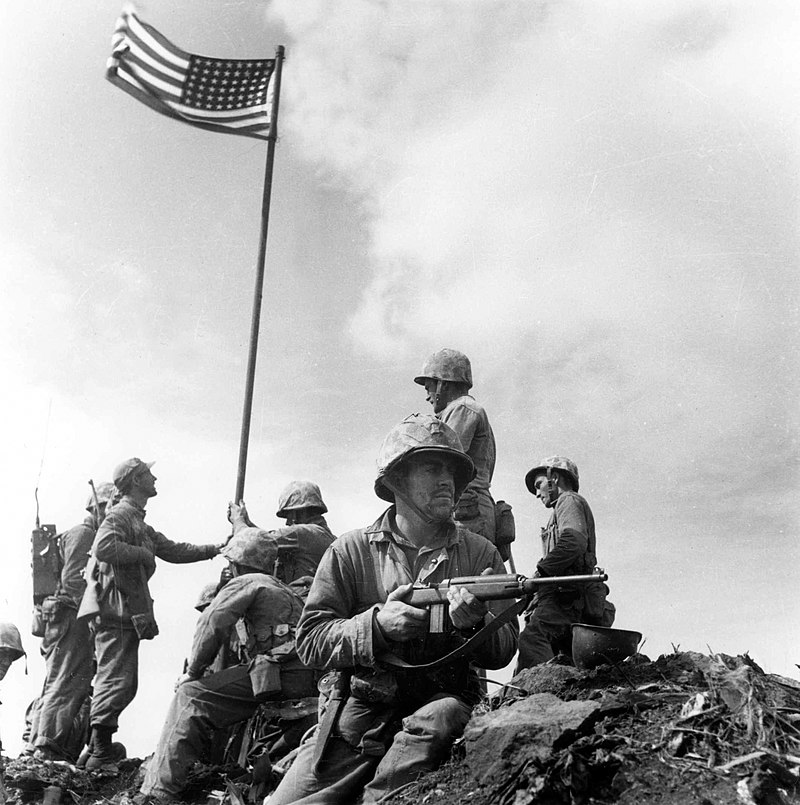
Charles Lindberg, first Iwo Jima flag raising

June 26, 2007

1st flag raising on Iwo Jima, photo by Sgt Lou Lowery, Leatherneck Magazine

First raising of the U.S. flag on Iwo Jima on February 23, 1945. Photo by Sgt. Lou Lowery, Leatherneck Magazine

This photo doesn’t look like the Joe Rosenthal photo that won the Pulitzer Prize, and then inspired the book and movie, Flags of Our Fathers?

It’s not the same photo. Different photographer. Different group of Marines.

This is the first flag raising on Mt. Suribachi, the highest point of the island that was known then as Iwo Jima. This shows the mean of Easy Company, including Charles Lindberg of Grand Forks, North Dakota, raising a flag they carried on a pipe they found. The photo was taken by Sgt. Lou Lowery of Leatherneck Magazine.

Charles Lindberg, one of the Marines in the photo, died this week. He was 86 years old.

In addition carrying a name made famous by that other guy, the pilot, few people believed him when he said his company raised the flag first on Iwo. He wasn’t in the Rosenthal photo. But Lindberg told the truth.

From his obituary on the Associated Press wire (in The Washington Post):

Three of the men in the first raising never saw their photos. They were among the more than 6,800 U.S. servicemen killed in the five-week battle for the island.

By Mr. Lindberg’s account, his commander ordered the first flag replaced and safeguarded because he worried someone would take it as a souvenir. Mr. Lindberg was back in combat when six men raised the second, larger flag about four hours later.

Rosenthal’s photo of the second flag-raising became one of the most enduring images of the war and the model for the U.S. Marine Corps memorial in Washington.

Rosenthal, who died last year, always denied accusations that he staged the photo, and he never claimed it depicted the first raising of a flag over the island.

Mr. Lindberg was shot through the arm March 1 and evacuated. After his discharge in 1946, Mr. Lindberg went home to Grand Forks, N.D. He moved to Richfield, Minn., in 1951 and became an electrician.

If you’re over 45, if you read James Brady’s Flags of Our Fathers, if you saw the Clint Eastwood movie version, or if you’re a fan of Johnny Cash’s Ballad of Ira Hayes, you know the stories of heroism and sorrow and tragedy that accompany Joe Rosenthal’s photo. As so often happens in history, there is a back story, a bit of a correction — and it has some of the same bittersweet flavors.

Lindberg was 24 years old when his company landed on Iwo Jima. That was 62 years ago. Those who were eyewitnesses are mostly gone. We need to seek out those few remaining, brave survivors, and let them tell what they remember, what they saw, how they felt and how they feel.  Of the twelve men who raised the two flags, Lindberg was the last survivor.  Three of the men from each group died in battle action after raising the flags.

Here’s to the memory of Charles Lindberg, a good American, a good soldier. Thank you, Mr. Lindberg.

Charles Lindberg in 1999, holding a copy of Sgt. Lou Lowery's photo of the first Iwo Jima flag raising Charles Lindberg holding the photo taken by Sgt. Lou Lowery of Leatherneck Magazine, of the first U.S. flag raising on Iwo Jima, by Easy Company. Lindberg is the soldier standing in back, on the right of the photo. Lowery’s photo was taken about four hours before the second flag raising, captured by Joe Rosenthal, which photo won the Pulitzer Prize. This photo of Lindberg, left, is from 1999, by Associated Press photographer Jackie Lorentz.

Lindberg’s citation for the Silver Star is below the fold.

Read the rest of this entry »


Quote of the Day: John Kennedy, June 26, 1963

June 26, 2007

President Kennedy addresses Berlin citizens, 6-26-1962 (photographer unidentified)

From the Smithsonian Magazine site:

June 26, 1963: “Ich bin ein Berliner”

In West Berlin, President John F. Kennedy delivers the famous speech in which he declares, “Ich bin ein Berliner.” Meaning literally “I am a citizen of Berlin,” the statement shows U.S. solidarity with democratic West Berlin, surrounded by communist territory.

View a video of President Kennedy’s speech at American Rhetoric, Top 100 Speeches.

Photo of President Kennedy addressing Berlin’s citizens, photographer unidentified; from American Rhetoric site.


History is the Dickens — or could be

June 26, 2007

Faithful readers here may note some long, substantive comments from another “Ed,” who is connected with the Open History Project, it turns out. I’ve linked to the OHP before, but not often enough. It really is a treasure trove.

For example, there is a page of links to computer/internet media works. Included there is a fascinating animation from the British site accompanying what was a PBS Masterpiece Theatre program in the U.S. from Charles Dickens’ novel, Bleak House. The animation, by a creative crew called Rufflebrothers (Mark and Tim Ruffle), covers the life of Charles Dickens. As a simple cartoon, it’s droll — notice Dickens’ siblings dropping dead in an early scene. As a piece of history pedagoguery, it’s brilliant. [It’s Flash animation, and I can’t copy it to paste a sample.]

(I can’t find this animation on the PBS website for Bleak House — but there is another, simpler timeline, covering Dickens and more authors.)

Watch the British animation of Dickens’ life, then go back and take it scene by scene. A pocket watch allows you to see what else was happening in history at that moment. Careful linking allows you to get much more detail — in the scene where his siblings are shown dying (as they did, in fact), the feature gives the details of each of Charles’ brothers and sisters, opening a door of new understanding for the inspiration of the characters in Dickens’ work (It was originally Tiny Fred? Really? After Dickens’ younger brother Frederick?).

Imagine such an animation for the life of George Washington, or for the life of Abraham Lincoln, or Henry Ford, Queen Victoria, Sam Houston, Mark Twain, Theodore Roosevelt, or Albert Einstein.

What in the world can we do to encourage BBC to do more like this? Who else can get in on the act?

What other treasures await you at the Open History Project?


Rachel Carson’s honor defended

June 25, 2007

Bug Girl sleuthed around a bit, and found information from official sources that really demonstrates the critics of Rachel Carson are using Gillette Foamy to make us think “mad dog!”

DDT concentration in the food chain - USFWS

Chart from US Fish and Wildlife Service (USFWS) illustrates biomagnification, by which a minuscule dose of DDT to small plankton gets magnified a few million times by the time the top predators in the food chain get it.

So the evidence continues to pile up that Rachel Carson was simply a fine writer, a good scientist, and correct about DDT’s dangers.

Check out the Fish and Wildlife Service’s site, here; notice especially their structure of the site, to dispel the falsehoods.

FWS quotes Carson on DDT use:

In Audubon magazine she wrote, “We do not ask that all chemicals be abandoned. We ask moderation. We ask the use of other methods less harmful to our environment” (4). Countering claims that she was advocating a back-to-nature philosophy, she said, “We must have insect control. I do not favor turning nature over to insects. I favor the sparing, selective and intelligent use of chemicals. It is the indiscriminate, blanket spraying that I oppose” (5).

Evidence mounts that claims against Rachel Carson are sheer calumny. While the political motivations of this smear campaign are not clear, we don’t need to know for certain who is telling lies about a great American hero, or why. As Americans, as concerned citizens, as teachers and parents — as patriots — we only need to know that the claims against Rachel Carson are false.

And now it is our duty to call on Oklahoma’s Sen. Tom Coburn to stop the campaign against Carson. Coburn is the point man in the smear campaign right now: He has put a committee hold on the well-intentioned, justified bill to name a post office in her hometown after Rachel Carson. It is time for Tom Coburn to stand up and do the right thing for a great American. Sen. Coburn needs to lift his committee hold and allow committee action on this minor honor.

Other sources of note:

Bruce Watson, “Sounding the Alarm,” Smithsonian Magazine, September 2002. (Watson, Bruce. Sounding the alarm. Smithsonian, v. 33, Sept. 2002: 115-117.   AS30.S6)

“The Berry and the Poison,” about methyl bromide and its ban, Smithsonian Magazine, December 1997.


Whither history?

June 25, 2007

Very few high school students say they want to grow up to be historians. As a profession, we ignore history.

Still, a few do. More seriously, what happens in the high school class depends a lot on what is being done by professional historians. What is that?

Historian Keith Thomas wrote a long piece about where history is headed for The Times of London, in October 2006. It even has hints about it of how to make history more intrigueing in high school. Go see. Read the rest of this entry »


Typewriter of the moment: William Faulkner

June 24, 2007

Faulkner at typewriter, Aug 12, 1954 - AP Photo, ShelfLife

William Faulkner at his typewriter, August 12, 1954, at his home in Oxford, Mississippi. Associated Press photo, via Eons website.

The photo was probably posed; the two books to the left of the typewriter are Faulkner books. Faulkner may have written in a pressed shirt and tie.

Faulkner won the Nobel Prize for Literature in 1950, and delivered a memorable speech about “the human condition” and the importance of art, especially poetry and prose, at his acceptance. His 1954 book, A Fable, won both the National Book Award and the Pulitzer Prize for Fiction, in 1955.

The typewriter is a Royal KHM.

Faulkner was born September 25, 1897 — 2007 marks the 110th anniversary of his birth.

“The past is never dead. It’s not even past.”

—Gavin Stevens

Act I, Scene III, Requiem for a Nun