Stealth malaria promotion in favoring DDT over brown pelicans

November 14, 2009

Another blogger decided to take some potshots at the environmental protection success that banning DDT was is.

edwinleap.com laments that the brown pelican flew off the Endangered Species List this week.  “Brown pelicans 1, brown human beings 0,” the headline reads.  The piece claims that banning DDT use in America has somehow increased malaria, or prolonged it, in Africa and Asia.

Clearly the writer can’t didn’t read a map, or figure distances, and knows nothing knew little about the migratory habits of mosquitoes.  Stopping the spraying of DDT in Arkansas didn’t stop the use or manufacture of DDT in Africa nor Asia, anywhere.  Nor did mosquitoes not killed in America fly to Africa to infect kids.  Someone who has decided to rail against wise science probably isn’t interested much in the facts, though.

I responded there:

DDT has never been banned in Africa, nor Asia.  Today, China and India together manufacture thousands of tons of DDT for use around the world.

Odd — in the nations where DDT was banned (for use on agriculture, never to fight malaria), malaria is eradicated or all but eradicated.  In those nations where DDT is still legal, still manufactured, and still used in great quantities, malaria runs rampant.

Perhaps a lack of DDT doesn’t have anything to do with the spread of malaria.

There are very few, if any, serious malaria fighters asking for DDT.  Improved medical care is the basis for beating malaria in humans.  Malaria is a parasite that must live for part of its life cycle in mosquitoes, and for part of its life cycle in humans.  If your goal is to wipe out malaria, you could do it more effectively by wiping out the humans that harbor the parasite.  That would be stupid and cruel, and very expensive.

Fortunately, DDT is not a powerful acute poison to use against the mammals where malaria breeds.  Perhaps unfortunately, it’s no panacea against malaria, either.

Why did African malaria fighters stop using DDT in the middle 1960s?  Mosquitoes had become resistant and immune to DDT.

Ronald Reagan once said for every serious problem there is a solution that is simple, easy, and wrong.  DDT is that simple, easy and wrong solution for malaria.

Why is this man so bigoted Let’s hope it’s ignorance of the issue and not bigotry against brown beings that he thinks leads anyone to think the brown pelican should have been sacrificed, and that  he thinks brown Africans are too stupid to figure out how to fight malaria with DDT, if DDT would in fact save them?  [See Mr. Leap’s comment below. Not stupid at all, he just didn’t have the facts.  Great to find someone willing to admit error.  Clearly, I was wrong assuming he knew better — see edits throughout the post.  It’s actually pleasant to discover one was wrong in a case like this.]

Rachel Carson was right: We should have restricted the use of DDT to save wild populations of animals, and to have preserved its efficacy for fighting malaria in carefully planned and delivered programs to fight malaria and other insect-borne diseases around the world.  Carson proposed we use integrated pest management (IPM) to fight disease, and this is the program and process Africans and Asians have turned to over the past decade as other slap-dash methods of fighting disease faltered.

In diverting attention from improving medical care to fight malaria, to a hopeless campaign to reintroduce DDT where it would not work the miracle claimed, edwinleap.com favors too many people favor  malaria over the kids in reality.  Odd position for a health professional to take, and we can be relatively certain that he’s responding to political hackery, and not basing his views on any sound science or history.

The brown pelicansmigration from the Endangered Species List pays high tribute to Rachel Carson’s views on saving life in the wild, and verification once again that she was right.  Perhaps its time more people paid attention to her accurate and effective ideas about how to fight human disease, without trying to poison all of Africa.

Add to FacebookAdd to NewsvineAdd to DiggAdd to Del.icio.usAdd to StumbleuponAdd to RedditAdd to BlinklistAdd to TwitterAdd to TechnoratiAdd to Furl


Who are those Boy Scouts in 1943?

November 13, 2009

A posed photograph:  Three Boy Scouts, from at least two different units, holding a poster Scouts were distributing about international cooperation in World War II.  They are saluting, and behind them rises the dome of the U.S. Capitol on a brilliantly sunny day.

Boy Scouts at the Capitol, 1943? - Library of Congress image

Caption from the U.S. Senate Historical Office: "Boy Scouts aid the war effort by delivering posters that encourage a united fight for freedom, ca.1943. credit: Library of Congress"

1943?  Who were the Scouts?

The photo is online in the collection of the U.S. Senate Historical Office (a good source of images, by the way).

I just wondered, who are those Scouts, and where are they today?

Boy Scouts assisted war efforts in a lot of ways in a lot of American cities, towns and villages.  Affiliates at the Tom Harbin Scout Museum at Camp Wisdom in Dallas (Circle 10 Council) have papers documenting and detailing massive scrap and paper drives, and a lot of other activities we probably wouldn’t let Scouts get into today.

The three Scouts in the photo wear what appears to be two different neckerchiefs, suggesting they come from at least two different troops or other units.  All three wear the uniform of the Boy Scouts of America, but two of the three look as though they may be immigrants or children of immigrants.

The date given is a “circa 1943.”  But the poster plugs a “United Nations” — could it have been as late as 1945 or 1946 and the official organizing of the United Nations?

What do you think?  What do you know?

Update: Wikimedia puts the date of the poster as 1941Shorpy says the photo is 1943:

“Washington, 1943. “United Nations Fight for Freedom: Colored, white and Chinese Boy Scouts in front of Capitol. They help out by delivering posters to help the war effort.” View full size. 4×5 Kodachrome transparency by John Rous for the Office of War Information. What photo expert out there can tell us about the numbers on these Kodachromes — how and at what point in the manufacturing/ exposure/ developing process they were made, and what they signify.

All those details and not the names of the Scouts?  In comments at Shorpy we also see that the temporary patch for the Scout on the left is for a 1942 campout.  So we know the photo was later than 1941.  The community patch for the Scout on the right says Washington where the city patch should be, with no state patch (if they had separate patches then).  So it’s probably a Washington, D.C. unit — and it’s Troop 11.  Anybody from National Capital Council ever read this site?  Were all three of these Scouts from Troop 11?

I have found, but cannot yet examine, another photo from the same roll of film, showing just the Scout in the middle.

Update 2: This may identify one of the Scouts, with an astounding story:

1941, Boy Scout, poster urging water saving, Anderson Grimes

Caption from CityDesk.net: "July 1941. Local Boy Scout Anderson Grimes in front of the U.S. Capitol building in Washington, D.C., holding a copy of a WPA poster designed for the city’s landmark water conservation program."

That solo Scout is clearly the same one in the first photo, so we have one name:  Anderson Grimes.

But the entire story from CityDesk.net is more amazing, if true:

July 1941. Local Boy Scout Anderson Grimes in front of the U.S. Capitol building in Washington, D.C., holding a copy of a WPA poster designed for the city’s landmark water conservation program. Shortly after this photo was taken, he was to present the poster to local congressman Harford Collins in a brief ceremony. Tragically, Grimes, along with several local reporters and congressional aides, instead found Senator Collins slumped over his desk, dead from a heart attack.

Thirty years later, Grimes ended up serving the same seat in Congress for four terms. He did not die in office.
– RJ White

If true?  I can’t find a listing for a Sen. Harford Collins in the Congressional biography pages, nor for any Member in either house named Anderson Grimes.

More mystery.  Is the Scout even named Anderson Grimes?

Okay, after j. a. higginbotham wrote in, I finally got it:  CityDesk.net is a satire site.  They wrote a phony story to accompany the photograph.

That’s right:  I got hoaxed.

Still looking for information on the Scouts and their troop(s).

Update, November 15: Is the water conservation poster in the version above a PhotoShop addition?  Here’s a photo held by the Library of Congress:

Boy Scout after 1942 showing posters Scouts distributed; photo by John Rous, Library of Congress collection

From Library of Congress: "United Nations Fight for Freedom: Boy Scout in front of Capitol. They help out by delivering posters to help the war effort"

Add to FacebookAdd to NewsvineAdd to DiggAdd to Del.icio.usAdd to StumbleuponAdd to RedditAdd to BlinklistAdd to TwitterAdd to TechnoratiAdd to Furl


50 U.S. Senators missing — can you help find them?

November 13, 2009

No, not current senators — don’t get your ignoble hopes up.

With more than 40,000 photographs and other images, the Senate Historical Office has images of almost all people who have served as members of the U.S. Senate.  5o members are completely absent from the Senate collection, however.

Got any idea where to find images of these guys?  This comes from the Senate Historical Office:

Senators Not Represented in Senate Historical Office Photo Collection

The Senate Historical Office maintains a collection of more than 40,000 still pictures, slides, and negatives. The collection includes photographs and illustrations of most former senators, but to date no photo or other illustration of about fifty members has been found. Below is a list (by state) of U.S. Senators for whom we have no image in our collection. If you have an image, or information that may lead us to an image, please contact the Senate’s photo historian.

__________________________

Alabama: – 2
William Kelly, 1822-1825
John Williams Walker, 1819-1822

Connecticut: – 2
Thaddeus  Betts, 1839-1840
Perry Smith, 1837-1843

Delaware: – 1
Outerbridge Horsey, 1810-1821

Georgia: – 5
William Bellinger Bulloch, 1813-1813
Thomas Willis Cobb, 1824-1828
Alfred Cuthbert, 1835-1843
James Gunn, 1789-1801
Josiah Tattnall, 1796-1799

Kentucky – 1
George Walker, 1814-1814

Louisiana – 3
Eligius Fromentin, 1813-1819
Allan Bowie Magruder, 1812-1813
Robert Carter Nicholas, 1836-1841

Massachusetts – 1
Eli Porter Ashmun, 1816-1818

Maryland – 6
John Henry, 1789-1797
Robert Henry Goldsborough, 1813-1819, 1835-1836
James Lloyd, 1797-1800
William Dunhurst Merrick, 1838-1845
John Selby Spence, 1836-1840
David Stewart, 1849-1850

Mississippi – 4
Robert Huntington Adams, 1830-1830
John Black, 1832-1838
Joseph Williams Chalmers, 1845-1847

New Hampshire – 2
Charles Cutts, 1810-1813
Nahum Parker, 1807-1810

New Jersey: – 3
Jonathan Elmer, 1789-1791
Aaron Kitchell, 1805-1809
James Jefferson Wilson, 1815-1821

New York – 1
Obadiah German, 1809-1815

North Carolina – 4
Timothy Bloodworth, 1795-1801
Jesse Franklin, 1799-1805, 1807-1813
Francis Locke, 1814-1815
James Turner, 1805-1816

Ohio – 3
Stanley Griswold, 1809-1809
Joseph Kerr, 1814-1815
John Smith, 1803-1808

Pennsylvania – 1
Samuel Maclay, 1803-1809

Rhode Island – 7
Nathan Dixon, Sr., 1839-1842
Benjamin Howland, 1804-1809
Henry Frederick Lippitt, 1911-1917
Francis Malbone, 1809-1809
Samuel John Potter, 1803-1804
Joseph Stanton, Jr., 1790-1793
William Sprague, 1842-1844

South Carolina – 1
John Hunter, 1796-1798

Tennessee – 3
Daniel Smith, 1798-1799, 1805-1809
Jesse Wharton, 1814-1815
Jenkin Whiteside, 1809-1811

Vermont – 4
Dudley Chase, 1813-1817, 1825-1831
Nathaniel Chipman, 1797-1803
Jonathan Robinson, 1807-1815
Israel Smith, 1803-1807

_________________________

You just know that somewhere out there, a local museum has a painting of one of these guys.  Or, someone has a painting or drawing of an old-timey guy hanging over a fireplace, a family heirloom that features one of these guys.  I mean, how could a guy like Outerbridge Horsey fail to inspire an artist somewhere?

Do you know of one?  Contact the Senate Historical Office, and let us know here, too.


Fly your flag today: Veterans Day 2009

November 11, 2009

Fly your U.S. flag today — thank a veteran.  We have a lot to thank veterans for, and veterans need a little more appreciation today.

Veterans Day Poster, 2009, U.S. Department of Veterans Affairs

US Veterans Administration tells the history of celebrating Veterans Day on November 11:

World War I – known at the time as “The Great War” – officially ended when the Treaty of Versailles was signed on June 28, 1919, in the Palace of Versailles outside the town of Versailles, France. However, fighting ceased seven months earlier when an armistice, or temporary cessation of hostilities, between the Allied nations and Germany went into effect on the eleventh hour of the eleventh day of the eleventh month. For that reason, November 11, 1918, is generally regarded as the end of “the war to end all wars.”

In November 1919, President Wilson proclaimed November 11 as the first commemoration of Armistice Day with the following words: “To us in America, the reflections of Armistice Day will be filled with solemn pride in the heroism of those who died in the country’s service and with gratitude for the victory, both because of the thing from which it has freed us and because of the opportunity it has given America to show her sympathy with peace and justice in the councils of the nations…”

The original concept for the celebration was for a day observed with parades and public meetings and a brief suspension of business beginning at 11:00 a.m.

The United States Congress officially recognized the end of World War I when it passed a concurrent resolution on June 4, 1926, with these words:

Whereas the 11th of November 1918, marked the cessation of the most destructive, sanguinary, and far reaching war in human annals and the resumption by the people of the United States of peaceful relations with other nations, which we hope may never again be severed, and

Whereas it is fitting that the recurring anniversary of this date should be commemorated with thanksgiving and prayer and exercises designed to perpetuate peace through good will and mutual understanding between nations; and

Whereas the legislatures of twenty-seven of our States have already declared November 11 to be a legal holiday: Therefore be it Resolved by the Senate (the House of Representatives concurring), that the President of the United States is requested to issue a proclamation calling upon the officials to display the flag of the United States on all Government buildings on November 11 and inviting the people of the United States to observe the day in schools and churches, or other suitable places, with appropriate ceremonies of friendly relations with all other peoples.

An Act (52 Stat. 351; 5 U. S. Code, Sec. 87a) approved May 13, 1938, made the 11th of November in each year a legal holiday—a day to be dedicated to the cause of world peace and to be thereafter celebrated and known as “Armistice Day.” Armistice Day was primarily a day set aside to honor veterans of World War I, but in 1954, after World War II had required the greatest mobilization of soldiers, sailors, Marines and airmen in the Nation’s history; after American forces had fought aggression in Korea, the 83rd Congress, at the urging of the veterans service organizations, amended the Act of 1938 by striking out the word “Armistice” and inserting in its place the word “Veterans.” With the approval of this legislation (Public Law 380) on June 1, 1954, November 11th became a day to honor American veterans of all wars.

Later that same year, on October 8th, President Dwight D. Eisenhower issued the first “Veterans Day Proclamation” which stated: “In order to insure proper and widespread observance of this anniversary, all veterans, all veterans’ organizations, and the entire citizenry will wish to join hands in the common purpose. Toward this end, I am designating the Administrator of Veterans’ Affairs as Chairman of a Veterans Day National Committee, which shall include such other persons as the Chairman may select, and which will coordinate at the national level necessary planning for the observance. I am also requesting the heads of all departments and agencies of the Executive branch of the Government to assist the National Committee in every way possible.”

  • Click here for the 2007 poster from the Veterans Administration, or for posters dating back to 1978.
  • Veterans Day Teacher Resource Kit, for lesson plans and activities
  • veteransday09 Google

    Google's 2009 tribute to Veterans Day

    Remind others to fly their flags, too:

    Add to FacebookAdd to NewsvineAdd to DiggAdd to Del.icio.usAdd to StumbleuponAdd to RedditAdd to BlinklistAdd to TwitterAdd to TechnoratiAdd to Furl


    Rep. Pete Sessions: Being a woman is “pre-existing condition”

    November 10, 2009

    When I first joined the Dallas Bar I quickly met a delightful woman who had some experience from which she spoke:  Louise Raggio.  On a few occasions I was fortunate enough to sit with her at a continuing education session and benefit from her explanations of how law really works in Texas.

    I was interested to get an e-mail from her this morning, in which she complains about Texas Republican Rep. Pete Sessions’s vote on the health care bill that passed the House of Representatives Saturday.  You might enjoy it, too:


    A Message from Louise B. Raggio
    (a.k.a. the Texas Tornado)

    This is an outrage.

    As our Members of Congress debated health care reform legislation late into the night this weekend, our incumbent Congressman Pete Sessions likened the insurance industry’s practice of charging higher rates to women to their practice of charging higher rates for smokers.  According to Sessions, being a woman is a pre-existing condition – and it merits higher insurance rates (read it here).

    Hey Pete, are you serious?

    Rep. Sessions’ blatant disrespect for women is precisely why we need a change in Congress.  Will you contribute now to help bring new leadership to Washington?

    Give online today at Act Blue!

    When I first became a lawyer in the 1950s, Texas women could not buy or sell their own property, could not sign contracts, and could not have control over their own paychecks or open their own bank accounts without their husbands’ permission.  I decided to devote my career to changing those laws so I helped write legislation that secured legal equality for married women and became the Texas Family Code.

    Now my son Grier is running for Congress.  I couldn’t be prouder to see him carry on our family’s legacy of public service.  After hearing about Rep. Sessions’ remarks pushing gender inequality, I am more determined than ever to do whatever it takes to send my son to Congress and to stand up for women.

    Can you help Grier with his campaign?  We have to send a message to Pete Sessions and his allies in Congress when they try to turn the clocks back on women’s rights – we can’t let this stand.

    Please help by contributing today!

    Thanks for all you do to support my son and his campaign for Congress.

    Sincerely,

    Louise B. Raggio

    PS:  Grier is traveling to Washington, DC tomorrow to meet with DCCC Chairman Chris Van Hollen to discuss his efforts to unseat Rep. Sessions.

    Please help Grier show Chairman Van Hollen that he has the support and commitment of Democrats like you.

    Donate today!

    It came to me as a message paid for by Raggio for Congress.  There’s no cash floating in the Bathtub; I pass it along for the entertainment and information value.


    New music station fires up in Dallas today

    November 9, 2009

    KXT-FM hits the airwaves at 7 a.m. Central Time, in Dallas today.  91.7 on the FM band.

    KXT is a sister station to public broadcasting KERA-FM, 90.1.  In the past 20 years KERA’s outstanding music programming slowly gave way to talk and news — good talk and great news, but the music suffered.

    In response to member requests, North Texas Public Broadcasting decided to launch a separate station for music.

    KXT is a new radio station found at 91.7 FM in North Texas, and at kxt.org worldwide. It’s an incredible selection of acoustic, alt-country, indie rock, alternative and world music, hand-picked just for you – the real music fan.

    KXT features between 9 and 11 hours of local programming each weekday, bringing you an eclectic variety of artists and genres, including a number of performers from North Texas and elsewhere in the Lone Star State.

    Gini Mascorro will host the KXT Morning Show, Monday through Friday from 7 to 11 a.m. Joe Kozera will take listeners home weekdays with the KXT Afternoon Show from 3-6pm and the KXT Evening Show from 6-8pm.

    90.1 at Night with host Paul Slavens, which appeared on KERA-FM for a number of years, has moved to KXT and is now known as The Paul Slavens Show.

    National shows appearing regularly on KXT include Acoustic Café, American Routes, Mountain Stage, Putumayo Music Hour, Sound Opinions, The Thistle & Shamrock, UnderCurrents and World Café.

    KXT should be a boon to Texas music, to live music, and to music generally.

    You can listen to KXT live on the internet, or pick up podcasts.

    Dallas still lacks serious rock and roll broadcasting, being mostly a city in the shadow of Clear Channel music censorship.   One step at a time.  KXT is a great big step.  Or maybe more accurately, KXT is a great, big step.

    Help broadcast the news about the broadcast music:

    Add to FacebookAdd to NewsvineAdd to DiggAdd to Del.icio.usAdd to StumbleuponAdd to RedditAdd to BlinklistAdd to TwitterAdd to TechnoratiAdd to Furl


    20 years ago, the Berlin Wall fell – reverse domino effect

    November 9, 2009

    High school sophomores in Texas study world history, and juniors study U.S. history. At 16 and 17 years old, they have difficulty figuring out the fuss over the Berlin Wall. It’s just pictures in their textbook.

    The Wall was already three or four years gone when they were born. They don’t remember living with the Soviet Union at all — it’s been Russia to them for their entire lives.

    I have some hopes that the celebrations set for this week will aid their understanding, on the 20th anniversary of the breaching and destruction of the wall.

    Dominoes set for celebration of the Berlin Wall's destruction.  AP photo by Herbert Knosowski, via Canadian Broadcast System

    Caption from CBC: "Dominoes are placed where the Berlin Wall once stood in front of the Brandenburg Gate in the German capital. (Herbert Knosowski/Associated Press)"

    An enormous line of giant dominoes is set up along the line where the old wall stood — to be toppled on November 9, the anniversary of the official breaching of the wall.

    It’s the “domino theory” in reverse.

    About 1,000 plastic foam dominoes will fall to the ground Monday along the route where the Berlin Wall once stood to mark the 20th anniversary of the crumbling of the Cold War barrier.

    The 2.3-metre-high blocks, painted by schoolchildren, stretch for 1.5 kilometres in a path near the Brandenburg Gate and the German parliament.

    Former Polish leader Lech Walesa, whose pro-democracy movement Solidarity played a key role in ending communism in Eastern Europe, will tip the first domino at 8 p.m. local time.

    I made one visit to the wall, late on a night in 1988.  American Airlines explored the possibility of taking over the service authorized from Munich to Berlin.  Soviet and East German rules required passenger flights to stay at a very uncomfortable 10,000 feet.  Pan Am had the route, but Pan Am was in trouble.  We spent a day with Berlin airport authorities and real estate agents trying to figure out how to set up a reservations office and other ground facilities.  European airports tended to force foreign carriers to share gate facilities, which was a problem, and we devoted a lot of time to gathering data for computer lines.

    But then, after a smashing dinner of sausage and German-style potatoes in a great, small Berlin pub, we talked our taxi driver into giving us a tour of the wall.  He drove a spot near the Brandenburg gate, and there on a chain link fence keeping westerners from the wall were eight fresh wreaths.  Eight people had died trying to cross from East Berlin to West Berlin in the previous six months.  One wreath for each death.

    Just over a year later, the Berlin Wall itself would be gone.

    West Berlin acted much like a normal, western European city.  But the wall was there as a constant reminder of the oppression on the other side, a dull fog to constantly dim even the sunniest day.

    Old posts on the Berlin Wall here at the bathtub are suddenly popular — usually they get a lot of hits after March when U.S. schools get to the post-World War II era, the Cold War and the Berlin airlift.  I imagine the current popularity has something to do with the anniversary.

    I hope somebody has some great video of the dominoes toppling.

    Dominoes acerbicly note the irony:  While the U.S. feared nations would fall under communism in a “domino effect,” especially in Southeast Asia (Indochina), communism broke up in a domino effect, as one communist-dominated country after another found freedom near the end of the Cold War.  Why has no one done a serious essay on the domino effect of freedom?

    More news and resources:

    Famous sign warning visitors leaving West Berlin

    A sign of old times, now unneeded

    Viral dominoes: Help spread the news:

    Add to FacebookAdd to NewsvineAdd to DiggAdd to Del.icio.usAdd to StumbleuponAdd to RedditAdd to BlinklistAdd to TwitterAdd to TechnoratiAdd to Furl


    Quote of the moment: Robert F. Kennedy, on what matters in economies

    November 8, 2009

    Cribbing completely from Harry Clarke (with a few corrections in the text):

    Robert F. Kennedy speech at the University of Kansas, Lawrence, March 18, 1968

    Robert F. Kennedy speech at the University of Kansas, Lawrence, March 18, 1968 - Photo by George Silk, Time-Life Pictures/Getty Images

    RFK said this in 1968.  In a speech I heard today it was quoted and it stirred me.

    Too much and for too long, we seem to have surrendered personal excellence and community value in the mere accumulation of material things. Our Gross National Product, now, is over eight hundred billion dollars a year, but that GNP — if we judge the United States of America by that — that GNP counts air pollution and cigarette advertising and ambulances to clear our highways of carnage. It counts special locks for our doors and the jails for the people who break them. It counts the destruction of the redwoods and the loss of our natural wonder in chaotic sprawl. It counts napalm and it counts nuclear warheads, and armored cars for the police to fight the riots in our cities. It counts Whitman’s rifle and Speck’s knife, and the television programs which glorify violence in order to sell toys to our children.

    Yet the Gross National Product does not allow for the health of our children, the quality of their education, or the joy of their play. It does not include the beauty of our poetry or the strength of our marriages, the intelligence of our public debate or the integrity of our public officials. It measures neither our wit nor our courage, neither our wisdom nor our learning, neither our compassion nor our devotion to our country; it measures everything, in short, except that which makes life worthwhile. And it can tell us everything about America except why we are proud that we are Americans.

    Kennedy delivered these words in an address at the University of Kansas, Lawrence, Kansas, on March 18, 1968.

    Here’s a video production from the Glaser Progress Foundation which includes an audio recording of the speech:

    More resources:

    Add to FacebookAdd to NewsvineAdd to DiggAdd to Del.icio.usAdd to StumbleuponAdd to RedditAdd to BlinklistAdd to TwitterAdd to TechnoratiAdd to Furl


    If at first you don’t succeed . . .

    November 7, 2009

    . . . try again, and then quit, Mark Twain said.  “No use being a fool about it.”

    All I can say is, I’m happy she is not working to get a license to drive a bus.

    (News story:  Woman passes written test for drivers license on 950th attempt.)


    All U.S. flags at half-staff until Veterans Day, Obama orders

    November 7, 2009

    President Obama issued a directive ordering all federal facilities to fly the national flag at half-staff from now until Veterans Day (November 11), to honor the soldiers and civilians felled at Fort Hood, Texas.

    “It is an act of violence that would have been heartbreaking had it occurred anyplace in America,” Obama said. “It is a crime that would have horrified us had its victims been Americans of any background. But it’s all the more heartbreaking and all the more despicable because of the place where it occurred and the patriots who were its victims.”

    The president said he met Friday with FBI Director Robert Mueller, Defense Secretary Robert Gates and others to discuss their continuing investigation into the attack, which also injured at least 30.

    Obama also expressed his condolences to the victims’ families and recognized those who helped the wounded after the shooting at the base’s Soldier Readiness Processing Center. The center is where soldiers go to have their teeth checked and medical records updated before deploying overseas.

    “These are the men and women we honor today. These are the men and women we’ll honor on Veterans Day,” Obama said. “And these are the men and women we shall honor every day, in times of war and times of peace, so long as our nation endures.”  (from the Virginian-Pilot, in Norfolk, Virginia)

    Obama’s directive follows Texas Gov. Rick Perry’s order for flags in Texas to be flown half-staff until Monday.

    Flag etiquette reminder: When flown at half-staff, the U.S. flag should be raised quickly to full staff, then lowered slowly to half-staff.

    President Obama addressed the tragedy in his weekly radio and television message:

    Vodpod videos no longer available.
    (More about “Weekly Address: Tragedy at Fort Hood …“, posted with vodpod)
    Obama’s statement and proclamation can be found at the White House website.

    Geography Awareness Week, November 15-21

    November 6, 2009

    Geography Awareness week is sneaking up — November 15-21.

    Got your special lesson plans ready, teachers?


    Texas flags at half-staff today, remembering Fort Hood

    November 6, 2009

    Texas Gov. Rick Perry has ordered flags in Texas to be flown at half-staff through Sunday, November 8, in remembrance of the victims of the shootings at Fort Hood.  The statement from Perry’s office follows.

    AUSTIN – Gov. Rick Perry today issued the following statement regarding the shootings at Fort Hood:

    “The Texas family suffered a significant loss today with the tragedy at Fort Hood. Along with all Texans, Anita and I are keeping those affected by today’s incidents in our thoughts and prayers.

    “We are deeply saddened by today’s events, but resolve to continue supporting our troops and protecting our citizens.

    “To honor those who lost their lives today, I have ordered that all Texas flags be lowered to half-staff until Sunday, and ask all Texans to pray for the victims, their families and the extended Fort Hood community.”

    The governor has been in contact with military and state law enforcement officials. To provide support at Fort Hood, Gov. Perry directed the deployment of a variety of state resources to the area, including Texas Department of Public Safety troopers, Texas Rangers and helicopters, to assist in securing the perimeter of the base and provide other support as necessary.

    The governor’s flag order applies to all U.S. and Texas flags under the control of the state. Flags will be lowered to half-staff on the State Capitol Building, flag displays in the Capitol Complex, and upon all public buildings, grounds and facilities beginning immediately until sunset on Sunday, November 8th.

    Individuals, businesses, municipalities, counties and other political subdivisions are encouraged to fly the flag at half-staff for the same length of time as a sign of respect.

    To view text of the governor’s remarks, please visit http://governor.state.tx.us/news/speech/13905/.

    Add to FacebookAdd to NewsvineAdd to DiggAdd to Del.icio.usAdd to StumbleuponAdd to RedditAdd to BlinklistAdd to TwitterAdd to TechnoratiAdd to Furl


    What books and papers literally turned history around?

    November 6, 2009

    Debating the effects  of Rachel Carson’s Silent Spring got me wondering about the true influence of that book.  That quickly turned into wondering about the true influence of other writings, books and papers that might be credited with having turned around history in a given field, or in the United States (I’m focusing on U.S. history this year since that’s what I’m teaching).

    What books and writings — not events, not inventions — literally changed U.S. history?

    I have a quick list, not in chronological order, nor any other order, really:

    1. The Jungle, by Upton Sinclair
    2. Common Sense,” Tom Paine’s broadside
    3. Adam Smith’s Wealth of Nations
    4. Federalist Papers and Antifederalist Papers
    5. Uncle Tom’s Cabin, by Harriett Beecher Stowe
    6. Das Kapital, by Karl Marx
    7. On the Origin of Species, Charles Darwin
    8. Perhaps The Bible, at least after 1880 during the rise of fundamentalism
    9. Einstein’s five papers in 1905 (which led to a cascade of events to nuclear weapons, and more)
    10. John Maynard Keynes’ General Theory on Employment, Interest and Money (or would his Treatise on Money be the one to look at?)
    11. Ludwig von Mises (which writing?)
    12. Crick’s and Watson’s paper on DNA in 1953
    13. Silent Spring, by Rachel Carson
    14. Lincoln’s “Gettysburg Address” in the way it recast the Declaration of Independence

    What about Profiles in Courage? Did it have so much influence?  Any influence at all?

    I didn’t include Twain’s Adventures of Huckleberry Finn, but I wonder if it should be there.  I regard it as the novel in which America came of age, when Huck decides he’ll go ahead and burn in hell by not turning Jim in as an escaped slave, because Jim is a man and a good friend.  (I don’t think a discussion of the validity of Huck’s religious beliefs gets at the issue here, where he does what is right assuming bad consequences, but maybe that’s a greater influence later on.)

    Oh, surely I’ve overlooked some very important contribution by someone.  De Tocqueville perhaps?  Were there other books that were greatly influential in their time, that we now generally don’t consider?  Ida Tarbell’s work, perhaps?  Did Edwin Hubble have a fundamental publication we can point to?  How about Alpher, Herman and Gamow and Big Bang?

    A follow-on question might be music, plays and movies that had similar results —  not sure of any that qualify, though I wonder about the influence of “Show Boat” in the campaign for desegregation and civil rights, and I wonder about the influence of “Our Town” on our view of civic government and small town life especially given that so many thousands of people participated in local and school productions of the thing over the years.  “Hair!?”

    I’m looking for sources to use to provide genuine light to a high school student in U.S. history.  Some of these sources we touch on, but others are completely ignored in all current U.S. history texts for public schools.

    What do you think?


    Surely we’ve found everything by now

    November 4, 2009

    Well, no, we haven’t.  Nice little post by a photographer urging people to go look to see what they can find, with a brilliantly concise set of arguments about big things discovered just in the past few years.

    Nice photos, too — go see.


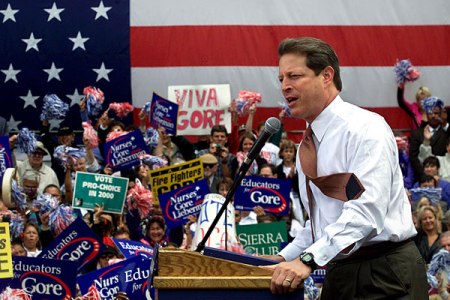
    Al Gore shows how green investing works

    November 3, 2009

    Then Vice President Al Gore campaigning in Des Moines, Iowa, November 25, 1999.

    Then Vice President Al Gore campaigning in Des Moines, Iowa, November 25, 1999.

    Among the more amusing about-faces in conservative knee-jerk politics is conservative criticism of Al Gore for being a successful investor.

    No, I’m not kidding.

    Back in April, Gore testified to a House Energy and Commerce Committee in April — one of the committees where Gore was a shining star when he was a Member — and he ran into a challenge from Tennessee Rep. Marsha Blakburn who tried to play bad cop in grilling Gore about his investment work.  Since leaving politics Gore has worked to put his money where his advocacy is, backing green industries and energy efficiency projects. Blackburn is a Republican representing Tennessee’s 7th District. Blackburn appears not to understand how cross-examination works.

    In most discussions I’ve had on warming issues over the past two months, advocates for doing nothing almost always bring up Gore as as “profiteer” for investing in green businesses.

    It’s as if conservatives and Republicans have forgotten how business works in a free-enterprise system, and they think that free enterprise is tantamount to communism.

    T. Boone Pickens used to be a favorite witness for Republicans to call at Congressional hearings.  Pickens was, and still is, a staunch advocate of free enterprise, and he advocates a lot less regulation than most Democrats want.  Then Pickens’s investments, especially his vulture investments in dying companies where he’d sell off the assets and put the company out of existence, were touted by Republicans as indication that Pickens is a genius.

    A hard look at Gore’s investments shows him to be nothing more than a free-enterprise advocate who leads the way in green investments.  He has made huge gambles in businesses that warming skeptics claim won’t work — and his investments have tended to pay off, to the great consternation of warming do-nothings who understand markets.

    This story in the New York Times suggests just how well Gore has done, and how much his leadership in investing might benefit us.  It’s worth bookmarking for your next discussion on what we should do about global warming — because you know somebody will try to make it about Al Gore.  It just galls the heck out of conservatives and anti-science folks that Gore is right so often, and that he is such a practitioner of the Scout Law.

    Anti-pollution is good business.  Reducing the dumping of poisons into the air and water makes sense, and it makes a better economy in the long run.  Sometimes it makes a better economy in the short run, too.  Gore stepped into the marketplace, a very capitalist act.  His investments paid off, demonstrating that markets do work, and demonstrating that green business is smart business.  What are Republicans and conservatives thinking in taking after Gore’s business success?

    Oh — Boone Pickens? He used to have an office in Trammell Crow Tower when our offices at Ernst & Young LLP were a floor or so away.  We shared elevator rides many times, and he is in person as gracious and smart as he appeared in those Congressional hearings years ago.

    His money today?  He’s investing in wind power, because he thinks we need to act now to reduce dependency on oil imports.

    Maybe Republican anti-green politics is coming home to roost.

    Add to FacebookAdd to NewsvineAdd to DiggAdd to Del.icio.usAdd to StumbleuponAdd to RedditAdd to BlinklistAdd to TwitterAdd to TechnoratiAdd to Furl