Foul ball! OUCH!

June 9, 2010

Rangers Ballpark panorama, 6-8-2010, Rangers v Mariners - IMGP2029 - photo by Ed Darrell, use permitted with attribution

"Hmmm. Sitting here, we might be able to catch a . . . FOUL BALL!" Click thumbnail for larger view

Kathryn scored some great seats, with great parking pass.  Rangers ran away with the game, eventually, beat the Mariners 7-1.

Just after I took this panoramic shot, I thought I should put the camera away in case a foul ball should come our way.

And then it did.  Fast!

I got a bruise on my left thigh where the little spinning devil first hit, but it spun away and bounced about three rows in back of us.  On the way it took out the nachos of the guy next to us.  Whoever got the ball probably got a cheesy surprise.

I have the bruise, but lost the ball.

Another surprise: The brätwursts down on the lower level of the Ballpark at Arlington are pretty good — not so good as the bräts at Miller Stadium in Milwaukee last June, but very good.


How Extreme Will the Texas GOP Get? (via Texas Freedom Network)

June 9, 2010

Mothers, hide the babies: Republicans are coming to Dallas this weekend.

Come to think of it, you maybe ought to hide your Bible and any other books of note — dictionaries, science books, history references — too.  Texas Freedom Network has the full rundown.  Be sure to read the specific stupidities.

UPDATE: The Fort Worth Star-Telegram is reporting that immigration is likely to be a key point of contention in the Texas GOP’s platform debate this weekend. Other platform proposals are expected from “birthers” who don’t believe President Obama is a natural-born U.S. citizen and people who want Republicans to support the Constitution against threats by “Sharia law adherents living in the United States of America and the rest of the world.” … W … Read More

via Texas Freedom Network


One hopes it’s a joke

June 9, 2010

TV is gooder then books is

Everyone is a critic

You need to read the sign.  Click the picture for a larger view.

Can anyone identify the location of this muffler shop?


Lorrie Otto, environmental warrior

June 9, 2010

The Milwaukee Journal-Sentinel carries the news that Lorrie Otto has died.

When DDT spraying killed birds and bats in her yard, Lorrie Otto went to work to stop the destruction.  Otto won.  Someone should step up to take her place, in each of the things she did.

‘Nature Lady’ Otto helped lead DDT fight

Lorrie Otto leads Natural Landscape Tour in Milwaukee - Journal-Sentinel photo by Michael Sears

Caption from the Journal-Sentinel: Lorrie Otto (left) leads the "Natural Landscape Tour" along the banks of Lake Michigan in the 9700 block of N. Lake Drive. A video crew from NBC News photographed the event for a segment. Journal-Sentinel photo by Michael Sears

She began with natural yards, progressed to national causes

By Amy Rabideau Silvers of the Journal Sentinel

Posted: June 2, 2010

Lorrie Otto understood that it wasn’t nice to mess with Mother Nature.

And so the woman known as “the Nature Lady” planted her Bayside yard with native species and wildflowers – fighting for the right to keep her land natural and teaching others how to do the same. She rose to become an environmental warrior, a leader in the battle to ban DDT in Wisconsin and then nationally.

She shared her vision that average people could make a difference by eliminating the standard lawn for more ecological alternatives. The well-manicured lawn was not, she said, a healthy green space.

“They look like golf courses,” Otto once said, then corrected herself. “They look like cemeteries.”

Otto died of natural causes Saturday in Bellingham, Wash., where she moved in 2008 to be near her daughter. She was 90.

Otto served as a founder and leader with groups including Citizens Natural Resources Association of Wisconsin, the Riveredge Nature Center and Wild Ones. She became a nationally recognized naturalist and speaker, called “the godmother of natural landscaping.” Media credits include everything from Martha Stewart Living to “NBC Nightly News.”

“In recent years, a New Yorker article credited her and Rachel Carson for leading the movement,” said daughter Tricia Otto, referring to the author of the famous book “Silent Spring.”

Lorrie Otto, Milwaukee environmental activist, in 1999 - Milwaukee Sentinel-Journal photo

Milwaukee Journal-Sentinel photo: Lorrie Otto, shown in 1999, kept a lively prairie garden.

Otto was named to the Wisconsin Conservation Hall of Fame in 1999. The Schlitz Audubon Center’s annual natural yards tour is named in her honor.

“If suburbia were landscaped with meadows, prairies, thickets or forests, or combinations of these, then the water would sparkle, fish would be good to eat again, birds would sing and human spirits would soar,” Otto said.

She was born Mary Lorraine Stoeber, taking the name Lorrie after marriage. She grew up on a family dairy farm in Middleton and graduated from the University of Wisconsin in Madison.

During World War II, she saw an advertisement for the Women Airforce Service Pilots – what the ad called the “Cream of the Crop” – her daughter said.

“You had to be college-educated and have a pilot’s license,” Tricia said. “She went to the local airport and, with her own money, became a pilot.”

WASP pilots were civilians and the first women to fly American military planes. Just before she graduated, the war was coming to an end and the program quickly disbanded. She married her high school sweetheart, Owen Otto, and they settled in Bayside about 1952.

For Otto, the battles for natural landscaping and against DDT began in her own yard.

The former farm girl planted the family’s yard in a natural way, mostly to create “an enchanting place for my children to play.”

Soon Otto was confronting what she called “the lawn police” in Bayside. One day, a crew arrived and mowed part of her yard. She fought back, proving that her yard might look wild but that it did not contain weeds.

“She was so passionate,” Tricia said. “She would appear in court as an expert witness to defend someone whose yard was being persecuted.”

In the late 1950s, she learned of plans to develop the Fairy Chasm woodland area in her area. “She finally triumphed in 1969, when the Nature Conservancy purchased Fairy Chasm,” according to a copyrighted article by the National Wildlife Federation.

Those were also the days of routine DDT spraying, first to kill mosquitoes and then to kill the beetles destroying elm trees.

“Robins would go into convulsions. . . . I’d see the dead robins near the road,” she told The Milwaukee Journal in 1992. “Red bats would be dangling dead in the rosebushes.”

“She carried big bushel baskets of dead robins into village hall,” Tricia said. The official response ranged from indifferent to angry. “They said, ‘What do you want, lady, birds or trees?’ ”

Otto took the fight to the state level, finally deciding to sue. She contacted the Environmental Defense Fund, a fledgling out-of-state group that won a national reputation for action in Wisconsin. In 1970, Wisconsin banned the use of DDT. The federal ban was approved in 1972.

“She invited scientists from all over the country to her house, and they worked on the paper to present to Congress to get the ban on DDT,” said Dorothy Boyer, a friend and president of the Milwaukee North chapter of Wild Ones. “She had scientists sleeping in sleeping bags in her living room.”

Years later, she was still making new friends and encouraging others. One younger couple, Susannah and Lon Roesselet, began their own natural landscaping in Bayside a few years ago.

“One day the doorbell rang and this little white-haired woman was there, saying, ‘Hello, my name is Lorrie Otto,’ ” Susannah Roesselet said. “We knew about her. She stepped in and became our mentor. Our entire yard is now natural; she is everywhere. She’ll be missed, but she left her mark.”

When Otto finally had to leave her own home, she moved to Washington state to live with her daughter on a hundred acres of natural land.

“She was just having a ball,” Tricia said. “Living here, she said, you could believe the world was happy and whole.”

And Otto made plans for her own last plot of land, delighted to find a green burial cemetery and planting flowers on what would be her own grave. She will be buried without benefit of embalming or chemicals, returning to the earth she loved.

Otto is also survived by her sister, Betty Larson.

A Wisconsin gathering is being planned by friends.


Washington Times felled by DDT poisoning

June 9, 2010

Washington Times‘ owner, the Unification Church, put the paper up for sale earlier this year — tired of losing north of $30 million a year on the thing.  It appears that, in a cost-cutting move, the paper has laid off all its fact checkers and most of its editors.

And anyone with a brain.

DDT use in the U.S. peaked in 1959, with 70 million pounds of the stuff used in that year.  This ad comes from about that time.

DDT use in the U.S. peaked in 1959, with 70 million pounds of the stuff used in that year. This ad for a French product containing DDT comes from about that time.

How do we know?

Our old friend Stephen Milloy complains about Time Magazine’s “50 Worst Inventions” list, including, especially the listing of DDT, as discussed earlier.  It’s wrong, and silly.  Good fact checkers, and good editors, wouldn’t let such claptrap make it into print.

Milloy packed an astounding number of whoppers in a short paragraph about DDT:

From 1943 through its banning by the EPA in 1972, DDT saved hundreds of millions of lives all over the world from a variety of vector-borne diseases. Even when Environmental Protection Agency Administrator (and closeted environmental activist) William D. Ruckelshaus banned DDT in 1972, he did so despite a finding from an EPA administrative law judge who, after seven months and 9,000 pages of testimony, ruled that DDT presented no threat of harm to humans or wildlife. Today, a million children die every year from malaria. DDT could safely make a tremendous dent in that toll.

Let us count the errors and falsehoods:

1.  DDT was used against typhus from 1943 through about 1946, and against bedbugs; it saved millions, but not hundreds of millions. Death tolls from typhus rarely rose over a million a year, if it ever did.  Bedbugs don’t kill, they just itch.  If we add in malaria after 1946, in a few years we push to four million deaths total from insect-borne diseases — but of course, that’s with DDT being used.  If we charitably claim DDT saved four million lives a year between 1943 and 1972, we get a total of 117 million lives saved.  But we know that figure is inflated a lot.

Sure, DDT helped stop some disease epidemics.  But it didn’t save “hundreds of millions of lives” in 29 years of use.  The National Academy of Sciences, in a book noting that DDT should be banned because its dangers far outweigh its long-term benefits, goofed and said DDT had saved 500 million lives from malaria, and said DDT is one of the most beneficial chemicals ever devised by humans.  500 million is the annual infection rate from malaria, with a high of nearly four million deaths, but in most years under a million deaths.  Malaria kills about one of every 500 people infected in a year.  That’s far too many deaths, but it’s not as many lives saved as Milloy claims.

NAS grossly overstated the benefits of DDT, and still called for it to be banned.

The question is, why is Milloy grossly inflating his figures?  Isn’t it good enough for DDT to be recognized as one of the most beneficial substances ever devised?

My father always warned that when advertisers start inflating their claims, they are trying to hide something nasty.

2.  Ruckelshaus didn’t ban DDT on his own — nor was he a “closeted” environmentalist. He got the job at EPA because he was an outstanding lawyer and administrator, with deep understanding of environmental issues — his environmentalism was one of his chief qualifications for the job.  (Maybe Milloy spent the ’70s in a closet, and assumes everyone else did, too?)  But EPA acted only when ordered to act by two different federal courts (Judge David Bazelon ordered an end to all use of DDT at one of the trials).  At trial, DDT had been found to be inherently dangerous and uncontrollable.  Both courts were ready to order DDT banned completely, but stayed those orders pending EPA’s regulatory hearings and action.

In fact, regulatory actions against DDT began in the 1950s; by 1970, scientific evidence was overwhelming (and it has not be contradicted:

The U.S. Department of Agriculture, the federal agency with responsibility of regulating pesticides before the formation of the U.S. Environmental Protection Agency in 1970, began regulatory actions in the late 1950s and 1960s to prohibit many of DDT’s uses because of mounting evidence of the pesticide’s declining benefits and environmental and toxicological effects. Rachel Carson’s book Silent Spring in 1962 stimulated widespread public concern over the dangers of improper pesticide use and the need for better pesticide controls.

In 1972, EPA issued a cancellation order for DDT based on adverse environmental effects of its use, such as those to wildlife, as well as DDT’s potential human health risks. Since then, studies have continued, and a causal relationship between DDT exposure and reproductive effects is suspected. Today, DDT is classified as a probable human carcinogen by U.S. and international authorities. This classification is based on animal studies in which some animals developed liver tumors.

DDT is known to be very persistent in the environment, will accumulate in fatty tissues, and can travel long distances in the upper atmosphere. Since the use of DDT was discontinued in the United States, its concentration in the environment and animals has decreased, but because of its persistence, residues of concern from historical use still remain.

3.  Judge Sweeney ruled that DDT is dangerous to humans and especially wildlife, but that DDT’s new, Rachel-Carson-friendly label would probably protect human health and the environment. EPA Administrative Law Judge Edmund Sweeney presided at the hearings in 1971.  As in the two previous federal court trials, DDT advocates had ample opportunity to make their case.  32 companies and agencies defended the use of DDT in the proceeding.  Just prior to the hearings, DDT manufacturers announced plans to relabel DDT for use only in small amounts, against disease, or in emergencies, and not in broadcast spraying ever.  This proved significant later.

Judge Sweeney did not find that DDT is harmless.  Quite to the contrary, Sweeney wrote in the findings of the hearing:

20.  DDT can have a deleterious effect on freshwater fish and estuarine organisms when directly applied to the water.

21.  DDT is used as a rodenticide. [DDT was used to kill bats in homes and office buildings; this was so effective that, coupled with accidental dosing of bats from their eating insects carrying DDT,  it actually threatened to wipe out some species of bat in the southwest U.S.]

22.  DDT can have an adverse effect on beneficial animals.

23.  DDT is concentrated in organisms and can be transferred through food chains.

DDT use in the U.S. had dropped from a 1959 high of 79 million pounds, to just 12 million pounds by 1972.  Hazards from DDT use prompted federal agencies such as the Department of Agriculture and Department of Interior to severely restrict or stop use of the stuff prior to 1963.  Seeing the writing on the wall, manufacturers tried to keep DDT on the market by labeling it very restrictively.  That would allow people to buy it legally,  and then use it illegally, but such misuse can almost never be prosecuted.

Sweeney wrote that, under the new, very restrictive label, DDT could be kept on the market.  Ruckelshaus ruled that EPA had a duty to protect the environment even from abusive, off-label use, and issued a ban on all agricultural use.

4.  More DDT today won’t significantly reduce malaria’s death toll. Milloy fails to mention that DDT use against malaria was slowed dramatically in the mid-1960s — seven years before the U.S. banned spraying cotton with it — because mosquitoes had become resistant and immune to DDT.  DDT use was not stopped because of the U.S. ban on spraying crops; DDT use was reduced because it didn’t work.

Milloy also ignores the fact that DDT is being used today.  Not all populations of mosquitoes developed immunity, yet.  DDT has a place in a carefully-managed program of “integrated vector management,” involving rotating several pesticides to ensure mosquitoes don’t evolve immunity, and spraying small amounts of the pesticide on the walls of houses where it is most effective, and ensuring that DDT especially does not get outdoors.

To the extent DDT can be used effectively, it is being used.  More DDT can only cause environmental harm, and perhaps harm to human health.

Most significantly, Milloy grossly overstates the effectiveness of DDT.  Deaths from malaria numbered nearly 3 million a year in the late 1950s; by the middle 1960s, the death rate hovered near 2 million per year.  Today, annual death rates are under a million — less than half the death rate when DDT use was at its peak.  Were DDT the panacea Milloy claims, shouldn’t the death numbers go the other way?

Milloy gets away making wild, misleading and inaccurate claims when editors don’t bother to read his stuff, and they don’t bother to ask “does this make sense?”  Nothing Milloy claims could be confirmed with a search of PubMed, the most easily accessible, authoritative data base of serious science journals dealing with health.

Obviously, Washington Times didn’t bother to check.  Were all the fact checkers let go?

Even more lunatic

Milloy also attacked the decision to get lead out of gasoline.  Ignoring all the facts and the astoundingly long history of severe health effects from lead pollution, Milloy dropped this stinking mental turd:

As to leaded gasoline, we can safely say that leaded gasoline helped provide America and the world with unprecedented freedom and fueled tremendous prosperity. We don’t use leaded gasoline in the United States anymore, but more because people simply don’t like the idea of leaded gasoline as opposed to any body of science showing that it caused anybody any harm. It’s the dose that makes the poison, and there never was enough lead in the ambient environment to threaten health.

The U.S. found that getting lead out of gasoline actually improved our national IQ.  Lead’s health effects were so pervasive, there was an almost-immediate improvement in health for the entire nation, especially children, when lead was removed.  Denying the harms of tetraethyl lead in gasoline goes past junk science, to outright falsehood.

What is Milloy’s fascination with presenting deadly poisons as “harmless?”  Why does he hate children so?

Why do publications not catch these hallucination-like errors and junk science promotions when he writes them?

Antidote to DDT poisoning in humans:  Spread the facts:

Add to FacebookAdd to NewsvineAdd to DiggAdd to Del.icio.usAdd to StumbleuponAdd to RedditAdd to BlinklistAdd to TwitterAdd to TechnoratiAdd to Furl


Adventures in Condor land: Moonrise over Hopper Ranch

June 8, 2010

Moon over Hopper Ranch, by Amanda Holland

Moon over Hopper Ranch, by Amanda Holland

Kathryn’s cousin Amanda Holland writes from her great adventure helping to rescue the California Condor, with this photo of the Moon, behind clouds and haze, over the mountains, from Hopper Ranch.

Here’s where I feel the pangs of leaving biology behind for rhetoric, then politics and law.  Probably the best part of research in biology was the places one had to go.  The best adventures involve getting to and back from the places researchers must go to get data or samples.

And now, with electronic cameras and cards that will easily accommodate 1,000 photos, images are easy to capture.

Some of the images I wish I could get back:  Moonrise over Shiprock*; the rattlesnake who liked to hide in the equipment box at the New Mexico Agriculture Experiment Station; the field of asparagus at the Experiment Station, poking up through the desert for the first time (I wonder if they decided to grow asparagus); thunderstorms at Shiprock and over Kimberly, New Mexico; sunrise in Huntington Canyon, Utah; looking nearly into Nevada through crystal air after a summer thunderstorm near Seeley Mountain.  There are a lot more, really.

Adventures past: We remember them warmly.  Getting out in the wild, doing the hard, grunt work necessary to learn about endangered species, or save them, or just improve conservation practices, is close to godliness, and among the greatest pleasures life can offer.

More:

  • See this photo of Shiprock and Moon, probably by a photography named William Stone; this photo of Shiprock and storm, by Radeka, is good, too; at one time my job was to drive from Farmington, New Mexico, past the Shiprock everyday, to get air pollution samples.  The Shiprock rivals Mt. Timpanogos in my personal pantheon of great mountains I grew up with.

Maybe, 4th grader disproves much warming in Beeville, not entire planet?

June 7, 2010

Hmmm.  News from Beeville is tough to come by when limited to calls that tend to catch school officials before they get to their office or after they go home (early, by most standards — but it’s summer, so we cut ’em some slack).

But we can find more information on what would be an astounding, groundbreaking study by 4th grader Julisa Castillo, which has been advertised as disproving global warming.

Again from the Beeville Bee-Picayune, about five months ago:

Conclusion: ‘pretty creative’

by Scott Reese Willey
As world leaders meet in Copenhagen to draft legislation to rein in the release of greenhouse gases and stem climate change, an R.A. Hall Elementary School student is questioning the science supporting global warming.

High school student judging R. A. Hall Elementary science fair projects

Caption from Beeville Bee-Picayune: A.C. Jones High School student Zachary Johnson, above, looks over a science experiment entered in R.A. Hall’s annual science fair. Zachary and other members of the high school’s science club judged the exhibits. Photo from, and read more at: mySouTex.com - Conclusion ‘pretty creative’

“There is not enough evidence to prove global warming is occurring,” fourth-grader Julisa Raquel Castillo concluded in a science project she entered in the campus’ annual science fair on Tuesday.

Julisa studied temperatures in Beeville for the past 109 years to develop her conclusion.

She researched online data basis of the National Oceanic and Atmospheric Administration, or NOAA, the National Weather Service, and checked out books on climate change at the Joe Barnhart Bee County Library.

Her findings:

• temperatures rose and fell from 1900 to 1950.

• temperatures in Beeville cooled down over a 20-year period beginning in 1955 and ending in 1975.

• Since 2001, temperatures in Beeville have grown cooler year after year.

Close to 200 R.A. Hall students entered projects in this year’s science fair, said organizer Denise Salvagno, who also teaches the school’s gifted and talented students.

Fourth- and fifth-graders were required to enter projects as part of class work; however, students in grades first, second and third could enter projects if they desired.

Students in Ben Barris’ science club at A.C. Jones High School judged the projects.

“Some of these projects are pretty creative,” said Zachary Johnson, a senior at A.C. Jones and one of the judges. “You can tell a lot of the students put a lot of effort into their projects. Some of them didn’t put much effort into it but a lot of them did and, overall, I’m impressed with what I am seeing.”

Fourth-grader Kaleb Maguire proved that all tap water in Beeville was the same quality.

He took samples of water at 10 different sites across town and came to the conclusion that because the water originated at the same source — the city’s fresh water plant — the samples contained the same amount of alkalinity, pH and free chlorine.

Fourth-grader Amber Martinez concluded that worms subjected to music were more alert than those not.

And fourth-grader Sam Waters’ project was no doubt much enjoyed by his pet pooch, Lucky.

Sam wanted to know which meat his dog would like more. Turns out Lucky preferred chicken over both hotdogs and sausage.

Fifth-grader Savannah Gonzales found out that ants prefer cheese over sugar, but classmate Misty Nienhouse concluded that ants preferred sugar over cheese. Tessa Giannini’s science project also seemed to prove that ants preferred sugar over cheese, bread or anything else.

However, fourth-grader Faith Hernandez conducted a similar experiment and concluded ants preferred cheese over ham.

Yet, Jose Vivesos, a fourth-grader, concluded that ants prefer sugar water over anything else.

Nathanial Martinez, also a fourth-grader, built a working seismograph and demonstrated how it detected and recorded earthquakes.

Fifth-grader Jamison Hunter decided to see if money in the hand made a difference in someone’s heart rate.

He recorded the heart rate of each volunteer without money in their hand, with one dollar bill in their hand, two one dollar bills in their hand and three one dollar bills in their hand.

His conclusion: “From this experiment, I learned that everyone’s heart rate is different by how much money they hold,” he said. “No two people had the same results even with the test being done the same way.”

Read more: mySouTex.com – Conclusion ‘pretty creative’

Temperatures may have cooled in Beeville.  Can we extrapolate Beeville to the entire planet?

The title of the project may be a little bit ambitious.

[See earlier post on the issue here.]

More:


Cynthia Dunbar’s sham marriage of God and politics

June 7, 2010

Tony Whitson’s Curricublog has a rather lengthy, and very troubling, post about Texas State Board of Education member Cynthia Dunbar and her wilder gyrations on the issues of religion in education.  Go read it.  It’s got quotes, it’s got video, and if you don’t find it troubling you’re not paying attention.  There is an astounding smear of  Thomas Jefferson, the Constitution, and the principle of separation of state and church.

There’s a line usually attributed to Euripides, “Whom the gods destroy, they first make mad.”  That’s mad-crazy, not mad-angry.

What’s Dunbar done to upset the gods so?


Beeville fourth grader disproves global warming?

June 7, 2010

John Mashey alerted me to this news story from the online Beeville Bee-Picayune via mySouTex.com:

R.A. Hall fourth-grader is science national champion

R. A. Hall fourth grader Julisa Castillo, national science fair winner?

Caption from mySouTex: R.A. Hall fourth-grader Julisa Castillo (center) is the 2010 national junior division champion for the National Science Fair. Her project, “Disproving Global Warming,” beat more than 50,000 other projects from students all over the nation. She is pictured with her father, J.R. Castillo (left), and R.A. Hall Principal Martina Villarreal. Read more: mySouTex.com - R A Hall fourth grader is science national champion

R.A. Hall Elementary School fourth-grader Julisa Castillo has been named junior division champion for the 2010 National Science Fair.

Her project, “Disproving Global Warming,” beat more than 50,000 other projects submitted by students from all over the U.S.

Julisa originally entered her project in her school science fair before sending it to the National Science Foundation (NSF) to be judged at the national level.

The NSF panel of judges included former U.S. Vice President Al Gore, 14 recipients of the President’s National Medal of Science, and four former astronauts.

“Before she sent it off, she just had to add more details, citations for her research, and the amount of hours she spent working on it,” said Julisa’s father, J.R. Castillo.

In addition to a plaque, trophy and medal, Julisa has won an all-expenses-paid trip to Space Camp at the U.S. Space & Rocket Center in Huntsville, Ala., which she plans to attend this summer.
Read more: mySouTex.com – R A Hall fourth grader is science national champion

The blog of the North County Times (California) has doubts.  There are signs of hoax.  While the Beeville Independent School District does have an R. A. Hall elementary, the list of winners of last December’s science fair does not include Ms. Castillo.  To go from not placing at the local school to winning the national would be quite a feat!

I suspect an error somewhere, perhaps in the title of the project, or in the understanding of what the title implies.

Most of the obvious hoax signs check out against a hoax:  Beeville exists (improbably Texan as the name may be), R. A. Hall is an elementary school in Beeville ISD.  The principal of R. A. Hall is Martina Villareal.  Beeville has a guy named J. R. Castillo (listed as Julisa’s father in the photo caption), and his photos at the site promoting his music shows photos of a guy who looks a lot like the guy in the photo here.  Most hoaxers wouldn’t go so far for accuracy on details.

Fun little mystery.  I have made inquiries with the newspaper, and hope to follow up with the school.  Stay tuned.  There may be a great little science project somewhere in here.

_____________

See update here: Quick summary, big title, project not quite filling those shoes. I’ve made inquiries at the paper and school district without answers; there’s more to the story, but not much.  A good project with a misleading title, for those who would be misled by a 4th grade science fair project.


Dan Valentine – “Call me anti-American”

June 7, 2010

By Dan Valentine

Dear Hattip:

Call me anti-American.

When I was in high school, I entered an essay contest, sponsored by the Veterans of Foreign Wars, called Voice of Democracy.  I wrote about socialism, communism, and capitalism, and how all three were good systems.  With a hundred-or-so people!  Add five or ten more folks to the mix and all three tend to get corrupted.  All three have little or nothing to do with democracy.  I was awarded a prize.

Call me anti-American.

I joined the Navy to avoid going to Vietnam.  My three good friends at the time joined the Army.  They were sent to New Jersey.  The Almighty, She’s got a sense of humor.  I was sent to ‘Nam.

After boot camp, I caught a flight to Guam to catch my assigned ship, the USS Tanner, a survey ship.  It was at sea at the time, steaming from Pearl Harbor.  I caught pneumonia, killing time, in a sudden downpour on Gab-Gab Beach waiting for it.  Sent to the Naval Hospital to recoup.  The wards were filled with Marines, soldiers, sailors, and the like, with major combat wounds.  Some missing an arm; others, a leg.  Pneumonia or not, I was well enough to swing a mop.  So I was given the duty to sweep, swab, and buff the corridors and rooms.  The least I could do.

Call me anti-American.

I recovered, caught my ship.  To Vietnam.  Assigned to deck force.  Hell on earth, in small quarters.  If there’s a Devil, he or she taught boatswain mates all he or she knows.  And then some.

“Just out of boot camp?”  There were a handful of us.  “Welcome to the fleet!”  Initiation time.  One seaman apprentice, while chipping, sanding, and painting the side of the ship, was repeatedly lowered by chortling boatswain mates, down and up, down and up, repeatedly, into the water below, swarming with barracudas.  From that day forward, he was called Screamin’ Wiley.  Another was stripped naked and smeared with butter all over his exposed body, private parts included.  He was forever-after called Butterball.

I was assigned to stand mid-watch in the crow’s nest.  In a wind-storm.  I’m afraid of heights.  How did they know?  Their kind always knows.  Clouds fast-approaching were grumbling, lightning streaks flashing.  I was scared to death.  When the winds got to be too much, they brought me down.  I planted my feet firmly on the deck, smiling, happy as hell.  From then on, I was known as Smiley Face.  When I was first learning to man the helm (it was part of our duties, among others), a boatswain mate would stand nearby and kick me in the butt with his boot–wham!–whenever I went off course the slightest.  “Keep it on course, Smiley Face.”  Wham!  You soon learn to keep on course.

Call me anti-American.

I served two tours in Vietnam.  I was there the night the Tet Offensive began.  Tracer rounds flying.  One night I was standing the starboard or port watch when I thought I saw a swimmer in the water getting closer and closer to the ship.  With explosives?  General quarters!  Boats were lowered and percussion bombs were tossed all night long.  They never found a body.  If there was a swimmer, I like to think he or she is escorting American tourists around, telling them war stories, just as Americans in his or her shoes would.

Call me anti-American.

Another time I was on day-watch when a Vietnamese junk approached.  The Officer of the Deck, bullhorn in hand, warned those on aboard the junk to turn away.  I was told, if need be, to shoot the fellow at the helm, dead, on command.  The junk turned around.  To this day, I don’t know if I could have carried out the order.

Call me anti-American.

In Vietnam I wrote a book of short essays in my off-hours called Military Moods.  (Moments of Truth; Ports of Call; Christmas:  The Loneliest Day of the Year; etc.  One was:  Love Letter to a Country.)

Call me anti-American.

When the Tanner was decommissioned–my book of essays my ticket “outta here!”–I got assigned to the USS Canopus, a submarine tender, which supplied nuclear attack submarines with nuclear missiles to attack with.

I met the ship in Bremerton, WA, and we sailed to GITMO for a month-long series of sea exercises, preparing for future possible attacks, both chemical and nuclear.  As the ship’s journalist, with no duties other than to put out the ship’s newspaper, cruise book, and hometown news releases, I was assigned to save the Old Glory from radiation or chemical exposure.  Officers timed us with a clock-watch.  Drill after drill, I was killed, and I told myself if there ever was an attack, I was not going to die retrieving a piece of cloth.  But, being young at the time, I probably would have.  That’s why they draft nineteen-year olds.  When there is a draft.

Call me anti-American.

In the 80s, I worked for Sen. Orrin Hatch (R-Utah), in Washington, D.C., for half a decade.  Whenever there was a speech to be written “from the heart” (Flag Day, Memorial Day, Fourth of July, Veterans Day, both Washington’s and Lincoln’s birthdays, I was the one called upon to write it.

When a Senate colleague died, Republican or Democrat, I was the one called upon to write the floor statement “from the heart”.  The New York Times picked up one and reprinted parts of it, saying, “Such eloquence is seldom heard on the Chamber floor.”

Call me anti-American.

In the 90s, when my dad died and, later, when my mom died, I had their sealed-ashes placed in Arlington National Cemetery.  My dad–he was wounded on Guadalcanal–would have liked that.

Call me anti-American.

I was in Salt Lake when 9/11 happened.  I had canceled my flight back to New York to see a touring musical at the Capitol Theatre, or I would have been there when it happened.  When I did return, a week later, it just so happened to be the first day the subways were running again.  I caught one into town from the airport.  Dead silence all the way.  No one spoke a word.  Everyone was stunned.

I had moved up to the Upper West Side, two blocks from Lincoln Center, a couple of blocks to Central Park.  My New York ID, though, still listed my first home address there.  On Duane Street in Tribeca, only a stone’s throw away from the Towers.

I showed an armed National Guardsman my ID and walked to where the Towers once stood.  On the way, I stopped to take a look at my former residence.  There was a National Guardsman standing close by the entrance, armed and ready.

Across the street was a firehouse.  The firefighters there were the first to be called to the scene after the first plane hit the first building.  They were lucky.  They didn’t lose a single man or woman.

Further down the street, by Ground Zero, women were having their photos taken, hugging firemen, the nation’s new heroes.

The next day, I seriously thought about going to see an eye doctor.  I could barely see.  It was due to the debris in the air.

One day, shortly after, I paused on a street corner before crossing and motioned for a cabbie, speeding to catch the light before it turned, to continue on by.  He put his foot on the brake and motioned for me to cross.  I motioned for him to drive by.  He motioned for me cross.  Etc.  He was mid-eastern.

Call me anti-American.

Such courtesy between strangers and nationalities lasted, I’d say, less than a week.

Later on, one evening, I stopped for a drink at the Russian Tea Room.  Took a seat at the bar by a couple, sitting speechless and stunned, as everyone in town was.  The two paid their tab and left.  The bartender said, “That was Mel Brooks and Anne Bancroft.”  Elbow to elbow and I hadn’t even noticed.

Now paying some attention, I glanced around to see two older ladies at the end of the bar, enjoying themselves, laughing, drinking champagne.  They looked rather bedraggled.  But lots of folks did that first week or so.  That, and you never know who’s got money and who doesn’t in New York.  They could very well have been ga-zillionaires.

They weren’t.

They didn’t have a dime on ’em.  When they began to depart, without paying, a cocktail waitress blocked their path.  The bartender called the cops.  Two were there just like that!  There was a battle of wills.  Both women started kicking and scratching.  One of the cops had to physically throw one to the floor, cuffing her hands behind her.  He came over to me and asked if he could have my drink.  Sure!  He poured the contents on the scratches on his arm.

Call me anti-American.

March or April, 2010.  In Houston at an ATM drive-thru.  My dearest friend and I.  Waiting behind a souped-up pick-up with dark tinted windows.  On the back bumper, a sticker that read:  f-Obama.

I told my friend, Quick, get a pic of it, along with the license plate, on her cell camera, so we could call some city or county or state or federal agency.  But the vehicle zoomed off.  Scary stuff.  I fear for Obama’s life.

Call me anti-American.

Call me a little twerp, too.  Childish, self-hating, revolting, juvenile, and beyond shame.

I’ve been called worse.  When my son was four or so, he called me a bastard.  Out of the blue.  He’d heard it from his mother’s mum.  A truer statement has probably never been said about me.  I’ve done some terrible things in my life, looking back.  One or two beyond shame.  A good many of us, by the time we reach our 60s, have.

My dearest friend’s step-dad once called me “the stupidest person” he had “ever known” in his “entire life”, glaring at me with pure hatred from across a table at an International Pancake House one morning near NASA.  He was so mad I could see he wanted to take me by the neck and strangle me to death right then and there.  If Bin Laden had been eating pancakes in the booth next to us, her step-dead would have killed me first.  We were talking politics.  He’s a Republican.

But enough already.

Hattip, I wish you well.

Call me anti-American.

[Editor’s note:  View Hattip’s comment here.]


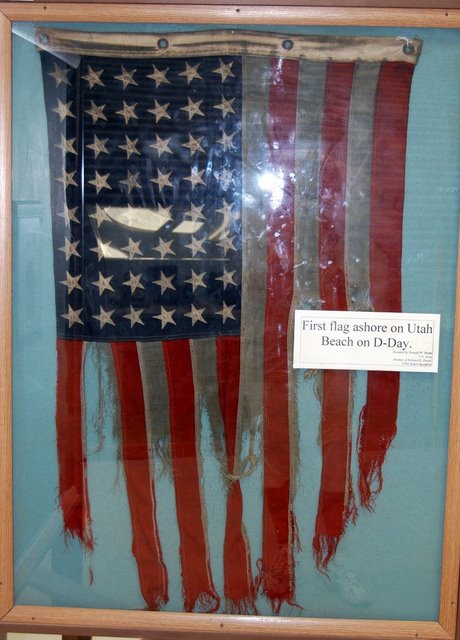
Remembering D-Day, in 2010

June 6, 2010

Encore posts:

D-Day:  66 years ago today

First Flag on Utah Beach, June 6, 1944

First U.S. flag on Utah Beach, Normandy, D-Day, June 6, 1944; Pima Air Museum, Tucson, Arizona

This mostly an encore post. A reader sent an e-mail with a question: Does U.S. law suggest the flying of the U.S. flag on the anniversary of D-Day?

Today is the 66th anniversary of the Invasion of Normandy in World War II, a date generally called D-Day. No, you don’t have to fly your flag. This is not one of the days designated by Congress for flag-flying.

But you may, and probably, you should fly your flag. If you have any D-Day veterans in your town, they will be grateful, as will their spouses, children, widows and survivors. A 22-year-old soldier on the beach in 1944 would be 87 today, if alive. These men and their memories of history fade increasingly fast. Put your flag up. You may be surprised at the reaction.

If you do run into a D-Day veteran, ask him about it. Keep a record of what he says.

First Wave at Omaha:  The Ordeal of the Blue and the Gray by Ken Riley:  Behind them was a great invasion armada and the powerful sinews of war. But in the first wave of assault troops of the 29th (Blue and Gray) Infantry Division, it was four rifle companies landing on a hostile shore at H-hour, D-Day -- 6:30 a.m., on June 6, 1944. The long-awaited liberation of France was underway. After long months in England, National Guardsmen from Virginia, Maryland and the District of Columbia found themselves in the vanguard of the Allied attack. In those early hours on the fire-swept beach the 116th Infantry Combat Team, the old Stonewall Brigade of Virginia, clawed its way through Les Moulins draw toward its objective, Vierville-sur-Mer. It was during the movement from Les Moulins that the battered but gallant 2d Battalion broke loose from the beach, clambered over the embankment, and a small party, led by the battalion commander, fought its way to a farmhouse which became its first Command post in France. The 116th suffered more than 800 casualties this day -- a day which will long be remembered as the beginning of the Allies Great Crusade to rekindle the lamp of liberty and freedom on the continent of Europe.  Image from National Guard Heritage series, from which the caption was borrowed.

"First Wave at Omaha: The Ordeal of the Blue and the Gray" by Ken Riley: Behind them was a great invasion armada and the powerful sinews of war. But in the first wave of assault troops of the 29th (Blue and Gray) Infantry Division, it was four rifle companies landing on a hostile shore at H-hour, D-Day -- 6:30 a.m., on June 6, 1944. The long-awaited liberation of France was underway. After long months in England, National Guardsmen from Virginia, Maryland and the District of Columbia found themselves in the vanguard of the Allied attack. In those early hours on the fire-swept beach the 116th Infantry Combat Team, the old Stonewall Brigade of Virginia, clawed its way through Les Moulins draw toward its objective, Vierville-sur-Mer. It was during the movement from Les Moulins that the battered but gallant 2d Battalion broke loose from the beach, clambered over the embankment, and a small party, led by the battalion commander, fought its way to a farmhouse which became its first Command post in France. The 116th suffered more than 800 casualties this day -- a day which will long be remembered as the beginning of the Allies' "Great Crusade" to rekindle the lamp of liberty and freedom on the continent of Europe. Image from National Guard Heritage series, from which the caption was borrowed.

Quote of the moment: Eisenhower on D-Day

Eisenhower talks to troops of invasion force, June 5 -- before D-Day[Encore post from 2007.]

Soldiers, Sailors, and Airmen of the Allied Expeditionary Force: You are about to embark upon the Great Crusade, toward which we have striven these many months. The eyes of the world are upon you.

Order of the Day, 6 June, 1944 (some sources list this as issued 2 June)

mmm


False claims on DDT

June 6, 2010

One wishes Rachel Carson were still alive, to sue for slander.

One of the more interesting ways claims like those of Rich Kozlovich can continue to circulate, they are not based on any scientific studies.  Had Kozlovich made such claims in a scientific journal, they would have to be retracted. The claims in favor of DDT made at that site are pure hoax, junk science, bogus science, voodoo science (pick your favorite term).

Kids aren’t dying for a lack of pesticides — DDT is still available and cheap in India, China and across Africa.  Malaria is a disease, and it can’t be cured in humans by poisoning the environment.  Malaria’s spread can’t be stopped until we cure in humans so mosquitoes have no pool of disease to draw from, to spread to the next victim.

More:


I get e-mail, from the President on the Gulf oil eruption

June 5, 2010

First time in years I’ve gotten solid information from a politician that didn’t come wrapped in a plea for money. I got a message from President Obama today (I’m sure a few million of his closest friends got the same one):

Ed —

Yesterday, I visited Caminada Bay in Grand Isle, Louisiana — one of the first places to feel the devastation wrought by the oil spill in the Gulf of Mexico. While I was here, at Camerdelle’s Live Bait shop, I met with a group of local residents and small business owners.

Folks like Floyd Lasseigne, a fourth-generation oyster fisherman. This is the time of year when he ordinarily earns a lot of his income. But his oyster bed has likely been destroyed by the spill.

Terry Vegas had a similar story. He quit the 8th grade to become a shrimper with his grandfather. Ever since, he’s earned his living during shrimping season — working long, grueling days so that he could earn enough money to support himself year-round. But today, the waters where he has worked are closed. And every day, as the spill worsens, he loses hope that he will be able to return to the life he built.

Here, this spill has not just damaged livelihoods. It has upended whole communities. And the fury people feel is not just about the money they have lost. It is about the wrenching recognition that this time their lives may never be the same.

These people work hard. They meet their responsibilities. But now because of a manmade catastrophe — one that is not their fault and beyond their control — their lives have been thrown into turmoil. It is brutally unfair. And what I told these men and women is that I will stand with the people of the Gulf Coast until they are again made whole.

That is why, from the beginning, we have worked to deploy every tool at our disposal to respond to this crisis. Today, there are more than 20,000 people working around the clock to contain and clean up this spill. I have authorized 17,500 National Guard troops to participate in the response. More than 1,900 vessels are aiding in the containment and cleanup effort. We have convened hundreds of top scientists and engineers from around the world. This is the largest response to an environmental disaster of this kind in the history of our country.

We have also ordered BP to pay economic injury claims, and this week, the federal government sent BP a preliminary bill for $69 million to pay back American taxpayers for some of the costs of the response so far. In addition, after an emergency safety review, we are putting in place aggressive new operating standards for offshore drilling. And I have appointed a bipartisan commission to look into the causes of this spill. If laws are inadequate, they will be changed. If oversight was lacking, it will be strengthened. And if laws were broken, those responsible will be brought to justice.

These are hard times in Louisiana and across the Gulf Coast, an area that has already seen more than its fair share of troubles. The people of this region have met this terrible catastrophe with seemingly boundless strength and character in defense of their way of life. What we owe them is a commitment by our nation to match the resilience they have shown. That is our mission. And it is one we will fulfill.

Thank you,

President Barack Obama

Good news is that BP now reports some success in stopping the flow of oil.  Information flows increase, oil flows decrease — good trends.

Obama and Jindal, May 2, 2010 - Pete Souza, WH photo

Caption from the White House: President Barack Obama talks with U.S. Coast Guard Commandant Admiral Thad Allen, who is serving as the National Incident Commander, and Louisiana Gov. Bobby Jindal, aboard Marine One as they fly along the coastline from Venice to New Orleans, La., May 2, 2010. John Brennan, Assistant to the President for Homeland Security and Counterterrorism, is in the background. (Official White House Photo by Pete Souza). (This official White House photograph is being made available only for publication by news organizations and/or for personal use printing by the subject(s) of the photograph. The photograph may not be manipulated in any way and may not be used in commercial or political materials, advertisements, emails, products, promotions that in any way suggests approval or endorsement of the President, the First Family, or the White House.)

More information:


Who is that woman with Sen. Watkins, Sec. Benson and President Eisenhower?

June 5, 2010

Minor mystery, but still, it nags.

Who is the woman in this photo?  This is a chance to play history detective.

Sen. Arthur V. Watkins, Sec. of Agriculture Ezra Taft Benson, President Eisenhower, and unidentified woman, 9-9-1958, Shipler Photography image via Utah Hist Soc

Utah Sen. Arthur V. Watkins, Sec. of Agriculture Ezra Taft Benson, and President Dwight D. Eisenhower, with unidentified woman, on September 9, 1958. Photo by Shipler Commercial Photography, scanned at Marriott Library from the collection of the Utah Historical Society (which holds the rights).

I stumbled across the photo at the on-line archives of the Utah Historical Society.  At the time of this picture, Watkins was running for re-election in a race he would lose in November, in a three-way vote split, to Democrat Frank E. Moss.  Watkins had run afoul of very conservative Utah politics when he chaired the Senate select committee that investigated Sen. Joseph McCarthy, and recommended censure of McCarthy.

Ezra Taft Benson served as Eisenhower’s Secretary of Agriculture for the full eight years of Eisenhower’s administration.  Benson was an arch conservative, closely affiliated with the extreme right-leaning John Birch Society, which officially regarded Eisenhower as a bit of a traitor. Benson later served as President of the Church of Jesus Christ of Latter-day Saints (LDS, or Mormon).

Oddly, the picture doesn’t identify the woman.  She’s in a wheel chair.  The large stone columns suggest this is a government building, or monument.  The microphone is set at the level of the woman, so obviously she was speaking at this event, whatever it was.  In an election year, such a scene might be played out in the state of the election, Utah — but I suspect it was a Washington, D.C., venue (was Eisenhower in Utah in 1958?).  Shipler Photography was a Utah company, though — what would they be doing in Washington?

Who is that woman?  What was the event?  Where was it?

_______________

Update: Best guess so far:  Louise Lake, a polio victim from Salt Lake City, and “handicapped American of the year” for 1958. See comments.


Dan Valentine – Romans in ballcaps

June 5, 2010

By Dan Valentine

Ensenada Backpacker. “The hostel of the city.”

Two Italian women – mid-twenties, thereabouts; both beautiful; full of life; educated – walk out of the women’s dorm room, after a night’s sleep.

They’ve been here a couple of days.

One blond, one dark-haired. They both speak several languages. Italian, German, English, Spanish. Fluently. Of course! (It’s a European thing.)

In the United States, we’re lucky to learn English.

“Where are you going today?” I asked. No need for an answer, really. It was early morning. I was making coffee.

“We don’t know yet,” said one. “It’s our last night.”

“Where are you going from here?” I asked. Just making conversation.

“South,” she said.

“Less Americans,” I quipped.

“That’s good!” she said, and meant it.

“I agree,” I said.

And they both laughed. No explanation needed. Humor is identification. And Italians, faster than others, should/can/do connect the dots.

In the eyes of the world, both north and south of the border, across the seven seas, in and around and in between, and to a growing number of citizens born and bred in the United States, we are looked upon as:

Romans in ballcaps!

Chain-store togas (“You’re gonna like what you wear”), Nike clogs.

A nation fast-galloping into its Ben-Hur phase …

Christians and others fed to the lions on “Dancing With the Stars”. Credit card money-lenders …

If Christ were to return any day soon, where do you think He’d end up?

Gitmo is a good guess. No nails but lots of water. If I remember right, Charlton Heston gave Him a much needed sip on His way to, well, you-know-where.

I, myself, think He’d be picked up as a babbling vagrant on the streets of a southern town, locked up in a prison cell at night, tending some rich cattleman’s herd during the day, a short ways from the facility, and after some twenty years – after a lawyer has proven Him innocent of all charges and collected a large fee – let go. Then, looking up to the heavens, I think He would say, “They do not know what they do. Get me the hell outta here.”

In short, deja vu all over again.

Romans in ballcaps.