In Concord, New Hampshire, on March 11 and 12, 2011, apparently testing to see whether that little state has bad enough education standards before announcing a presidential bid, Michelle Bachmann butchered history and geography once again, according to the conservative Minnesota Independent:
“You’re the state where the shot was heard around the world in Lexington and Concord,” she said, referencing Ralph Waldo Emerson’s “Concord Hymn,” an ode to the lives lost at the start of the American Revolution in Concord, Massachusetts, not New Hampshire.
How many bites at the apple does stupid get? Has Ed Brayton picked up on this yet?
New American did its damnedest to explain it away as a slip of the tongue — either assuming Bachmann is too reckless not to use prepared remarks for her first foray into New Hampshire (maybe a more serious indictment), or not paying attention to her written remarks (Was it just one more in a long string of really stupid slips of the tongue? Loose tongues sink as many ships as loose lips . . .); in another article New American falsely claimed a worldwide ban on DDT, falsely claiming the ban killed 30 million kids, and said that it disrupted food growing in America, though food crops hadn’t been sprayed with DDT for nearly a decade when its use was banned on agricultural crops in the U.S. alone. Accuracy isn’t in that animal
[On the slashing of arts education funding:] It’s especially discouraging when you live in a democracy where anything good is possible, if only we have the courage to deal with it.
I could see a bell-ringer in there somewhere. Who do you think ought to see this thing? What classes in public schools should see it, for what purpose?
I hope the year-long series lives up to the video. I hope there are a lot more videos to go along with it. As a piece of persuasive rhetoric, it does make a decent case for subscribing to National Geographic for a year. How’s that for rhetorical criticism?
Spread the word; friends don't allow friends to repeat history.
Eric Brehm teaches in Wisconsin. Now you know the answers to any questions about bias you may have.
It’s been more than three weeks, and Mr. Brehm has gotten no answer from Wisconsin Gov. Scott Walker. It’s not exactly like Walker is a student who hasn’t done his homework, but it’s close enough.
On Saturday, February 19, 2011, I sent the following letter to Wisconsin Governor Scott Walker. It has since been reposted and blogged a number of times, for which I am grateful. However, this blog would not be complete unless I included a copy of it here. And so, here is where it all began:
To the Duly-Elected Governor of Wisconsin, Scott Walker (and anyone else who gives a hoot):
It has only been a week, and I grow weary of the political struggle that your Budget Repair Bill has caused. I am tired of watching the news, though I have seen many of the faces of those I hold dear as they march on the Capitol. I am tired of defending myself to those who disagree with me, and even a bit tired of fist-bumping those who do. I am tired of having to choose a side in this issue, when both sides make a certain degree of sense. And so I offer you this desultory (aimless or rambling) philippic (angry long-winded speech), because at the end of the day I find that though this issue has been talked to death, there is more that could be said. And so, without further ado, here are my points and/or questions, in no particular order.
1. You can have my money, but. . .. Ask any number of my students, who have heard me publicly proclaim that a proper solution to this fiscal crisis is to raise taxes. I will pay them. I have the great good fortune to live in a nation where opportunity is nearly limitless, and I am willing to pay for the honor of calling myself an American. Incidentally, Warren Buffett, the second richest man in the nation (and a Democrat) agrees with me. Your proposed Budget Repair Bill will cost me just under $3000 per year at my current salary, with the stated goal of saving $30 million this year on the state budget. I say, take it. You can have it. It will hurt me financially, but if it will balance the budget of the state that has been my home since birth, take it with my blessing. But if I may, before you do, I have some questions.
According to the 2009 estimate for the U.S. Census, 5,654,774 people live in the state of Wisconsin. Of those, 23.2% are under the age of 18, and presumably are not subject to much in the way of income tax. That still leaves about 4,342,867 taxpayers in the state of Wisconsin. If you wished to trim $30 million off of the budget, that works out to about $6.91 per Wisconsin taxpayer. So I must ask: Is it fair that you ask $3000 of me, but you fail to ask $6.91 of everyone? I know that times are tough, but would it not be more equitable to ask that each taxpayer in the state contribute an extra 13 cents a week?
Would you please, kindly, explain exactly how collective bargaining is a fiscal issue? I fancy myself to be a fairly intelligent person. I have heard it reported in the news that unless the collective bargaining portion of this bill is passed, severe amounts of layoffs will occur in the state. I have heard that figure given as 6,000 jobs. But then again, you’ve reportedly said it was 10,000 jobs. But then again, it’s been reported to be as high as 12,000 jobs. Regardless of the figure, one thing that hasn’t been explained to my satisfaction is exactly how or why allowing a union to bargain collectively will cost so much money or so many jobs. Am I missing something? Isn’t collective bargaining essentially sitting in a room and discussing something, collectively? Is there now a price tag on conversation? How much does the average conversation cost? I feel your office has been eager to provide doomsday scenarios regarding lost jobs, but less than willing to provide actual insight as to why that is the case. I would welcome an explanation.
Why does your concern over collective bargaining, pensions, and healthcare costs only extend to certain unions, but not all? Why do snow plow drivers and child care providers and teachers and prison guards find themselves in “bad” unions, but firefighters and state police and local police find themselves in unions that do not need to be effected by your bill? The left wing news organizations, of course, state that this is because these are unions that supported your election bid, while you seek to punish those unions that did not; I would welcome your response to such a charge. You have stated that the state and local police are too vital to the state to be affected. Can I ask how child care, or prison guards, or nurses or teachers are not vital? Again, I would welcome a response.
Though you are a state employee, I have seen no provision in your bill to cut your own pension or healthcare costs. The governor’s salary in Wisconsin was about $137,000 per year, last I checked. By contrast, I make about $38,000 per year. Somewhere in that extra $99,000 that you make, are you sure you couldn’t find some money to fund the state recovery which you seem to hold so dear? As you have been duly elected by the voters of Wisconsin, you will receive that salary as a pension for the rest of your life. I don’t mean to cut too deeply into your lifestyle, but are you sure you couldn’t live off $128,000 per year so that you could have the same 7% salary reduction you are asking certain other public employees to take?
2. Regarding teachers being overpaid and underworked. I don’t really have many questions in this regard, but I do have a couple of statements. If you haven’t already figured it out, I am a teacher, so you may examine my statement for bias as you see fit. I admit I find it somewhat suspect that teachers are mentioned so prominently in your rhetoric; those protesting at the Capitol are indeed teachers. But they are also students, and nurses, and prison guards, and plumbers, and firefighters, and a variety of other professions. If you could go back to “public sector employees,” I would appreciate it. But as far as being overpaid and underworked . . . I grant you, I have a week’s vacation around Christmas. I have a week off for Spring Break. I have about 10 weeks off for summer. With sick days and personal days and national holidays and the like, I work about 8.5 months out of every year. So perhaps I am underworked. But before you take that as a given, a couple of points in my own defense.
The average full-time worker puts in 40 hours per week, 50 weeks per year, with two weeks’ vacation time. That makes for a grand total of 2000 hours per year. Part of the teachers’ arguments regarding their time is that no one sees how many hours they work at home to grade papers, or create lesson plans, or things of that nature. I am in a rare state, in that I am not one of those teachers. I work an hour from where I live, and I like to keep my work at work. I, therefore, do not bring work home with me, but rather stay at school, or come in early, so that I can grade papers or create lesson plans while at school. So I am more prepared than most to explain the hours it takes to do my job. I also supervise an extra-curricular activity (as many teachers do), in that I serve as the Drama Coach for my school. The school year, so far, has lasted for 24 weeks. I have, in that time, averaged 78 hours per week either going to school, being at school, or coming home from school. If you remove my commute, of course, I still average 68 hours per week, thus far. That means I have put in 1,632 hours of work time this year, which works out to over 80% of what your average full time worker does in a calendar year. If you include my commute, I’m over 90%. If ikeep going at my current pace, I will work 2,720 hours this school year (or 3,120 hours if you include my commute). That means I work 136% to 156% as much as your average hourly worker.
As to underpaid — I’m not sure I am underpaid in general, though I do believe I am underpaid in terms of the educational level expected to do my job. I have two Bachelor’s Degrees, and will be beginning work toward my Master’s this summer. By comparison, sir, you never completed college, and yet, as previously stated, you outearn me by almost $100,000 per year. Perhaps that is an argument that I made the wrong career choice. But it is perhaps an argument that we need to discuss whether you and others like you are overpaid, and not whether teachers are.
3. Regarding the notion that teachers that are protesting, or legislators currently in Illinois, are hurting the state. Very briefly, if I may:
Teachers have been accused of shirking their duties by protesting for what they believe to be their rights instead of being in school. The argument has been, of course, that no lessons have been taught when classes aren’t in session. I must submit that lessons in protest, in exercise of the First Amendment right to peaceable assembly, in getting involved as a citizen in political affairs, have been taught these past few days. The fact that they haven’t been taught in the classroom is irrelevant. Ultimately a very strong duty of the school system is to help students become citizens — I think that has clearly happened this week.
As to the legislators, it seems to me as though they feel their constituents deserve to have a length of time to examine the proposed bill on its merits, not vote it straight up or down three days after it was presented. As the current budget does not expire until June, this seems to me like the only response left them in light of your decision to fast-track the bill without discussion. Give them another option, and perhaps they will come back. I can’t say that I agree with their decision, but I can say that I understand it.
4. Regarding the notion that protestors at the Capitol are rabble-rousers and/or thugs. Such name-calling on the part of conservatives in the state and the conservative media could be severely curtailed if you would speak out against it. True, most of the people protesting, if not all, are liberals. Historically, liberals have always tended to think that they have far more support than they actually do. They also (in my opinion) have a tendency to get extremely organized about three months too late, if at all. So you can fault them for their decision-making, but I would ask you to speak out against the notion of thuggery. Again, very briefly:
So far, 12 arrests have been made. Estimates say there were about 25,000 people at the Capitol today, and about 20,000 yesterday. Let’s be conservative (mathematically) and say that 40,000 people protested over two days. That would mean that officers arrested .0003% of all protestors. By almost any definition, that is an extremely peaceful demonstration, and of course you are aware that the U.S. Constitution guarantees the right of peaceable assembly for a redress of grievances. So in the main, these people have done nothing wrong.
5. If I may provide you with a sense of history. You work in the largest and most magnificiently appointed state capitol in the nation, built by Bob LaFollette (a Republican). You work in the same building where Phil LaFollette (a Republican) helped guide Wisconsin out of the Great Depression. You work in the same building where Gaylord Nelson (a Democrat) was the first in the nation to offer rights to unions of state employees, rights that you now seek to overturn. And you work in the same building where Tommy Thompson (a Republican) provided more state funding to education than any other governor before or since. Are your current actions truly how you would choose to be remembered?
6. Finally, Governor, a note of thanks. Whatever the outcome of the next several days, you deserve a certain degree of credit. As an educator, I understand how difficult it can be to get young people interested in politics. You have managed to do this in the space of one week. A number of Wisconsin’s youth support you. A number of them do not. But whatever else can be said of you, you have them paying attention, and thinking about voting, and walking around the Capitol, and turning out to be involved. You have taught your own lessons this week, Governor, and that has its own value.
Thank you for your time,
Eric Brehm
XXX North XXXXXX Street
Endeavor, WI 53930
While I recognize that the governor has many issues on his plate, I should note that I am still waiting for a response.
Just when you think the conservatives can’t possibly sound any more like fascists of the 1930s . . . I mean, can we just repeal Godwin’s law and call a racist fascist argument, a racist fascist argument?
Paul Krugman, whose Nobel Memorial Prize for economics galls conservatives more than left turns bothered J. Edgar Hoover, noted the other day that Texas is in a series of fixes. This is important because Texas is what Wisconsin’s governor claims Wisconsin should be: Shorn of union interference in almost all things, especially in public service sectors including education. Krugman wrote in his column, “Leaving Children Behind”:
Texas likes to portray itself as a model of small government, and indeed it is. Taxes are low, at least if you’re in the upper part of the income distribution (taxes on the bottom 40 percent of the population are actually above the national average). Government spending is also low. And to be fair, low taxes may be one reason for the state’s rapid population growth, although low housing prices are surely much more important.
But here’s the thing: While low spending may sound good in the abstract, what it amounts to in practice is low spending on children, who account directly or indirectly for a large part of government outlays at the state and local level.
And in low-tax, low-spending Texas, the kids are not all right. The high school graduation rate, at just 61.3 percent, puts Texas 43rd out of 50 in state rankings. Nationally, the state ranks fifth in child poverty; it leads in the percentage of children without health insurance. And only 78 percent of Texas children are in excellent or very good health, significantly below the national average.
But wait — how can graduation rates be so low when Texas had that education miracle back when former President Bush was governor? Well, a couple of years into his presidency the truth about that miracle came out: Texas school administrators achieved low reported dropout rates the old-fashioned way — they, ahem, got the numbers wrong.
It’s not a pretty picture; compassion aside, you have to wonder — and many business people in Texas do — how the state can prosper in the long run with a future work force blighted by childhood poverty, poor health and lack of education.
But things are about to get much worse.
A few months ago another Texas miracle went the way of that education miracle of the 1990s. For months, Gov. Rick Perry had boasted that his “tough conservative decisions” had kept the budget in surplus while allowing the state to weather the recession unscathed. But after Mr. Perry’s re-election, reality intruded — funny how that happens — and the state is now scrambling to close a huge budget gap. (By the way, given the current efforts to blame public-sector unions for state fiscal problems, it’s worth noting that the mess in Texas was achieved with an overwhelmingly nonunion work force.)
Krugman was too easy on Perry. In his campaign last year, Perry claimed that Texas had plenty of money, a surplus, even. In debates with Democratic candidate Bill White, Perry pooh-poohed the notion that Texas had a sizable deficit, certainly not the $18 billion deficit White named.
No, the Texas deficit actually is north of $25 billion. (Linda Chavez-Thompson, the defeated Democratic candidate for Lieutenant Governor, addressed Perry’s denial in a line that very few reporters bothered to report (or report accurately): “Do you know how many zeroes there are in 18 billion?” Chavez-Thompson said. “11, when you count Perry and Dewhurst.”)
But blogger Iowahawk would hear none of that — no, the issue isn’t bad government and poor fiscal management. Texas loses out in education because its got more racial minorities, he wrote at some length.
Krugman’s original point was untouched by any of these guys. Texas is in deep trouble, on many, many fronts. One of the more common comments on Texas education is, “Thank God for Mississippi!” Mississippi’s having closed down its education system rather than integrate, and continued underfunding and mismanagement since the federal government forced the reopening, keeps Mississippi at the bottom of almost all state rankings regarding children. That means Texas isn’t dead last. Texas’s very real problems will affect racial disparities in achievement, but they are in no way caused by racial disparity, or race of the students.
Notice, too, how Iowahawk changed the comparison. Krugman noted dropout rates. Unable to muster a direct rebuttal to Krugman’s point, Iowahawk switched to comparing scores in NAEP. It’s not the same thing by any stretch.
No Texas teacher would say Texas performs better than any other state in stopping dropouts. While we might brag a bit on how we’ve increased scores on the ACT and SAT, it’s not across the board, and it’s not enough. (It’s a miracle with the stingy funding, and it will likely stop with the proposed budget cuts — but we’re proud of our ability to make improvement despite obstacles carefully placed by state policy makers.)
Notice, too, that dropouts tend to perform more poorly on standardized tests. If one wishes to screw around with the statistics for spin, one might note that by forcing students to drop out, Texas raises its scores on NAEP. I seriously doubt any Texas educator conducts a campaign to get dropouts to boost NAEP scores, but let’s be realistic. (Which is not to say that there is not a lot of action to mask the dropout problem; a Texas high school is responsible for the academic achievement of kids who drop out, or more accurately, the lack of academic achievement. Dropouts count against a school’s performance rating, and count hard. Every school on the cusp of “Exemplary,” or “Recognized,” or “Unacceptable,” has a campaign to track down dropouts to find that they have enrolled in another school to whom blame can be passed, or that they have left the state or the nation, and so don’t count in Texas at all. One wishes one could school administrators and legislators in Deming’s Red Bead Experiment.)
It’s impossible to claim Wisconsin union teachers are to blame for any Wisconsin woe, when Texas, with it’s strong anti-union stands and ban on unionizing among teachers, performs worse, on average.
Will busting the unions put Wisconsin in the black? It didn’t work for Texas.
Will busting the unions help Wisconsin schools? You can’t make that case based on the information from Texas. In fact, Angus Johnson conducted a more serious analysis of statistics that may provide a better view into the issue, and they tend to show that unionized teachers improve education performance.
Surely these guys understand where their argument ends up. It is absolutely untrue that Texas’s minorities dragged the state into deficits.
We know where Texas deficits came from. Several years ago Texas cut property taxes, a key source of education and other funding for the state, promising to make up the difference with corporate tax reforms. But the corporations blocked significant reform. Texas has been running on empty for six years, and now the deficits are simply too big to hide.
Unwise tax cuts, made for political gains, that put Texas in the dumper.
It wasn’t unions, and it sure wasn’t the large population of hard-working, tax-paying, union-needing Hispanics and blacks and Native Americans who got Texas in trouble. They didn’t get the tax cut benefits, for the most part.
Race is not the cause of our education and budget woes, except in this way: Racists, especially the latent, passive-aggressive sort, will not hesitate to cut programs that they see benefiting minorities. Those education programs that have done the most to reduce the achievement gaps between the races, boosting minority achievement, are the first to go under the Republican budget meat cleavers. The proposed cuts are not surgical in any way, to preserve education gains.
Spread the word; friends don't allow friends to repeat history.
Looking at my print copy I was struck that most of the “states” listed — really communities of people — have lost economic ground in the past decade. Average per capita incomes dropped for most groups.
Since 1980, income inequality has fractured the nation. Click each icon to see each of the dozen states, which counties belong to them and how median income has changed over the last 30 years.
The old income inequality monster rearing its ugly, ugly head again. America is losing ground. No wonder the Republicans are discouraged — but why don’t they understand that its their policies that create the trouble?
This week, EPA bashing took front and center on the performance stage that passes as Congress these days. There is a school of thought that thinks EPA should be eviscerated because EPA is carrying out the mandate an earlier Congress gave it, to clean up the air. Especially, the recent assailants claim, EPA should not try to reduce carbon emissions, because clean air might cost something.
Steven Milloy, who makes crude and false claims against William Ruckelshaus, a great lawyer and the hero of the Saturday Night Massacre. Why does Milloy carry such a pathetic grudge?
Wholly apart from the merits, or great lack of merits to those arguments, the anti-EPA crowd is just ugly.
78-year-old William Ruckelshaus, the Hero of the Saturday Night Massacre, a distinguished lawyer and businessman, and the founding Director of EPA who was called back to clean it up after the Reagan administration scandals, granted an interview on EPA bashing to Remapping Debate, an ambitious, independent blog from the Columbia School of Journalism designed to provide information essential to policy debates that too-often gets overlooked or buried. [Remapping Debate sent a note that they are not affiliated with CSJ; my apologies for the error.]
Ruckelshaus, as always, gave gentlemanly answers to questions about playing politics with science, and bashing good, honest and diligent government workers as a method of political discourse.
He’s the 20th century’s only mass murderer to survive and thrive (as a venture capitalist) in the 21st century.
Milloy owes Ruckelshaus an apology and a complete retraction. I rather hope Ruckelshaus sues — while Milloy will claim the standards under New York Times vs. Sullivan as a defense, because Ruckelshaus is a public figure, I think the only question a jury would have to deal with is how much malice aforethought Milloy exhibits. Malice is obvious. Heck, there might not even be a question for a jury — Milloy loses on the law (nothing he claims against Ruckelshaus is accurate or true in any way).
This is much more damning than what got two NPR officials to lose their jobs.
Who will stand up for justice here? Rep. Upton? Rep. Boehner? Anthony Watts?
I tried to offer a correction, and since then have written Milloy demanding an apology and retraction — neither comment has surfaced yet on Milloy’s blog. Here’s the truth Milloy hasn’t printed:
No, Sweeney did not rule that DDT is not a threat to the environment. He said quite the opposite. Sweeney wrote, in his ruling:
20. DDT can have a deleterious effect on freshwater fish and estuarine organisms when directly applied to the water.
21. DDT is used as a rodenticide. [DDT was used to kill bats in homes and office buildings; this was so effective that, coupled with accidental dosing of bats from their eating insects carrying DDT, it actually threatened to wipe out some species of bat in the southwest U.S.]
22. DDT can have an adverse effect on beneficial animals.
23. DDT is concentrated in organisms and can be transferred through food chains.
On that basis, two federal courts ruled that DDT must be taken off the market completely. Sweeney agreed with the findings of the courts precisely, but he determined that the law did not give him the power to order DDT off the market since the newly-proposed labels of the DDT manufacturers restricted use to emergency health-related tasks. With the benefit of rereading the two federal courts’ decisions, Ruckelshaus noted that the courts said the power was already in the old law, and definitely in the new law. [See, for example, EDF v. Ruckelshaus, 439 F. 2d 584 (1971)]
DDT was banned from use on crops in the U.S. as an ecosystem killer. It still is an ecosystem killer, and it still deserves to be banned.
Ruckelshaus’s order never traveled outside the U.S. DDT has never been banned in most nations of the world, and even though DDT has earned a place on the list of Dirty Dozen most dangerous pollutants, even under the Persistent Organic Pollutants Treaty of 2001, DDT is available for use to any country who wishes to use it.
Please get your facts straight.
Would you, Dear Reader, help spread the word on Facebook, Reddit, Twitter, or any other service you have, that the Brown Lobby has gone too far in it’s error-based propaganda against clean air and those who urge a better environment? Please?
Spread the word; friends don't allow friends to repeat history.
Tuesday morning, March 8, the Republican-controlled House of Representatives Committee on Energy and Commerce opened hearings on global warming, staging an assault on science with a series of witnesses, some of whom recently have made a career out of mau-mauing scientists.
Dr. Donald Roberts’ testimony to the House Committee on Energy and Power, on March 8, 2011, presented a grand collection of Bogus History, coupled with Bogus Science. Roberts has an unfortunate history of presenting doctored data and false claims to Congress.
One witness took after the EPA directly and Rachel Carson by implication, with a specious claim that DDT is harmless. Donald Roberts is a former member of the uniformed public health service. Since retiring, and perhaps for a while before, he started running with a bad crowd. Of late he’s been working with the Merry Hoaxsters of the unrooted Astroturf organization Africa Fighting Malaria (AFM), a group dedicated to publishing editorials tearing down the reputation of Rachel Carson, the World Health Organization (WHO) and the Environmental Protection Agency (EPA).
(That would all be purple prose, were it not accurate in its description of people, organizations and their actions.)
Why was Roberts testifying at a hearing on global warming? He’s carrying water for the anti-science, “please-do-nothing” corporate crowd. It’s a tactic from the old tobacco lobbyist book: Roberts claims that scientists got everything wrong about DDT, and that the ban on DDT done in error has wreaked havoc in the third world. Therefore, he says, we should never trust scientists. If scientists say “duck!” don’t bother, in other words.
Roberts is in error. Scientists, especially Rachel Carson, were dead right about DDT. Because corporate interests refused to listen to them, the overuse and abuse of DDT rendered it ineffective in the fight against malaria, and DDT use as part of a very ambitious campaign to eradicate malaria had to be abandoned in 1965. The entire campaign had to be abandoned as a result, and more than 30 million kids have died since.
So don’t grant credence to Roberts now. He’s covering up one of the greatest industrial screw-ups in history, a screw up that, by Roberts’ own count, has killed 30 million kids. What in the world would motivate Roberts to get the story so wrong, to the detriment of so many kids?
Roberts said:
Putting issues of EPA budget aside, I want to introduce my technical comments with a quote from a recent Associated Press article with a lead statement “none of EPA’s actions is as controversial as its rules on global warming.” In my opinion, this is wrong.
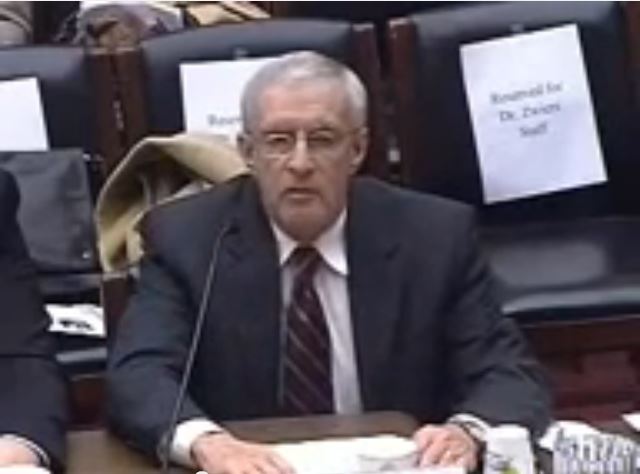
Dr. Donald Roberts testifying to the House Energy Committee, March 8, 2011. Screen capture from Committee video.
Roberts is correct here in his opinion. It is simply wrong that EPA’s rules on global warming and controls of the pollutants that cause it should be controversial. Among air pollution scientists the rules are not controversial. Among climate scientists the rules are not controversial. Roberts and his colleagues at the so-called Competitive Enterprise Institute, Africa Fighting Malaria (AFM), and American Enterprise Institute (AEI) work hard to manufacture controversy where the science does not support their case.
It is wrong. Roberts should be ashamed.
Roberts said:
Almost forty years ago EPA banned DDT in the United States. Its action against DDT was extraordinarily controversial, and still is. As activists advanced fearful claims against DDT, the EPA was warned, over and over again, a ban would destroy critically important disease control programs and millions upon millions of poor people in developing countries would die as consequence. Leaders of the World Health and Pan American Health Organizations, and even the U.S. Surgeon General warned against the ban. The EPA banned DDT anyway, and the doomsday predictions of those public health leaders proved prescient.
EPA’s ban on DDT in the U.S. was limited to the United States. Roberts doesn’t say it flat out, but he implies that the U.S. ban on spraying DDT on cotton fields in Texas and Arkansas — and cotton was about the only crop where DDT was still used — somehow caused a ban on DDT in Africa, or Asia, or South America, or other places where malaria still occurs.
I’m also not sure that health officials “pleaded” to stop the U.S. ban on any grounds, but certainly they did not plead with Ruckelshaus to keep spraying DDT on cotton. Roberts is making stuff up in effect, if not in intent.
Probably more to the point, health officials had stopped significant use of DDT in Africa in 1965, seven years before EPA acted in the U.S., because overuse of DDT on crops in Africa had bred mosquitoes that were resistant and immune to the stuff. Since 1955, in close cooperation with the malaria-fighting experts from the Rockefeller Foundation including the great Fred Soper, WHO carried on a methodical, militant campaign to wipe out malaria. The program required that public health care be beefed up to provide accurate malaria diagnoses, and complete treatment of human victims of the parasitic disease. Then an army of house sprayers would move in, dosing the walls of houses and huts with insecticide. Most malaria-carrying mosquitoes at the time would land on the walls of a home or hut after biting a human and getting a blood meal, pausing to squeeze out heavy, excess water to make flight easier. If the wall were coated with an insecticide, the mosquito would die before being able to bite many more people, maybe before becoming capable of spreading malaria.
DDT was Soper’s insecticide of choice because it was long-lasting — six months or more — and astonishingly deadly to all small creatures it contacted.
But, as Malcolm Gladwell related in his 2001 paean to Soper in The New Yorker, Soper and his colleagues well understood they were racing against the day that mosquitoes became resistant enough to DDT that their program would not work. They had hoped the day would not arrive until the late 1970s or so — but DDT is such an effective killer that it greatly speeds evolutionary processes. In the mid-1960s, before an anti-malaria campaign could even be mounted in most of Subsaharan Africa, resistant and immune mosquitoes began to stultify the campaign. By 1965, Soper’s crews worked hard to find a substitute, but had to switch from DDT. By 1972 when the U.S. banned DDT use on cotton in the U.S., it was too late to stop the resistance genes from killing WHO’s anti-malaria program. In 1969 WHO formally abandoned the goal of malaria eradication. The fight against malaria switched to control.
Roberts claims, implicitly, that people like those who worked with Soper told EPA in 1971 that DDT was absolutely essential to their malaria-fighting efforts. That could not be accurate. In 1969 the committee that oversaw the work of the UN voted formally to end the malaria eradication project. In effect, then, Roberts claims UN and other health officials lied to EPA in 1971. It is notable that Soper is credited with eradicating malaria from Brazil by 1942, completely without DDT, since DDT was not then available. Soper’s methods depended on discipline in medical care and pest control, and careful thought as to how to beat the disease — DDT was a help, but not necessary.
Interestingly, the only citation Roberts offers is to his own, nearly-self-published book, in which he indicts almost all serious malaria fighters as liars about DDT.
Can Roberts’ testimony be trusted on this point? I don’t think we should trust him.
In fact, DDT and the eradication campaign had many good effects. In 1959 and 1960, when DDT use was at its peak in the world, malaria deaths numbered about 4 million annually. The eradication campaign ultimately was ended, but it and other malaria-fighting efforts, and general improvements in housing and sanitation, helped cut the annual death toll to 2 million a year by 1972.
After the U.S. stopped spraying DDT on cotton, mosquitoes did not migrate from Texas and Arkansas to Africa. As noted earlier, the EPA order stopping agricultural use, left manufacturing untouched, to increase U.S. exports. So the ban on DDT in the U.S. increased the amount of DDT available to fight malaria.
Malaria fighting, under Soper’s standards, required great discipline among the malaria fighters — the sort of discipline that governments in Subsaharan Africa could not provide. Had WHO not slowed its use of DDT because of mosquito resistance to the stuff, WHO still would not have been able to mount eradication campaigns in nations where 80% of residences could not be sprayed regularly.
Advances in medical care, and better understanding of malaria and the vectors that spread it, helped continue the downward trend of malaria deaths. There was a modest uptick in the 1980s when the parasites themselves developed resistance to the drugs commonly used to treat the disease. With the advent of pharmaceuticals based on Chinese wormwood, or artemisinin-based drugs, therapy for humans has become more effective. Today, the annual death toll to malaria has been cut to under a million, to about 900,000 per year — a 75% drop from DDT’s peak use, a 50% drop from the U.S. ban on farm use of DDT.
With the assistance of WHO, most nations who still suffer from malaria have adopted a strategy known as Integrated Vector Management, or IVM (known as integrated pest management or IPM in the U.S.). Pesticides are used sparingly, and insect pests are monitored regularly and carefully to be sure they are not developing genetic-based resistance or immunity to the pesticides. This is the method that Rachel Carson urged in 1962, in her book, Silent Spring. Unfortunately, much of the malaria-suffering world didn’t come to these methods until after the turn of the century.
Progress against malaria has been good since 2001, using Rachel Carson’s methods.
Don Roberts’ blaming of science, EPA, WHO, and all other malaria fighters is not only misplaced, wrong in its history and wrong in its science, but it is also just nasty. Is there any way Roberts could not know and understand the facts?
These are the facts Roberts works to hide from Congress:
“Science” and scientists were right about DDT. DDT is a dangerous substance, uncontrollable in the wild according to federal court findings and 40 years of subsequent research. If we were to judge the accuracy of scientists about DDT, we would have to conclude that they were deadly accurate in their judgment that use of DDT should be stopped.
If the ban on DDT was controversial in 1972, it should not be now. All research indicates that the judgment of EPA and its director, William Ruckelshaus, was right.
EPA was not warned that a ban on agricultural use of DDT would harm public health programs, in the U.S., nor anywhere else in the world. In any case, EPA’s jurisdiction ends at U.S. borders — why would WHO say anything at all?
DDT use to fight malaria had been curtailed in 1965, years before the U.S. ban on farm use, because overuse of DDT on crops had bred DDT-resistant and DDT-immune mosquitoes. Consequently, there was not a huge nor vociferous lobby who warned that health would be put at risk if DDT were banned. Claims that these warnings were made are either false or grossly misleading.
Malaria death rates declined to less than 50% of what they were when DDT was banned from farm use in the U.S. — there was no “doomsday” because the U.S. stopped spraying DDT on cotton, and there never has been a serious shortage of DDT for use against malaria, anywhere in the world.
How much of the rest of the testimony against doing something about global warming, was complete hoax?
[Editor’s note: My apologies. I put this together on three different machines while conducting other activities. On proofing, I find several paragraphs simply disappeared, and edits to make up for the time of composing and fix tenses, got lost. It should be mostly okay, now, and I’ll add in the links that disappeared shortly . . . oh, the sorry work of the part-time blogger.]
Update, 2015: Video of the hearing, from YouTube:
Spread the word; friends don't allow friends to repeat history.
This probably deserves a longer, more thought-out post.
Maybe later.
Right now I just want to get this off my chest:
I do not believe, as the Republican budget insists, that America is no longer a great nation, that our greatest days are long past, and that America needs to hunker down and join the Second- or Third-World. I do not believe that America can afford to give up leadership in foreign affairs, nor leadership in education. I do not believe God will step in to save us from our own stupidity. America is an exceptional place because people chose to act, to make the things that make a great nation.
I believe we need to answer when the certain trumpets blow, and they are sounding now. I do not believe the full-scale retreat proposed by the Republican budget is the proper, best, nor American response.
Back to regular programming now.
Spread the word; friends don't allow friends to repeat history.
I don’t get the idea that Ham is sad about it, though, do you?
Destroying a child’s natural curiosity about science and the world around them damages them for life. In the U.S., we are fighting trends that show kids in 4th grade are as scientifically adept as the other best students in the world; by 8th grade their affinity for science has begun to fade, and by 12th grade, U.S. students rank far below many other industrialized nations in science achievement. Ken Ham’s story is one reason why that happens.
Isn’t crushing a child’s intelligence a form of child abuse?
“Over 1 million people a year die because of the massive populations of misquotes.”
I preserve it here just because it gives me a smile; here is the sentence above with what I presume is a typographical error that carries great humor, in its natural habitat:
While there is a a discussion going on whether DDT should be used or not in America, it is undeniable that It should be used in 3rd world countries like in Africa to stop the spread of Malaria. Over 1 million people a year die because of the massive populations of misquotes. No doubt that this number could be lowered dramatically. Not only is DDT a type of pesticide, it is a pest repellent, meaning that even if the bug has grown immunity to the pesticide, it will invariably avoid area’s where DDT is sprayed. To use it to a maximum effect, it would be a good idea to spray it on 1 wall inside a home. That’s all that is required to stop the malaria epidemic in Africa. —Preceding unsigned comment added by Delata38 (talk • contribs) 14:48, 10 August 2010 (UTC)
I have no idea who Delata38 is, and hope she or he is not offended at my preservation of the typo. The error may have been caused by an over-enthusiastic autocorrect function, and no fault of the author at all. The statement may be completely correct in a few other contexts, something that should give all journalists pause and cause to strive harder for greater accuracy.
This letter, written on the day established for the first meeting of the Congress, sets the scene as the members began to gather in New York City. Morris’s concern that the “public expectation seems to be so highly wound up that I think disappointment must inevitably follow after a while, nothwithstanding that I believe there will be inclination and abilities in the two houses to do every thing that reasonable and sensible men can promise to themselves, but you know well how impossible it is for public measures to keep pace with the sanguine desires of the interested, the ignorant, and the inconsiderate parts of the Community.” eloquently expressed the challenge that faced the members of the new Congress.
Odd stuff:
New York City was bustling with 29,000 residents in 1789
Spread the word; friends don't allow friends to repeat history.
Or, until that account is unsuspended by the forces supporting Donald Trump: Follow @FillmoreWhite, the account of the Millard Fillmore White House Library
We've been soaking in the Bathtub for several months, long enough that some of the links we've used have gone to the Great Internet in the Sky.
If you find a dead link, please leave a comment to that post, and tell us what link has expired.
Thanks!
Retired teacher of law, economics, history, AP government, psychology and science. Former speechwriter, press guy and legislative aide in U.S. Senate. Former Department of Education. Former airline real estate, telecom towers, Big 6 (that old!) consultant. Lab and field research in air pollution control.
My blog, Millard Fillmore's Bathtub, is a continuing experiment to test how to use blogs to improve and speed up learning processes for students, perhaps by making some of the courses actually interesting. It is a blog for teachers, to see if we can use blogs. It is for people interested in social studies and social studies education, to see if we can learn to get it right. It's a blog for science fans, to promote good science and good science policy. It's a blog for people interested in good government and how to achieve it.
BS in Mass Communication, University of Utah
Graduate study in Rhetoric and Speech Communication, University of Arizona
JD from the National Law Center, George Washington University


 Posted by Ed Darrell







 Millard Fillmore's Bathtub