Annals of Global Warming: It didn’t start with the hockey stick . . .

December 12, 2011

Peter Sinclair comes through with a good explanation of the history of concern about global warming — how the warming trend was discovered.

It wasn’t scientists trying to get government grants.  It was the U.S. Air Force, trying to beat the commies and keep America safe for democracy and, ironically, safe for dissent from such applications of science.


9,996

Real history couldn’t be published as fiction, which is one way we can tell real history from the stuff that gets made up.  In the story told in this video, note carefully the serendipity of figuring out the CO2 issues:  Who could invent a story about warfare leading to the discovery of global warming?  As with the coincidence of John Adams and Thomas Jefferson both dying on the 50th anniversary of the Declaration of Independence, no editor of fiction would accept it as believable.

More:

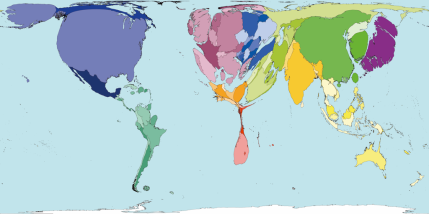
Why we worry, why policy makers are involved:  Carbon Emissions, 2000 – from WorldMapper, with a serendipitous tip of the old scrub brush to Petra Tschakert at Penn State.

Carbon emissions 2000, from worldmapper.org - creative commons license

Carbon Emissions 2000, from worldmapper.org - creative commons license

Carbon Emissions 2000 © Copyright 2006 SASI Group (University of Sheffield) and Mark Newman (University of Michigan). “We welcome use of our maps under the Creative Commons conditions by educational, charitable and other non-profit organisations.”

Progress from Durban?

December 11, 2011

Meeting in Durban, South Africa, government officials from many nations worked to find solutions to human causation of destructive climate change, in the framework of proposed treaties under United Nations aegis.

Negotiations at Durban, South Africa, December 10, 2011 - UK DECC photo

Negotiators at the COP17 Climate Conference in Durban work late into the night to reach agreement on a roadmap to a legally binding deal, 10 December 2011. UKDECC photo and caption

Did anyone expect good reports out of these meetings?

From the UK Department of Energy and Climate Change, we get this press release, dated Sunday, December 11, 2011:

Road open to new global legal climate treaty

  • Global agreement achieved on a roadmap to a legally binding deal
  • Second commitment period of Kyoto Protocol to be agreed next year
  • Green Climate Fund to be set up

The UN climate talks in South Africa have been heralded a success after a climate change deal was struck in the early hours of Sunday morning.194 parties have spent the past two weeks in Durban discussing how to cut emissions to limit global temperature rise to below two degrees to avoid dangerous climate change.

In a major realignment of support, well over 120 countries formed a coalition behind the EU’s high ambition proposal of a roadmap to a global legally binding deal to curb emissions. African states together with the least developed countries such as Bangladesh and Gambia, and small island states vulnerable to rising sea levels, like the Maldives, joined with the EU to put forward a timetable which would see the world negotiate a new agreement by 2015 at the latest.

The talks resulted in a decision to adopt the second commitment period of the Kyoto Protocol next year in return for a roadmap to a global legal agreement covering all parties for the first time. Negotiations will begin on the agreement early next year.

Energy and Climate Change Secretary Chris Huhne said:

“This is a significant step forward in curbing emissions to tackle global climate change. For the first time we’ve seen major economies, normally cautious, commit to take the action demanded by the science.

“The EU’s proposal for the roadmap was at the core of the negotiations and the UK played a central role in galvanising support. This outcome shows the UNFCCC system really works and can produce results. It also shows how a united EU can achieve results on the world stage and deliver in the UK’s best interests.

“There are still many details to be hammered out, but we now need to start negotiating the new legal agreement as soon as possible and there are still many details to be hammered out.”

Also the conference agreed to get the Green Climate Fund up and running, this will help deliver financial support to developing countries to reduce emissions and adapt to the effects of climate change.

Notes to editors:

Further details on the Durban climate talks can be found at: www.unfccc.int

Visit the Durban COP 17 pages of the DECC website www.decc.gov.uk/durban

Call me skeptical that this report is completely accurate, but as I refuse to be “skeptical” of the reality that the Earth warms, call me hopeful, too.  It’s an agreement to keep talking.

More:


American tsunami

December 10, 2011

Alfredo Sabat on starvation in Africa, Lurie Award winner 2006

Alfredo Sabat on starvation in Africa, Lurie Award winner 2006

Remember this cartoon, from Sabat, in Brazil?  It was a commentary on the “tsunami” striking African children, who were not getting aid like victims of the Indian Ocean tsunami were getting.

Steve Benson, the genius cartoonist at the Arizona Republic, updated the idea.

Steve Benson on the increase in poverty and hunger in America, 2011

Steve Benson in the Arizona Republic, on the increase in poverty and hunger in America, 2011

More: 

Save


War on Christmas: Truce would be more in the spirit, no?

December 10, 2011

Kate at The Radula wrote good thoughts on the imaginary, but still destructive, “War on Christmas”:

Perhaps, dear followers of Christ, there is no war on Christmas.  Perhaps the war is on the world, a war that YOU are waging on other religions, other cultures, and those who have equal faith, and equal right to express their faith (or lack there-of).  Perhaps you feel that even acknowledging that there are other ways to believe, (God help anyone who says “Happy Holidays”) is an attack on you, but isn’t acknowledging your holiday while acknowledging that there are others the loving and peaceful solution?  Why does the Hindu, the Jew, the Muslim, the Atheist, HAVE to wish you a Merry Christmas, and ignore their own faiths and the faiths of others?

There’s more, and you can buy a nice t-shirt to give to your genius daughter or son, at Kate’s site.  (Or maybe this shirt.)


Japan and U.S. team up on new topographic map of the world

December 9, 2011

This will strike a note of joy in the heart of every Boy Scout and every orienteer in the world:  The U.S. and Japan have teamed up for new, super-accurate topographic maps.

Here’s the NASA press release:

RELEASE : 11-351

NASA, Japan Release Improved Topographic Map Of Earth

WASHINGTON — NASA and Japan released a significantly improved version of the most complete digital topographic map of Earth on Monday, produced with detailed measurements from NASA’s Terra spacecraft.

The map, known as a global digital elevation model, was created from images collected by the Japanese Advanced Spaceborne Thermal Emission and Reflection Radiometer, or ASTER, instrument aboard Terra. So-called stereo-pair images are produced by merging two slightly offset two-dimensional images to create the three-dimensional effect of depth. The first version of the map was released by NASA and Japan’s Ministry of Economy, Trade and Industry (METI) in June 2009.

“The ASTER global digital elevation model was already the most complete, consistent global topographic map in the world,” said Woody Turner, ASTER program scientist at NASA Headquarters in Washington. “With these enhancements, its resolution is in many respects comparable to the U.S. data from NASA’s Shuttle Radar Topography Mission (SRTM), while covering more of the globe.”

The improved version of the map adds 260,000 additional stereo-pair images to improve coverage. It features improved spatial resolution, increased horizontal and vertical accuracy, more realistic coverage over water bodies and the ability to identify lakes as small as 0.6 miles (1 kilometer) in diameter. The map is available online to users everywhere at no cost.

“This updated version of the ASTER global digital elevation model provides civilian users with the highest-resolution global topography data available,” said Mike Abrams, ASTER science team leader at NASA’s Jet Propulsion Laboratory in Pasadena, Calif. “These data can be used for a broad range of applications, from planning highways and protecting lands with cultural or environmental significance, to searching for natural resources.”

The ASTER data cover 99 percent of Earth’s landmass and span from 83 degrees north latitude to 83 degrees south. Each elevation measurement point in the data is 98 feet (30 meters) apart.

NASA and METI are jointly contributing the data for the ASTER topographic map to the Group on Earth Observations, an international partnership headquartered at the World Meteorological Organization in Geneva, Switzerland, for use in its Global Earth Observation System of Systems. This “system of systems” is a collaborative, international effort to share and integrate Earth observation data from many different instruments and systems to help monitor and forecast global environmental changes.

ASTER is one of five instruments launched on Terra in 1999. ASTER acquires images from visible to thermal infrared wavelengths, with spatial resolutions ranging from about 50 to 300 feet (15 to 90 meters). A joint science team from the United States and Japan validates and calibrates the instrument and data products. The U.S. science team is located at JPL.

NASA, METI, Japan’s Earth Remote Sensing Data Analysis Center (ERSDAC), and the U.S. Geological Survey validated the data, with support from the U.S. National Geospatial-Intelligence Agency and other collaborators. The data are distributed by NASA’s Land Processes Distributed Active Archive Center at the U.S. Geological Survey’s Earth Resources Observation and Science Center in Sioux Falls, S.D., and by ERSDAC in Tokyo.

Users of the new version of the ASTER data products are advised that while improved, the data still contain anomalies and artifacts that will affect its usefulness for certain applications.

Data users can download the ASTER global digital elevation model at:

https://lpdaac.usgs.gov/or

http://www.ersdac.or.jp/GDEM/E/4.html

For more information about NASA’s Terra mission, visit:

http://www.nasa.gov/terra

– end –

New topographical map of Earth from Ministry of Economy, Trade, and Industry (METI) of Japan and the United States National Aeronautics and Space Administration (NASA)

New topographical map of Earth released October 17, 2011, from the Ministry of Economy, Trade, and Industry (METI) of Japan and the United States National Aeronautics and Space Administration (NASA)

Save


Bill of Rights Day, Thursday, December 15, 2011

December 8, 2011

I get e-mail from friends — especially for you, teachers:

Hi Ed,

As you get ready for the holidays, I wanted to send you a few reminders to wrap up the semester.

First – Bill of Rights day in next Thursday, December 15th! Be sure to check out the variety of fun and engaging activities to help you celebrate on our website! Resources include our new SMART Board activity, Fight For Ur Rights; a classroom pledge to read the Bill of Rights; rank your rights activity; free classroom lessons; trivia questions; and a quiz about the Constitution and Bill of Rights; and more!

Second – Registration for our spring one-day seminars is underway! Locations include Albuquerque, Phoenix, Newark, New York, Boston, and more; visit our website for a complete schedule with our dates and locations this spring, and to register.  Space is limited so register today!

Third – Did you know we have stocking stuffers? Give the gift of knowledge in stocking-sized Pocket Constitutions, Bill of Rights Wallet Cards, and our newest resource, America: The Quiz Game. Hurry! Order by December 16th to receive by Christmas.

Fourth – Remember all Being an American Essay Contest submissions are due on December 15th!

Happy Holidays,

Jason

Jason Ross, Ph.D.
Vice President of Education Programs
Bill of Rights Institute


Religious freedom for students in public schools — what is the law?

December 7, 2011


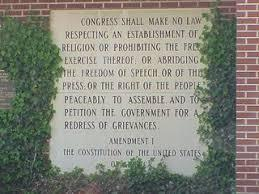
It's engraved in stone. The First Amendment, at the entrance to the Bremen Public Library in Bremen, Indiana. The Bremen Public Library serves the citizens of German Township in Marshall County, Indiana. Photo from Bremen Library.

It’s engraved in stone. The First Amendment, at the entrance to the Bremen Public Library in Bremen, Indiana. The Bremen Public Library serves the citizens of German Township in Marshall County, Indiana. Photo from Bremen Library.


President Clinton directed the Secretary of Education and the Attorney General to inform  each school district in America about the law on religious freedom in public schools.  This was the law in 2000 when Clinton left office, and it still is the law.  This statement is still accurate. [And if that site stays weird or doesn’t work for you, check it out here at the 5th Circuit U.S. Court of Appeals.]

UNITED STATES DEPARTMENT OF EDUCATION
THE SECRETARY


“…Schools do more than train children’s minds. They also help to nurture their souls by reinforcing the values they learn at home and in their communities. I believe that one of the best ways we can help out schools to do this is by supporting students’ rights to voluntarily practice their religious beliefs, including prayer in schools…. For more than 200 years, the First Amendment has protected our religious freedom and allowed many faiths to flourish in our homes, in our work place and in our schools. Clearly understood and sensibly applied, it works.”

President Clinton
May 30, 1998


Dear American Educator,

Almost three years ago, President Clinton directed me, as U.S. Secretary of Education, in consultation with the Attorney General, to provide every public school district in America with a statement of principles addressing the extent to which religious expression and activity are permitted in our public schools. In accordance with the President’s directive, I sent every school superintendent in the country guidelines on Religious Expression in Public Schools in August of 1995.

The purpose of promulgating these presidential guidelines was to end much of the confusion regarding religious expression in our nation’s public schools that had developed over more than thirty years since the U.S. Supreme Court decision in 1962 regarding state sponsored school prayer. I believe that these guidelines have helped school officials, teachers, students and parents find a new common ground on the important issue of religious freedom consistent with constitutional requirements.

In July of 1996, for example, the Saint Louis School Board adopted a district wide policy using these guidelines. While the school district had previously allowed certain religious activities, it had never spelled them out before, resulting in a lawsuit over the right of a student to pray before lunch in the cafeteria. The creation of a clearly defined policy using the guidelines allowed the school board and the family of the student to arrive at a mutually satisfactory settlement.

In a case decided last year in a United States District Court in Alabama, (Chandler v. James) involving student initiated prayer at school related events, the court instructed the DeKalb County School District to maintain for circulation in the library of each school a copy of the presidential guidelines.

The great advantage of the presidential guidelines, however, is that they allow school districts to avoid contentious disputes by developing a common understanding among students, teachers, parents and the broader community that the First Amendment does in fact provide ample room for religious expression by students while at the same time maintaining freedom from government sponsored religion.

The development and use of these presidential guidelines were not and are not isolated activities. Rather, these guidelines are part of an ongoing and growing effort by educators and America’s religious community to find a new common ground. In April of 1995, for example, thirty-five religious groups issued “Religion in the Public Schools: A Joint Statement of Current Law” that the Department drew from in developing its own guidelines. Following the release of the presidential guidelines, the National PTA and the Freedom Forum jointly published in 1996 “A Parent’s Guide to Religion in the Public Schools” which put the guidelines into an easily understandable question and answer format.

In the last two years, I have held three religious-education summits to inform faith communities and educators about the guidelines and to encourage continued dialogue and cooperation within constitutional limits. Many religious communities have contacted local schools and school systems to offer their assistance because of the clarity provided by the guidelines. The United Methodist Church has provided reading tutors to many schools, and Hadassah and the Women’s League for Conservative Judaism have both been extremely active in providing local schools with support for summer reading programs.

The guidelines we are releasing today are the same as originally issued in 1995, except that changes have been made in the sections on religious excusals and student garb to reflect the Supreme Court decision in Boerne v. Flores declaring the Religious Freedom Restoration Act unconstitutional as applied to actions of state and local governments.

These guidelines continue to reflect two basic and equally important obligations imposed on public school officials by the First Amendment. First, schools may not forbid students acting on their own from expressing their personal religious views or beliefs solely because they are of a religious nature. Schools may not discriminate against private religious expression by students, but must instead give students the same right to engage in religious activity and discussion as they have to engage in other comparable activity. Generally, this means that students may pray in a nondisruptive manner during the school day when they are not engaged in school activities and instruction, subject to the same rules of order that apply to other student speech.

At the same time, schools may not endorse religious activity or doctrine, nor may they coerce participation in religious activity. Among other things, of course, school administrators and teachers may not organize or encourage prayer exercises in the classroom. Teachers, coaches and other school officials who act as advisors to student groups must remain mindful that they cannot engage in or lead the religious activities of students.

And the right of religious expression in school does not include the right to have a “captive audience” listen, or to compel other students to participate. School officials should not permit student religious speech to turn into religious harassment aimed at a student or a small group of students. Students do not have the right to make repeated invitations to other students to participate in religious activity in the face of a request to stop.

The statement of principles set forth below derives from the First Amendment. Implementation of these principles, of course, will depend on specific factual contexts and will require careful consideration in particular cases.

In issuing these revised guidelines I encourage every school district to make sure that principals, teachers, students and parents are familiar with their content. To that end I offer three suggestions:

First, school districts should use these guidelines to revise or develop their own district wide policy regarding religious expression. In developing such a policy, school officials can engage parents, teachers, the various faith communities and the broader community in a positive dialogue to define a common ground that gives all parties the assurance that when questions do arise regarding religious expression the community is well prepared to apply these guidelines to specific cases. The Davis County School District in Farmington, Utah,is an example of a school district that has taken the affirmative step of developing such a policy.

At a time of increasing religious diversity in our country such a proactive step can help school districts create a framework of civility that reaffirms and strengthens the community consensus regarding religious liberty. School districts that do not make the effort to develop their own policy may find themselves unprepared for the intensity of the debate that can engage a community when positions harden around a live controversy involving religious expression in public schools.

Second, I encourage principals and administrators to take the additional step of making sure that teachers, so often on the front line of any dispute regarding religious expression, are fully informed about the guidelines. The Gwinnett County School system in Georgia, for example, begins every school year with workshops for teachers that include the distribution of these presidential guidelines. Our nation’s schools of education can also do their part by ensuring that prospective teachers are knowledgeable about religious expression in the classroom.

Third, I encourage schools to actively take steps to inform parents and students about religious expression in school using these guidelines. The Carter County School District in Elizabethton, Tennessee, included the subject of religious expression in a character education program that it developed in the fall of 1997. This effort included sending home to every parent a copy of the “Parent’s Guide to Religion in the Public Schools.”

Help is available for those school districts that seek to develop policies on religious expression. I have enclosed a list of associations and groups that can provide information to school districts and parents who seek to learn more about religious expression in our nation’s public schools.

In addition, citizens can turn to the U.S. Department of Education web site (http://www.ed.gov) for information about the guidelines and other activities of the Department that support the growing effort of educators and religious communities to support the education of our nation’s children.

Finally, I encourage teachers and principals to see the First Amendment as something more than a piece of dry, old parchment locked away in the national attic gathering dust. It is a vital living principle, a call to action, and a demand that each generation reaffirm its connection to the basic idea that is America — that we are a free people who protect our freedoms by respecting the freedom of others who differ from us.

Our history as a nation reflects the history of the Puritan, the Quaker, the Baptist, the Catholic, the Jew and many others fleeing persecution to find religious freedom in America. The United States remains the most successful experiment in religious freedom that the world has ever known because the First Amendment uniquely balances freedom of private religious belief and expression with freedom from state-imposed religious expression.

Public schools can neither foster religion nor preclude it. Our public schools must treat religion with fairness and respect and vigorously protect religious expression as well as the freedom of conscience of all other students. In so doing our public schools reaffirm the First Amendment and enrich the lives of their students.

I encourage you to share this information widely and in the most appropriate manner with your school community. Please accept my sincere thanks for your continuing work on behalf of all of America’s children.

Sincerely,


Richard W. Riley
U.S. Secretary of Education


RELIGIOUS EXPRESSION IN PUBLIC SCHOOLS

Student prayer and religious discussion: The Establishment Clause of the First Amendment does not prohibit purely private religious speech by students. Students therefore have the same right to engage in individual or group prayer and religious discussion during the school day as they do to engage in other comparable activity. For example, students may read their Bibles or other scriptures, say grace before meals, and pray before tests to the same extent they may engage in comparable nondisruptive activities. Local school authorities possess substantial discretion to impose rules of order and other pedagogical restrictions on student activities, but they may not structure or administer such rules to discriminate against religious activity or speech.

Generally, students may pray in a nondisruptive manner when not engaged in school activities or instruction, and subject to the rules that normally pertain in the applicable setting. Specifically, students in informal settings, such as cafeterias and hallways, may pray and discuss their religious views with each other, subject to the same rules of order as apply to other student activities and speech. Students may also speak to, and attempt to persuade, their peers about religious topics just as they do with regard to political topics. School officials, however, should intercede to stop student speech that constitutes harassment aimed at a student or a group of students.

Students may also participate in before or after school events with religious content, such as “see you at the flag pole” gatherings, on the same terms as they may participate in other noncurriculum activities on school premises. School officials may neither discourage nor encourage participation in such an event.

The right to engage in voluntary prayer or religious discussion free from discrimination does not include the right to have a captive audience listen, or to compel other students to participate. Teachers and school administrators should ensure that no student is in any way coerced to participate in religious activity.

Graduation prayer and baccalaureates: Under current Supreme Court decisions, school officials may not mandate or organize prayer at graduation, nor organize religious baccalaureate ceremonies. If a school generally opens its facilities to private groups, it must make its facilities available on the same terms to organizers of privately sponsored religious baccalaureate services. A school may not extend preferential treatment to baccalaureate ceremonies and may in some instances be obliged to disclaim official endorsement of such ceremonies.

Official neutrality regarding religious activity: Teachers and school administrators, when acting in those capacities, are representatives of the state and are prohibited by the establishment clause from soliciting or encouraging religious activity, and from participating in such activity with students. Teachers and administrators also are prohibited from discouraging activity because of its religious content, and from soliciting or encouraging antireligious activity.

Teaching about religion: Public schools may not provide religious instruction, but they may teach about religion, including the Bible or other scripture: the history of religion, comparative religion, the Bible (or other scripture)-as-literature, and the role of religion in the history of the United States and other countries all are permissible public school subjects. Similarly, it is permissible to consider religious influences on art, music, literature, and social studies. Although public schools may teach about religious holidays, including their religious aspects, and may celebrate the secular aspects of holidays, schools may not observe holidays as religious events or promote such observance by students.

Student assignments: Students may express their beliefs about religion in the form of homework, artwork, and other written and oral assignments free of discrimination based on the religious content of their submissions. Such home and classroom work should be judged by ordinary academic standards of substance and relevance, and against other legitimate pedagogical concerns identified by the school.

Religious literature: Students have a right to distribute religious literature to their schoolmates on the same terms as they are permitted to distribute other literature that is unrelated to school curriculum or activities. Schools may impose the same reasonable time, place, and manner or other constitutional restrictions on distribution of religious literature as they do on nonschool literature generally, but they may not single out religious literature for special regulation.

Religious excusals: Subject to applicable State laws, schools enjoy substantial discretion to excuse individual students from lessons that are objectionable to the student or the students’ parents on religious or other conscientious grounds. However, students generally do not have a Federal right to be excused from lessons that may be inconsistent with their religious beliefs or practices. School officials may neither encourage nor discourage students from availing themselves of an excusal option.

Released time: Subject to applicable State laws, schools have the discretion to dismiss students to off-premises religious instruction, provided that schools do not encourage or discourage participation or penalize those who do not attend. Schools may not allow religious instruction by outsiders on school premises during the school day.

Teaching values: Though schools must be neutral with respect to religion, they may play an active role with respect to teaching civic values and virtue, and the moral code that holds us together as a community. The fact that some of these values are held also by religions does not make it unlawful to teach them in school.

Student garb: Schools enjoy substantial discretion in adopting policies relating to student dress and school uniforms. Students generally have no Federal right to be exempted from religiously-neutral and generally applicable school dress rules based on their religious beliefs or practices; however, schools may not single out religious attire in general, or attire of a particular religion, for prohibition or regulation. Students may display religious messages on items of clothing to the same extent that they are permitted to display other comparable messages. Religious messages may not be singled out for suppression, but rather are subject to the same rules as generally apply to comparable messages.

THE EQUAL ACCESS ACT

The Equal Access Act is designed to ensure that, consistent with the First Amendment, student religious activities are accorded the same access to public school facilities as are student secular activities. Based on decisions of the Federal courts, as well as its interpretations of the Act, the Department of Justice has advised that the Act should be interpreted as providing, among other things, that:

General provisions: Student religious groups at public secondary schools have the same right of access to school facilities as is enjoyed by other comparable student groups. Under the Equal Access Act, a school receiving Federal funds that allows one or more student noncurriculum-related clubs to meet on its premises during noninstructional time may not refuse access to student religious groups.

Prayer services and worship exercises covered: A meeting, as defined and protected by the Equal Access Act, may include a prayer service, Bible reading, or other worship exercise.

Equal access to means of publicizing meetings: A school receiving Federal funds must allow student groups meeting under the Act to use the school media — including the public address system, the school newspaper, and the school bulletin board — to announce their meetings on the same terms as other noncurriculum-related student groups are allowed to use the school media. Any policy concerning the use of school media must be applied to all noncurriculum-related student groups in a nondiscriminatory matter. Schools, however, may inform students that certain groups are not school sponsored.

Lunch-time and recess covered: A school creates a limited open forum under the Equal Access Act, triggering equal access rights for religious groups, when it allows students to meet during their lunch periods or other noninstructional time during the school day, as well as when it allows students to meet before and after the school day.

Revised May 1998


List of organizations that can answer questions on religious expression in public schools

Religious Action Center of Reform Judaism
Name: Rabbi David Saperstein
Address: 2027 Massachusetts Ave., NW, Washington, DC 20036
Phone: (202) 387-2800
Fax: (202) 667-9070
Web site: http://www.rj.org/rac/
American Association of School Administrators
Name: Andrew Rotherham
Address: 1801 N. Moore St., Arlington, VA 22209
Phone: (703) 528-0700
Fax: (703) 528-2146
Web site: http://www.aasa.org
American Jewish Congress
Name: Marc Stern
Address: 15 East 84th Street, New York, NY 10028
Phone: (212) 360-1545
Fax: (212) 861-7056
National PTA
Name: Maribeth Oakes
Address: 1090 Vermont Ave., NW, Suite 1200, Washington, DC 20005
Phone: (202) 289-6790
Fax: (202) 289-6791
Web site: http://www.pta.org
Christian Legal Society
Name: Steven McFarland
Address: 4208 Evergreen Lane, #222, Annandale, VA 22003
Phone: (703) 642-1070
Fax: (703) 642-1075
Web site: http://www.clsnet.com
National Association of Evangelicals
Name: Forest Montgomery
Address: 1023 15th Street, NW #500, Washington, DC 20005
Phone: (202) 789-1011
Fax: (202) 842-0392
Web site: http://www.nae.net
National School Boards Association
Name: Laurie Westley
Address: 1680 Duke Street, Alexandria, VA 22314
Phone: (703) 838-6703
Fax: (703) 548-5613
Web site: http://www.nsba.org
Freedom Forum
Name: Charles Haynes
Address: 1101 Wilson Blvd, Arlington, VA 22209
Phone: (703) 528-0800
Fax: (703) 284-2879
Web site: http://www.freedomforum.org

-###-

Rick Perry promises war on homosexuals and religious freedom

December 7, 2011

Is there any other way to read this?

Perry imagines a “war on religion,” based on his bigoted, anti-liberty views and some gross disinformation about what the rules are for kids praying in school.

What are the odds that, if elected, Perry would say, “Oops, I was wrong; I won’t do what that ad suggests?”

Perry’s offensive and erroneous text:

I’m not ashamed to admit that I’m a Christian, but you don’t need to be in the pew every Sunday to know there’s something wrong in this country when gays can serve openly in the military but our kids can’t openly celebrate Christmas or pray in school.
As President, I’ll end Obama’s war on religion. And I’ll fight against liberal attacks on our religious heritage.
Faith made America strong. It can make her strong again.
I’m Rick Perry and I approve this message.

I’ll take Barney Frank over Rick Perry any day.  Barney Frank is twice the man Rick Perry is, especially in standing up for the Constitution and freedom for all Americans.

I’ll take Barbara Jordan over Rick Perry.  She was twice the person Rick Perry is.  It seems to me that Perry plays with fire when he makes an ad that targets genuine Texas heroes like Jordan.

Perry professes to be a Methodist; does he have the guts to leave the church if he disagrees with its positions so much?

Is Perry going negative just because he’s losing, or is it really going to be that dirty a campaign?  This man shouldn’t be governor of Texas, and he has no business running for president.

More:

Hey, Slacktivist, thanks for the link.


Oranges beat the freeze

December 7, 2011

We get our first freeze of the season in Dallas tonight.  I’m thinking of the heat of the summer.

Kathryn gambled a bit, bought a Satsuma orange tree for the patio plant menagerie this summer.  To her joy and my utter surprise, it fruited.

Kathryn's Satsuma oranges in Dallas

Kathryn's Satsuma oranges in Dallas -- oranges take a long time to ripen; photos from late October 2011

Green fruit approached its final size in late June, then tortured us as it just sat there, green and unripe.  They turned orange slowly, through August and September.  An occasional individual would give up and hit the ground.  So we had samples — bitter at first, hints of sugar in September.

Two weeks ago Kathryn harvested a score of the little beauties.

Oranges on the patio in Dallas

Through the summer the oranges rested there, teasing us with their sloth . . .

First freeze tonight, but we enjoyed the last of the oranges this morning.

Horticulture teaches patience.  Horticulture is fun.

More, Resources: 


The wolf that keeps me from using Carbonite

December 5, 2011

A couple of computer crashes and a couple of stolen flashdrives convince me on-line storage might be a good idea.

How could anyone not appreciate a company like Carbonite, named after a Star Wars concept?

So, I wander to the company’s website, and I see this:

Rush Limbaugh endorses Carbonite on-line storage

Rush Limbaugh for Carbonite

Rush Limbaugh?  Seriously?

How can I buy Carbonite if it’s being pushed by Rush?


Bill Moyers: Democracy and plutocracy don’t mix

December 4, 2011

The really good news is that Bill Moyers will be back in January, with “Bill Moyers and Company.”

Details at Bill Moyers.com, where you can see this vintage critique of current politics (even though it’s a year and a half old).

Bill Moyers Essay: Plutocracy and Democracy Don’t Mix from BillMoyers.com on Vimeo.

Moyers broadcast this in his farewell performance on Bill Moyer’s Journal, April 30, 2010

Text of his remarks below the fold.

Read the rest of this entry »


Annals of DDT: No DDT produces benefits in Thunder Bay, Ontario

December 4, 2011

My news grabbers frequently take in articles about the recovery of some wild species in some far-flung place, a benefit of our having stopped the use of DDT in the area.

It occurs to me these stories should be filed away somewhere for future reference.

For example, here’s a letter to the editor of The Chronicle-Journal, in Thunder Bay, Ontario:

Let’s not reverse gains in falcon population

Saturday, December 3, 2011

I grew up in this town in the 1960s and ’70s never having seen nor heard a bald eagle or Peregrine falcon. I could only listen as my father (an MNR game warden) treated me to stories of the magnificent raptors previously living along the Nipigon River, Sibley and the Nor’Westers. I was 25 years old before I saw my first bald eagle and that was in Minnesota.

Decades of DDT use decimated the predator bird population to almost extinction in Ontario. The government eventually recognized the problem and corrected it by banning DDT in 1970. With the help of local groups, finally the birds are back.

In 1989, the Thunder Bay Field Naturalists, with support from the Ministry of Natural Resources, launched Project Peregrine “in an attempt to reintroduce this species to the Superior north shore . . . In 1993, successful nesting peregrines were recorded for the first time in the last quarter-century . . . due to an abundance of excellent habitat.”

A mere 20 years has gone by. Are we going to allow another crime against these species?

Allowing Horizon Wind to rape the escarpment for a few megawatts that we do not need now or in any foreseeable future is falling into a bully trap.
Parties have stated there will be no harm to the birds or to the escarpment. Au contraire. The blasting alone, not to mention the construction and roads, can be compared to demolishing the whole north core downtown and building a skyscraper no one intends to occupy.

Leave the birds and the escarpment alone. Go home, Horizon Wind.

Maggie Cummins
Thunder Bay


Save the babies. Oh, and fight global warming, too

December 3, 2011

I wonder exactly how the “warming skeptics” will complain about this?

Just a reminder, cleaning the air to fight global warming also has immediate health benefits.

From the American Lung Association:

You know they will  complain about, for some trumped up reason.

Tip of the old scrub brush to James Kaliway at Everything Wrong with Today’s Youth.  He’s got more to say at his blog.


Avoiding fraud and scams on line during the holidays

December 3, 2011

One advantage of having an HP computer and Norton, I get an e-letter at least once a month with useful tips.

Norton warns against frauds and scams — good advice I repeat here for your benefit.  Abbi Perets wrote the piece:

Prevention

Avoid These 5 Holiday Scams

By Abbi Perets

’Tis the season to be careful. As you make your lists and check them twice, don’t forget to keep your eyes open for scammers who try to take your goodwill — and leave you with nothing to show for it.

Here are some of the top online scams to beware of this holiday season.

Cheating Charities

Families in your neighborhood are going hungry. Children in far-away countries are sick and need your help. You can give generously this holiday season, but be sure that you’re donating to a legitimate charity, not a scammer. Check out any online charity solicitation very closely. Some, unfortunately, are fraudulent.

Stay safe:

  • Run the charity through the databases at Charity Navigator (CharityNavigator.org) or the Better Business Bureau (BBB.org/US/Charity) to see whether it’s legitimate.
  • Never give your credit card or bank account information to someone who contacted you, whether by phone, by email or even in person.
  • Resist the urge to donate to unfamiliar charities if you don’t have time to check them out thoroughly.
  • An email pitch from a recognized organization might be legitimate, but to be safe, don’t click that link. Instead, use a search engine to find the site, and make your payment that way.

Bogus Bargains

Every year, there’s that one item you absolutely need to get, or else you risk ruining Christmas forever. Savvy shopper that you are, you want to make sure you don’t overpay. And then you find it online for a great price! Before you click that “Buy” button, stop and think: Why would anyone sell this hot-ticket item at a discount?

Stay safe:

  • Don’t order from a site you’ve never heard of. Trust the big names: Amazon, eBay, and other established retailers with policies in place to protect you.
  • If it sounds too good to be true, it probably is. No one is going to sell you this year’s equivalent to the Cabbage Patch Kids or Tickle Me Elmo for less than retail price. In fact, if an item is in high demand, they’ll likely sell it for more than retail. So either cough up the cash or wait until after the holiday rush is over and sales ease back to normal.
  • Use a one-time credit card number with a limit just above your purchase price (ask your bank or credit card provider for information) if you decide to order from a lesser-known reseller.

Happy Holidays?

Grandma Jane sent you a holiday e-card? Just click to view it … and infect your computer with spyware or worse. E-card scams prey on your sense of social niceties: You get a card, you open it. But don’t let politeness cut you off from your computer.

Stay safe:

  • If you receive a card from a person you barely know, or if the email notification is full of grammar and spelling errors, delete it.
  • Trust your gut. If you suspect the link is fraudulent, don’t click it. Just trash it. You can always send an email to the supposed sender asking if the card is legit.
  • Never download software in order to view a card.

Freebie Fraud

Who doesn’t want a free iPad? It’s incredibly tempting to click on these offers. Best-case scenario, though, is that you’ll discover you only have to buy $2,000 of worthless products to get your $500 iPad. Worst case? You’ll provide your credit card number, get nothing in return, and find out that thieves have run up thousands in fraudulent charges in the meantime.

You might also come across free e-book offers online. Some of these are legitimate; for example, Amazon makes plenty of free Kindle books available daily. But many free e-books are filled with spam links and malware designed to catch your credit card information.

Stay safe:

  • Accept the cold, hard truth that no one — not Bill Gates, not Apple, not anyone — is going to give you a high-value item for free. Delete all offers immediately.
  • Stick with e-book sellers and authors you already know, advises the Better Business Bureau (BBB). If an e-book piques your interest but the author seems unfamiliar, do a quick search and see what comes up.
  • Never click on links inside an e-book unless you purchased it from a site you know and trust, says the BBB. And you’re always better off typing the link into your browser rather than clicking directly from the book.

Working the System

If you could use a little extra cash for the holidays, you’re not alone — and scammers know it. They offer you the chance to earn thousands of dollars per week just by using your computer. Once again, set your excitement aside and let common sense prevail.

Stay safe:

  • Never pay anyone in order to work. A job should pay you, not the other way around.
  • Don’t provide your credit card or other personal information for a “background check” for work you found online.
  • Do your own background check: Look up the company, ask questions and push for answers. A legitimate company won’t have any problem providing plenty of information.
  • With these tips in mind, may your holidays be merry and scam-free.

Abbi Perets has been writing about technology, parenting, health care, kitchen gadgets and other topics for the last 15 years. Her work has been featured in numerous print and online publications.


If stupid and arrogance shone like the Sun . . .

December 3, 2011

. . . we could solve all energy crises forevermore.

Over at Watt’s Up With That, the leading anti-science blog on the web, Anthony Watt turned the podium over to the indefatigable, often inscrutable, sometimes-funny-but-almost-always wrong, Willis Eschenbach, who worries about when solar power may run out:

Their study includes “renewable” sources like solar, although I’ve never found out exactly how they plan to renew the sun once it runs out.

In a just and sane world, Dave Barry would be preparing to sue Eschenbach for infringing on Barry’s humor patent.

Just when will energy from Old Sol run out?  The Sun will die one day, but well after President Obama’s second term has expired, and long after all current photo-voltaic devices have worn out from providing cheap energy.

The facts:

Our Sun won’t last forever. Dr. Carolyn Brinkworth explains the ramifications for our home planet in this ‘Ask an Astronomer’ video.

Vodpod videos no longer available.

What Will Happen to the Earth When the Sun Dies?, posted with vodpod

Shorter Eschenbach:  Don’t worry about cleaning the air to fight global warming, because in the looooooooooooooooooooooooooooong run, we’re all dead.  Certainly after 4 billion years.