Dallas educators still bracing for the budget storm

April 14, 2011

Here’s the view from Ross Avenue, HQ of the Dallas Independent School District, as of today:

A message from Superintendent of Schools Michael Hinojosa

Today, Proposed Budget Version 3.0 was presented to the Dallas ISD Board of Trustees. This plan considers what a $110 million cut would mean to the district’s budget during the 2011-2012 school year.

From the outset, I want to be clear that we are under no impression at this time that the district will end up facing a $110 million cut. It may end up being larger than that. At the same time, there is a slight possibility that it could be less.

In any event, with only six weeks to go in the Texas legislative session, it is more apparent than ever that school districts throughout the state, including ours, are facing significant cuts because of the state’s budget shortfall. I have worked in public education in Texas for more than 30 years and have never seen anything like this.

The Texas House already has approved HB1, which would require cuts to our budget of anywhere from $130 to $170 million. It would also eliminate significant funding for prekindergarten; reading, math, and science initiatives; and teacher performance pay incentives.

The Senate has yet to vote on HB1, nor has it passed a Senate version, but we are hopeful that it will be an improvement over the current bill. The deficit is so large, however, that it is difficult to get too optimistic.

Proposed Budget Version 3.0 would still eliminate more than 2,400 positions from the district’s payroll. The only positive under this scenario is that, thanks to the 700 contract employees who took the early resignation incentive, the district would not have to further reduce the number of teachers currently employed. While that may be a relief to many, it means that those teachers who remain will be asked to do more.

For instance, under 3.0, the collaborative planning period during the school day for secondary teachers would be eliminated. Middle and high school class-size ratios would be set at 25-1.

The details of Proposed Budget Version 3.0 can be found on the special Web site created to update everyone on our budget: www.dallasisd.org/finoutlook. Bear in mind, however, that as soon as you have a chance to review this plan, our financial staff will have already begun preparing Proposed Budget Version 4.0.

I again want to thank all staff members for your patience throughout this process. I also want to thank those of you who have contacted your lawmakers about your concerns and, especially, to all those who have traveled to Austin to speak out in person. Every little bit helps. Please continue to make your feelings known to lawmakers as they reach the final stretch of their discussions.

When school begins next fall, we will have the same number of students in Dallas ISD, all of whom have dreams for the future. None of them will care about our budget; they will only care about how we are preparing them with the skills to be successful. I know that our dedicated staff will once again rise to the occasion, as it has done so many times before, to meet their needs.


One Boy Scout’s story: Kazimierz Piechowski, “I escaped from Auschwitz”

April 14, 2011

Good reading:  An article by Homa Kahleeli in The Guardian from Tuesday, April 12, 2011:

I escaped from Auschwitz

Kazimierz Piechowski is one of just 144 prisoners to have broken out of the notorious Nazi camp and survive. Today aged 91, he tells his extraordinary story

Kazimierz Piechowski, Boy Scout who escaped Auschwitz - Guardian photo

Guardian caption: "Kazimierz Piechowski in 2011. 'We just planned that I would play the role of an SS officer so well that the guards would believe me.' Photograph: Christian Sinibaldi for the Guardian"


George Jetson come true? Maverick Flying Car at Oshkosh

April 14, 2011

Next time somebody asks ‘where’s my flying car?” you can show them this.

Steve Saint of I-TEC drove his road-legal flying car from Florida to Oshkosh this summer. Since then the FAA has also issued the Maverick a S-LSA aircraft airworthiness certificate. I-TEC hopes to be in production by EAA Oshkosh 2011.

[Because it comes with built-in autoplay from the Experimental Aircraft Association, it’s below the fold.]

Read the rest of this entry »


Graphic version of the Dunning-Kruger Effect?

April 13, 2011

Mark at Sting of Reason may have the graph to illustrate the Dunning-Kruger Effect perfectly:

Saturday Morning Breakfast Comics for March 8, 2011

Saturday Morning Breakfast Cereal for March 8, 2011, via Sting of Reason

Original here, at Saturday Morning Breakfast Cereal.

Does that pretty well nail Dunning-Kruger, or what?


Jailing the teachers . . .

April 13, 2011

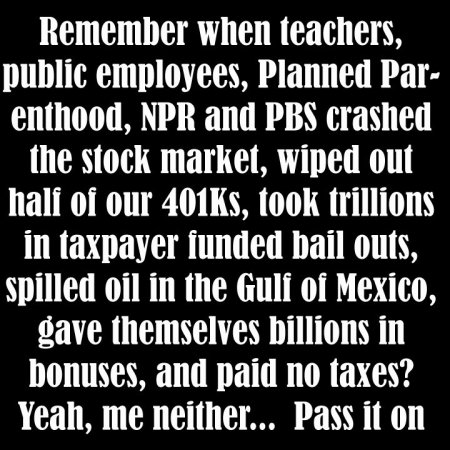
. . . who ruined Wall Street.  Or something.

When teachers and NPR crashed the stock market

Teachers are not to blame - pass it on

Our nation faces real crises.  While much of the wealth destroyed by the Crash of 2008 has been recovered, it’s been reallocated from working families to large banks and the wealthy.  We still have a crisis in the Gulf of Mexico, not least over how and whether we can explore for ever-more-precious oil in ever-more-dangerous places — Congress cut the money to improve regulations to prevent future spills.  We need secure pensions for people who work for their entire lives, and want to retire so a younger person can have their job — heck our economy needs people to retire earlier, not later.  We need secure funding for education, for primary and secondary education, and for college, which is increasingly a necessity.

None of those problems was created by teachers, NPR, Planned Parenthood, Head Start, PBS, the guy next door who lost his job, nor the many immigrants who came to this nation to build our economy while building their own little store of wealth.

Ronald Reagan said that for every difficult problem, there is a solution that is simple, easy to understand, popular — and wrong.  I wish people would quit endorsing those solutions to problems we don’t have, and work for real solutions to the problems we do have.


“Is that a poem in your pocket?” she asked.

April 13, 2011

Not only is April National Poetry Month, but April 14th is National Poem in Your Pocket Day.

Poem in Your Pocket Day logo, 2011

National Poem in Your Pocket Day 2011 - click for details

The idea is simple: select a poem you love during National Poetry Month then carry it with you to share with co-workers, family, and friends.

Poems from pockets will be unfolded throughout the day with events in parks, libraries, schools, workplaces, and bookstores. Create your own Poem In Your Pocket Day event using ideas below or let us know how your plans, projects, and suggestions for Poem In Your Pocket Day by emailing npm@poets.org.

Put Poems In Pockets

In this age of mechanical and digital reproduction, it’s easy to carry a poem, share a poem, or start your own PIYP day event. Here are some ideas of how you might get involved:

  • Start a “poems for pockets” give-a-way in your school or workplace
  • Urge local businesses to offer discounts for those carrying poems
  • Post pocket-sized verses in public places
  • Handwrite some lines on the back of your business cards
  • Start a street team to pass out poems in your community
  • Distribute bookmarks with your favorite immortal lines
  • Add a poem to your email footer
  • Post a poem on your blog or social networking page
  • Project a poem on a wall, inside or out
  • Text a poem to friends

Help us expand the list: send your ideas to npm@poets.org.

Poem In Your Pocket History

Poem In Your Pocket Day has been celebrated each April in New York City since 2004. Each year, city parks, bookstores, workplaces, and other venues burst with open readings of poems from pockets. Even the Mayor gets in on the festivities, reading a poem on the radio. For more information on New York City’s celebration, visit nyc.gov/poem.

Highlights from past Poem In Your Pocket Day events.

Poems have been stowed in pockets in a variety of ways, from the commonplace books of the Renaissance to the pocket-sized publications for Army soldiers in World War II. Have a story about the marriage of the poem and the pocket? Send them to npm@poets.org.

I just stumbled into National Poetry Month and National Poem in Your Pocket Day a few years ago, gearing up to use The Ride of Paul Revere on the anniversary of his famous ride.  How are you using poetry in your job?


Hawaii confirms Obama’s eligibility (again); but who knows where Donald Trump really came from?

April 11, 2011

NBC’s Michael Isikoff grubbed out the story to get Hawaii to confirm, once again, that President Obama’s birth certificate is archived and well, and says exactly what Obama said it says, and what Hawaii said it says, under seal.

The mystery deepens:  Why is Donald Trump making an issue about this now?

After the Bathtub noted that we don’t know where Trump was born, and that the story of his life can’t be corroborated exactly as he claims, Trump released what he called a birth certificate.

But it turned out to be bogus.

What is Trump trying to hide, with all his pointless fulminations?  At this point, anything he releases must be regarded as suspect.


April is National Poetry Month, 2011

April 10, 2011

You did remember, right?  I got another reminder in e-mail:

National Poetry Month continues, and so does your support! We’re getting closer to our goal of $30,000 in 30 days, and we thank you for your donation. If you haven’t donated yet, please do. You’ll be helping us share your love of poetry with children and adults all across America.

Here’s another way to support National Poetry Month: celebrate Poem In Your Pocket Day on Thursday, April 14. It’s simple: tuck a poem you love in your pocket and share it with co-workers, family, and friends. Or go a step further and create your own Poem In Your Pocket Day event using the ideas at www.poets.org/pockets.

And please, please, show your support for poetry with a donation to the Academy of American Poets. As an added incentive, we’ll thank you for your generosity with these free gifts:
• Donate $25 and receive a free download of W.S. Merwin recordings.
• Donate $50 and receive a free download of W.S. Merwin recordings and a Walt Whitman ruled notebook for your own poems.
• Donate $100 and receive a free download of W.S. Merwin recordings, a Walt Whitman ruled notebook for your own poems, and a copy of the innovative anthology Poem in Your Pocket for Young Poets.

Please click here to support National Poetry Month. And if you haven’t downloaded the Poem Flow app for your iPhone, find it on iTunes and take poetry with you wherever you are.


Thanks for being a part of the Poets.org community. Please sign in to subscribe to other Poets.org newsletters, change your email address or unsubscribe from this list at any time.

Academy of American Poets
75 Maiden Lane, Suite 901
New York, NY 10038
212-274-0343
academy@poets.org


Republican policy: Forward to the Gilded Age

April 10, 2011

Cover of "The Gilded Age"

Cover of "The Gilded Age," a novel by Mark Twain and Charles Dudley Warner published in 1873. Image courtesy of the Center for Mark Twain Studies, Elmira College.

You know why it was called the Gilded Age, right?

Santayana’s Ghost keeps telling me the Republicans don’t know why.  Republicans as a rule do not read Mark Twain, so it’s a cinch they’ve never read Mark Twain plus Charles Dudley Warner.

Mark Twain, PBS image from Mark Twain House

Mark Twain, who wrote the novel, The Gilded Age, with Charles Dudley Warner. Twain wrote of the Republican Manifesto earlier: "What is the chief end of man?--to get rich. In what way? -- dishonestly if we can; honestly if we must." Image from Mark Twain House, Hartford, Connecticut, via PBS

Still, don’t you recall with some fondness the Eisenhower, Nixon and Ford years, when Republicans at least pretended not to be grand misanthropes?  Do you remember that?  Nixon tried to make nicey-nice with conservationists and environmentalists, expanding the National Parks and creating the Environmental Protection Agency (fitting, since the environmental movement had been born among and from wealthy  and smart Republicans); even after killing the air traffic controllers union, Ronald Reagan enjoyed easy camradary with Teamsters, and to some degree, even with the heads of the AFL-CIO.    Reagan encouraged and signed a jobs training bill, and signed our first home health care law, making it possible for people to go home to die, where they ironically lived much longer than in hospitals, but at much reduced cost to Medicare.

Forget those days.  Forget that human compassion.  Today’s conservatives don’t have time for the wimpiness of Ronald Reagan.

Did you see the full list of proposed agency cuts the Republicans tried to pin on the 2011 appropriations bill, H.R. 1?

Here’s the entire list, from OMB Watch:  OMB_Watch-HR1_Policy_Riders (April 7, 2011).  I’m sure OMB Watch  has a bias, but the descriptions of the cuts are so balanced and neutral that they may hide some of the more unscrupulous, Scroogey actions.

In consumer protection, for example, Republicans inexplicably oppose the creation of watchdogs to prevent another housing bubble — are Republicans protecting criminals here?

Prohibits the Federal Reserve from transferring more than $80 million to the new Bureau of Consumer Financial Protection, Sec. 1517
Prohibits funds for a government sponsored “consumer products complaints database,” Sec. 4046.

No one to prevent new crimes, and no collecting of information to warn consumers of dangerous products.  Wonderful.

Prohibits funds to take any action to effect or implement the disestablishment, closure or realignment of the US Joint Forces Command.  Sec. 4020

No, no, don’t want the Pentagon to save money — heaven knows, wasting money at the Pentagon is flag-waving patriotism — so let’s ban the Secretary of Defense, Robert Gates, from making changes that save money.  It’s in the Bible that this must be done, I’m sure.

Prohibits funds for implementing a provision specific to the State of Texas in the “Education Job Fund.”  Sec. 4051

After claiming he wouldn’t accept “bailouts” from the federal government, Texas Gov. Rick Perry accepted money from Congress to prevent the loss of teaching jobs — but then threw the money into a different pot, so teachers were not protected.  U.S. Rep. Lloyd Doggett, D-Texas, amended the last appropriation bill to say that Texas can’t take money from the teachers — but the Republicans want to allow Perry to take the money, and keep it from the teachers, again.  It’s the old playground game where the big kids play keep away from a little kid.  It’s vicious, of course, and should be criminal — but the older kids have a lot of fun.

Prohibits funding for the Weatherization Assistance Program or the State Energy Program.  Sec. 1434

Let the poor people freeze in the dark — they all vote Democratic, anyway.  But wait!  Tea Partiers, fresh from the Mad Hatter’s, say that global warming will take care of the poor people!   No need for weatherization.

Prohibits funding for various environmental projects in California.  Sec. 1475
Prohibits funding for a climate change czar in the White House.  Sec. 1535
Prohibits funding for EPA efforts to regulate greenhouse gases.  Sec. 1746

Oh, well, maybe there isn’t any global warming.  Yeah, this is contrary to what the Republicans said about warming keeping the poor from needing weatherization — but they’re just poor people, the Republicans say.  Let ’em get a job!  (Where?  Not the problem of Republicans; Republicans identified that the poor need to get a job, and that should be the limit of federal action . . .).

This morning on CBS, New York Sen. Charles Schumer said he would not list cuts until he sees a final copy of the bill.  Probably wise — but it’s also almost a cinch that almost all of the cuts will be mean-spirited, worthy of Ebenezer Scrooge before his conversion, and damaging to the U.S. people and the U.S. economy.

What in the hell is going on in Washington?

Tip of the old scrub brush to Jean Detjen, protecting the nation from being over-run by Canadians up there in the north, in Wisconsin.


More wisdom: From Burlington, Vermont, grassroots ideas on fighting global warming

April 10, 2011

Another local newspaper op-ed, this time from Burlington, Vermont (yeah, I know — a Gannett paper — still, smaller than Dallas). This comes from the March 4 edition of the Burlington Free Press’s “I Believe” series:

I Believe: ‘We have a responsibility to learn about climate change

by Joan Knight

“If politicians remain at loggerheads, citizens must lead.”
— Dr. James E. Hansen, physicist, director of NASA Goddard Institute

I was impressed when I attended a recent meeting with a group of volunteer activists forming a Vermont chapter of the Citizens Climate Lobby. This group is different, I thought. It might actually work. As a newly retired 72-year-old, I was looking for a new focus, and found it.

Religious groups use the word “creation.” Most people say “nature.” Academics speak of global ecology. Deep ecologists who view Earth as one living being say “Gaia,” in reverential tones, meaning our planet and its atmosphere is a living “body.” Its “cells” include us humans, plants, forests, microbes. All life is tied together by dynamic, interdependent relationships. Most native peoples sense that all beings are like sisters and brothers — members of the same family.

I understand. It started for me as a young child with what Rachel Carlson called a sense of wonder. Grasses back-lit by the setting sun; starfish in tide pools crawling about among colorful mats of living plants and fungi. It was a more spiritual experience than was going to church under parental orders. Nature really mattered.

Growing older, I revered the writing of Rachel Carson, David Brower, John Muir, Aldo Leopold, Wendell Berry and so many more. I still feel abiding love for it all. I believe in Earth as a planetary living being.

It is clear that our family of All Beings is suffering.

Climate change. Global warming. Is it real? Is it a problem? Why are the changes happening? There is controversy about the answers to these questions. The collapse of climate and energy legislation last year in Congress was a relief to some in big business.

Natural laws or physics and chemistry are in action. The climate is warming faster than it ever has. Weather patterns are strange and tragic. Species are becoming extinct. Predictions of the end of nature (Bill McKibben’s 1984 book title) are common now. What if the scientists are right? We don’t need all the answers to figure out that something awful is going on.

Can we slow down the rate of change? Yes. Can we stop the climate from warming too much? It’s not likely, but I believe we must try. Should we let it happen while we enjoy our greenhouse-gas-producing lifestyles? Some family members deny the reality that their loved one has a serious illness and is likely to die prematurely. We humans have an interesting default to denial. This does happen. Might some of us, similarly, deny that our planet is critically ill?

Most of us agree that conservation of energy and resources is good for us and for the environment. We are changing our personal lifestyles. We have changed our light bulbs to compact fluorescents; we vacation closer to home; we’re working to improve the efficiency of our buildings.

Many of us also become members of environmental organizations. We read their magazines, put in bird feeders to enjoy nature, donate money and sign petitions in the attempt to show our legislators how we would like them to vote. Here in Vermont, we even talk with state legislators and are proud we are the “green state” — cherishing our remaining cows in pastoral landscapes and our forests for both wildlife and recreation. We’re thankful our delegation to the Congress “gets it.”

There are many grassroots activists successfully influencing lawmakers on a town and state level. But we know that states tend to make changes in laws and budgets in response to constraints brought on by federal legislation and financing. Are there ways to really influence federal representatives and senators? Paid lobbyists do it on a massive scale. Money speaks. But what about us?

The Citizens Climate Lobby believes in an approach by which ordinary people influence the federal “deciders” enough to sometimes change their votes. The influential people take the trouble to learn about and appreciate some things an individual legislator has done, seek to discover common ground, listen respectfully and talk in a collaborative way. After discovering what information would be relevant, they come back to provide it. In this comfortable way of relating, ordinary people do make a difference.

As citizens of this country we have a responsibility to learn about climate change, solutions and how to take part in the democratic process. We can sit down for a conversation and tell our legislators what we care about and why. We can write letters. It’s really our job as citizens to share these thoughts with our legislators, if we ever hope to be truly represented by them.

That’s where the new Citizens’ Climate Lobby comes in. The group gives us the tools we need. There is a monthly conference call with a leading thinker who will help keep us informed of the latest issues, and an opportunity to practice speaking with each other about those issues. We work together to help our legislators hear the non-confrontational message: We want a healthy planet for our kids and grandkids.

If I dare to step forward to lobby my representative, I want to learn how, to practice, to feel supported by kindred spirits, to know it’s OK to make mistakes and keep on gaining new knowledge and skills. I’m up for it. And I hope many of you will consider joining us as we begin making our voices heard where it matters most.

Check out the Citizens Climate Lobby website, and get information about how to join in on the next national conference call. This one will be focused on messaging — the importance of context and delivery. This organization seeks to empower each of us to have breakthroughs in our personal power, to be heard and to be counted. It feels good to be a part of a supportive web of passionate citizens.

Join us. Talk with an active member on the phone, go to the website (www.citizensclimatelobby.org), find the lobby on Facebook.

It’s not too late to make a difference. We have been lazy in hoping someone else would do the right thing, that sending a check to an organization and signing an online petition was enough. It’s time for folks, including myself, to step up and be heard.

Real grass roots politics, from a woman concerned enough about the issue to think historically, and to read broadly about it.

Citizenship is wonderful to behold, when it is practiced so nobly and elegantly.

What else might we learn, if we really listened to the people?

Citizens Climate Lobby masthead

Masthead for the home page of Citizens Climate Lobby - click to see


Only in small towns, where leaders have time to think . . .

April 7, 2011

Years ago when I staffed a U.S. senator’s office, one of my tasks was to look through all the weekly newspapers in the state.    Back then subscriptions were cheap, and most senators would take out a subscription to these weeklies more to flatter the editors and publishers than to read.  We put them to use, first checking to see whether the clipping services were getting all the clips (mostly), and then on a hunch, to see what issues were raging in the state, well below the radar of the big city daily newspapers and broadcast outlets.

You can learn a lot.

Many of those old weekly newspapers are gone, now, victims to local populations that turn over in every recession, and to electronic news gathering services — and to general alienation:  People are not so sure they want to know what their neighbors are up to, these days.  Heck, many people aren’t sure they want to know their neighbors.

My own electronic news gatherers occasionally pull out something to think about from a minor news outlet.  For example, below is an opinion piece out of the Carrboro Citizen from Dan Coleman, a member of the town council in Carrboro, North Carolina.  I gather from the paper it is rather close to Chapel Hill, the home of the University of North Carolina (I haven’t checked a map).

But look at what this guy says.  He questions the wisdom of Adam Smith.  Adam Smith! It appears Coleman wasn’t led astray by all those Adam Smith neckties that were so popular in the Reagan administration.  He questions the true need for profits from corporations, and he wonders if there isn’t a higher duty for a corporation.

How many others like Dan Coleman are there, out there in America, relatively sane on all other accounts, and thinking?

How many bottom lines do we really need?

April 7, 2011 | Posted in: Opinion | 0 Responses

By Dan Coleman

Did you know that Carrboro’s Town Code incorporates a principle devised by Shell Oil? That’s right, the same Shell Oil that has been accused of human rights violations in Nigeria, including summary execution, crimes against humanity, torture, inhumane treatment and ­collaborating in the execution of Nigerian activist Ken Saro-Wiwa. The same Shell Oil that has despoiled the Niger delta and was responsible for the largest freshwater oil spill ever.

With a record like this, it is little wonder that Shell came up with one of the corporate world’s more effective public relations concepts of recent years: the Triple Bottom Line (TBL), also known as People, Planet, Profit. It’s as if Shell was saying, sure you can criticize our environmental and humanitarian record but don’t forget, we have to make a profit.

Efforts to value people have dogged profiteering for over a century. The late 19th and early-to-mid-20th centuries were marked by many thousands of strikes by workers, more than 1,400 in the year 1886 alone. Many of these were met by violent strikebreakers backed up at times by military force. This is a struggle that continues in 2011 in Wisconsin and other states.

William Blake, Biography Online

William Blake

Through the efforts of these men and women, much of value was created: the weekend, workplace-safety standards, health care for workers, vacation and sick leave, etc. And each of these was wrested from the one bottom line that corporate America really cares about.

Despite William Blake offering the image of “dark satanic mills” as far back as 1804, the environmental impacts of industrial capitalism began to be understood with Rachel Carson’s 1962 publication of The Silent Spring. Within a decade, there was Earth Day, the Environmental Protection Agency, the Clean Water Act and much more, each a challenge to the profit-focused priorities of capital.

Given the pre-eminent importance of profit-maximization, it is not surprising that corporations touting the Triple Bottom Line often oppose measures to combat global warming, oppose workers’ rights and oppose regulatory mechanisms to protect the health of people and planet.

History has taught us that Adam Smith was wrong when he offered the justification for prioritizing profit that “by pursuing his own interest [the businessman] frequently promotes that of the society more effectually than when he really intends to promote it.” If Smith were correct, companies like Shell would not have such a devastating impact on society and nature. In part, this impact results from profit being measured in a short timeframe, a year or even a quarter of a year, while sustainability requires a vision spanning, as the Iroquois put it, as much as seven generations.

But Smith was right that profit ought to serve human well-being. Therefore, it must be understood within an ethical system that places people and planet first. This holds true for the vague term “stakeholder value” that some, including Carrboro, use instead of profit. Who are the stakeholders if not people and planet?
The TBL offers nothing to help us navigate the inevitable contradictions between profit on the one hand and people/planet on the other. But, really, why should we have any social or political bottom lines at all?

It was social ecologist Murray Bookchin who bemoaned the cultural turn to the “grubby language” of the market economy, which has “replaced our most hallowed moral and spiritual expressions. We now ‘invest’ in our children, marriages, and relationships. … We live in a world of ‘trade-offs’ and we ask for the ‘bottom line’ of any emotional ‘transaction.’”

There are a variety of frameworks that speak to a more fundamental commitment to the well-being of all life. In an 1854 speech, Chief Seattle offered the notion of a web of life: “Humankind has not woven the web of life. We are but one thread within it. Whatever we do to the web, we do to ourselves.”

Aldo Leopold, in Arizona

Aldo Leopold, in Arizona, Arizona State Parks image

A century after Chief Seattle, Aldo Leopold articulated his land ethic in Sand County Almanac, “A thing is right when it tends to preserve the integrity, stability and beauty of the biotic community. It is wrong when it tends otherwise.” The biotic community, of course, includes humans.

We need the ability to truly place people and planet first and to reject the false, self-serving homilies offered by those who spread pavement and poverty in pursuit of the almighty dollar. Rather than seek simplistic nostrums, we may have to take the time to look hard at each decision, and bring a clear ethical sensibility, like that of Seattle or Leopold, to bear.

Dan Coleman is a member of the Carrboro Board of Aldermen.

Coleman may want to check the provenance of the Chief Seattle quote — but the thought is solid.

What do you think?


A Seussian fable, about how tests ruin school reform

April 7, 2011

Look, you really need to go to TeacherSabrina’s blog, Failing Schools, where she first posted this, and take a look at many of her posts.

But I can’t resist putting the video here, because I know a few old-timers would be confused by the link, and some people will think they don’t have the time to make two clicks instead of one.

So, here, in its Seussian glory and demand for Flash Animation, is TeacherSabrina’s story of D.C.’s late Queen of the Schools, Michelle Rhee, and her desire to get D.C.’s kids to score well on an increasing battery of tests  [Got a good joke about assault and battery we can insert here?]:  “Rhee the Reformer:  A Cautionary Tale.”

Tip of the old scrub brush to Accountable Talk.


Slow posting – apologies

April 6, 2011

Oh, there’s plenty to write about.

But:  Crunch at school.  Lots of other spring activities for various organizations.  I’ve got a rip-roaring sinus infection.

Feel free to comment, with links, to stuff we should be covering.


It’s on: Obama opened the campaign for 2012

April 4, 2011

I get e-mail — with a few million others, I’m sure:

2012

Ed —

Today, we are filing papers to launch our 2012 campaign.

We’re doing this now because the politics we believe in does not start with expensive TV ads or extravaganzas, but with you — with people organizing block-by-block, talking to neighbors, co-workers, and friends. And that kind of campaign takes time to build.

So even though I’m focused on the job you elected me to do, and the race may not reach full speed for a year or more, the work of laying the foundation for our campaign must start today.

We’ve always known that lasting change wouldn’t come quickly or easily. It never does. But as my administration and folks across the country fight to protect the progress we’ve made — and make more — we also need to begin mobilizing for 2012, long before the time comes for me to begin campaigning in earnest.

As we take this step, I’d like to share a video that features some folks like you who are helping to lead the way on this journey. Please take a moment to watch:

In the coming days, supporters like you will begin forging a new organization that we’ll build together in cities and towns across the country. And I’ll need you to help shape our plan as we create a campaign that’s farther reaching, more focused, and more innovative than anything we’ve built before.

We’ll start by doing something unprecedented: coordinating millions of one-on-one conversations between supporters across every single state, reconnecting old friends, inspiring new ones to join the cause, and readying ourselves for next year’s fight.

This will be my final campaign, at least as a candidate. But the cause of making a lasting difference for our families, our communities, and our country has never been about one person. And it will succeed only if we work together.

There will be much more to come as the race unfolds. Today, simply let us know you’re in to help us begin, and then spread the word:

http://my.barackobama.com/2012

Thank you,

Barack


Ironic anniversary: Marshall Plan, April 3, 1948

April 4, 2011

Texas Republicans rammed through their radical budget cut program on April 3, 2011 — ironically on the anniversary of another legislative decision made in the depths of deficit spending.

President Truman signing legislation to create the Marshall Plan, 1948 - Library of Congress, Averill Harriman collection

Caption from Library of Congress: "Surrounded by members of Congress and his cabinet, on April 3, 1948, President Harry S Truman (1884-1972) signed the Foreign Assistance Act, the legislation establishing the Marshall Plan. His official statement said, "Few presidents have had the opportunity to sign legislation of such importance. . . . This measure is America's answer to the challenge facing the free world today." The Marshall Plan was a bipartisan effort--proposed by a Democratic president and enacted into law by a Republican Congress in a hotly contested presidential election year. The plan's supporters shown in the photograph are (l-r) Senator Arthur Vandenberg (R--Mich.), Treasury Secretary John Snyder, Representative Charles Eaton (R--N.J.), Senator Tom Connally (D--Tex.), Secretary of the Interior Julius A. Krug, Representative Joseph Martin (R--Mass.), Representative Sol Bloom (D--N.Y.),and Attorney General Tom Clark." Copyprint from The Marshall Plan at the Mid-Mark. Averell Harriman Papers, Manuscript Division

April 3 is the traditional anniversary of the Marshall Plan.  From the U.S. Census Bureau:

SUNDAY, APRIL 3: MARSHALL PLAN

Profile America — Sunday, April 3rd.  One of the major programs that helped to shape history after World War II was signed into law on this date in 1948.  The European Recovery Program — far better known as the Marshall Plan, was suggested a year earlier by Secretary of State George Marshall. It had become clear that the economies of the nations battered by the war were not recovering on their own, and millions of people were not only jobless, but were also going hungry.  The Marshall Plan lasted for four years, distributing some 130 billion in today’s dollars, and helped many nations on the road to recovery.  Recently, the U.S. has given nearly $34 billion a year in economic aid and some $15.5 billion in military aid to countries around the world.  Profile America is in its 14th year as a public service of the U.S. Census Bureau.

Sources:  Chase’s Calendar of Events 2011, p. 204

Statistical Abstract of the United States 2011, t. 1298

Profile America is produced by the Public Information Office of the U.S. Census Bureau. These daily features are available as produced segments, ready to air, on a monthly CD or on the Internet at http://www.census.gov (look for “Multimedia Gallery” by the “Newsroom” button).

SOURCE U.S. Census Bureau

Read more: http://www.sacbee.com/2011/04/02/3523990/us-census-bureau-daily-feature.html#ixzz1IY7ec6mu

On that date in 1948, the U.S. faced the greatest deficits the nation had ever seen, leftover from World War II. Faced with the choice of deeper deficits or no Marshall Plan, Members of Congress chose to borrow the money to rebuild nations hammered by the war,  including our enemies, Germany, Italy and Japan.

What would have happened had the U.S. said “we can’t afford a Marshall Plan?”  Santayana’s Ghost shakes his head.  The U.S. would not have had the aid of growing, free-market economics in France, Germany, Italy, England and Japan, during the Cold War.  Advantages would have been conceded to the Soviet Union and communism, worldwide.

Notice the photograph includes Republicans and Democrats.

What are Texas and U.S. legislators thinking these days?

Resources: