Small business and Obama

July 24, 2012

Makes sense to me, so I’ll pass it along.

I get e-mail from the Obama campaign, from Stephanie Cutter:

Romney claims the President told entrepreneurs they didn’t build their own businesses — an attack the Washington Post called “ridiculous.” If you’ve seen the President’s actual remarks, you know that all the President said was that, together, Americans built the free enterprise system we all benefit from.

President Obama has consistently fought for small businesses and entrepreneurs — he knows the American middle class was built by hardworking people turning ideas into successful businesses. But if the Romney campaign wants a debate about who’ll step up to support small business, we’re ready.

Take a look at this video I recorded to respond to Romney’s distortion, and help make sure people know the truth about President Obama and small businesses:

It’s the Truth Team’s job to push back against smears like this.

President Obama’s record shows his commitment to helping small business owners. His tax plan will extend tax cuts for 97 percent of American small business owners — building on the 18 tax cuts he’s already signed that are helping small businesses grow and create jobs. Romney opposes the President’s plan, and supports a plan that would favor large corporations and give tax breaks to companies that ship American jobs overseas. Check out this blog post comparing the President’s record to Romney’s, then share it with others.

This isn’t the first time the Romney campaign has twisted the President’s words. It won’t be the last. But every time they do this, we need to call them out — and this time is no different.

Here’s the relevant excerpt from President Obama’s speech in Roanoke, Virginia, on July 13:

You may see President Obama’s entire speech on C-SPAN, here.


Obama a socialist? You’re kidding, of course . . . Milos Forman

July 24, 2012

Wrote movie director Milos Forman, for The New York Times:

Milos Forman, PBS image

Milos Forman, PBS image, American Masters

When I was asked to direct One Flew Over the Cuckoo’s Nest, my friends warned me not to go anywhere near it. The story is so American, they argued, that I, an immigrant fresh off the boat, could not do it justice. They were surprised when I explained why I wanted to make the film. To me it was not just literature but real life, the life I lived in Czechoslovakia from my birth in 1932 until 1968. The Communist Party was my Nurse Ratched, telling me what I could and could not do; what I was or was not allowed to say; where I was and was not allowed to go; even who I was and was not.

Now, years later, I hear the word “socialist” being tossed around by the likes of Rick Perry, Newt Gingrich, Rick Santorum, Sean Hannity, Rush Limbaugh and others. President Obama, they warn, is a socialist. The critics cry, “Obamacare is socialism!” They falsely equate Western European-style socialism, and its government provision of social insurance and health care, with Marxist-Leninist totalitarianism. It offends me, and cheapens the experience of millions who lived, and continue to live, under brutal forms of socialism.

. . . Whatever his faults, I don’t see much of a socialist in Mr. Obama or, thankfully, signs of that system in this great nation.

Tip of the old scrub brush to Fred Clark writing at Slacktivist.

More information:


July 24 – reflecting on a day of arrivals

July 24, 2012

July 24 – almost the end of the month, but not quite.  In Utah, July 24 is usually a state holiday, to celebrate the date in 1847 that the Mormon refugees arrived in Salt Lake Valley and began to set up their agriculture and schools.  In Salt Lake City, bands from across the state and floats from many entities form the “Days of ’47” Parade.  When I marched with the Pleasant Grove High School Viking Band, the route was  5 miles.  We had only one band uniform, for winter — I lost nearly 10 pounds carrying a Sousaphone.

Ah, the good old days!

From various “Today in History” features, AP, New York Times, and others:

Buzz Aldrin walks on the moon, July 20, 1969

Buzz Aldrin walks on the moon, July 20, 1969 (Photo credit: Wikipedia)

July 24, 1969: Apollo 11 returned to the Earth, and splashed down in the Pacific Ocean, Michael Collins, Buzz Aldrin and Neil Armstrong — Aldrin and Armstrong having landed on the Moon.

July 24, 1847: A larger contingent of Mormons, refugees from a literal religious war in Illinois and Missouri, entered into the Salt Lake Valley under the leadership of Brigham Young, who famously said from his wagon sick-bed, “This is the place; drive on!”

Mormon Tabernacle Choir, and organ

Would there be a Mormon Tabernacle Choir, and organ, had the Mormons settled somewhere other than Utah? Wikipedia photo

July 24, 1866: Tennessee became the first of the Confederate States, the former “state in rebellion,” to be readmitted fully to the Union, following the end of the American Civil War.

July 24, 2005: Lance Armstrong won his seventh consecutive Tour de France bicycle race.

English: Cropped image of Richard Nixon and Ni...

Nixon advance man William Safire claimed later than he’d set up the famous “debate” between Eisenhower’s Vice President Richard Nixon and Soviet Communist Party Premier Nikita Khrushchev, at the American National Exhibition in Moscow, 1959. Nixon argued that the technology on display made better the lives of average Americans, not just the wealthiest. (Photo credit: Wikipedia)

July 24, 1959: Visiting Moscow, USSR, to support an exhibit of U.S. technology and know-how, Vice President Richard Nixon engaged Soviet Communist Party Secretary and Premier Nikita Khruschev in a volley of points about which nation was doing better, at a display of the “typical” American kitchen, featuring an electric stove, a refrigerator, and a dishwasher.  Khruschev said the Soviet Union produced similar products; Nixon barbed  back that even Communist Party leaders didn’t have such things in their homes, typically, but such appliances were within the reach of every American family.  It was the “Kitchen Debate.”

Cover of Time Magazine, July 22, 1974, explaining the showdown between President Richard Nixon and the Special Prosecutor, playing out in the U.S. Supreme Court. Image copyright by Time Magazine.

July 24, 1974: In U.S. vs. Nixon, The U.S. Supreme Court ruled unanimously that President Richard Nixon had to turn over previously-secret recordings made of conversations in the White House between Nixon and his aides, to the special prosecutor appointed to investigate the Watergate affair and cover-up.  Nixon would resign the presidency within two weeks, the only president to leave office by resignation.

July 24, 1975: An Apollo spacecraft splashed down after a mission that included the first link-up of American and Soviet spacecraft.  (The Apollo mission was not officially numbered, but is sometimes called “Apollo 18″ — after Apollo 17, the last trip to the Moon.)

More information:


Typewriter anniversary: July 23, 1829, William Austin Burt’s “typographer”

July 23, 2012

An encore post, history we need to remember.

National Typewriter Day, July 23?  Type a letter to your mom, to celebrate.

William Austin Burt received a patent on a typographer on July 23, 1829 — signed personally by President Andrew Jackson.

First patent issued for a typewriter, July 23, 1829, to William Austin Burt -- signed by Andrew Jackson

Image of the first patent issued for a typewriter, July 23, 1829, to William Austin Burt, a Michigan surveyor and inventor. It was signed personally by President Andrew Jackson.

The typographer is considered the forerunner to the typewriter.

Burt’s chief reputation came from his work as a surveyor in Michigan. He discovered the massive iron ore deposits for which Michigan became famous, the iron that fueled much of American industrialization in the 19th and 20th centuries. He discovered one of the world’s largest deposits of copper, the Calumet and Hecla Mine. He invented the solar compass, to survey areas where iron deposits made magnetic compasses inaccurate.

English: Typographer patent 1829 by William Au...


Patent drawing of W. A. Burt’s typographer, the first patented typewriter – Wikimedia image

Some of Burt’s biographies do not mention his invention of the typewriter.

Burt was born in an era of great technological development and invention. People in all walks of life invented devices to aid their work, or just for the joy of invention. Even future president Abraham Lincoln invented a device to float cargo boats in shallow water, hoping to increase river commerce to his home county, Sangamon County, Illinois.

William Austin Burt

William Austin Burt (Photo: Wikipedia)

Burt invented devices to aid his work in surveying, a very important service industry in frontier America. Because surveyors often worked on the frontier, they were famous for discovering natural resources in the course of their work. So it was that Burt, working in the Upper Peninsula of Michigan, found his magnetic compasses spinning wildly. Suspecting a natural phenomenon, Burt ordered his crew to look for ferrous rocks, and they quickly determined they were in an area rife with iron deposits.

It was to further surverying in such areas that Burt invented the solar compass.

Even uninteresting frontiersmen could lead lives that fascinate us today. Was it Burt’s inventiveness that led him to such a life as a surveyor, or was it his work that pushed him to invent?

First typewritten letter, 1829 - Wikimedia Image

First letter ever written on a typewriter, in 1829 — to Martin Van Buren, then Vice President of the U.S., and future president. Notice the letter was written nearly two months prior to the patent being issued on the device upon which it was written. Wikimedia image


Fire hoop dance at the Kwahadi Indian Dancers in Amarillo

July 22, 2012

Fire Hoop Dance, Kwahadi Indian Dancers, Amarillo, Texas, 7-21-2012

Fire hoop dance at the Kwahadi Indian Dancers event center in Amarillo, Texas, July 21, 2012. The dance troupe is off on a national tour over the next three weeks or so.

Venture Crew 9 in Amarillo, Texas, preserves traditional American Indian dances, and performs them literally around the world.  Troop 355 from Duncanville, Texas, stopped off to visit and view the performance — just in time, because the troupe starts a national tour tomorrow.

The performances range from very good to spectacular.  You ought to stop in Amarillo to see.

There’s a better sequence of photos at the Kwahadi dancers’ site.

Dancers belong to a Scouting organization, either Boy Scouts or Girl Scouts — and they continue about a 50 year tradition at their museum and performance center, just off of I-40 in Amarillo.

Probably 200 Boy Scouts in the audience tonight.


“Who you calling a squirrel?”

July 22, 2012

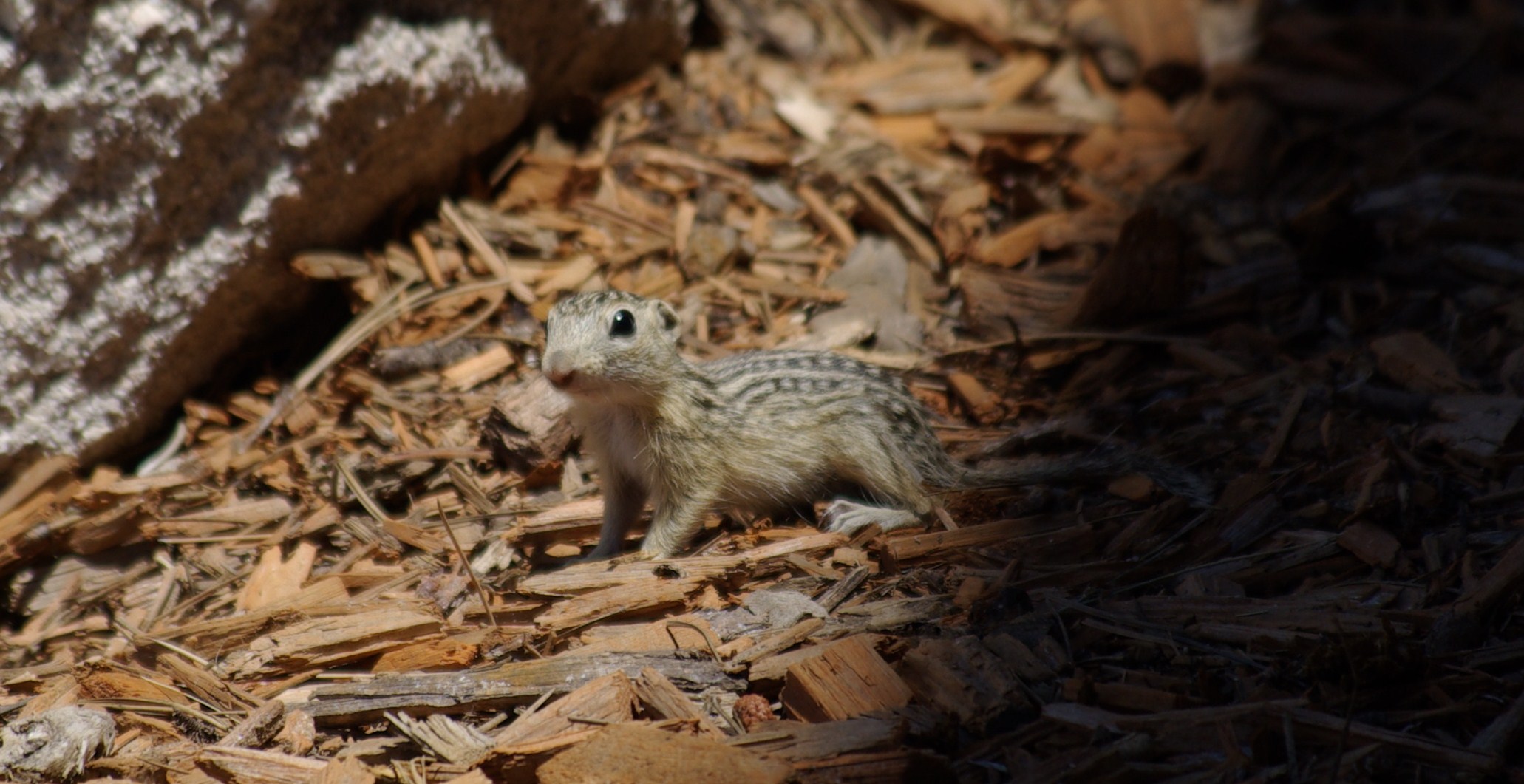
Ground squirrel at Camp Cris Dobbins, BSA:

13-lined ground squirrel, photo by Ed Darrell

13-lined ground squirrel, Ictidomys tridecemlineatus, photographed by Ed Darrell, at BSA Camp Cris Dobbins, Colorado


War is no piece of cake: First Battle of Bull Run, July 21, 1861

July 21, 2012

Only after the Civil War did Gen. William Tecumsah Sherman become famous for telling military academy graduates that “War is hell.”

In the summer of 1861, both Unionists and Confederates expected a short fight to settle what would come to be known as the American Civil War.  South Carolina fired on the Union Ft. Sumter in April.  But the first major action did not sully history until July.  Confederate forces and Union forces massed for a battle near Manassas, Virginia, at a little creek called Bull Run.

Spectators came out from Washington, D.C., bringing the family and picnic lunches, expecting a great drama to unfold — but they were surprised by the actual carnage.  What did they expect?

This battle gave rise to the famous story of farmer Wilmer McLean.  His house backed up on what would become the battlefield.  His summer kitchen took a cannonball.  Hoping to avoid further entanglement in the war, McLean moved his family and his farming farther south, to the unlikely-named town of Appomattox Court.

There, in 1865, Gen. U.S. Grant’s entourage asked to borrow McLean’s parlor, for the surrender of Gen. Robert E. Lee.  McLean was able to say, with some high accuracy, that the war began in his back yard, and ended in his front room.

Details from the Library of Congress:

The First Battle of Bull Run

Bull Run, 1st battle of, map from LOC

Battle field of Bull Run, Va. July 21st 1861, Showing the positions of both armies at 4 o’clock, P.M.,
Map Collections: Military Battles and Campaigns

On July 21, 1861, a dry summer Sunday, Union and Confederate troops clashed outside Manassas, Virginia, in the first major engagement of the Civil War, the First Battle of Bull Run.

Union General Irvin McDowell hoped to march his men across a small stream called Bull Run in the vicinity of Manassas, Virginia, which was well-guarded by a force of Confederates under General P. G. T. Beauregard. McDowell needed to find a way across the stream and through the Southern line that stretched for over six miles along the banks of Bull Run.

McDowell launched a small diversionary attack at the Stone Bridge while marching the bulk of his force north around the Confederates’ left flank. The march was slow, but McDowell’s army crossed the stream near Sudley Church and began to march south behind the Confederate line. Some of Beauregard’s troops, recognizing that the attack at Stone Bridge was just a diversion, fell back just in time to meet McDowell’s oncoming force.

First Battle of Bull Run- Bull Run, Virginia

View of the Stone House
Matthews’ or the Stone House

Ruins of Cub Run Bridge
Cub Run, with Destroyed Bridge
George N. Barnard, photographer,
March 1862.
Selected Civil War Photographs

These photographs of First Bull Run were not made at the time of the battle on July 21, 1861; the photographers had to wait until the Confederate Army evacuated Centreville and Manassas in March 1862. Their views of various landmarks of the previous summer are displayed here according to the direction of the Federal advance, a long-flanking movement along Sudley’s Ford.

When Beauregard learned of the attack, he sent reinforcements to aid the small group of Southerners, but they were unable to hold back the oncoming tide of Union troops. As more Union soldiers joined the fray, the Southerners were slowly pushed back past the Stone House and up Henry Hill.

The battle raged for several hours around the home of Mrs. Judith Henry on top of Henry Hill, with each side taking control of the hill more than once. Slowly, more and more Southern men poured onto the field to support the Confederate defense, and Beauregard’s men pushed the Northerners back.

At this point in the battle, Confederate General Barnard Bee attempted to rally his weary men by pointing to Brigadier General Thomas Jackson, who proudly stood his ground in the face of the Union assault. Bee cried, “There stands Jackson like a stone wall!” From that moment on, Thomas Jackson was known as “Stonewall” Jackson.

As the day wore on, the strength of McDowell’s troops was sapped by the continuous arrival of fresh Southern reinforcements. Eventually, the stubborn Confederates proved more than a match for McDowell’s men, and the Northerners began to retreat across Bull Run.

The Union pullout began as an orderly movement. However, when the bridge over Cub Run was destroyed, cutting off the major route of retreat, it degenerated into a rout. The narrow roads and fords, clogged by the many carts, wagons, and buggies full of people who had driven out from Washington, D.C., to see the spectacle, hampered the withdrawal of the Union Army. The Southerners tried to launch a pursuit, but were too tired and disorganized from the day’s fighting to be effective.

The morning of July 22 found most of the soldiers of the Union Army on their way back to Washington or already there. It was more than a year before the Northerners attempted once again to cross the small stream outside of Manassas named Bull Run.

Beauregard Bull Run Quick Step
J. A. Rosenberger, music,
1862.
Historic American Sheet Music, 1850-1920


White-breasted nuthatch in action

July 21, 2012

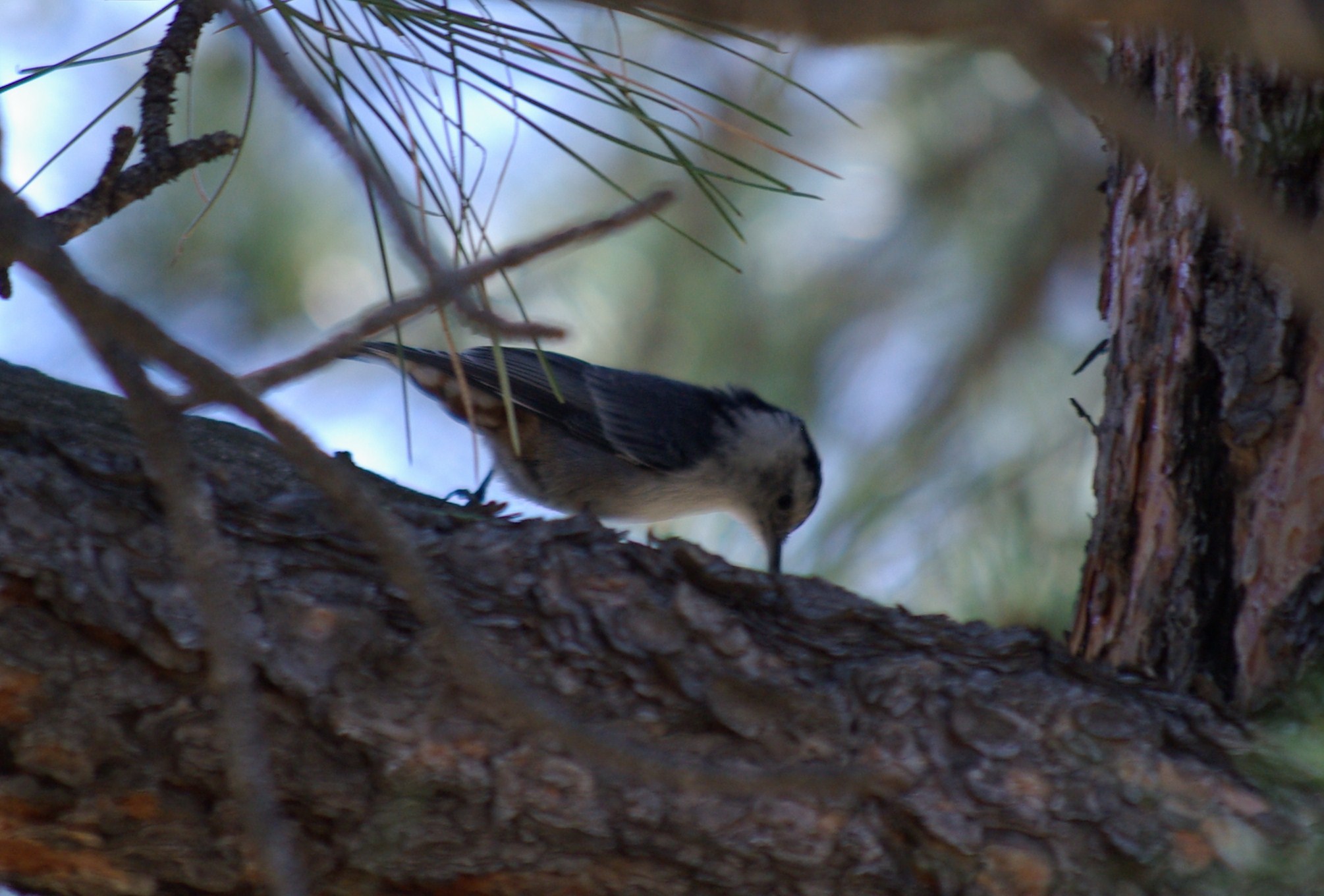
White-breasted nuthatch (Sitta carolinensis) (male?), cracking a nut on a pine limb, Peaceful Valley Scout Ranch, Colorado, July 2012:

White breasted nuthatch in action, Peaceful Valley Colorado, 2012 - photo by Ed Darrell - 061

White-breasted nuthatch (Sitta carolinensis)works over a seed, Colorado, 2012 – photo by Ed Darrell


Look on the cloudy side of the street . . .

July 21, 2012

. . . for the rainbow.

A view from Elbert Road, a few miles north of U.S. Highway 24 in Colorado, on July 18, 2012:

Rainbow on Elbert Road, Colorado, July 18, 2012 - photo by Ed Darrell, Creative Commons License (please attribute)

Start of a dual rainbow in an afternoon rainfall, Elbert Road, Colorado – photo by Ed Darrell


Religious liberty in America: July 21, 1591, baptism of Anne Marbury (Hutchinson)

July 21, 2012

Do we overlook her because she was female?  Do we overlook her because she stands for religious freedom?  Either way, Anne Marbury Hutchinson gets the cold shoulder from most U.S. history texts used in high schools.

She was a woman to celebrate, and the Library of Congress explains why in detail:

Anne Marbury Hutchinson

Although her exact birth date is uncertain, on July 20, 1591, the infant Anne Marbury was baptized in Alford, Lincolnshire, England.1 The first female religious leader among North America’s early European settlers, Anne Marbury Hutchinson was the daughter of an outspoken clergyman silenced for criticizing the Church of England. Better educated than most men of the day, she spent her youth immersed in her father’s library.

At twenty-one, Anne Marbury married William Hutchinson and began bearing the first of their fourteen children. The Hutchinsons became adherents of the preaching and teachings of John Cotton, a Puritan minister who left England for America. In 1634, the Hutchinson family followed Cotton to New England, where religious and political authority overlapped.

The General Laws and Liberties of the Massachusetts Colony: Revised and Reprinted [right page]      The General Laws and Liberties of the Massachusetts Colony: Revised and Reprinted [left page]
The General Laws and Liberties of the Massachusetts Colony:
Revised and Reprinted,
Cambridge, Massachusetts: Samuel Green, 1672.
Religion and the Founding of the American Republic, Section I. Part 1
Many criminal laws in the early New England colonies were based on the Bible, especially the Old Testament. Often called “Bible Commonwealths,” the New England colonies sought guidance from the scriptures in regulating the lives of their citizens.

Serving as a skilled herbalist and midwife in the Massachusetts Bay Colony, Anne Hutchinson began meeting with other women for prayer and religious discussion. Her charisma and intelligence soon also drew men, including ministers and magistrates, to her gatherings, where she developed an emphasis on the individual’s relationship with God, stressing personal revelation over institutionalized observances and absolute reliance on God’s grace rather than on good works as the means to salvation. Hutchinson’s views challenged religious orthodoxy, while her growing power as a female spiritual leader threatened established gender roles.

Mary Dyer
Mary Dyer Led to Execution on Boston Common,
Color Engraving,
Nineteenth Century.
Courtesy of The Granger Collection.
Religion and the Founding of the American Republic, Section I. Part 2
Like Anne Hutchinson, Mary Dyer was banished from Massachusetts. Eventually, she was hanged for challenging Puritan orthodoxy.

Called for a civil trial before the General Court of Massachusetts in November 1637, Hutchinson ably defended herself against charges that she had defamed the colony’s ministers and as a woman had dared to teach men. Her extensive knowledge of Scripture, her eloquence, and her intelligence allowed Hutchinson to debate with more skill than her accusers. Yet because Hutchinson claimed direct revelation
from God and argued that “laws, commands, rules, and edicts are for those who have not the light which makes plain the pathway,” she was convicted and banished from the colony, a sentence confirmed along with formal excommunication in the ecclesiastical trial that followed.

Refusing to recant, Hutchinson accepted exile and in 1638 migrated with her family to Roger Williams’ new colony of Rhode Island, where she helped found the town of Portsmouth. After her husband died in 1642, Hutchinson moved to Dutch territory near Long Island Sound (an area now known as Co-op City, along New York’s Hutchinson River Parkway, which is named for Anne Hutchinson). There in 1643 Hutchinson and all but one of her younger children were killed by Siwanoy Indians, possibly with the encouragement of Puritan authorities. “Proud Jezebel has at last been cast down,” was the supposed comment of Hutchinson’s nemesis, Massachusetts Governor John Winthrop.

Learn more about early America in American Memory:

More:


Scouting: In Baden-Powell’s footsteps

July 20, 2012


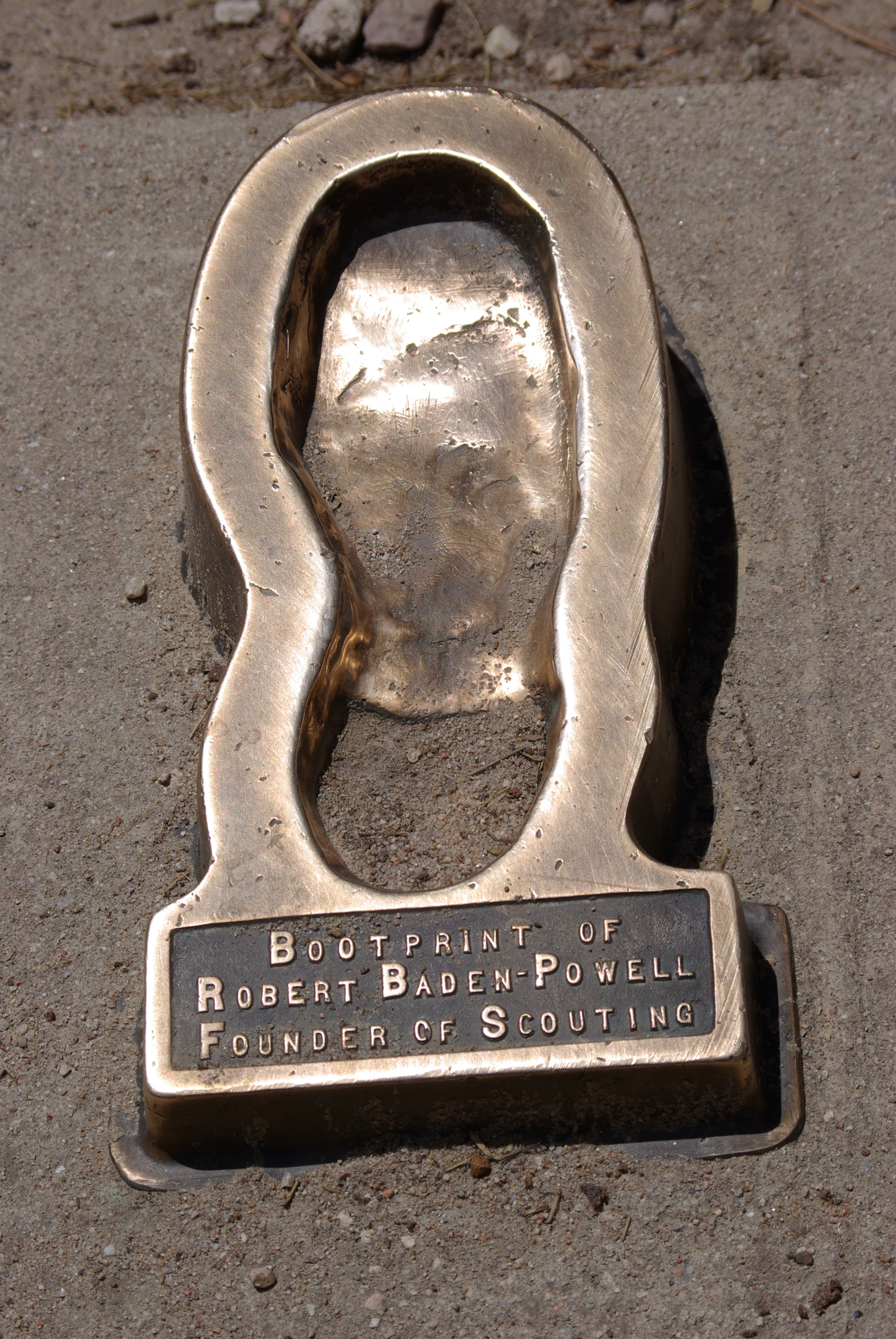
Cast of Baden-Powell's footprint, at Camp Chris Dobbins, Peaceful Valley Scout Ranch, Colorado

Cast of Baden-Powell’s footprint with the brass worn bright from Scouts seeing how they measure up, at Camp Chris Dobbins, Peaceful Valley Scout Ranch, Colorado

Another in a series of where and how people interact with sculpture.

At Peaceful Valley Scout Ranch in Colorado, at Camp Chris Dobbins, there is a cast of a footprint from Lord Robert Baden-Powell, the founder of the International Scouting Movement.

Of course, every Scout must check it out to see whether his or her foot measures up, you can tell from the bright brass color where the piece is touched by hundreds of boots.


Six fundamental forces (Dave Barry via Mark Sackler)

July 19, 2012

Needed some comic thought today. Fortunately, Mark Sackler blogs:

“Magnetism is one of the six fundamental forces in nature, the other five being gravity, duct tape, whining, remote control and the force that pulls dogs towards the groins of strangers.”–Dave Barry

Dog on leg gifDown boy!

I can certainly agree with the first three. I think there is also an absolute force which draws my daughter towards her mother’s credit cards, and everything else is relative.

Well, maybe I don’t agree with the .gif. Our bigger dog has a nose that is just groin height on most people, though, and he acts as if he considers himself duty-bound.  But isn’t Sackler right on with the Dave Barry quote?


Sen. Marco Rubio’s call for a mediocre America

July 19, 2012

As good ideas go, it’s difficult to top the idea of public broadcasting, and particularly Lyndon Johnson‘s creation of the Corporation for Public Broadcasting and the subsequent formation of NPR and PBS, and the proliferation of public broadcasting stations across the U.S.

For a small pittance of money from public coffers, the nation gets the massive advantage of working news networks dedicated to informing the public accurately, and great cultural preservation, including education of the very young.

Big Bird, wikipedia image from PBS

Florida’s U.S. Sen. Marco Rubio wants to kill the Big Bird that lays the golden eggs for our kids. Big Bird doesn’t make rude comments in response.

For-profit broadcasting has been absolutely unable to equal quality programs on television like “Sesame Street,” or “Masterpiece Theatre,” or “American Masters,” or “American Experience.  For-profit radio has nothing to equal “Morning Edition,” “All Things Considered,” “Prairie Home Companion,” or even “Car Talk.”

You know some politician is playing to the yahoos and anti-civilization types when he takes a swipe at schools, libraries, or public  broadcasting.

So, we know Marco Rubio‘s questioning of funding for CPB is a swing for the foul territory, an appeal for ignorance, to ignorance and ignorants.  ABC News, a rival of both NPR and PBS, reported the story with all its ironic drippings:

Sen. Marco Rubio, R-Fla., expressed worry this morning about broadcasting outlets that use taxpayer money to stay on the air.

But Rubio made his comments on NPR, a broadcasting outlet that uses taxpayer money to stay on the air.

“I do have concerns about spending money on public broadcasting,” Rubio told Diane Rehm during an hourlong Q&A on NPR.

NPR has been a source of criticism from congressional Republicans who view it as a liberal refuge that espouses its views courtesy of public funding. Although only 2 percent of NPR’s funding comes from government grants, the loss of federal funding would undermine the ability of NPR stations to pay for NPR programming, NPR says.

Rubio argued that private donations should support such an enterprise as NPR, and that plenty of outlets are available to house that ideology and format. He admitted, though, that he enjoys Rehm’s show and that NPR’s funding is low on the list of costs that should be cut.

A caller pointed out the irony of Rubio’s position, saying, “He’s spending an entire hour on the show today.”

Rubio countered that a half-century ago, a station like NPR might have been necessary, but “today there is no shortage of options” for news and opinion.

“I have 300 stations on my satellite radio,” Rubio boasted.

300 stations on his satellite — which most Americans cannot afford — and not a single station equal to the worst of NPR’s network.

Shame on Marco Rubio.  Tighten your seatbelts, America, it’s going to be a bumpy election, with lots of appeals to ignorance and praise for doing less than the best.

Do you know where the word “yahoo” comes from?  Rubio is one of the epitomes.

Now, here’s the trouble:  Is he making this appeal in hopes of winning votes, in hopes of getting Mitt Romney’s attention for the vice president’s slot on the ticket?  Or is he really just that anti-quality, anti-American?  Bet he doesn’t like baseball or apple pie, either — we won’t even mention Mom.


July 19, 2012

Found this at Under the Lobsterscope — our incarceration rates form a testament to one of the greatest failures of the U.S. over the past two decades. Live links added here for your convenience.

(This may be the last time we use the reblog feature — it’s very clunky!)

btchakir's avatarUnder The LobsterScope


Here are the facts… you make your own conclusion. Personally, I think making prisons a private industry sucks— I wonder when they’ll be exporting the prisoners to China.


View original post


John Muir: The saving of 100 million acres begins with a first word on paper

July 19, 2012

John Muir’s place in American history endures constant assault.  Not only did businessmen and politicians of his own day find Muir’s policies anathema to their hopes of profiting from the destruction of the American wild, so today do we hear that profits cannot be had without the rape of the environment.

Muir knew better, and so should you!

On July 19, 1869 — in the middle of the administration of U. S. Grant, Muir began his journals on the beauty of life in the Sierras, to be published 42 years later as My First Summer in the Sierra.

It should be required reading in more American classrooms:

John Muir

Watching the daybreak and sunrise. The pale rose and purple sky changing softly to daffodil yellow and white, sunbeams pouring through the passes between the peaks and over the Yosemite domes, making their edges burn; the silver firs in the middle ground catching the glow on their spiry tops, and our camp grove fills and thrills with the glorious light. Everything awakening alert and joyful…John Muir,
Entry for “July 19 from
My First Summer in the Sierra, 1911.
“California As I Saw It”: First-Person Narratives of California’s Early Years, 1849-1900

John Muir
John Muir,
1902.
The Evolution of the Conservation Movement, 1850-1920

On July 19, 1869, naturalist John Muir set pen to paper to capture his experience of awakening in the Sierra Nevada Mountains of California. Published in 1911, My First Summer in the Sierra is based on Muir’s original journals and sketches of his 1869 stay in the vicinity of the Yosemite Valley. His journal tracks his three-and-a-half-month visit to the Yosemite region and his ascent of Mt. Hoffman and other Sierra peaks. Along the way, he describes the flora and fauna as well as the geography and geology of the area.

Muir immigrated from Scotland to Wisconsin as a child. He attended the University of Wisconsin and began working as a mechanical inventor. After an 1867 industrial accident nearly blinded him, he abandoned his career as an inventor to work as a naturalist.

California, El Capitan, Yosemite Valley
El Capitan,
Yosemite Valley,
California,
William Henry Jackson, photographer,
1899.
Touring Turn-of-the-Century America: Photographs from the Detroit Publishing Company, 1880-1920

An early defender of the environment, Muir in 1876 advocated adoption of a federal forest conservation program. His popular articles and books describing Yosemite’s natural wonders inspired public support for the establishment of Yosemite National Park in 1890 and expansion of the park in 1906.  At the same time, Muir continued to work and write as a serious scientist whose fieldwork in botany and geology enabled him to make lasting contributions. Alaska’s Muir Glacier is named for him. In 1892, Muir co-founded the as an association explicitly dedicated to wilderness preservation and served until 1914 as its first president, shaping it into an organization whose leadership in political advocacy for protection of the natural world continues to this day.

The popularity of President Theodore Roosevelt’s groundbreaking conservation program owed much to Muir’s writing. In 1903 Roosevelt and Muir visited the Yosemite region together. In 1908, Roosevelt issued a presidential proclamation establishing the Muir Woods National Monument in Marin County, California, in Muir’s honor. Muir died six years later. Although sorrow and disappointment at his failure to save Hetch Hetchy Valley from becoming a reservoir for San Francisco may well have contributed to his death, Muir had succeeded more than any other single individual in establishing the preservation of wild nature as a major American cultural and political value. The clarity of his vision and the eloquence of his writing continue to inspire environmentalists throughout the world.

Learn more about John Muir and the conservation movement in American Memory: